

I’ve lived in the Netherlands for years, and I can finally say something I never thought I’d say: I speak fluent Dutch.
And no, I didn’t grow up speaking it. I’m Australian, and if there’s one thing Australians are notoriously bad at, it’s learning languages.
When you grow up in Australia, you can get through pretty much your entire life speaking English. So when I moved to the Netherlands, a land that houses the best non-native English-speakers in the world, learning Dutch felt like something I should do, rather than something I necessarily had to do.
Which made it incredibly easy to put off.
Then suddenly, you’ve been here for five years and your Dutch crashes out speaking to the cashier at Albert Heijn.
Eventually, I decided I was done with just living in the Netherlands. I wanted to actually feel like I was part of it.
So I started taking Dutch lessons with Taalthuis. And I kept going.
A few courses later, I had gone from an A2 certificate to speaking Dutch confidently — and eventually all the way to C1.
So, having actually gone through the process, here’s why I think you should learn Dutch too — and why Taalthuis worked so well for me.
You can learn Dutch from your sofa (or in a classroom)

One of the first things I loved about Taalthuis is that you don’t have to completely reorganise your life around learning Dutch.
There are lessons in 10 locations across the Netherlands, so you can learn face-to-face with fellow Dutch-learning internationals. Or you can take your lessons online.
And yes, by online I mean you can sit on your sofa in your pyjamas and learn Dutch. I have done exactly this. Multiple times. I’ve even logged on from Australia (in the middle of the night), Hong Kong, Canada, Italy, and anywhere else I was in the world.
The online lessons don’t feel like a lesser version of the in-person experience. You still have your teacher, your classmates and plenty of opportunities to speak (thank god for breakout rooms!) — just without having to cycle through the rain to get there.
Alternatively, tell your company all the benefits of learning Dutch and have Taalthuis come to your workplace!
Taalthuis can take you all the way to C1
Here’s where Taalthuis really stood out to me.
The CEFR language levels go from A1 and A2 (beginner), through B1 and B2 (intermediate), and then to C1 and C2 (advanced).
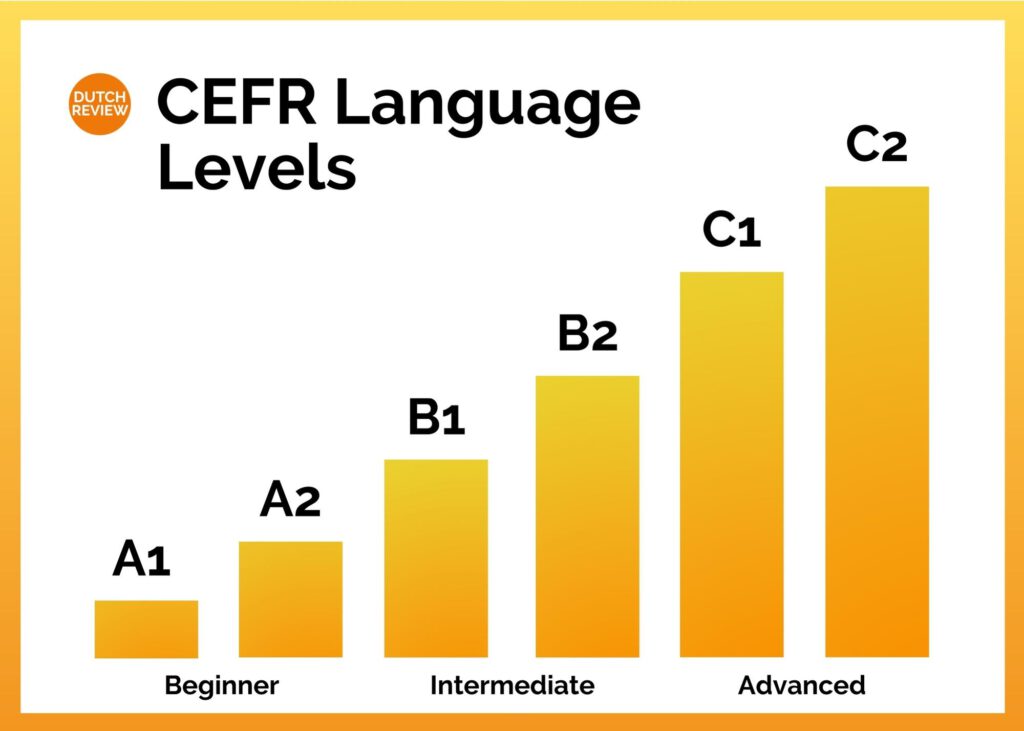
Unlike other Dutch schools, at Taalthuis, you can choose to go all the way to C1 level.
At C1, you’re not just getting by in the supermarket or understanding what your gemeente is asking you to do. You can understand complex language and express yourself confidently in professional, academic and social situations.
That’s the difference between being able to survive in Dutch and being able to live your life in Dutch.
I started my Taalthuis journey with an A2 certificate from another school, thinking I’d give B1 a go. Then I kept going. And going.
Somewhere along the way, Dutch stopped being something I was studying and became something I could actually use.
This is how I actually became comfortable speaking Dutch
This is probably my favourite thing about Taalthuis.
Language learning can very easily become an exercise in memorising vocabulary and completing worksheets. You learn a grammar rule, do 15 exercises about it, and then immediately forget how to use it the moment a Dutch person speaks to you.
At Taalthuis, they’ve got 20 years of experience, so this school knows what it’s doing. The lessons are built around reading, writing, listening and speaking — because, naturally, becoming fluent requires all four.
At the higher levels, classes are typically designed around a longer Dutch text that you read as homework. The text introduces new vocabulary and grammar constructions, which you then practise throughout the week.
You’ll read. You’ll write. You’ll listen. And, most importantly, you’ll speak. A lot.
One of my favourite parts was the speaking challenges. Often, I’d have to go out and actually speak to a Dutch person about a particular topic. This pushed me beyond the safe little bubble of my Dutch lessons and made me use the language in the real world.
The teachers pushed me when I needed it

There’s another thing that makes a huge difference when you’re learning a language: your teacher.
A good Dutch teacher doesn’t just know Dutch. They know how to teach Dutch to people who don’t already speak Dutch.
Taalthuis works with professionally trained, certified NT2 teachers. NT2 is the teaching field specifically focused on Dutch as a second language.
When you’re struggling with a grammar rule for what feels like the 47th time, you need a teacher who can explain it in a different way rather than simply repeating the same explanation louder.
The learning materials are made for people learning Dutch as a second language
For the beginner and intermediate levels, Taalthuis creates its own learning materials, including its own textbooks and teaching methods.
There’s also an e-learning platform with additional exercises and materials, giving you somewhere to practise between lessons.
For the higher levels, Taalthuis uses the “Nederlands in gang” series, giving students a structured route as they progress towards more advanced Dutch.
Learning Dutch gives you more than just another language
I’ll be honest: when I first started learning Dutch, I mostly wanted to understand what people were saying, stop panicking when someone spoke to me unexpectedly, and deal with boring administrative things without immediately reaching for Google Translate.
But somewhere along the way, it became about much more than that.
Speaking Dutch has made me feel more connected to the Netherlands.

You can have conversations with your neighbours, make Dutch friends, understand more of the jokes and culture around you, and open up opportunities at work.
And then there are the little moments. When you understand a conversation happening next to you. When you make a joke in Dutch and someone actually laughs. When you realise you’ve just spent ten minutes speaking Dutch without thinking about the fact that you’re speaking Dutch.
That feeling is so satisfying and makes you feel way better than what you can buy in the coffeeshops.
So, should you finally learn Dutch?
Look, I’m not going to pretend learning Dutch is easy.
There will be moments when you wonder why one tiny country needs de, het, irregular verbs, separable verbs and approximately 17 different ways of saying that something is “quite nice”.
There will be days when you understand absolutely nothing. And there will definitely be a Dutch person who hears you speaking Dutch and immediately switches to English.
But keep going.
Because I learned fluent Dutch with Taalthuis, and I can honestly say that the effort was worth it.
If you’re sitting there thinking “I really should learn Dutch” but you’ve been saying that for the last five years, take it from someone who knows how easy it is to keep putting it off:
Just start.
You don’t have to be fluent tomorrow.
You just have to get past “Mag ik een koffie, alstublieft?”
Taalthuis can help you get there — and, if you stick with it, take you much further.
Have you been putting off learning Dutch? Or are you already somewhere on your Dutch-learning journey? Let us know in the comments!