
The Dutch cabinet is preparing a ban on goods from illegal Israeli settlements in the occupied West Bank, but enforcing it will be far harder than announcing it.
The problem boils down to the humble labels on imports, which currently give customs officers almost nothing to work with.
Which products are from where?
An investigation by the legal non-profit Global Echo analysed nearly 6,000 shipments of citrus, dates and tahini sent from Israel to Europe between 2017 and 2026.
Roughly one in five consignments arriving in the EU turned out to be grown in illegal settlements, despite carrying a “Product of Israel” label.
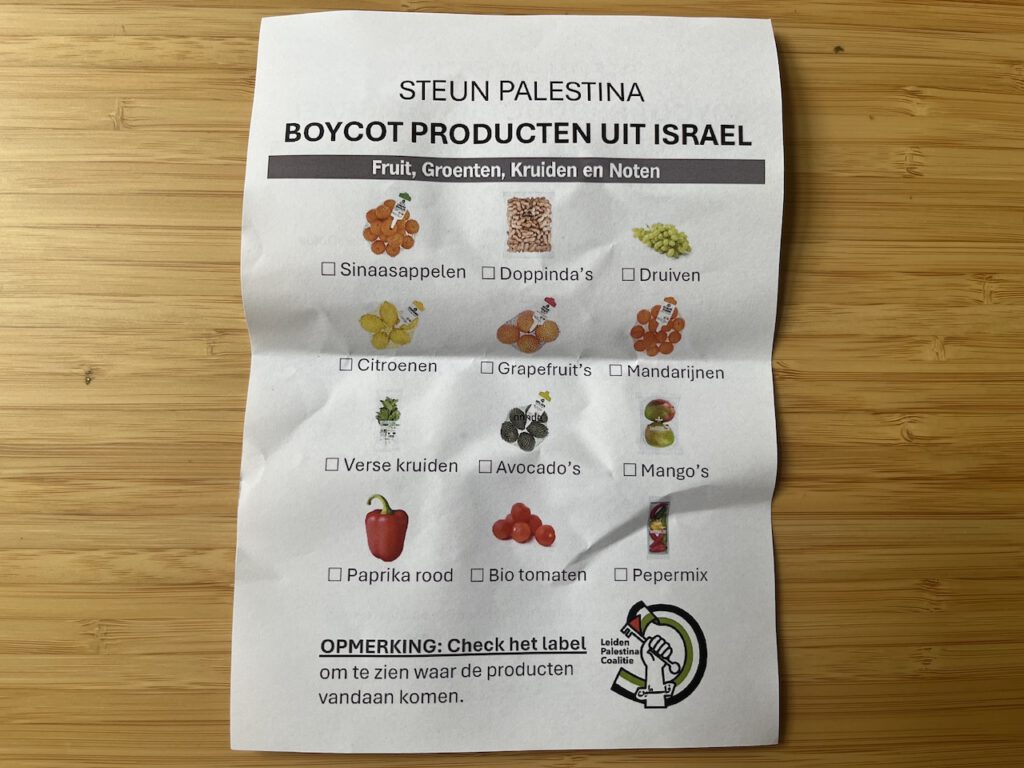
That mislabelling is exactly what the Raad van State (an independent body that advises the government on legislation) flagged when it reviewed the proposal.
Customs officials and importers, it warned, will struggle to prove where a piece of fruit actually grew.

What’s actually being banned?
According to NU.nl, less than you might assume. The measure the cabinet announced covers agricultural goods such as citrus, sesame, dates, avocados and pomegranates.
However, Israel’s heavyweight exports to Europe are medical equipment, weapons, chips, and services like software, cybersecurity and cloud computing. Those are almost entirely made inside Israel proper, so they’re untouched.
Thomas van Gool, spokesperson for the peace organisation PAX, tells NU.nl the ban is good, but won’t cause much harm.
“Physical agricultural products are only a small part of the trade between Israel and Europe,” he tells the outlet. “But even so, any form of trade is enough to keep a settlement economically afloat. However small, it contributes to its viability.”
He also points out that most shoppers aren’t inspecting origin labels in the vegetable aisle. “Most people buy it by accident, they don’t check labels on vegetables,” he says. “What matters is that a conversation starts, and that people become more aware of what they’re actually buying.”
“Every settlement product sitting on a shelf here is really one too many,” he continues.
Europe still can’t agree on a ban
The Netherlands is acting alone because Brussels hasn’t managed to. Last week the European Commission again put three options to member states: a licensing system, steep import tariffs, or a full ban.
The Commission prefers the outright prohibition, but it needs all 27 governments to agree, which makes it unlikely for now. Germany and Italy already blocked an earlier attempt by Belgium, Ireland, Slovenia and Spain to suspend the EU-Israel association agreement.
The legal backdrop hasn’t shifted, though. In 2024, the International Court of Justice ruled the occupation and settlements illegal, and said countries must avoid propping them up through trade or investment.
Still, some shops here will feel this ban. For example, The Israël Producten Centrum in Nijkerk, run by the Christian-Zionist group Christenen voor Israël, will have to pull products including Golan Heights wine from its shelves.
Its director describes the measure as symbolic to NU.nl — as does PAX, but for entirely opposite reasons.
Do you check where your fruit comes from, or is this the first time you’ve thought about it? Tell us in the comments.