Great news for Dutch universities, coffeeshops and DutchReview of course. There are now more international students in the Netherlands studying then ever. A whopping 112.000 students are enjoying a Dutch education at a University or ‘Hoge School’.
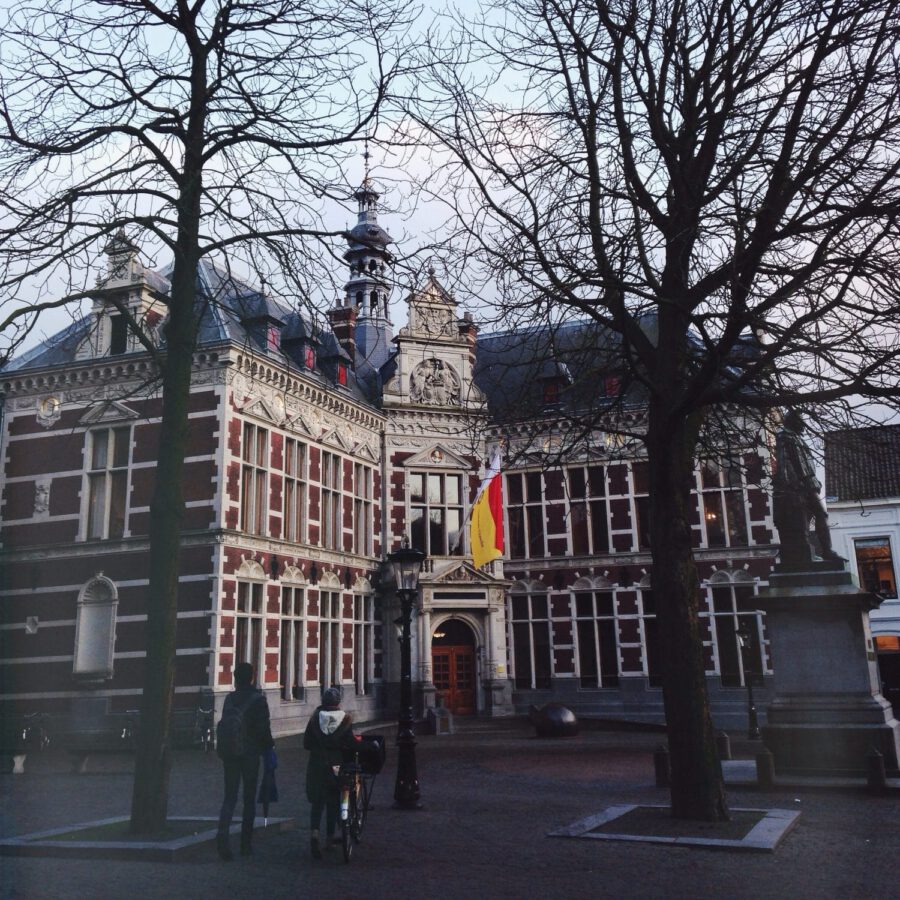
University in Utrecht
Where are these international students in the Netherlands from?
Research from Nuffic (the Dutch organisation for internationalizing our education, how cosmopolitan of us!) shows that there are 81.000 students doing full time stuff here, the rest of them are here for shorter stints -doing Erasmus for example. There are 164 nationalities hitting the books/bong here. Most of them are Germans, with 22.000 of our neighbours from the East here. After that are the Chinese (4300) and the Italians (3300). And no, I will not make those horrible biased jokes about the different demographics of the Chinese and Italians in the University libraries and innercity coffeeshops.
Why international students in the Netherlands are a good thing
Many of the international students stick to the Netherlands after graduating here, and one of our statistical offices (the CPB) has calculated that they contribute around 450 million euro’s to the Dutch economy each year (coffeeshop spending is not even included in this!). Low costs, good quality of education and of course the fact that both our uni’s as the regular Dutch folk (pretend to) speak superawesome English are the main reason why internationals students and the Netherlands is such a successful combination.
The Dutch being Dutch have also found that their schools can make money from international students, so it’s win win for everybody here (except for those people that long back to the coffeeshop-and-international-student- free Holland of the 50’s).
The good old days. Because screw diversity and multiculturalism
Vattenfall powers around 2 million customers across the Netherlands, making it one of the country’s biggest energy suppliers. For internationals weighing up who gets to keep their lights on, that scale comes with a specific set of things worth knowing.
Choosing an energy supplier is never fun, especially when you’re trying to translate contract terms and make sense of annual estimates.
So here’s what actually makes Vattenfall so popular, and why it could be a good fit for your home.
A provider with a proven track record
Needless to say, no one wants to get hit with a massive year-end energy bill. Vattenfall avoids this with a clear annual statement, a jaarafrekening, so you know exactly what you’re paying for.
Throughout the year, you’ll also get check-ins on your termijnbedrag (your fixed monthly instalment). Via Mijn Vattenfall, the app, or a little nudge they call a Seintje.
Vattenfall has nearly 2 million happy customers across the Netherlands. Image: Magnific
They’ll flag whether you’re paying too much or too little, while there’s still time to adjust.
For anyone still figuring out how Dutch utilities work, that predictability matters. There’s no mystery, and no maths-induced panic in your inbox.
Contracts that flex to how you live
Perhaps the biggest draw, though? Your freedom to choose.
Vattenfall lets you pick a contract that matches your lifestyle, rather than the other way round. You can explore the full range of energy contracts on their site, but it broadly comes down to four:
Fixed price (Vaste Prijs): your rates stay locked for the whole term (one to three years). This is ideal if you want certainty and zero effort.
Variable: rates can shift a few times a year, dropping when the market dips and rising when it climbs. A flexible middle ground you can cancel at any time.
TijdPrijs: fixed rates for the one-year term, but with cheaper electricity during off-peak hours. Handy if you can run appliances in those windows.
FlexPrijs: fully dynamic pricing, with electricity priced by the hour and gas by the day.
For example, you can choose to benefit during off-peak hours. Image: Magnific
The FlexPrijs contract rewards people who can shift their usage to cheaper moments. For example, by running the washing machine or charging the car when prices dip. EV drivers are the classic winners here.
However, you should know that FlexPrijs needs a smart meter, and it works best if you actually keep an eye on the prices. If that sounds like effort, a fixed contract is your low-stress friend.
Earn up to €200 in home perks just for sticking around
Loyalty pays here, through Vooruit (forward), Vattenfall’s rewards programme. You collect points automatically each month, and the longer you stay, the faster they stack up.
Where it gets useful is with big home upgrades. As a customer, you get:
€100 off solar panels installed through a Vattenfall partner, plus up to €200 more when you put your Vooruit points towards it.
€100 off a home charging point, rising to up to €200 in total once you add your Vooruit points.
The points stay valid for up to five years, and the whole programme runs digitally through Mijn Vattenfall and the app, so there are no paper vouchers to lose down the back of the sofa.
A green energy provider you won’t outgrow
Vattenfall’s headline ambition is bold: making fossil-free living possible within one generation. That’s a big promise, and it’s already backed by numbers.
In 2025, all of Vattenfall’s home and small-business customers received 100% green electricity from the Netherlands, generated from Dutch wind and sun, according to the company’s electricity label.
Take them with you, at any stage of life. Image: Magnific
So if you go more electric later (a heat pump, an EV, a set of solar panels), this is a supplier built to grow with you, not one you’ll be ditching in a year.
Keep tabs without the paperwork
The final pro is visibility. The Vattenfall Energie-app and Mijn Vattenfall give you a live view of your usage and costs, so you’re never left guessing.
You can check whether your monthly instalment still matches your usage, adjust it yourself, browse your invoices, and even arrange a house move, all in one place. When you’re juggling life admin in a second language, that’s a real relief.
If you’re an American running a business in the Netherlands on a DAFT residence permit, you’ve probably wondered whether all those years actually count towards something more permanent.
Good news: they can.
The Dutch-American Friendship Treaty (DAFT) is a popular route into the Netherlands for US citizens. For many American entrepreneurs, DAFT provides a comparatively accessible route to Dutch residence through self-employment, provided the applicable business, investment and residence requirements are met.
But a DAFT permit isn’t permanent residency. It’s a temporary permit tied to your business, so let’s clear up what it actually gets you.
First things first: what is a DAFT residence permit?
To put it simply:
It’s a self-employment residence permit for US citizens, based on a treaty signed back in 1956.
It’s valid for two years, then renewable (usually for another five), as long as your business is active and that €4,500 stays put.
There’s no Dutch-language requirement to get it or renew it. (Yes, really.)
So, does it lead to permanent residency?
Not automatically.
Your DAFT years count as legal residence, and after five continuous years of legal residence in the Netherlands, DAFT holders can apply for a permanent residence permit, or even Dutch citizenship, according to the IND.
In other words, DAFT gets you in the door and keeps the clock ticking. Permanent residency is the reward at the end, if you meet a few extra conditions.
What are these extra conditions?
Permanent residency comes with more requirements than the DAFT permit. To qualify, you’ll need:
Five years of continuous legal residence, with your permits renewed on time.
A stable, sufficient income.
Registration in the BRP (the Basisregistratie Personen, or municipal population register).
A passed inburgering (civic integration) exam.
DAFT renewals, BRP registration and the leap to permanent residency can get admin-heavy fast. TAMM Solutions is a Leiden- and Amsterdam-based integrated legal and business advisory firm supporting international entrepreneurs and professionals in the Netherlands across immigration, corporate, employment, financial and ongoing compliance matters—from establishing a business and maintaining residence status through to longer-term residence planning.
For many, one of the biggest challenges is being able to speak Dutch to a high enough level. DAFT lets you skip Dutch entirely; permanent residency does not.
At the moment, US citizens are required to prove that they speak Dutch at an A2 level. They must do this as part of the inburgeringsexamen. Consider it the universe’s gentle nudge to finally learn what gezellig means.
The upside of going through this process? Permanent residency frees you from the business requirement, and you get to keep your US passport, with no renouncing required.
Are you on the DAFT-to-PR path, or have you already made the leap? Tell us how it’s going in the comments below!
Packing for a holiday and surviving Schiphol is stressful enough without worrying about whether your precious medication will make it through the trip.
If you’re on weight-loss medication like a GLP-1 treatment, a few practical questions come up every time a trip comes up: can it fly, does it need a fridge, and what happens if you miss a dose while you’re away?
Good news first; none of this needs to derail your holiday. With a bit of planning, most people on this kind of weight loss treatment travel exactly as they would otherwise. Here’s what’s actually worth knowing before you zip up that suitcase.
What is GLP-1 medication?
GLP-1 medication (you’ll also see it called weight-loss medication or weight-loss treatment throughout this piece: they mean the same thing) is a prescription-only treatment that helps regulate appetite, making it easier to feel full sooner and eat less. It’s designed to work alongside lifestyle changes like diet and exercise, not instead of them.
It’s become one of the most talked-about treatments in the Netherlands over the past couple of years, especially among internationals who don’t always know where to start when it comes to accessing it locally.
How to get weight-loss medication (GLP-1) in the Netherlands?
In the Netherlands, weight-loss medication is prescription-only. Image: Dreamstime
You can’t just walk into an apotheek (pharmacy) and buy this over the counter; it’s prescription-only, and getting there usually means one of two routes. We’ve covered both in detail in our guide to getting weight-loss medication in the Netherlands as an international, including costs and BMI eligibility criteria, but here’s the short version.
Route one is through your huisarts (GP), though eligibility criteria and waiting times vary depending on your situation and your practice. As a general benchmark, Dutch clinical guidelines typically require a BMI of 30 or higher, or 27 or higher with a weight-related condition such as high blood pressure or sleep apnoea.
Route two is via online platforms offering consultations with doctors. Look for ones staffed by BIG-registered doctors specifically. BIG registration is the Dutch government’s official register confirming a healthcare professional has the right qualifications and is legally entitled to practise — it’s run by the CIBG, part of the Ministry of Health, and covers protected titles like arts (doctor) and verpleegkundige (nurse). If you’re curious exactly what that online process looks like step by step, we walked through it in our piece on getting a weight-loss prescription online in the Netherlands.
Reputable providers won’t just take your word for it, either. Expect a proper screening process: a medical questionnaire, some form of verification, and an actual consultation with a doctor before anything gets prescribed.
Wellis, for example, can check a patient’s existing medication record via the Landelijk Schakelpunt (LSP), the secure national system Dutch GPs and pharmacies already use to share medication data with each other.
This only happens with the patient’s explicit permission, and it lets the doctor check for potential interactions with anything else you’re taking before prescribing. Not every provider in this fast-growing market offers that level of oversight, which is worth keeping in mind when comparing options.
Eligibility, in short, gets assessed medically. It’s not something you can simply request and receive.
Thinking about starting your own weight-loss journey? Wellis offers fully online consultations with BIG- and EU-registered doctors, a free intake with a full refund if you turn out not to be eligible, and free PostNL delivery within one to two business days. Start your free consultation with Wellis.
Can you fly with weight-loss medication?
Yes, and this part is genuinely straightforward. Schiphol’s own guidance confirms that medication is always allowed in hand luggage, and the usual 100ml liquid limit doesn’t apply if you can show it’s medically necessary.
A few practical points:
Always carry it in your hand luggage, never checked baggage (temperature swings in the hold can damage it)
Keep it in its original packaging with the label visible
A doctor’s certificate or medical letter makes the process smoother, and Schiphol specifically recommends one for proving the medication is necessary
For international flights beyond the EU, it’s worth double-checking the destination country’s own rules on bringing injectable medication in, since these vary.
How to store weight-loss medication while you’re away
Storage depends on whether the pen has been opened yet.
Before first use, it needs to stay refrigerated between 2°C and 8°C. Once you’ve started using it, the official EMA product information for this class of medication confirms it can be kept below 30°C, out of the fridge, for a limited period — though the exact number of weeks varies by product and brand. Always check your own patient leaflet for the precise figure, or reach out to the professionals supervising your treatment.
Heat is the real risk here, and Dutch summers are becoming less of a joke on that front every year.
Don’t leave it in a hot car, even “just for five minutes” while you nip into the Jumbo
Avoid direct sunlight and prolonged heat above 30°C
A cooling travel case helps enormously on flights, long drives, or anywhere refrigeration isn’t guaranteed; Wellis, for instance, provides customers with a cooling pouch designed to keep medication safely stored for one to two days without a fridge
No fridge at the hotel? Don’t panic. Ask reception — plenty of hotels can store medication for you even without an in-room fridge, or a cooling pouch will usually cover you for a short stay. (They have done so for years for Diabetes type 1 folks as well)
Can you pause GLP-1 treatment for your holiday?
You need to plan ahead. Image: Magnific
This is the question with the most nuance, so treat it as a “check with your doctor” topic rather than a DIY decision.
Missing a single dose generally isn’t the disaster it might feel like. Official guidance for GLP-1 medications typically allows a short window, often several days, where you can still take a missed dose late. Beyond that window, standard advice is to skip it entirely and wait for the next scheduled one rather than doubling up.
Longer interruptions are a different story. According to the EMA’s product information for this medication class, restarting after missing multiple doses often means going back to a lower starting dose — the same gradual step-up used when first beginning treatment, specifically to reduce side effects.
It’s also worth setting expectations early: this isn’t a fast-acting medication. Many patients don’t notice big changes in the first two to three weeks, and clinics generally describe the full weight-loss treatment path in months, not weeks. A short pause for a two-week holiday isn’t going to unravel that.
Anyways, never restart or adjust dosing without talking to your doctor first!
Planning ahead makes this easy
Most questions patients have while travelling turn out to be logistical rather than medical: where to store something, whether a flight is fine, what a heatwave means for a pen sitting in hand luggage. Providers with a proper support line are set up to handle exactly this kind of question quickly, without needing a full consultation every time.
With a bit of preparation (hand luggage, a cool bag, and a doctor’s letter if you’re flying long-haul) this kind of treatment doesn’t need to complicate your trip at all.
Got questions about your treatment while you’replanning your new trip? Wellis patients get ongoing access to their medical team for exactly this kind of logistical question, from storage advice to travel documentation, no need to book a fresh appointment every time. Learn more about Wellis’s patient support.
Frequently asked questions
Can you take GLP-1 medication on a plane?
Yes. It’s always allowed in hand luggage, and a doctor’s letter helps at security and customs.
Does GLP-1 medication need to stay in the fridge?
Only before first use. Once opened, it can generally be kept below 30°C for a limited period — check your specific patient leaflet for exact timing.
Can weight-loss medication go in checked luggage?
No. Temperature fluctuations in the hold can damage it, so hand luggage only.
Can you pause weight-loss medication for a holiday?
A single missed dose is usually manageable, but always check with your doctor first, especially before a longer break.
Do you need a doctor’s letter for GLP-1 medication when travelling?
It’s not strictly required for EU hand luggage rules, but it makes security checks smoother and is recommended for international travel.
Between the taxman, brokerage fees, and currency conversion costs, your investments can end up taking quite the hit. Let’s fix that.
Here are seven of the most common culprits whittling away at your Dutch investments, and what you can actually do to mitigate the effects of each.
1. Box 3 taxes your estimated gains, not your actual earnings
In the Netherlands, the tax you pay on investments, known as Box 3 taxes or vermogensrendementsheffing (capital gains tax), has precious little to do with your actual earnings. Instead, the Belastingdienst takes a slice of your estimated gains.
In other words, you’re taxed on earnings the tax office assumes you’ve made, irrespective of whether you’ve actually gained that value through your investments.
For 2026, the Belastingdienst assumes a flat 5.88% return on investments like shares, ETFs, and bonds, then charges a 36% tax on that figure.
Have you made less than 5.88% on your investments? Doesn’t matter. Have you lost money entirely? Still doesn’t matter. To the tax office, you’re taxed as if you’ve hit that 5.88% regardless.
Box 3 can be quite confusing to new internationals, so it’s worth speaking to a tax accountant if this is your first filing. Image: Magnific
So, what can you do about it? Well, your first port of call is making sure you’re claiming your full tax-free allowance.
In 2026, the Belastingdienst sets this at €59,357 per person (or €118,714 with a tax partner). Anything below this value is tax-free, and you can deduct this value from your taxable return.
Meanwhile, if your actual returns are lower than the assumed 5.88%, a handy little scheme called the Wet tegenbewijsregeling box 3 (Box 3 counter-evidence act) has your back.
Just report your actual returns on your income tax return, and the Belastingdienst will use the more accurate figure instead.
2. Currency conversion costs chip away at non-euro purchases
Many of the most popular ETFs and shares trade in US dollars, not euros. This means that every time you purchase non-euro investments, your broker needs to convert your money into USD — pocketing a currency conversion fee for the trouble.
While FX or foreign exchange fees might seem like small fry, they definitely add up over time. Thankfully, there are two main ways to keep them in check.
Before you sign up anywhere, check, double-check, and triple-check your broker’s FX or auto-conversion fees. These can vary more than you’d expect, and percentages will add up the more you trade.
And, where it suits your investment strategy, try leaning towards EU-listed ETFs and euro-priced shares.
Struggling to hold assets in multiple currencies, without FX fees eating you alive? Trading 212 offers a handy multicurrency investment account, letting you hold and trade in up to 12 currencies.
It’s built for the long game, too — buy in from as little as €1, set your investments to run on autopilot each month, and earn daily interest on whatever cash you haven’t put to work yet.
Disclaimer:When investing, your capital is at risk. Spreads and, where applicable, FX fees and product-related costs apply.
3. Investment platforms can charge you just for making an account
Currency conversions aren’t the only fees hitting your account, because some brokers can hit you with charges before you’ve even bought a single share.
These are called “custody” or “platform” fees, and they’re a monthly or yearly charge that brokers levy for keeping your account open.
Prices vary per platform, but they’re typically a flat fee of several euros or a percentage of your total portfolio.
Always run through the platform fees before deciding where to invest your cash. Image: Magnific
While “several euros” sounds relatively harmless, these have a nasty way of compounding in the long run. Within a few years, they could easily skim hundreds of euros off your returns — and that’s before we’ve even hit transaction fees.
If you want to avoid the steepest platform fees, check two things before you open an account:
Does the broker charge an account fee? Many don’t.
If they do charge an account fee, is it a flat fee or a percentage of your portfolio? If it’s the latter, the value of that percentage fee grows as your investments do. For anything but the smallest of portfolios, a flat fee usually works out cheaper in the long run.
4. Panic selling in a downturn might add to your losses
If you thought fees and taxes were the only things whittling away at your investments, helaas… you’re (probably) to blame, too.
When the market drops, many investors scurry to jump ship and sell their stocks before the downturn gets worse.
However, the problem with selling during a downturn is that you miss the market’s inevitable rebound, thus compounding your losses.
Needless to say, the fix is mostly mental. While every fibre of your being might be screaming at you to sell, it’s helpful to treat downturns as a normal part of investing, as opposed to a financial nightmare.
And, if you haven’t already, consider opening a separate emergency fund for savings that can cover your expenses in a pinch. That way, when life throws you a financial curveball, you aren’t forced to sell your investments to cover your bills.
5. Broker fees are charged on each trade you make
Beyond any account fee, plenty of brokers pocket small charges on transactions you make.
These can range from a commission every time you make a trade, a transfer fee if you move your investments elsewhere, or even an inactivity fee if you forget to log in for a while.
Look for platforms that offer commission-free trading. Image: Magnific
While these small charges are easy to miss on their own, they can certainly stack up over a few years of trading, taking an unwelcome chunk out of your investments.
Where you can, opt for brokers that offer commission-free trading or a core selection of low-cost funds.
And we hate to state the obvious, but always make sure to read the fine print before you start trading, especially when it comes to brokerage fees.
With zero commission on stocks and ETFs, zero account fees, and zero inactivity charges, Trading 212 makes buying and holding investments refreshingly straightforward.
And, good to know: even if you change your mind further down the line, portfolio transfers in and out are free. Learn more.
Disclaimer:When investing, your capital is at risk. Spreads and, where applicable, FX fees and product-related costs apply.
6. Inflation will quietly erode your uninvested funds
Waiting for the “perfect” moment to buy stock is a very natural urge, because we’re all hoping to get the most bang for our buck.
The downside, however, is that while your money sits in a low-interest Dutch savings account, inflation is busy chipping away at what your funds are actually worth.
In the investing world, this is known as “cash drag”: the opportunity cost of holding uninvested cash, instead of investing it in higher-yield assets.
The good news is that there are some easy fixes, with relatively minimal risk. One option is to move your funds into a money market account until you’re ready to invest.
A money market account is a type of deposit account offered by banks and credit unions, which typically offers much higher variable interest rates than standard savings accounts. (The trade-off, however, is that these typically require higher minimum balances.)
If a money market account isn’t your scene, it’s worth checking whether your investment platform pays interest on uninvested cash. Some offer regular interest on cash in your account, often at higher rates than traditional banks.
7. Chasing last year’s winners will have you buying at peak price
Everyone loves jumping on the hype train, and investors are no different.
But while it’s tempting to hop on whichever stock was hot property last year, strong past performance isn’t always the best predictor of future returns.
A diversified portfolio is generally better than one filled with last year’s winners. Image: Magnific
There’s even a name for what often happens next: mean reversion. This financial theory states that asset prices eventually return to their long-term average, even if they’ve currently soared or plummeted.
And if you’re buying assets at the peak of their popularity, you’re likely facing the steepest prices for investments that likely won’t hold that value long-term.
The more sensible approach is to choose a broad, diversified portfolio, as opposed to betting on individual winners. Your risk is then spread over a wide range of investments, and you needn’t pay top dollar (or euro!) for diminishing returns.
What are some handy investment tips you’ve learnt over the years? Share them in the comments below.
When Undutchables started matching multilingual talent with Dutch employers back in 1996, candidates were still mailing paper CVs in envelopes, and recruiters archived them in filing cabinets.
Three decades and one AI revolution later, one thing hasn’t budged: recruitment is still about people.
That might sound like a sentimental line to end on, rather than start with. But it’s the thread running through everything that’s changed in Dutch recruitment over the past 30 years that Undutchables has been on the scene, and there’s been plenty of change to keep up with.
How do we know this? We asked Undutchables’ experts to tell us themselves. So let’s take a walk through three decades, from fax machines to algorithms, and figure out what’s changed, and what hasn’t.
From 50 envelopes a morning to a database of 60,000
Picture a recruiter’s morning in the late 1990s. More than 50 envelopes would land in the mailbox, each containing a printed CV and cover letter. Entire office walls were dedicated to candidate archives.
Recruiters now use databases to find their candidates. Image: Magnific
Email was once considered a revolutionary step forward. Candidate introductions happened by phone or, yes, by fax.
Today, that same recruiter can search a database of over 60,000 multilingual candidates in seconds, alongside professional networks and communities across social media.
Sourcing, screening, interview scheduling and most interviews themselves now happen online.
AI is the latest big shift, helping with everything from admin to initial sourcing.
Undutchables’ approach here is what they call “high tech, high touch.” In other words, let the technology handle the repetitive tasks, so recruiters have more time for the personal side of the work.
International recruitment went from being niche to a necessity
Believe it or not, hiring international talent used to be unusual.
When Undutchables began, recruiting internationals was mostly limited to call centres and other direct customer-contact roles. It was a niche specialism, not a business strategy.
Now? Many Dutch employers actively rely on international professionals to solve talent shortages and to bring in expertise and perspectives they simply couldn’t find otherwise.
International recruitment has moved from a “nice-to-have” to business-critical.
That’s good news if you’re an international reading this. The multilingual skills and cultural adaptability you bring aren’t a footnote on your CV anymore.
If there’s one constant in recruitment, it’s that nothing stays the same for long.
The market keeps swinging between employer-driven and candidate-driven conditions.
It’s not just about the employer now. Image: Magnific
What people expected five years ago already looks different today, and what they expected 30 years ago is practically unrecognisable — from communication styles to the types of contracts companies want to use.
One of the biggest shifts, however, has been the move from local hiring to a fully global market. The Netherlands has always been a natural hub connecting continents and hosting EMEA headquarters, but early on, there was still a lot of local searching and hiring.
Now, companies are willing to hire remote workers in entirely different time zones. That opens up possibilities, but it also ramps up competition.
Candidates hold more cards than they used to
The relationship between employers and candidates has become far more balanced, which is a polite way of saying candidates can (and should) expect more these days.
In the past, candidates largely adapted themselves to employers. Now they expect transparency and quick feedback, and both sides have to prove themselves.
Speed matters enormously. Where perfection used to be the priority, instant feedback can now make or break a process for either party.
Employer branding, company culture, flexibility and purpose have also become real decision factors. The newer working generation cares about values and personality fit, not just the practical stuff like salary and job title.
Recruiters became advisors, not just vacancy-fillers
Somewhere along the way, good recruiters stopped being people who simply fill empty chairs.
They’ve become labour market advisors and genuine partners. Clients now lean on them for salary benchmarking, advice on talent availability, and help understanding what candidates actually expect.
Your recruiter does much more for you nowadays. Image: Magnific
Skills-based hiring is increasingly replacing purely CV-based hiring, which is a win for anyone with transferable skills and a slightly unconventional path.
And more companies now treat diversity and inclusion as a business strategy, not a box-ticking exercise.
For Undutchables, that consultative approach and international focus have been part of their DNA since day one. It’s nice when the rest of the market catches up.
The rules changed a lot (and mostly for the better)
Warning: we’re about to talk about Dutch labour law. Stay with us, because this affects your rights.
Over 30 years, temporary agency work has transformed from a lightly regulated, ultra-flexible arrangement into a formally recognised employment relationship. Much stricter rules now cover contracts, equal treatment, illness, pensions, and job security.
A few of the bigger developments:
TheWaadi (the law governing the provision of labour) and the Flexibility and Security Act laid early foundations for fair working conditions, and have been built on ever since.
Temporary workers gained stronger rights to the same pay and conditions as direct staff. The most recent step is equivalent remuneration in the new CAO (collective labour agreement), which requires the total employment package to be at least equivalent to that of comparable direct employees.
The flexible phases of agency employment were shortened, so workers build up security sooner.
Protection during illness improved dramatically. Getting sick used to end a temporary contract with an agency clause automatically. Today, agency workers have far more comprehensive income and employment protection.
Stricter rules now cover pensions, migrant-worker protection, housing, wage deductions, and transparent employment information.
As an ABU member, Undutchables stays on top of all this, which matters when you’re explaining Dutch regulations to someone who’s never encountered them before.
Recruitment advertising once meant newspapers, magazines, directories, phone calls and word of mouth.
Then the internet arrived and changed everything. LinkedIn transformed professional networking, online reviews started shaping candidate decisions, and employer branding became a strategic priority.
At Undutchables, marketing grew from something individual recruiters handled on the side into a dedicated three-person team covering events, social media, job boards, email, and website content.
Turns out staying visible in a crowded market is a full-time job.
What three decades couldn’t change
For all the technology, legislation, and market swings, the fundamentals have stayed put.
International recruitment is still an essential bridge between companies and talent, especially as remote and cross-border work keeps growing. Personal contact still matters, arguably more than ever.
In the end, it’s still about the people. Image: Magnific
As long-time Undutchie Nick, now General Manager, puts it: “However impressive and capable AI, bots and automation become, I believe people will always seek out the realness and warmth of personal contact. People as the starting point for everything we do will, I think — and truly fervently hope — never disappear from our industry.”
As for the constant changes, Marjan, who’s been with the company since 1999, sees them as the best part of the job: “Recruitment remains a wonderful profession to me, precisely because it never stands still. The market constantly moves between a client market and a candidate market, and laws and regulations change continuously too.”
Thirty years in, Undutchables’ four values still do the heavy lifting: Personal, Partner, Enterprising, Expertise. The tools keep changing. The point of the work doesn’t.
Whether you’re an international hunting for your next role or an employer trying to hire across borders, you can explore three decades of experience over at Undutchables. Check them out.
Are you an international navigating the Dutch job market, or an employer trying to hire across borders? Tell us about your recruitment experiences in the Netherlands in the comments — we’d love to hear how it’s gone.
You’ve heard your money should be “working for you,” but every time you look into investing, you’re hit with a wall of jargon and confusing graphs.
Take a breath. Starting out here is far simpler than it looks.
Put simply, yes, you can start investing from the Netherlands with very little money and even less expertise. But it requires a bit of understanding first.
Note: When investing, your capital is at risk, and you may get back less than invested. Past performance doesn’t guarantee future results. The following does not count as investment or portfolio advice.
First, an uncomfortable truth about “getting rich quick”
The people flipping stocks for overnight fortunes are usually either very lucky, very rich already, or lying.
Slow, steady, and long-term is where the real magic happens, thanks to a little thing called compound interest.
There are a number of things to consider, but remember, slow and steady wins the race. Image: Magnific
Instead of earning interest on just the cash you put in, you earn interest based on the cash + any accumulated interest you’ve already earned.
That’s your returns earning their own returns, snowballing quietly over the years.
How to start with the boring-but-brilliant basics
Before you invest a single euro, get your foundations sorted. It’s the financial equivalent of eating your stamppot before dessert.
Build a buffer: Keep three to six months of expenses in an easy-access savings account first. Investing money you might need for next month’s rent is a recipe for stress.
Clear expensive debt: No investment reliably beats the interest on a credit card, so tackle that first.
Know your timeline: Investing works best when you leave your money alone for at least five years, ideally longer.
The easiest way in: index funds
For most beginners, the simplest route is a low-cost index fund or ETF (exchange-traded fund).
Instead of gambling on one company, an index fund spreads your money across hundreds or thousands of them at once. If one flops, the others cushion the blow.
Plenty of brokers operate in the Netherlands and are happy to serve internationals — many offer English-language apps, so you won’t be wrestling with Dutch financial terms at every step.
Want a beginner-friendly start? Trading 212’s Investment Pies let you set a mix of stocks and ETFs, and every deposit splits automatically to match. New customers can also currently earn 4.2% interest on uninvested cash. Curious? Use code REVIEW to enjoy up to €100 in fractional shares.
Disclaimer: This is sponsored content. Investing involves Risks. Upon activation, cash is held in money market funds and with Trading212’s partner banks. Includes a new customer bonus for four months, thereafter 2.80% (variable). Terms apply & activation required. Find further information and terms ontrading212.com. The following does not count as investment advice or portfolio management.
Automate it and forget about it
The easiest approach? Set up a monthly automatic deposit into your chosen fund, then resist the urge to check it constantly.
This is called dollar-cost averaging — investing a fixed amount regularly regardless of whether prices are up or down. It smooths out the bumps and removes the temptation to panic.
You can also automate your investing and relax. Image: Magnific
Now, the Dutch bit. Investments here fall under Box 3 of your tax return, which taxes wealth above a tax-free threshold of €59,357 per person in 2026.
And rather than taxing your actual gains, it currently assumes a fixed return on what you hold. As a beginner with modest savings, you likely won’t cross that threshold, but it’s worth understanding as your portfolio grows.
A quick reality check
Investing always carries risk, and your money can go down as well as up. Anyone promising guaranteed returns is either confused or trying to sell you something.
Start small, only invest what you can afford to leave alone, and be prepared to be patient.
Have you started investing since moving to the Netherlands, or is the Box 3 paperwork still putting you off? Share your beginner tips (or cautionary tales) in the comments below.
ING’s international payments feature lets you transfer money abroad in more than 30 currencies — directly from your Dutch banking app, with transparent fees and no nasty surprises.
If you’ve ever tried to transfer money to or from the Netherlands, you’ve probably come across unclear fees, a mark-up on the exchange rate that only shows up mid-transfer, and at least one request for a code you’ve never heard of.
We went looking for a transparent, stress-free option, and found it sitting right inside our ING banking app.
What counts as an international payment?
Before diving in, it’s worth understanding the difference between the two main types of international transfers, as they work quite differently.
Transfers within Europe
If you’re sending money to someone within the Single Euro Payments Area (or SEPA), the process is generally quite straightforward.
Transfers with the SEPA zone tend to be the most inexpensive and straightforward. Image: Magnific
SEPA covers all 27 EU member states, plus Iceland, Liechtenstein, Norway, and Switzerland. You can think of it as a standardised payment network that makes transferring euros across European borders feel much like a domestic transfer.
All you’ll need is your recipient’s IBAN, which is a string of alphanumeric code that identifies their account.
Transfers outside Europe
If you’re transferring funds outside of the Eurozone, we’ve found that things get slightly more complex.
You’ll need your recipient’s SWIFT/BIC code, which is an 8–to 11-digit identifier that tells the network exactly which bank and branch you’re sending cash to.
Some banks may also require additional details, such as a routing number for US transfers or your recipient’s address. We find it quite handy that the ING app flags these requirements when you select your destination country, so you aren’t caught off guard mid-transfer.
Dutch banking apps tend to offer far greater reliability, which is a major pro when handling your precious money. Image: Magnific
Why we opted to use a Dutch bank for international money transfers
In our experience, using a Dutch banking app typically means fewer moving parts, as you needn’t trust a third party with your personal bank details.
In addition to this, traditional Dutch banks like ING have considerably improved their English-language support over the years.
Not only is the ING app (and many pages of their website) available in English, but the bank also has a widespread branch network with brick-and-mortar offices you can actually visit.
Plus, with European Central Bank oversight and a regulatory track record going back decades, transferring funds with ING just feels a lot more reliable.
How ING’s international transfers work: a step-by-step guide
Whether you’re sending money back home, paying for a foreign holiday, or transferring funds for your university tuition, ING handles it all from the same app you already use for your daily banking.
Best of all? You needn’t download any extra apps. Image: Magnific
Here’s how a typical transfer works:
1. Open the ING app, tap “Transfer”, then hit the globe icon in the top right corner. If you’re using the My ING online banking portal instead, select “New Transfer”.
2. Fill in the necessary details, such as the destination country, the name and account number of your recipient, the amount, and your preferred currency. You can also include a transaction description.
3. Review the rate and costs before you confirm the transaction. ING shows you the exchange rate, the fees, and the total amount to be debited.
4. Confirm your payment once you’re satisfied.
In most cases, your money will arrive the same day, although processing times may vary by currency and destination. Do refer to the ING website if you’re unsure of your exact transfer timeline.
What to expect with fees, costs, and currencies
If you’re anything like us, you probably hate surprises, especially where money’s concerned. Luckily, we’ve found that ING is quite transparent about listing their transfer fees and costs, so you can go in with your eyes open.
For those sending euros within the SEPA zone, good news: you won’t be charged fees or a currency exchange markup.
If you’re transferring funds within the EU, you’ll avoid currency exchange markups and many additional fees. Image: Magnific
For international payments, ING charges a small fee per transaction — but how that’s applied depends on who’s picking up the bill. When you initiate a transfer, you’ll be asked to choose one of three cost arrangements:
SHA (shared) cost: you pay a small fee per transaction, and the recipient’s bank covers their own charges
OUR cost: you pay a small fee per transaction, plus any charges levied by the recipient’s bank
BEN (beneficiary) cost: the recipient covers all charges; you pay nothing upfront except for the money you’re sending
If your transfer involves a currency conversion, there’s one more figure to factor in.
ING generally applies a 0.85% mark-up to the base exchange rate for the 19 most commonly used non-euro currencies. These include AED, AUD, AWG, BHD, CAD, CHF, CZK, DKK, GBP, HKD, HUF, ILS, JPY, NOK, NZD, PLN, SAR, SEK, SGD, USD, and XCG.
Is ING’s International Payments option right for you? Our thoughts
Naturally, ING’s international transfers won’t be a perfect fit for everyone.
If you send frequent, high-volume transfers, those €6 transaction fees and 0.85% markup can really add up. In those cases, it’s worth comparing ING’s International Payments against specialised money transfer platforms to see if you’re getting a better deal.
However, in our opinion, ING is a great option if you value transparency and simplicity. The exchange rate is shown upfront, fees are fixed and published, and you won’t find hidden charges lurking in your confirmation email.
ING really shines when it comes to simple, straightforward payments. Image: Magnific
For those living and working in the Netherlands, we think this bank offers a straightforward, transparent process, built into a banking app you’re probably already using.
Customer support is accessible, and you’ve got no third-party apps and no waiting for funds to settle in your account before they can be transferred.
Thinking of trying out ING’s International Payments? Learn more.
Have you transferred funds with ING’s International Payments feature? Share your experience in the comments below.
Disclaimer:
This article is provided in English for convenience. If any differences arise, the Dutch version of ING’s terms and conditions is leading and binding.
ING Bank N.V., registered office at Bijlmerdreef 106, 1102 CT Amsterdam, the Netherlands.
ING Bank N.V. is supervised by De Nederlandsche Bank (DNB) and the Autoriteit Financiële Markten (AFM).
ING Bank N.V. is registered in the Dutch Commercial Register under no. 33031431 and is a member of Kifid (www.kifid.nl).