

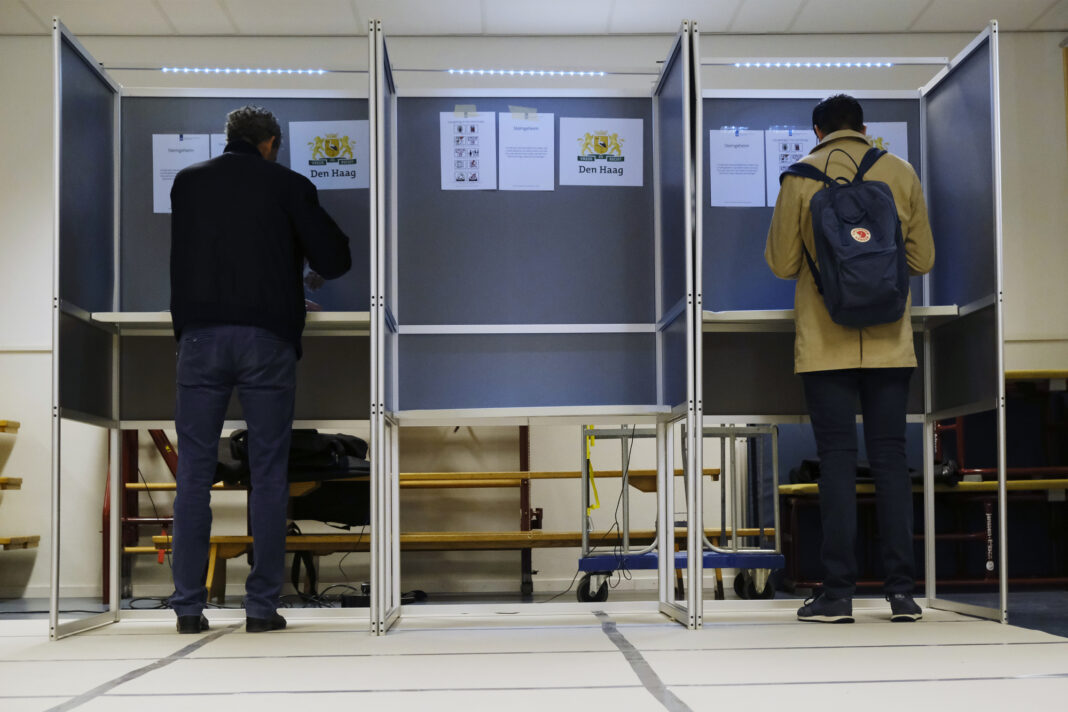
The Netherlands went to the polls on Wednesday, and as ever, local politics did its own thing.
The results of the 18 March gemeenteraadsverkiezingen (municipal council elections) have been rolling in across the country.
A few clear trends are already emerging: local parties won big, and one man in The Hague is having a very good week.
Here’s what you need to know.
1. Local parties win big (again)
Among the big winners this year was the sprawling category of lokale partijen — parties that exist only in one municipality and focus entirely on local issues.
According to NOS, they took the largest share of council seats nationwide by a considerable margin.

Increasingly, migration and plans for (or better said, against) asielzoekerscentra (asylum seeker centres, or AZCs) featured heavily in these local campaigns.
2. In The Hague: De Mos is back, and voters have made their feelings clear
Richard de Mos and his party Hart voor Den Haag (Heart for The Hague) surged to a commanding victory, according to the NOS liveblog, landing 16 seats on the 45-seat city council.
That result carries extra weight given De Mos’s recent history.
After a lengthy corruption case that had shadowed him for years, he was acquitted of bribery in 2023, and the appeals court largely cleared him again in June 2024 (though he did receive a suspended fine of €2,000 for breaching official secrecy). The prosecution service decided not to pursue the case further.
Voters, it seems, were not particularly troubled by any of that. It’s a reminder that personal recognition and local credibility can matter far more in municipal politics than whatever story is circulating at a national level.
3. Big cities paint very different stories
Zoom into the major cities, and the national picture fragments quickly.

Utrecht: Groenlinks-PvdA and D66 remain triumphant
The GroenLinks–PvdA and D66 combination, which has run the city for the past four years, picked up enough seats between them to govern without needing anyone else at the table, according to RTV Utrecht.
Rotterdam: a more politically divided picture
Rotterdam’s results tell a different story entirely.
GroenLinks–PvdA and Leefbaar Rotterdam both finished with 11 seats, according to NOS, making coalition talks anything but straightforward. The city remains one of the most politically divided in the country.
Amsterdam: GroenLinks, D66, and PvdA win big
Amsterdam has now finished counting its results. According to the municipality, GroenLinks proved to be the most popular party, winning 10 seats with 17.9% of the votes.
However, they were followed closely by D66, who won 8 seats with 16.1% of votes, and PvdA who earned 7 seats with 14.1%
4. Forum voor Democratie expands locally and across the country
One of the more striking national developments is the growth of the extreme-right Forum voor Democratie at the municipal level.
The party ran in roughly twice as many municipalities as it did four years ago, and NOS reports that its total vote count quadrupled to around 300,000 across the country — making it the biggest climber of the night among national parties.
The catch: in several municipalities, other parties have already ruled out forming a coalition with FvD, citing candidates with links to far-right extremist groups.
The party’s parliamentary faction leader called that reasoning “an excuse.” Either way, winning seats and actually ending up in local government are two very different things.
5. Some of the left lost ground, some rose triumphant
Not every party had a good night. The SP and ChristenUnie lost ground across many municipalities, with seats shifting towards local parties.
The national governing parties, however, came through relatively unscathed.
According to NOS, D66 actually posted a slight gain, VVD picked up more seats, and CDA suffered only minor losses.
This is notable given the controversy surrounding recent decisions in the national coalition, including plans to raise the retirement age faster and cut unemployment benefit duration. No major backlash, at least not here.
GroenLinks–PvdA looks set to be the largest national party overall, with around 13% of the vote — though that’s down from nearly 16% in 2022.
6. Turnout rose (slightly)
Nationally, voter engagement ticked upward. NOS puts turnout at just over 54%, up from 51% four years ago — modest progress, but progress nonetheless.
Rotterdam’s mayor Carola Schouten, and even Prime Minister Jetten, who reportedly both promised to abseil down the Euromast if turnout went up, may want to start stretching.
7. Now, it’s time for coalition talks, Dutch-style
Now begins the part the Netherlands arguably does best: formeren — building coalitions out of fragmented results.
Across hundreds of municipalities, negotiations will kick off to turn these results into workable local governments.
These talks tend to move faster than at a national level, but they can still throw up surprising combinations.
Parties that wouldn’t share a table in The Hague routinely end up governing together at a municipal level.
Did you vote in Wednesday’s elections? Whether you went full local party or stuck with a national name, tell us in the comments who got your vote and why.

VERY interesting analysis – in English!!
Helpful and very interesting, for ex-pats – like myself!