
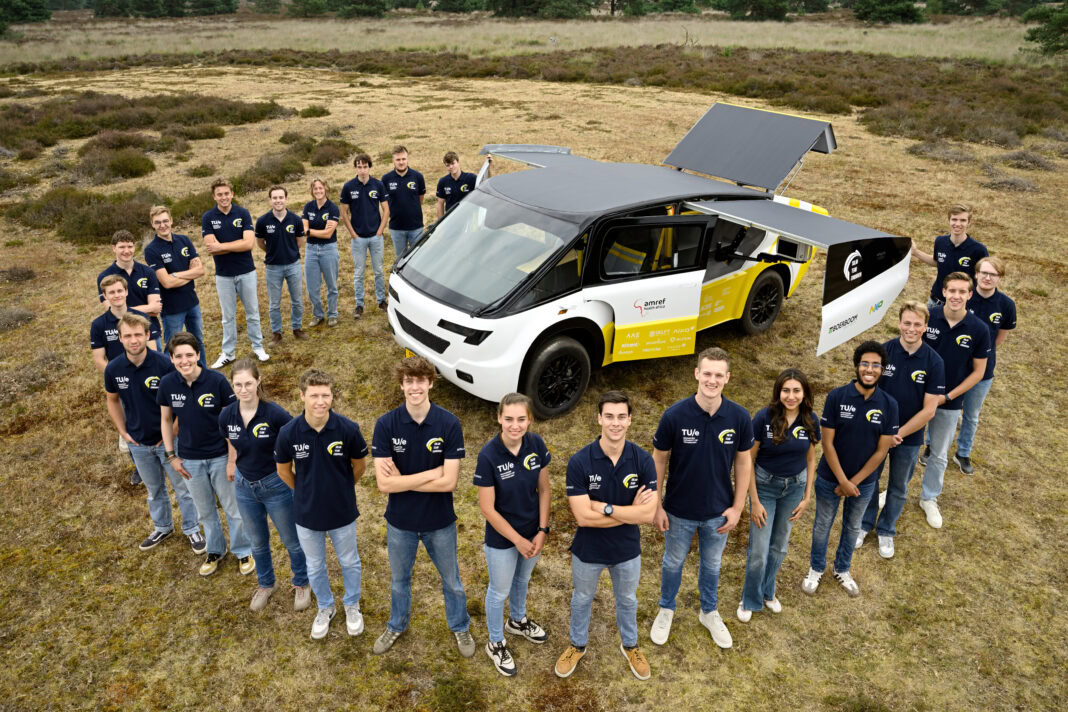
A student team in Eindhoven is unveiling “Stella Juva” today, an ambulance designed to run entirely on solar energy while also powering all the medical equipment on board.
The brains behind the operation belong to Solar Team Eindhoven, a self-described “team of 23 enthusiastic and ambitious students from the Eindhoven University of Technology.”
Stella Juva is built for remote areas where poor roads and a shortage of fuel or electricity limit access to healthcare.
What makes this ambulance different?
Of course, hybrid and electric ambulances already exist.
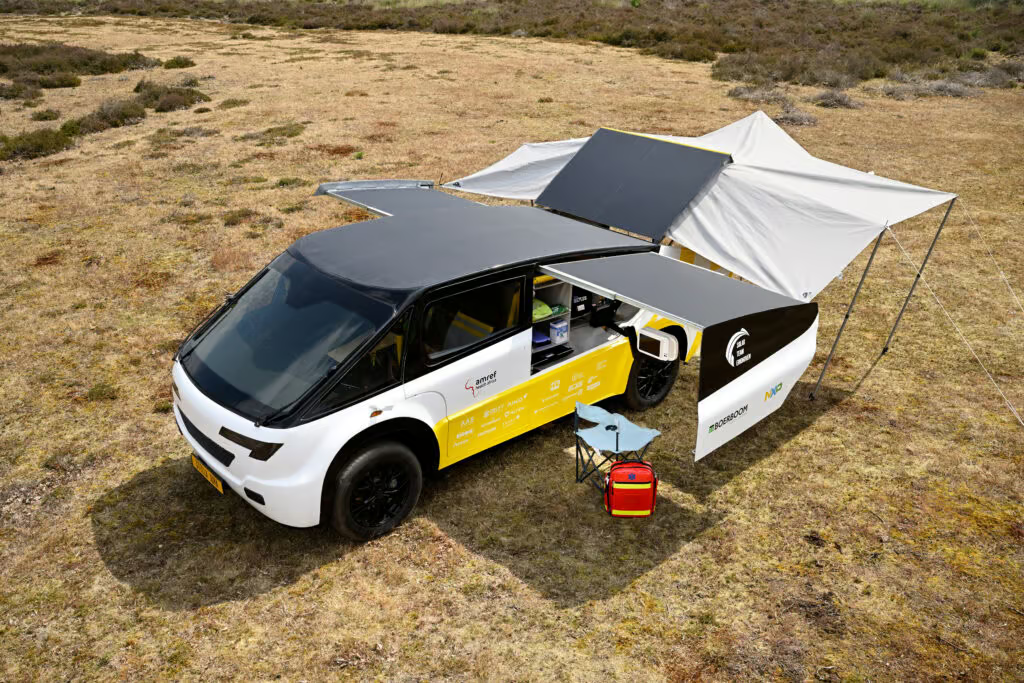
The difference with Stella Juva is that the same solar energy that drives the ambulance also powers the medical equipment, so no separate power source is needed to keep the appliances running. On a sunny day, the team expects a maximum range of around 715 kilometres.
And this isn’t Solar Team Eindhoven’s first foray into solar-powered cars, either — having developed and tested Stella Terra and Stella Vita previously.

It’s a hospital on wheels
Plus, unlike traditional ambulances, which primarily exist to deliver a patient to the hospital, Stella Juva is the hospital.
Healthcare workers can use it as a treatment space to run blood tests, screen for tuberculosis and malaria, administer vaccinations, and perform pregnancy ultrasounds.
“For millions of people, good healthcare remains out of reach. Access to care shouldn’t depend on whether there’s access to electricity or fuel,” says Femke Maurits, partnerships manager of Amref Health Africa in the Netherlands, in a press release. “In remote areas, healthcare workers sometimes travel great distances by bicycle, and reliable energy is not a given.”
“We hope to improve healthcare access and make it more sustainable,” echoes Yarno Basten, partnerships manager of Solar Team Eindhoven.
Kenya is the real test
The team heads there next month with two field locations lined up, where healthcare scenarios including tuberculosis treatment will be simulated.
They also plan to cover hundreds of kilometres on solar power alone, which will prove whether that 715 kilometre figure holds up under real-world conditions.

Prospects seem bright, given that Amref Health Africa, formerly the Flying Doctors, helped develop it. As Maurits states, the organisation is “proud to explore together with Solar Team Eindhoven how solar-powered innovation can bring healthcare closer to people who currently have almost no access to it.”
Would you trust a solar-powered ambulance to turn up when you needed one? Let us know in the comments below!