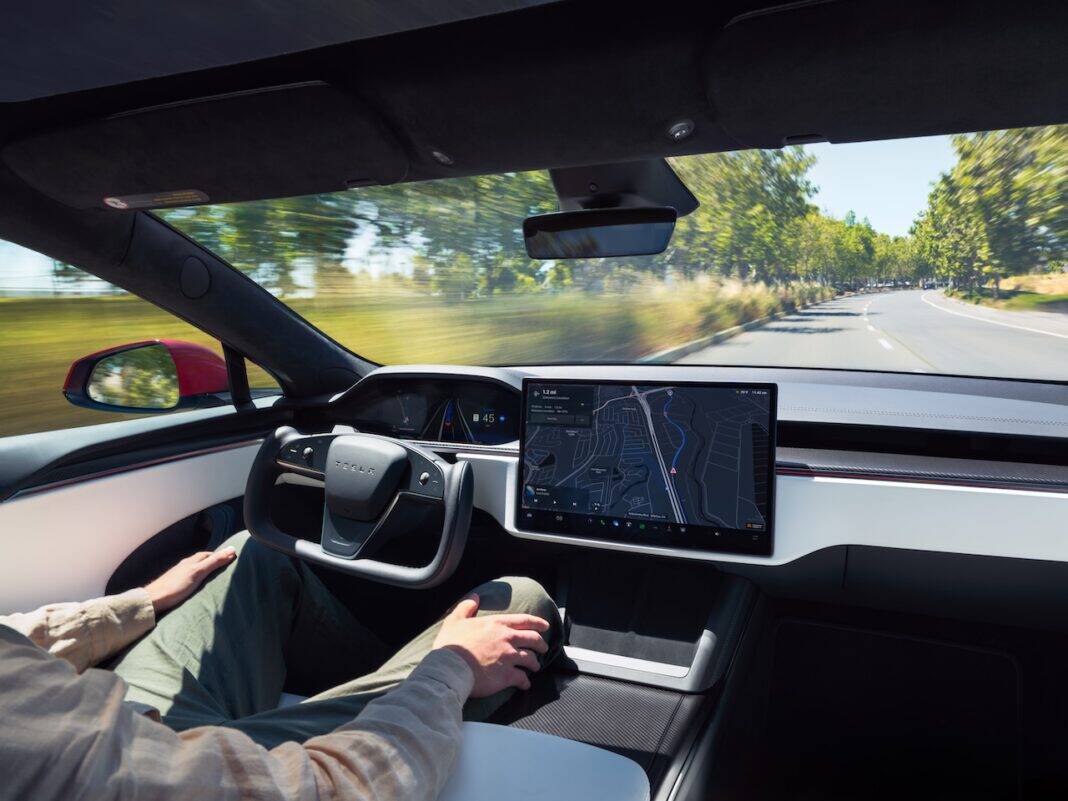

The Netherlands is on the verge of becoming the first European country to approve Tesla’s self-driving technology for use on public roads.
The Full Self-Driving Supervised (FSD) technology handles navigation, steering, lane changes, and the most herculean driving act: parallel parking.
The software is already available across the US, Canada, Mexico, Australia, New Zealand, China, and South Korea.
While the Rijksdienst voor het Wegverkeer (RDW) has confirmed its final assessment is underway, Elon Musk expects an answer by April 10.
Now, Europe is watching RDW’s decision closely. A green light for these magical cars would allow Tesla to add the EU to its roster.
Yet, one question remains: In case of an accident…
Who is liable?
Despite the self-driving technology, a driver must keep her hands on the wheel at all times. At least for legal reasons, this ensures that the driver is liable.
Rembrandt Groenewegen, a traffic and personal injury lawyer, tells Een Vandaag, “Whoever is behind the wheel must intervene if anything goes wrong.”
If the driver was reckless (drunk, watching a film, texting, snapping, or reclining their seat) behind the wheel, insurers can still pursue damages. “But it was my robotic car’s fault,” will not be a suitable excuse.
However, if an accident is caused by the car’s software, things are a bit tricky. Vehicle data is often inaccessible to the owner, and extracting it from Tesla may require going to court.
FSD Supervised in Europe:
— Esther Rebers (@EstherRebers) April 3, 2026
We had a very similar situation recently when we drove with @Tesla FSD Supervised in Tilburg, The Netherlands.
I was amazed by how the car found its way so easily.@teslaeurope https://t.co/k7LvtXgK0J pic.twitter.com/OdXFyQzqGT
Things always go wrong
Emeritus Professor of Transport Policy, Bert van Wee, is a wee bit sceptical. “In built-up areas or narrow streets, things can go wrong much more easily due to children crossing unexpectedly or a frozen bridge,” he tells EenVandaag.
🇺🇸 A @Tesla pulled off a split-second crash avoidance move that looked straight-up impossible.
— Mario Nawfal (@MarioNawfal) April 4, 2026
It’s the kind of moment AI and robotics fans live for: proof FSD tech could actually make roads safer.
Great reflexes… for a car.pic.twitter.com/CwIBihmnwC https://t.co/JQCX58NnYZ
Accidents in the early stages are, in his view, inevitable, as seen in the US and China. If they happen too often, public trust could collapse even if the technology is statistically safer.
Yet, Gijs Dubbelman, researcher of ‘Mobile Perception Systems’ at Eindhoven University of Technology, says that without keeping up with technology, European carmakers risk losing ground.
Nonetheless, Dutch people, and Europeans, are weary of Tesla for completely different reasons. Primarily because its CEO has certain fascist tendencies, or perhaps because of the Grok fiasco. The time that Musk allegedly did the “Hitler salute” also comes to mind.
Would you trust a self-driving Tesla on Dutch roads? Let us know in the comments.