
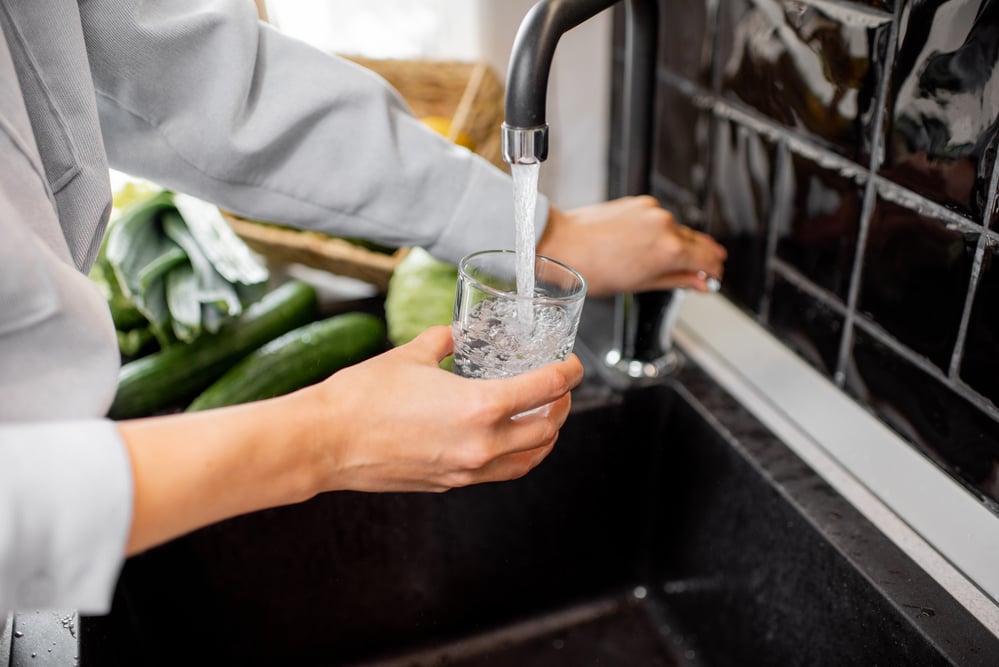

Analysis by Greenpeace has revealed that the amount of PFAS (also known as forever chemicals) in North and South Holland’s tap water is at an unacceptable level.
What counts as unacceptable? According to the RIVM, anything above 4.4 nanograms of PFAS per litre of water.
And just how much was found in our tap water? Well, in places like IJmuiden and Zaandam, that number is as high as 14.2 nanograms.
Wait, what are PFAS?
PFAS are a number of manmade chemicals that are very difficult to breakdown, hence the name “forever chemicals.”
They’re often used to make surfaces grease and waterproof, which means they’re found in a lot of everyday items such as your raincoat or your non-stick cookware.
The unfortunate thing is, they’re associated with health problems, such as increased risk of cancer.

Now, it’s important to know that in Europe, the legal maximum amount of PFAS is actually 100 nanograms per litre.
However, according to the RIVM, this number should actually be lowered to 4.4 nanograms per litre. It’s the typical health expert versus politician problem.
Although, to be fair, Dutch politicians agree with the RIVM that the amount of PFAs in Dutch drinking water should be lowered. Minister of Infrastructure and Water Management, Vincent Karremans, tells Nu.nl that he is working to tackle PFAS pollution.
So, just how much am I drinking?
If you live in North or South Holland, we can at least say we’ve won something. It’s just not a good trophy.
In North Holland, tap water in Amsterdam contains 9.3 nanograms of PFAS per litre. Around Alkmaar and Den Helder, it rises to 11.6 nanograms of PFAS per litre, according to Nu.nl.
Meanwhile, in South Holland, the numbers are slightly lower with the Rijnmond region has tap water containing 6.6 nanograms of PFAS per litre. Living around The Hague? Then you’re ingesting 8.3 to 8.7 nanograms of PFAS per litre.

But the tap water is safe to drink
While this may sound alarming, Greenpeace and the RIVM emphasise that the tap water is still safe to drink.
“It is not dangerous to drink that water,” an RIVM spokesperson tells Nu.nl. “You do see health effects, but that also depends on the level of exposure, age, overall health, and how much other PFAS you ingest.”
In fact, if you really want to worry about PFAS, then you should really look at the food you’re eating and the packaging you’re using. According to the RIVM, people ingest three times as much PFAS through their food than through drinking tap water.
So yes, don’t worry too much about the tap water, you have bigger problems.
Want the latest Dutch news to come zooming through the internet to your inbox? Dat kan! Subscribe to DutchReview’s weekly roundup 📮