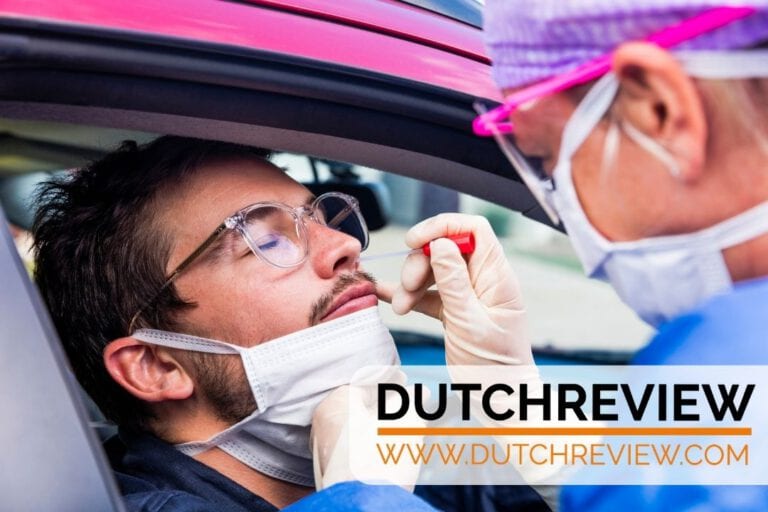
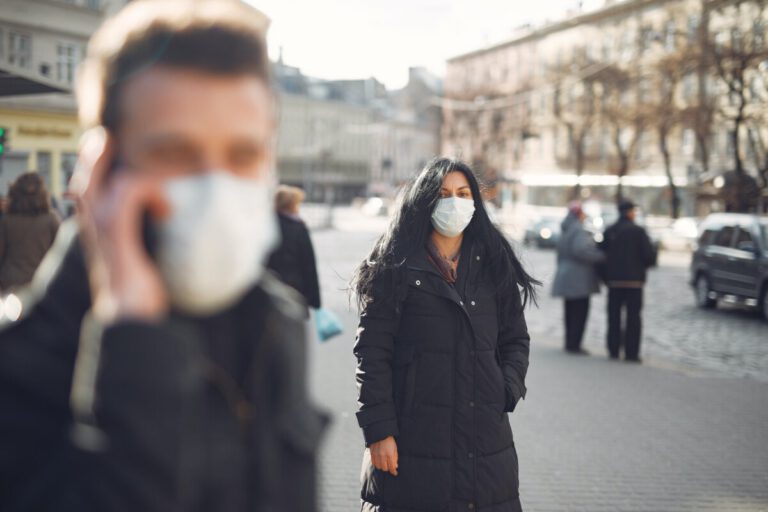
The Netherlands is taking a big approach to testing, with even more XL test lanes with rapid and PCR tests being developed around the Netherlands.
The XL locations will be able to conduct between 3,000 and 12,000 tests every day. The test streets will have a combined capacity of 100,000 per day, double what the Netherlands currently has.
Utrecht, Groningen, Rotterdam and The Hague already have construction on the XL test streets underway. Schiphol, Arnhem/Nijmegen, and Eindhoven will also receive an XL location.
Tests for everyone
The government says that the streets are likely to open by the end of November or the start of December.
“With this approach, we want to ensure that every Dutch person is within a maximum radius of 45 minutes to visit a test location,” the government wrote in a document.
Soldiers will staff the streets to begin with. After a few weeks, GGD employees or hired staff will take over.
Beyond the Randstad
IJssellanden, Twente, Zuid-Limburg, and West-Brabant regions will also receive L-size test streets. However, the exact location of these is still being decided.
Meanwhile, the provinces Friesland, Drenthe, and Zeeland are looking into how they can implement rapid tests at their existing test locations.
What do you think of the Netherlands’ approach to testing? Tell us your thoughts in the comments below!
Despite being a (very) secular country, the Netherlands has a long and rich history with religion, especially Christianity.
No matter how you feel about religion, one thing is certain. Churches are architectural masterpieces, and you do not need to be religious to enjoy their beauty.
There’s a great variety of churches in the Netherlands that are worth your time. With great vaulted roofs, Gothic details and beautiful sculptures, there’s definitely something to please your senses and give you some good ol’ eye candy.
Protestantism vs Catholicism
Before going on our architectural adventure, there are some things to note about Christianity in the Netherlands. The Dutch were some of the first to adopt Calvinism after their independence from Spain, who supported the Catholics. Nevertheless, The Dutch allowed some level of religious independence for the Catholics.
The north of the Netherlands is generally dominated by Calvinism and Protestantism, while the south is dominated by Catholicism. At the end of the 19th Century and the beginning of the 20th Century, the Catholics were emancipated completely through pillarization.
Nevertheless, nowadays, Christianity and religion have lost the role they used to play in society, as the country has become increasingly secular and atheist. The churches remain, however, as proof of the strong links to Christianity this country had. Without further ado, let’s get straight to them cathedrals, shall we? (We know what you’re here for).
Can you visit churches for free?
A very Dutch question, but an important one. The answer really depends from church to church. Some of them still operate classically as religious sites, so you’ll be able to go on Sundays for free. Others have become tourist attractions so you’ll need to pay a fee to get in. Some have separate fees for climbing to the top of the tower, so a bit of research beforehand is always helpful.
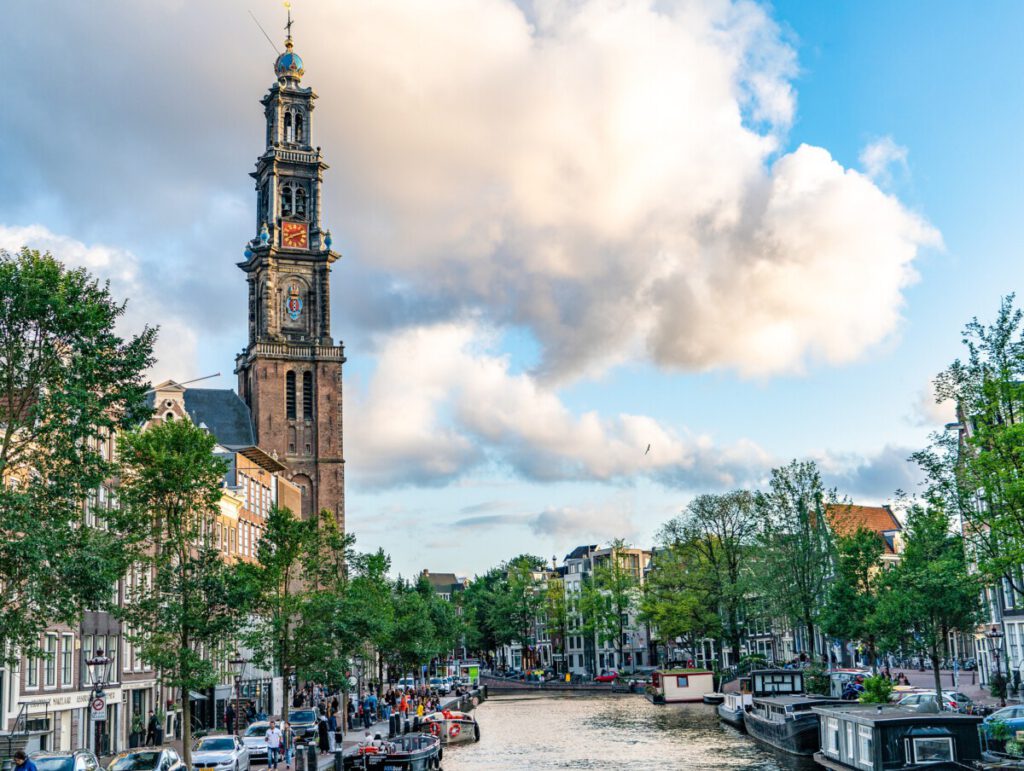
The Westerkerk is one of the most iconic churches not only in Amsterdam but in the whole of the Netherlands. Built to serve the Protestant community, it is also the biggest Protestant church in the country. Its tower is 86 meters long, making it the tallest church in Amsterdam, so it is certainly not hard to miss!
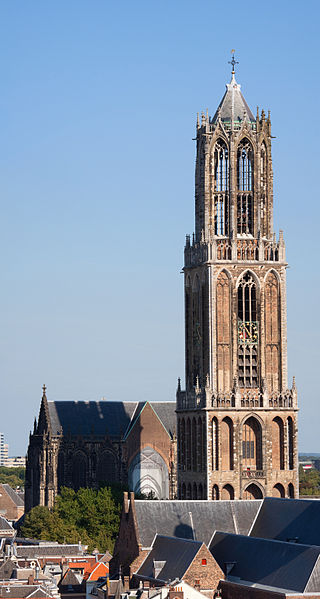
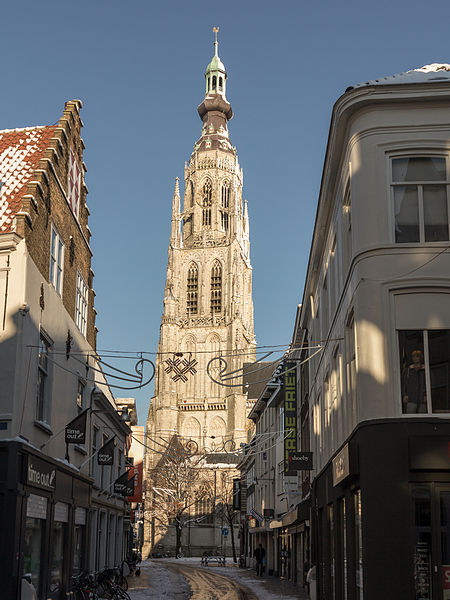
The Dom Tower in Utrecht is the highest church tower in all of the Netherlands. The cathedral behind it was never fully finished, and the tower is not even attached to the cathedral. If you climb all the way to the top of the 112 metre-long tower, you can, on a clear day, see as far away as Rotterdam.
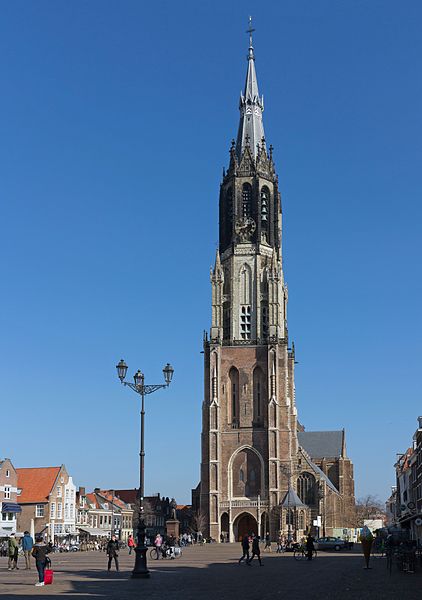
Next on our list is the Protestant Nieuwe Kerk in Delft. The tower was finished in 1872 and it is the second-highest in the Netherlands. One of the notable things about the church is that it’s the resting place for the members of the Royal house of Orange-Nassau. Beyond that, expect to be mesmerized by its beautiful interiors!
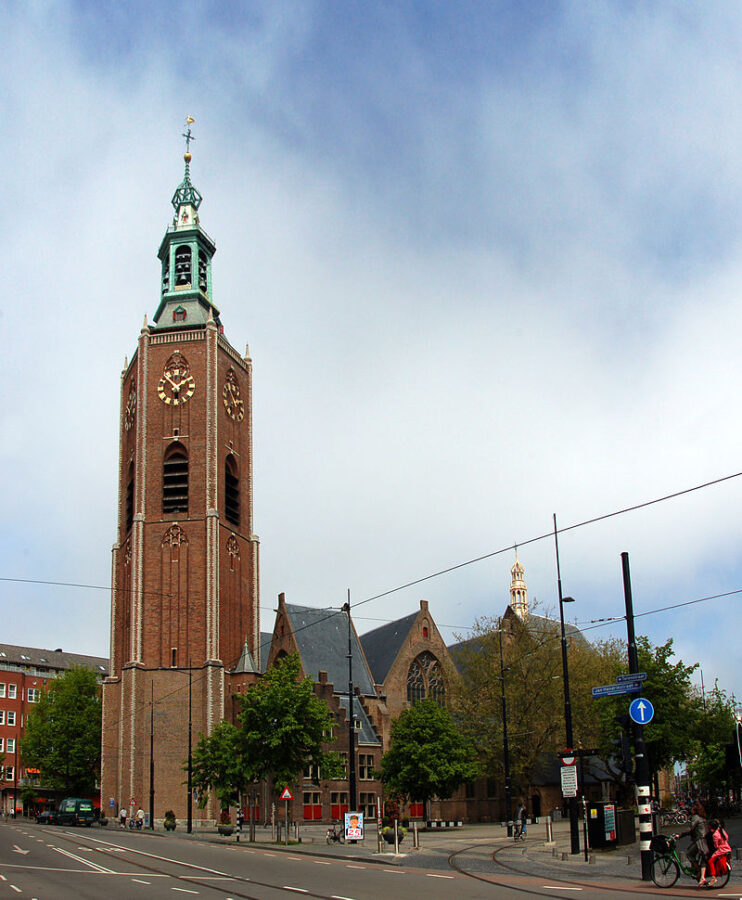
This timeless beauty from the Hague is one of the oldest buildings in the city. Its Gothic architecture is certainly notable, and it’s hard to miss, as its high tower dominates the skyline of the old historical centre of The Hague.
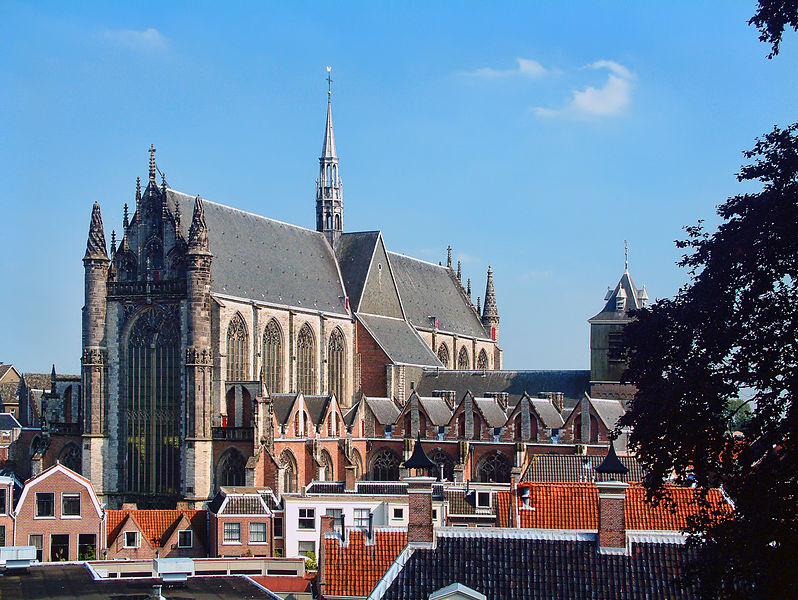
This beautiful Protestant church is located in Leiden and it is one of the most iconic sights of the city. The church fell into despair in the 19th Century and was even considered for demolition, but thankfully after a long and intensive restoration, it was brought back to its former glory.
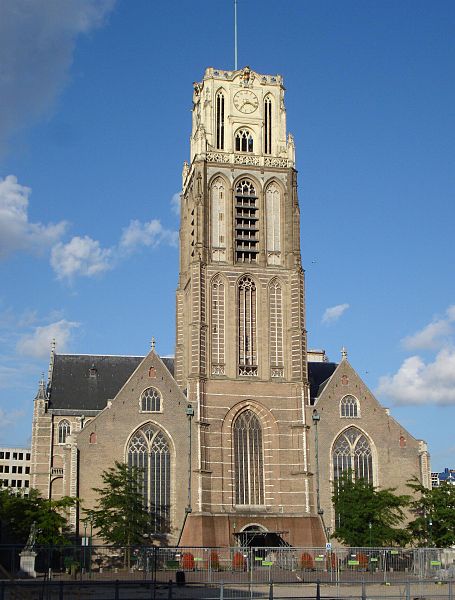
This church in Rotterdam is the last remnant of the old medieval city. You’ll find it amongst the most modern buildings of Rotterdam, as the church is one of the sole survivors in the area of the Blitz of World War II.
Entrance fee: normally yes, (can also be rented). Also holds religious sermons for free on Sundays.
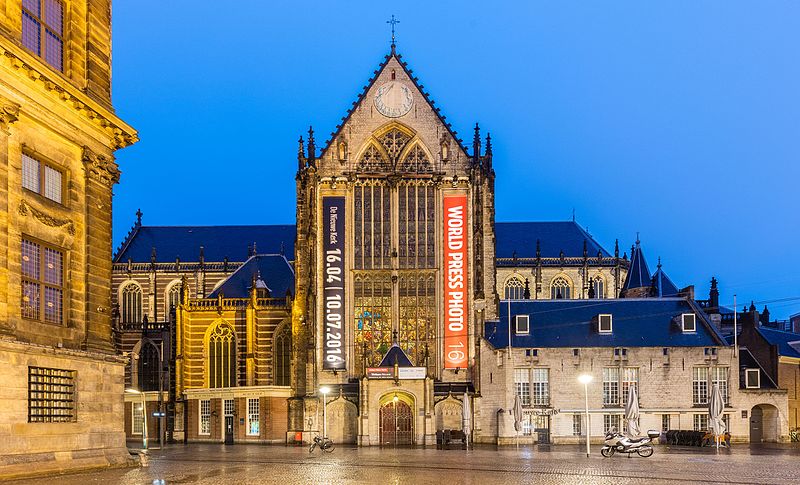
This is one of the oldest churches in Amsterdam, right in the centre of Dam square. Built back in the 15th Century, it’s a well-preserved building, showcasing exquisite gothic details.
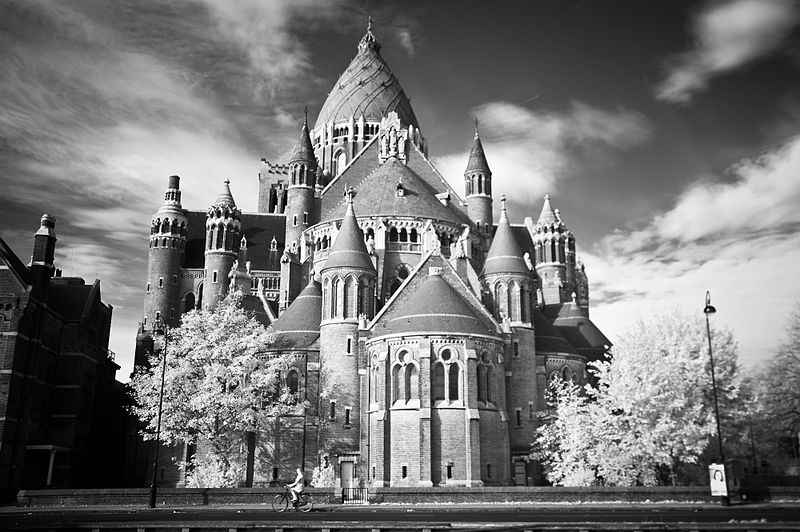
This beautiful neo-gothic Catholic church in Haarlem is definitely a stunner. It’s also one of the newer churches on the list, built between the years 1895-1930.
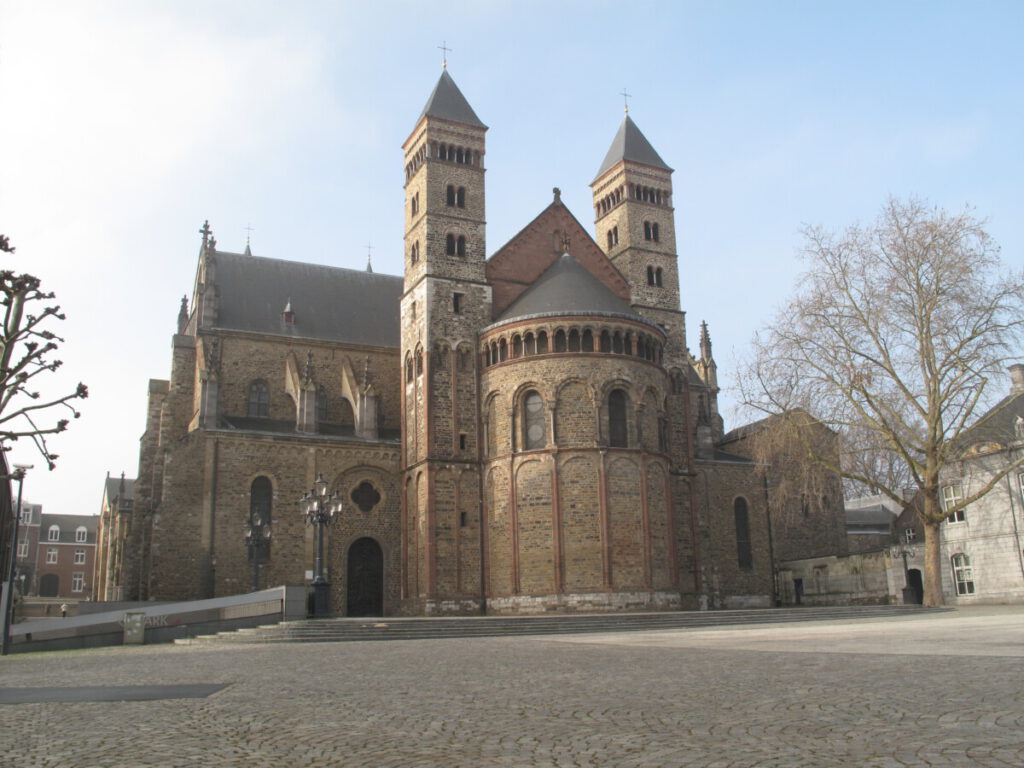
This church in Maastricht is a bit of an odd one out architecturally speaking, built in an eclectic Romanesque style. It’s located in the centre of the city in the Vrijthof square.
This gothic protestant church is full of history, founded back in 1424. Its pipe organ has been rebuilt to its former glory and you can enjoy concerts in its grand vaulted halls.
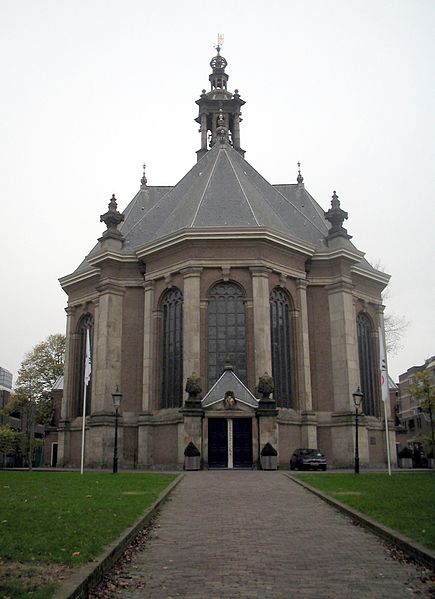
The Nieuwe Kerk in The Hague is also known as Spinoza’s Church, as the famous philosopher is buried on the ground of the church. It was completed in 1656 and has a revamped and modern concert hall for all of your musical pleasures.
Taking a break from all these Protestant churches, it’s time for another Catholic church. This beautiful neo-gothic cathedral, finished in the late 19th century, is one of the best sights to see while going around Leeuwarden.
Entrance fee: not for entering, but for visiting the tower
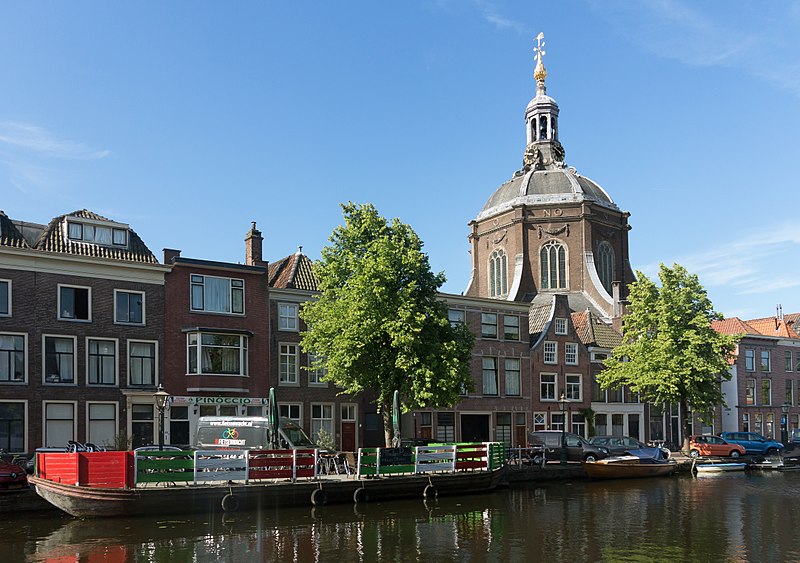
This iconic dome in Leiden dominates the skyline of the city and it’s one of the most recognizable landmarks. The church still holds services every Sunday, so you can go if you want to visit the building.
Entrance fee: no, but sometimes the church is rented for events, so check on their website beforehand
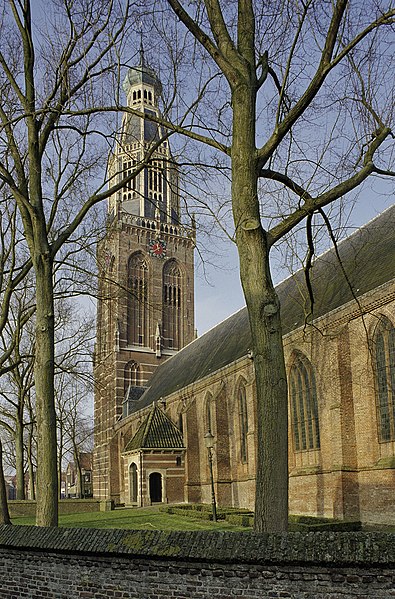
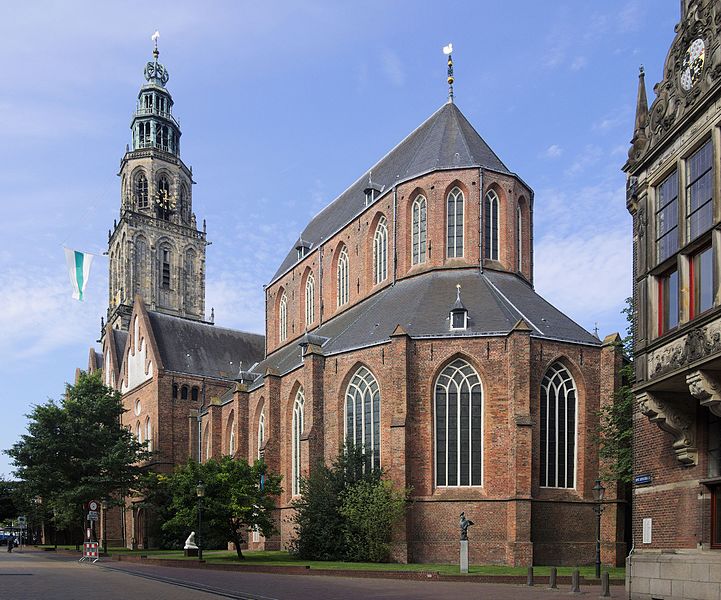
This one is the oldest church in Groningen, with construction starting back in 1225. The tower, called Martinitoren, is the highest tower in the city, and it’s a great place to catch views over the place.
This beautiful gothic church has one of the oldest organs in the Netherlands that is still functioning. It operates as an event hall, so if you ever wondered how it is to go to a food truck inside a church, this is the place to go.
Scammers have been selling fraudulent statements indicating that a person is free from coronavirus without ever having been tested, reports AD. The bootleg documents show falsified names of doctors and laboratories and are sold primarily for use when crossing borders.
Such virus-free declarations are required to cross borders into many countries, including Germany, Switzerland, and Italy.
As the GGD only tests people with complaints and does not issue such travel statements, they must be purchased from private parties. These legitimate companies take a standard PCR test and issue a statement of results, costing the consumer around 150 euros.
Cheap rates
Fraudsters have taken the opportunity to issue false statements for a much lower rate — between 50 and 60 euros. They operate via WhatsApp and Snapchat under names such as Digitale Doktor and Vliegtuig Arts.
The declaration is arranged in a matter of minutes. All it takes is a bit of personal information and online payment. An actual coronavirus test is not a part of the package.
Doctors who have had their names used falsely, such as Preem Heera who works for the Corona Test service, have notified police.
Not surprising
Director of HetHuisartslab (one of the falsified labs) Maarten Cuppen knows that Dutch people have been travelling with forgeries and is not surprised. “If the carrier or the country of arrival does not properly check those statements, the fraudsters will go free,” he tells AD. The Health and Youth Care Inspectorate doesn’t “supervise the content of travel statements.”
Arjan van Emmerick, director of Corona Test Service (another forged test lab) says there’s a lack of government supervision. “There have been very stormy developments. Out of nowhere, other governments demanded that you can only enter their country with a statement.” He adds, “Many children nowadays are very handy with computers.”
Heavy consequences
Criminal lawyer Sander Janssen tells AD that buyers and sellers are both at risk of criminal charges. “This is forgery, a serious crime for which you can get a prison sentence.”
And if the traveller is, in fact, infectious with coronavirus, a harsher penalty is likely. “If you infect someone and this person becomes seriously ill, it can be seen as causing serious physical injury. Compare it to an HIV patient who has sex with someone else. And if someone dies, it can even go towards attempted homicide. It is far-fetched, but it is possible.”
Are you surprised by the forgeries of negative test declarations? Let us know your thoughts in the comments.
Dutch police are now asking that dating app users remain vigilant following an increase in attacks and robberies. The police in Utrecht have arrested six people for carrying out robberies against victims they met on dating apps.
Victims have been left shocked after arranging to meetup for dates, only to be attacked or robbed by the person they were meant to be meeting with.
There have been a number of victims to this type of organised crime as of late. In Utrecht, the six arrests were related to three separate incidents, RTL Nieuws reports.
Recent incidents
Last month, police arrested a 19-year-old in Utrecht after he met with a 48-year-old victim. The two had arranged to meetup for a date but upon meeting, the man threatened, extorted and robbed the victim.
More recently, four teenagers were arrested last Wednesday for carrying out a robbery against a 30-year-old victim who, again thought they were on a date. The teenagers were 16, 17, 18 and 19-years-old and all came from the Utrecht region.
This Saturday, Utrecht police arrested an 18-year-old woman for robbing a 55-year-old victim whilst meeting with them for a date.
Police dating advice
The police are now asking that people remain vigilant whilst using dating apps. They say the greatest risks are apps that allow users to remain anonymous.
They recommend that app users ask for recent photos and arrange to meet in public spaces.
Remember people, always keep an eye out for the red flags. Will you be making use of dating apps this year?
An increasing number of coronavirus infections has caused Zeeland, the last safety region with a “worrisome” risk level, to be upgraded to “serious,” the second-highest risk level.
As a result, there are now no regions in the Netherlands not considered in the top highest risk areas. No more regions are considered just “vigilant” or “worrisome”.
North and East Gelderland have also had increasing cases, forcing their region to rise to the “very serious” risk level.
Every region now “serious” or “very serious”
Now, five regions are considered to have a serious risk. Zeeland joined Groningen, Friesland, Drenthe, and South Limburg.
The situation is considered even worse in the other 20 regions, which include the provinces of North Holland, South Holland, Utrecht, North Brabant, Gelderland, Overijssel and Flevoland, and the North Limburg region.
Will regional measures be implemented?
The risk levels don’t change anything for the regions for the time being, except for encouraging residents to be alert. However, in last Tuesday’s press conference, the government announced regional measures may be implemented for areas at the highest risk.
While infection rates in 20 regions are considered “very serious,” the outbreak is the most severe in Rotterdam-Rijnmond, South Holland South, Twente, and Central and West Brabant.
It’s likely that local governments will implement new coronavirus measures in these regions. This could include the closure of high schools, a curfew, or more.
Risk levels are determined by the number of positively tested residents in a region. For a region to be considered “serious” there must be 150-250 new cases per 100,000 inhabitants per week. For “very serious” the number is anything above 250.
Overall fewer infections
The (slightly) good news is that new coronavirus infections have been lowering in recent days. For the first time since October 12, the number of infections was below 7,000 on Wednesday, when 6,996 cases were reported.
However, the Netherlands is continuing to struggle with the situation. The government set up an alarm system for regions after the first wave. The alarm would ring if a region reported more than seven positive tests per 100,000 inhabitants.
However, every region in the Netherlands has been above that value for 53 consecutive days.
What are your thoughts on how the Dutch government is managing coronavirus in the Netherlands? Tell us in the comments below!
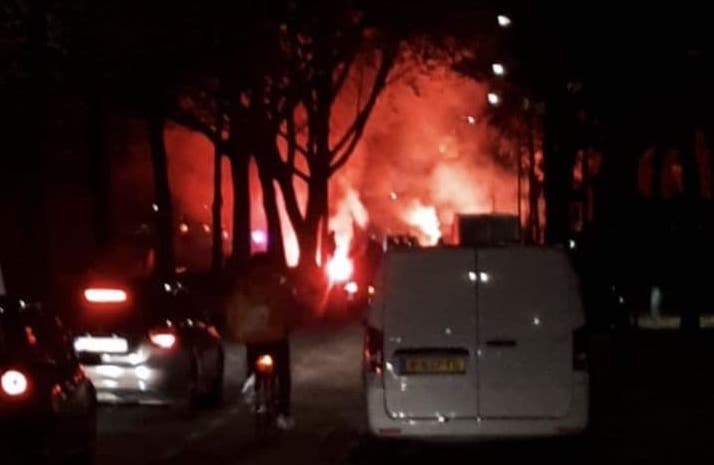
Feyenoord fans keen to show their support for their favourite football team took it too far yesterday. The night ended with the fans throwing fireworks directly at police officers.
The fans wanted to watch the home game against Moscow, but current coronavirus measures prohibit spectators during football matches.
Instead, the supporters headed to the hotel where the Feyenoord players were staying and lit fireworks before heading downtown.
When confronted by police in the city, the fans lobbed fireworks directly at the officers in response. Two police employees are now having difficulty with their hearing.
Police arrested seven people and issued 15 fines to others for violating coronavirus rules. According to police, the behaviour was “unacceptable”.
“Even when the circumstances are difficult, we act,” writes a spokesman.
So you’re in Amsterdam for a city break and – instead of buying another pair of weed print socks – you’d like to get yourself a more sophisticated souvenir, such as an English translation of Herman Koch’s ‘The Dinner’.
Or perhaps you’ve been living in the city for one year already, but your Dutch is limited to hoi, lekker and doei and you’re longing for the comfort of a good bedside-table book (one that you can immerse yourself in, away from all those korte klinkers and lange klinkers that you think you’ll never be able to master).
Or maybe you’ve been living here for quite some time now and engage in lengthy conversations with your Dutch neighbour, but reading Mata Hari’s life story in Dutch is simply out of the question. Whichever it is, read on; you’re in the right place.
When it comes to English language books, Amsterdam has plenty of options. It’s hardly surprising in a city (and a country, for that matter) in which English is no longer a foreign language but, functionally, a second language (according to Leiden University’s Alison Edwards). And the good news doesn’t stop there. The go-to bookstores are really cool.
Here are my top three. They’re centrally located, within close distance of each other, and all span several floors. Each is special in its own way. Maybe one of them, at least, will make it to your top three too.
Scheltema: Boekverkopers sinds 1853
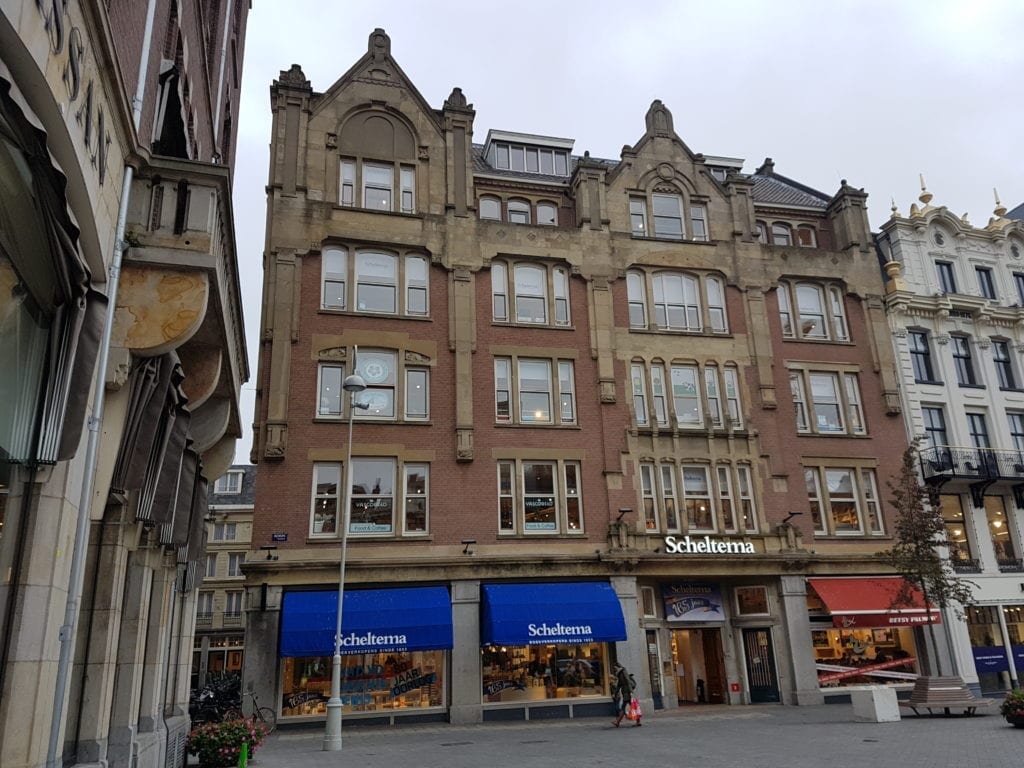
Booksellers since 1853, that is. Located on Rokin, steps away from Dam Square, Scheltema is the largest bookstore in Amsterdam. It’s also one of the largest and the oldest in the Netherlands – and Europe. It is simply beautiful. It moved to its current location in 2015, having returned to Rokin after more than 30 years in Koningsplein. The building, formerly known as Gebouw De Roos after the art auction company (CF Roos) that once operated on its premises, dates back to 1911.
It was then renovated and decorated into a quiet, elegant place where one could read, work, have coffee, or even a healthy meal. They serve lunch until early evening every day (so no need to turn to bountiful bowls of bitterballen if you happen to be hungry at 4 pm). Of course, despite my best efforts, my kids manage to disrupt the place whenever I take them there.
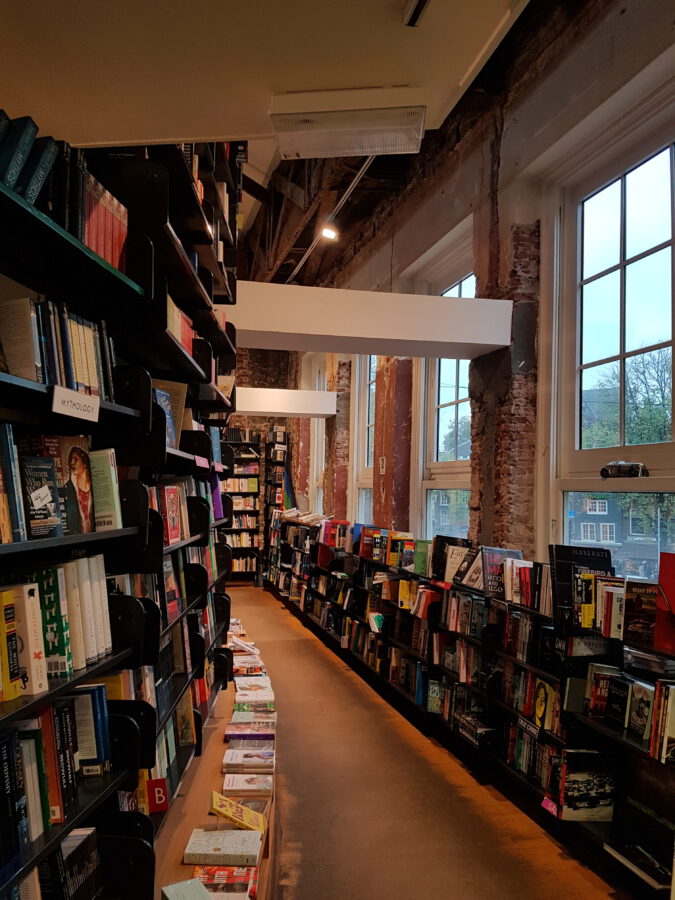
Scheltema has a huge selection of English-language books. Image: Iulia Romaniuc
The big question: what kind of books does Scheltema sell?
For English language books, head to the first floor. You will find a few ones at bargain prices in the remainder (ramsj/boekenvordeel) section, right next to Scheltema’s Vascobelo V-bar. Nothing too impressive quantity-wise, but don’t be too disappointed; the actual selection of English books is on the other half of the floor, at the back of the building.
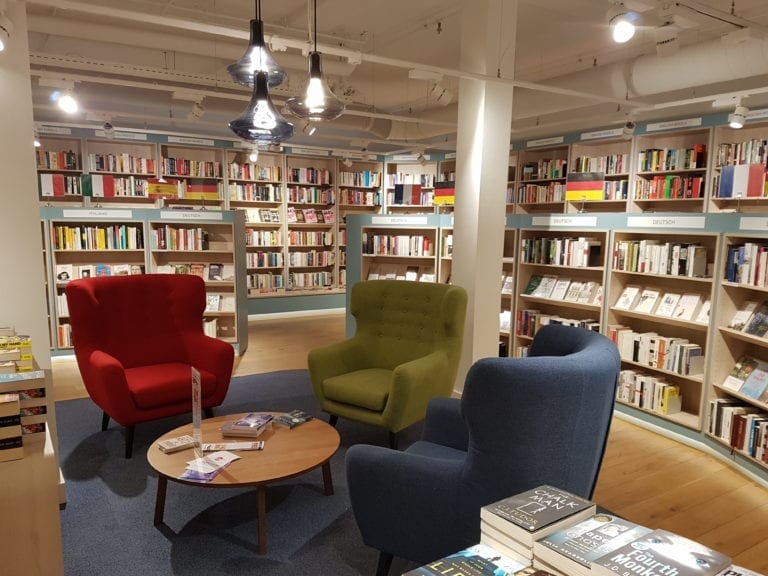
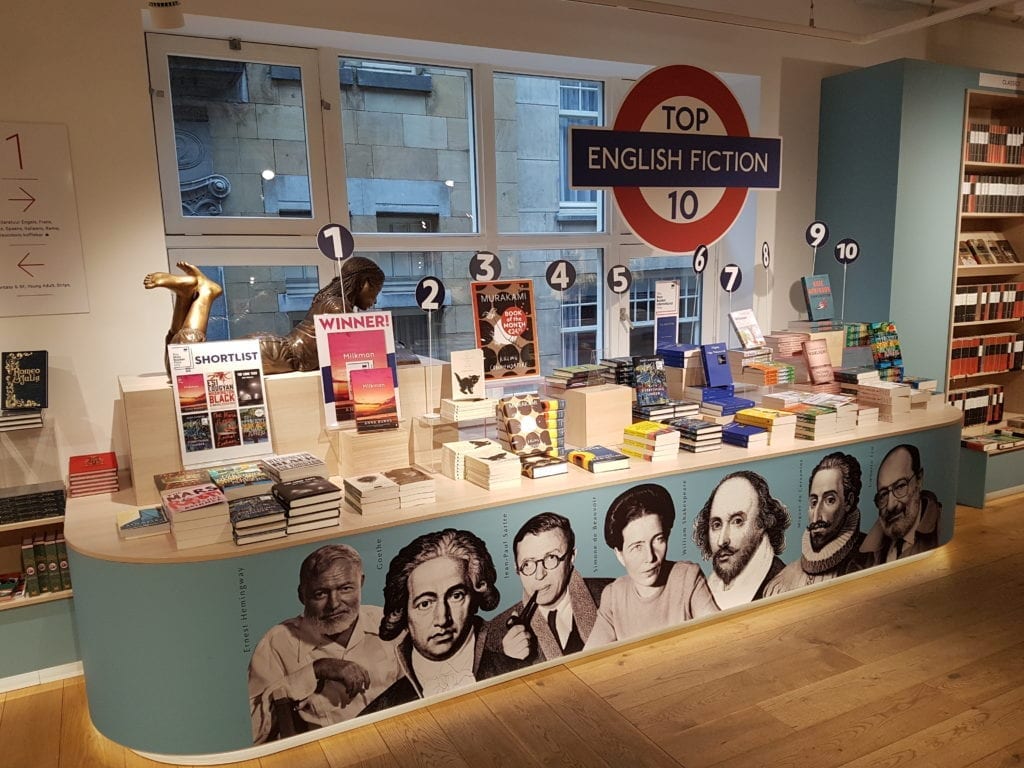
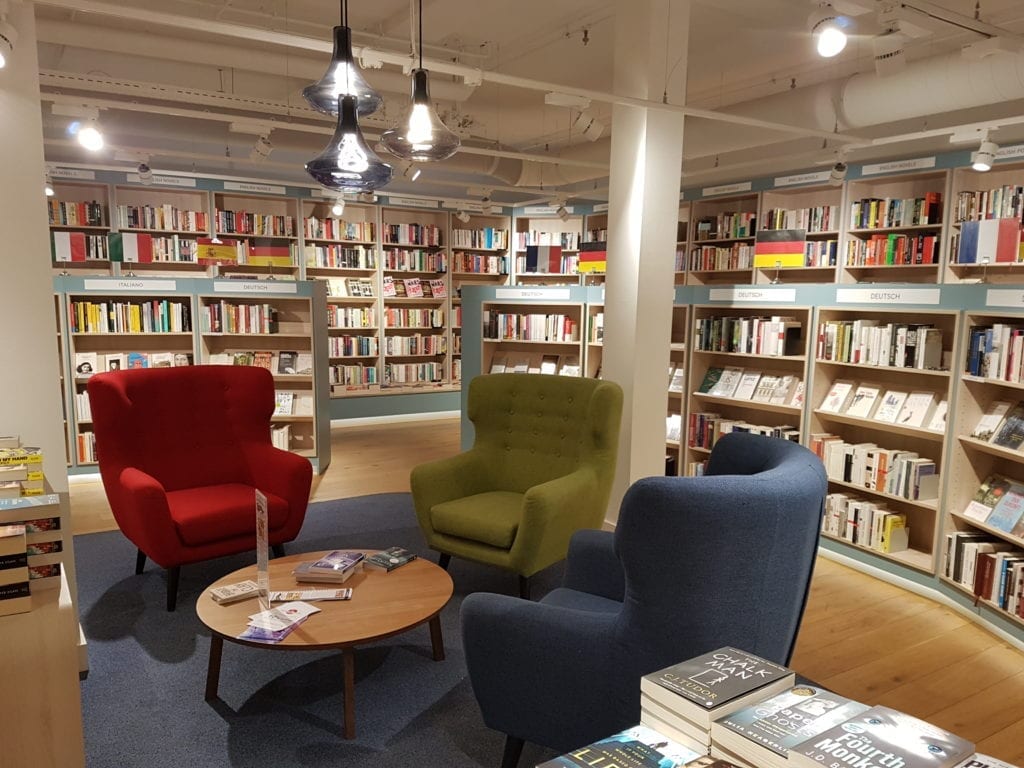
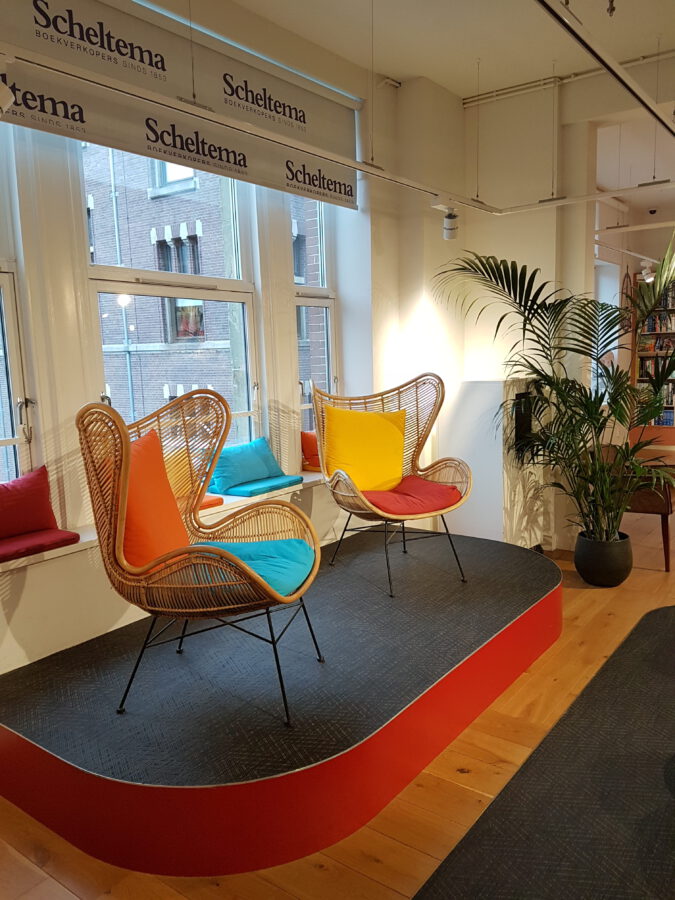
The section is organized around a stylish reading area. It displays plenty of titles – such as crime, poetry, fantasy and science fiction – ranging from new books by contemporary authors to classics like Dostoevski. No history or politics subsections (which is where I initially head to when entering a bookshop). Surprisingly, though, there are a few history and politics titles on the remainder shelves.
Image: Iulia RomaniucLooking for Dutch literature? A really nice touch is the subsection dedicated to English translations of Dutch novels. Image: Iulia Romaniuc
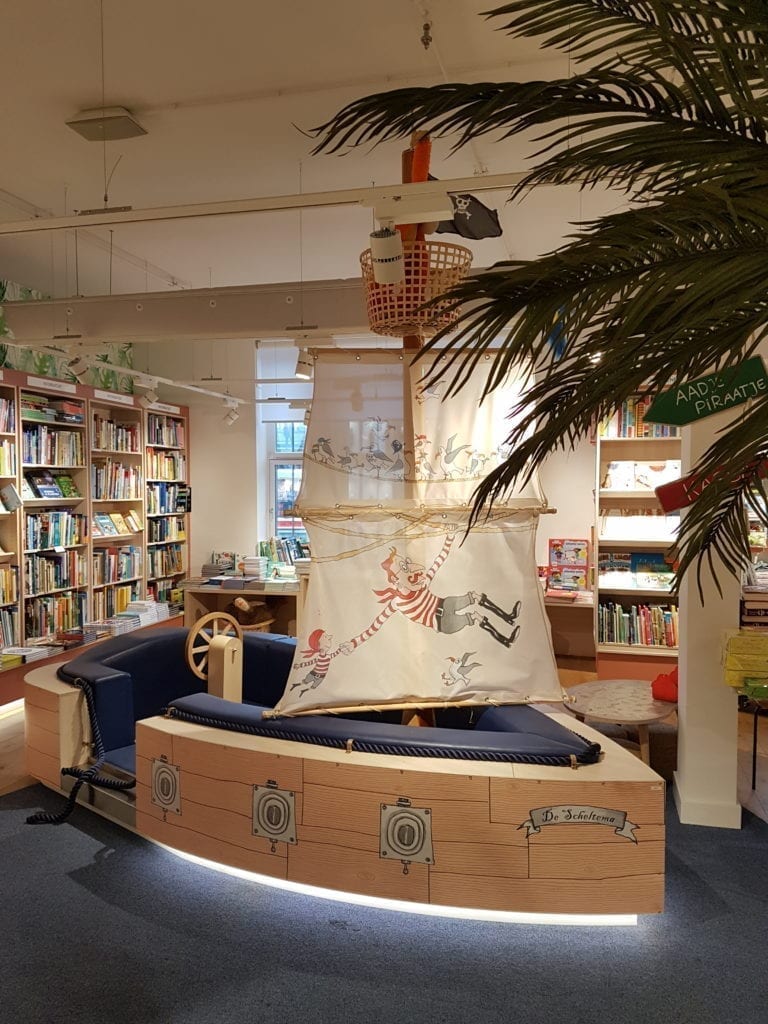
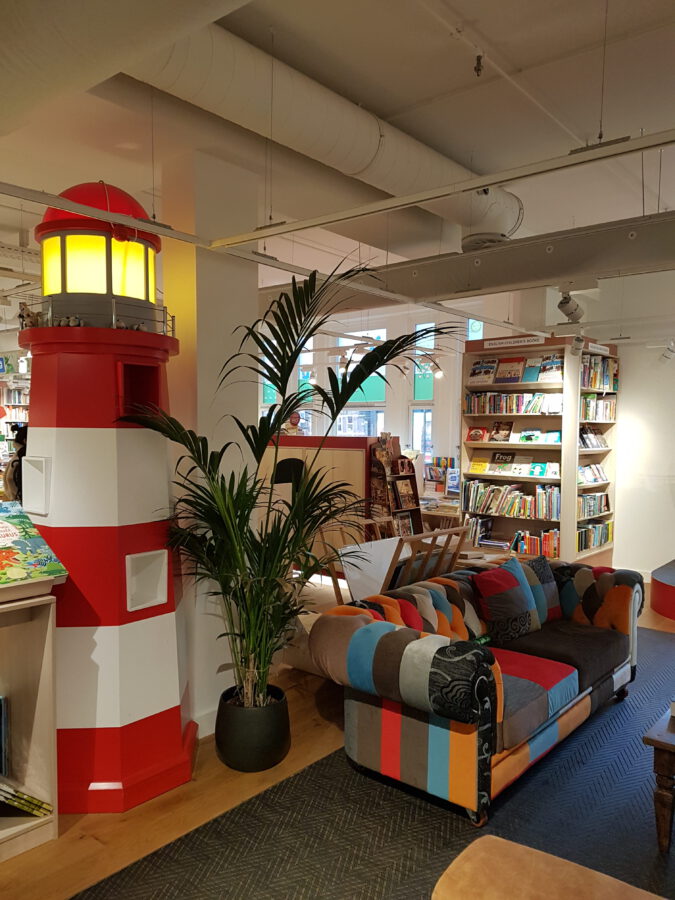
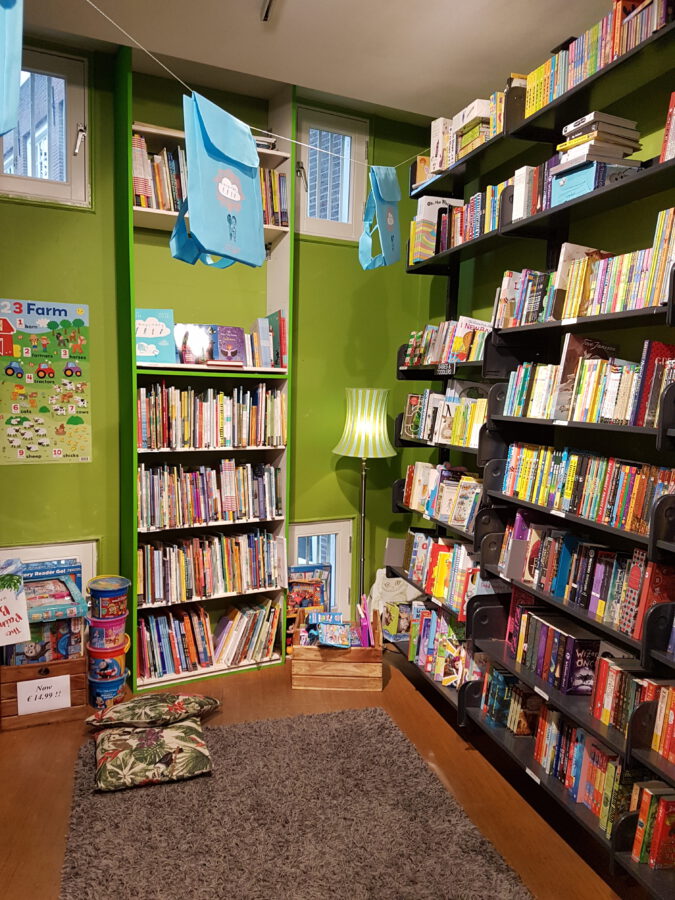
For English language children’s books, head to the second floor. If you brought the kids along, brace yourself for some commotion. The children’s reading corner is closer to an indoor playground centred around a pirate ship. Add to these two big toy boxes and a beautiful lighthouse, with actual intermittent light. This is where they are supposed to read, I guess, but they almost never do because they’re too busy playing. This all comes in handy, though, when you have to motivate them into shopping for a book, instead of a toy. Or bribe them into agreeing to enter the bookstore and allow you a few precious minutes to get a book for yourself.
Image: Iulia RomaniucImage: Iulia Romaniuc
While the overall children’s books section is huge and displays a great selection of Dutch books, the English subsection could use some improvement, especially for smaller children. Quality varies, depending on the season. I usually find it gets better around Christmas, but not around the traditional Dutch Kinderboekenweek each autumn. The focus is obviously on the Dutch language. Older kids are luckier. Recent hits, such as “Good Night Stories for Rebel Girls” are almost always available. There is also a small but good selection of English children’s books on Amsterdam and the Netherlands. They make great gifts for family and friends abroad.
Finally, there’s the travel section, right next to the kids’ area, where English editions are also available.
Image: Iulia Romaniuc
What else is there besides the books?
Last but not least, since babies will be babies even in a bookshop, it’s good to know that Scheltema has your back covered. There’s a baby changing room on the third floor – very impressive for Amsterdam Centrum. Accessibility is not an issue because of the huge, modern elevator. Plus: if your phone is almost dead but you desperately need it for that Facebook check-in, no worries, there’s a smartphone charger station next to the elevator on the first floor.
Address: Rokin 9, 1012 KK, Amsterdam.
The American Book Center: Three floors of ideas
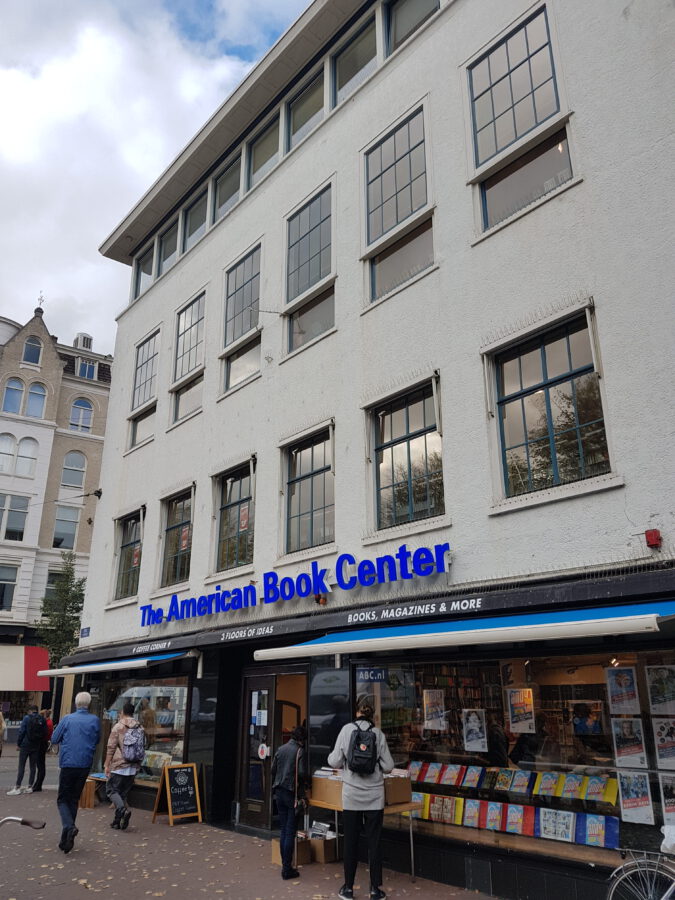
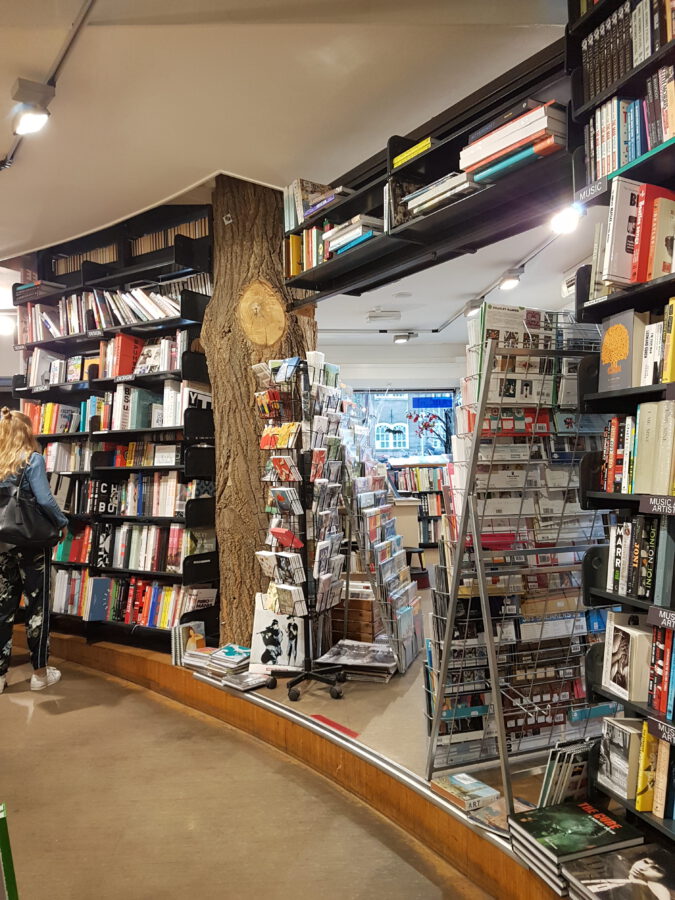
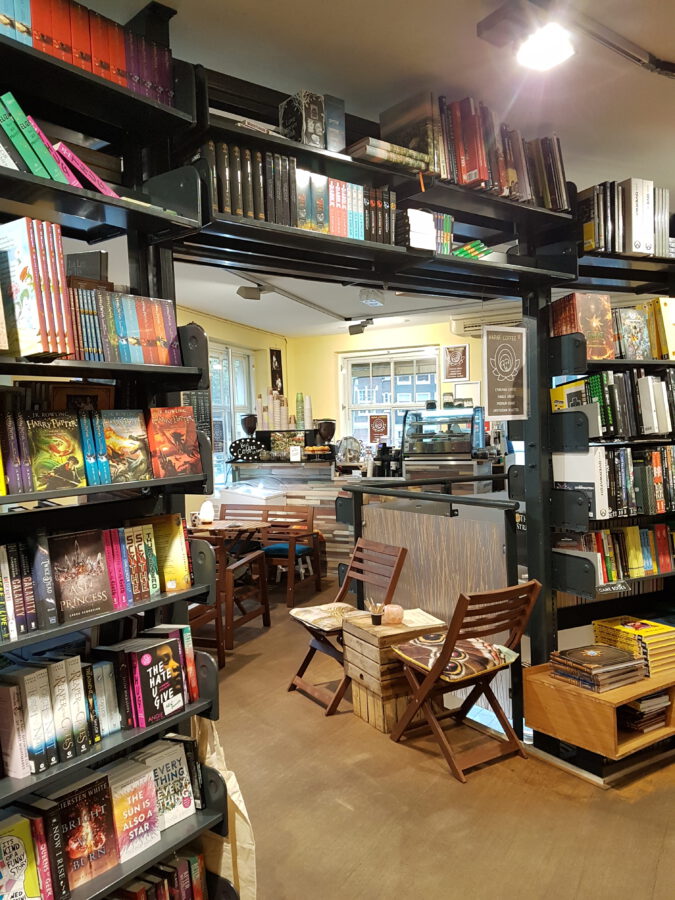
Less stylish than Scheltema, but definitely edgy: ABC, as we lovingly refer to it in Amsterdam, has a fabulous selection of titles. Obviously, 100% English language. I almost never leave with my wallet intact.
Image: Iulia Romaniuc
It was founded in 1972 by two Americans, Mitch Crossfield and Sam Boltansky. Mitch was already living in Amsterdam when he came up with the idea of a discount shop for remainder English language magazines and books that his friend, Sam, could bring over from America. Not a bad idea in a city where, in Mitch’s words, everybody spoke English. They came up with a long and intricate name that sounds pretty funny today: American Discount Book, Magazine, Poster Retail and Distribution Center B.V. Lynn Kaplanian Buller, a fellow American (who has been managing ABC for more than 40 years now) happened to pop into the newly opened store, looking for magazines.
Over the years, focus moved from discount to completely different criteria for title selection. The business expanded to The Hague, where the store includes an events space called the ABC Treehut, which frequently hosts lectures, workshops and exhibitions. Betty the Bookmaking Machines were added in 2010, the first of their kind on the continent, in order to allow for self-publishing. This is a super interesting service provided by ABC, the details of which are available on their website. The American Book Center is nowadays perceived as an essential Anglo-Saxon cultural hub in the Netherlands. An inspiring story of pioneering, don’t you think?
Now you know the history, let’s talk books…
I can’t even begin to list their sections. There’s something for everyone: from urban culture to kitchen, from kids to philosophy. The magazine section on the ground floor is jaw-dropping. Tonnes of design, art and pop culture, and yes – Amsterdam, Dutch and the Netherlands are also on the ground floor. Crime, cooking, manga, romance, travel, kids’ books and many more on the first floor. Heavyweight titles are on the top floor, ranging from religion to computer science. Much more than it makes sense to mention here. You have to see it to believe it. Check them all out by yourself.
Image: Iulia RomaniucImage: Iulia Romaniuc
Not surprisingly, their selection of children’s books is slightly larger than Scheltema’s, but it’s less variable in quality and quantity; it’s got trendy and classic titles, but the kids’ corner, on the whole, is actually quite basic. You can’t keep smaller children busy there, but it’s definitely worth stopping by if you’re alone.
Image: Iulia Romaniuc
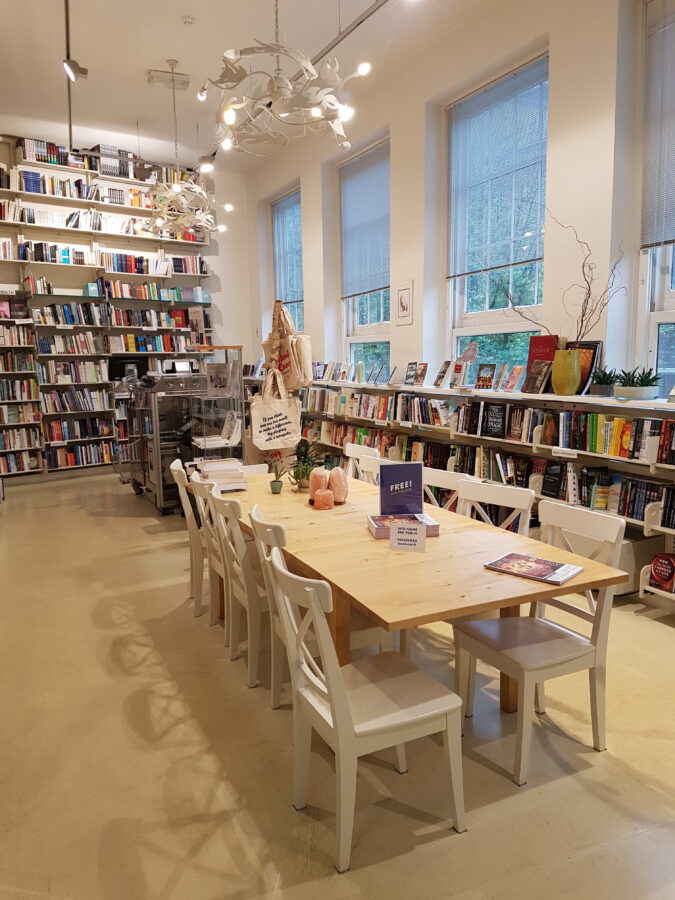
There is a beautiful reading table on the top floor, close to the cash register. Coffee, juice and cakes are available in a small cafe on the first floor. The elevator is at the back of the store, look for “LIFT” written in red capital letters.
Image: Iulia RomaniucImage: Iulia Romaniuc
Address: Spui 12, 1012 XA Amsterdam.
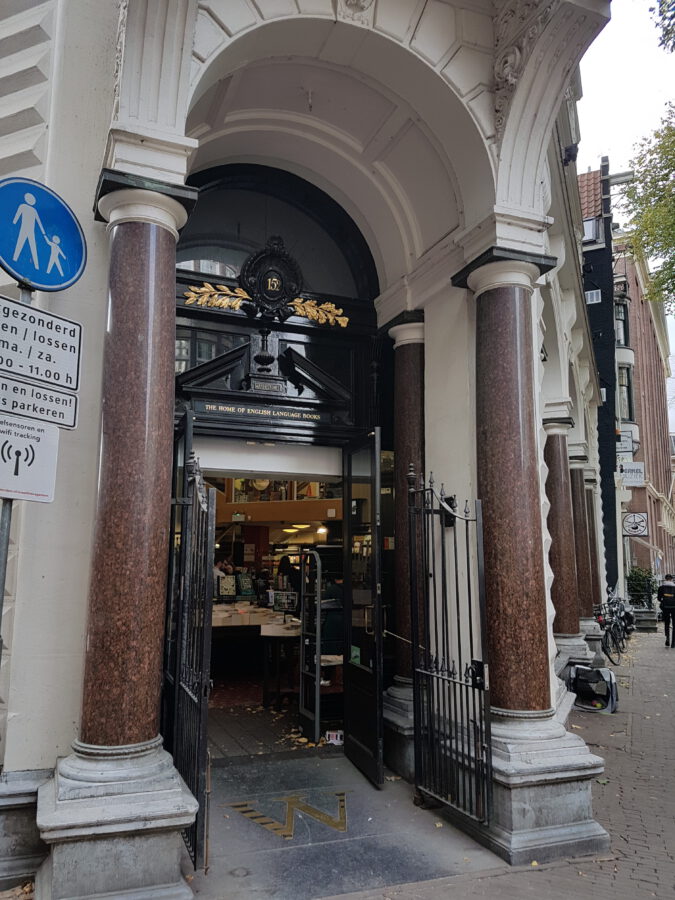
Waterstones: Home of English Language Books.
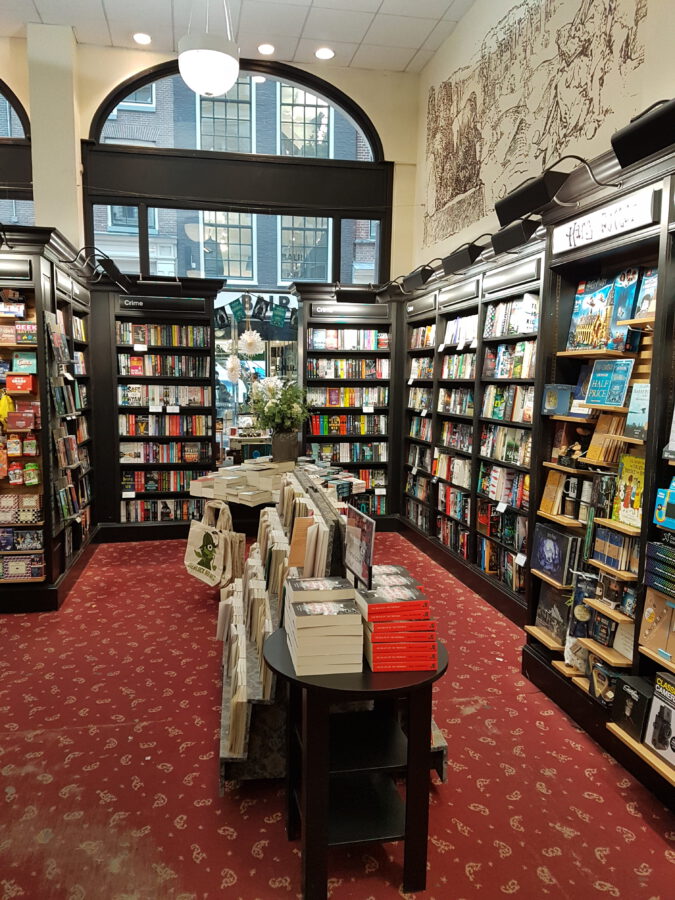
With a very British feel, the Kalverstraat bookstore is part of UK’s Waterstones, the country’s last surviving bookshop chain (which was founded in 1982 by Tim Waterstone). Its four floors provide a great choice of titles, including many specific to the UK’s book market.
Image: Iulia Romaniuc
Book sections to look forward to at Waterstones
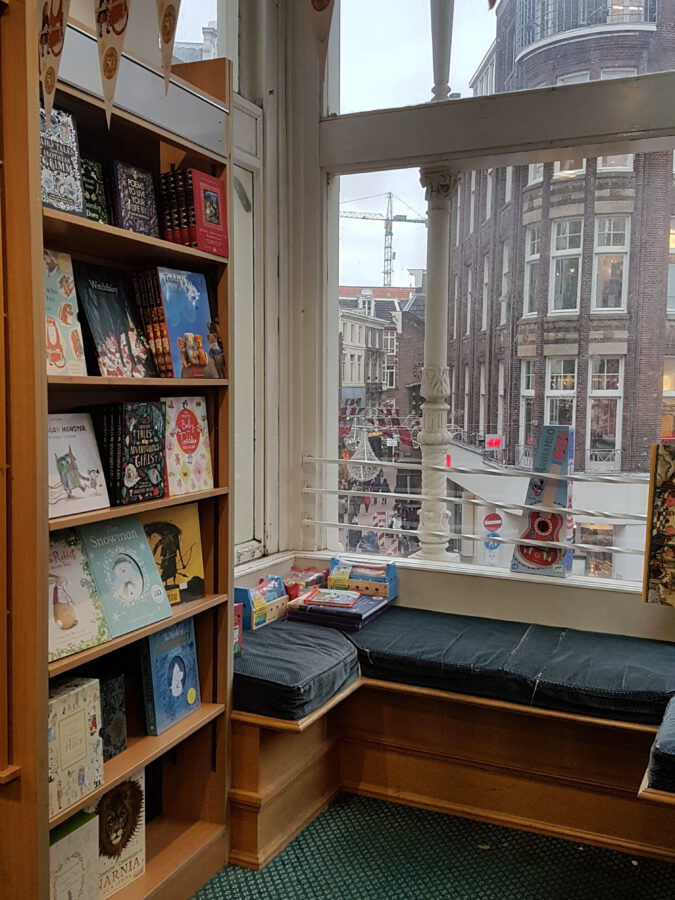
It’s mostly fiction and crime on the ground floor, as well as a collection of gifts. There’s a smaller first floor (more like a staircase landing) with greeting cards and various British goodies, such as Cadbury chocolate or Walkers biscuits, as well as seasonal delicacies. There’s a great selection of children’s books, the best so far, alongside young adult literature, manga and science fiction, on the spacious second floor. The children’s section has a cosy, quiet reading corner by the window, overlooking the hustle and bustle of Kalverstraat. On the top floor, you can find history, pop culture, travel, sports and an austere reading table (too austere, perhaps).
Image: Iulia RomaniucImage: Iulia Romaniuc
The booksellers certainly go out of their way to help. They offered to bring me a book I was looking for or offered to keep an eye on my stroller and sleeping baby for a few minutes, while I went to fetch what I needed. Unfortunately, there is no elevator at Waterstones.
Address: Kalverstraat 152, 1012 XE Amsterdam.
If you’re still hesitating to go out in the cold, despite all those inviting reading corners, you can always order your books online. Whether you’re into paper books or digital ones, the online world will help you. Online is also where you should go in order to keep up with the various cool events these bookshops host. Oh, and don’t forget your English-speaking friends. It’s Amsterdam – you must have many! If they’re big readers, a gift voucher from any of the iconic Scheltema, ABC or Waterstones might just be perfect for an upcoming birthday.
If you liked this, don’t miss more helpful expat stuff by following DutchReview on Facebook, Instagram, and Twitter. And, as always, if you have anything important to add to this article then be sure to let us know in the comments!
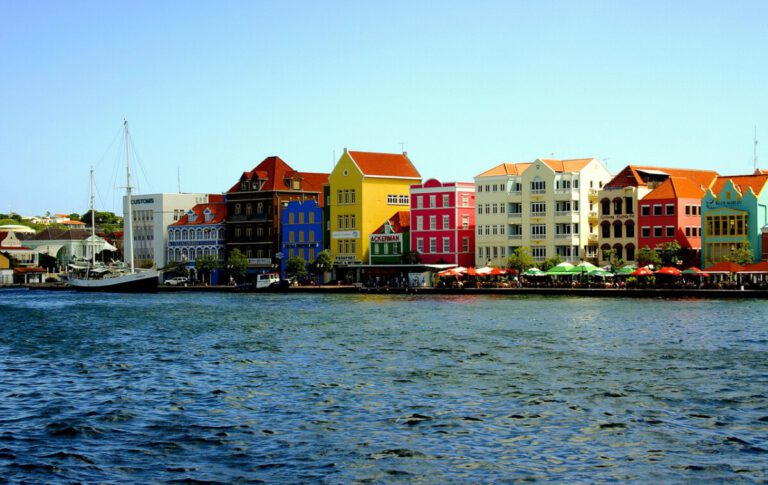
Almost immediately after this week’s press conference, travel agents began receiving bookings for the Dutch-Caribbean island territory of Curaçao.
During the press conference, Prime Minister Rutte and Minister for Health Hugo De Jonge advised that people should only travel abroad this Christmas if absolutely necessary.
The negative travel advice stretches from now to mid-January, meaning that many Dutch Christmas holidays will have to be cancelled. However, there was one exception to this restriction, the island of Curaçao.
As part of the Kingdom of the Netherlands, and as a region that is only classified as code yellow, Dutch citizens may travel there. The result of this decision? A huge increase in the number of holiday bookings to Curaçao this Christmas.
Immediate bookings
The Caribbean islands are usually a popular tourist destination, especially amongst the Dutch, however, the sudden interest in Curaçao cannot be explained away as the usual Christmas haul.
A spokesperson for travel agency Corendon has told ANP news that the travel agency saw an instant response from the public following Tuesday’s press conference.”We saw the bookings coming in to Curaçao immediately after the press conference.”
A spokesperson for TUI spoke of a similar phenomenon and their agency, claiming that there is now “more interest” in the region than usual.
Only Curaçao
As for the rest of the Dutch Caribbean, many regions are rated as code orange, meaning that travel is only advised if absolutely necessary.
This status remains in place for Aruba, Bonaire and the special municipalities of Saba, St. Eustatius and St. Maarten.
What do you think of this interesting phenomenon? Let us know in the comments below!
Multiple online threats over a cartoon have forced a Dutch high school teacher into hiding, reports NRC.
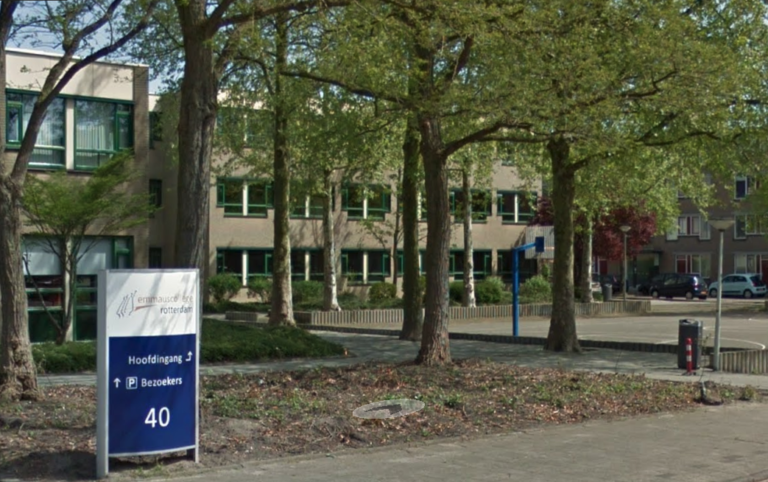
The threats concern a cartoon that hung in the teacher’s classroom in Rotterdam’s Emmaus College for the past five years. The cartoon by Joep Bertrams depicts a decapitated man wearing a Charlie Hebdo shirt who is sticking his tongue out at the jihadist who decapitated him.
The image hangs alongside philosophical quotes from spiritual teacher Krishnamurti, Nobel laureate and Pakistani women’s activist Malala, pictures of Socrates and Anne Frank on the classroom bulletin board.
Memorial for Samuel Paty
The threats began on Monday when the school held a memorial for the beheaded French teacher Samuel Paty, who was murdered last month by an extremist Muslim. Paty had displayed a cartoon of the prophet Muhammad during a class on free speech.
During Emmaus College’s memorial for Paty, a number of Muslim girls began to dispute the Emmaus College teacher’s cartoon. The girls believed the teacher was guilty of blasphemy and should remove the image.
The school’s teachers tried to explain to the girls that the image was a drawing of a jihadist — not the prophet Mohammed. The discussion in the classroom became heated.
Depictions of Mohammed are not explicitly prohibited in the Quran. However, many Muslims believe the teaching of Islamic scholars that the prophet should not appear in images.
Social media fans fire
The cartoon was eventually removed from the bulletin board and the girls left the classroom. However, a secretly-taken picture of the cartoon in the classroom appeared on Instagram shortly afterwards, described as “a cartoon of our prophet.”
The Instagram post becomes widely shared. One user wrote, “If this is not removed very quickly we will do this differently”. Police say that the teacher has received online threats. Authorities have launched a “substantial” digital investigation to find the senders.
After the recent attacks in France and Austria, police are taking the threats very seriously. While the students responsible for the uproar have returned the school, the threatened teacher is in hiding, and other teachers at the school no longer feel safe.
A ‘care team’ has been established at the school to talk to students. “Together we must ensure that we maintain a dialogue with each other in tolerance,” Rector Raoul Majewski tells NRC.
While the RIVM has started to record a slight decline in coronavirus cases across the Netherlands, numbers still remain too high in certain regions. There are four regions in particular where case numbers are worrying.
The worrying regions continue to record over 500 new cases per 100,000 people each day. Such regions include Rotterdam-Rijnmond (579), South Holland-South (588), Twente (528) and Central and West Brabant (511), RTL Nieuws reports.
There are also three further regions where the number of infections falls dangerously close to the 500 cases per 100,000 people mark. These consist of Hollands-Midden (413), Brabant-Noord (404) and Brabant-Zuidoost (430).
In order to lower the number of infections in these regions, the cabinet is considering implementing extra regional measures. These would include: closing secondary education institutions, imposing a curfew and curbing the retail trade in some way.
Big differences
The number of cases in other parts of the Netherlands, such as the north, have been experiencing a decline in numbers for some time now. The fear is that these dangerous regions will equate this drop in numbers as equally spread throughout the Netherlands.
Speaking to the Lower House yesterday, Joep van Dissel of the RIVM has said that regions with too many infections remain vulnerable because if a “feeling of relaxation” begins in these areas, coronavirus numbers will quickly spike again.
The issue with regional restrictions
However, there are also reasons why the imposition of extra measures may cause more harm than good. For example, Van Dissel warns of the “waterbed effect.”
The “waterbed effect” refers to the worry that if strict regional measures are implemented in certain areas where coronavirus cases are too high, people will simply move out of these regions into areas where numbers are at a safer level.
Overall, this may cause the further spread of coronavirus cases whilst also making it appear that high-risk regions are no longer a danger.
For the cabinet to decide.
When speaking to RTL Nieuws, Van Dissel did not want to say whether or not regional measures should be introduced. He noted that it may come across as “confusing” for people and said the decision falls to the cabinet.
What do you think of regional measures? Let us know in the comments below!