Today will begin with some showers on the west coast but will be mostly sunny, with temperatures remaining below 11 degrees. Later in the day, rain will move over the south of the Netherlands, with strong gusts of wind in the southwest.
The maximum temperature for today will be a chilly 14 degrees, reports Buienradar. Whilst the strongest rains will be in the south, scatters of showers will drizzle over other parts of the Netherlands too this evening. In South Holland and Zeeland, you might want to keep the shutters closed, as winds will reach 100 kilometres per hour this evening.
The weekend
No, not the singer. Temperatures on Saturday will reach a high of 16 degrees, with bursts of sun and rain taking turns in true Dutch fashion. Sunday may see some heavier rains, but once again the weather will be a bit indecisive with sun and rain interchanging throughout the day. The maximum temperature on Sunday will be around 14 degrees.
Next week
Maximum temperatures in the coming week will rise a little to around 17 degrees, and the sun is set to show her face a little more, although showers of rain will be visiting too. But Monday doesn’t seem to be joining the party, and will be quite rainy.
The RIVM has reported 16 new deaths from coronavirus. These numbers have not been so high since the end of May.
This follows a sharp increase in the number of coronavirus cases throughout the Netherlands, with 2,359 new infections reported yesterday. They also reported 25 new hospital admissions.
The beginning of June saw similar daily numbers ranging between 13 and 15, but never as high as 16. These new numbers only confirm that the Netherlands is entering a second wave of the coronavirus.
Number of deaths higher than reported
It is expected that the number of deaths and admissions may be higher than reported. This is due to backlogs at the GGD which can lead to up to a week’s delay.
Given that these numbers may therefore be from last week, and this week saw a spike in the number of admissions and cases, the number of deaths is likely to be higher than the figures reported by the RIVM.
Randstad holds the highest number of infections
Areas of the Randstad, particularly Amsterdam, The Hague and Rotterdam, continue to have the highest numbers of new corona cases. Amsterdam saw 247 new cases, whilst The Haag saw 137 and Rotterdam 243.
Experts believe the only way to prevent the continuing spread of coronavirus across the Netherlands is through a nationwide approach to measures.
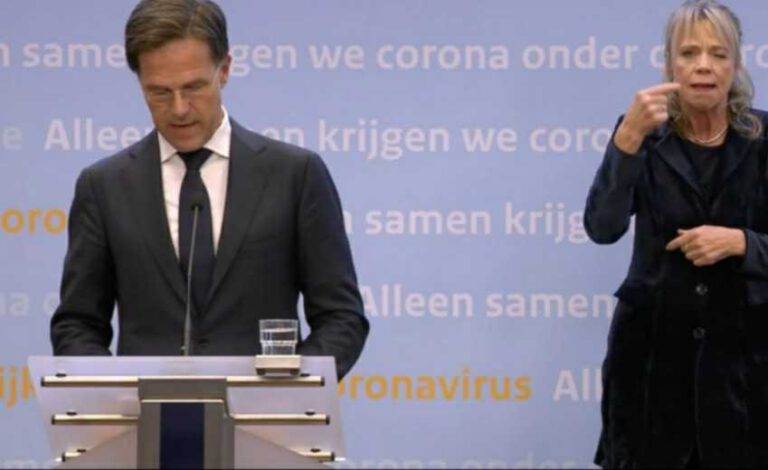
At the moment, the government is implementing measures at a regional level. Last Friday, PM Rutte and Minister of Health, Hugo de Jonge, announced new measures for six regions of the Netherlands.
However, this week has seen a continued sharp increase in the number of coronavirus cases across the Netherlands. Experts are coming forward to say that they believe the only way to prevent the further spread of coronavirus is through the implementation of nationwide measures.
Nationwide measures instead of regional
Regional measures were implemented so as to prevent a low-risk area from having to lock down to the same extent as high-risk areas. However, experts claim the virus is spreading too fast for this to work.
One expert to come forward is epidemiologist Hans Heesterbeek of Utrecht University. Heesterbeek believes that unless Dutch citizens drastically change their behaviour, strict nationwide measures will be the only solution.
“If we stick to the ground rules, we will prevent the government from having to intervene extra. So keep your distance, avoid crowds and large meetings, do not go to work if symptoms are present, and so on. Wearing masks in busy public spaces where keeping a distance is difficult, such as shops, could also be part of this,” he tells AD.nl.
While the hope is that strict measures won’t have to be implemented, he does believe nationwide measures are necessary. He says that people are moving too frequently between high and low-risk areas for Rutte’s new measures to be effective. “The virus is spreading from the Randstad like an oil slick. You can’t solve that with regional measures. People travel a lot from one region to another. You see too much mixing for regional measures to be effective.”
No way of measuring risk
In agreement with Heesterbeek is Bart Berden, director of the Elisabeth-TweeSteden Hospital in Tilburg. Berden believes the virus is spreading too quickly for the regional measures to be effective. On top of this, delayed testing prevents regions from knowing how high-risk they truly are.
“It is going so fast now. How useful is it to take a regional approach when you see that regions are growing closer in terms of contamination figures? In addition, there is currently a shortage of testing capacity. It is therefore difficult to determine exactly where you stand as a region.”
He points to Tilburg as an example, the hospital has already started taking patients from hospitals in the Randstad yet the region remains more flexible than other high-risk areas. “It is not logical that the measures in our own region are more flexible than in the rest of the Netherlands.”
What do you think of the regional measures? Let us know in the comments below!
In an interview with NU.nl, Edwin Boel, project leader of the National Coordination Team Diagnostic Chain (LCDK), admitted they were surprised by the increased demand for coronavirus tests that we have seen over the past few months.
Boel explained that they are racing to enlarge test capacity across the nation before winter. But already the Netherlands is facing vast shortages, as people often have to travel over 100 kilometres for a test, and results can take days. The current demand for coronavirus tests is 38,000 per day, but the current capacity is only 28,000 tests per day.
International shortage
Boel blames the lack of capacity on the international shortage of testing materials. “The main cause is the same as always: because there is a lot of testing internationally, there is a scarcity of materials. We have a lot of machine capacity, but there is a shortage of test material. We are now getting additional materials, but at the same time we also see that demand has increased considerably. We continue to work with scarcity.”
Bridging the gaps
By October, the organisation predicts they will need a testing capacity of 50,000 per day to meet demands. Boel assures that by the end of October, they will have enough machines and materials for 70,000.
By February, Boel plans to have a capacity of 85,000 tests in a day. He explains that they are making contracts with various laboratories and that the Ministry of Health are supporting a number of innovative projects. These projects hope to create testing systems that do not rely on materials from major international manufacturers.
Criticism over lab management
Some have accused the organisation of taking too long to reach out to larger commercial laboratories for help. Boel argues that in the beginning, the focus was on understanding the virus, and so tests were limited to medical laboratories at the RIVM and Erasmus MC. Thirteen other laboratories were then added once information was becoming clearer. Since then, they have been cautiously expanding.
Boel explains that test demands went down drastically over the summer, and GGDs were preparing for an increase in Autumn. But when demand spiked again in August it came sooner than expected, and testing sites were not prepared.
This time, LCDK plans to be fully prepared for the increases that will surely come with winter. Boel says it is impossible to go from zero to maximum capacity quickly, but that they are doing everything they can to meet the 85,000 goal by February.
What do you think of the LCDK’s management of coronavirus tests? Let us know in the comments below.
Release of the CoronaMelder app, originally set to be available for widespread use in August, is now postponed again. The government says the earliest it may be ready is mid-October.
The hold-up seems to be with a sitting bill in the Senate regarding privacy laws. “The app has been technically ready since the beginning of August but it is now on the shelf,” one of the app makers told NOS.
A vote on the new law will take place on October 6 at the earliest. Then, it will take another week or more before legal paperwork is squared away. If additional questions arise from the Senate, the process may take longer.
Government hold-up
App developers worked long and hard to have it ready on time and completed it in an impressively short amount of time. “We worked for a long time, also on weekends and evenings, holidays have been postponed,” says app maker Jelle Prins.
The tech side of the operation is disappointed in the delay after all of their effort, but doesn’t wish to blame the government. However, those involved say it was clear from the beginning that legal substantiation would be necessary. App makers question why the Ministry of Health had not foreseen the slow parliamentary process.
Another oddity of the government’s response is that this particular app is under such scrutiny, while privacy is less of a concern in other areas. Developers say the app is “very well boarded up.” And in addition to keeping data secure, everyone remains anonymous, and the virus can be well-traced.
The app is available for download now in the App Store and Play Store. Developers encourage people to download it so they can begin to map encounters.
What do you think of the legal hold-ups with the corona app? Let us know in the comments!
B-List Dutch celebrities are starting to see sense following backlash over their “ikdoenietmeermee” videos and statements on social media. The anti-corona measures movement became a trending topic this week following multiple posts by Dutch celebs.
In the middle of all this drama was the Dutch singer Famke Louise, who wrote a controversial anti-corona measure statement on instagram this Monday. “The longer we live in corona time, the more I am convinced that the measures and all their consequences are worse than the ailment,” she wrote.
The caption was followed by the hashtag “ikdoenietmeermee” which roughly translates to “I don’t do this anymore” — referencing corona measures. This was especially controversial given the new surge in coronavirus cases.
“I do not support this message anymore.”
Following the backlash, multiple B-list celebrities have started to take back their support of the “ikdoenietmeermee” movement — including Famke.
The singer wrote that Monday was “not my best day” and she hopes to educate herself further on the virus. “I thought I could make a difference, but I now realize the seriousness of making unfounded statements. I’m looking for someone who specializes in pandemics to educate me, to talk about this situation and perhaps with me onstage.”
Famke is not alone in retracting her statement, with other small celebrities such as Bizzey, Tim Douwsma and Mental Theo also retracting their support for the hashtag.
How do you feel about “ikdoenietmeermee”? Let us know in the comments below!
Learning and pronouncing Dutch names can be a struggle. “What’s in a name? That which we call a rose would smell as sweet” — a statement that has stood the test of time.
A name doesn’t necessarily tell me everything about who you are or where you’re from (or whether or not your hips lie, just look at my name.) 💃
Yet, you see a Starbucks cup with the name “Harry” on it and say “So you’re basically real-life Harry Potter!” (Harry Styles also comes to mind).
You meet a Belinda and start humming along to “Me and my wife called, ‘Pretty Belinda, pretty Belinda, pretty Belinda…”
You read an article written by “Shaakira” and think, well, there’s a wealth of things people ask me based on my name alone. Some original and some not so much but all of them chuckle-worthy.
I can barely remember the anonymity I experienced before “Hips don’t lie” came out, and as a teenager hearing this song every morning, noon and night — the song was overplayed at that but no ones seemed to mind. I had no idea the effect it would have on my name in the years to come.
Skip ahead 13 years later and people will still hit me with “so…do your hips lie?”
There is already a great guide to Dutch female names, so here’s how to master the pronunciation of Dutch male names.
Culture shock: Dutch names
Dutch names can be really tricky for internationals. Image: Robin Higgins/Pixabay
When I moved to the Netherlands, I realised there was something I had thought about when it came to assimilating into society: names!
Now, as someone who understands the importance a name, I in fact pride myself on being good at remembering names. I was surprised when an incredibly tall colleague introduced themselves to me and, instead of hearing and repeating his name, “Koen”, I heard and thus repeated “Cool”.
It’s funny now, but at the time I was so overwhelmed trying to meet everyone else in the room that repeating “Cool” and having Koen trying to correct me was mildly mortifying.
This proceeded to happen more than once in my first few weeks in the Netherlands. I struggled over different Dutch names and remember remarking to a friend that, honestly, I could not understand why I was struggling with them so much! Apparently this is heel normaal.
Learning and pronouncing Dutch male names
Below are some of the common Dutch male names that I’ve noted throughout my stint here in the Netherlands:
Timo
Is this a version of the name Tim? Or is it a name of an exotic place that was appropriated by pronouncing it with a Dutch accent?
Job
Now I am certain there is some wonderful Dutch heritage behind this name (also there is a biblical reference) but in English of course ‘a job’ is where you work… maybe your parents naming you this was a way of ensuring your future financial success? Or perhaps it’s ironic; knowing that you might hate having said job and aspire to be a house-husband? Look, I don’t know your life, all I can do is guess… 🤷♂️
Jordy
Okay, this is just a classic English name that the Dutch stole, but the make it their own by pronouncing the “J” like a “Y”.
Jeroen
Now, this is a great Dutch name but I can imagine in an English or American accent it sounds very interesting. Is it the Dutch version of Jeremy? Or maybe Jimmy? Really rolls off the tongue either way…
Learning to pronounce Dutch names takes hard work. Image: Free-Photos/Pixabay
Joost
This name boggles my mind because it’s also quite an Afrikaans name. It’s spelt the exact same in Afrikaans but pronounced differently. Different accents make your name sound cute, but I’m sure “Joost” (NL: /Yow-st/) would not appreciate me calling him “Joost” (SA: /Yooo-st/).
Jelle
Even the appearance of this name in the list gives me anxiety that I will mess up the pronunciation. Because I have, many times. I was never quite sure how to pronounce it until I received some guidance: Apparently, you don’t pronounce it “Jel”, or “Jelly” but in fact more of a “Yelluh”.
Koen
The Dutch version of the name “Cool”. Refer above.
Mathijs
The Dutch version of the name Matthew. Matt. Matty.
Michiel
Michael of course. Or maybe the Dutch version of the French male name, Michele — we may never know for sure.
Jan
John (Basically like John Legend)
Niels
Neil (Yes, like Neil Diamond).
Pieter
The Dutch version of the name Peter, but not to be confused with “Peter” (longer “e” sound: /pay-ter/). Peter was obviously a popular name at some point and like all popular names, someone has to spell theirs uniquely (Eg: Megan, Meegan, Meghan etc.)
I feel that there are less traditional Dutch female names but this is probably just me being biased. Let’s recognise Dutch names for what they are — cool — I mean KOEN!
There are so many more unique Dutch names. Have you struggled with any names during your time in the Netherlands? Drop them in the comments below!
Editor’s Note: This image was originally published in June 2019, and was fully updated in February 2021 for your reading pleasure. Feature Image: Free-Photos/Pixabay
Dutch company Janssen Vaccines has entered into its large-scale coronavirus testing phase.
Janssen is a subsidiary of the larger US company, Johnson & Johnson (so, Johnson, Johnson & Janssen?) The company has been developing the vaccine in Leiden, and testing has begun on 60,000 volunteers in the United States, South Africa, and parts of South America, reports NOS. It’s one of six vaccines that have been reserved for development by the EU.
Either the vaccine or a placebo will be distributed among participants aged 18 and older in countries where the virus is particularly prominent. The testing will show whether the vaccine has the intended result, and what any side effects may be.
Next steps
This is considered the third phase of testing, and several other companies have also reached this phase. Results will not be released until early next year, but if they are favourable Janssen will be ready — the company has already begun producing the vaccine. Negotiations are taking place regarding 200 – 400 million vaccines to be made available to the EU next year.
An additional study will be taking place in the UK, where the company plans to administer a double dose of the vaccine to volunteers.
Would you volunteer for the coronavirus vaccine trial? Let us know in the comments!
The RIVM director of infectious disease control, Jaap van Dissel has officially referred to the rising coronavirus numbers as the beginning of the “second wave.” This follows a record-breaking increase in the number of coronavirus cases in the Netherlands.
During a speech in the Lower House yesterday, Van Dissel was asked to explain the recent jump in coronavirus cases. In his explanation, Van Dissel finally made use of the term “second wave.”
What makes it a second wave?
When asked about why he uses the term “second wave,” Van Dissel told NOS journalists that there are a number of reasons as to why he uses the term.
Sharp increase in the number of coronavirus cases
The first reason that Van Dissel gives is the sudden sharp increase in the number of coronavirus cases that followed the plateau in recent months. This week alone has seen a record-breaking 13,471 new positive cases of coronavirus, a 60% increase from the previous week.
The rate of reproduction has been above one for a number of weeks. This has led to a nationwide spread of the virus. “It has spread from the west to the rest of the country. We also see fireplaces in Groningen, for example.”
Increase in hospital beds and ICU cases
Secondly, Van Dissel cites the increase in the number of hospital beds being made available to potential coronavirus patients. Hospitals are once again beginning to set up special units for coronavirus and patient numbers are increasing. The RIVM has reported 152 new corona hospitalisations this week.
The number of corona patients in ICU is also increasing. RTL Nieuws reports that there are currently 103 people in intensive care. This is slightly higher than the numbers in mid-March, which saw 95 people in the ICU.
Van Dissel says, “we are at a tipping point.” Although, he does not believe that the number of ICU cases will increase as fast as they did in March. This is because doctors now know more about how to treat coronavirus. It also means that hospital stays should hopefully be shorter.
More elderly infections
Van Dissel has also noted that whilst the increase in coronavirus infections is highest in young people at the moment, he fears they will eventually pass it on to their elders. “After the young people come the older ones.” This would also lead to an increase in the number of hospitalisations.
Tighter restrictions
It is expected that restrictions will be tightened throughout high-risk regions. Rutte hinted at this in the parliamentary debate yesterday, saying that he expects eight more regions to be moved up to level 2 risk.
However, the Prime Minister did not name the eight regions. “You can assume that, as things look now, this week eight regions will be placed on the level where we put the six regions of last Friday.”
No more than 50 people can gather at an unorganised event,
Cafes and restaurants must be closed by 1 AM, and,
Children under the age of 12 no longer need to be tested for coronavirus.
However, the restrictions given have been criticised by certain members of the parliament who believe more must be done. For example, PvdA leader Lodewijk Asscher asked, “Who really thinks that scrapping the last round in the pub will reverse this trend?”
How do you feel about the recent restrictions? Let us know in the comments below!
Just like any other country, the Netherlands was brutally occupied by our big jolly neighbour to the east 75 years ago. The Netherlands didn’t make it into international headlines too much during the war (maybe with the exception of the bombing of Rotterdam in May 1940), but there was one notable operation that got the world’s attention: Operation Market Garden.
Market Garden: Paratroopers landing in Holland. Image: US Government/Wikimedia Commons
History of Operation Market Garden: what was it about?
Most of you reading this article probably won’t admit it but, the only reason you knew about Operation Market Garden was through Band of Brothers and one of the Call of Duty games (those games before it turned into the modern shooting travesty it now is).
But long-story short for those of you not into those games: Operation Market Garden was a failed World War II operation in the Netherlands that was fought between September 17 – 25, 1944. It gets its name because of the ambitious two-part mission that Field Marshal Sir Bernard Law Montgomery planned. The name is derived from each of these suboperations. The ‘Market’ part of the mission was an airborne assault to take control of key bridges in the Arnhem region. The second part, ‘Garden’, was a ground attack to occupy the seized bridges.
Why did Operation Market Garden fail? For many reasons, and if you’re interested to know how exactly, check out this mini-documentary! You just need to spare 20 minutes of your time. 😉
Operation Market Garden and A Bridge Too Far
If you’re more of a movie buff then you must’ve heard of this movie. Back in the seventies, all of the era’s big movie stars joined up and made a movie which was a whole lot better than Ocean’s 11,12,13: A Bridge Too Far. It’s not only awesome because Sean Connery shoots a random German soldier, but also because it pays a reasonable amount of time to the whole operation, where you actually learn something at the same time.
Since it’s 2020, you can actually see the whole movie on YouTube:
(Check 1:28:01 to see the real James Bond shoot a Jerry soldier.)
Anyway, moving on…
Do Dutch people commemorate Operation Market Garden?
We do! With the last actual participants and eyewitnesses of the battle being 90 years of age or older, the Dutch (and many other people in the world, I would think) are actually paying more and more attention to World War II. With Operation Market Garden now 76 years ago, last year was more or less the last proper chance to pay homage to the Allied soldiers who fought in and around Eindhoven, Nijmegen, and Arnhem.
Normally there are mass para-drops on the old dropzones (check the pic below from 2014 for an impression) as a commemoration. Of course, there are also lots of other services, demonstrations and nice old tanks and such to look at.
Photo by Abuzer van Leeuwen, I hear good things about this guy
What’s happening in the Netherlands to commemorate Operation Market Garden?
Public commemorative events would normally be taking place in the Netherlands this month, but due to coronavirus things look different this year (here’s more info in English). On the bright side, you can watch videos of this year’s commemorative activities from your own home on RTV Arnhem’s YouTube channel.
Have you been to any of the commemorative events in the past? Will you watch from home them this year? Let us know in the comments below!
Feature Image: Abuzer van Leeuwen/Supplied
Editor’s note: This article was originally published in September 2016 and was fully updated in September 2020 for your viewing pleasure.