

You know Leiden for its canals and Rembrandt. But behind those pretty facades, something bigger is brewing, and it’s putting the city on the global innovation map.
(Hint: it involves a €2.6 billion pharma investment that just made everyone sit up and pay attention.)
With the oldest university in the Netherlands, gorgeous canals, enough museums to keep you busy for months, Leiden is the classic Dutch postcard. However, in recent years, something has been added to this pretty picture.
The city is transforming into one of the country’s most exciting science and innovation hotspots.
And we’re not just talking about impressive lab coats and test tubes here. We’re talking about world-changing breakthroughs in healthcare, sustainable food, and clean energy.
The science park changing everything
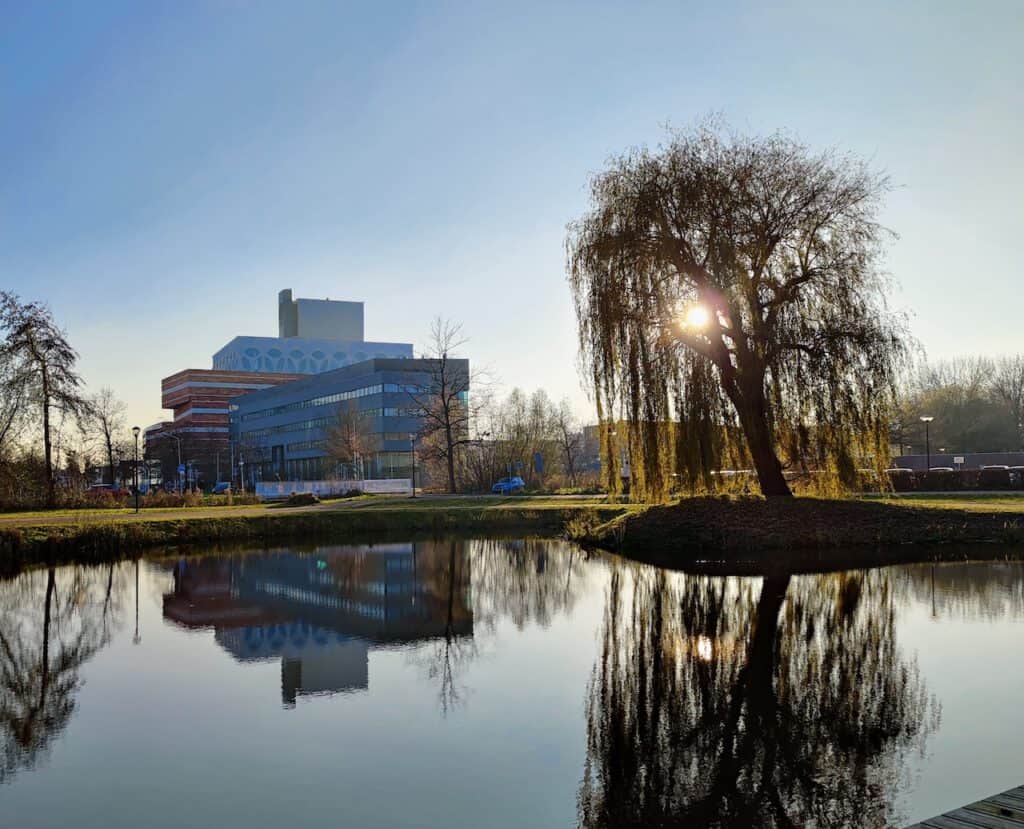
You can see this transformation in brick and steel at Leiden Bio Science Park, now the Netherlands’ largest life sciences hub and one of Europe’s leading biotech clusters.
Here, you’ll find thousands of researchers, students, and entrepreneurs working on everything from vaccines to regenerative medicine, AI-driven healthcare, and next-generation medical technology.
Then came the latest news: global pharma giant Eli Lilly is investing around €2.6 billion in a new manufacturing plant connected to the park. That’s 500 highly skilled jobs and a pretty clear signal that Leiden has arrived on the global pharma stage.
So what exactly is happening in this corner of Zuid-Holland, and who are the innovators making it happen?
Leiden’s latest chapter fits perfectly within the national New Dutch movement: a celebration of Dutch innovation. New Dutch captures a mindset that’s distinctly Dutch: problem-solving meets ambitious thinking, with a healthy dose of collaboration thrown in. And Leiden? It’s become one of the movement’s flagship cities.
LeydenJar — smaller, stronger, cleaner batteries
If you’re going to electrify the world, you need better batteries. That’s where LeydenJar comes in.
The deep-tech company develops 100% silicon battery anodes. By replacing traditional graphite, their anodes can increase the energy density of lithium-ion batteries by up to 50%.
In practice? Smaller, more powerful batteries for smartphones, wearables, and eventually electric vehicles.
LeydenJar operates from two locations. In Leiden, they run a battery lab building and testing prototype cells. In Eindhoven, another prominent NewDutch spot, a pilot plant prepares the technology for mass production.
Recent funding will help complete a new production facility with operations starting in 2027. That’s clear evidence that investors believe this Leiden-grown technology can compete globally.
Meatable — real meat, minus the animals
Just across the park sits Meatable, one of the world’s frontrunners in cultivated meat.
Meatable produces meat that’s identical to the real thing, but without slaughtering animals and without the environmental footprint of traditional livestock farming.
Using a small sample of animal cells, they grow meat in bioreactors instead of barns.
In 2023, the company opened a new 3,300 m² pilot facility at Leiden Bio Science Park. The space allows Meatable to scale bioreactor capacity from 50 litres to 200 and beyond, moving from lab scale to serious production volumes.
The world has noticed. Meatable appeared on TIME’s Best Inventions list in 2024, underlining just how seriously people take what’s happening in this corner of the Netherlands.
From the outside, it’s another sleek building in the park. On the inside? A glimpse of what the future of food might look like.
Rapidemic — ultra-fast diagnostics with global impact
Rapidemic proves you don’t need to be a giant to have global impact.
The startup, based at BioPartner 3 in Leiden Bio Science Park, is building ultra-rapid molecular tests for infectious diseases, starting with sexually transmitted infections like chlamydia and gonorrhoea.
Their technology combines the accuracy of lab-based diagnostics with the speed and ease of a point-of-care test: results in minutes rather than days.
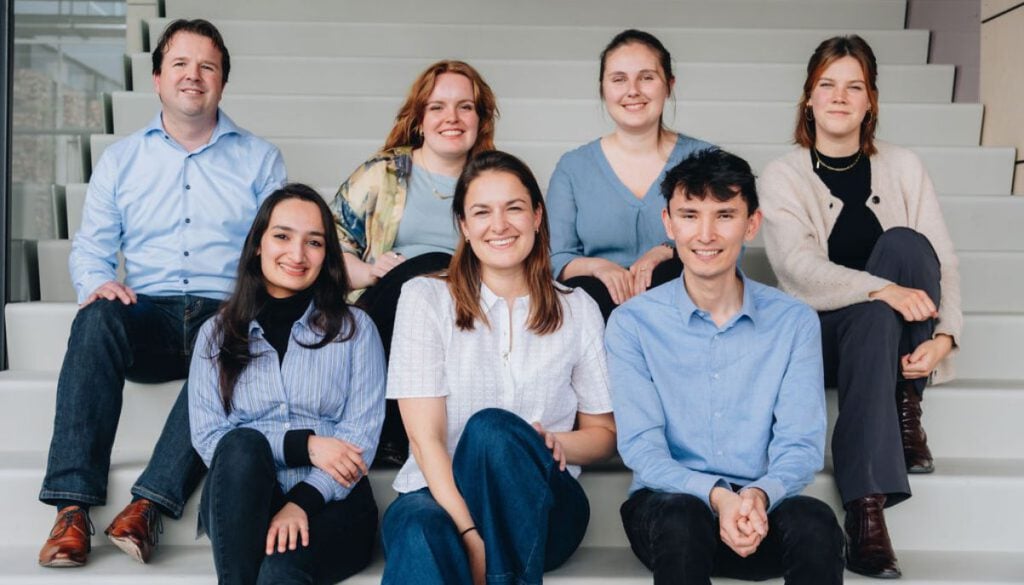
In September 2025, the Bill & Melinda Gates Foundation awarded Rapidemic a $2.7 million grant to develop its rapid STI tests and scale up production.
That’s a strong vote of confidence that this Leiden innovation could make a real difference in global public health, especially in underserved regions.
Rapidemic’s team splits time between the lab at Bio Science Park and the entrepreneurial buzz at PLNT. It’s a brilliant example of how Leiden’s ecosystem makes science and entrepreneurship collide.
A scientific tradition that continues to evolve and grow
Zoom out, and LeydenJar, Meatable, and Rapidemic start to look like three corners of the same triangle: climate and energy solutions through next-generation battery technology, sustainable food via cultivated meat, and global health impact from rapid diagnostics.
All three share the same DNA: deep roots in Leiden’s scientific tradition, space to grow at Leiden Bio Science Park, and backing from local players like PLNT and Key Region Leiden.
Together, they’re living proof of what the New Dutch movement is all about.
So if you just think of Leiden only as a postcard-perfect student town with charming canals and cosy terraces, you should also think of it as a booming and innovative place for the future. The city attracts international talent to the region, offering jobs while at the same time providing a postcard-like place to live in.
Leiden isn’t just studying the future anymore. It’s quietly building it, one silicon anode, cultivated pork dumpling, and STI test at a time.
Have you visited Leiden lately? What impressed you most about the city? Let us know in the comments below!