

So, you’ve decided to learn Dutch. Brave. Very brave.
But before you start sweating over the difference between de and het (good luck with that), let us introduce you to a school that makes learning Dutch feel doable — dare we say, even fun.
Meet Taalthuis. Since 2006, this school has been helping internationals crack the Dutch code — not just with grammar and vocabulary, but with confidence, humour and an excellent method behind it all.
Unlike many other schools that only take you as far as ordering a beer or surviving during a gemeente appointment, Taalthuis does something extraordinary: they can take you all the way up to C1 level Dutch.
READ MORE | I learned fluent Dutch at this Dutch school; here’s why you should too
That’s near-native, “arguing with your Dutch neighbour about the recycling schedule” level. And trust us, very few schools can get you there.
Great teachers make all the difference
You know the difference between a good class and a painful one? The teacher.
At Taalthuis, you’ll find more than 120 professionally trained, certified NT2 teachers who are not only experts but also genuinely enthusiastic about teaching.

And this isn’t just marketing fluff, because Taalthuis hand-picks its teachers to make sure they’re both knowledgeable and engaging.
After all, if you’re going to spend hours trying to wrap your head around Dutch sentence structure, you want someone who can make it feel like an engaging challenge — and get you real results.
Learning Dutch, the Taalthuis way
Here’s the magic: Taalthuis doesn’t just copy-paste a textbook. For beginners, they create their own materials, specially designed for internationals taking their first wobbly steps into Dutch.
Even better, those first steps are backed up by an e-learning platform full of songs, exercises, vocabulary, and grammar — basically a toolkit that makes the learning stick.
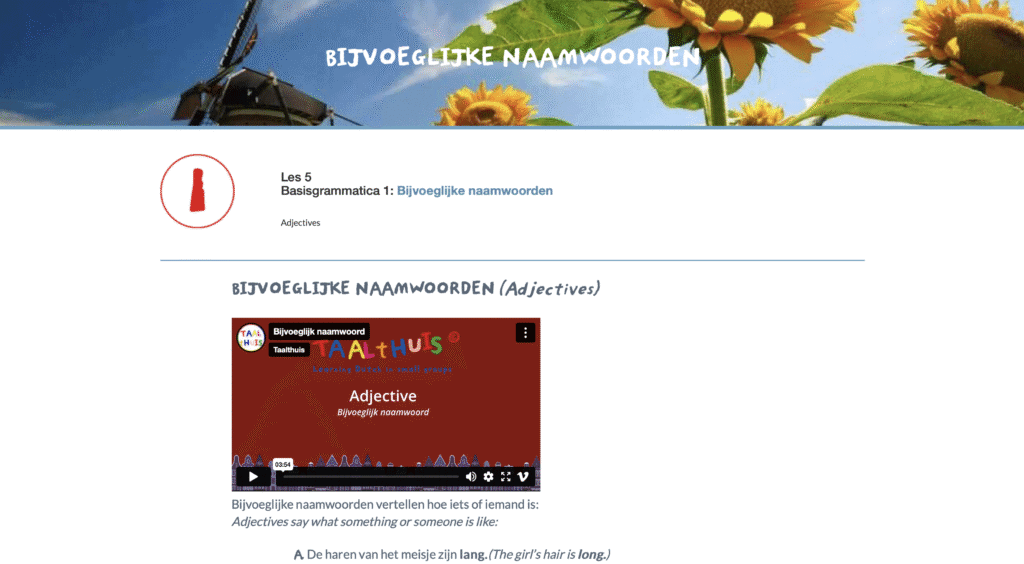
Once you’ve got the basics down, Taalthuis shifts gears and uses the tried-and-tested Coutinho method. This means you’re working with books like “Nederlands in Actie” (B1), “Nederlands op Niveau” (B2), and eventually “Nederlands naar Perfectie” (C1).
These books are the gold standard for advanced Dutch learning, and Taalthuis teachers know exactly how to guide you through them.
Every lesson = all the skills
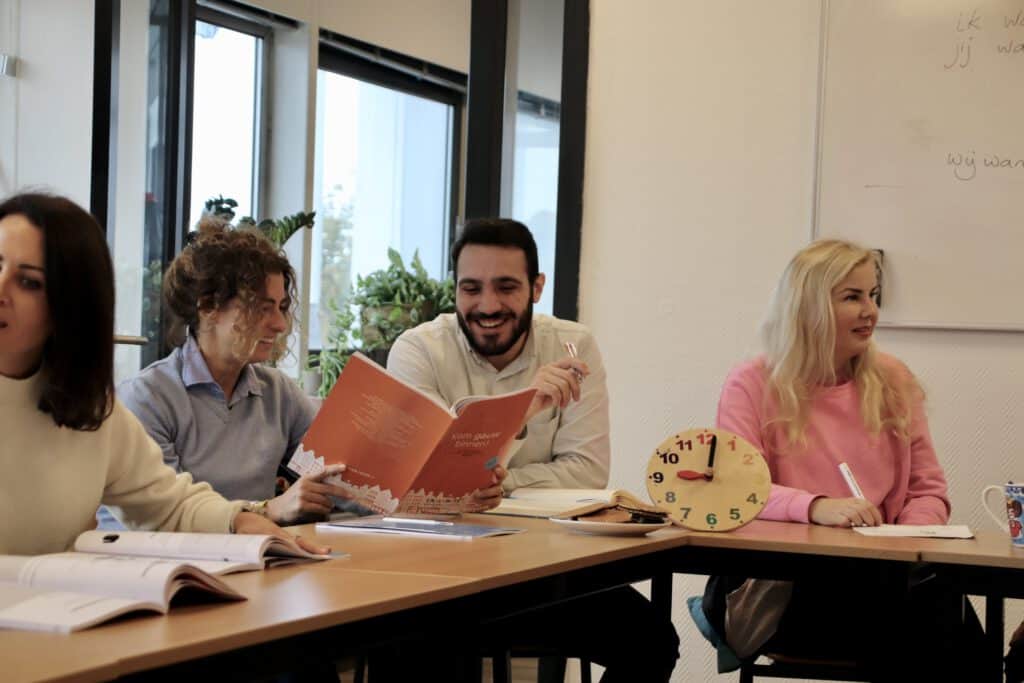
One of the big wins with Taalthuis? Every lesson covers it all: reading, writing, speaking, and listening. No sitting in silence filling out worksheets for an hour, and no endless grammar lectures either.
You’ll be reading texts, listening to Dutch conversations, writing short pieces, and speaking (yes, out loud, in front of other people).
The idea is simple; the more you practise all aspects of the language, the quicker it all clicks. And with classes kept deliberately small — usually no more than nine people — you’ll get time to practise speaking instead of hiding in the corner.
The unicorn of Dutch schools: reaching C1
Let’s pause for a second on this whole C1 thing. Reaching C1 means you’re fluent. You can follow Dutch news debates without panicking, write complex texts with ease, and hold your own in professional or academic settings.
Most Dutch schools? They stop at B1 or B2. Perfectly fine levels for everyday life, but if you’ve got big goals — maybe working in a Dutch-speaking environment, studying at university, or just proving to yourself that you can do it — then C1 is the real deal.
That’s why Taalthuis’s top-level course is called “To Perfection (B2>C1)”. And it delivers.
Why people love Taalthuis
So, what makes students rave about Taalthuis? Let’s break it down:
- Brilliant teachers: not just experts, but warm, patient, and enthusiastic.
- Custom beginner materials: designed in-house, so you’re not lost in a sea of generic textbooks.
- Coutinho method for higher levels: academically sound, structured, and proven to work.
- All-skills learning: every lesson includes speaking, listening, reading, and writing.
- Small groups: so you get to practise instead of zoning out.
- Catch-up support: miss a class? Use the e-learning platform or book a private make-up lesson.
- Flexible formats: in-person courses in seven Dutch cities and online courses that don’t feel like a downgrade.
And, let’s be honest: learning Dutch can be intimidating. Taalthuis takes that fear away by giving you the tools, the structure, and the encouragement you need.
Where you’ll find Taalthuis
Taalthuis has 11 physical locations across the Netherlands, including Amsterdam, Amstelveen, Amersfoort, Eindhoven, Haarlem, Utrecht, Leiden, Den Haag, Den Bosch, Hilversum, and Rotterdam.
Prefer to stay in your pyjamas? Their online classes deliver the same quality in a digital format, complete with real textbooks sent to your door and the full e-learning platform to back you up.

Trust me: I’ve taken four online courses with Taalthuis now, and there’s nothing better than being able to take your Dutch lessons from the comfort of your own home (especially while rocking the t-shirt on the top, pyjamas on the bottom half look).
What it’s like to study with Taalthuis
I started with Taalthuis a few years ago, rocking up with an A2 certificate from another school and ready to tackle B1.
All of Taalthuis’s courses are split, so to get B1, you take two separate 14-week courses. That means I’ve had the luck of studying with Taalthuis across different courses, teachers, textbooks, and, man, even seasons.
I mentioned above that I loved the online lessons because they’re super flexible. Sure, I’ve taken lessons from my apartment in the Netherlands, but I’ve also taken them when I’ve flown back home to Australia (at 3 AM, but I did finish the course!).
I’ve even logged in while on vacation, from Hong Kong, Italy, and Thailand.
Now let’s talk teachers and let’s be honest: it’s nerve-wracking coming into a fresh lesson with new classmates, not knowing if you’ll understand anything beyond hallo.
But the teachers really make it — they know when to slow down, how to explain the grammar so you can understand it, and will repeat it as many times as you need (for me, that was a lot).
Is Taalthuis worth it?
There are plenty of Dutch schools out there, but very few can guide you all the way to C1. Taalthuis does. And they do it with skilled teachers, engaging lessons, and a learning method that’s built for internationals.
The proof is in the pudding. This year, I received my C1 certificate after completing Taalthuis’ online “To Perfection” course — and it’s safe to say I couldn’t have done it without them.
So if you’re ready to stop mumbling “Mag ik een broodje kaas?” and start holding your own in Dutch politics debates (or, more realistically, your neighbourhood WhatsApp group), Taalthuis might just be your perfect match.
Have you taken Dutch lessons? Share your experience in the comments below!