

With new AI systems seemingly popping up at every corner, such innovation requires substantial computing power and technology.
At the heart of this are specialised chips, designed in the United States and manufactured in Taiwan using equipment produced in the Netherlands.
For years, Dutch company ASML has held a near monopoly over supply in the semiconductor industry.
READ MORE | This new Amsterdam hub wants your AI startup under its roof (and Google’s already on board!)
However, Rotterdam-based Nearfield Instruments — a spin-off from research institute TNO — just announced a massive €330 million Series D funding round on Monday, and it may be knocking on ASML’s door.
This marks the largest deep-tech funding round in Dutch history, catapulting Nearfield to unicorn status, with a fresh valuation of €1.4 billion, reports NRC.
Where does Nearfield fit in the supply chain?
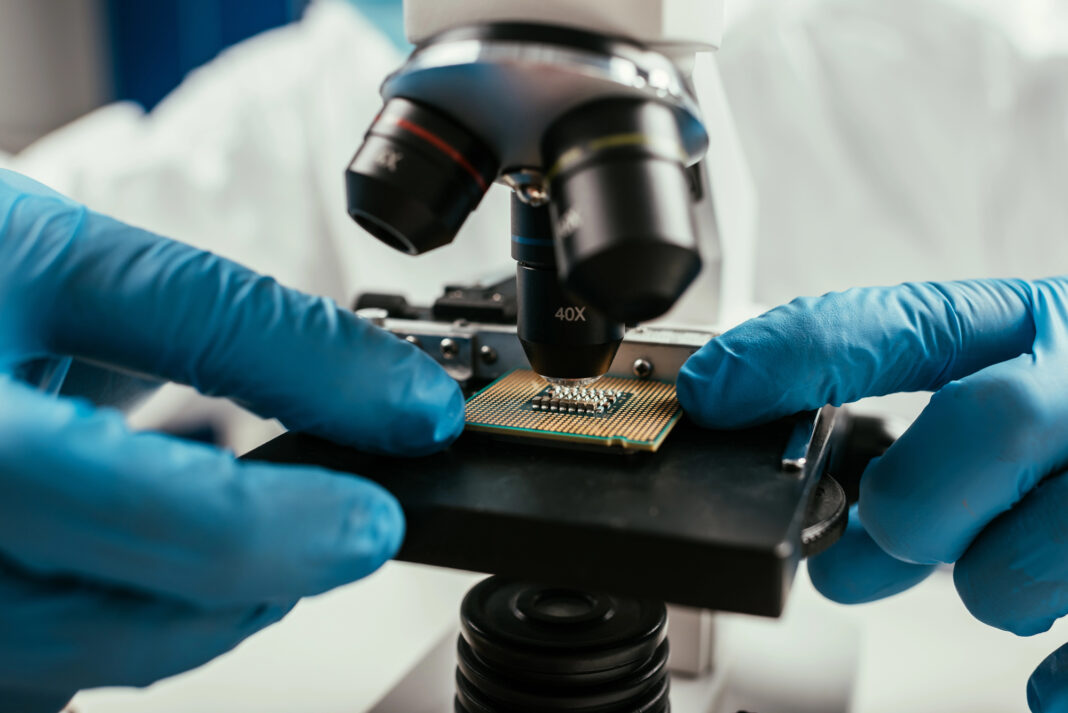
The chip machine manufacturer specialises in metrology and inspection systems — in other words, machines that chipmakers like TSMC, Intel, or Samsung rely on to measure, analyse, and verify the structures they build on wafers.
ASML creates the lithography machines that write patterns (designed in the US) onto silicon wafers.
Nearfield creates the machines that measure and inspect what was actually built, using atomic force microscopy to catch errors only a few atoms tall.
Put simply: without ASML, you can’t produce the most advanced chips at all. Without Nearfield, you can make them, but you can’t verify they were made correctly. This verification step has become a serious bottleneck in its own right.
The demand for improving quality, yield, and efficiency in chip production has grown alongside demand for more advanced semiconductors, thanks to the AI boom and the data centres powering it, explains TNO.
IPO around the corner?
With investment coming in from the US, Europe, Qatar, and Singapore, Nearfield founder Hamed Sadeghian has hinted at an IPO, possibly as early as 2027.

READ MORE | Here’s how the Dutch government just made DigiD’s future America-proof
Whether this will happen in New York or Amsterdam isn’t yet known, but Nearfield would be making its debut alongside fellow Dutch-listed chip machine manufacturers ASML, Besi, and ASM International — further cementing the Netherlands’ role at the heart of the AI boom.
Speaking with NRC, Sadeghian didn’t rule out an acquisition by one of those very same Dutch peers, either.
What’s next?
Should I stay or should I go is a question as old as time, or at least as old as The Clash. With 450 employees, most of them stationed in the Netherlands, Nearfield is looking to expand — but not without growing pains.
Sadeghian tells NRC that while the Netherlands remains an ideal environment to develop new technology, expansion is hindered by “too much talk, too little decisiveness, and a severe housing shortage.” Don’t we know it!
Meanwhile, geopolitical tensions continue to hang over the semiconductor industry. ASML and ASM International have already faced export restrictions from the Trump administration on advanced chipmaking equipment destined for China.

READ MORE | The Dutch are concerned over the international legal order: here’s what we know
Whether Nearfield will soon find itself caught in the same crossfire remains unclear, but its growing strategic importance means it’s increasingly playing in the same tense geopolitical arena as its bigger Dutch siblings.
Nearfield may not be “the next ASML” just yet. But it’s well on its way to becoming one of the Netherlands’ most important semiconductor companies.
What do you think about the Netherlands’ positioning in the AI boom? Let us know in the comments.