

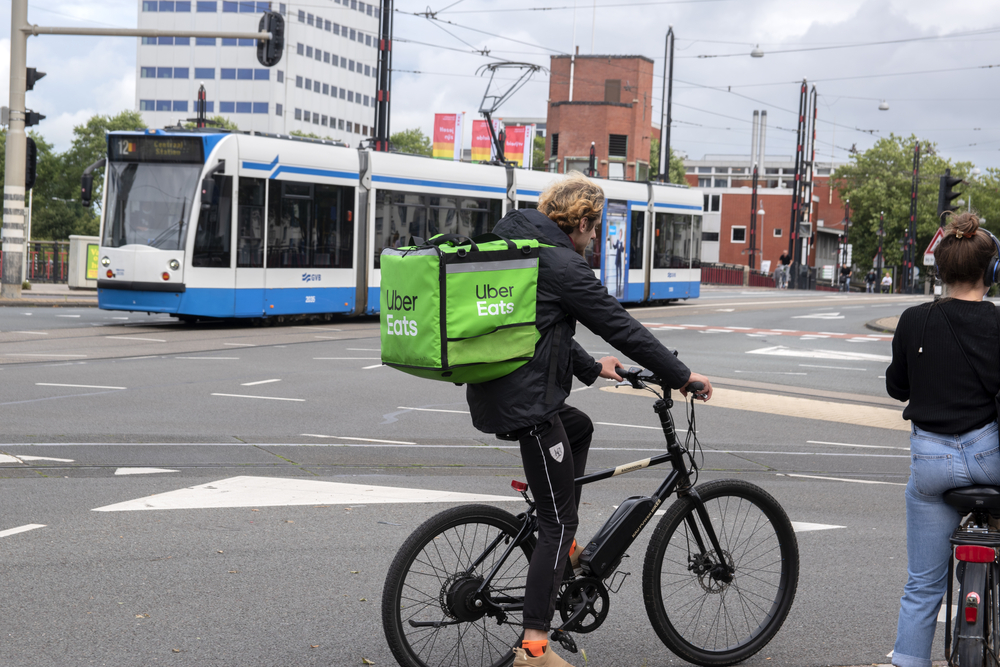

After years of failed promises and mounting fines, the Netherlands Labour Authority has had enough of Uber Eats.
The delivery platform could face a month-long ban in the Amsterdam region for repeatedly employing couriers without valid work permits.
The drastic measure would hit thousands of restaurants and delivery workers who rely on the platform.
But according to the Ministry of Social Affairs, Uber Eats has been leading authorities on a merry chase for years whilst illegal couriers continue delivering your pad thai.
Uber Eats keeps getting caught with its hand in the cookie jar
The numbers paint a damning picture. Since summer 2021, authorities have caught Uber Eats with illegal workers seven times, reports NRC.
During five separate inspections over five years, the Labour Authority (Arbeidsinspectie) found violations every single time.

Of 44 couriers checked by inspectors, a whopping 60% were working illegally. Even at the most recent inspection in February 2025, half the couriers lacked proper work permits, despite Uber Eats repeatedly assuring the ministry that its controls were now watertight.
The selfie checks weren’t checking much at all
Uber Eats introduced enhanced selfie verification to stop account sharing, where workers without permits use someone else’s account to deliver food. The company told courts this system made fraud impossible.
Spoiler: it didn’t. Inspectors discovered the checks were “easily circumvented.” Couriers could simply have the legitimate account holder take a selfie on a different phone.
At a December 2024 court hearing, Uber insisted identity fraud “basically doesn’t happen anymore.” Two months later, inspectors caught ten couriers — five were working illegally, three through identity fraud.
Why this matters
Employment without proper permits exploits vulnerable workers who lack legal protections.
The platform’s model particularly attracts undocumented workers who need no Dutch skills or diplomas and have no direct contact with Uber Eats.

Since early 2025, couriers are hired through temp agencies (uitzendbureaus) and paid hourly, after Dutch courts ruled delivery workers must be employees.
But workers delivering your dinner may still be operating without legal status, unable to access healthcare, and without the ability to report workplace issues.
What happens next?
The ministry confirmed its intention to impose a “preventative shutdown” during a December hearing at the Council of State (Raad van State). If approved, Uber Eats would be banned from operating in greater Amsterdam for a month.
The platform can appeal, triggering yet another legal procedure. Meanwhile, Uber commissioned research showing a ban would be catastrophic: restaurants would lose an average of 27% in revenue, and consumers would have “much less choice.”
A ministry spokesperson confirmed seven violations since 2021, with inspectors finding “multiple violations at every single inspection.”
Have you noticed fewer food delivery options in Amsterdam? Would a temporary shutdown push you towards cooking at home? Share your thoughts in the comments below!

I will like to work if possible