With a fellow orange man across the pond trying to make his country great again, we, at DutchReview, are poised to tell you the story on how to make Holland great again!
Every now and then an idea comes by that shows the full potential of Dutch imagination. Different times when Dutch visionaries weren’t held back by typical Dutch modesty in the megalomaniac dreams they had. Times when the Afsluitdijk, the Delta Works and Flevoland were created. Or even better, when the Dutch set out to conquer the rest of the world (okay, this definitely caused much worse times for other people.)
Nederland terugveroveren. pic.twitter.com/mfZZt4tpI5
— Geert Wilders (@geertwilderspvv) 9 augustus 2016
When a post only needs three sentences to break out a delicious crazy-ass picture of Wilders in a VOC outfit then you know we are are up to GREATNESS (or utter ridiculousness, depends if you catch the sarcasm).
What we like most here at DutchReview is that these projects show how things can be changed which seem unchangeable. The fact that the Zuiderzee had been there for centuries didn’t seem to bother Cornelis Lely, godfather of the Zuiderzee works. So let’s dam this water, create a new province and completely change the map of the Netherlands.
We think this kind of ideas need more attention, whether they’re actually realized or not. That’s why we’re introducing the hashtag #MakeHollandGreatAgain to collect all these projects!
Now no time to waste, time to kick-off with megalomanic plan number one:
Make Holland Great Again With: The Dutch mountain
Before you came here you probably knew about the weed, tulips, rain and this:
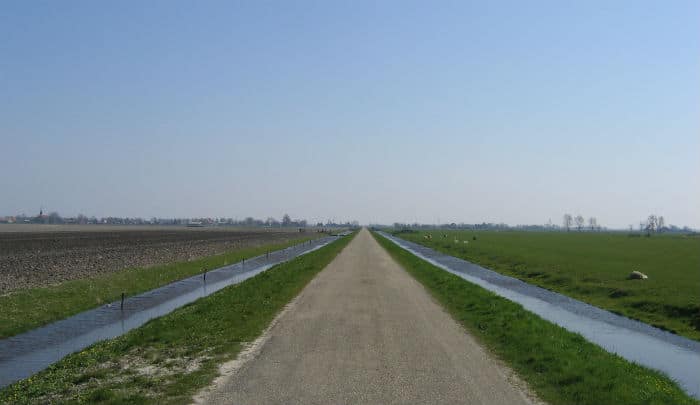
This country here is a flatter than flat country with the exception of Maastricht and it’s surroundings – which we didn’t even want in the Netherlands in the first place. Sadly our flatness prevents us from going on a ski-vacation in the Netherlands or organising a cycling event with a decent mountain (no, the ‘Vaalse heuvel’ is not a proper mountain you Limburgians).
Since we just couldn’t stand the stupid Swiss with their mountains and cheese-fondues (should have been a Dutch invention as well) people immediately jumped on the band wagon of the Dutch Mountain idea by journalist Thijs Zonneveld.
Yes, that image is correct! The idea was for a 2000 meter mountain right there in the middle of the Netherlands. Besides being downright awesome, it would also serve as a much needed ski-ing and mountain-biking area.
Thankfully, instead of just building it when Thijs launched the idea, some people felt it was necessary to do some calculations as to whether it was actually possible to build. Turns out that we would have experienced a mid-Holland implosion due to the ridiculous weight of the thing. Besides which, the whole thing was going to cost like 7 jillion gulden (yes, GULDEN, we’re not gonna make Holland great again with the stupid euro).
Scientists said the whole thing might be a better idea to build it off the coast, but even then it would be unfeasible. So with this information Thijs Zonneveld and the rest of the Netherlands had to put the plans for a decent mountain in the koelkast.
Make Holland Great Again With: New Islands
This a small country with some dirty spots and we Dutch people just connived a plan to solve both. Just northeast of Amsterdam, the Netherlands has come up with the ingenious solution of building a string of new islands while at the same time cleaning up the polluted lake.
They’ve called it the Marker Wadden (after the Wadden islands that lie just off the country’s northern coast) and these new islands are being created while you are reading this Napoleonic-complex-filled-article.
The new four square kilometre site will not only mean more landmass for the Dutch (#MakeHollandGreatAgain!) but it will also mean a severe improvement for the sea life and bio-state of the Markermeer. Once created, the island on itself will ‘collect’ more land from the sediment and sand and such.
The Markermeer’s history as a lake is a relatively short one. Until 1932 it was part of the Zuiderzee, a shallow, brackish bay feeding straight into the North Sea, albeit partly sheltered by a string of islands.
Then in 1932 the Afsluitdijk was constructed and the Zuiderzee was renamed as the Ijsselmeer on account it being not a sea anymore. Back then they really knew how to make Holland great because after that the Dutch created Flevoland, the 12th province of our country – which can shamefully proclaim to have some of the ugliest cities of the Netherlands.
Make Holland Great Again With: Schiphol in the Sea
Every true Dutchmen loves Schiphol. From the moment when one lands at our national airport and sees the cheesy cheese shops, the murderous Dutch efficiency with luggage-transferring and the swarms of shady illegal-cab drivers at the entrance a Dutchman knows he’s thuis.

Every decade or so the Dutch decide that one Schiphol just won’t do, and the grand plan of Schiphol in the Sea is reintroduced again.
The plan would literaly put an airport on the sea, and to be fair it does have certain advantages. No one will be bothered by the noisy overflying airplanes and the North Sea is considerably less densely populated than the rest of this small country.
In 2007 construction companies Haskoning and Van Oord, came up with such a plan once again (totally not because they want to make money) and they proposed rotating, floating landing strips.
The Ministry of Transport had already concluded in 2003 that a second national airport was hellacrazy and mucho expensive, after Schiphol and the TU-Delft originally came up with the idea of Schiphol at sea in 1997.
The parameters under which the plan is reintroduced are always the same. Schiphol is getting too small for our ambitions, and the plans always come when economic tide is at its highest in the Netherlands and we’ve got money to burn. And the reason why this doesn’t happen is the same as well: just too expensive when our economy isn’t flourishing anymore. The last plan was introduced more than a decade ago, so we should be seeing the latest iteration of the plan soon.
Well at least we might have a new touristic attraction:
Nonetheless, the Schiphol in the Sea plan is a great example on how to make Holland great again in the future!
Of course the Dutch don’t always succeed at everything they do – in fact sometimes they downright fail. What do you think of these plans to #MakeHollandGreatAgain? Got any suggestions? Let us know in the comments below!
Feature Image: Public Domain/Wikipedia
Originally published 24th October 2016. Updated September 2019.