
While it may be shocking to many expats, most Dutchies cycle without helmets! If you are cycling with a helmet in the Netherlands, people can tell that you’re not a local.
Cycling is an important part of Dutch culture. As the Dutch dare to do what most people wouldn’t do on bicycles (like carrying an entire TV in their backseat), you would think they’d be super careful by wearing a helmet, right?
Wrong! Most Dutchies wouldn’t be caught dead wearing a helmet. Here are some of the reasons why. 👇
1. Other road users are more aware of cyclists
Over 27% of all trips in the Netherlands are made by bicycle. Wherever you are in your car (except the motorway, of course), you will almost always share some part of your journey with a cyclist.
Compare this to the UK, where only 4% of journeys are taken by bike, and you can begin to understand why Dutch car users are so used to sharing the road.
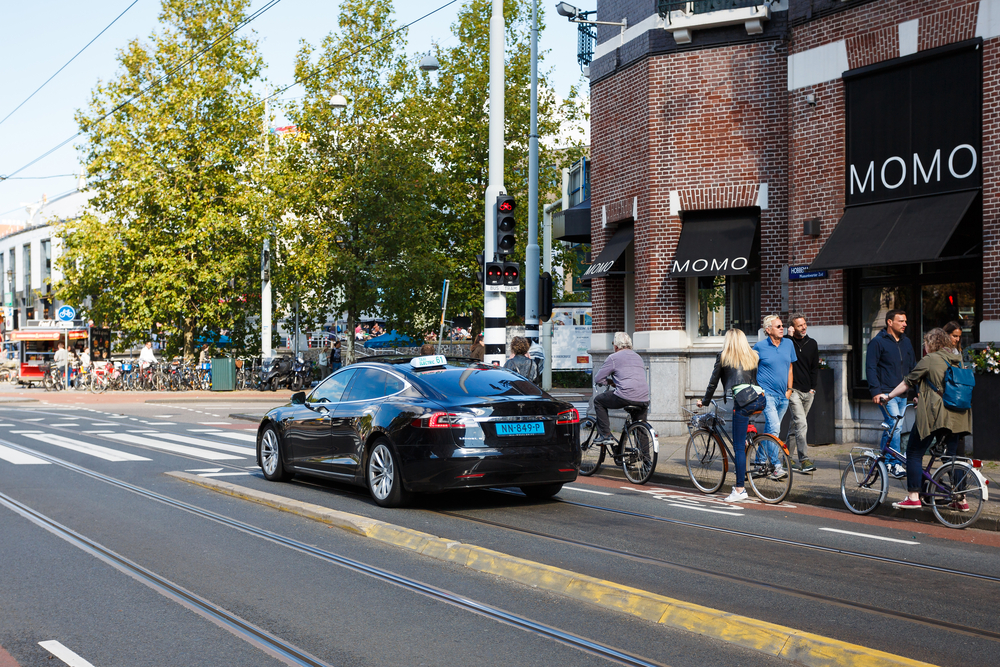
According to the Dutch Institute for Road Safety and Research (SWOV), cycling is becoming safer over time due to just how much the Dutchies cycle. 🚴♀️

While it’s less safe than travel by car, it is considered safer than travelling by moped or motorcycle.
2. No one wears a helmet while walking
OK, this argument may sound a bit weak at first glance, but hear us out! Head injuries aren’t as likely to happen when you are cycling. Even more so, they are more likely to happen while driving, or, surprisingly, walking!
READ MORE | Do’s and don’ts of riding a bicycle in the Netherlands
General falls are responsible for almost 50% of traumatic brain injuries in the USA. Yet, you don’t see people advocating for compulsory helmets in cars or when out on a summer stroll. 🚶♂️
3. Helmets can be ineffective
Many Dutch people argue that bike helmets are restrictive and can obstruct cyclists’ vision, making it difficult for them to quickly look over their shoulder to check the traffic or make a sharp right turn without hitting anyone.
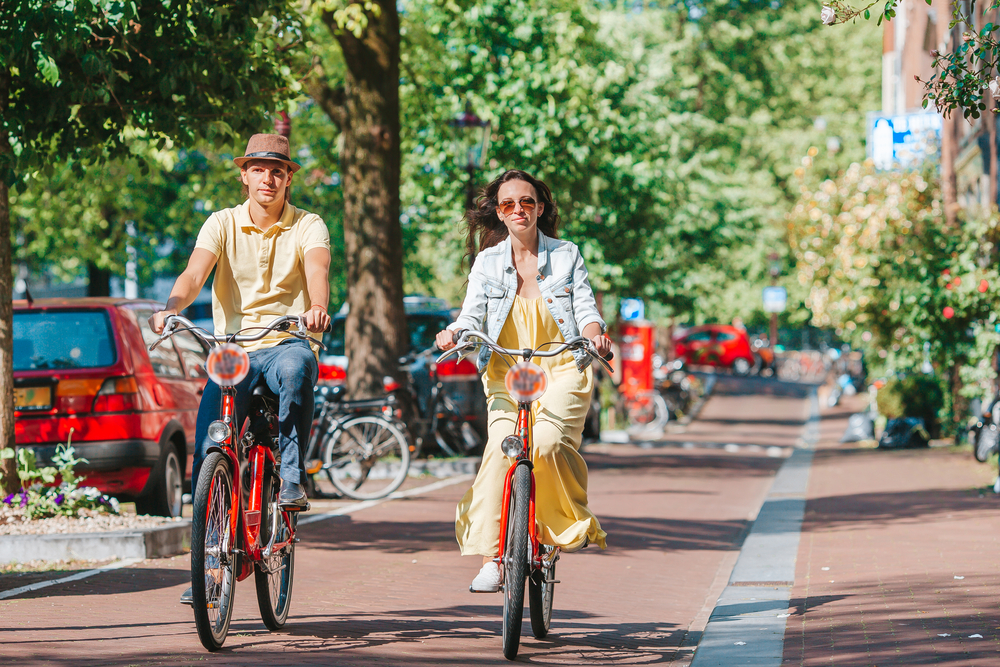
If you are hit by a car on your bike, a bike helmet will protect your skull, but it will not protect you againtst the other dangerous impacts you may experience at high speeds.

READ MORE | 19 things the Dutch did to make cycling easy and attractive
That baing said, helmets may be helpful when having a collision with other cyclists.
4. The Dutch teach them young
Verkeerslessen (traffic lessons) start in school when little Dutchies are just five years old. It may just begin with running around the playground and knowing that red means stop and green means go.
The older the Dutch children get, the more complicated the lessons become, and before you know it, they’re all cycling themselves to school.
READ MORE | 24 TikToks explaining why the Dutch are ahead of their time with bikes
Before they can officially start cycling independently, they must pass a cycling exam that tests their knowledge and skills.

5. Fewer restrictions = more cycling
As you can imagine, cycling every day (the Dutch manage at least 70 minutes per week!) means that the Dutch have earned their frikandel and fries on the weekend.
A 2015 study quantifying the benefits of cycling in the Netherlands showed that all this cycling and fresh air mean that Dutch people have half a year longer life expectancy and 6,500 fewer deaths per year. 😲
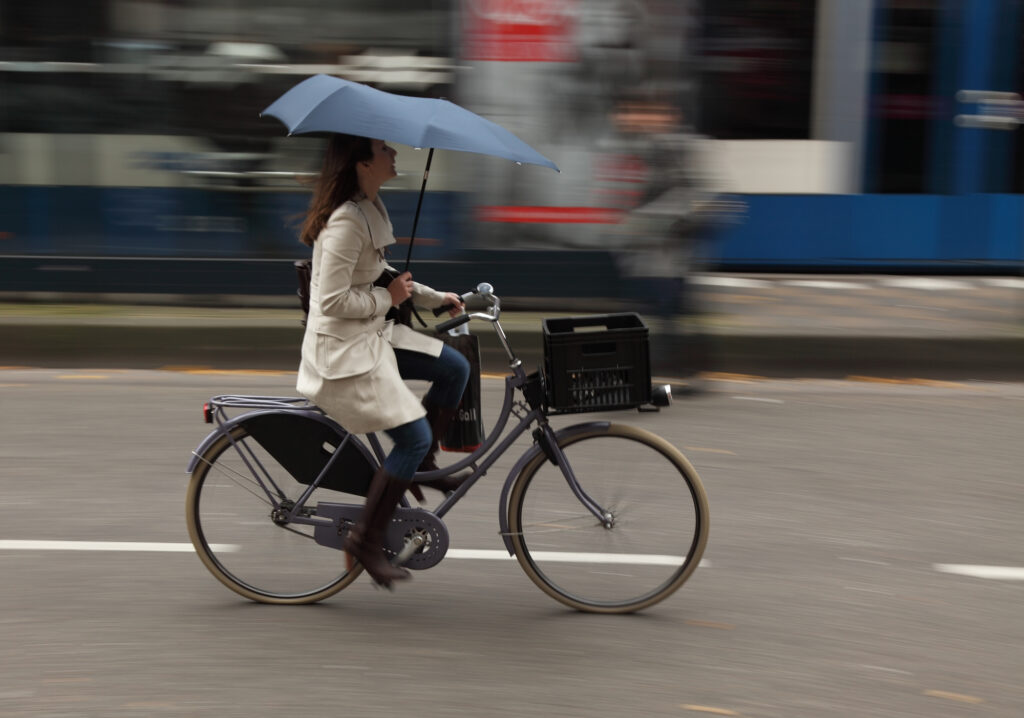
According to Cycling UK, enforced helmet laws in some countries have caused a huge reduction in bicycle use. For example, in Western Australia, bike use has dropped by about 30% since the introduction of such a law.
Who knows what would happen in the Netherlands if the government introduced a similar restriction? It’s possible that it would put people off the many short cycling trips they take if they didn’t have their helmets.
READ MORE | Dutch Quirk #74: Become exhausted when cycling over a bridge
Instead of promoting and enforcing helmets, the Dutch seem to be more focused on implementing good biking practices, such as no drunk cycling, no texting whilst biking, and having well-lit bicycle paths.
What do you think about the Dutch not wearing helmets when cycling? Tell us your thoughts in the comments below!


Five times last year other cyclists ran into me. I wear a helmet because of the concussion I suffered six months ago. Since I started wearing my helmet no other cyclist has violated my right of way. If five percent of cyclists are dangerous to other cyclists, someone is a threat to me every day. Soldiers don’t wear helmets to protect against tanks. Helmets protect against the higher frequency light shrapnel and small arms fire.
Small arms and higher frequency light shrapnel are uncommon in the Netherlands 😉
I cycle like a maniac but never have (near) accidents with other cyclists. Only cardrivers fail to anticipate to my presence.
Have you tried looking around more and making more eye contact? That’s crucial for inter cyclist communication.
Likewise in Germany – though in most areas leisure weekend cyclists, often on E-bikes, have become a majority and roadbike Sports are a boom as well. Oftlenly riders without much experience in cycling traffic and riding skills, are causing more and more incidents and dangerous situations on bikelanes and off. Helmets are mostly worn and making sense, but give sn illusion of being protected til one breaks his arm, hand, leg when falling.
Kids in our place learn riding in traffic through a project of schools and Police and making their (not obligatory) rider’s licence, important for many parents who have become too anxious to allow their children playing outside on their own. So cycling more than ever is a skill for growing up to freedom.
Effects of bicycle helmet wearing on accident and injury rates, GB National Road Safety Conference, November 2019
https://www.researchgate.net/publication/337367329_Effects_of_bicycle_helmet_wearing_on_accident_and_injury_rates
Details how helmet use results in a higher accident rate
Its important to discipline the high speed vehicles so that bicycle safety is utmost important &helmet is mild head gear
I’m dutch and used to biking without a helmet.
First; There is a lot of drunk cycling over here same goes for biking whilst apping (which will be illegal from the first of july 2019)
I’m not sure how other counties organized it but in the Netherlands the one who drives a car is responsible if a biker is injured, imo this gives the bikers an unfair (needed, I know) advantage, but in the age we are living in now, when I drive my car I see a lot of bikers just ‘Throw’ themselves in front of my car without even looking behind them. It’s horrifying, and I have no idea why they don’t lecture the cyclist at this point.
My mother taught me how to safely pass from one way to the other, most important lesson was that I looked behind me to see what was happening over there, and respect the traffic rules.
Now I’m riding my car, and I’m looking out for the cycler who goes rogue and may jump before my car, and that happens a lot.
Enough of my rant for now and to the point.
I’ve been in GB and Usa, and I was petrified a few times.
Cyclist riding on highways and there where curves, so I could not see the cyclist from ahead.
I was freaking out about that! You may think it’s weird that we don’t use helmets, but I was freaking out that I was allowed to drive so fast, and past cyclist with such a high speed.
That won’t happen in the Netherlands, because it’s not allowed for cyclist to be on that kind of roades.
Sad to hear that about the Nederlands. When I was there on visits in the 70s, 80s and 90s I didn’t see any uncivilised cycling and I thought the Platt Deutsch were so sensible like their Deutsch neighbours. I also discovered mayonnaise on chips and cheese with jam!
The best way to prevent injury is by not having accidents!!
Wow! That is rocket science Noko! But like immaculate conception it is difficult to achieve.
Wearing a helmet means you have to take it with you when you get off the bike, which is extremely annoying. You can of course keep it on and look like an idiot while you’re shopping, or find a spot on a chair next to you in the pub or restaurant, but all these solutions are bound to cause problems and aggravations. Much easier therefore not to wear the damn thing at all…
I’d rather look foolish that look like I broke my cranium.
look: Dutch people are good at biking in daily life. i know because im dutch. trust me, accidents dont happen that much
Very interesting article and agree with all points except #3. Studies about cycling and wearing helmets are extremely conclusive, wearing a helmet will help prevent injury and possibly death. Will they prevent all injuries, no. Do you expect your seatbelt to prevent injury form a train/car collision? No, but it’s a good idea to wear your seatbelt.
Having cycled in the Netherlands the main thing that stands out (and possibly makes the best point for not wearing a helmet in NL) is that the country is full of bike paths and bike lanes. This, I believe, makes me feel comfortable not wearing a helmet in the Netherlands.
I hope you’re wearing a helmet when walking and driving the car??
You really can’t compare tripping while walking at 4-6 km/h to falling to the pavement at cycling speeds (16-26 km/h) while starting from an elevated position.
You are also much less likely to be able to control your fall trajectory if, for any number of reasons, any part of your bicycle malfunctions or you simply lose balance by hitting a rock or an indent in the road.
I’d rather have something protecting my brain if I ever do hit my head against a paved surface but you do you.
Silly comment. Do you wear a seatbelt while travelling in a car?
This article is a load of BS. It finds statments to conclude what the they want to conclude, so they can justify not wearing a helmet. Wearing a helmet while riding a bicycle will make you more safe from having a head injury that not wearing any – that can’t be argueed, but yes off course it can be annoying and ugly and bite uncomfortable and the arguments you’re bringing here can of course give a reason for why people is still not wearing a helmet. But stop trying to use your arguments to make it sound like it’s safer to not wear one, than wearing one.
I live in Denmark a country where they population rides their bikes on a daily basis probably as much as the Dutch people and have the same cycling/car traffic culture. Copenhagen bicycle culture = Amsterdam bicycle culture.
I’m a nurse and hear about the headtraumas caused by falling on a bike without a helmet from my colleagues at ICU an neuro on a daily basis. And I just arrived home from 5 days as a foot tourist in Amsterdam.
So I feel that I have some knowledge to speak in this subject.
In DK people are beginning to be more aware of the risk of not wearing a helmet and we are begging to at see at least half of adult cycelist and all children having a helmet on.
Then I was horrified from in 5days in Amsterdam only seeing one kid and one sport cyclist wearing a helmet!
They where carrying their kids some thight up in really fancy safety chairs but also some barely strapped in! I saw a kid with rollerblades an protective gear on his nees but nothing on his head!!
And maybe people from Amsterdam learn traffic safety from an early age as we also do here in Denmark but most of them drove like maniacs no regard for red light, cars ore pedestrians as weel again as people in Copenhagen. We also saw some young kids having fun and being silly on their bikes one actually feel and hit her head.
So after all my rambling, my point is I am pretty sure if you check the Dutch statistics of head traumas caused by not wearing a helmet in a bike accident I’m pretty sure it’s high. You are shutting your eyes to a problem that could be easily solved.
And no a helmet can’t safe you from a broken leg in an accident but it’s a hell lot easier to repair a broken leg than a broken brain…
And yeah yeah you’re a chill country and enjoys your legal prosteuition and legal pot, and you don’t wanna be tied down by safety things like a helmet but don’t come and say it is not without a consequence??
Inspite of this i love loved Amsterdam sweet actice biking pepole and the all the bikes because i reminds me of home. But stay safe guys!
Ps..! you can lock your helmet to your bike lock so you don’t have to bring it everywhere, and in Denmark you can buy a necklace that you can wear that will inflate and protect your head so your hair can still flow in the wind…
You’ll find it difficult to convince a Dutch person cycling is dangerous. Wearing a helmet will undoubtedly reduce the incidence of head injury by a factor of 2. That sounds great, but chances are so small you get one in the first place. One in 90 people in their whole life(!) in the Netherlands are admitted to hospital due to a cycling head injury. On top of that these injuries are mostly from race bikers and electric bikers who tend to wear helmets…
At the same time every Dutch person cycles virtually every day and an average of 2.5 km/day.
Good luck getting the Dutch to buy into this.
Cycling without a helmet isn’t dangerous, car drivers are dangerous.
Dutch seem to cycle like maniacs, but in fact the traffic is well structured in an organic way. My children were three when I taught them to ride a bike and the first few times (when they were 4) we went to the market in the center they wore a helmet. Now the oldest is 10 and is able to teach my Indian co-workers how to participate in traffic.
I’m not affraid of him colliding with other cyclists. I’m affraid of car drivers being distracted by their phone, arguing children or a pretty women…
The floor is much harder than a skull.
I guess your argument falls apart if it’s you or someone from your family who falls into the wrong side of the statistic
First off, pot isn’t legal, and legalised prostitution is not for the enjoyment of customers, but to protect the sex-workers and get them out of the criminal circles that rule prostitution in other countries.
That said, both the article and you are missing several points. Most obvious is the wrong use of statistics. Those people in the emergency with head trauma weren’t there because they didn’t wear helmets, they were there because they had an accident. That sounds flippant, but it’s a real thing. Helmets add some protection IF an accident occurs, but do they make an acident less likely, or more likely? There are two sides to that. The side of the wearer, whose sensory awareness may be hampered not only by the helmet, but also by the fact that they’re wearing one in the first place. Most biking helmets have an aerodynamic design, which will disrupt the airflow when you turn your head. Racing helmets especially are notorious for this. But there’s also the side of the surrounding traffic. Statistically, there are less accidents on the road during heavy rain or storm. Because people either stay indoors, or drive very carefully. It has been suggested that drivers are more careful around fragile looking road users (in fact, it has been proven that drivers keep more distance from bicyclists who don’t wear helmets, but the only cyclists who wear helmets right now are the very young – who are still practising – the very old – who have reduced reaction speed, balance and bone strength – and idiots-on-racing-bikes-who-don’t-follow-traffic-regulations-and-are-universally-hated, so these studies are not yet conclusive).
And then there’s the difference between accute danger and chronic danger. I work in industry, I’m issued with safety footwear. I once got a pair that fulfilled all the legal requirements for accute danger, but I couldn’t for the life of me call them shoes. They were more like safety draw-string purses that you could put on your feet. Absolutely no thought for chronic danger. If I had continued wearing them (I threw them away after the first day), I wouldn’t just have developed flat feet, heel spur, worn knees, lower back aches and severe head aches, I would have had a hernia by now.
I’m 60yrs old and have ridden a bike all my life (driving doesn’t agree with me). I’ve never been to the hospital for head injury, but I have had a pneumonia (bacterial) that I barely survived. I wear protective head gear, a sturdy woolen flat cap, to protect me from the very real chronic danger of severe head colds and worse. It also helps keeping the rain off my (safety) glasses, so I can see where I’m going. How many people in Denmark wear bike helmets in the midst of winter?
Finally, there’s the bigger picture. If you spent a short holiday in Amsterdam, you were there longer than I have been. Remember all the cyclists you saw and imagine them driving a car instead. It would be nigh impossible to get into the city and the air downtown would be unbreathable. The object is to get people out of their cars and on a bike. It’s not just healthy exercise for them, it’s healthier and safer for all of us. (It also allows mobility to people who cannot drive or cannot afford – financially or otherwise – a car, it keeps people mobile and moving upto high age, which is also socially and psychologically healthier, and it decongests roads and inner cities. Given the number of people that use them, the extra bike lanes and seperated paths actually save space.
It’s hard to believe you failed to mention the main reason. The safety increase that separating cars from bikes on their own roadways gives. It is the most important factor. While biking you will often have minimal to no contact with car traffic increasing enjoyment and safety.
Agree Bart, separation and reducing the speed of cars are the life savers.
And on a side note. Most dutch people use a helmet on high speed bikes. Both race and electric.
Our 2 week tour leader said we look like Germans, by wearing helmets…
You can also lock it to the bike! Unless you take the bike and sit it next to you in the pub?
Speaking as a neuropsychologist, who has assessed many people with traumatic brain injury, I would never cycle without a helmet. Yes, if you get hit by a car at high speed you will certainly suffer injuries to other parts of your body – and no helmet can prevent that – but it absolutely can reduce the likelihood of damaging your brain if your head hits the ground with any significant force, for whatever reason you happen to come off your bike.
When DO you cycle? Because my ears would freeze off if I wore a helmet in winter even before the temperature drops below zero. There is also serious debate about whether helmets reduce the chance of getting any accidents in the first place, because studies suggest the opposite. Both cyclists and the traffic around them are more prone to take risks when the cyclist wears a helmet.
You’ll be relieved to hear that it is possible to wear a hat, such as a thin merino wool cap, under your helmet.
Ask anyone working with head traumas about whether you should wear a helmet while cycling and you’ll get a pretty resounding “yes”.
A helmet reduces the chances of serious injury even if you’re hit by a car. The anti helmet arguments here are disingenuous.
The Dutch do not to worry about a bicycle helmet because THEY are hard headed by nature! That is also why every one is wearing wooden shoes, klompen! (just kidding)
Its fantastic cars and bikes have a mutual respect relationship over there but theres more to consider beside bike on bike or bike on car accidents. When we were kids my brothers wheel snagged something and he fell off his bike. His head hit the ground hard enough for him to black out and a neighbour had to help him home so we could take him to the hospital. His helmet was cracked in half. If he hadn’t been wearing his helmet that would have been damage to his skull. Its an interesting read and I’m sure its working out for them but after seeing that I’d never go biking without a helmet.
There is never a good reason to ride without a helmet. Safety should never be compromised. None of your arguments convinced me it was worth the risk. I race bikes and always wear a helmet.
ever ‘raced’ in the Netherlands? its safe as hell. i promise you
The floor is no softer there.
There is never a good reason to ride with a helmet. Do you also wear one when walking or driving a car? IF not, you also don’t need to wear one when cycling unless your balance is shit.
You race bikes, you don’t ‘ride’ them. Look at the picture above the article. Most cyclists in the Netherlands ride in an upright position. Biking is utilitarian. It’s school and work traffic, shopping, etc. Even as a leisure activity, upright cycling is preferred, because it allows for better enjoyment of the surrounding countryside.
Riding upright, you’re extremely unlikely to hit your head on anything other than low hanging branches. Riding a racing bike you’ll be catapulted out of your seat and you WILL land on your face the moment you hit something, anything. People on racing bikes wear helmets because they know this, and because clubs mandate it, and because helmets are aerodynamical and you can have long discussions with your friends about whose helmet is best. People on speed-pedelacs wear helmets because they’re legally obliged to because the speed e-bike is categorised a an electrical moped, not a bicycle.
There’s already a consensus among cyclist as well as other road users, that bike racers should be banned from using public space.
If helmets are not increasing safety, WHY are the professional bike riders using helmets, then??? I find the article of very low quality – Where are your statistics and your sources?
20+ yrs. – how did you get out?
Agree. It’s not an article based on statistics and recommendations I have read in the past.
How would you define professional bike riders? People who deliberately take unnessecary risk on a public road? People who accept ending up in a big heap of broken limbs as a calculated risk? People who wear short sleaved shirts and rather offensive shorts knowing full well that most injuries are to the limbs and roads aren’t exactly sanitary? Are you seriously suggesting that these people are concerned about safety? Racing bikes, racing ANYTHING is a danger sport!
Professional bike riders (wielrenners) wear helmets because they’re aerodynamical and will give an ever so slight chance of finishing one fraction af a second before the competition.
I don’t wear a helmet in a city where it’s mandatory, and regularly get spooked by police who could pull me over for it.
Despite this, I’m proud to ride around showing people it’s possible.
Yes, they make a small difference to personal safety. But they make cycling so inconvenient and ugly that more people drive. The only real danger on a bike is cars.
Anyone speaking for helmets needs to consider the weight of their years of lobbying. The auto industry funds helmet promotion.
You forgot reason 6: The Dutch ride extremely slow.
Ha Ha – very true! I used to be a Cycle Courier in London for a couple of years and I hack around Amsterdam without a helmet and only ever get overtaken by the electric bikes.
Thank you for a very interesting article !
Each of the 5 reasons are quite true, but it might also be worth mentioning: The extremely low incidence of bicycling head injuries in the Netherlands (as compared to ridiculously high number in the U.S.) is in great part due to the much better cycling posture and weight distribution of Dutch bicycles. With Dutch bikes the seat is lower and the swept-back handle bars are higher, requiring an upright seating posture. This facilitates good forward vision and situational awareness. This posture also shifts the weight distribution towards the back and greatly reduces the likelihood of a forward tumble over the handle bars and the inevitable ensuing head injuries. The typical American cyclist rides with the seat higher than the handle bars (frequently much higher), reaching forward for the handle bars, and the resulting head-down riding posture significantly reduces forward vision. Not to mention reduced peripheral vision with a helmet. With that posture, any incident, even benign, will result in the American cyclist pitching forward head-first and becoming another participant in head injury statistics.
Thanks again for the great article !
You can put everyone in a big blowup plastic bubble and not have any injuries ever . There has to be an end to how far you go with safety, you will never achieve 0 accidents. It is putting too much control over people. Just stop it
I think it is more beneficial to not cycle drunk, or text while you cycle. Head injuries are proven to be the same when walking. Injurie rate while texting or being drunk is another problem. However actively enforcing anything is always tough!
Seems to work in making people wear seatbelts, or not drink alcohol and drive?
Two distinct points: one, “I should have the freedom not to wear a helmet.” And, two: “I personally wouldn’t ride without a helmet given the reduced risk of traumatic brain injury offered by a helmet.”. These are not mutually exclusive concepts. You can enjoy the freedom from wearing a helmet yet still choose of free will to wear one.
For casual bike riding I wouldn’t wear a helmet, but on a Road Bike wearing clip to pedal shoes….definitely.
U.K. prospective.
Since AU mandated helmet use (1990-92):
-80% reduction in 0-16 year old deaths from cycling
-55% reduction in head injuries from cycling
-34% reduction in cycling deaths
More info: https://www.tmr.qld.gov.au/Travel-and-transport/Cycling/Research-and-resources/Safety-research
On cycling less…. NL Children in a 2016 study in Zeeland did not cycle less when they had to wear helmets: https://swov.nl/nl/publicatie/evaluatie-fietshelmcampagne-coole-kop-helm-op-zeeland
Australia is not designed as the Netherlands
I would never cycle without a helmet (I don’t ski without a helmet either). I have a plate in my wrist from a bike fall. How did it happen? I don’t know, I’m missing 30 minutes of memory. There was a crease in my helmet that matched up nicely with the curb. The doctor said that if I had not been wearing the helmet I would have had the plate in my head or worse. This is really an easy call.
n=1. You didn’t account for the reduction of cyclists that will be caused by mandatory helmet use and thus increase in other health issues. You do you, but preaching for helmets is bullshit.
Why are people so against it? Do they also say people should be allowed to drink alcohol and drive, or take drugs before driving? I’m not sure helmets should be made compulsory for cyclists, but being critical of the concept of wearing one seems absurd.
I was in Amsterdam for four days last week and didn’t see a single cyclist wearing a helmet. And that’s fine. That’s their prerogative. I wish the article above would have just stated something like, “Hey, Amsterdamers don’t like helmets, and will cycle the way we want to cycle.” Would have been more understandable than suggesting things are “safer” there or that helmets are “ineffective.” Both of which are not true.
Bicyclists in Amsterdam ride fast and blow through intersections that are full of people and cars. And that’s their right. But to suggest there isn’t danger involved is naive.
The Dutch also used to parade around in black face and say it was tradition. Mandatory seatbelts in cars is also relatively recent. Wear a helmet or not, the Dutch will do what they want unless there is a fine involved or take a risk. But don’t give these weak arguments that helmets don’t work. It’s your health and your head… You only have one shot. https://www.theguardian.com/world/article/2024/jun/16/the-brain-is-very-vulnerable-dutch-cyclists-urged-to-wear-helmets-as-road-deaths-rise
Dutch cyclists also eschew the helmet because they use bicycles as transportation; it’s not just as sport/recreation. They’re not wearing spandex or other “cycling clothes,” either.
And they have dedicated cycling lanes all over, but even when there’s no cycling lane drivers tend not to encroach. So much safer than in the UK or US.
It works in the Netherlands, but here in the UK the infrastructure, culture and general attitude is not pro cycling. In fact many people in cars and people walking are either contemptuous or plainly unaware of people on bicycles. And the approach to riding bicycles properly i.e. observing traffic laws and being considerate of other road users is often ignored by people who only consider a bicycle a cheap form of transport before moving on to powered vehicles.
The only time I’ve been knocked of my bicycle was by a teenager who (despite me ringing a bell and calling out loudly) swung his bike out widely on a cycle path giving me nowhere to go. The resulting impact cracked my helmet.
The curb is harder than your skull. Many accidents occur without any other traffic. Once your skull is hurt it is hard to recover. Do you refuse wearing a safety belt in your car?
When you use a bicycle a lot, you become amazing at how you can accelerate and balance yourself out of close calls. One example is how I passed parked cars in 1968 in Melbourne, where it was also important to keep an eye out for a person in the driver seat in the parked car, in case the door would suddenly open. You would need to quickly balance between the opening door and the larger vehicle traffic further out in the traffic lane.
What struck me on a recent visit to Copenhagen (and numerous trips to Amsterdam) was that few cyclists are attempting to turn their commute into work out! On similar commuting rides in London there are a significant number of Lycra clad cyclists determined to complete the journey as fast as possible (even if it requires breaking the law!!). This is far more dangerous than not wearing a helmet. Safe roads require all road users to have a common attitude. The road user that thinks it is ok to jump a red light…. No matter what vehicle they are driving, does not deserve to share the road.
Helmets do reduce the chance of traumatic brain injury.
how about, ‘i don’t like them’? even though i own one…
or, what’s to lose, considering the Dutch mentality?
just kidding…but i DO have to SAY i’m just kidding because people wouldn’t get it, otherwise…
fijne dag, y’all…
The reason in NL you feel safer without a helmet ia the bike lanes and omafiets! I moved from Amsterdam to Zurich. No bike lanes, drivers have to share the space with bikers AND bikers in Zurich are not enjoying their oma fiets bike ride as if they woult sit ok the couch, dutch style, they pedal lile they need to win a cycling championahip t shirt on their expensive race/ebikes.