

The Dutch-American Friendship Treaty (DAFT) visa is one of the most accessible routes to legal residency in the Netherlands for American citizens — and in 2025, almost 700 Americans used it to make the move.
The DAFT visa allows US entrepreneurs and freelancers to live and work in the Netherlands by simply registering a Dutch business and depositing a minimum of €4,500 in starting capital.
There’s no points-based assessment, no employer sponsor required, and no Dutch language requirement. For self-employed Americans, it’s one of the simplest legal pathways to EU residency available anywhere in the world.
It sounds almost too good to be true. As a politically fatigued US-citizen myself, I’ve watched more and more Americans start asking: “Wait, can I actually just… leave?”
Well, if you’re a freelancer, consultant, or entrepreneur, the answer is yes. Here’s everything you need to know.
While the DAFT visa is one of the most accessible routes to the Netherlands, it’s still complex — and having proper legal guidance can save you a lot of stress. The expert immigration lawyers at AZ Legal specialise in the DAFT visa process and have helped countless US citizens make the move.
What is the Dutch-American Friendship Treaty (DAFT)?
The Dutch-American Friendship Treaty is a bilateral agreement between the Netherlands and the United States, signed in The Hague on March 27, 1956. The treaty was originally signed as part of the Marshall Plan to encourage trade and investment between the two countries.
It’s technically a residence permit — not a visa —, but everyone calls it the DAFT visa, so we will too. In plain terms, it lets American entrepreneurs start a business in the Netherlands and live there legally.

You don’t need a Dutch employer, a job offer, or an especially impressive business plan. You just need to be American, be self-employed, and meet a few financial requirements. Easy peasy.
How does the DAFT visa work in the Netherlands?
Normally, non-EU nationals who want to work independently in the Netherlands have to pass a points-based evaluation system. The Dutch government assesses your business against strict criteria to determine whether it provides “added value” to the Dutch economy. You need at least 90 points to qualify.
DAFT allows Americans to skip all of that: it exempts them from the points test entirely.
What you’re left with is a much faster and more accessible process: register a business, apply for your permit with the IND (the Dutch Immigration and Naturalisation Service), and renew it every two years.
So why wouldn’t Americans want to move here? The country consistently ranks highly for quality of life, is almost entirely English-friendly, and sits at the centre of Europe. Win-win-win!
Who is eligible for the DAFT visa?
The headline requirement: you must be a US citizen. That’s a non-negotiable.
Beyond that, you need to start or operate a business in the Netherlands and keep it genuinely active. Passive income, retirement funds, and dormant shell companies don’t count.

There’s no age restriction, no diploma requirement, no minimum number of Dutch clients, and no business plan requirement. That means you can even serve American clients from Amsterdam!
Can family members join a DAFT visa holder?
Yes, your partner and children under 18 can join you, provided they apply for their own residence permits as dependents. One nuance worth flagging: family members can start working in a self-owned business from the moment they receive their residence sticker, but they can’t enter regular employment until you’ve received the final verdict on your DAFT application. It’s an important distinction, especially if your partner has a job lined up.
If your partner isn’t a US citizen, the process may be slightly more involved — some nationalities require an MVV (machtiging tot voorlopig verblijf).
This is a temporary entry clearance visa that non-exempt nationalities must obtain from a Dutch embassy in their home country before travelling to the Netherlands for a long stay.
DAFT visa requirements for Americans
Here’s what you’ll need to get your DAFT permit.
Minimum investment requirement
You must deposit a minimum of €4,500 into your Dutch business bank account. Keep in mind that this isn’t a fee or a one-time payment — it’s a capital requirement that must stay in the account for the full duration of your permit.
Business requirements
You need to register your business with the Dutch Chamber of Commerce, known as the Kamer van Koophandel (KVK). You must operate as a self-employed entrepreneur (ZZP) or company owner (BV), and the business must be active and generating real revenue at the time of application.
Documents required
- Valid US passport (copies of all stamped pages)
- Apostilled birth certificate (and marriage certificate or certificate of unmarried status, if applicable)
- Business registration documents
- Proof of the €4,500 deposit and an opening balance sheet from a BECON-registered Dutch accountant
- Rental agreement or consent declaration for your Dutch address
- Proof of health insurance
How to apply for the DAFT visa step by step
Before you get into the steps, there’s one decision you need to make first: which type of business are you setting up? This matters more than it sounds, because it changes the entire sequence of events.
Your two main options are
- a ZZP (zelfstandige zonder personeel): a sole trader, roughly equivalent to being a 1099 freelancer in the US, or
- a BV (besloten vennootschap): a private limited company, roughly equivalent to an LLC.
The ZZP can only be registered after you arrive in the Netherlands and have acquired your BSN number.
The BV, on the other hand, should ideally be set up before you move. This is especially important if you want to claim the Dutch 30% ruling, a tax benefit that lets some expats receive 30% of their income tax-free.
Both the BV and the ZZP route have legal and tax implications, and handling these properly can save you a lot of hassle down the line.
The expert team at AZ Legal specialise in the DAFT visa, and can help you secure residency in the Netherlands quickly and with confidence.
It cannot be backdated, so if you want it, you need to act before you board the plane.
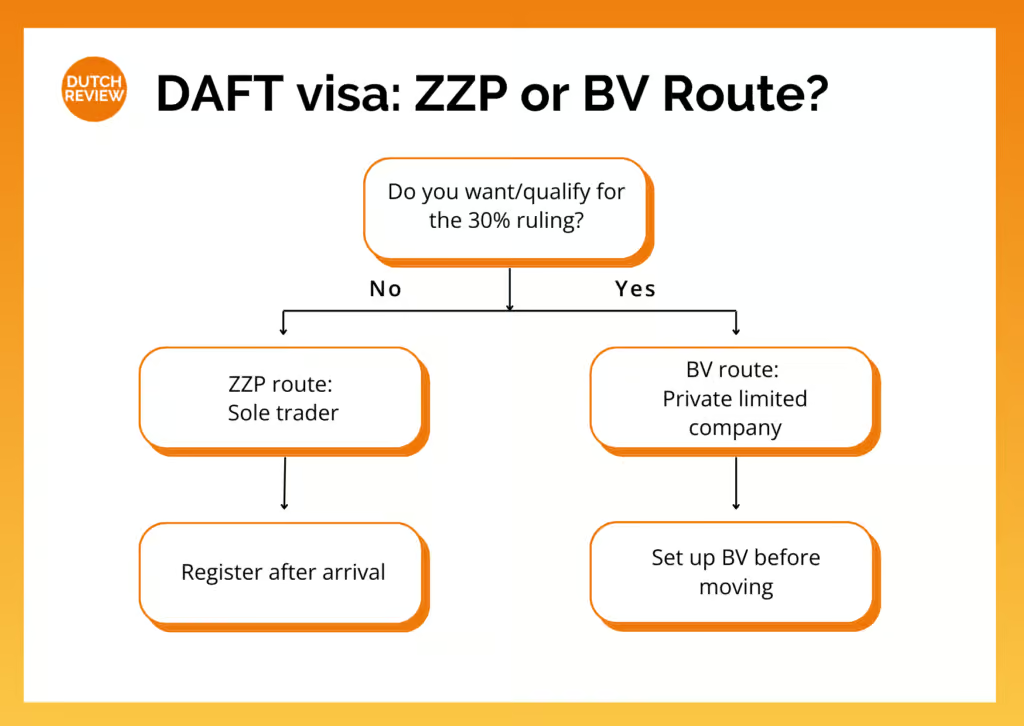
Path 1: ZZP (zelfstandige zonder personeel — sole trader)
This is the simpler setup and most likely the right call if you expect to earn under €69,000 per year.
Step 1: Enter the Netherlands
- Arrive on your 90-day visa-free Schengen entry.
- Post your DAFT application to the IND. This can also be done from abroad before you arrive. You can skip the BSN and KVK fields for now, as you don’t have those numbers yet.
Step 2: Book your IND appointments and get your residence sticker
- Once the IND receives your application, you’ll get a V-number and an invoice for the €423 application fee.
- Use your V-number to book two IND appointments: one for biometrics and one for your verblijfssticker (residence endorsement sticker). They’re separate appointments but can usually be booked back-to-back.
- Your verblijfssticker goes straight into your passport and immediately grants you the right to live and work in the Netherlands while your full permit processes.
Step 3: Register at the gemeente (municipality) and get your BSN
- This must happen after your IND sticker appointment because you need to show the sticker to register.
- Bring your passport, apostilled birth certificate, rental agreement, and IND confirmation letter.
- Your burgerservicenummer (BSN) — your Dutch citizen service number, needed for taxes and banking — arrives by post within a few days.
Step 4: Register your business with the KVK
- Now that you have your BSN, you can register your eenmanszaak (sole proprietorship) with the Chamber of Commerce. The KVK registration fee is €80.10.
- Open a business bank account in your company’s name.
Step 5: Deposit €4,500 and get your opening balance sheet
- Deposit the minimum investment into your business bank account.
- Obtain an opening balance sheet from a BECON-registered Dutch accountant (a Dutch accounting register that verifies professional qualifications).
- All of this must be in place within 6 months of IND approval.
Important: the IND is currently running an expedited pilot that allows you to submit your application without these documents upfront. This may revert during 2026. If it does, KVK registration, balance sheet, and bank statements will need to be submitted before IND approval. Double-check the current situation when you apply.
Step 6: Receive your full residence permit
- Expect the final verdict within one to two months of submitting your application.
- Your permit is valid for two years.
- Joining family members can live in the Netherlands from the moment they receive their own sticker and can work in a self-owned company from that point, but can only enter regular employment after the final DAFT verdict.

Path 2: BV (besloten vennootschap — private limited company)
This is the route to take if you expect to earn over €69,000 per year in wages from your company and want to access the 30% ruling. The front-loading is more work, but the tax savings can be substantial.
Step 1: Set up your BV before you move
- Incorporate your BV and sign an employment contract with it before migrating. This is a hard requirement for 30% ruling eligibility — it cannot be backdated.
- Be aware that setting up a BV costs considerably more than a ZZP. In addition to the KVK registration fee (€82.25), you’ll need a civil-law notary to draft the deed of incorporation. Notary fees typically run €500–€1,500, bringing the total setup cost to roughly €1,200–€2,000 for a standard single-founder BV.
- Open a business bank account.
- Deposit at least €4,500 into your BV’s business bank account and obtain an opening balance sheet from a BECON-registered Dutch accountant. Since your BV is already set up, this can and should be done before you arrive.
Important caveat: the BV and pre-arrival employment contract are only required if you want the 30% ruling. The ruling has a salary minimum of €69,000 in 2026. If you won’t meet that threshold, you don’t need to set up the BV pre-arrival.
Step 2: Enter the Netherlands and submit your DAFT application
- Arrive on your 90-day visa-free Schengen entry.
- Submit your application to the IND. Since your BV is already set up, you can also do this from abroad before you even arrive.
Step 3: Book your IND appointments and get your residence sticker
- Use your V-number to book biometrics and sticker appointments — two separate appointments, bookable back-to-back.
- Receive your verblijfssticker, which lets you live and work immediately.
- Pay the €423 IND fee.
Step 4: Register at the gemeente and get your BSN
- Must happen after your IND sticker appointment.
- Bring a passport, an apostilled birth certificate, a rental agreement, IND confirmation letter.
- BSN arrives by post within a few days.
Step 5: Receive your full residence permit
- Expect the final verdict within one to two months.
- The permit is valid for two years.
- Joining family members can live in the Netherlands from the moment they receive their own sticker and can work in a self-owned company from that point, but can only enter regular employment after the final DAFT verdict.
How long does the DAFT visa last?
Your initial permit lasts for two years. After that, you can renew provided your business has been active, and your minimum of €4,500 has stayed in the account. The renewal then lasts for five years.
Keep in mind that when it’s time to renew your permit, the IND will check your financials. While there’s no strict benchmark, some recommend showing you’ve earned at least €1,700 per month between the seventh and 24th months.
So while nobody’s checking your revenue on day one, don’t treat the first two years as a free ride. It could be catastrophic later on.
Can DAFT lead to permanent residency?
Yes. After five years of legal residence in the Netherlands, you may be eligible to apply for permanent residency — or even Dutch citizenship, if you meet the additional requirements (including passing a Dutch language and integration exam, known as inburgering).

Worth knowing: permanent residency lets you keep your US passport while living in the Netherlands indefinitely.
Dutch citizenship is a bigger step; the Netherlands generally requires you to renounce your US citizenship as part of the naturalisation process, unless you qualify for one of a limited number of exceptions.
Examples of businesses Americans start under DAFT
The beauty of DAFT is that there are no restrictions on the type of business you run or where your clients are based. You can invoice American clients from an Amsterdam apartment — plenty of people do. Here’s who typically takes this route:
- Freelancers and consultants: writers, designers, strategists, coaches
- Tech professionals: developers, product managers, UX designers
- Marketing and creative agencies: solo operators or small teams
- E-commerce businesses: product sellers, dropshippers
- Remote workers: anyone with a US employer willing to hire them as a contractor
In short, if you can work independently and remotely, DAFT would probably work for you. Who knew moving to the Netherlands from the US was so achievable?
Pros and cons of the DAFT visa
The advantages
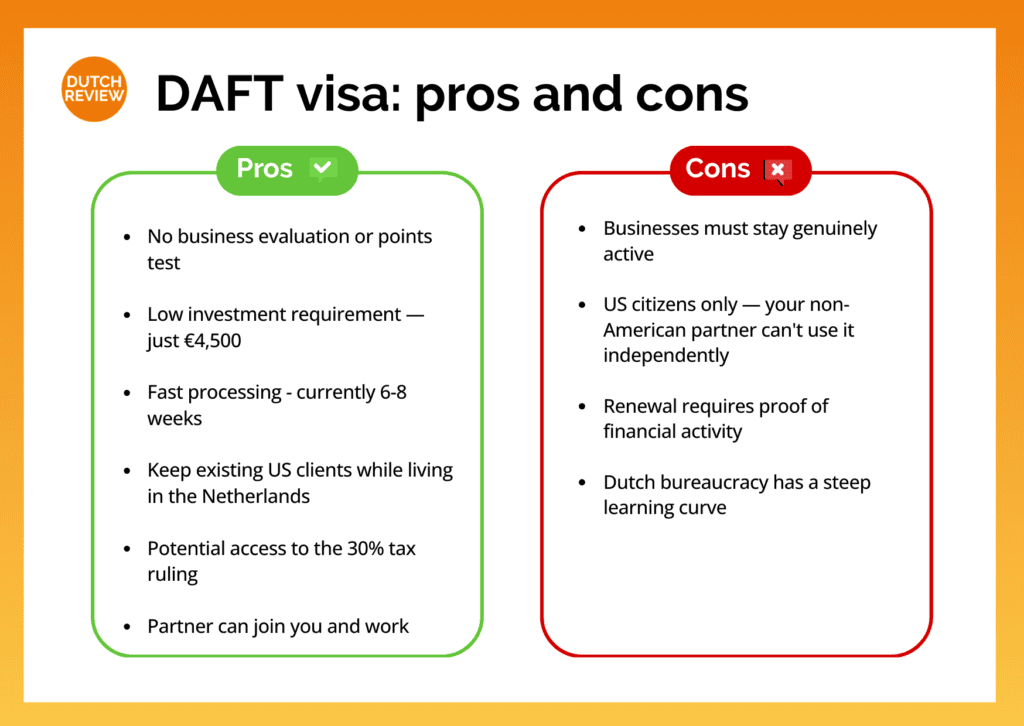
- No points-based evaluation; you don’t have to prove your business “adds value” to the Dutch economy
- Low investment requirement (€4,500) compared to most entrepreneur visas worldwide
- Fast processing; currently 6–8 weeks under the expedited pilot
- Flexibility on business type and client location
- Potential access to the Dutch 30% ruling — one of the most generous expat tax benefits in Europe
- Family can join, and your partner can work
The challenges
- You must keep the business genuinely active; passive income or shell structures won’t cut it
- Dutch bureaucracy takes some getting used to. Apostilles, BECON accountants, BSN numbers — there are a lot of acronyms to learn
- Exclusive to US citizens: your non-American partner can’t use DAFT as their own immigration route, though they can apply to join you as a dependent once your permit is approved.
- At renewal, you’ll need to show the business has been financially productive
DAFT vs other ways to move to the Netherlands
If you’re not sure whether DAFT is right for you, here’s how it stacks up against the other main options.
DAFT vs Dutch self-employed visa
The standard Dutch self-employed visa requires you to pass a 90-point evaluation of your business concept. It’s time-consuming, difficult, and routinely rejected. DAFT removes that requirement entirely for Americans.
Personally, I’ve seen multiple friends and family members get rejected on this basis. There’s no contest: DAFT is an easier route.
DAFT vs highly-skilled migrant visa
The highly skilled migrant (HSM) visa is for Americans who have a job offer from a Dutch employer. It’s a strong option if you’re going the employment route, but it requires a sponsor and a salary above a set threshold.
If you’re self-employed or want to run your own business, DAFT is the better fit. If you’ve got a cushy job offer and sponsorship, don’t overcomplicate things, though!
DAFT vs Startup visa
The startup visa is aimed at innovative, scalable businesses. It requires a Dutch “facilitator” (an approved mentor organisation) and only runs for one year.
DAFT is less restrictive, more flexible, and available to a much broader range of business types.
Thinking about making the move? Share your questions or experiences in the comments below.
Frequently asked questions about the DAFT treaty
How much money do you need for the DAFT visa?
You need a minimum of €4,500 deposited in your business bank account to qualify for the DAFT visa. This amount must stay there for the duration of your permit.
Do you need to speak Dutch for DAFT?
You don’t need to speak Dutch to apply for or hold a DAFT permit. The Netherlands is one of the most English-friendly countries in the world, so day-to-day life and running a business in English is very manageable. You will need to pass a Dutch language exam (inburgering) if you later apply for permanent residency or citizenship — but that’s years down the line, and there are plenty of resources to help you pass!
How long does the DAFT application process take?
Under the current IND expedited pilot, you can expect a verdict within six to eight weeks of submitting your application. You’ll receive your residence sticker within a couple of weeks of arriving in the Netherlands, which allows you to live and work immediately while you wait for the final decision.
Can you work as a freelancer under DAFT?
Yes, freelancing is one of the most common uses of the DAFT visa. You can serve clients anywhere in the world, including your existing US clients, as long as you invoice them through your Dutch business.
Can you bring your partner or family?
Your partner and children under 18 can apply for dependent residence permits alongside your DAFT application. Your partner will be able to work in the Netherlands without a separate work permit once the final DAFT verdict comes through. If your partner is not a US citizen, additional steps may apply depending on their nationality.
“must have health insurance” – I doubt that US Medicare is going to work in the Netherlands. How would acquire health insurance if I am not a citizen?
Hi there Dale! You are correct, US Medicare won’t be accepted in the Netherlands. Anyone who comes to live or work in the Netherlands is required to sign up for Dutch health insurance (zorgverzekering) within four months of being registered.
To sign up, you’ll need a BSN (Burgerservicenummer), which is the Dutch citizen service number you get as a legal resident. As an American from outside the EU/EEA, you’ll also need your residence permit before you can apply for basic coverage.
If your registration is taking some time but you’re already in the Netherlands, you can take out a temporary bridging insurance (example: OOM Provisional Residence in the Netherlands Insurance) to make sure you’re covered until you have your BSN and residence permit sorted and can officially sign up with a Dutch insurer.
We are also about to publish a health insurance guide and how-to for Americans moving to the Netherlands, so keep an eye out for that. Hope this answered your question!
Thanks for these details. Can you bring an adult child if they are a disables dependent?
Does DAFT allow a person to work as a remote 1099 contractor for a US company (the company is located in the US)? Meaning no salary and have no benefits to do the work. Thanks.