

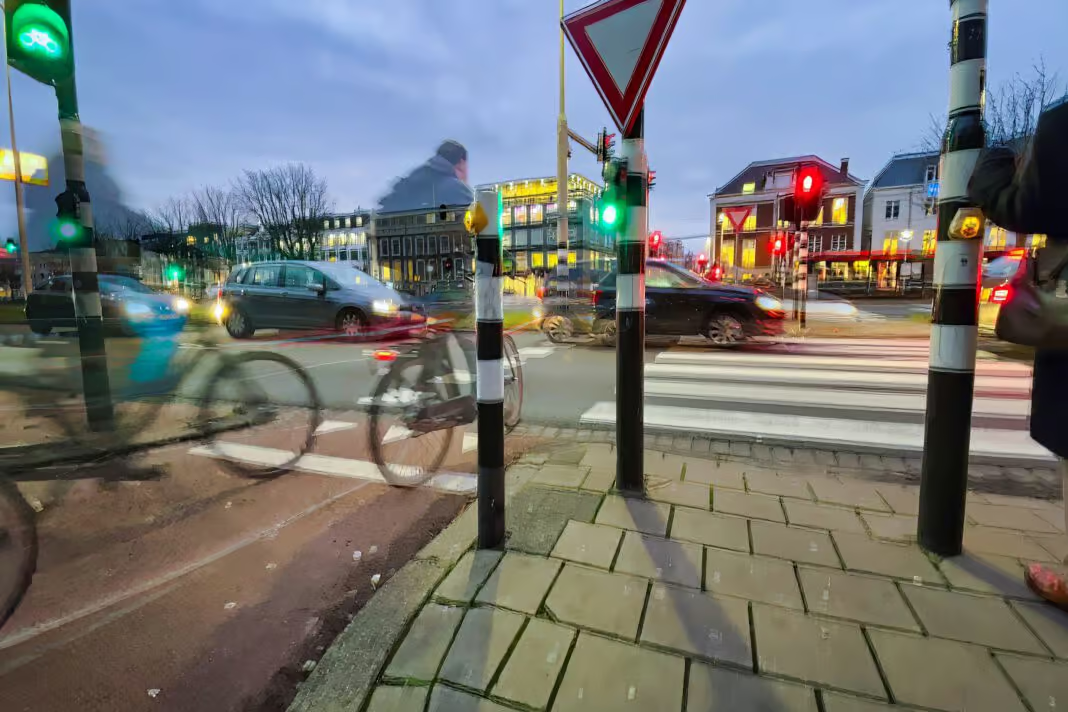

Amsterdam and Houten are officially hitting the brakes on speeding cyclists, launching new pilot programs that cap speeds on certain fietspaden at 20 km/h.
If you’re a speedy e-bike rider, this new 20 km/h boundary sits noticeably lower than the standard national e-bike limit of 25 km/h.
The trials are part of the national Meerjarenplan Fietsveiligheid 2025–2029, a major push for safer cycling that the Dutch government launched last summer.
Several municipalities put their names forward, and Amsterdam and Houten were chosen to go first, as the AD reports.
Where and when
Houten kicks off the trial on June 8, with the pilot centred on the Fossa Iberica, a narrow, well-used street behind the Castellum shopping centre.
The Fossa Iberica sees upwards of a thousand cyclists and moped riders on a typical day, with a notoriously problematic intersection in the mix and a string of accidents logged since 2023, reports AD.

Amsterdam follows suit in September. Amsterdam alderman Melanie van der Horst has been pushing for exactly this, telling the AD that growing congestion and the surge in electric vehicles have made the city’s cycle paths increasingly hazardous.
She argues that a lower limit would give elderly cyclists and parents with children the confidence to cycle safely again.
What’s actually being measured
Speed signs will be installed at both locations, accompanied by cameras that record the position, speed, and type of each passing road user. Cyclists will also be surveyed on how safe they feel at the spot and what they make of the new rule.
The goal isn’t punishment — it’s data. According to AD, the Ministry of Infrastructure wants to understand whether the limit shifts behaviour and whether that translates to fewer incidents.
And with cycling getting measurably more dangerous in the Netherlands, the change couldn’t have come at a more pressing time.
Minister Vincent Karremans cited 281 cyclist deaths and 81,000 emergency room visits in 2025 alone as the driving force behind the urgency.
However, there’s a catch
Unfortunately, the enforcement side falls flat, as the police won’t be issuing fines. Stretched too thin, with other priorities taking precedence, they’re not part of this pilot.
Local Houten residents are already sceptical, reports AD.
After all, cities including Amsterdam have been battling the fatbike problem for years, trying bans, zones, and now speed limits, with varying degrees of success.
Only time will tell if this pilot program is effective.
Do you think this plan will be effective in slowing things down? Share your thoughts in the comments.


What is the real problem with fatbikes, space, speed, behaviour ? instead of bothering everyone else, authorities should focus on the real problem. If it’s speed, why has it never been a problem with e-bikes limited to 25 km/h ? if it’s because 25 was fine why not stick to this limit instead of reducing it for everyone ? The people who are going too fast will continue even of the limit is reduced. What about small cars and scooters ? small cars allowed in cycle path are much more dangerous, it’s bigger, people inside feel protected so they go fast and the injuries will be to others, not them. Scooters are poluting the air and causing noise. These 2 are much more a problem. I suggest cycle path are too cycle, if you don’t work with your legs, you should not be allowed there, as simple as that.