
Whether you’re flying out of Schiphol, Eindhoven, or Rotterdam, the rules on liquids, medication, and power banks can trip up even seasoned travellers, so here’s exactly what’s allowed.
Getting this wrong at security means losing your favourite face cream, or worse… missing your flight while you argue with a Schiphol security officer about your nail scissors.
In general, most rules come from European aviation security law, but individual airports and airlines can each add their own layers on top. As a team of internationals, we know firsthand that they can be extremely confusing!
Here’s what actually applies if you’re flying from a Dutch airport.
Can you bring liquids through security?
Since September 1, 2024, you can only carry liquids in your hand luggage if each container holds a maximum of 100 millilitres, according to Schiphol. That includes drinks, but also gels, creams, ointments, pastes, and sprays such as deodorant or liquid sunscreen.
Got a half-empty 200ml bottle of sunscreen in your bag? This may also get confiscated, since it’s the size of the container that counts, not how full it is.
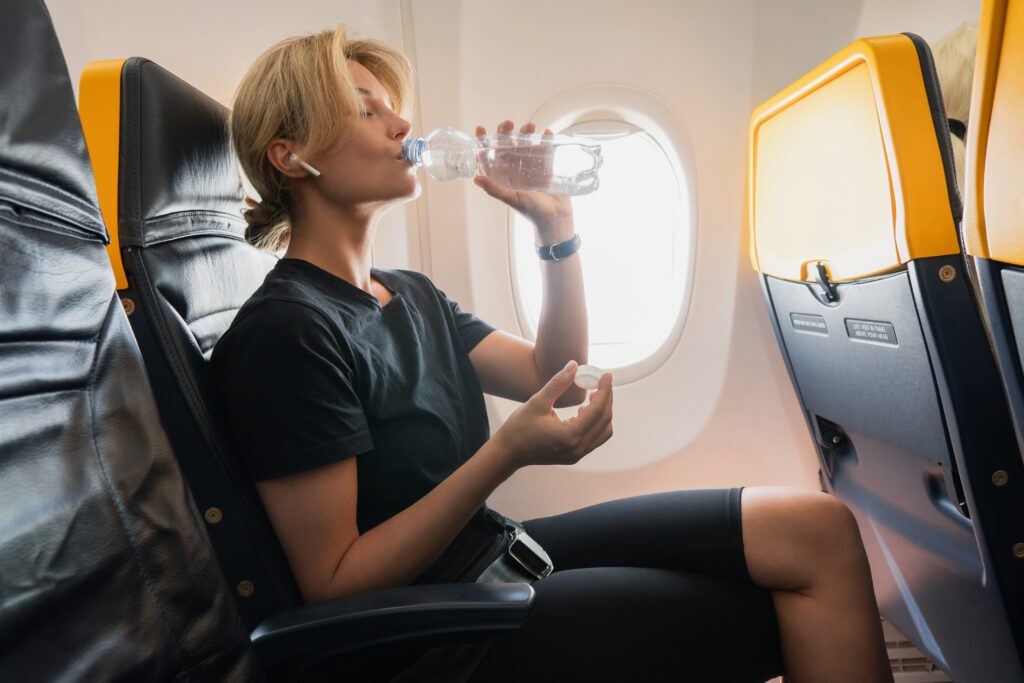
In addition to this, all your small containers together can’t exceed a litre, and need to fit in one resealable, transparent bag.
However, good news if you’re flying with a baby or have medical needs: there’s an exception for baby food and medical liquids you’ll need during the flight, which don’t count towards that limit.
Can you bring sharp objects on a flight?
According to Schiphol’s list of prohibited items, sharp objects are only allowed in hand luggage if the sharp part is no longer than 6cm.
Loose razor blades, kitchen knives, and pocket knives all need to go in your checked bag instead.
That 6cm rule covers small scissors, nail files, and tweezers too, so a compact manicure set usually passes fine. If you’re unsure, measure it before you leave home rather than finding out at the gate.
Can you bring your medication in your hand luggage?
Yes, in most cases, you can travel freely with your medicines. Pharmacists generally recommend packing them in your hand luggage rather than checked bags, since the hold can get cold enough to affect them.

That being said, it gets more complicated for medication covered by the Dutch Opiumwet (Opium Act), which includes some strong painkillers, sleeping pills, and ADHD medication.
For these, you need a medicine declaration, which you request through the CAK (Centraal Administratie Kantoor, the Dutch body that handles this paperwork). You can check exactly which declaration applies to your situation using the CAK’s online tool.
A general medication overview from your pharmacy isn’t enough on its own for these controlled substances; you’ll need the official declaration itself.
What about power banks and other electronics?
Laptops, tablets, and phones are all fine in your hand luggage, and thanks to modern scanners at Schiphol, they often don’t even need to come out of your bag anymore.
(I like popping my electronics and chargers in a large Ziploc bag, so they’re easily accessible in my backpack if security ever wants to check.)
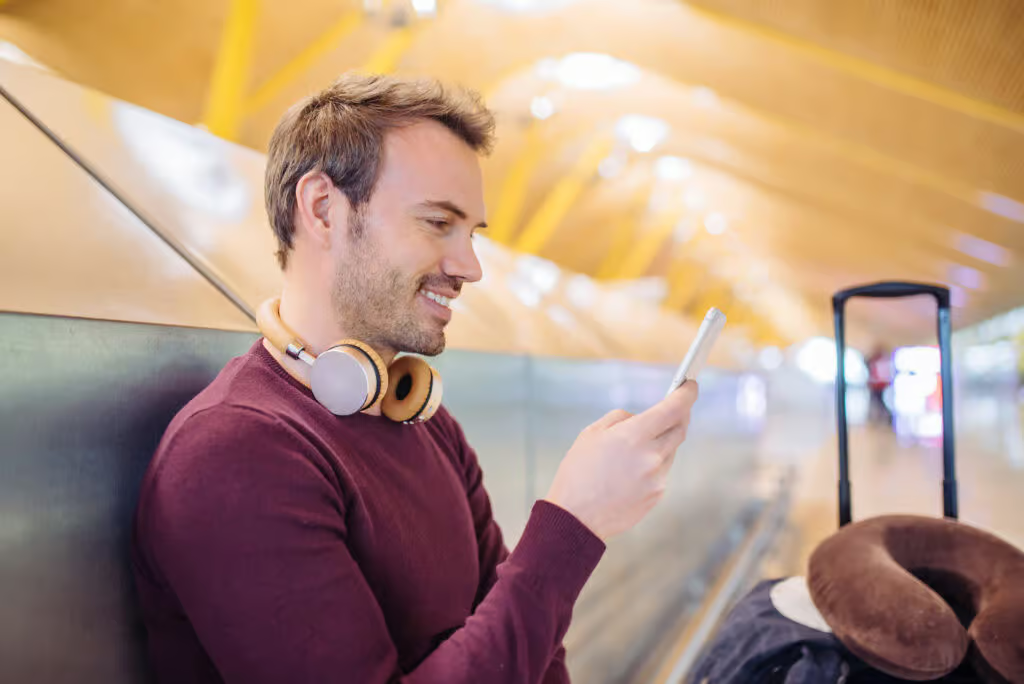
Power banks are a different story, and the rules depend on the airline.

Under KLM’s policy, you can bring devices with a lithium battery of up to 100 Wh, up to 20 spare batteries in total. However, because power banks count as spare batteries, they are generally capped at two per person.
Let op: Anything between 100 and 160 Wh needs prior permission, and anything above 160 Wh is never allowed.
Unlike medication, you have to pack power banks in your hand luggage. For many airlines, you can’t charge devices with them or store them in the overhead bin during the flight.
What can you bring back into the Netherlands duty-free?
Are you back from your (hopefully fabulous!) holiday? Welkom terug! Certain rules apply to what you’ve brought back with you, so let’s dive in.
If you’re arriving from outside the EU, Dutch customs (Douane) allows goods worth up to €430 per person tax-free. Anything above that, and you owe import duties and VAT on the full amount, not just the excess.
Alcohol has its own separate allowance. You can bring in a maximum of 1 litre of strong spirits above 22% alcohol, or 2 litres of lighter drinks like liqueur or sparkling wine.
You can also mix the two proportionally, per Douane’s guidance. So if you’ve got 0.5 litres of spirits and 1 litre of sparkling wine, you’re good to go.
Go over these limits, and you’re required to declare the goods at the “Goods to declare” exit, rather than sailing freely through the green channel.
Ever had something confiscated at Schiphol that genuinely surprised you? Tell us what it was in the comments below.