

Who run the world? As Beyoncé wisely said, girls. But which ones paved the way? The answer many Dutch women will give you is: the Dolle Mina’s.
There’s no denying it, Dutch women are feisty. They’re known for their direct and confident nature, characteristics women are often told not to possess.
And the Dolle Mina’s? They helped pave the way for Dutch women to be unapologetically themselves.
Who are they?
You may have seen evidence of this mighty feminist group before, even without knowing. For instance, if you’ve ever seen this sign:
Or, though this may be more niche, if you’ve ever seen women’s brassieres hanging from windows or flagpoles!
The gutsy Dutch group was established in 1969 to protest traditional gender roles and the unequal treatment of men and women in professional spaces.

The demands of the Dolle Mina’s were many: access to abortion, equal childcare expectations, support for single mothers, and more.
Their tongue-in-cheek protest nature, which involved burning corsets, body paint, and even public playpens, brought them attention within the Netherlands and beyond.
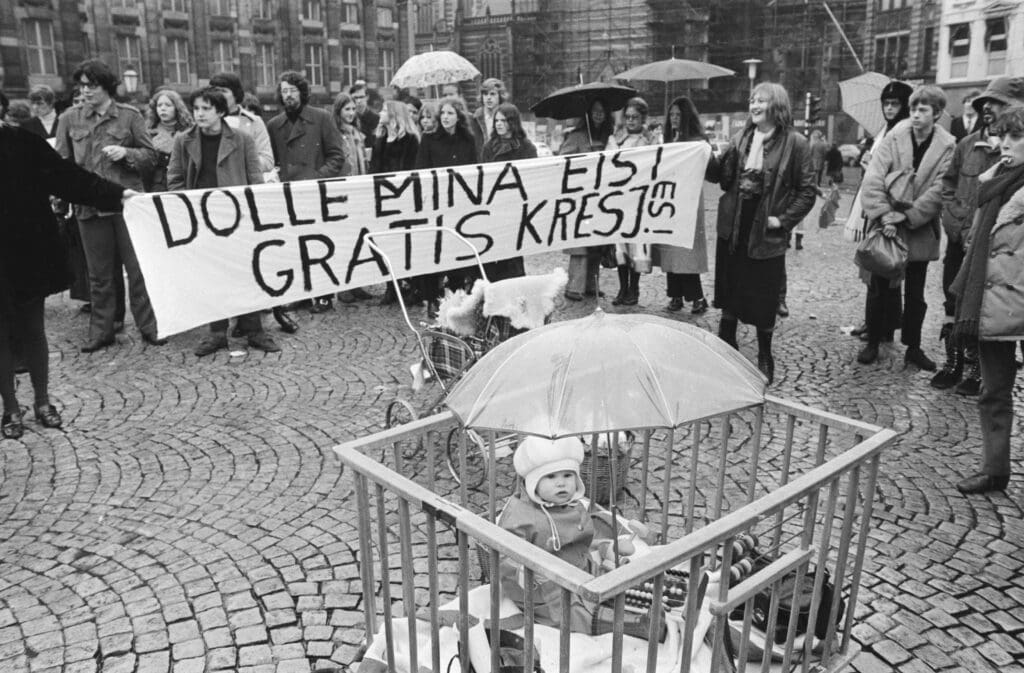
For instance, they even garnered recognition in the US with this piece from The New York Times, published in 1970.
Safe to say, the Dolle Mina’s are a squad worth knowing about.
What did they achieve?
Oh, plenty.
The group is credited with motivating women’s helplines, shelters, and support systems, and with increasing women’s studies at universities during this period.
Their innovative protests and specific goals made them a force of nature. From breaking into a gynaecology conference in Utrecht to distributing condoms at Domestic Science Schools, no action was too big or too small.
While the group was a staple of Dutch protest movements and post-war feminism for close to a decade, a loss of momentum led them astray. The Dolle Mina’s were no longer in the limelight.
Despite their impact, the impressive group had all but disappeared by 1980. That is, until this past spring, when everything changed.
Mina’s return
You may be wondering, if this group is from the 1970’s, why am I hearing about it now?
Well, dear reader, the Dolle Mina’s have returned, and they’re bringing their demands into the 21st century.
In early 2025, an Instagram account by the name of “dollemina2025” created its first post:
The image showed one of the original Dolle Mina protests for abortion rights, depicting a young woman with the phrase “Baas in eigen buik” (boss in my own belly) painted on her stomach.
It’s a famous picture — the bare-stomach protests were one of the Dolle Mina’s first widely recognised initiatives.
This post marked the reignition of the Dolle Mina action group in 2025, 55 years after its inception.
Since then, the account has amassed tens of thousands of followers, and similar accounts such as “dolleminaleiden” and “dolleminaamsterdam” have emerged.
These platforms, which function as information sources for members and interested parties, are just a small piece of the action. Protests like the anti-femicide event in Rotterdam last August attracted hundreds of activists.
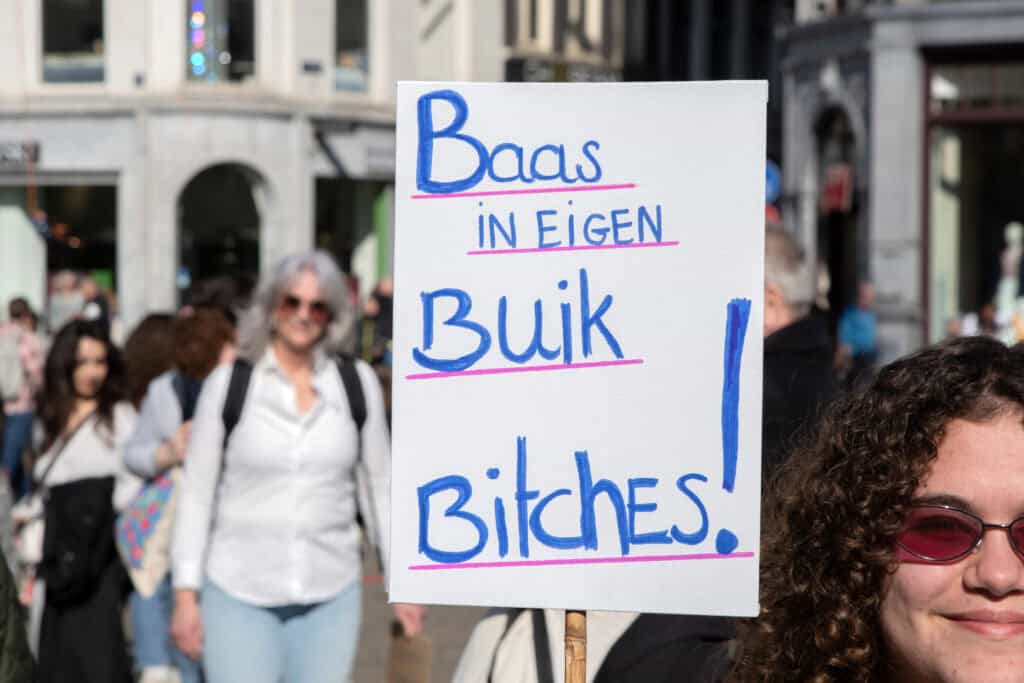
The Dolle Mina’s have returned, and they’re feistier than ever.
Why are they back?
According to the group’s revivalists, which includes both new and original members, there is too much at stake not to react.
Speaking with NOS, Mina member Sia Hermanides says “the fight isn’t over yet,” and that while the original activist group laid vital groundwork, the younger generation’s Dolle Mina’s aren’t quite finished.
While the Netherlands is a highly developed and generally gender-equal country, the last few years have proved that women’s safety and development are at risk (yes, even here).
READ MORE | Cheese, tulips, and… inequality? Dutch gender pay gap widens
The list of worries is long. The most recent Dutch government enacted budget cuts and repeals of resources dedicated to gender equality back in 2025. Online misogyny is rampant across the globe. 45% of women and girls surveyed in the Netherlands still report experiences of sexual harassment or physical violence.
The older Dolle Mina issues are still on the docket, too. Abortion, while accessible in the Netherlands, is still officially listed in the criminal code. And with the recent repeal of Roe v. Wade in the US, the Dolle Mina’s are fearful that the legality of abortion could come into question here, too.
Additionally, femicide rates are stagnating instead of decreasing — here, a woman becomes a victim of femicide every 8 days on average.
It’s issues like these, their website indicates, that make independent and self-organising feminist groups essential in a contemporary context.
How has it changed?
The Dolle Mina’s 2.0 are not replicas, however.
Dunya Verwey, one of the original Dolle Minas, says, “Dolle Mina is rejuvenating!” when speaking to EenVandaag.
What does that mean, exactly? More intersectionality and innovation, it seems.
The group today has emphasised new tactics, additional resources, and inclusivity. Issues around LGBTQ+ rights and safety in the Netherlands are being equally elevated, along with discussions of race and wealth disparity.
The organisation is also becoming more determined: Dolle Mina’s meet every Monday of the month, and individual cities are represented by local factions of the overall organisation.
Their online presence is a true asset for the renewed group. The ability to communicate action plans, information, and enthusiasm for the cause helps them stay at the forefront of people’s minds.
In other words, they are dead-set on maintaining their momentum. Clearly, lessons were learned from their foremothers.
How can I support the Dolle Mina’s?
If you’re hoping to get involved or simply learn more, look no further.
The Dolle Mina’s are always looking for new members and supporters, so they’ve made themselves as accessible as possible.
From the general website to the city-based Instagram accounts, there’s no shortage of information about their upcoming agenda.
You’ll find it very easy to see the who, what, and where of their next meeting.
What’s next?
The future of the Dolle Mina’s looks bright. The group is actively growing and gaining national media attention, and has already been credited with sparking political discourse on women’s safety.
Of course, not everything is happy and shiny. Harassment and violence have also been directed at the returning group.
At a “We Claim the Night” protest back in September, women reported being booed, chased, and spat at by (male) anti-protesters. They even threw eggs, according to NOS.
READ MORE | Participants of “We claim the night” protest were spat at, chased and sexually harassed by men
A silver lining to this, however? It shows the Netherlands exactly why the Dolle Mina’s are so vital.
There is immense beauty in a seemingly lost activist group springing back to life in this momentous way. Not only does it emphasise the resilience and necessity of organised action, but it ties generations of Dutch women together like never before.
Women and girls deserve better. That’s exactly why the Dolle Mina’s are here to stay.
What do you think of Dolle Mina’s return? Let us know in the comments!
Feature Image: Anefo, Rob Mieremet/Wikimedia Commons/Public Domain