
✍🏻 Written by Lise-Milou Lagerwerf, family law expert at GMW lawyers.
Before you get married in the Netherlands, you should be aware of the consequences of this romantic but also legal commitment you are entering into.
While getting married is a beautiful thing, its implications may vary depending on the country where the marriage is entered.
So, what are the legal implications of getting married in the Netherlands?
We spoke with the experts at GMW lawyers to learn more about this. Their experts are happy to help internationals navigate the legal matters of their marriage. Here’s what they had to say. 👇
First things first, who can get married in the Netherlands?
Getting married here isn’t as simple as getting down on one knee, saying yes, and running to a courthouse. To be eligible to get married in the Netherlands, you must first meet the following conditions:
- You and your partner are 18 years old or older. Are you younger than 18 and getting married outside of the Netherlands? In that case, the government will only recognise the marriage once you are both 18 years of age.
- Neither you nor your partner may already be married to or in a registered partnership with someone else.
- Neither you nor your partner is under guardianship. Are you or your partner under guardianship? Then you need permission from the guardian or the subdistrict court.
- You and your partner are not related.
- Are you and your partner cousins, uncles or aunts? Then you may only marry if you and your partner declare that you are both freely choosing to marry or enter into a registered partnership. To do so, you must make a sworn statement before the registrar.
We want a religious wedding ceremony — what legal consequences will this have?
If you want to have a religious wedding ceremony in the Netherlands, it’s important to know that, according to Dutch law, a marriage is only valid if it is conducted by a civil registrar.
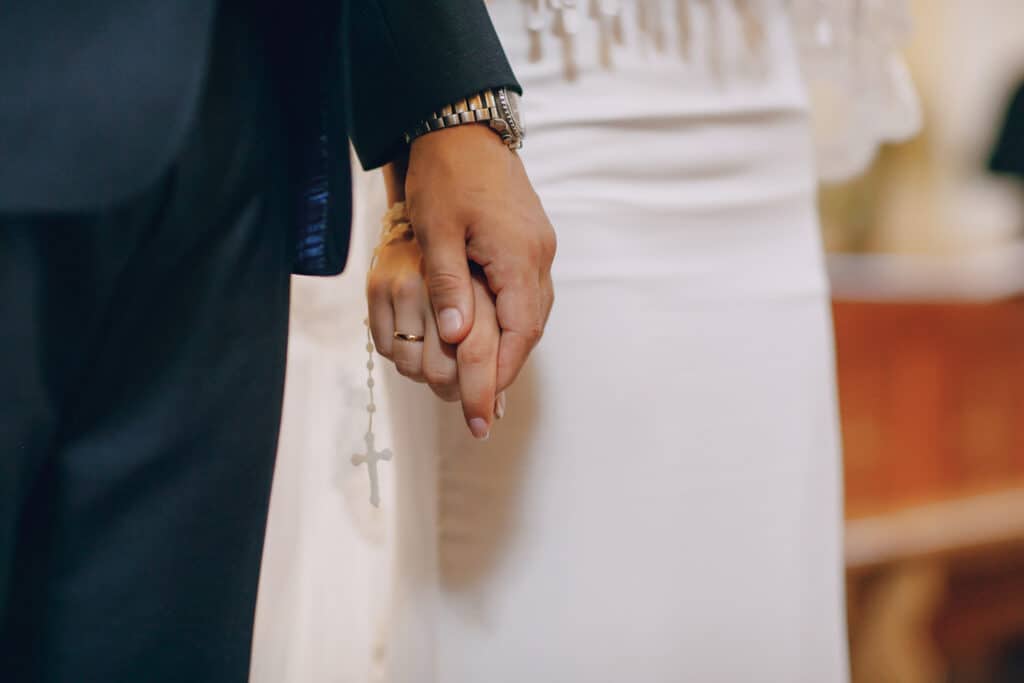
This is referred to as a civil marriage. A religious marriage may only take place after the civil marriage has been concluded.
This is to prevent couples from entering into a religious marriage only. A religious marriage can have adverse consequences for one or both spouses.
The financial consequences of getting married in the Netherlands
Of course, marriage also has consequences for the distribution of your assets. If you marry in the Netherlands without a prenuptial agreement and continue to live in the Netherlands after the marriage, Dutch law may apply to your marital property by default.
If Dutch law applies, you are married in limited community of property:
- This means that the assets and debts you had before the marriage are private assets.
- Assets accumulated during the marriage and debts incurred (regardless of whose name they are in) are considered joint assets.
And what if you get divorced? In this case, both joint property and debts accumulated during the marriage are divided equally.
However, property acquired during the marriage through inheritance and/or gifts is considered private property under this system and will not be divided in the event of divorce.
READ MORE | Divorces in the Netherlands: All you need to know
Getting married in the Netherlands also has consequences for the pension you accrue during the marriage.
The principle in the Netherlands is that you are entitled to half of the pension built up by the other spouse during the marriage.
What if you want something different for your assets? Geen probleem, you can draw up a prenuptial agreement with a notary before or during the marriage. As part of this, you can opt for a different system that applies to your assets during the marriage.
What are the legal consequences of a registered partnership vs a marriage in the Netherlands?
Unsure of whether or not to enter into a civil partnership or get married? Well, it’s good to know that in the Netherlands, many of the legal consequences of a registered partnership are the same as the rights and obligations of a marriage.
In both a marriage and a registered partnership, you are obliged to provide each other with the necessary provisions.
Since January 1, 2018, if you enter into a registered partnership without making partnership conditions, you enter into a registered partnership in limited community of property.
As with a marriage, all your and your partner’s assets and liabilities become common from that moment, except for inheritances and gifts obtained.
READ MORE | Should I use a mediator when ending a relationship in the Netherlands? Here’s an expert’s opinion
You can also choose to draw up partnership conditions. In this agreement, just as with a prenuptial agreement, you can arrange your finances in the way you wish should you ever separate.
If you and your partner have a child within the registered partnership, the consequences are also the same as with a marriage.
If there is no will, you automatically become each other’s heirs, and you can choose to bear each other’s name.
Nevertheless, there are still a few differences between marriage and registered partnership.
- If you do not have children and you both want to terminate the registered partnership, you can do so without the intervention of a judge.
Instead, you can go to a civil-law notary or a lawyer to dissolve the registered partnership. When dissolving a marriage, on the other hand, you always have to go to court. - However, if you want to have your registered partnership dissolved and you do have children together, you must draw up a parenting plan and go to court. (Just as you would if you were married.)
- Unlike when you get married, you cannot legally separate if you are in a registered partnership. It is also possible to have a registered partnership converted into a marriage. However, this is not possible the other way around.
A legal separation is where you remain legally married, but live separately. You may then choose to reconcile with your partner or decide to proceed with a divorce.
Surname choices after marriage
Excited to take on a super Dutch surname? Or rejecting it completely? If you are married, you don’t have to take on your partner’s surname. If you choose to, here’s what you need to know:
You can register this name with your local authority in the Basisregistratie Personen (BRP). This is for everyday use; your official surname will not change. You do not need your partner’s permission to do this.
You have three options for using your partner’s surname:
- Your partner’s name first, followed by your own name
- Your own name first, followed by your partner’s name
- Your partner’s name instead of your own name
You do not have to choose the same surname as your partner, and your official surname will always appear on official documents, such as your passport or driving licence.
Duty of support
If you marry in the Netherlands, Dutch law requires you to provide for each other as spouses. This includes both material and immaterial support. Spouses are obliged to support each other financially.
This can be done, for example, by paying household expenses or providing pocket money.
After divorce, a maintenance obligation towards the former spouse may also arise. Under Dutch law, this maintenance obligation cannot be excluded by contract.
READ MORE | Everything you need to know about mediators in the Netherlands
This means that, unlike other countries, in the Netherlands, you can’t agree in a prenuptial agreement that no spousal support will be paid in the event of divorce.
Parental rights and responsibilities
If you have children during the marriage, both you and your partner are, by default, the legal parents of the child. The child does not need to be legally acknowledged.

As a result of the marriage, you both have parental authority over your children. Put simply, this means you are obligated to make decisions about your children together. For example, you must both give permission for medical decisions, or for relocating and enrolling your children at school.
Want to know more about the legal consequences of getting married in the Netherlands? GMW lawyers’ experts have years of experience guiding internationals through the Dutch legal landscape. Contact them now.
Congratulations on your upcoming adventure, and here’s to the many exciting chapters that will follow. 🥳
Have you been married in the Netherlands? Tell us about your experience with the legalities in the comments below.