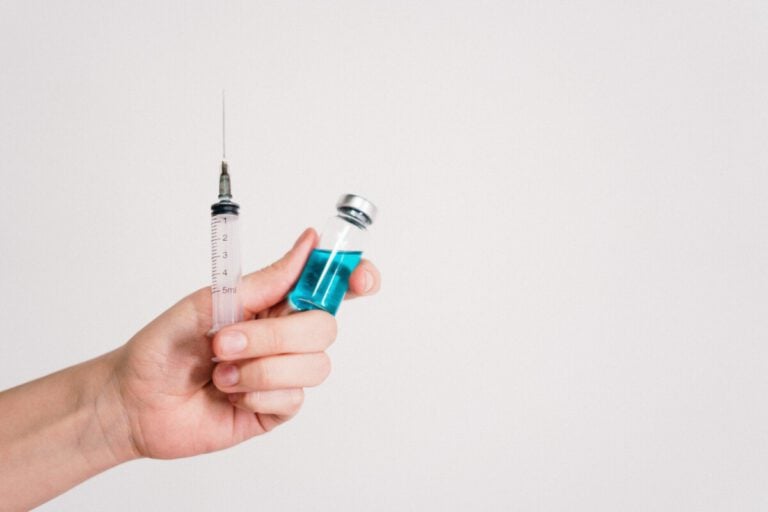
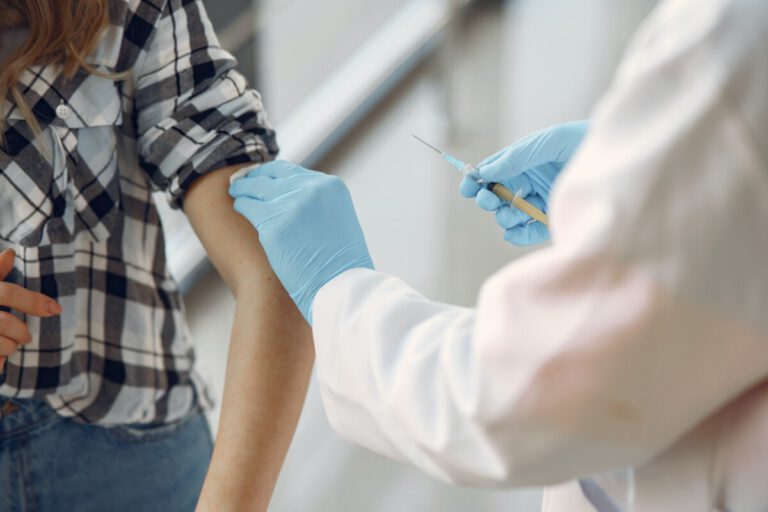
Decommissioned Minister for Health Hugo De Jonge has said that anyone in the Netherlands who wants a coronavirus vaccine will have received at least their first jab by July.
He claimed this last night on the Dutch TV programme OP1, the NOS reports. When asked about how he thought the Dutch vaccination campaign was going, this was De Jonge’s response.
He believes that if there are no delays in receiving deliveries from pharmaceutical companies, 80-85% of adults in the Netherlands will have received at least one shot of the coronavirus vaccine.
Many will be fully vaccinated
Of this percentage, the minister calculated that two-thirds (approximately 8 million people) should have received two doses of the vaccine by the beginning of July. The remainder (4 million) will have received at least one dose.
Dependant on setbacks
Of course, this is only achievable so long as there aren’t delays along the distributive chain, the minister made sure to emphasise.
However, De Jonge did take a moment to point out that the Netherlands reached its millionth vaccine this month (1.8 million to be exact). All going well, the country will see two million vaccines given by mid-March and the three million vaccines “on the March/April threshold.”
Are you feeling hopeful? Let us know your thoughts in the comments below!
Expats who come to work in the Netherlands are often faced with both a culture shock and a language barrier.
The Dutch are famously blunt: expect your work to be criticized, regardless of your position on the corporate ladder, by some mumbling Dutchman without a grasp of proper English, claiming you’re “walking off the sides.”
It stands to reason then that you must be armed with some essential phrases for prospering — or at least understanding — the Dutch workplace.
Here’s all you need to know about speaking Dutch at work.
De kantjes er vanaf lopen
So you woke up Monday morning still hungover from a weekend-long bender in Amsterdam. You arrive at work half an hour late, wearing the darkest sunglasses you could find, hair a mess and clothes still smelling like tobacco (or something else…?) and beer.
While no self-respecting Dutchman would hold that against you, be prepared to face some backhanded comments if your work suffers under your evening activities.
Your colleagues may inform you that you’re “de kantjes eraf aan het lopen bent.” This translates literally to “walking off the sides” and is meant to convey that you’re dodging the hard work taking place in the middle, or at least doing your job half-heartedly.
Met een Jantje-van-Leiden er vanaf maken
The Dutch language contains many phrases like “de kantjes er vanaf lopen” which essentially mean the same thing. Take for instance “met een Jantje-van-Leiden er vanaf maken,” a phrase which essentially means “Pulling a Jantje-van-Leiden.” The phrase is named after Jan van Leiden, a smooth-talking, sly Dutchman born in 1509.
He was so universally acknowledged for being a dishonest Ne’er-do-well that 500 years after being murdered for it, his name is still synonymous with a bad work ethic. No-one holds grudges quite like the Dutch.
Met de pet ernaar gooien
Finally, there is “met de pet ernaar gooien,” which translates to “throwing the hat at it.” The phrase comes from a Dutch children’s game of yore, where Dutchlings would throw their hats at butterflies to try to catch them (the bug net was a late invention in the Netherlands).
Of course, the Dutch children usually failed in catching butterflies, as they are notoriously hard to trap by throwing headwear at them. The phrase has survived through the ages and now is used in the workplace to tell people off for being unwilling to put in the effort.
While the Dutch will definitely let you know if your work has been subpar, they’ll also gladly tell you how well you’re doing and to stick up for yourself.
The phrase “laat de kaas niet van je brood eten” is an example of this and roughly translates to “don’t let them eat the cheese off your bread.”
If someone tells you this, it means you should take credit for your work rather than letting someone else get away with honour which should be rightfully yours!
De handen uit de mouwen steken
“De handen uit de mouwen steken” is a phrase you’re likely to hear when your colleagues are running around in a panic because of that one deadline which seemed so far off, yet is now by some arcane magic due tomorrow.
It is also one of the few phrases which has an equivalent in English, similar to “roll up the sleeves.”
Have you been practising speaking Dutch at work? Let us know in the comments below!
Feature Image: CoWomen/Pexels Editor’s Note: This article was originally published in August 2017, but was fully updated in March 2021 for your reading pleasure.
The RIVM has released its weekly coronavirus figures for the period of February 24 to March 2. The number of infections has risen slightly compared to the previous week.
A press conference will be held on Monday, March 8. All current measures will remain in place until at least March 15.
New number of infections
Over the past week, the RIVM reported 31,984 new infections in the Netherlands. This is an increase compared to the previous week’s number of 29,977 new infections.
Deaths
The number of patients who have died from COVID-19-related complications has slightly decreased. This week 309 people passed away, compared to 418 people the previous week.
Hospitalisations
Hospitalisations are going down, however, the number of admissions to the ICU has gone down. The past week saw 1,133 new admissions to the nursing ward and 224 new patients in the ICU. The week before, there were 1,140 and 240, respectively.
The Dutch government remains concerned over the new variants of coronavirus as well as the third wave of infections, and as such, strict measures are likely to remain in place in the Netherlands for the foreseeable future.
New vaccines
As of March 2, more than 1.8 million people in the Netherlands received their first dose of the coronavirus vaccination. This puts the Netherlands in fourth place in the EU for the number of first doses administered.
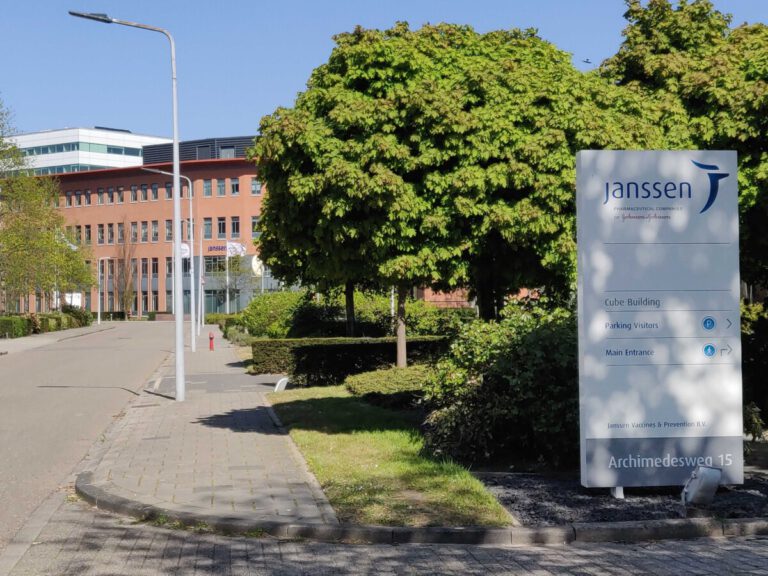
The Netherlands is also set to receive 11.3 million doses of the Janssen vaccine. This vaccine was partly developed in Leiden and only requires recipients to receive one-shot to be protected against coronavirus.
In other coronavirus-related news, here is a quick overview of what happened over the past week.
Hospitality protests against current measures
Today bars, shops, and sex workers are staging protests against coronavirus measures. Bars and restaurants set out tables on their terraces, but are not serving customers in an attempt to waive the €4,000 fine. They are encouraging supporters who gather on terraces to maintain a safe distance.
Sex workers in the Hague are performing a peep-show on the go. This is to protest the fact that sex work is the only contact profession not able to open under the current measures. The protest is taking place now until 6 PM.
Vaccination passport debated
In an EU summit last week, the majority of members were in favour of introducing a vaccination passport. Prime Minister Mark Rutte, is in favour of the passport but believes it is too soon to start developing it.
Rutte told RTL Nieuws that “there are still some major decisions between idea and implementation. This will take a few more months. It won’t happen overnight.”
Follow DutchReview on Facebook for the latest news and coronavirus measures.
Restaurant terraces will open across the Netherlands today and sex workers are to give a peep-show in The Hague.
Both of these acts break current coronavirus regulations. These moves are being made by entrepreneurs to protest against the effect these measures are having on business, and the lack of support from the government, reports RTL Nieuws.
Restaurants and cafés have been closed since October 2020. Today, many of them are opening their terraces despite it being against the law.
Safe protests
In principle, it is a playful action, and people on the terrace are therefore not served. Although Johan de Vos, bar owner and chairman of the Breda department of Koninklijke Horeca Nederland, is still considering doing so. He and dozens of his colleagues will be setting their tables and chairs outside a little after 12 noon. The goal: “We will show that it can be done responsibly, with sufficient distance.”
Almost 100 retailers in Drenthe’s Klazienaveen will be joining the bars and restaurants in their protest, RTL Nieuws also reports. Their doors opened at 9 AM this morning.
Sex show in The Hague
Meanwhile, a group of sex workers will perform a peepshow on wheels between 3 PM and 6 PM in The Hague today. The only contact occupation not allowed to work yet, sex workers, have been excluded from government support for over a year.
The GGD tracks the number of infections occurring in particular sectors, such as education and healthcare. It has not been tracking infection rates amongst sex workers, which makes it unclear how many transmissions occur in this sector.
Fines for sex workers are often much higher than those for the hospitality industry. This puts sex workers in a dangerous situation, and many of them are forced to work in secret in order to make a living.
What do you think? Should these businesses be allowed to open again? Tell us in the comments below!
Much like any language that has existed for centuries, Dutch has lost many of its more charming words and phrases from the olden days.
Some argue most of these losses occurred during the black plague when people tended to stay quiet since most conversations would end up circling to tragic losses, no matter how hard you tried to keep talking about your cats.
Others say this is simply due to times changing. Linguists claim it is a common characteristic of languages to evolve and leave behind lesser-used words in the process. Regardless there are some hidden gems in the ancient Dutch language of yore, and today we shall attempt to give you the tools to insult and/or hold a conversation with a Dutchman from the 1300s.
Swimpie
A word that dates back to medieval times when men were men and everyone died around age 32 due to a lack of dietary knowledge and things like clean water. Swimpie was used to describe the squire to another squire, (effectively a servant’s servant) an exceptionally low position to hold in a feudal system.
There have been very few famous swimpies throughout history, with good reason. Why would you ever want to write about the squire’s squire when you can write about knights? The word got a slight resurgence in the early ’00s when it was used as slang for a loser. Seems some things don’t really change much.
Schobbejak
Schobbejak is another traditional Dutch insult. It stems from a combination of “schubbe” and “jak” which mean scales and jacket respectively. Basically, the word implies that someone is wearing a coat of scales, effectively calling the villain in question a snake.
The word is only used in two situations in contemporary Dutch. The first is by hipsters, who believe using a word that is centuries-old makes them look cool. The second is when people need to insult these same hipsters and use their own language against them. En gard!
Kwipsch
Feeling a bit under the weather and considering calling in sick by sending a messenger pigeon to your 1700’s Dutch merchant boss? You may want to tell him that you’re feeling a bit kwipsch!
The word most closely translates to sickly and was used to describe those who lived in a constant state of weak physical health. Think Théoden in Lord of the Rings, before Gandalf kicked Saruman’s arse, with words.
Natgierig
Perhaps my personal favourite Dutch words of old is natgierig. Taken apart the words nat and gierig mean wet and greedy respectively. Put together they’re used as an adjective to describe someone who really, really enjoys getting drunk. Someone who’s in effect greedy to get wet by imbibing copious amounts of alcohol.
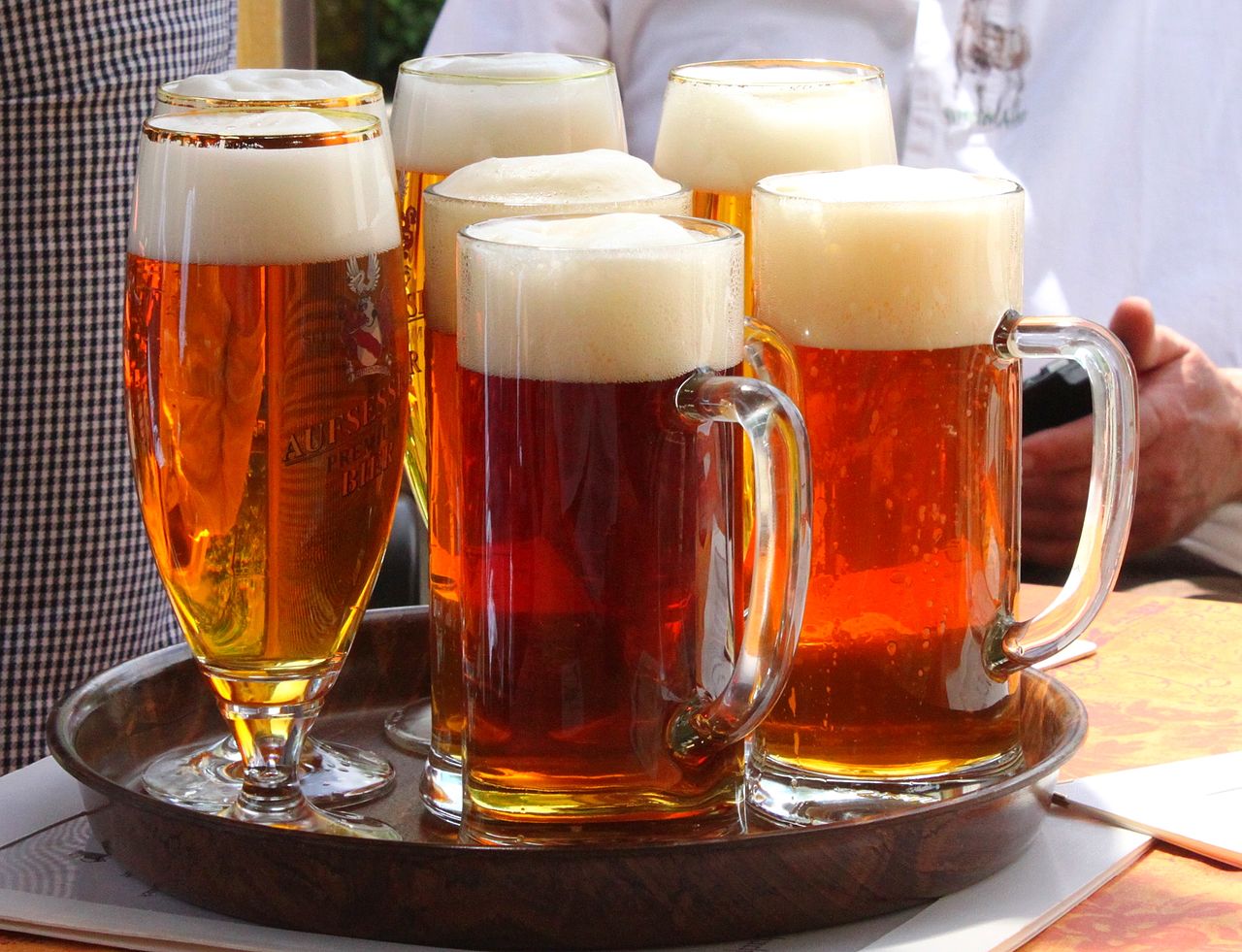
Words may have changed, but enjoying a biertje hasn’t. Image: Benreis/Wikimedia Commons/CC3.0
Leuningbijter
A leuningbijter can be literally translated as “someone who bites armrests”. It was used as a noun to describe a person who, well, never does anything. It is unclear even to the greatest of Dutch linguist what exactly this has to do with biting armrests.
However, the word has been around for quite some time. Rumour has it there are cave drawings in Limburg where people are depicted biting the armrests of chairs, though few can claim to have seen them in person. 😉
Adamiet
Another noun, adamiet is used to describe someone who walks around naked. As in, all the time. Apparently, in the Dutch olden days, people ran around naked so frequently that they needed a word to describe these naturists.
The word stems from Adam, the person most for being naked prior to Kim Kardashian, and “iet” which is a bit like the suffix-ish. Effectively, everyone who walked around naked was Adam-ish and basically biblical. Why is there no word that means Eve-ish you ask? Because of the patriarchy. Now stop asking!
Addergebroed
Addergebroed is another one of those biblical serpent references to Satan and his untrustworthiness. It translates to “spawn of snake”, and while it would still be very much useful to describe our contemporary politicians, for some reason it has fallen out of favour. I blame the politicians for this.
Strapatsen
This one is still in use though not very often. It is used to describe a mischievous prank, usually pulled by Dutch children, such as “belletje lellen” (knock-down-ginger or other based bell ringing pranks).
Goudvinger
This literally translates to goldfinger, and no, medieval Dutchies did predict the 1964 Bond classic. It was used to refer to your ring finger but is a reference to arguably one of the better Bond villains, Goldfinger. Unfortunately, the word has fallen out of use, so don’t try to use it when speaking with your Dutch doctor.
Got any other favourite old Dutch words? Let us know in the comments below!
Editor’s Note: This article was originally published in September 2015, and was fully updated in March 2021 for your reading pleasure. Feature Image: RalfGervink/Pixabay
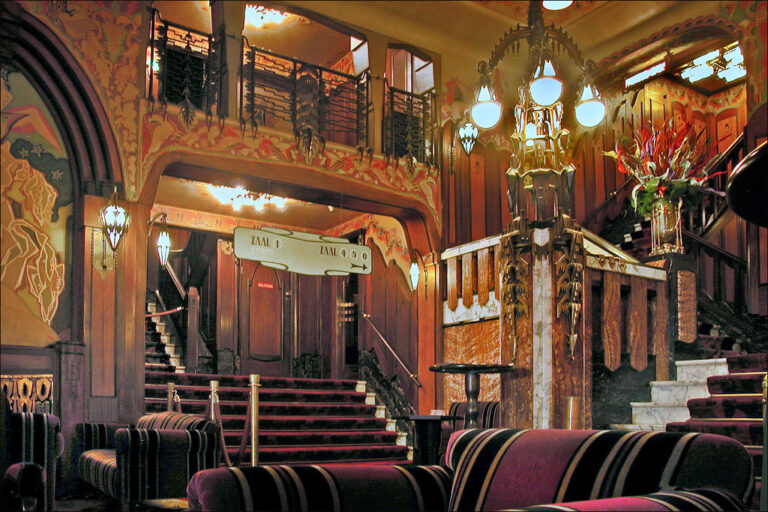
LA better watch out, as Pathé Tuschinski in Amsterdam is named the most beautiful cinema in the world!
The British magazine, Time Out, has bestowed this title on the cinema. One of the magazine’s editors, Phil de Semlyen, encourages readers to “make a pilgrimage to this opulent, historic shrine to the movies.”
The theatre was designed by Abram Icek Tuschinski and it opened its doors in Reguliersbreestraat in October 1921 where it still stands today.
Since then, it has been taken over by the French studio Pathé. It has recently undergone a major renovation to celebrate its 100th birthday. The celebrations were halted by the coronavirus and it is as yet unclear when they will continue, according to the NOS.
More than movies
Despite the cinema getting a revamp, it retains a lot of its old charm. It still has the original Wurlitzer-Strunk organ, and historic paintings adorning the walls. But they did take time jazz up the bar, where the thirsty film nerds can grab a “Pulp Fiction Milkshake”.
Before coronavirus, the theatre regularly streamed live concerts and operas from around the world. At present, the movie theatre is closed like all cinemas in the Netherlands in line with the latest coronavirus measures.
Have visited this national treasure? Let us know in the comments!
Lockdown, winter weather, and windmills: these are the words that come to mind of late when one thinks of the Netherlands. This small country normally conjures images of tulips, Amsterdam’s cannabis scene and, of course, Dutch art masters.
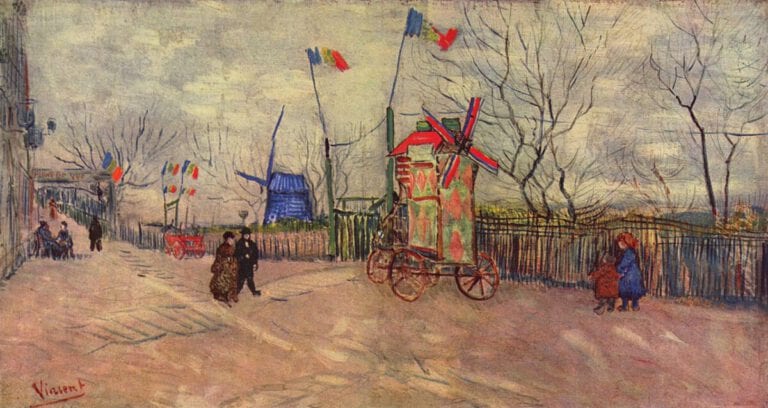
It is no surprise, then, that an unseen Van Gogh is currently dominating Dutch news. The painting, named “Scene de rue a Montmartre” (Street scene in Montmartre), is said to have been painted just three years before this Dutch Master committed suicide in 1890.
After being kept in the private collection of a (lucky!) French family for almost a century, this recently-unveiled masterpiece shows Parisians walking in the popular tourist destination, Montmartre.
Sotheby’s Paris shows an 1887 painting of a Paris street scene “Scene de rue a Montmartre” by Vincent Van Gogh which will be presented to the public for the first time after spending more than a century behind closed doors February 24, 2021. REUTERS/Christian Hartmann pic.twitter.com/rKw4fdWeac
The painting is part of a series of works depicting the famous Moulin de la Galette windmill-turned-dance hall. Van Gogh’s hidden gem encapsulates the atmosphere of pre-industrial rural France.
Van Gogh in Paris
Having arrived in Paris in 1886 and staying with his confidant and brother, Theo, Van Gogh was attracted to the cheap rates of the up-and-coming art scene in Montmartre which is now known for the Sacre Coeur Church.
However, after living there for just two years, Van Gogh became wary of the busy Paris life and moved to Arles, France.
Up for auction
The sale of “Street scene in Montmartre” is being handled by Sotheby’s in Paris where it will be auctioned on March 25. Before arriving in France at the end of March, the work will be publicly displayed in Amsterdam and Hong Kong.
The auction house has placed an estimated value between €5 million and €8 million on this Van Gogh, which has not actually been seen in public but has been catalogued.
Small, mostly black-and-white, reproductions of this painting have been made in the past, but now the world can marvel at the unveiled colour-masterpiece of this once-hidden work!
Who said 2021 had to be all bad! Are you excited to hear about this painting?
A simple walk around one of the many Amsterdam canals with a keen eye for waste and the plastic leaves one feeling ashamed. Plastic bottles, plastic cups, tons of plastic packaging. Plastic is literally everywhere.
According to Waternet, 3,500 kg of waste is removed from Amsterdam waterways canals every day. The litter (plastic included) usually piles up behind moored boats, inside old and forgotten ones, at the corners of canals, or under bridges. Plastic is an extraordinarily versatile product, but we are all drowning in it. Here’s how you can help to reduce the amount of plastic in Amsterdam’s waters by plastic fishing.
Taking action: How can I go plastic fishing in Amsterdam?
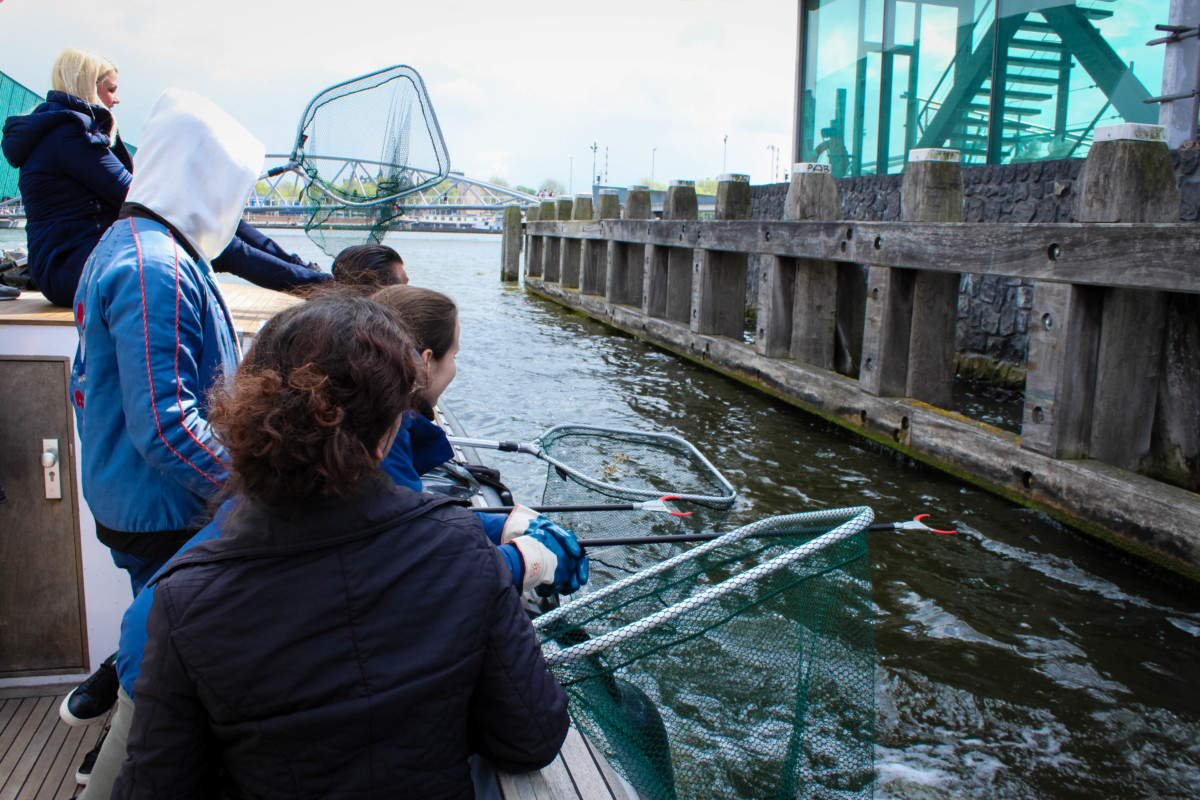
It is just as simple as it sounds — gather a group, get the tools, and go for it! After all, fishing for plastic is a rewarding activity in more ways than one: you help cleaning the waste from the canals and at the same time have fun doing an activity together as a team.
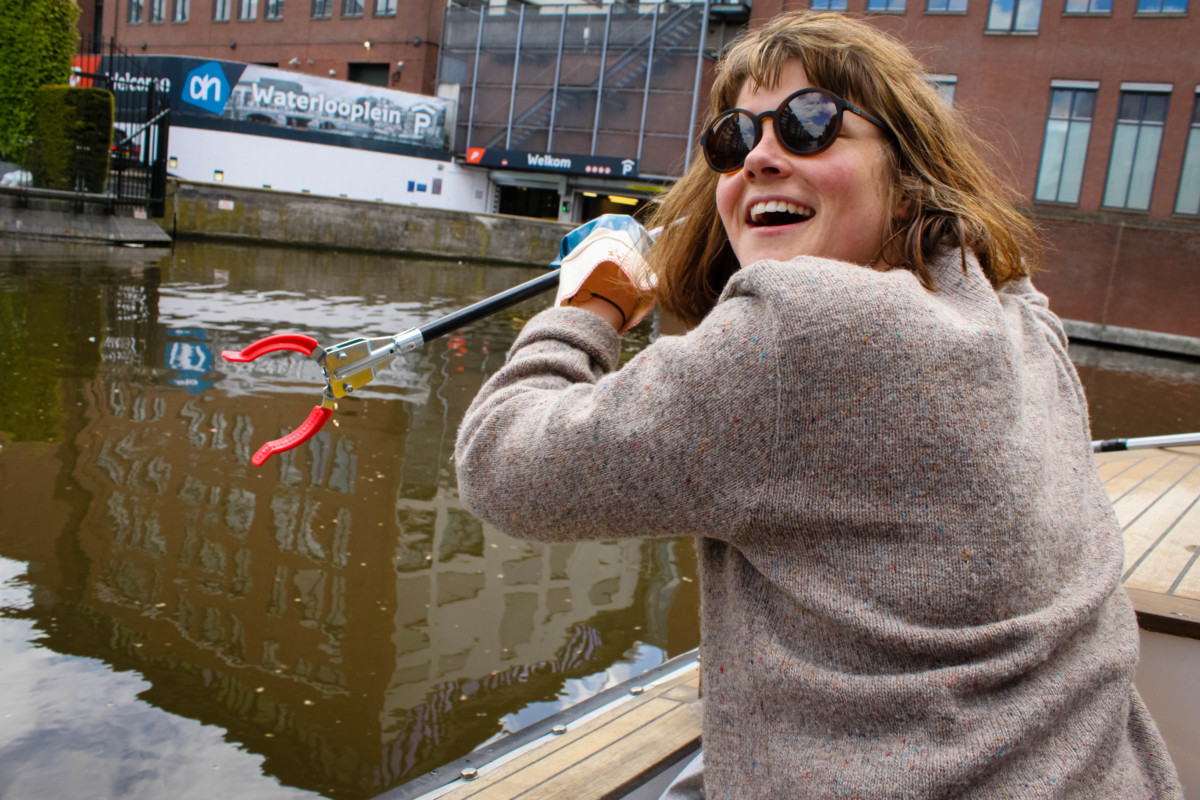
Fishing for plastic requires neither a large investment in special equipment nor any previous fishing knowledge. You can try to get some equipment from the Gemeente, such as fishing nets and rubbish pickers. If you plan on becoming an active plastic fisherman, you may wish to invest in your own tools. The prices range from about €5 for a rubbish picker to approximately €10 for a fishing net.
What about the boat?
There are numerous organizations in Amsterdam that you can rent a boat from. The choice of boats to pick from ranges from little electric ones that you can steer yourself to larger ones with a steersman to ride it for you and your team.
Simply try to find what works best for you personally — budget-wise and in terms of availability and routes. Depending on the company you end up going for, they might make arrangements for food and drinks. The possibilities are endless, and in the end, it all comes down to your personal preference.
Are there guided tours for plastic fishing in Amsterdam?
The short answer is yes, there are! One of them is offered by the Plastic Whale Foundation — a movement of people who are taking action towards a plastic-free ocean. Since 2011, Plastic Whale has been organizing plastic fishing tours around the Amsterdam canals. The unique experience has become quite popular and more than 20,000 people have joined the tours ever since they started.
The plastic collected from Amsterdam’s Canals is used in a creative way to make various items. These include Plastic Whale’s tour boats, as well as furniture, which is part of the Plastic Whale Circular Furniture initiative.
Fishing for plastic as a team-building activity
The best activities are those where the whole group feels happy to participate. The benefits of volunteering on our mental health are unequivocal. Activities done for a good cause encourage the group to act as one, rather than focusing on individual achievements. They can also be a great way to inspire new conversations and attitudes in the workplace.
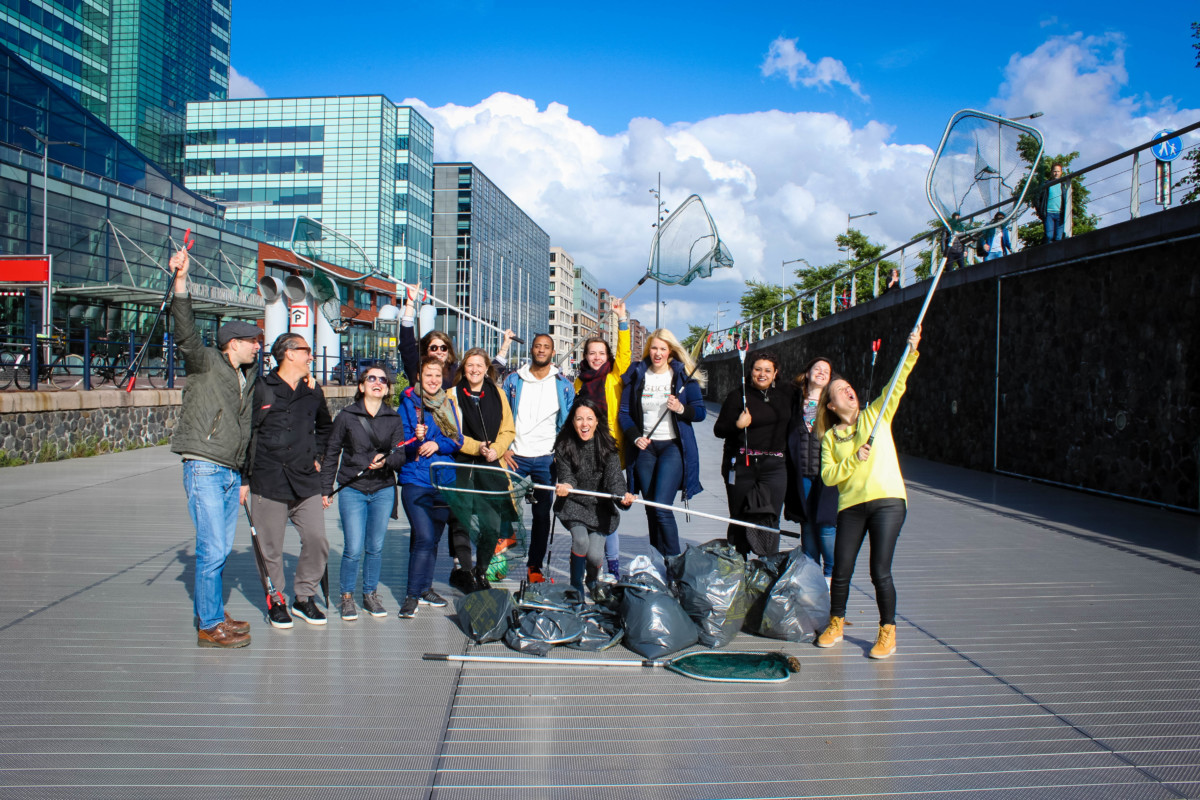
Inspired by the Plastic Whale Foundation, this group of workmates organized their own team-building activity to hunt for plastic in the Amsterdam Canals. With the help of the Gemeente which provided the equipment needed to collect the floating waste, the group managed to collect 10 bags of plastic litter within two hours. The collected items included bottles, crisps packages, toothbrushes, snack containers, and much more.
Plastic Fishing in Amsterdam team building activity. Image: Maria RozhdestvenskayaPlastic Fishing in Amsterdam. Image: Maria Rozhdestvenskaya” I think is a great exercise to make us aware – How our choices and actions affect the environment around us and further away” – Helena Olsen is from New Zealand – Living in the Netherlands since 2015. Image: Maria Rozhdestvenskaya
Will a single plastic fishing tour solve the problem?
The answer is obviously no. However, the bottom line is that waste comes from us. We are the source of plastic pollution, and every person has the power and responsibility to prevent plastics from ending up in the sea. With this in mind, behavioral change is the first step to divert from single-use plastic products.
The versatile & durable characteristics of plastic make it an attractive material for producers and consumers. However, mass production is only adding to the environmental crisis. As individuals, we all have the power to make small changes to tackle the problem.
For instance, try avoiding single-use coffee cups or take your own reusable bag to do groceries. Change from single-use containers to refillable bottles and reject (free) plastic gifts at the supermarket. Or as we suggested above, you can also try to collect plastic waste yourself, especially when it is disposed of close to the sea.
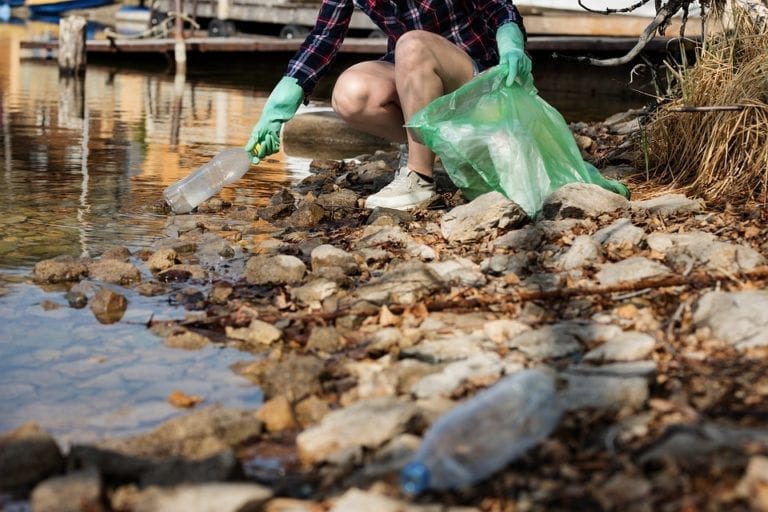
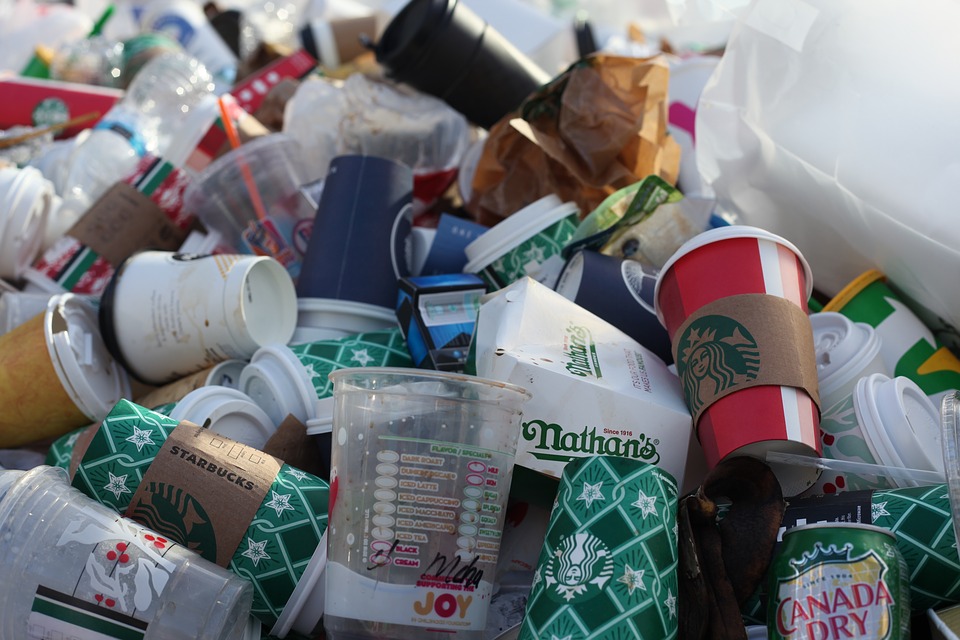
Cups and bottles are common types of plastic waste. Image: Jasmin Seeler/Pixabay
Organizations in the Netherlands fighting plastic pollution
The Plastic Soup Foundation: With a clear mission of ‘No plastic waste in our water!’ the Plastic Soup Foundation tackles the issue at all fronts. They work with innovative solutions, educational programs, and also promote a deeper understanding of the problem of plastic pollution.
Grondstofjutters: Grondstofjutters focuses on organizing projects that put the principles of the circular economy into practice. For instance, they help to get young people involved with the issue through special programs where students work as researchers and advisors for the municipality. By identifying and creating concrete solutions for their own city, they can make an impact as a team.
The Ocean Cleanup: This is perhaps the most ambitious project of all time. The Ocean Cleanup designed a structure to collect plastic waste directly from the sea which relies on the power of ocean currents. Their ambitious goal is to remove 90% of floating ocean plastic.
Stichting Noordzee: The Dutch North Sea establishment’s goal is to preserve the North Sea. Stichting Noordzee focuses on the preservation of the sea, sustainable fishing, renewable power sources (wind stops), and waste reduction. One example of their activities is called the ‘shoreline tidy up’, where volunteers come together to clean the Dutch coast.
Ghost Fishing: The diving community has also stepped in with the Ghost Fishing initiative. Abandoned fishing nets not only kill marine life but can also be dangerous for scuba divers. Formed by experienced divers, Ghost Fishing help removing marine debris from the sea and also raise awareness about the issue.
Have you taken any steps to help tackle the plastic soup? Let us know in the comments below!
Feature Image: Nastya Gepp/Pixabay Editor’s Note: This article was originally published in May 2019, and was fully updated in March 2021 for your reading pleasure.
Things are finally looking up for the Dutch vaccination strategy. This is partly because the Netherlands is one step closer to receiving 11.3 million doses of the Janssen vaccine. The vaccine requires only one dose in order to immunise recipients against coronavirus.
The Janssen vaccine has already been approved for use in the US with 20 million citizens expected to receive the shot. Soon, the European Medicine Agency (EMA) will make a decision about whether or not the vaccine is approved for EU citizens.
This EMA is expected to give their decision on March 11 and the Netherlands has already bought 11.3 million doses for when the green light is given. All going well, it is expected that the doses of the Janssen vaccine will be given within the second quarter of 2021.
What is the Janssen vaccine?
The Janssen vaccine was partly developed and produced in Leiden. The Janssen pharmaceutical company made use of their previous research into an Ebola vaccine in order to produce a successful coronavirus vaccine.
There are two reasons why the Janssen vaccine is at an advantage to other coronavirus vaccines. Firstly, it requires only one dose in order to prevent against a serious case of coronavirus.
Secondly, the Janssen vaccine is much easier to store compared to other vaccines. For example, unlike the Pfizer vaccine — which needs to be stored at -80 degrees celsius — the Janssen vaccine only needs to be stored between 2 and 8 degrees.
How effective is the Janssen vaccine?
The vaccine has proven to be 66% effective on average. However, in the US the effectiveness stands at 72%.
Most importantly, the vaccine has proven so far to be 85% effective against a serious case of coronavirus and 100% effective against death by coronavirus.
First doses in April
Whilst the EMA will deliver their decision regarding the vaccine on March 11, the first doses in the Netherlands would not be expected until April. This is because contracts must be drawn up between the EU states and the pharmaceutical company regarding delivery.
The vaccine would then be delivered to the Netherlands in April. However, whether this will happen within the first week is uncertain, a spokeswoman for Janssen tells RTL Nieuws.
US delivery of vaccine does not affect delivery to NL
While the US may have received approval and delivery before the Netherlands, this will not impact the delivery of vaccines to the Netherlands, Janssen has said. The spokeswoman explained that the speed of the delivery to the US has to do with the delivery contracts that were written up.
“With the US on the one hand and the European Commission on the other. Agreements have been made in the contracts about the deliveries” she says.
Regardless, of the number of vaccines going to the US, following EMA approval, the Netherlands is expected to receive its doses once the relevant delivery contracts have been written up in April.
What are your thoughts on the Janssen vaccine? Let us know in the comments below!
After a slow and steady start, the Netherlands picks up the pace on its vaccination programme. Yesterday, the European Centre for Disease Prevention (ECDC) released data showing that the Netherlands is in fourth place amongst EU countries.
As of yesterday, 7% of adults in the Netherlands had received their first injection. Malta pinches the top spot with 10.1%, with Denmark and Finland coming in second and third respectively.
Compared to the data released last Monday, this is a sharp increase in coronavirus vaccinations. Last Monday, 5.6% of the adult population in the Netherlands had received their first dose of the vaccine according to NU.
Not so many fully vaccinated
Despite the Netherlands picking up the pace in giving people their first dose, it’s lagging behind when it comes to adults being fully vaccinated. On Sunday, the EDCD reported that approximately 1.8% of adults in the Netherlands had received both doses of the vaccine.
However, this is an increase from last week’s figures, at which point 1.5% of adults in the Netherlands were fully vaccinated.
New daily record
Minister of Health, Hugo de Jong, announced that last Thursday gave the Netherlands a new daily record — over 50,000 injections administered in one day.
In total, over 1.3 million doses of the vaccine have been given out. The Dutch cabinet hopes to raise the weekly rate to 2.5 million doses by the beginning of the second quarter.
How do you feel about the vaccine timeline? Let us know in the comments below.