Two members of a German far-right extremist group were arrested in Heerlen in the province of Limburg.
The arrest was conducted as part of a large-scale operation by the German police, reports RTL Nieuws.
Goyim Partei Deutschland
It’s believed that one of the people arrested is Fadi J., one of the founding members and leaders of Goyim Partei Deutschland (GPD). The group is known for their antisemitism, as they deny the Holocaust, call for the murder of Jews as well as promoting a Nazi world view. The group conducts most of their existence online, with one of their Facebook groups having 500 members.
Another leading figure was arrested in Berlin. Those who have been arrested will be put on trial this Friday
Love is in the air — or it will be soon, when the Netherlands makes an exemption for loved ones of the Dutch to enter the country again.
People from outside the EU and Schengen area have been banned from entering the lowlands for months. The entry ban left those dating residents of the Netherlands in a difficult position, when borders around the world slammed shut in the wake of coronavirus.
But from July 27, loved ones will be able to enter the Netherlands again. Hallelujah!
Of course, there are restrictions in place (it is the Netherlands after all). Sweethearts will have to meet strict conditions, such as being in a relationship for at least three months. They’ll also have to sign a handwritten statement — and any lies will be punished.
And sadly, it’s not permanent. The visit can last only up to 90 days, and the foreigner has to show a ticket for a return flight upon entry.
Regardless, in a time of uncertainty, we’re all stoked to see that love wins after all. Now go book that ticket, lovebirds!
Will you be reuniting with a loved one under the new rules? Tell us in the comments below!
Initially, when the Dutch border was reopened to UK and EU nationals on July 1, people from Sweden and the UK were strongly advised to go into isolation.
The self-isolation advice was dropped after the UK changed its policy towards the Netherlands, allowing the Dutch to go visit the UK without having to undergo quarantine upon arrival.
The Dutch government continues to change its travel advice as the situation of the coronavirus continues to develop throughout Europe. For example, the status of Bulgaria was changed to orange on Thursday (essential travel only) after a spike of cases in the region.
The advice of self-isolation upon arrival in the Netherlands still applies to Romania, two Portuguese regions and two Spanish regions. However, the advice is not legally binding. Travellers from these countries will need to respect social distancing measures currently in place in the Netherlands.
Sweden has a code orange alongside the Republic of Ireland, which still requires visitors from the Netherlands to self-isolate for 14 days.
Vacationing in 2020 is weird: officially, we can fly (but really don’t want to because, well, corona). So all these touristy places like Venice and Barcelona aren’t as filled up with tourists as they usually are. There’s an upside to this as well, as our own touristy Amsterdam is also nice and tranquil — and we can finally be typical tourists in our own capital.
This year was going to be the busiest year ever for visits to Amsterdam and the hotel business was properly prepping for it. Sadly for them, this isn’t the case. But good for you perhaps, because you can enjoy Amsterdam on the (relatively) cheap.
Many hotels are offering great deals at the moment, and if you’re an international living in Eindhoven or Maastricht — this might be the year to properly visit Amsterdam.
Where to stay: Boat and Co
One of these hotels is the fresh Boat and Co in the newly developed Houthaven quarter, it just opened up in autumn of 2019 and everything obviously feels and smells new. It’s a bit away from the centre though — so either get a bike (the hotel has some!) or just plan ahead.
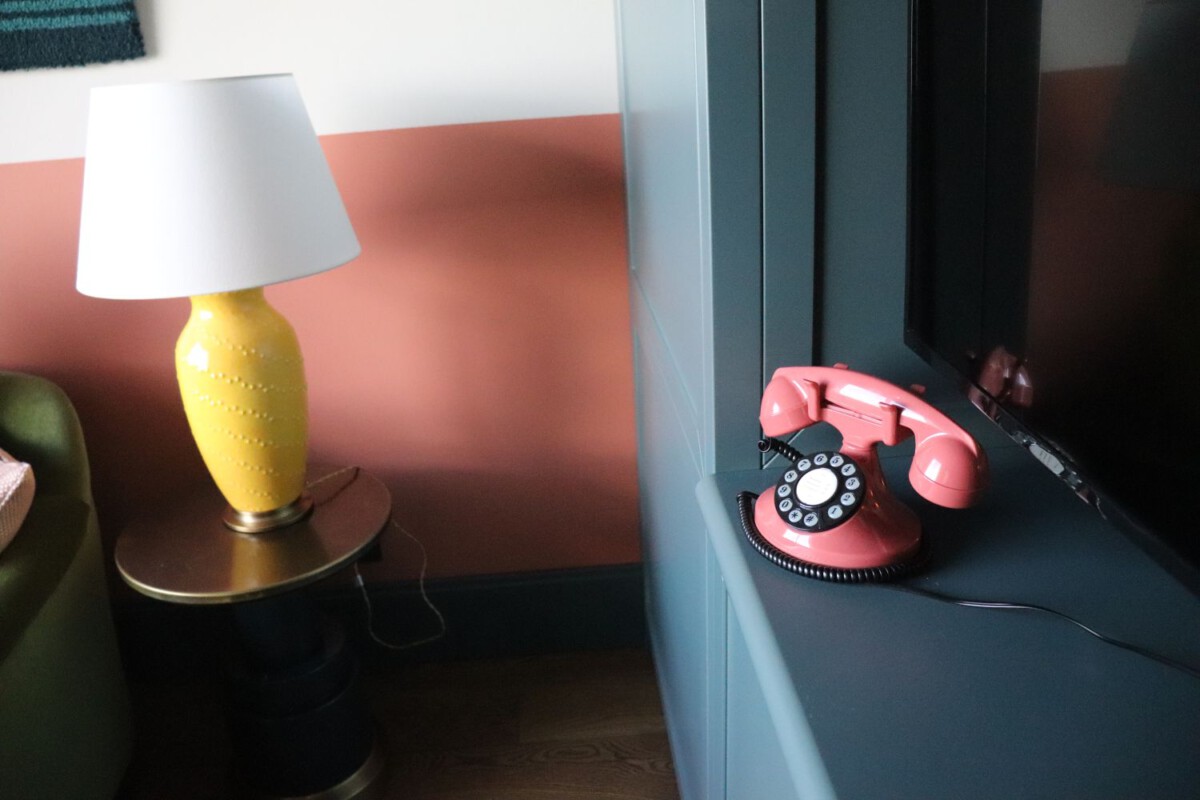
Boat and Co does hotel things a bit differently, things that make it an excellent spot for a staycation. For starters, it’s more of an apartment than a hotel in the sense that there’s a kitchen and a little living room. Staying in one of these for a few days feels more natural than a compact hotel room. I also loved how they designed it with colours and some attitude instead of the regular white-industrial-minimal look that we usually encounter.
Image: DutchReview
They also throw in rental bikes, which really is the way to go and explore Amsterdam. And they’re open to you bringing your kids, and are fully prepared with little kiddy beds and such and so a staycay with the whole family is also a possibility.
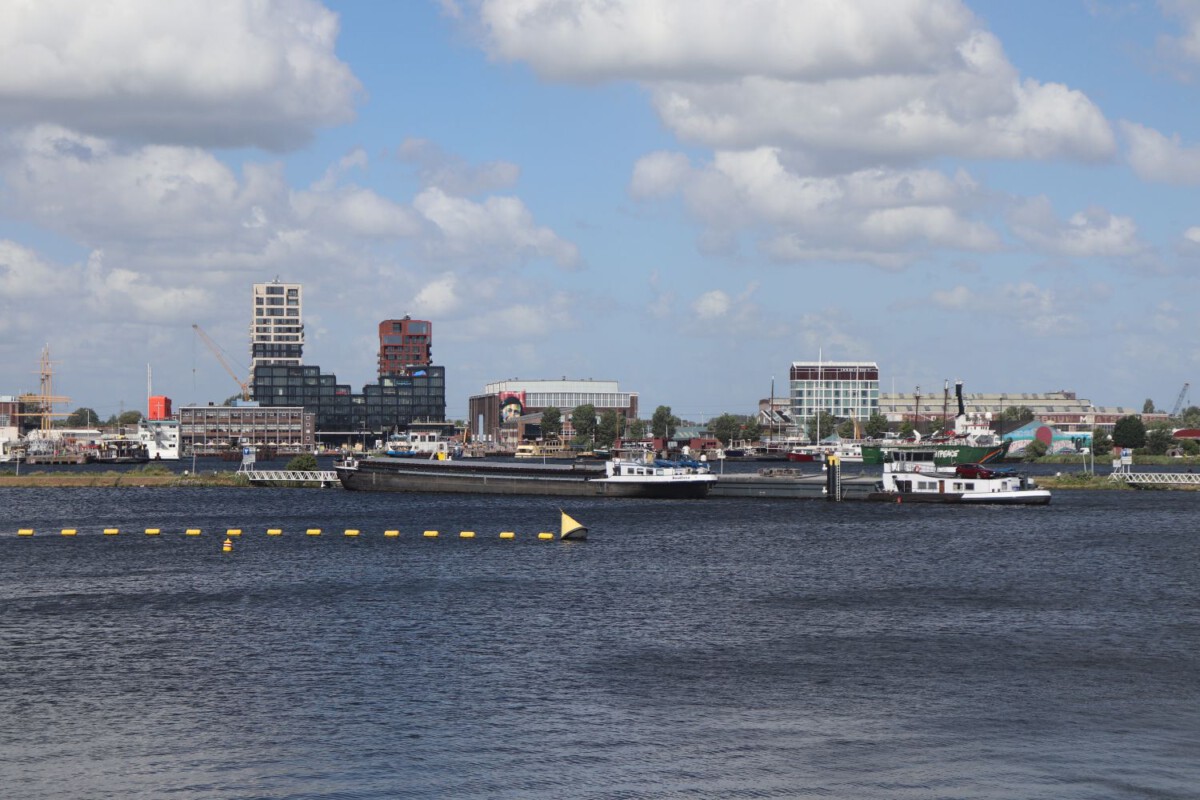
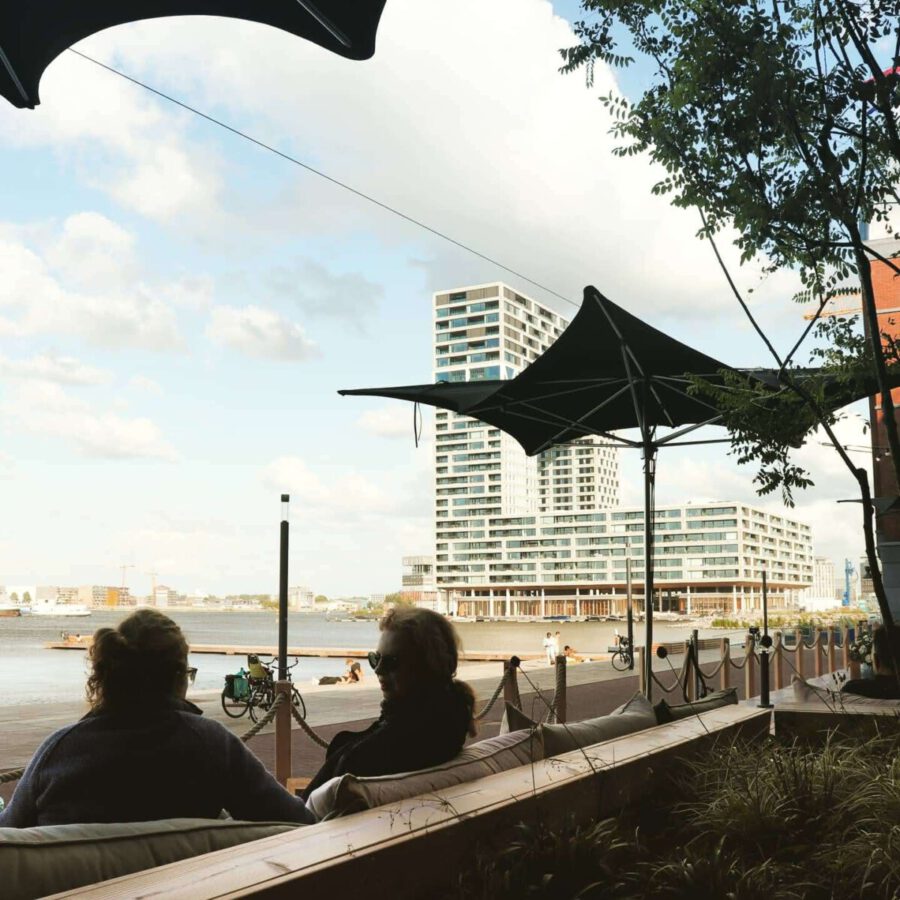
Oh, and how can one resist this view?
Image: DutchReview
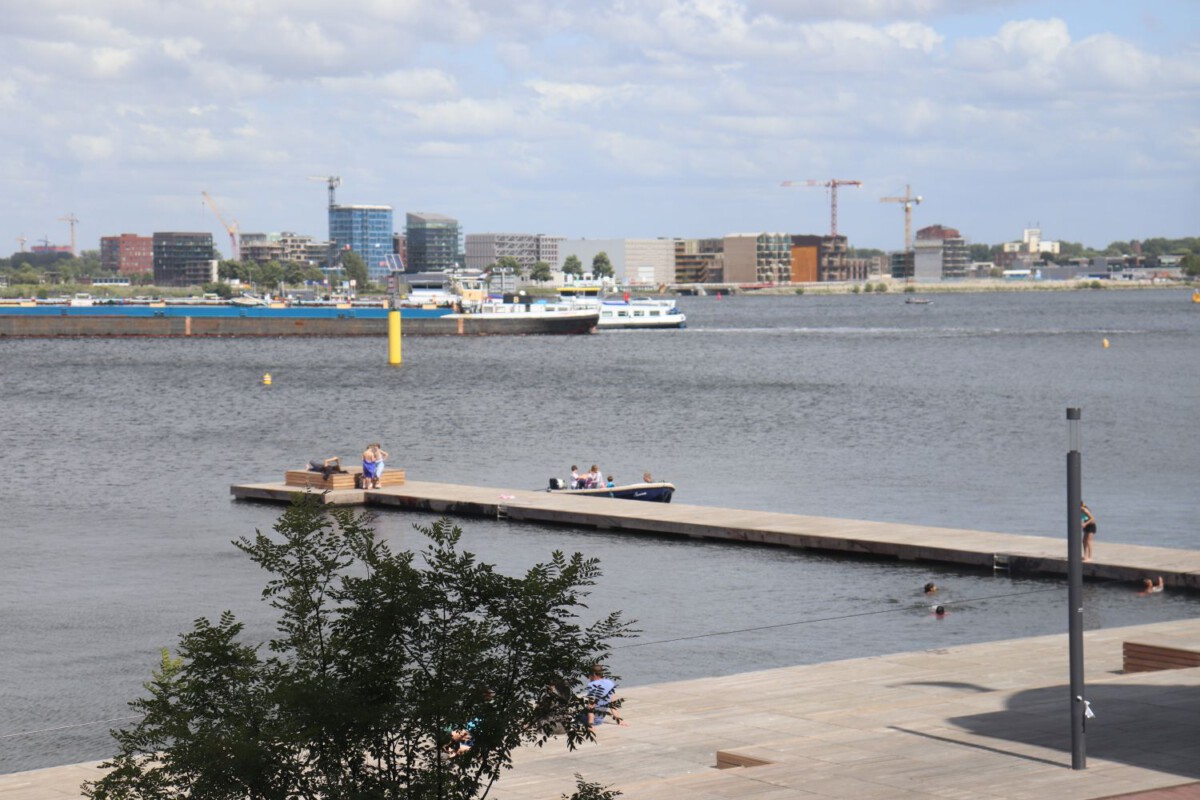
They also built a pier in front of the hotel for swimming. It was already a lively scene on a chilly day — must be a buzzing thing on a warm day.
Image: DutchReview
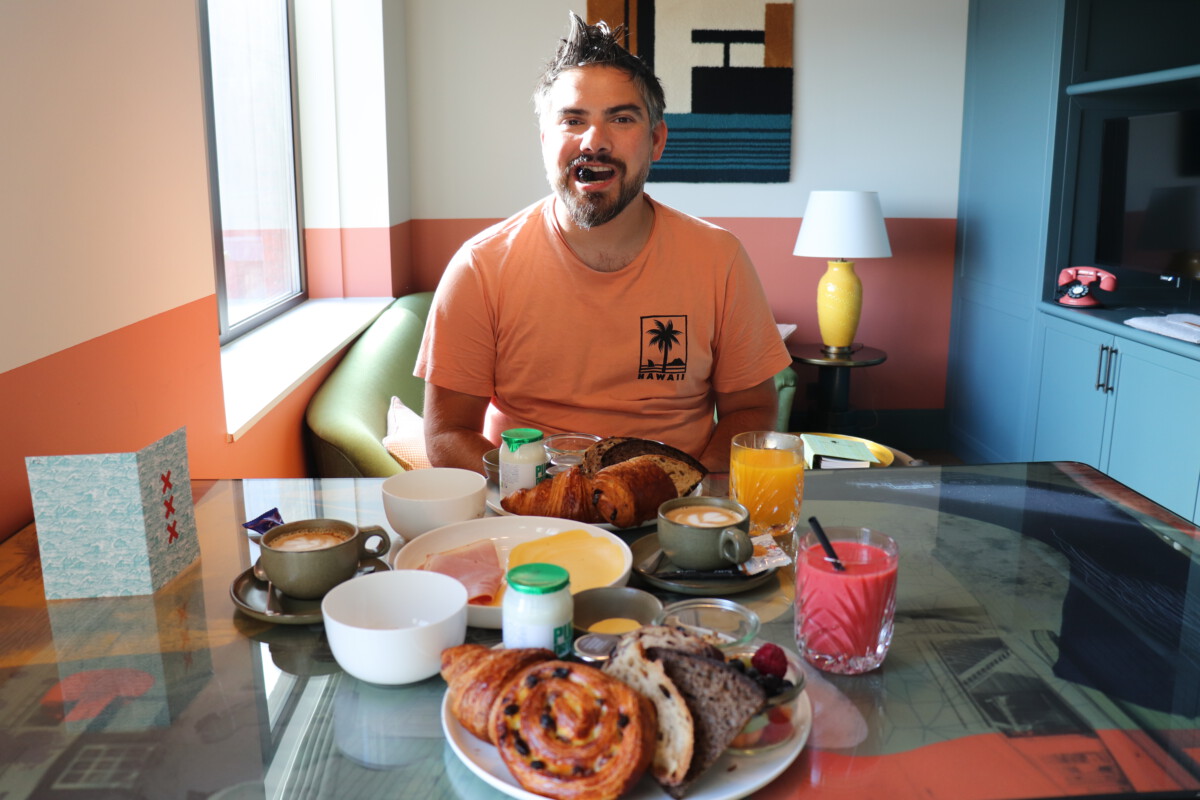
The whole corona situation is sad, but it does mean that there’s the option to get the breakfast delivered to your room – we thoroughly enjoyed this socially distanced breakfast.
Image: DutchReview
Yes, it was as good as it looks!
Where to eat: Vessel Amsterdam
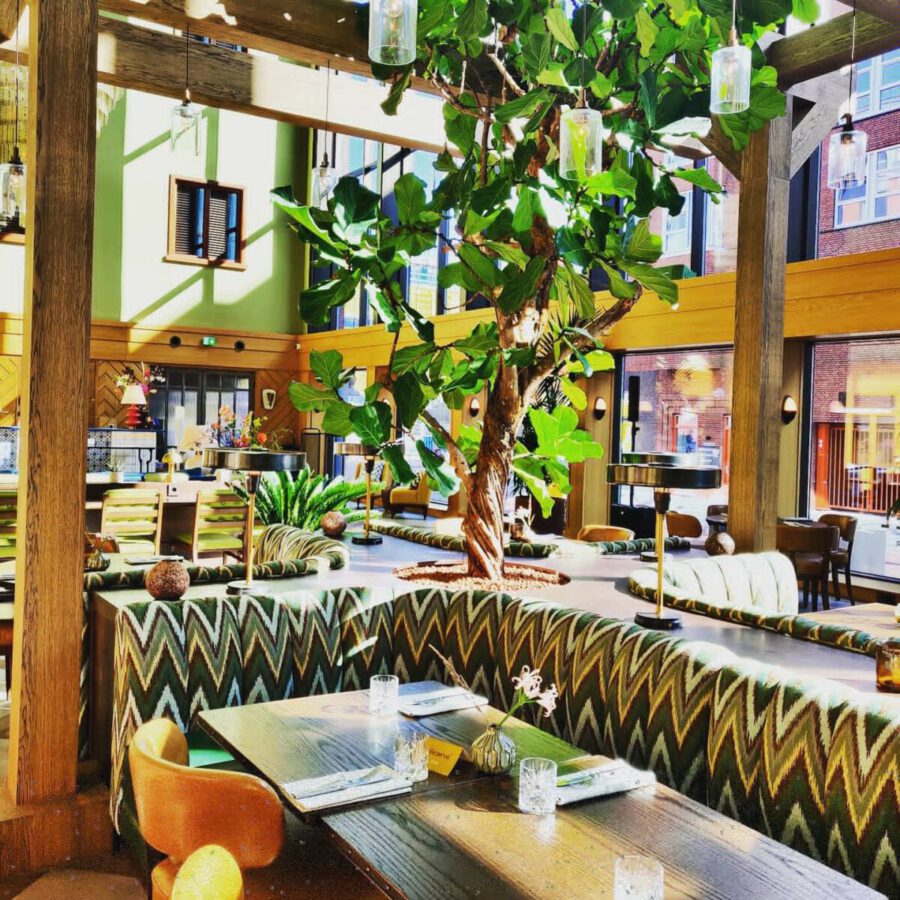
This hotel features both a splendid hall with all the decor you could wish for and an outside terrace with swooping views of the river IJ and some modern architecture.
Image: DutchReviewImage: DutchReview
It was above 15 degrees, so as true Dutchies we opted to go outside and enjoy the last rays of sunshine. The menu has something for everybody and you can go for the regular three courses or share anything with anybody. A big plus is that it’s mostly locally sourced food coming from a low waste kitchen.
And yes, you’ll be happy to know that there were good cocktails with a nice platter with finger food to enjoy as well in case you’re not up for a full dinner.
Image: DutchReview
We were up for a full dinner though, and it was good with grown-up portions. In fact, we opted for the shared Cote d’Boeuf and I’m happy to report that the only reason we could finish that massive piece of meat was that it was so excellent (ask for another sauce though too, mix it up)
Image: DutchReview
A staycation in Amsterdam during corona times — what to do?
It’s Amsterdam, but without the insane crowds of tourists, so what should you do? Well, the answer is obvious — touristy things!
Obviously I mean the good things, not the getting ripped off in the red light district-things. I never saw the Van Gogh museum so this was my chance. We booked ahead and enjoyed a tranquil museum, even spent some time alone with some of these famous paintings (no pics allowed, so no pics here).
Most museums are working with a reservation system, and for the most well-known ones like the Rijksmuseum and the Anne Frank house, it’s advisable to book a week in advance. But yeah, this is the time to see these hotspots.
What else can you do?
Bring your kids, the city is a bit more easygoing now. You can also cycle through the town without the cycle paths being full of stoner tourists or bachelor parties.
Go for a Dutch pancake! Normally I would never do such a thing, but we now enjoyed a nice classic pancake at the pancake bakery (which is normally crowded with tourists).
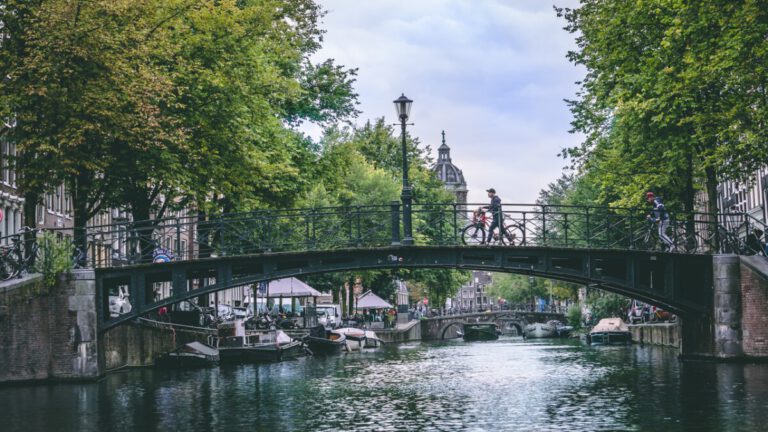
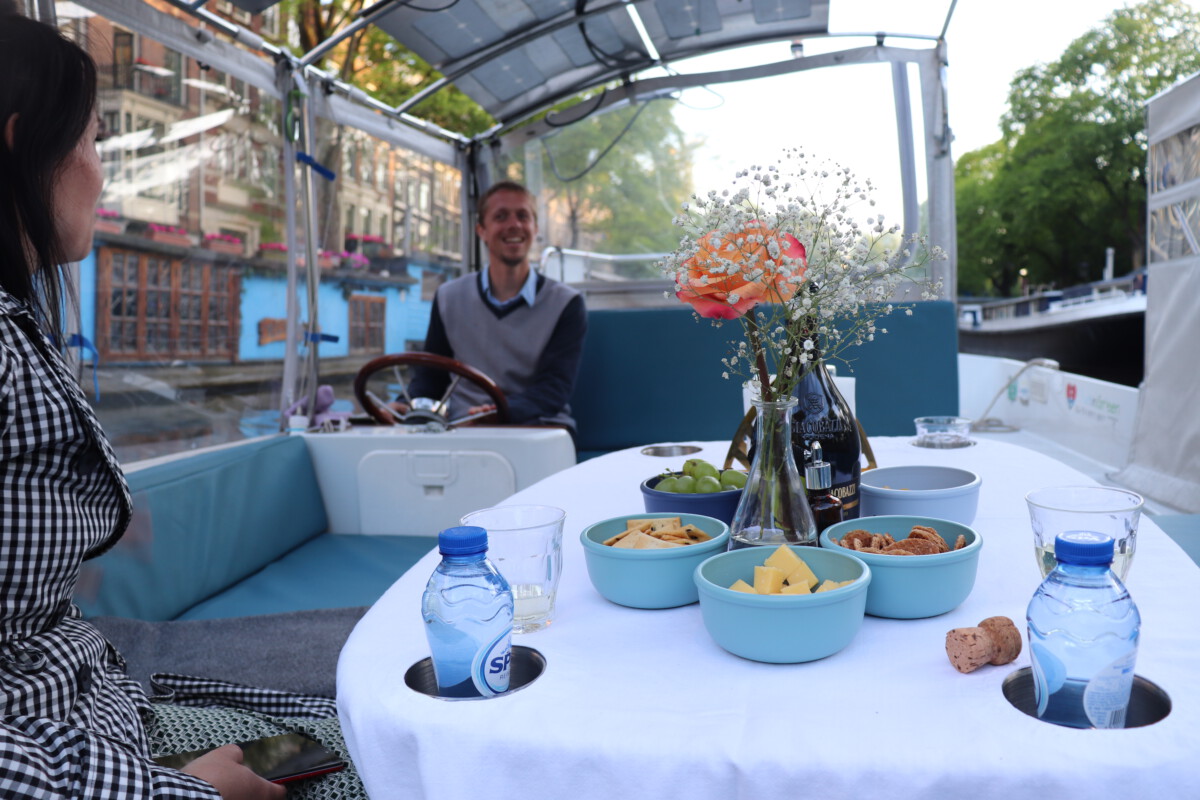
Go for a boat ride in Amsterdam, it’s way better since there aren’t that many other peeps on the boat with you and there are generally fewer boats on the canals.
Image: DutchReview
Go to the centre or the negen straatjes, beautiful areas that are actually accessible and enjoyable these days — we might as well enjoy the beautiful city in this fudged up year of 2020.
What are your plans for the summer of 2020? Let us know in the comments!
Feature Image: Chait Goli/Pexels *We teamed up with Boat and Co for this article (and a great stay!), but no payment was involved
The Netherlands must pay more attention to educating its citizens on its colonial past and slavery, says UN rapporteur, Tendayi Achiume. In a report on the history of racism and discrimination in the Netherlands, she considers that it is “urgent” that a more complete history of the country is presented.
Achiume is a special rapporteur for the UN, dedicated to researching racism, xenophobia and discrimination across the globe.
This week she presented her final report on the Netherlands, reports AD. While noting that the country has good equality principles in law, a lot of work still needs to be done. She said that believing that the Netherlands is already a place of high equality and tolerance hinders real progress.
The importance of a new history curriculum
She continued by saying that the Dutch government should play a leading role in education on colonial history in the Netherlands. The contribution of Morrocan and Turkish immigrants, among other ethnic groups, deserves more attention at school. She also criticized ethnic profiling done by the Dutch police, considering this a direct impact from history.
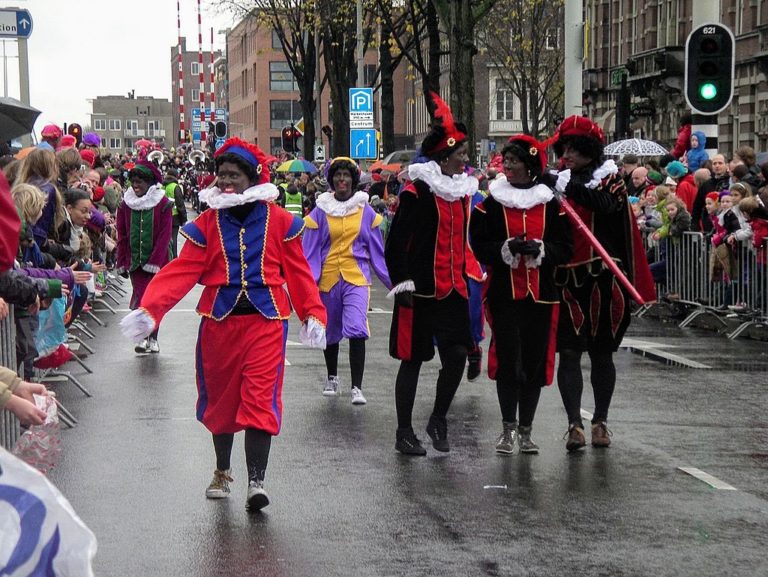
Achiume praised the fact that cities are starting to ban blackface for Sinterklaas. Nevertheless, she noted with surprise the threats anti-racism activists face and the lack of involvement from authorities. “Protection of the government does not seem enough. Penalties for people participating in racist activities are low.”
Interview with the UN rapporteur
Tendayi Achiume gave an interview to AD, discussing some of these issues. Among her answers, she noted that “What I encountered time and time again, is what I call the Dutch paradox. Civil servants and citizens said that the Dutch identity is inclusive and tolerant, and has always been so.”
“But at the same time, they couldn’t do much with the experiences of racial, ethnic and religious minorities, who feel they are eternal foreigners. People from the Caribbean parts of the Kingdom have been described as non-Western migrants, even though they have been Dutch citizens for centuries. So I hope that the current debate will lead to more reflection on who belongs and who is not seen as someone who belongs. And what the role of the government is, to make you feel like a full member of Dutch society, regardless of your ethnicity, race, or religion.”
She continued by saying that “One of my big recommendations is about education, more attention to the Dutch colonial past and the history of slavery.”
“This is not only about understanding the ways in which people of African descent and other groups have contributed to building the Netherlands, but also about emphasizing that white Dutch people have benefited from the exploitation of these groups. And then really reflect on the stereotypes, the ways we see people that still exist today because of that legacy.”
“Take ethnic profiling by the police. That is based on stereotypes about crime. They have been influenced by history.”
Progress also noted
She also noted that she does see progress in the Netherlands on these issues, stating that “The legal frameworks are strong, and there seems to be progress in the debate about Zwarte Piet. There is a very lively community of people who are committed to anti-racism, which gives me hope. At the municipal level, people are more open to reflecting on how to represent Dutch culture in a more inclusive, fairer way. And it is positive that I was allowed to do this visit – there are countries that do not even allow it.”
Patients with mild symptoms of coronavirus who were not hospitalized had a longer recovery period.
This has been revealed by a survey of pulmonologists in the Netherlands, who have a wave of ex-coronavirus patients with fatigue and respiratory problems coming to their clinics, reports NOS.
According to Leon van den Toorn, chairman of the pulmonary association, “We are surprised by the high number of ex-COVID-19 patients who now come to us with complaints.” This group of patients was initially not hospitalized, but have since gone to their GPs as their health complaints continued. They initially seem to recover, only for their symptoms to reappear, sometimes in an even worse form.
Van den Toorn stated that “We see that almost all patients complain about persistent laboured breathing and poor exertion, while the abnormalities on the lung photos are quite minor. The immune system may be less cranked up during a ‘mild’ course of the disease so that fewer antibodies are released and the recovery is therefore slower.” Antibody tests in this category of patients are often negative.
Van den Toorn also emphasizes the fact that it seems that the lungs of these patients do not seem to have major damage. Further research will need to be conducted over the next six months in order to track the recovery of these patients.
Mental restlessness and fatigue
Beyond physical complaints, many patients with mild symptoms report mental restlessness, constant fatigue as well as memory problems. Marjolein Borsboom, a woman with mild symptoms, reported that she got diagnosed back in March, and has not fully recovered since. “I still suffer from my airways, I am very tired and still cannot work fully. After several hours of effort, I am extremely tired.”
In exchange, KLM must become more environmentally sustainable, reports RTL Nieuws.
The company will receive €3.4 billion worth of loans to help it stay afloat. The company has promised in return to reduce CO2 emissions per passenger kilometre by 50% by 2030. This refers specifically to the amount of CO2 emissions made by one passenger per kilometre of travel. 14% of fuel also needs to be sustainable by 2030.
The plans to reduce emissions is in line with plans by the Dutch government, which seeks to reduce emissions of CO2 in the country by half by 2030. The aviation industry can continue to grow as long as they halve their emissions by that date.
Criticism of KLM’s environmental policies
Not everyone is happy with the way KLM is treating their reduction of emissions. If all other industries in the Netherlands will need to halve their collective emissions by 2030, the aviation industry can still emit twice as much CO2 in 2030 as it did in 1995.
Bram van Lierre from Milieudefensie considers lowering emissions per passenger kilometre interesting “in theory”. However, if the aviation industry continues to grow economically and more passengers continue to fly, nothing will change. He told RTL Nieuws that “If we fly more, the environmental benefits will evaporate again.”
Paul Peeters, professor at the University of Applied Sciences in Breda stated that if you want to reduce emissions, you need to look at the total number of emissions. “You cannot speak of a strong sustainability policy at KLM.”
Researchers at CE Delft calculated the amount of emissions by KLM in 2018. The company emitted then 8.6 megatons of CO2. Per passenger-kilometre, 80 grams of CO2 were emitted. By comparison, total CO2 emissions in the Netherlands are 163 megatons, with the aviation industry accounting for 6% of total emissions in the Dutch economy.
European figures for 2019 have shown that emissions from the largest airlines have increased, including KLM. Whatever the case, it will be difficult for KLM to halve their emissions.
In June, 74,000 people became unemployed in the Netherlands, bringing the total number of unemployed people in the Netherlands to 404,000, the CBS reports.
This is the most rapid monthly increase in unemployment seen since monthly measurements began in 2003. It is the delayed result of the coronavirus crisis. The majority of those who have lost their jobs are young people, between 15 and 25 years of age. In a single month, the total unemployment rate rose from 3.6% to 4.3%, meaning that more people need to rely on unemployment benefit to survive. Since March, the number of unemployed people has grown by 131,000.
“Unemployment had a delayed reaction to the shock that we saw earlier in the economy from the corona measures,” says CBS economist Peter Hein van Mulligen. In June, the first NOW grant for businesses expired. This was a government aid package for businesses, and it imposed fines on companies that fired employees. Although there is a second NOW package available, some companies have chosen not to take it, and instead have let (some of) their employees go.
However, businesses letting their workers go is not the only reason why unemployment has risen so sharply in June. It’s also because a person must be actively searching for work to count as unemployed in the official statistics. During the lockdown, people may have been out of work, but not necessarily looking for a new job either. Now that the coronavirus crisis appears to be winding down, some of those people are now actively searching for work, and are therefore adding to the official unemployment statistics.
Some people have managed to find a job again. In June, the number of employed people grew by 45,000. In comparison to the past months, we’re seeing growth both in the number of unemployed people, and in the number of employed people.
What has your experience been of the economic implications of the coronavirus crisis in the Netherlands? Let us know in the comments below.
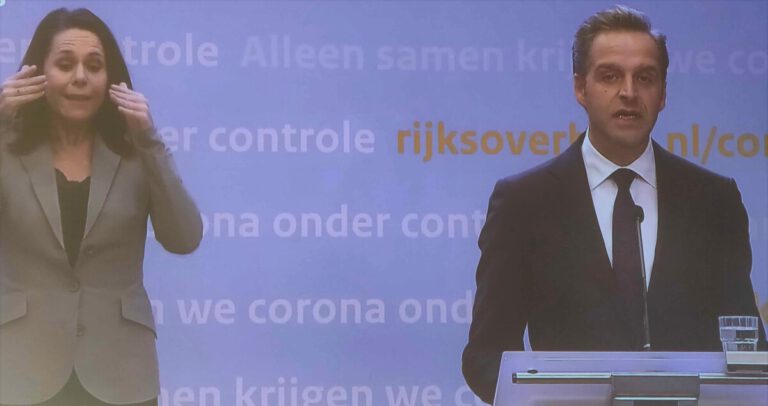
Minister for Health, Hugo de Jonge, is now the leader of the CDA party. He won by a small margin against Pieter Omtzigt.
Minister de Jonge has been one of the most recognisable faces in Dutch politics in recent weeks, as he has served as Minister for Health during the coronavirus crisis. The CDA has been looking for a new leader since May, when party leader Sybrand Buma became Mayor of Leeuwarden.
MP Pieter Heerma then became chairman of the group, but announced that he did not want to become its leader. This morning, he announced the results of the leadership election. Minister de Jonge got 50.7% of the vote, while Pieter Omtzigt got 49.3%.
The Dutch Christian Democrats are about to announce the new top parliamentary candidate (lijsttrekker) in an unexpectedly exciting contest between the current Health Minister and an unpredictable dark-horse gadfly who led an expose of racism at the tax service. /1
— Matt Steinglass Ở NHÀ LÀ YÊU NƯỚC (@mattsteinglass) July 15, 2020
It was expected that De Jonge would have an easy victory, after Minister for Finance Wopke Hoekstra decided not to run. However, Omtzigt’s efforts made the race exciting, De Jonge said. “Incredibly exciting. So close together.” He said he was really impressed with Omtzigt’s efforts. “We are going to do this together.”
You can follow DutchReview on Facebook for all the latest updates on news in the Netherlands.
After a period of decline in the number of cases of coronavirus throughout the Netherlands, this decline has now stopped. There has been a slight increase in cases, especially in South Holland.
Since tests have become widespread on June 1, the number of cases decreased from more than 1,200 cases a week to 400 cases two weeks ago. Now, the number of new weekly cases has increased to over 500, reports NOS.
More people have been getting tested this past week, which is a possible explanation for the slight increase in number of cases. At the national level, the percentage of people who tested positive is at 0.6%. This is much lower than it was in June; back then the percentage was at 2.1%.
Most of the newest infections over the past two weeks were in South Holland. 392 people were tested positive (11 out of 100,000). At the opposite end of the scale comes Drenthe, with only 5 people tested positive in the same time period (1 out of 100,000).
ICU numbers
There are currently 80 people in ICUs due to the coronavirus. A week ago, there were 100 people in ICUs. Outside of intensive care, there are 94 coronavirus patients, an increase from the 69 patients counted last Friday.
People are slowly but surely returning back to their normal lives. People travel more within the Netherlands, use public transport, as well as going out for meals and shopping.
Visits to the workplace have decreased, and are 30% lower than normal. This can also be partly explained by summer holidays being around the corner.