


Ever wondered why the Dutch wear orange to pretty much any national occasion, even though the colour isn’t even in their flag?
Perhaps you’ve been stampeded by hoards of orange football fans or drowned in a sea of orange that floods every Dutch city on King’s Day.
As it happens, orange has been the national colour of the Netherlands for hundreds of years. Here’s why.
Why does everyone wear orange on King’s Day?
If you’re not familiar, King’s Day is a national holiday in the Netherlands, where the entire nation dresses in orange, drinks beer, and celebrates the king’s birthday.
And boy, do they celebrate! 💃
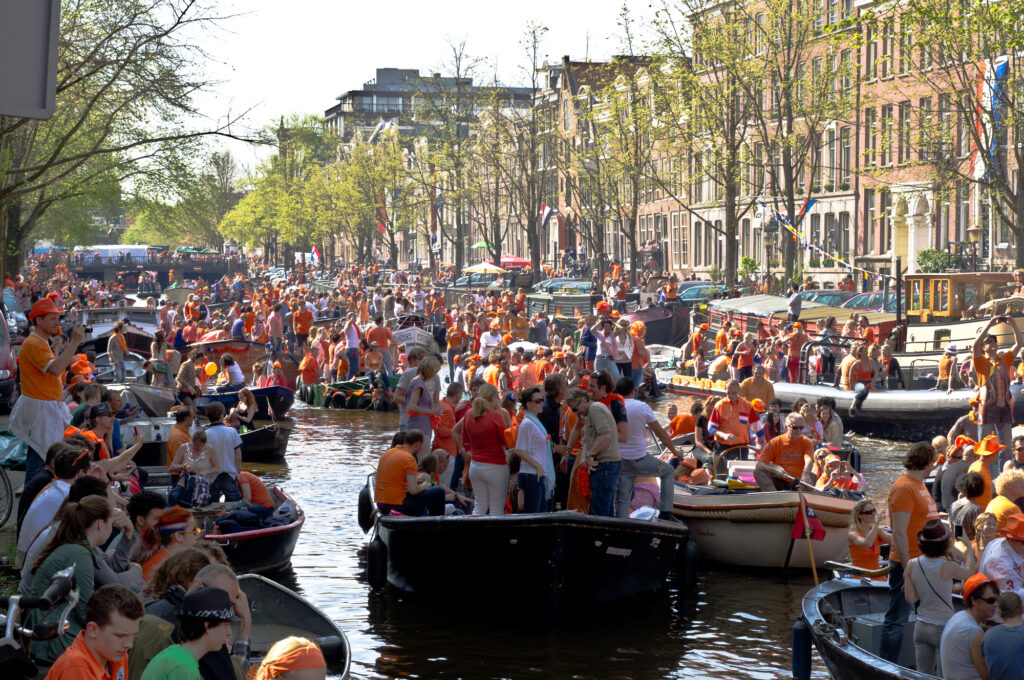
The canals overflow with boats of what look like oompa loompas drinking themselves to death, occasionally singing: Oranje boven, oranje boven, leve de koning! (Orange above all, orange above all, long live the king!).
READ MORE | 5 things to do on King’s Day to celebrate the Dutch way
The Dutch love for orange is tied to the royal family: the House of Oranje-Nassau.
The lineage began with the famous William of Orange, who was crowned Prince of Orange in 1544. With his leadership, the colour orange became a symbol of the Dutch royal family.
William of Orange, who?
William of Orange, also known as William the Silent, was named heir to the county of Orange by his cousin, René of Chalon, who himself died with no children.
Later, William led the Dutch revolt against the Spanish occupation of the Netherlands during the Eighty Years’ War, from 1568 to 1648.
READ MORE | The Dutch and their monarchy, a two-sided coin

His leadership was extremely influential in the rebellion, contributing to the official independence of the United Provinces of the Netherlands in 1648.
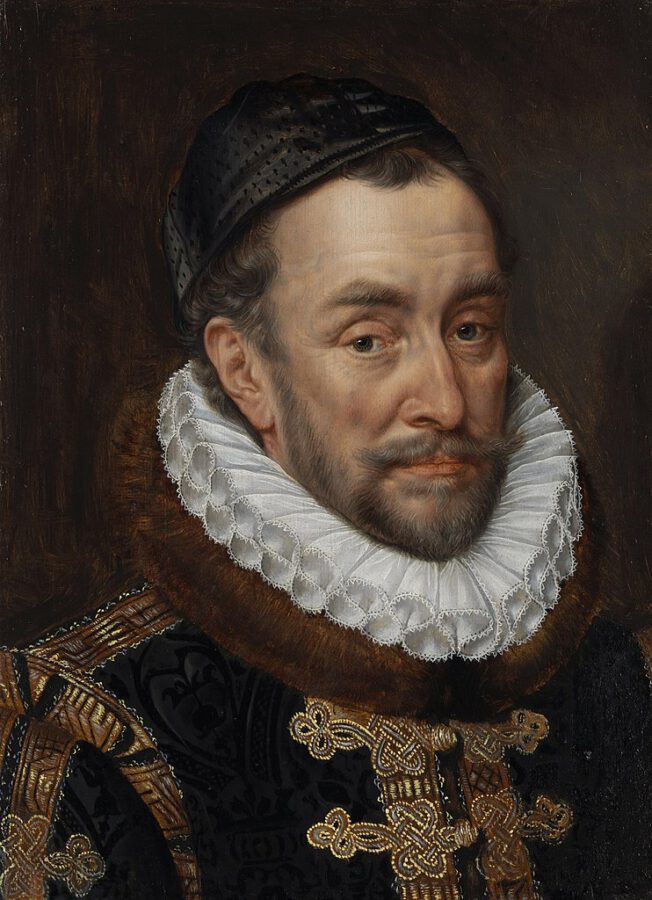
He is known as the father of the Netherlands, and he’s the first ancestor of the current royal family, making him the founder of the current Dutch monarchy.
So his name, and the bright colour that goes with it, symbolise the Dutch state. Even though the county of Orange technically isn’t in the Netherlands. Huh?
The town of Orange, France
Historically known as Oranghien by the Dutch, Orange is a town in modern-day southern France.
For many years, it was a county state under the Holy Roman Empire before it became a part of France in 1713. This is where, in 1544, William of Nassau became Prince William of Orange.
Why do Dutch football fans wear orange?
The dress code doesn’t only apply to the fans. The Oranje (nickname of the Dutch national football team) also dress completely in orange when they hit the field during national games.

The army of sports fans that follow the Dutch team is known as the Oranje Legioen (Orange Legion) and has an almost magical ability to turn every bar, stadium, and street into an orange haze.
This phenomenon is known as Oranjekoorts (Orange Fever), and it is just as crazy as it sounds.

The choice of orange, however, has the same explanation as King’s Day. Where orange once symbolised the Dutch royal family, it soon became a symbol of Dutch national pride.
Why is the Dutch flag not orange?
Originally, the Dutch flag was orange, white, and blue. It was designed by William of Orange himself. During the War of Independence, Dutch soldiers even wore this flag to battle.
However, by the end of the war, the orange band was changed to red. Historians have a few theories why.

The first theory is that the dye used to stain the flag orange was prone to changing to a red colour over time. So to avoid confusion, the flag was officially changed to red.
Other historians believe the change was a result of the political climate following the Anglo-Dutch agreement of 1654, which excluded members of the House of Orange from becoming head of the Dutch state.
Because the colour orange was closely associated with the House of Orange, the adoption of a red stripe may have reflected a desire to distance the Dutch Republic from Orangist influence.
Theory three goes back to 1354, when the county of Holland was ruled by the Bavarian House of Wittelsbach. The new Dutch flag could thus have been based on the Bavarian coat of arms.
Regardless of the reason, orange stuck around in the hearts of Dutch people.
When not to wear orange in the Netherlands
Wearing orange in the Netherlands will certainly win you brownie points on almost any day of the year, especially during the football World Cup. Except perhaps on April 30.
In honour of Queen Beatrix, King’s Day was actually Queen’s Day and celebrated on April 30. However, when King Willem-Alexander took the throne in 2013, King’s Day was switched to April 27.
Since the change, many tourists have still arrived in the Netherlands fully dressed in orange on April 30. These oblivious enthusiasts became known as vergistoeristen — mistake tourists. Oh, dear.
Toch weer vergistoeristen gespot in Amsterdam https://t.co/uUbfionzew pic.twitter.com/FHBfw95mwI
— AT5 (@AT5) April 29, 2017
The Dutch are not particularly patriotic. So don’t expect to see any orange on Prinsjedag (Budget Day) or Remembrance Day.
You might see a little orange on Liberation Day, but certainly not to the degree of real Orange Fever. The colour is mainly reserved for sporting events and King’s Day.
Countries that use orange because of the Netherlands
As the Dutch sailed across the globe to colonise and conquer, their influence left an indelible mark on the places they went.
This includes the colour orange, which leaked into many flags, names, and symbols we still see today.
South African Boers
Between 1652 and 1795, the Dutch East India Company controlled the Eastern Cape of Southern Africa.
Many employees of the company retired there and bought farmlands, as well as African and Asian slaves, to run the farms.
However, the Eastern Cape fell under British rule in 1806, which abolished slavery in the region in 1834. The Dutch Boers (farmers) eventually grew tired of paying taxes to the British and didn’t want to give up their slaves.
Thus, they departed on the Great Trek across southern Africa to establish their own settlements where they could rule themselves freely.
The Afrikaaner Boers thus established the Orange Republic in the middle of modern-day South Africa.
It became an independent republic in 1854, and of course, its flag had orange and white stripes, with the Dutch flag in the top left corner, for which the Dutch king gave his blessing.
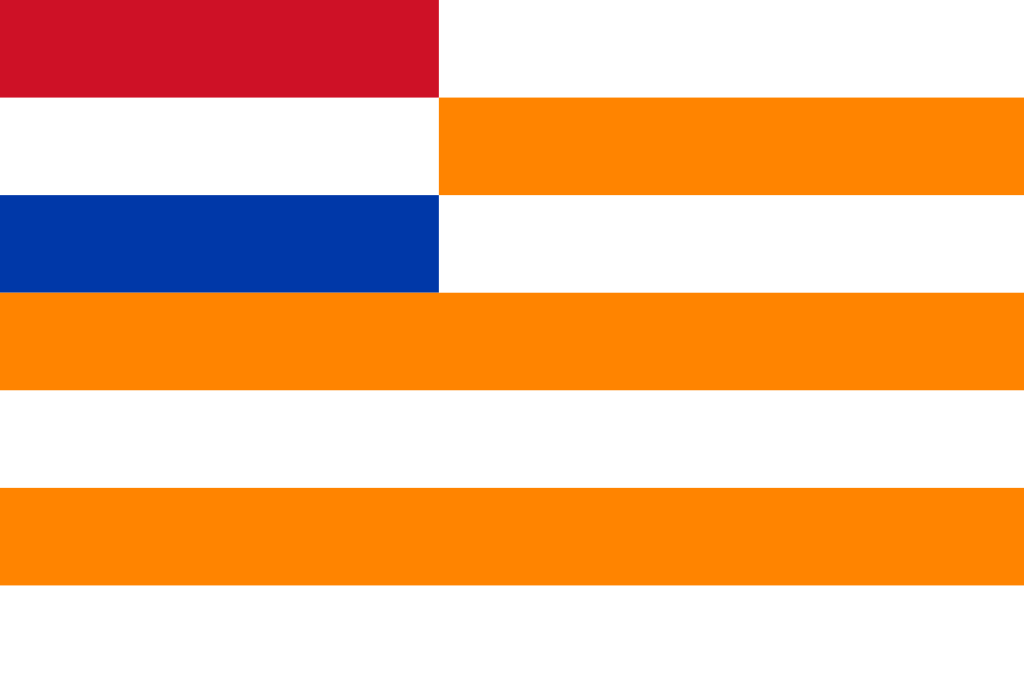
Fast forward past the Boer Wars, and the Orange Republic became the Orange Free State under the Union of South Africa in 1910.
Between 1928 and 1994, the Union of South Africa, which later became the Republic of South Africa, had the flag depicted below. You’ll notice the orange, white, and blue stripes of the old Dutch flag, as well as the Orange Free State’s flag in the middle.
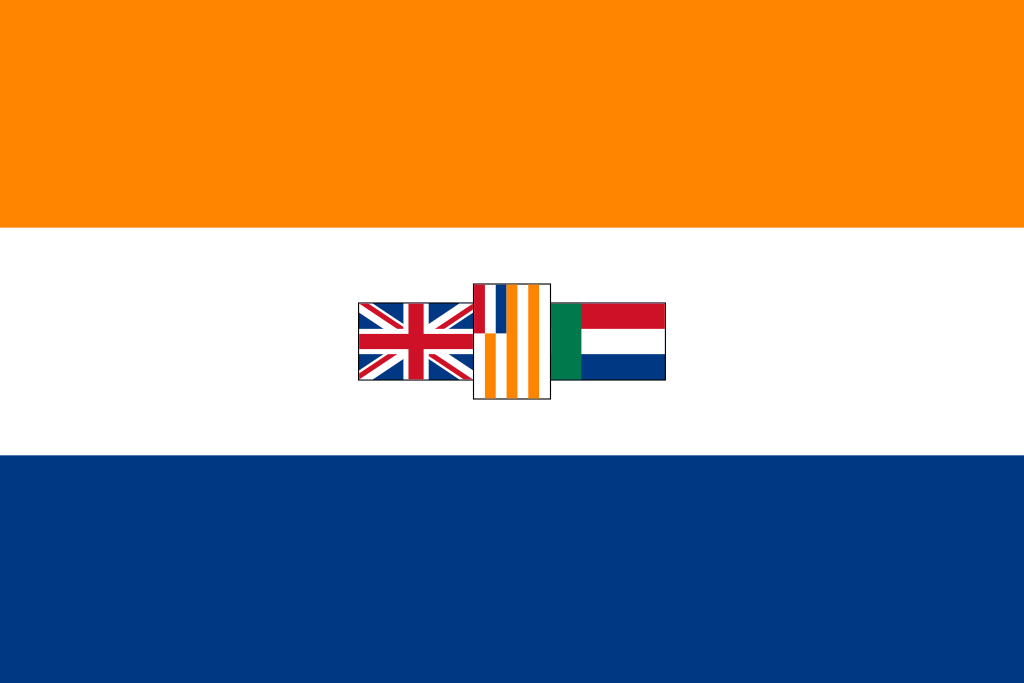
After Apartheid, this flag changed to the stunning multi-coloured flag that South Africa has today (with zero orange), and the Orange Free State simply became the Free State.
But the Orange River, which happens to be the longest one in the country, kept its name.
Irish Protestants
Coming back to Europe, the orange stripe in the Irish flag also has its links to William of Orange.
This colour represents the minority Irish Protestants who supported William of Orange.
During the Battle of the Boyne, Protestant King William of Orange faced up against the Catholic King James II of England, Scotland, and Ireland.
Irish Protestants, who conflicted with their Catholic countrymen, opted to support William of Orange instead. As a result, they adopted the colour orange as a symbol of their Protestant Irish identity.

This is in contrast to the green of the Irish flag, which symbolises Catholic Irish republicanism. The white in the middle symbolises peace between these two groups.
Carrots?
Did you know that the orange colour of your favourite root vegetable is a Dutch doing?
READ MORE | 7 times the Dutch did it first: fun facts from the Netherlands
Carrots were originally purple, red, or white, but Dutch farmers bred them to become the distinct orange colour they are known for today. And, of course, this colour change was a tribute to good old William of Orange.
To this day, you can hear the history of William of Orange in the Dutch national anthem. Apparently, what appears to be a random craze around all things orange is mostly out of admiration for the Father of the Netherlands.
What do you think of the Dutch obsession with orange? Tell us in the comments below.


A tidbit about the carrots. Recent studies show that yes… we made them orange but it might have had nothing to do with William of Orange
https://isgeschiedenis.nl/reportage/factcheck-zijn-oranje-wortels-een-eerbetoon-aan-het-koningshuis
You can also see Orange on some of New York’s sport teams uniforms, a nod to the state and city’s Dutch beginning
“The army of sports fans that follow them are known as the Oranje Legioen (Orange Legion) with an almost magical ability to turn every bar, stadium and street they hit completely orange.”
I follow Formula 1, and the Orange Legion is usually out in full force to support Max Verstappen. I can’t wait for the rebirth of the Dutch GP at Zandvoort, and I’m rooting for Max to win the championship!
A well written article i too like to wear something Orange, its to be expected, it is my Surname after all.
The colour ORANGE and the Dutchmen. My hubby’s family are from “The NETHERLANDS”, Papendrecht, to be more precise, 🇳🇱 and a very PROUD people they are, indeed!!!!! His 5 siblings and he, emigrated, along with his parents and many other close, family friends, to Canada, 🇨🇦 in the summer of 1954. They voyaged, on the ocean 🌊 for three long and treacherous weeks at sea, before their excursion ultimately landed them in The Maritimes, Canada, 🍁 before reaching their final destination of Ontario, a few days later, after a tranquil train 🚂 ride. Toot ~ Toot ~ Toot!!!
I’m not particularly keen on the colour “orange” myself, 🍊 but my hubby and his siblings surely are, except for, perhaps, his ONLY sister. To this day, ALL the remaining gentlemen always wear “orange”, 🍊 somewhere on their person, whether it be on a jersey 👕 or on a cap 🧢, before, during and immediately following an important match, in any sporting event, that’s being broadcast or televised, during game day.
Go👏Go “The NETHERLANDS”, Go👏Go!!!
Hi, our national flag was always accompanied with an orange banner: “Oranje Wimpel” https://nl.wikipedia.org/wiki/Oranje_wimpel
Members of the resistance during WWII were ‘Soldaten van Oranje” = soldiers of orange
Our national football team is named “Oranje” = orange
We cheer “oranje boven, oranje boven , leve de koning(in)” = orange above all else, long live the king (queen)
TY. IMO the Dutch flag should just be Orange since it is historically more meaningful, more on brand and more interesting with so many countries already having red, white and blue in its flag.
I think adding a vertical Oranje stripe to the outer edge of the existing Red-White-Blue flag would be a great way to go.
Agree.
Also the capital city of Aruba is called Oranjestad 🙂