

Leiden has always had a habit of being ahead of its time. The city where the Pilgrim Fathers found refuge, where Albert Einstein kept a professorship, and where the modern ECG was born is now applying artificial intelligence to hunt for tomorrow’s medicines.
Leiden University’s motto is Praesidium Libertatis, “Bastion of Freedom.” Since its founding in 1575, it’s been the kind of place where unconventional thinking is actively encouraged.
Bold thinkers have been gravitating here for centuries, and the results have been extraordinary.
A city that collects world-changers
The Pilgrim Fathers spent over a decade in Leiden before sailing to America on the Mayflower in 1620, drawn by the city’s reputation for tolerance and free thought.
As we’ve written before, Leiden shaped them in ways that would go on to define a nation.
Einstein was next in line. In 1920, Albert Einstein became a bijzonder hoogleraar (special professor) at Leiden University. As a result, he came to the city regularly for a few weeks a year, enjoying the idea of such a “comet-like existence in Leiden.”

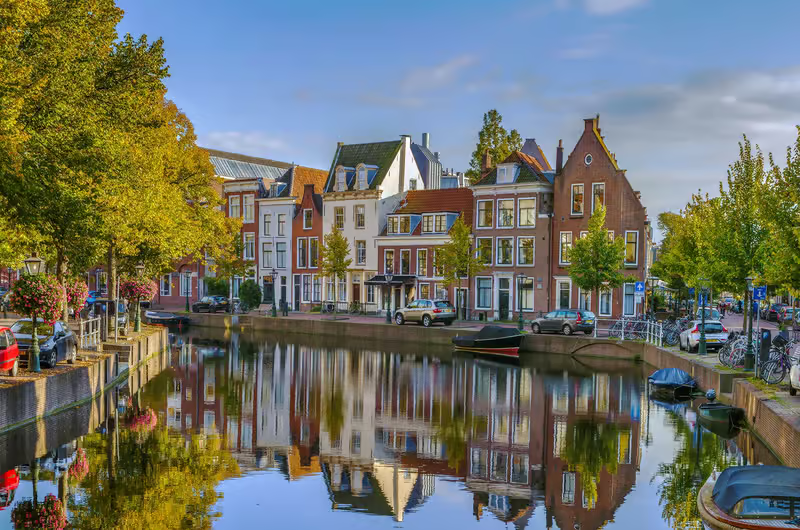
His close friendship with physicist Paul Ehrenfest made it feel like a second scientific home, and he visited regularly to meet fellow physicists, discuss his theories, and play music together.
He wasn’t the last Nobel laureate with ties to Leiden, however. Willem Einthoven, professor at Leiden University from 1886 to 1927, developed the first practical electrocardiograph and pioneered the ECG as a clinical tool, work that earned him the Nobel Prize in Physiology or Medicine in 1924.
In total, sixteen Nobel laureates have studied, taught, or conducted research at Leiden University over the centuries, and the city of knowledge continues to change the world of medicine.
From the lab to the medicine cabinet
Leiden University’s approach to drug discovery has always been unusually practical for an academic institution.
That work spans chemists, biologists, medical researchers, and computer scientists. Researchers in Leiden have contributed to developments in areas including cancer immunotherapy, muscle disease research, and malaria vaccines, often working in close collaboration with the Leiden University Medical Centre (LUMC).

On the research side, recent work from Leiden includes a “super antibiotic” developed to control a dangerous gut bacterium at a low dose, and mini organs-on-chips being explored as an alternative to animal drug testing.

However, the LUMC has also proven its capacity for frontline emergency care, most recently in 2026 when it received patients evacuated from the hantavirus outbreak aboard the cruise ship MV Hondius.
The machine learning medicine cabinet
Leiden has always found new tools to push medicine forward, and now it’s applying that same spirit to AI drug discovery software.
The Leiden Early Drug Discovery & Development network (LED3) brings together more than 250 researchers and staff with expertise spanning artificial intelligence, medicinal chemistry, molecular biology, pharmacology, metabolomics, structural biology, and toxicology.
One researcher worth knowing about is Gerard van Westen, an AI and medicinal chemistry expert at Leiden University.
Van Westen uses decades of bioactivity and medicinal chemistry data to train models that predict how candidate drugs interact with proteins in the human body, with a vision of rethinking how drug discovery works in the 21st century.
Traditionally, finding a viable drug candidate takes years of costly trial and error. AI models can help researchers identify promising compounds more quickly than traditional screening methods, which matters enormously when you’re working against diseases that have resisted treatment for decades.

The park where it all comes together
The physical home of much of this work is Leiden Bio Science Park, right next to Leiden central station.
It’s the Netherlands’ largest life sciences cluster, with researchers, startups, and multinationals working across vaccines, regenerative medicine, and medical technology.
The park is anchored by Leiden University and LUMC, and is home to global players like Janssen and Astellas alongside Dutch biotech firms.
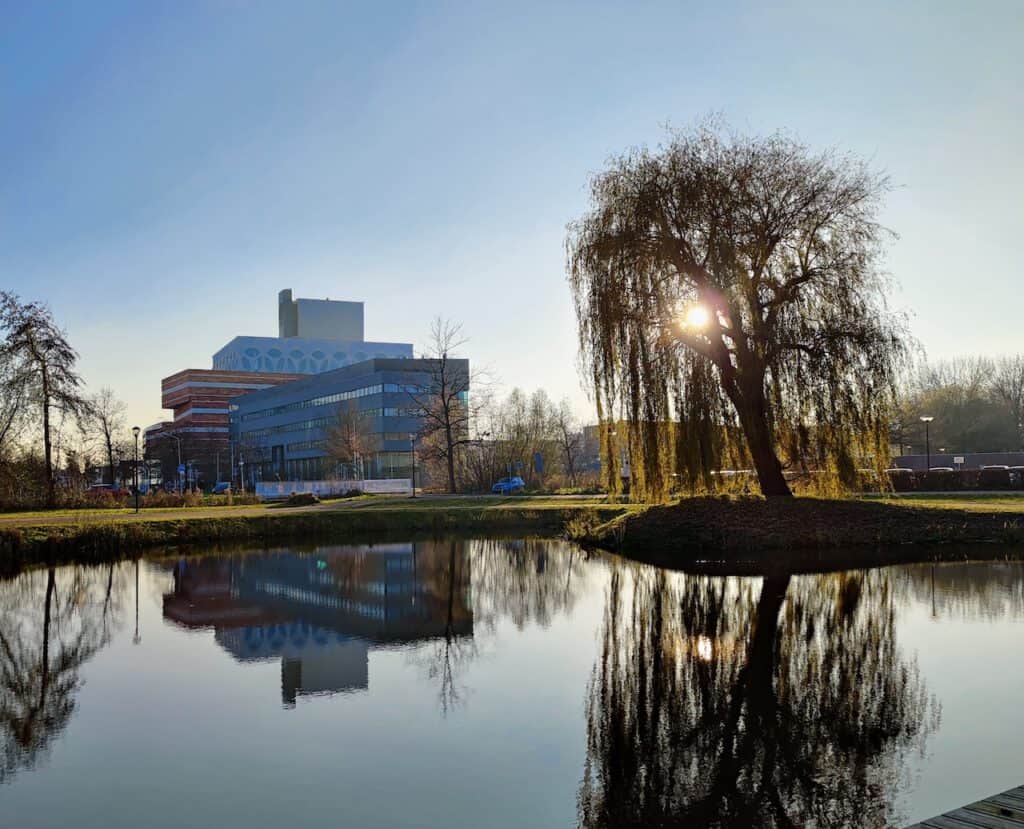
Eli Lilly recently announced a €2.6 billion investment in a new manufacturing facility connected to the park. Meanwhile, startup Idris Oncology is building cancer diagnostics on site, with the long-term goal of detecting tumours before symptoms appear.
Across the city, PLNT is where students and early-stage founders turn ideas into companies.
Rapidemic, one of the park’s younger diagnostics startups, splits its time between the Bio Science Park lab and PLNT, and recently received a $2.7 million grant from the Bill and Melinda Gates Foundation to develop rapid STI tests. Not bad for a small team out of Leiden.
From the Pilgrims seeking a city that valued free thought, to Einstein debating relativity at his friend’s house, to researchers training AI on decades of medicinal data to find the next antibiotic, something about Leiden keeps attracting people who want to figure things out.
Did you know about Leiden’s scientific legacy before reading this? Or do you work in or around the Bio Science Park? Tell us in the comments!