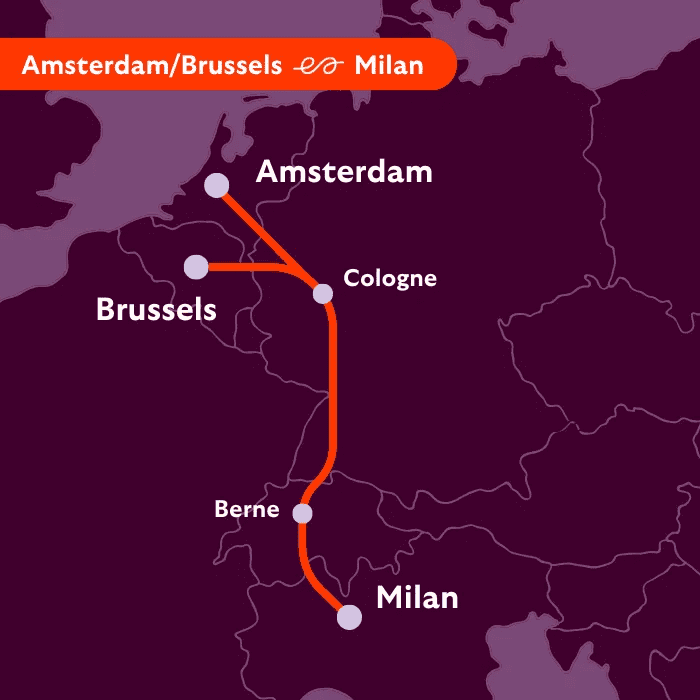
Mark your calendars! From June 2026, European Sleeper is launching a brand new route, connecting Amsterdam to the Swiss Alps and Italy’s fashion capital, Milan.
The Dutch-Belgian rail provider confirmed in a press release that this exciting north-south connection is set to dramatically expand its network.
Intended as an efficient, relaxing alternative to flying, European Sleeper has scheduled its inaugural journey for Thursday, June 18, 2026.
Say “hoi” to Alpine views and Italian charm
If you’re fed up with Schiphol’s queues and incessant delays for European flights, we’ve got great news for you.
The train will run three times a week, departing from both Amsterdam and Brussels on Monday, Thursday, and Saturday evenings. You’ll travel overnight and wake up, fresh as a daisy, to the sight of Bern’s quaint city centre or Milan’s historic flair.
The route will also take you past several other European cities. Image: European Sleeper
Meanwhile, your return journey will set off from Milan — operating on Wednesday, Friday, and Sunday nights.
Even better? The new route will open up seamless long-distance connections across Europe: think linking through Brussels (to and from London), Cologne (for Hamburg and Berlin), Bern (for Zürich and Geneva), and Milan (for Venice, Florence, and Rome).
Are you excited to try out European Sleeper’s new route? Share your thoughts in the comments!
Picture this: You’re sitting in a cosy Amsterdam café when your phone buzzes. It’s a friend from back home wanting to catch up. You’re excited — but then you remember the costs this international call may incur.
Sound familiar? We feel you. Staying in touch with your loved ones or even calling your bank back home can be quite a challenge when you live in a foreign country.
But luckily, there’s an easy solution: LEBARA’s SIM-only plan with international calling.
Introducing: LEBARA’s customisable SIM-only plans
What are the most important things when selecting a phone plan? For me, it would have to be flexibility and affordability. And LEBARA offers both of these.
LEBARA’s SIM-only plans are not only some of the cheapest in the Netherlands, starting at just €4 per month, but they also let you tailor your mobile experience according to your needs, your wants, and your budget.
From data, minutes, and texts to plan duration and extra add-ons, LEBARA’s bundles are fully customisable and put you in charge of your phone bill.
Here’s how it works:
Pick your plan duration: Choose the plan duration that works for you, whether it’s a short-term deal that can be cancelled monthly or a longer-term commitment of two years.
Select your data bundle: Determine the data allowance that suits your usage. From 1GB to 40GB, LEBARA has options to keep you connected without limits.
Calling and texting: All LEBARA data bundles include 250 minutes of calling and 250 texts — easy-peasy! Want unlimited? Just select it as an add-on.
Choose your extras: Lastly, select whether you’d like international calling, unlimited calling and texting, a data usage cap, or extra speedy data. For just a few extra euros, you can complete your perfect plan.
Once you’ve built the bundle that suits you, simply put in your details — et voilà!
Your SIM card will be sent to your address within a few days, and you’ll be ready to start calling, texting, and surfing the web.
Your LEBARA SIM will be delivered straight to your doorstep. Image: Depositphotos
But you can’t just customise your plan before committing; you can always still make changes later on. Yep, sometimes you realise that you need to adjust your plan for the month, for example, if you’re travelling and know you’ll be needing more data.
Thankfully, LEBARA makes it easy! A few taps on your phone let you switch up your bundle month by month, so you can enjoy maximum flexibility and save money as you go.
Not looking to commit to a phone plan right now? No worries, LEBARA also offers affordable prepaid SIM cards with great options. Learn more here.
International calls with LEBARA: affordable and powerful
Now, let’s talk about those international phone calls.
The Netherlands attracts thousands of expats each year, hailing from around the globe. However, most Dutch phone providers don’t offer an option that lets those people make phone calls to their home countries. Raar (weird), huh?
Enter LEBARA: one of the only mobile providers in the Netherlands offering international calls as part of a monthly plan.
Connected — whenever, wherever and with whomever! Image: Freepik
This way, LEBARA makes it easy to stay connected with friends and family or manage bureaucratic hassles, even overseas.
How easy? With LEBARA’s international calling bundle, you can make calls to 44 countries across the globe:
What countries can I call with my LEBARA subscription?
Inside the EU
Belgium
Bulgaria
Cyprus
Denmark
Estonia
Finland
France
Greece
Hungary
Ireland
Italy
Croatia
Latvia
Lithuania
Luxembourg
Malta
The Netherlands
Poland
Portugal
Romania
Slovenia
Slovakia
Spain
Sweden
Czech Republic
Austria
Outside the EU
Liechtenstein
Norway
Switzerland
Canada
China
Hong Kong
Iceland
India
Israel
Korea
Malaysia
Morocco (landline only)
Singapore
Turkey (landline only)
United Kingdom
United States
South Africa
The best part? It only costs €5 extra per month, so you never have to worry about hidden fees and excessive charges!
How much does a LEBARA plan cost?
LEBARA phone plans are some of the most affordable in the Netherlands. How much you’ll pay each month depends on the bundle you build for yourself.
As a baseline, all LEBARA plans include 250 minutes of calling and 150 SMSs. The amount of data is what you can adjust.
As such, prices start as low as €4 per month for 1 GB of data per month over two years and go up to just €25 for a whopping 40 GB. Prices slightly increase if you opt for a plan that can be cancelled monthly.
Let’s give you an example: If you opt for 10GB of data on a monthly rolling basis, that’ll cost you €11. Add to that international calling for €5, a data cap for €0.50, and extra fast 4G for €0.50, and your phone bill will be just €17 per month.
Pretty decent, huh?
Sign up now!
Wanna switch up your subscription? All it takes is a few taps in the LEBARA app! Image: Depositphotos
Ready to create your own LEBARA SIM-only bundle? There are so many variations to choose from that you’re guaranteed to find one that fits you just right!
You can get started today by simply heading to LEBARA’s website.
What do you like best about LEBARA’s SIM-only bundles? Share your thoughts in the comments!
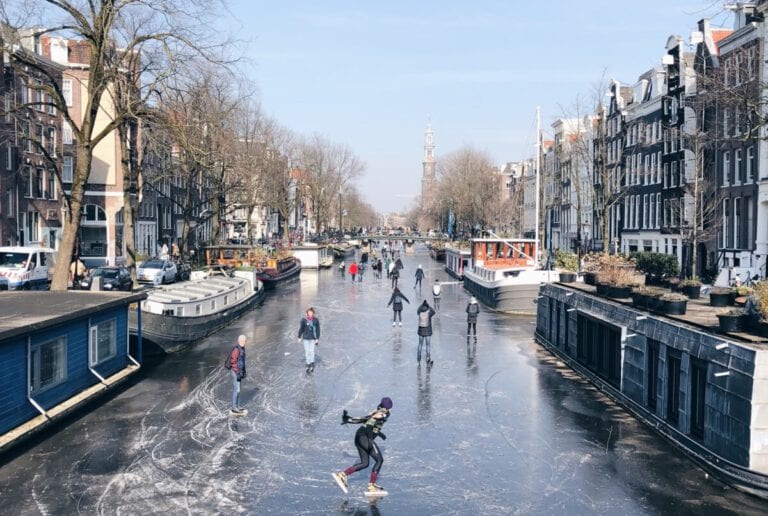
They’re tall, with legs of steel thanks to all the biking, and they live in picturesque towns with canals that freeze in the winter. It all logically leads to this, right?
Forgive my blunt over-fascination by this quirk. Years of Floridian weather have left me in awe over many Dutch things, including their serious ice skating obsession.
What is it?
Newton’s third law of motion states that for every action, there is an equal and opposite reaction — and that’s what ice skating is for the Dutch, a natural reaction.
As soon as the canals and lakes freeze, they react.
Also, they’re master balancers with years of training on bicycles and an odd trust in ice.
It’s not unheard of to even find buggies or prams on the frozen canals — which can push some internationals to a nervous breakdown.
Why is it quirky?
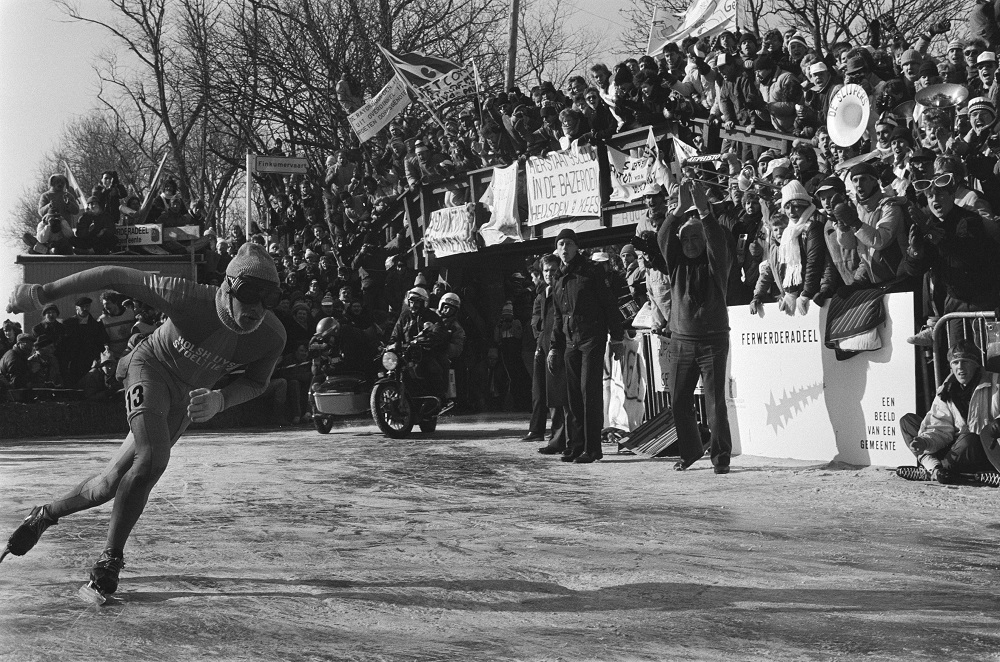
The fact that they have an ice skating tour as a potential placeholder on their winter calendars should give you an idea of why this is delightfully quirky.
It was even an item of discussion on the Dutch cabinet’s agenda in 2021 when considering safety measures in light of a global pandemic.
Beste reizigers, you read that right! Beginning in March, rail startup GoVolta will offer direct connections from Amsterdam to Berlin and Hamburg that are actually affordable.
Tickets start at just €10 for a one-way ride, with the average price of about €30, according to Het Parool.
The low-cost train operator from the Netherlands also plans to launch a daily Amsterdam-Paris service in a year.
In a press release, co-founder Maarten Bastian points out that many travellers want to take the train, but are terrified of the NS and Eurostar’s erratic prices.
“With GoVolta, we’re going to make it incredibly simple: affordable tickets and a guaranteed seat,” he says. We like the sound of that.
Ok, when are they running?
Pack your best Berghain outfit. From March 19, 2026, trains to Berlin will run on Tuesdays, Thursdays, and Sundays.
Meanwhile, Hamburg-bound departures will be scheduled for Mondays, Wednesdays, and Fridays.
But that’s not all, by the time summer arrives, GoVolta plans to offer a daily service to Berlin and Hamburg.
Each train has 11 carriages, accommodating a total of 820 seats, a lounge car, free seat reservations (no more sitting on the floor), and space for two pieces of carry-on luggage.
GoVolta has also informed the Netherlands Authority for Consumers and Markets (ACM) of its expansion plans from Amsterdam to Frankfurt, Munich, Copenhagen, Bruges, and even Basel.
Is this the RyanAir of the rails (but better)?
Given the rise of budget airlines in Europe, it is no surprise that more and more people opt for flights rather than trains to reach nearby cities.
However, in the press release, co-founder Hessel Winkelman says that if price, convenience, and reliability are assured, people will switch to train travel.
According to the startup, travelling to Berlin may cost €300 return with current providers in the Netherlands. Finding a cheap train ticket is like finding a needle in a haystack.
GoVolta wants the option to travel by train to become as “obvious” as booking a cheap flight.
Although the new operator will compete with ICE on the Berlin route, the direct connection from Amsterdam to Hamburg is bound to shake up the international rail market.
The Amsterdam-Hamburg route is also a first, giving the Germans a much-needed break from delayed DB transfers in Osnabrück.
Are you tempted now to go to Berlin? Do you think GoVolta will live up to the prices it has promised?
Forget winter coats, the Netherlands is experiencing temperatures more typical of early spring, with the mercury climbing well into double digits this week.
While December usually means cold, grey days and the occasional frost, this week is delivering something completely different.
Temperatures are reaching levels that would be perfectly normal in March or April, but in December? They’re completely out of place.
Another weirdly mild day
The north started grey and wet this morning, with some drizzle expected along the western coastline. The southeast is getting the best deal: clearer skies with the sun making occasional appearances.
But here’s what’s catching attention: it’s remarkably warm. This morning saw temperatures already sitting at 12 degrees across most areas, with only the Wadden Islands slightly cooler at 9 degrees.
As the day continues, expect highs between 10 degrees near the Wadden Sea and no less than 15 degrees in southern areas, reports RTL Nieuws. Central regions will see a balmy 13 degrees.
The week ahead looks spring-like
Tuesday brings more of the same: mostly dry conditions with regular sunshine and highs between 11 and 15 degrees, weather that RTL Nieuws describes as “truly exceptional for December.”
The dry pattern continues through Thursday and Friday with sunny spells, while the weekend may bring some showers.
Even then, temperatures will only drop slightly, staying between 10 and 12 degrees, well above what’s typical for mid-December.
Enjoying the unexpected warmth, or wishing for proper winter weather? Share your thoughts in the comments!
Choosing the right time and place to buy a Christmas tree in the Netherlands can feel like a mystery when you first arrive. In many countries, festive decorations appear the minute Halloween ends, but the Dutch follow a different rhythm.
Between Sinterklaas, practical considerations, and a love for all things gezellig, the timing of the Dutch Christmas tree has its own logic.
If you are wondering when people here actually buy their kerstboom (and where to get a good one) this guide breaks down everything you need to know. 🎄
When to buy a Christmas tree in the Netherlands?
For a small country, the Netherlands shows surprisingly consistent behaviour when it comes to Christmas tree timing.
Internationals often expect trees to appear the moment Halloween ends, but the Dutch follow their own schedule.
*Mariah Carey voice*: “It’s tiiiime”… but when?! Image: Freepik
Early December: Sinterklaas first, Christmas later
Most Dutch households wait until after 5 December, when Sinterklaas officially leaves the country.
Only once the last chocolate letter has been eaten and Sint has sailed back to Spain do Christmas decorations begin to appear.
For internationals, this slower start can feel unusual. While other countries put up trees in November, Dutch living rooms often stay bare until the very last pepernoot is swept away.
The second weekend of December rule
Ask around, and you will hear the same timing again and again: the second weekend of December.
It is early enough to enjoy the lights for a few weeks, but late enough that your tree is still standing by Christmas Eve rather than collapsing in a pile of dry needles. It is practical, neat, and very Dutch.
Families with kids tend to buy earlier
Households with young children are more likely to dive into Christmas mode as soon as the 5 December festivities end. Schools, neighbourhood associations, and community groups often put up their trees during the first full week of December, which inspires families to follow along.
Either way, if you wander into a shop after 20 December, expect some disappointment. Garden centres and supermarkets begin selling out, and the remaining trees tend to look a little tired.
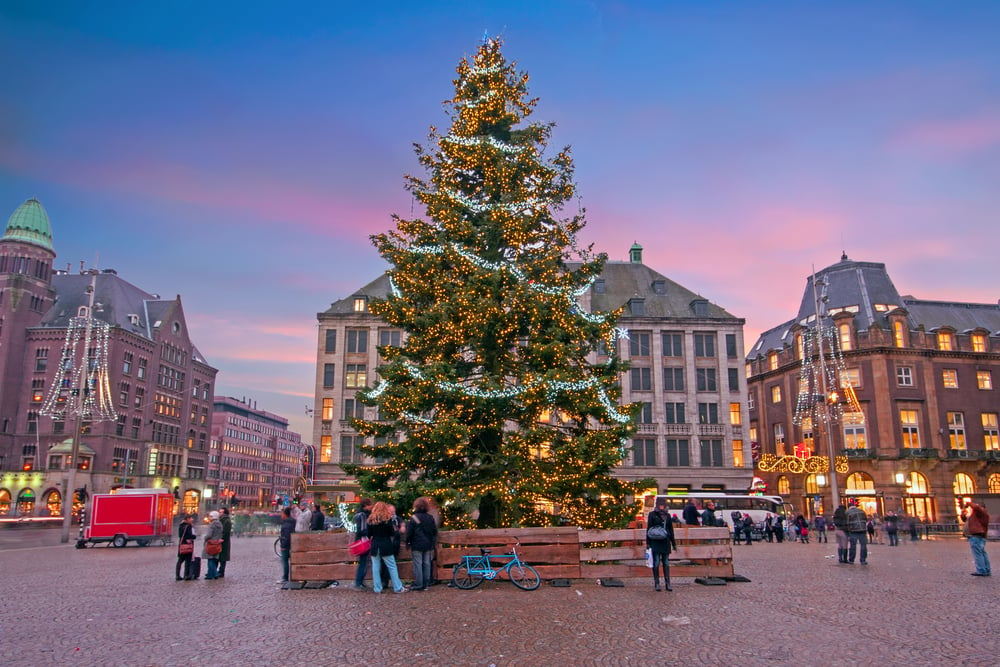
Amsterdam usually puts its famous Dam Square tree up in mid-December. Image: Depositphotos
The best places to get a Christmas tree in the Netherlands
You can find a Christmas tree almost anywhere in December. From giant garden centres to quick pop-up stands on street corners, there is a perfect option for every budget and every apartment size.
Garden centres (Intratuin, GroenRijk, etc.)
Garden centres are the most popular place to buy a tree in the Netherlands. They offer a huge range of sizes, species, and qualities. The Nordmann is usually the bestseller thanks to its soft needles and long lifespan.
Expect a full winter wonderland experience too. Many Dutch garden centres build entire indoor Christmas villages with lights, moving displays, and enough ornaments to decorate The Hague.
Prices are slightly higher than other shops, but the quality is reliably good.
Supermarkets (Albert Heijn, Jumbo, Lidl, Aldi)
From the first week of December, most supermarkets sell Christmas trees outside the entrance. They usually stock spruce or Nordmann varieties in a handful of sizes.
These trees are budget friendly, though the selection is sometimes limited.
In many Dutch cities, small pop-up stands appear throughout December. These sellers usually offer decent prices and quick service.
They are ideal if you do not need the most symmetrical, competition-ready tree, but you want something fresh, affordable, and easy to carry home.
You might find your perfect tree at a local stand. Image: Depositphotos
DIY stores (Praxis, Gamma, Karwei)
DIY stores are another reliable place to pick up a Christmas tree. They stock a good range, usually priced between supermarkets and garden centres.
The bonus is convenience. You can also grab tools, lights, and a sturdy stand all in the same trip.
Renting a Christmas tree in the Netherlands
Tree rental is becoming more popular in the Netherlands, especially among people who want a sustainable option.
Companies deliver a live, potted tree to your home, you enjoy it for December, and then it is collected in January and replanted. Some services include pickup so you do not have to drag a muddy tree through your hallway.
Search for terms like “kerstboom huren” or “rent a Christmas tree Netherlands” to compare providers.
Online delivery
Online Christmas tree delivery has taken off in recent years. Your tree arrives netted and ready to set up, which is ideal if you live car-free or have limited time.
It is also a lifesaver for internationals who are not quite ready to balance a two-metre tree on a bike.
Types of Christmas trees in the Netherlands
Ready to buy your tree but not quite sure what to look for? These are the most popular choices you’ll come across.
The Nordmann: the Dutch majority favourite
Walk into any Dutch garden centre, and you will see one species dominating the rows: the Nordmann fir.
It is popular because it lasts a long time, drops far fewer needles, and has soft branches that are easy to decorate. It is also the most expensive option, but most Dutch buyers decided long ago that the upgrade is worth it.
The traditional Dutch spruce is lighter on the wallet and has a wonderful classic Christmas scent. It does lose needles faster, so it is better suited to households that buy their tree later in December or do not need it to last into January.
Potted trees
Potted Christmas trees work well for smaller homes and eco-conscious families. They can be replanted after the holidays, though they tend to be smaller and require careful watering.
Artificial Christmas trees in the Netherlands
Not every Dutch household brings home a real tree. Artificial Christmas trees are hugely popular, especially among people who prefer a zero-mess, zero-maintenance option. Many families keep a reusable tree stored in the attic and bring it down as soon as Sinterklaas has left.
Why Dutch people choose artificial trees
Artificial trees stay perfectly shaped, never drop needles, and can be used for years. They are ideal for smaller flats, busy households, and anyone who does not fancy vacuuming pine needles every day in December.
While the environmental impact depends on how long you keep it, some experts say a good-quality artificial tree becomes the greener choice if you reuse it for at least seven to ten years — others say you need to keep it much longer.
For many Dutch families, this long lifespan is exactly why they buy one.
Wide range of styles
Shops like Intratuin, Blokker, and IKEA offer artificial trees in every size from tiny tabletop versions to full two-metre centrepieces. Some even come pre-lit, which saves a lot of time and untangling.
Making the Dutch tree-buying experience easier
Buying a Christmas tree in the Netherlands is fun, but a little preparation goes a long way:
If you don’t have a car, make sure to bring a sturdy bike with straps, or borrow a cargo bike if your tree is tall.
Check opening hours before you go — popular shops sell out early in the day during peak weekends.
If you live in an apartment, confirm that real trees are allowed, as some buildings prefer artificial ones.
Try to buy your tree and stand from the same shop, and ask the seller to shave off a small slice from the bottom of the trunk. This helps the tree absorb water and stay fresh for longer.
And most importantly: do not wait until the week of Christmas unless you enjoy the thrill of hunting through the leftover misfits.
How to get rid of your Christmas tree in the Netherlands
Once January arrives, it is time to say goodbye to your kerstboom. Luckily, the Dutch make disposal easy.
Municipal pickup
Most municipalities organise a special Christmas tree collection in the first two weeks of January. You simply remove all decorations and place the tree on the curb or at a designated drop-off point on the correct day. The trees are then shredded and turned into compost or biomass.
Recycling centres
If you miss the pickup — or want the tree gone earlier — you can take it to a local recycling centre (milieustraat). These centres accept bare Christmas trees and process them sustainably.
Bonfires and neighbourhood tree burnings
In some Dutch towns and villages, Christmas trees are collected for a traditional New Year bonfire.
These community burnings are usually organised by neighbourhood groups or the municipality and happen in early January. It is a festive, slightly chaotic tradition where piles of old trees go up in flames while locals gather to watch.
A heart-warming Dutch tradition (literally!). Image: Renzo Gerritsen/Supplied
Not every city still allows these events for safety reasons, but where they do exist, they offer a very Dutch way to end the season: warm, gezellig, and a bit dramatic.
What about artificial trees?
Artificial trees are not collected with real ones. If you ever want to dispose of a fake tree, take it to a bulky-waste collection point or donate it to a second-hand shop. Otherwise, pack it away for next year and enjoy the easiest January cleanup ever!
Whether you pick up a Nordmann from a sparkling Intratuin Christmas village or wobble home on a bike with a tree twice your height, choosing a kerstboom is one of the most magical things you will do in December in the Netherlands.
Have you already put up your Christmas tree? Let us know in the comments!
So, you’ve settled down in the Netherlands. You have a roof over your head, and you’ve filled it with your favourite books, your beloved records, and countless other valuables. Now the question remains: are you required to take out home contents insurance?
It’s a valid question, you’ve already forked out a lot of money to fill your home, so do you have to insure everything in it? Let’s talk about it. 👇
Is it mandatory to take out home contents insurance in the Netherlands?
Put simply, no. Taking out home contents insurance (inboedelverzekering) is not mandatory in the Netherlands.
It is worth noting, however, that some Dutch landlords may require you to take it out as part of your rental contract.
Whether you’re thinking of taking out home contents insurance or your landlord requires it, it’s strongly recommended that you do.
Why should I take out Dutch home contents insurance?
Home contents insurance covers your belongings should anything unexpected happen to them — and you know what they say, expect the unexpected.
Taking out home contents insurance will offer you a lot of financial protection. Image: Depositphotos
To be more specific, the “contents” in this case refer to any loose items that you own in your home. Think: your furniture, clothing, appliances, and valuables such as jewellery.
However, this insurance doesn’t just apply to certain items; it also covers other expenses such as clean-up costs after damage and alternative accommodation (if needed).
And under what circumstances would you be insured?
If your house is robbed
If a fire breaks out
If there’s water damage (think of that pesky leaking roof)
If there’s damage caused by a storm
If there’s damage caused by an impact or fall
Even if you’re dealing with damage caused by a cybercrime
Ready to insure your belongings? Univé’s home contents insurance will help protect you financially. They even give you the option to include your mobile electronics (such as your phone) in your policy. Calculate your premium now.
What’s more, insuring your belongings doesn’t have to break the bank. Unlike, for example, health insurance, the cost of home contents insurance in the Netherlands is relatively low.
On average, prices start from as low as €5 per month, rising to around €30 per month depending on whether you include any additional add-ons.
For example, many insurers offer to add your mobile electronics, including your phone, to their home contents insurance package.
Some providers also offer a buitenhuisdekking (outdoor coverage) add-on, which means your belongings are insured even outside of your home, provided you live in the Netherlands.
As you can see, while home contents insurance isn’t mandatory in the Netherlands, there are many reasons why it’s a good idea to take it out.
Life is full of unexpected twists and turns, you should be able to enjoy it while also knowing that when the unexpected comes, you’re ready to deal with it.
Do you think inboedelverzekering is important? Tell us your thoughts in the comments below.
In the Netherlands, the most common explanation for seeing people as dragons involves a trip to Amsterdam and a copious amount of shrooms.
But according to Live Science, one woman from The Hague had a real medical condition that caused her to hallucinate people’s faces morphing into dragons.
Let’s set the scene. Back in 2014, after decades of living with these terrifying visions, the woman finally sought help at an outpatient psychiatric clinic.
Faces with dragon-like features
The Live Science report, published in August 2025, tells of how the 53-year-old woman spoke with doctors about the vivid hallucinations she had been having since childhood.
When she looked at people, their faces “turned black, grew long, pointy ears and a protruding snout, and displayed a reptiloid skin and huge eyes in bright yellow, green, blue, or red,” according to a report by her doctors.
She never knew when the face of a friend would turn into a monstrosity.
Although initial tests showed nothing unusual, an MRI of her brain revealed small abnormalities that could explain what had been happening all along.
A rare condition
Doctors discovered lesions in the part of her brain that helps with object recognition.
The lesions in the “occipitotemporal cortex” triggered abnormal electrical activity.
Doctors said that temporary oxygen deprivation before or after her delivery during childbirth could have caused the lesions, given that she has lived with these hallucinations since childhood.
Damage to this part of the brain is most often linked to cognitive impairments such as those seen in Schizophrenia patients.
The physicians then diagnosed the woman with a form of prosopometamorphospsia (PMO), an uncommon condition that distorts how a person perceives human faces.
A 2021 review shows that only 81 cases of PMO have been reported over the past 100 years.
Relief at last
The doctors prescribed a drug that is typically used to treat symptoms of dementia caused by Alzheimer’s or Parkinson’s disease.
After three years of the treatment, there was a marked improvement in her work situation and social relationships.
Astronomy nerds rejoice! After a fairly boring astronomical year, 2025 is going to end with a dazzling star show (if the weather works in our favour, at least).
On the night of Sunday, December 14, Weerplaza expects more than 80 meteorites to shoot across the sky almost every hour.
So if you want to romanticise your weekend, grab a blanket, your favourite person, and maybe a hot water bottle.
Tell me more!
This spectacle is all thanks to a shower of meteors called the Gemenids.
Why this name? Well, the point where the meteors appear to come from (the radiant, for those of us who are new to the astronomy game) will be seen near the Gemini constellation.
If we want to get super scientific about it, the Geminids are actually dust particles that originate from the asteroid 3200 Phaeton.
Each December, Earth’s orbit passes through this asteroid’s orbit, and the result is a pretty neat light show.
How can I see them?
Well, the first thing you’ll have to do is cross your fingers and hope there are no clouds in the sky on the night of December 14.
Once we jump that hurdle, the next step will be to find somewhere dark with as little light pollution as possible (which means it’s best to avoid urban areas).
All set up in the dark? Great. You’ll then need to look for the Gemini constellation. If you’re not familiar with these, it’s time to romance a college boy — no, actually, you can just look for Jupiter.
The planet looks like a super bright star in the sky. It’s located near the Gemini constellation and will help you spot the point where the shooting stars should come from.
Let’s cross our fingers and hope the clouds stay away this Sunday.
Why companies in the Netherlands need German-speaking talent
Germany and the Netherlands share a unique economic relationship. In 2024, the Netherlands ranked as Germany’s third-largest trading partner, with a total trade volume of €205.7 billion — evidence of deeply rooted business ties.
Moreover, an estimated 24% of Dutch exports head to Germany, and around 18% of Dutch imports come from Germany.
These figures show that fluent German isn’t just a language skill. It’s a vital asset in sectors like logistics, tech, customer service, and international trade.
German language skills are a great asset in the Netherlands. Image: Freepik
Outside of trade data, real-world demand confirms the trend. German (and French) speakers are in extremely high demand in the Netherlands, especially within companies that serve German-speaking markets or maintain multinational headquarters in the country.
In fact, a recent study found that 43% of job offers in the Netherlands require German, based on data from Europe Language Jobs.
Undutchables: over 25 years of recruitment expertise
Since 1996, Undutchables has built a reputation on understanding what both Dutch employers and German‑speaking professionals need.
Their recruitment style goes beyond CV‑matching: they consider long‑term fit and cultural dynamics.
Specialists in placing German speakers across industries
Undutchables’ reach spans across industries, including (but not limited to):
Customer support and account management: helping German customers feel understood.
Marketing and communications: crafting content that resonates in German-speaking markets.
Purchasing and logistics: negotiating with German suppliers feels much smoother when you speak their language.
This means German speakers aren’t pigeonholed. Whether it’s e-commerce, pharma, finance, or logistics, Undutchables connects you to roles that value both your language and your sector skills.
Germany is culturally similar to the Netherlands, but has its own quirks. Image: Freepik
Jobs for every level — from entry to executive
Undutchables represents roles for every career stage:
Entry-level: ideal for newcomers, like junior customer service agents, support, or administration.
Mid-level: perfect for experienced professionals, like account managers, logistics specialists, or those searching for project roles.
Executive: leadership roles requiring cross-border strategic vision and fluency.
You’ll be supported at each stage, whether you’re stepping into your first role in the Netherlands or moving up through to management.
Why German speakers trust Undutchables
Thousands of German-speaking professionals have built (and grown) their careers in Dutch companies with Undutchables by their side. Why?
One reason is their personalised support. The recruiters (who are often internationals themselves) understand the cultural challenges that come with working abroad and offer practical guidance on applications, CVs, and interviews.
Another factor is their deep network. With decades of experience, Undutchables has built strong, trusted relationships with employers across the Netherlands who are actively seeking German-speaking talent.
Finally, there’s their cultural insight. It’s not only about being fluent in German — it’s also about understanding both Dutch and German workplace norms. This ability to bridge subtle cultural differences makes candidates not just employable but truly indispensable.
Find your next German-speaking role with Undutchables today
If you speak German and are exploring options in the Netherlands, opportunities are well within reach. Undutchables has roles across sectors and levels — whether you’re just starting or are already an experienced leader.