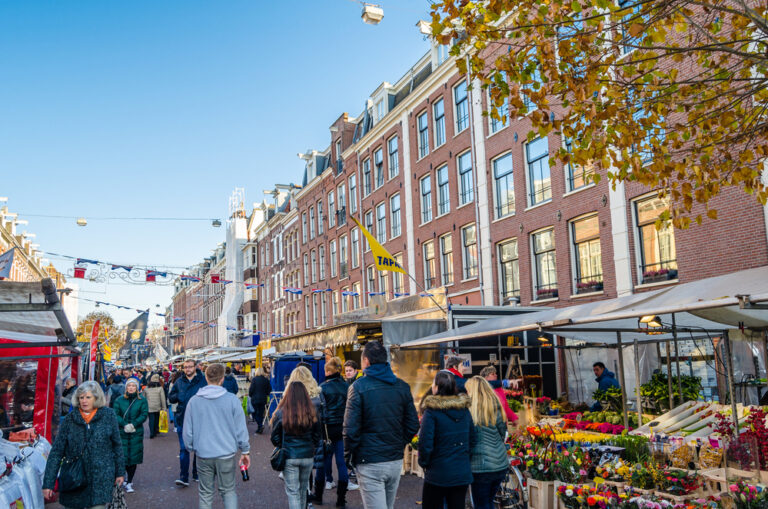
A surprise raid on Monday rocked Amsterdam’s Albert Cuypmarkt, uncovering signs of human trafficking.
According to De Telegraaf, the Dutch Labour Inspectorate led the operation, with support from the police. The raid resulted in the discovery of four potential victims of human trafficking.
As reported by NU.nl, they didn’t have valid residence permits, and it’s suspected that they were not paid legally.
“Three of the four victims were handed over to the Immigration Service because they were not in an asylum procedure,” a spokesperson for the inspection tells NU.nl.
Human trafficking and money laundering investigated
The main target of the operation was a stallholder responsible for daily market setup, who is suspected of employing workers from India under unclear and possibly illegal conditions.
As NU.nl also reported, the stallholder himself hasn’t been arrested yet, as the investigation is still underway.
Authorities are also looking into possible money laundering. The Fiscal Intelligence and Investigation Service (FIOD) joined the raid to look over the stallholder’s finances.
Amsterdam municipality faces growing pressure
This case could spell trouble for Amsterdam city officials, who are responsible for overseeing the market.
The stallholder has been working at the market — right in the centre of the city — for the past three years. Many are now questioning how this slipped under the radar.
Back in 2022, after the previous stallholder went bankrupt, the city skipped a public bidding process and quickly chose a new vendor from Leiden through a short consultation.
That decision has been defended ever since, but with serious violations now under investigation, officials are facing growing pressure to explain how this was allowed to happen.
What do you think? Should the city have done more to supervise the market, or was this impossible to see coming?
Highly-skilled migrants in the Netherlands might have more euros in their pockets, under a raft of proposed changes to the scheme.
According to a recent letter to parliament from outgoing Minister of Social Affairs Eddy van Hijum, the Dutch cabinet wants to tighten the requirements for recruiting knowledge migrants.
Alongside a stricter selection process, this also includes a salary increase.
According to de Volkskrant, the government plans to increase the minimum monthly salary requirement for knowledge migrants under the age of 30 by several hundred euros from the current €4,171. However, the exact amount hasn’t been revealed yet. 👀
Why the sudden salary spike?
The move is part of broader efforts to reduce what officials call “pressure on society” from migration.
Van Hijum’s letter emphasises that knowledge migrant numbers must be “in proportion to what municipalities can bear in education, care and housing.”
A rough translation? Dutch cities are struggling with housing shortages and stretched public services, and the government sees limiting migration as part of the solution.
But they’re walking a tightrope. They want fewer migrants overall while still attracting the tech talent and specialists that keep Dutch businesses competitive.
Cracking down on fake knowledge workers
The salary increase isn’t just about numbers, though. According to Van Hijum’s letter, it’s also about preventing abuse.
De Volkskrant points to findings by the Dutch Labour Inspectorate, which found employers gaming the system by bringing in hairdressers, cleaners, and restaurant staff under the knowledge migrant scheme.
Should a stricter selection process be implemented, the cabinet’s aim would be to ensure only genuinely skilled professionals can be hired as knowledge migrants.
The companies themselves will face tougher scrutiny too. The government plans to examine whether a company’s profits align with the salaries they’re offering knowledge migrants — essentially checking if the numbers add up.
Businesses previously caught employing illegal workers will have their permits to hire knowledge migrants removed. It’s a clear message: play by the rules or lose access to international talent.
What this means for your Dutch dreams
For now, concrete proposals detailing the specifics of these stricter requirements don’t exist yet.
According to de Volkskrant, two further recommendations will be presented to the cabinet, but these will only be debated after the summer recess.
This means that for now, nothing changes — but it could be on the way.
✍🏻 Written by Stephanie Hasselaar-Veltkamp, divorce lawyer at GMW lawyers.
Ending a relationship is never easy, especially when you’re living in another country. But how should you navigate it? Should you use a mediator?
In the end, the best person to answer this question is the professional. That’s why we spoke with the experts at GMW lawyers to ask their opinion on using mediation when ending your relationship in the Netherlands.
GMW lawyers has five lawyer-mediators within their firm who can help you in a divorce situation, or when ending your relationship.
These mediators handle all the different aspects of ending a relationship, such as children, financial aspects, spousal and child support, but also the explanation and application of international law in cases of divorce and the ending of a relationship.
My relationship is ending — when should I consider using a mediator?
It’s important to know that in the Netherlands, you always need to consult a lawyer to get a divorce. This is because a divorce petition must be filed by a lawyer.
And what about mediation? That’s where lawyer-mediators come in. Lawyer-mediators are family lawyers who have completed a specialisation course to become a lawyer-mediator.
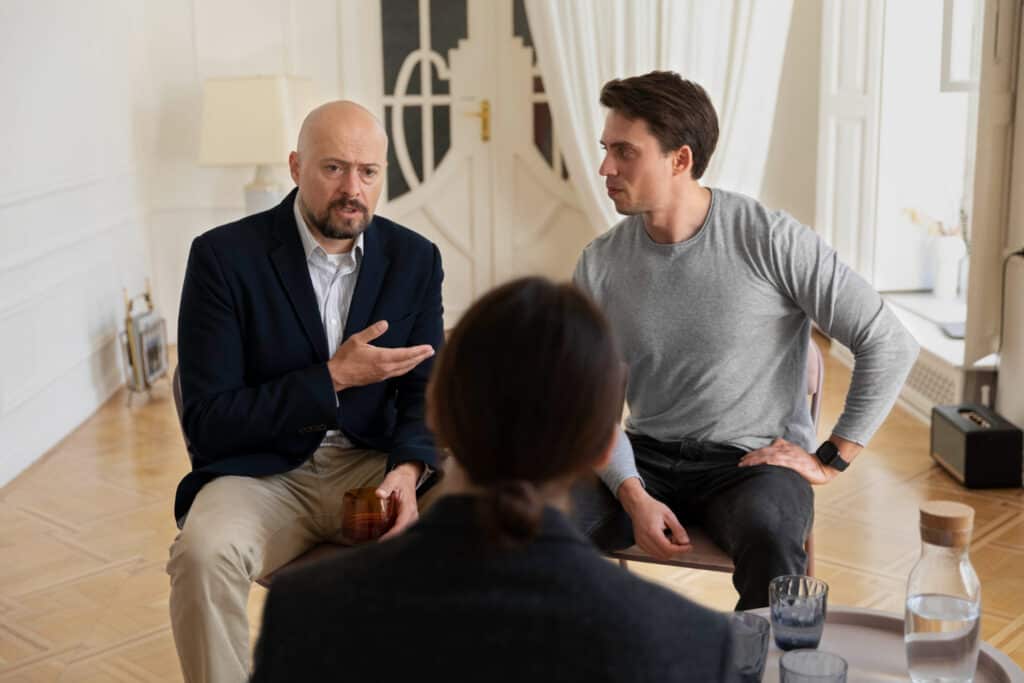
A mediator can help the two of you reach an agreement together. Image: Freepik
They will act as a neutral party for both parties during your divorce, and have the authority to file for divorce in the Netherlands (as opposed to “just” being a mediator).
If you have decided to divorce, an important question to consider is how you want to shape this process. Put simply, there are two ways to do this: each with your own lawyer, or through a lawyer-mediator.
Once you have made the joint decision to separate, it is therefore advisable to contact a mediator.
Tip: Even if you weren’t married but were in a relationship, it is still wise to approach a lawyer-mediator if you need or want to make arrangements. For example, about the children or the settlement of the marital property.
What exactly does a mediator do in a breakup or divorce?
So, you’ve opted to use a mediator. How will this work during your breakup?
A mediator will sit down with both of you, guiding and informing you throughout the process. An important goal of mediation is for you to reach agreements regarding the financial settlement of the divorce and any possible children.
A mediator will help you navigate this emotional time and reach an agreement. Image: Freepik
The mediator will inform you about the legal aspects of the case and will help you reach agreements together.
However, it’s important to note that mediation is not just sitting around the table and talking. Commitment is necessary. Mediation takes place in a confidential atmosphere, guaranteed by a mediation agreement.
The focus is on solution-oriented action and thinking in terms of (joint) interests and not positions.
What are the pros of using a mediator to end my relationship?
An advantage of mediation is that it is usually completed faster than court proceedings. It is also often cheaper; after all, you jointly pay for one mediator instead of two lawyers.
Another important advantage is that you make the agreements yourself and do not have them imposed on you by a judge.
Finally, mediation often has a healing effect on mutual communication. This is not only in your interest but also in the interest of your children, if you have any.
Is mediation only for married couples, or can unmarried partners use it too?
Divorce isn’t the only thing that can cause emotional turmoil. Moving out of the home you shared with your ex can also be difficult.
Regardless of whether or not you were married, ending a cohabitation can also have consequences. For example, if there are minor children, a parenting plan must be drawn up.
A mediator can help you even if you and your partner aren’t married. Image: Freepik
Or perhaps you have a cohabitation agreement that still needs to be terminated and financially settled. The mediator can help you with this.
At the end of the day, it doesn’t matter whether you are married or not: mediation is always an option if you want to reach agreements together.
My marriage/civil partnership did not occur in the Netherlands, can I still use a mediator?
The location where the marriage was entered into is irrelevant for the use of a mediator. If you live in the Netherlands, in most cases, you can get divorced here in the Netherlands.
It may be that the law of another country applies to a subject that will be dealt with during the divorce, for instance, maintenance or the division of the matrimonial property.
Our lawyer-mediators can help you determine which law applies and provide insight into the consequences this has for you.
My children are not Dutch, what can a mediator do for them?
If your children live in the Netherlands, in general, the Dutch court has jurisdiction to hear requests concerning the children.
A mediator will help you come up with a parenting plan for your child. Image: Freepik
In addition, based on private international law, the law of the country where the children have their habitual residence generally applies.
Put simply, if the children live in the Netherlands, then Dutch law applies; the nationality of the children is irrelevant.
If foreign law does apply, the lawyer-mediators from GMW lawyers can also assist with this. Sometimes it requires the involvement of a foreign lawyer.
What happens if my partner refuses to cooperate in mediation?
One of the basic principles of mediation is that it is based on voluntary participation. At the start of the mediation, agreements are made about the process, including that both parties will make every effort to bring the mediation to a successful conclusion.
The mediator will try to encourage this; however, if one of the parties is unwilling to cooperate, the mediation will not be effective. This may result in the mediation having to be terminated.
For example, the lawyer-mediator must terminate the mediation at some point if one of the parties is unwilling to participate or does not follow the lawyer-mediator’s instructions and persists in this attitude.
It is important to remember that cooperation in mediation often yields better results for both parties.
Are there any situations where mediation isn’t recommended?
In our opinion, there are no situations in which mediation is not recommended.
If you know in advance that you are not on the same page in the discussion, the mediator is there to help you and guide you together to reach an agreement.
There are some situations where mediation doesn’t work. Image: Freepik
One argument that comes up with parties is that someone prefers to have their own representative.
However, this is also possible in combination with mediation. If the parties feel the need for it, this is something you can agree on.
If you are both open to mediation and want to actively work towards a joint result, then mediation is always recommended.
Do I really need a mediator when ending my relationship in the Netherlands?
Mediation is always worth considering, especially if you intend to remain on good terms after the divorce or separation.
A lawyer-mediator can guide you and help you through the breakup, which can provide a good foundation for the future. Mediation has many advantages over going through the process of a divorce supervised by lawyers.
Do you have questions about a mediation procedure? Contact one of the lawyer-mediators at GMW lawyers for further information. They are happy to help internationals in the Netherlands navigate the end of their relationships.
Have you used a mediator in the Netherlands before? Tell us about your experience below.
As a newcomer in the Netherlands, it might come as a shock to discover that you can’t buy so much as a frikandelbroodje at your local Albert Heijn with a credit card.
So, if you’re thinking about whipping out any of these bad boys: MasterCard, AMEX, and Diner’s Club cards, sorry to say, but you’ll have a pretty hard time paying in any Dutch store. 😬
What is it?
Research shows that around 55% of Dutchies currently own a credit card.
While that’s more than half of the Dutch population, you won’t see them using those shiny plastic cards for anything more than holidays abroad or shopping at international sites.
The flatlanders prefer the humble pin card, which actually comes in the form of something called iDeal.
If you’ve ever tried to snag a purchase at an online store in the Netherlands, then you’ve likely come across an option to pay with iDeal — and also probably wondered what in tarnation it is. 🤔
With a debit card, your transaction data is better protected as it doesn’t go through a third-party source. Instead, it stays between you and your bank.
We could even go as far as to say that the Dutch’s distaste for credit cards has everything to do with their frugal ways.
The Dutch are experts when it comes to saving some bucks, and they learned how to “do without” for a long time.
So, when given the chance to skimp out on some extra, unnecessary payments, they’ll most certainly take it. If you ask us, we can all learn a thing or two from the Dutch. 🤷
Why is it quirky?
Simply put, it’s quirky because the whole wide world, from the United States to Timbuktu, accepts credit cards, and the Dutch would rather die than stuff one in their wallets.
If you’re a student frantically refreshing rental websites this summer, you’re not alone. According to the NOS, the availability of student rooms in the Netherlands has plummeted by 30% compared to last year.
And new rental regulations are partly to blame.
While the Dutch government introduced the Affordable Housing Act (Wet Betaalbare Huur) last year to protect tenants from sky-high rents, it’s having an unintended consequence: landlords are abandoning the student rental market entirely.
First, let’s talk about the numbers
In the past quarter, students could apply for fewer than 5,800 rentals under 25 square metres. This marks a dramatic drop from the same period last year.
And with university towns already struggling with housing shortages, this reduction is pushing the crisis to new extremes.
Speaking with the NOS, Jolan de Bie, director of student housing knowledge centre Kences, calls these developments “deeply concerning.”
According to Kences, nearly half of all student accommodation (43%) relies on private landlords, but these property owners are increasingly finding student rentals unprofitable.
“We see that, especially in university cities, many buildings with student rooms have been sold in the past year”, says De Bie.
What’s causing this? Landlords are backing out
The new rental regulations have created a perfect storm for private landlords. The points system now caps what they can charge for properties, and this is often below what owners consider viable.
Meanwhile, Box 3 taxes have increased, and renting to more than two people now requires municipal permits.
For international students, the situation is particularly brutal. You’re not just competing with Dutch students who have been on waiting lists for years — you’re also navigating a system where finding student housing has become increasingly like winning the lottery.
However, there could be a way to fix this. Housing experts suggest several approaches to address the crisis:
Campus contracts: These agreements require students to move out upon graduation, ensuring better housing turnover.
Municipal flexibility: Allowing more multi-person rentals without permits could encourage landlords to return to the market.
University responsibility: Student unions argue that universities accepting international students should provide adequate campus housing.
The irony isn’t lost on anyone: regulations designed to make housing more affordable have made student accommodation scarcer than ever.
As the Dutch saying goes, “de pijn wordt weggenomen, maar de ziekte blijft” — the pain is removed, but the illness remains.
For now, students face an increasingly impossible choice between affordable education and actually having somewhere to live while pursuing it.
Are you struggling to find student housing in the Netherlands? Share your experience in the comments below.
KLM ground staff were all set to down tools this Wednesday for eight hours, but the Dutch court has said, “Not so fast!”
A judge in Amsterdam grounded the planned eight-hour strike, citing unacceptable security risks and a big ol’ headache for summer travellers.
For now, flights go on
This isn’t the first time that a strike was brought to a halt. Last month, a court in Haarlem ruled that a 24-hour strike by KLM ground staff could not go ahead. Why? Too much potential for chaos at Schiphol.
According to the NOS, the Federation of Dutch Trade Unions (FNV) and the workers’ union (CNV) had hoped to strike for part of Wednesday instead, but a summary judge wasn’t having it.
KLM, meanwhile, is breathing a sigh of relief. The airline called the court’s decision a win for passengers and operations, adding that the real solution isn’t striking, it’s talking.
They’re eager to sit down with all unions and hammer out a new collective labour agreement.
Small strikes still possible
The unions? Not thrilled. FNV says they’re disappointed and weighing their next steps. FNV director John van Dorland tells the NOS, “We haven’t decided anything yet. I also can’t say yet whether we’re going to appeal.”
When asked if future strikes could still be on the table, Dorland answers, “We remain combative” — sounds like strikes remain a possibility.
Interestingly, the judge reminded everyone that smaller-scale union actions have been allowed before. But given the timing and potential travel chaos, this particular strike ban was deemed fair.
So for now, it’s business as usual at Schiphol. Just don’t forget your carry-on and your patience.
Do you agree with the judge’s decision to block the strike, or should the unions have been allowed to go ahead? Let us know in the comments!
There’s growing backlash against the Dutch government’s proposed changes to asylum laws, and it’s coming from all sides. 👀
This Tuesday (July 1), a majority in the Dutch House of Representatives (Tweede Kamer) just approved one major update to the Netherlands’ asylum laws.
A closer look at the new rules
In addition to making family reunification much harder, the Netherlands will also be introducing a two-status system to process asylum applications. 👇
Status one: refugees fleeing persecution based on religion, ethnicity, or sexuality
Status two: refugees fleeing war or natural disasters
Helaas, all asylum seekers falling into the second category will be granted fewer rights and are expected to return to their home countries much sooner.
The one bright light on the horizon, however, is that status one refugees will now receive more protection.
Municipalities fear local chaos
The Association of Dutch Municipalities (VNG) isn’t mincing words. They’ve called the new laws “legally untenable” and warn that they’ll cause chaos for local governments trying to implement them.
Their main concern? The changes risk turning the asylum process into a logistical nightmare, and the VNG says they’ll be taking their complaints straight to the Senate.
Refugee Council Netherlands (VluchtelingenWerk) isn’t convinced, either.
In a statement to the NOS, the organisation said, “The asylum laws do not offer concrete solutions to social problems such as the housing shortage, the long waiting times in the asylum procedure and the shortages in asylum reception.”
Children will suffer
Meanwhile, UNICEF Netherlands is especially worried about the impact on children.
Under the new law, foster children might not be allowed to reunite with their foster families in the Netherlands.
Plus, the government’s idea to introduce a ‘dual-status’ system for refugees could leave kids stuck in asylum centres for longer periods, adding instability to already uncertain lives.
Legal experts are speaking out, too. The Association of Asylum Lawyers and Jurists (VAJN) warns that the changes seem designed to trigger chaos and flood the legal system.
In short, the message from those on the ground is clear: this law doesn’t fix the system, it risks breaking it further.
What do you think about the current situation at asylum centres in the Netherlands? Tell us your thoughts in the comments below!
From July 1, newcomers to the Netherlands will face a refreshed Knowledge of Dutch Society (KNM) integration exam, updated to match today’s realities.
The Dutch government announced the changes in a press release, calling them significant and timely. Let’s take a look at what’s new and why it matters. 👇
From now on, newcomers will be expected to understand that in the Netherlands, women have the freedom to work, make their own choices, and live independently.
As State Secretary for Participation and Integration, Jurgen Nobel, explains: ”It is essential that newcomers learn that in the Netherlands you are allowed to work as a woman and to organise your own life.”
Alongside this, there’s now greater emphasis on Holocaust education. It includes questions about what the Holocaust was, the loss of many Dutch Jewish lives, and the importance of rejecting anti-Semitism and discrimination.
What you’re expected to know
The KNM exam is based on a set of final objectives that lay out what newcomers should understand to find their way in Dutch society.
These cover everyday topics such as work and income, social manners, values, housing, and the organisation of the government.
These objectives are updated every 5 to 10 years to stay in tune with changes in society and legislation.
It’s not just about learning the rules; it’s about building the kind of knowledge that helps people feel prepared, confident, and able to take part in daily life in the Netherlands.
What do you think of the new changes to the KNM exam? We’d love to hear your thoughts. 💬
Artificial intelligence (AI), ChatGPT, Nvidia — sound familiar? These words have been popping up all over the news and social media in the past year. AI is officially having a moment, and Leiden-based startup Landscape saw it coming a decade ago.
Today, Landscape is transforming how businesses harness the power of artificial intelligence.
As an AI consulting company, they help companies develop smart, tailored AI solutions. But what exactly does this mean? And how did they get started? I sat down with CEO and founder Erwin Haas to find out.
Meet the CEO, Erwin Haas! Image: Supplied
How did Landscape get started?
Landscape wasn’t built with a grand vision right off the bat. In fact, it started as something much simpler: a casual chat between Erwin and a friend.
Wait, what? Yep. Over a decade ago, Erwin and his co-founder “were frustrated by the everyday nuisances in our surroundings, like when a bench broke or a streetlight malfunctioned. We wished we could snap a photo and send it off for repair, no logins or detailed reports required.”
They toyed with the idea but didn’t act on it. A little while later, a startup made headlines with the same concept. Erwin’s reaction? “That could’ve been us.”
A short while later, Landscape was born. We didn’t have any clients or even a very specific idea, just the philosophy of ‘Okay, we need to do this,’” Erwin remembers. “I knew AI was going to be bigger and bigger,” Erwin says, and he wanted to see how it could revolutionise business.
After chatting with people in the industry, someone reached out and asked if they were still in business. “The next day, we went to the Chamber of Commerce and registered Landscape.”
In this ever-changing field, how do you measure the success of your company and the impact you’re making?
Fast forward to today, Landscape is a full-blown AI consulting company. Erwin explains, “We don’t just build AI models or custom solutions – we help our clients figure out where AI actually adds value for them, both technically and strategically.”
But how do they measure success in such a fast-moving field? Sure, the easiest way would be to see how much money they can save other businesses. However, that’s not what Landscape is all about.
“We take a very human-centered approach,” Erwin says, “of course, efficiency matters, but we also look at impact in ways that are harder to quantify, like making people’s jobs more enjoyable.”
AI makes work easier! Image: Freepik
One project in particular stands out. Erwin recalls: “We had a project where a company assigned one employee to “the mailbox” daily — someone who would just assign information to the right mailbox. This was like a full-time job, and it was covered by the entire support team.”
“Nobody liked it, so we were brought in to create a solution that could automatically sort that out. Did it save a lot of time, like money-wise? Maybe not even that much. But it made a big difference in employee satisfaction.”
How has the recent AI interest impacted your business?
With AI plastered all over the news, it’s no surprise that Landscape has been feeling the impact. “We always struggle a bit with the hype,” Erwin smiles.
“While it’s exciting, many people seem to be overwhelmed by possibilities and not always realistic in their expectations.”
Managing these expectations is part of Landscape’s role — showing companies that while AI can indeed transform their operations, it takes time, careful planning, and a customised approach.
“It’s very cool that you can use ChatGPT for lots of things, but people now expect everything to be solved by an LLM (Large Language Model), instantly. In reality, applying AI to real-world cases takes more than just typing in a prompt.”
Can you recount some pivotal moments or milestones in your journey?
When it comes to career-defining moments, Landscape’s work with Dutch hospitals is a biggie. Erwin explains: “Every patient record in a Dutch hospital used to be manually coded in order to be further processed and have reports go to several organisations. This was all done by hand.”
Landscape has changed the game for hospitals across the country. Image: Depositphotos
But that’s where Landscape came in and built a solution to automate much of this work. “We built a federated learning environment,” he explains, “allowing hospitals to share insights without compromising sensitive data. [This solution] reduces 70%-80% of the administrative burden in this specific field.”
“Creating this kind of federated AI solution, with the help of multiple hospitals, has never been done before in this field. We’re quite proud that we got it working, and we’re very happy to see that more and more hospitals are coming on board.”
Where do you see Landscape in 10 years?
As Landscape continues to grow, Erwin envisions a future where they not only consult but also foster innovation.
“I still see Landscape as a consulting company. We like this opportunity to look around companies to see what we can change there. It’s inspiring, and it teaches us a lot in our field.”
“But in ten years, we might also want to co-develop products that arise from our collaborations.”
They’ve already dipped their toes into this with Selectical, a startup focused on AI-assisted literature reviews, which they co-founded with an old client.
“I really like this model,” Erwin says, “where we bring our AI expertise to co-develop projects. I would like to keep moving in that direction.”
One thing is certain: Artificial intelligence is here to stay. And as long as AI continues to evolve, so will Landscape — combining technical know-how with a human touch.
What do you think about Landscape’s journey? Share your thoughts in the comments!
The Dutch are certainly no strangers to a good party. Take Amsterdam, for example, a hub for the occasional recreational drug on a long weekend.
We understand that’s not everyone’s cup of tea, so if you’d rather not spend 15 hours at a dingy and dirty club in Amsterdam, we suggest you take up the Polonaise. 🕺
What is it?
The Polonaise (meaning “the walking dance”) is one of Poland’s five national dances, featuring a rhythm in triple time, similar to formal dance styles such as the minuet and the waltz.
The Dutch happily adopted this popular dance, and truly made it their own — as you can see in the video below. 👇
As for how you dance the Polonaise, well, it’s simple! All you have to do is form a line with your hands placed on the shoulders of the person in front of you and walk around in a circle.
More popularly known as… the conga line! 💃
Why do they do it?
We’re not entirely sure why they do it, considering the Dutchies’ standoffish nature. Perhaps they may need a shoulder to lean on now and then? 🤷♂️
However, if Dutchies know how to do one thing best, it’s to party. 🎉