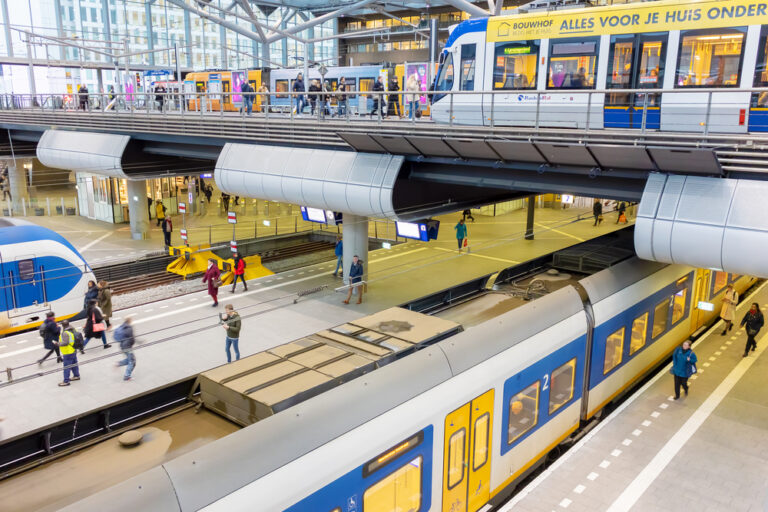
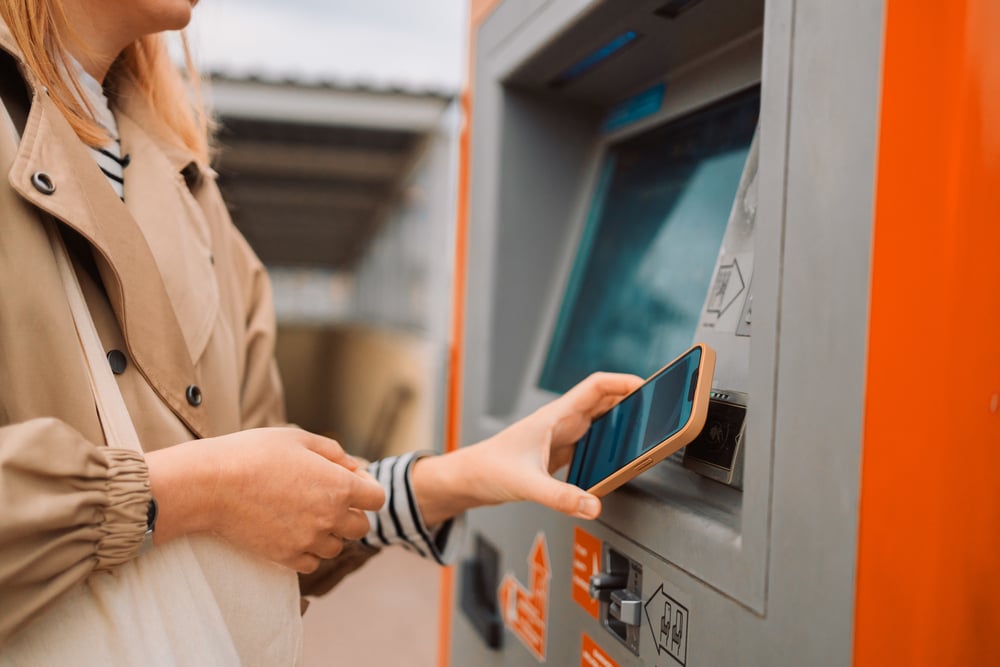
If you don’t cancel your €49 NS unlimited summer train pass before it expires, brace yourself, because it’ll automatically renew at €127.95 a month.
According to Rover, the Dutch consumer organisation for public transport passengers, “subscriptions expiring after August 1 will be automatically renewed at more than double the rate”.
The organisation expects “a financial blow” for customers who haven’t read the deal’s fine print, and calls on the NS to provide travellers with more information.
Here’s what’s going on.
From €49 to €127.95 in a mere month
The Nederland Dal Vrij summer deal has been a genuine hit, with more than a quarter of a million people snapping up unlimited off-peak travel for €49 a month.
That bargain price was funded by a €118 million contribution from the government, meant to keep trains affordable while fuel prices soared.
However, there’s one glaring catch for customers: the deal officially runs until August 31, but any subscription that ends on or after August 1 quietly rolls over into a full-price NS Flex Dal Vrij subscription… at a whopping €127.95 a month.
Consumer rights organisations point out “double standards”
Needless to say, Rover director Daan Zieren isn’t impressed by how NS has handled the issue, and he’s called out a bit of a double standard.
“Existing customers who have been travelling faithfully during off-peak hours for years with a regular Dal Vrij subscription were not automatically switched by NS to the cheaper rate of €49,” he points out. “But conversely, NS will soon be able to automatically switch travellers to the more expensive variant. That is applying double standards.”
He’s also keen to stress this isn’t some commercial NS offer, but a government scheme with millions set aside to make train travel cheaper.
“It is a government initiative in which millions have been allocated to make train travel more affordable,” Zieren says. “It is ironic that travellers are now being exposed to the risk of unintended expenses.”
So, how can you avoid an unexpected full-price fare?
The good news is that you’re in control, as long as you act in time.
Check your renewal date and cancel or downgrade before it flips to full price. If you like hassle-free direct debits, you can switch your subscription to NS Flex Basis for €0 a month, or move to a different NS product.
NS does say on its own subscription page that it warns you before the switch, and that over-65s renew at a lower €59.95. Still, Rover wants NS to go all out with reminders, whether that’s personal emails, app notifications, or anything else that gets the message across.
Did you grab the €49 summer pass, and are you planning to switch to a different subscription? Share your experience in the comments below.
Finding housing in the Netherlands can be ridiculously hard — and there’s a minefield of scams to dodge along the way.
Even if you think you’re too smart to be taken in by a housing scammer, the Netherlands housing crisis is the perfect storm of pressure, competition, and scarcity.
This means that even the most seasoned house hunters can fall for a rental scam.
However, armed with a bit of key knowledge, you can spot a con and save your cash from being swindled.
Here’s what to look out for to avoid housing and rental scams in the Netherlands!
If it’s too good to be true, it probably isn’t true
You may have heard that the Netherlands has a major housing shortage — yeah, it sucks.
This has bumped up competition for everyone searching for a house, and in response, landlords have bumped up their prices, too.
If you think you’ve hit the jackpot with a three-bedroom, two-bathroom apartment for €750 per month, we hate to break it to you, but that’s a Dutch housing scam.
Think you found that PERFECT rental flat? Don’t get too excited just yet. Image: DepositPhotos.com
Scrutinise the landlord’s social media
If you’re searching for a room or apartment on Facebook, you have a great advantage — Facebook profiles.
Some scammers are clever enough to hide most of their personal details, but they often forget to hide certain things.
For example, if they have a Dutch name, but you see they’ve liked pages with names in foreign languages, that’s a red flag.
If you’re using Facebook Marketplace, always click the “See Seller’s Other Listings” button.
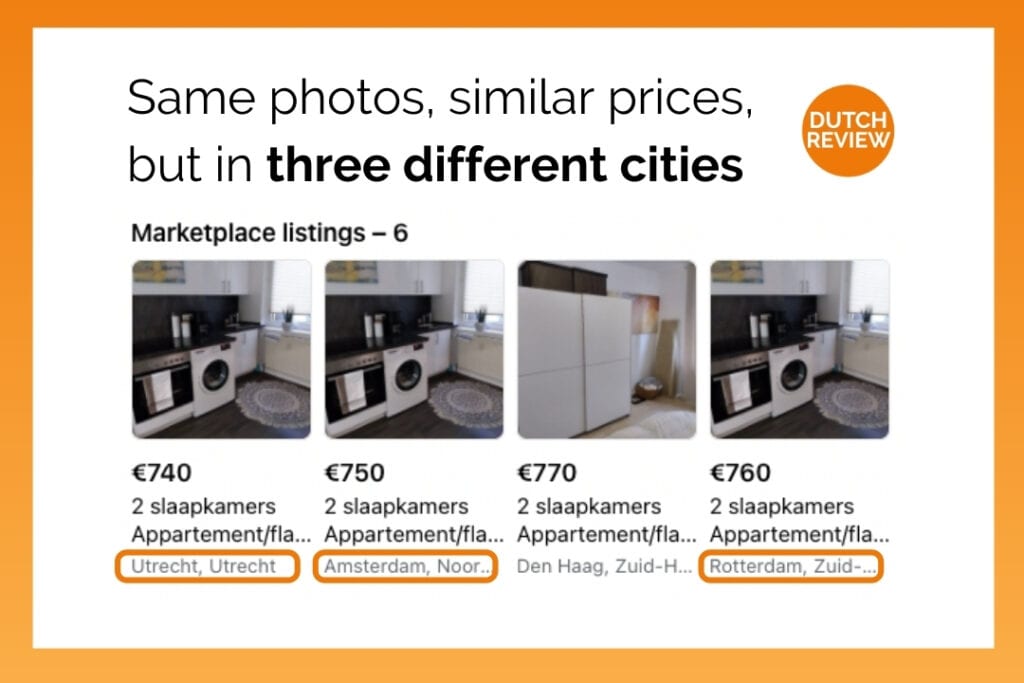
Scammers often post on multiple groups all over the Netherlands or all over Europe and will often use the same pictures or similar descriptions in all their ads.
It’s an easy way to see if they’re dishonest!
You can also search the seller on Facebook to see if they’re posting ads in house-hunting groups in multiple locations.
If an advertiser has the same property listed in different places, that’s a scam. Image: DutchReview
Go full detective on the pictures of the house
Pictures of a house mean nothing.
These are often lifted from Airbnb or other rental websites and shared between house scammers in the Netherlands and other countries.
First, do a reverse image search on the images and see if they appear elsewhere on the web.
Are power outlets the Dutch/EU standard? (One circle with two circular holes)
Is the apartment unreasonably spacious? Remember, homes in the Netherlands are generally small.
Does anything in the image look not Dutch? E.g. shopping bags or boxes with foreign letters on them, food brands, or shoes not worn in the Netherlands (like plastic, indoor slippers).
All tap water in the Netherlands is drinkable. It’s less common to have large bottles of filtered water in kitchens than it is in other countries. If you spot this, that could be a clue.
TIP: Reverse image search easily in Google Chrome by right-clicking on an image and selecting “Search Google for Image”. Then, see if the picture has been posted on other websites (like Airbnb or real estate websites).
Know what a scammer’s message looks like
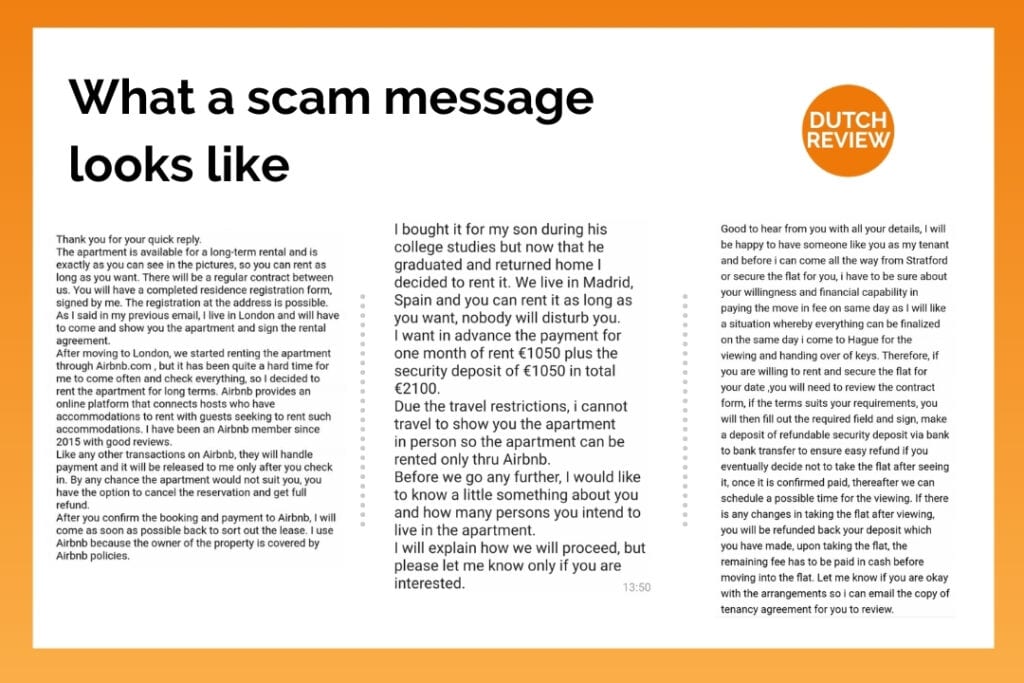
We’ve seen so many scammers’ messages at this point that we can pick out the patterns.
First, scammers provide way too much information up front, and it’s all designed to make you think, “This is the perfect house!” Spoiler: It’s just another Dutch rental scam.
Here are a few key points to look out for:
🚩 You’re immediately referred to another person
Scammers often (but not always) work by having multiple people send messages and post ads on various house-hunting websites or social media.
Then, to communicate, they’ll send you a WhatsApp number for the “landlord” or person taking care of renting the apartment.
This is straight-up a red flag. Unless they’ve sent you a real estate agent contact that you can verify online, proceed with extreme caution.
🚩 The apartment and lease are way too perfect
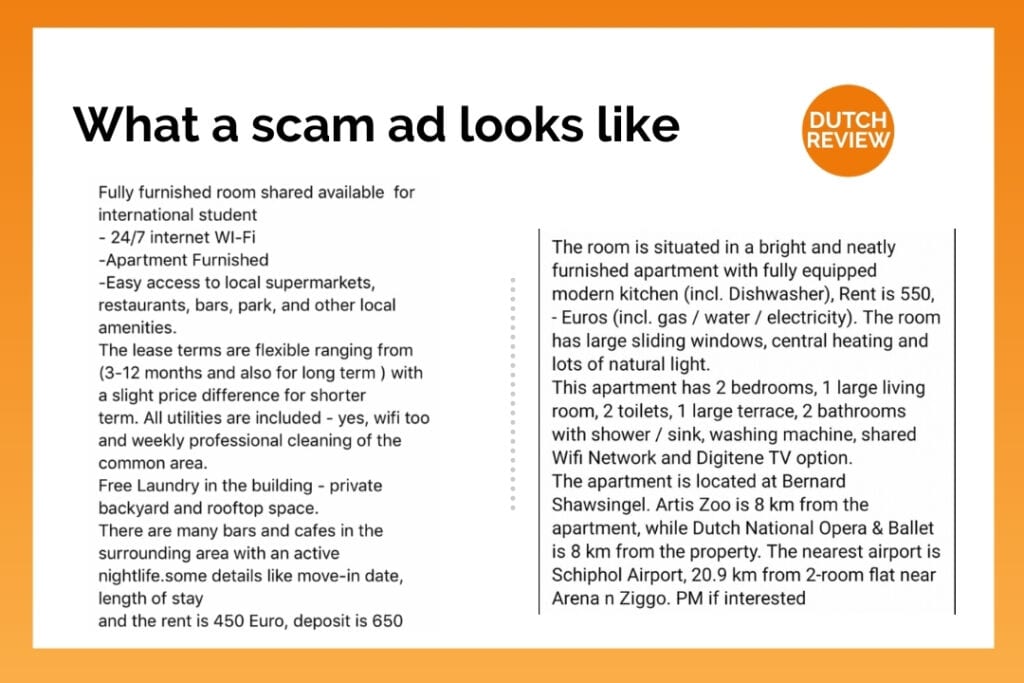
And strangely detailed. Scammers’ descriptions of the houses tend to have similar characteristics, including…
A long list of all the great appliances and features in the house.
No minimum or maximum rental term (you can stay as long as you like!).
A “perfect location” that is close to generic bars, restaurants, and grocery stores.
A very specific location (sometimes with the full address, sometimes the suburb and postcode). Dutch people rarely describe their address as “Westerpark, 1013 RR,” and will instead just say “Westerpark.”
Some scammers will even include oddly specific details like “Artis Zoo is 8 km from the apartment.”
Renting out rooms separately (each room is €420, and the price for the whole apartment is €840).
Scam ads generally all feature similar characteristics. Image: DutchReview
🚩 The “landlord” is in another country and can’t show you the property
If you ask for a viewing, the scammer will then tell you why they can’t show you the apartment in person. Watch out for:
Being out of the city on a business trip, visiting family, living in Spain, vaccinating children in Africa, and researching coronavirus vaccines in the UK.
A promise that as soon as you sign the lease and make the full deposit and first month’s payment, they’ll send you the keys via registered post/DHL.
Sellers always have a reason why they can’t show you the apartment. Image: DutchReview
Be wary of supplied IDs from the landlord
The landlord may send you passport copies to prove they are who they say.
Don’t take these at face value: scammers will request passport copies from people they are trying to scam and then steal their identity later — either for more scams like this one, to open new Facebook accounts, or for more insidious identity fraud.
NEVER send your ID until you’re 100% sure
Unless you want to find extra profiles of yourself online (or have loans taken out in your name), don’t send copies of your ID.
If you absolutely have to, be certain that you’re not working with a scammer, have met the landlord, and have viewed the apartment.
Check who officially owns the house
For €3.70, you can find out exactly who owns a house in the Netherlands (and make sure it matches up with your potential landlord). Head to the Kadaster property registerand click “Nu bestellen” (Order Now).
If there isn’t a match, request a written explanation from the person you’re in contact with.
Tell them you need written authorisation that the landlord or agency is acting on the owner’s behalf.
Avoid renting an apartment that you haven’t seen
We get it, the Dutch housing market sucks. If you know you’re moving here and have been given the advice to “start looking for a house before you arrive,” we understand. But you should be very careful.
If you can’t see an apartment yourself, try to find someone you can ask to view the property on your behalf: a friend, colleague, or classmate who may be willing to lend a hand.
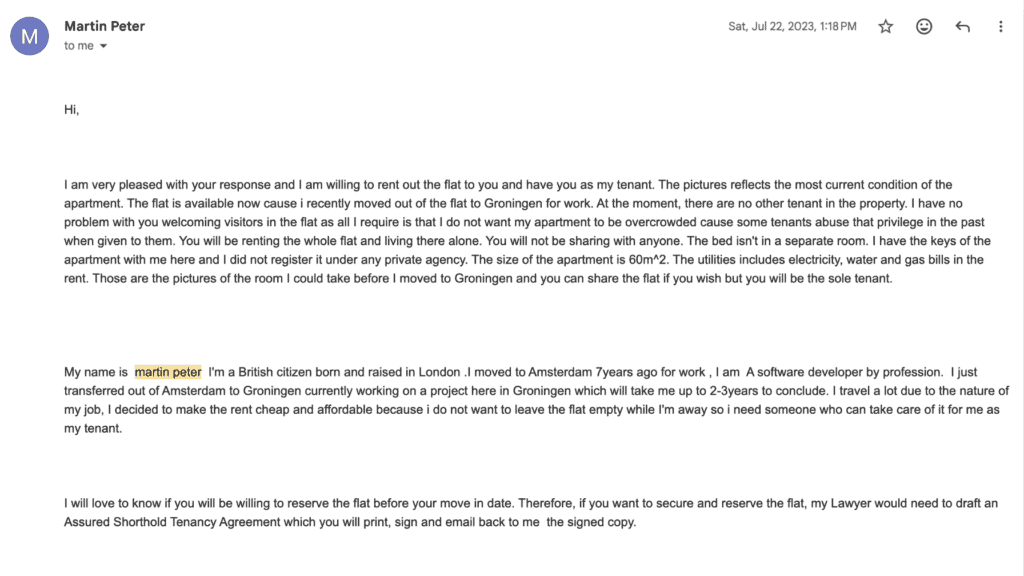
This is an email response one of our writers received from a real-life scammer. Yeah, right, Martin Peter! Image: DutchReview
And remember, if the landlord can’t show you the apartment (because they’re out of the country, or something along those lines), that’s a big red flag.
Avoid, avoid, avoid, or you may just fall for a housing scam in the Netherlands.
Resist the pressure to sign immediately
Scammers will often pressure you to sign on the dotted line to secure the apartment.
They may say that they have a lot of interest but that they will give it to you if you sign (and send money) now.
Beware of these pushy sales tactics, take a deep breath, and make sure you’re convinced you’re not working with a scammer first.
Be smart with how you pay
Scammers want one thing: money.
Be extremely careful when working with a landlord about how you will make the payments.
When paying cash
Try to avoid cash where possible: this leaves zero paper trail.
If you trust the landlord, but they ask for cash, try to get them to sign a receipt.
While handing them the money, record the conversation on your phone while you do it. Make sure to say key information out loud, such as “Here is €1,200 cash to pay rent for January for the apartment at 1234 Oudestraat.”
When paying via bank transfer
If you’re paying for your rent via bank transfer, be critical of the account details.
Does the account name match who you’re speaking with?
Is it a Dutch bank account? If not, why?
Is it an IBAN that you’re paying into?
Does the bank name look legitimate? Is it a bank you recognise or can verify online?
Other methods of payment
We’ve yet to see a legitimate landlord in the Netherlands who wants payment for their rental property via money transfer services like Western Union.
Do not do it.
Never, ever pay through Airbnb
A common scam is that, once you’ve found the perfect apartment, the “landlord” will request that you pay via Airbnb.
They’ll tell you to reserve the apartment for one month upfront, and then you’ll be able to extend indefinitely.
The landlord will then send you a link to their property on the Airbnb website that looks completely legit. Do not fall for it.
It will be a fake link to a scam website that will take your money and give you no apartment in return.
A true landlord will never do this. Why? Airbnb takes an average of 14-16% of every reservation from a landlord. If your rent is €1000, why would a landlord turn around and give €150 to Airbnb?
Beware of illegal sublets
If you can’t register at an address, you may be dealing with an illegal sublet. This occurs when someone who is renting an apartment wants to sub-rent it to another person.
You won’t be in trouble if you sub-rent an apartment, but if the landlord finds out, you may be kicked out — even if you’ve paid. You’ll also likely not be able to register with the local municipality, which is mandatory in the Netherlands.
Know where to ask for help
If you’re not sure, ask people around you for help. Sometimes, a critical eye that’s not emotionally involved can save you from a scam.
If you’re unsure about a rental contract, !WOON is an organisation dedicated to helping residents with housing issues. You can also contact your local Juridisch Loketfor free legal advice.
Of course, if you do fall for a scam, take action straight away!
Contact the police and press charges. Gather as much evidence as possible and screenshot any conversations that you’ve had with the scammer.
Have you had experience with a rental housing scam in the Netherlands? Share your story in the comments below so other people know what to look for!
Scammers are flooding TikTok and Facebook with bogus rental listings this summer, stealing pictures of real Dutch homes and pocketing deposits from house-hunters who never get a key.
Landlords in Groningen say the fraud spikes every summer, right when students and recent graduates scramble to find new accommodation.
As reported by RTV Noord, the fake ads are now getting harder and harder to spot, largely thanks to developments in AI (which writes flawless Dutch and English on the scammers’ behalf).
How these scams actually work
Fraudsters steal photos and property details straight from a legitimate landlord’s website, then repost them as their own ad. The bait tends to be a suspiciously low price on a “beautiful, spacious apartment”, in a central or attractive region.
Groningen real estate agency Gruno Verhuur flagged one such example to RTV: A home the company genuinely lists for €1,500 a month (with a €1,500 deposit) was reposted by scammers at €1,000 rent, but with a €2,000 deposit demanded upfront.
Once you message them, the tone turns pushy fast. They send bank details to prospective renters, insist on payment before any viewing, and brush off questions with lines like “after payment” or by suggesting you stop wasting their time.
And, with a rampant housing crisis, many renters in the Netherlands are unlikely to push back.
“For years, there have been fake advertisements and fake websites taking over our listings, where you have to pay if you want to register,” a spokesperson of housing association Lefier tells RTV. “We see that people are profiting from the tight housing supply.”
Internationals get hit the hardest
If you’re moving to the Netherlands from abroad, you often can’t pop round for a viewing before you commit. Scammers are well aware of this, and they capitalise on your need to lock something in from afar.
Gruno Verhuur’s co-owner Johannes Bruining tells RTV that he has seen the fallout in person: “A few years ago, we received calls from one of our tenants. People with suitcases were standing at their doors claiming they had rented that property. That wasn’t the case.”
Thankfully, the company managed to house those particular victims in spare furnished flats, but that’s a rare stroke of good luck. Most internationals caught up in these scams simply lose their money and their would-be home in one go.
And, while expats may have more funds at their disposal, international students often have their hands tied. Most want to find housing before their term starts, adding to the desperation.
“They cannot yet view properties from their own country and want to be assured of one, so they transfer money in advance,” Bruining continues.
“Some students have already sent dozens of responses and are happy that they finally have an advertisement where they can rent something.”
Why are these scams so hard to stop?
Reporting an account barely helps, because, as Bruining puts it, a fresh profile can pop up ten minutes after the old one is taken down.
Calling the police tends to lead nowhere either, since the fake identities vanish the moment they’re flagged. Housing association Lefier looked into the legal options and found little could be done, according to spokesperson Eefje Kuiper.
The old giveaway of clumsy, error-ridden Dutch is also fading. Sophie van der Zee, a fraud researcher at the Erasmus School of Economics who has studied rental scams in the UK, notes that AI can now churn out convincing text in any language.
“Someone can now have perfect texts generated in all languages specifically created to persuade people,” van der Zee tells RTV Oost. “It could very well be that the person behind the TikTok account is located somewhere abroad.”
Here’s how to protect yourself (and your funds!)
Van der Zee suggests a quick reverse image search: right-click the listing photos and look them up online. (Google Lens is great for this!) If the same shots appear on a real estate agent’s page, you’ve found the original and confirmed that the listing is bogus.
Her second rule is to trust your gut: “If you see a super beautiful and spacious apartment for 800 euros, that is often ‘too good to be true’.”
The safest option, landlords stress, is to only trust listings on a company’s official site, view before you pay, and never transfer a deposit before you’ve signed a contract and (ideally) have keys in hand.
Want to make sure DutchReview pops up on your news feed more often? Just add us as a preferred news provider, and we’ll handle the rest.
I’m proud to be Dutch; I really am. After all, the Netherlands is a country of amazing and wonderful occurrences and phenomena.
Citizens of this nation definitely have good reason to be proud of the country’s accomplishments. However, for all its genius, the Netherlands has many strange quirks.
Here are just seven of the odder cultural Dutch quirks.
1. They are always on time
When you schedule a meeting here at 11 AM, you’ll find that the meeting will begin at precisely 11:00 AM. Not a minute sooner or later.
You’re probably sitting there thinking, “Well, of course, the meeting was scheduled for 11:00 AM, so it starts at 11:00 AM.”
Get used to this expression from your boss — or friends. Image: Freepik
But the truth is, unless you’re Dutch (or from the handful of other ‘on-time’ places), then you’re probably late for every meeting you attend — even if you don’t realise it.
If you’re an international living in the Netherlands, then it might not be a bad idea to invest in a watch.
2. They congratulate absolutely everyone on birthdays
I don’t mean to imply that the Dutch don’t celebrate birthdays. They do. In fact, when someone is jarig (meaning that it’s their birthday), you’re expected to congratulate them. That doesn’t seem so weird, does it?
But you’re also expected to congratulate everyone else remotely related to them if you happen to come into contact with them.
Welcome to the party! Now join the circle of death. Image: Depositphotos
Say you’re invited to your friend’s birthday party. You show up (obviously on time), and you’re met by a living room filled with relatives and friends, all seated in a single circle surrounding the coffee table.
All the heads turn to you, and you’re expected to make your way around the circle to each person and congratulate them for the birthday of whoever is celebrating that day.
Only after this ritual of round introductions may you then take your own seat and witness the quiet, awkward politeness that is the Dutch celebration of birth.
3. Their toilets are just… weird
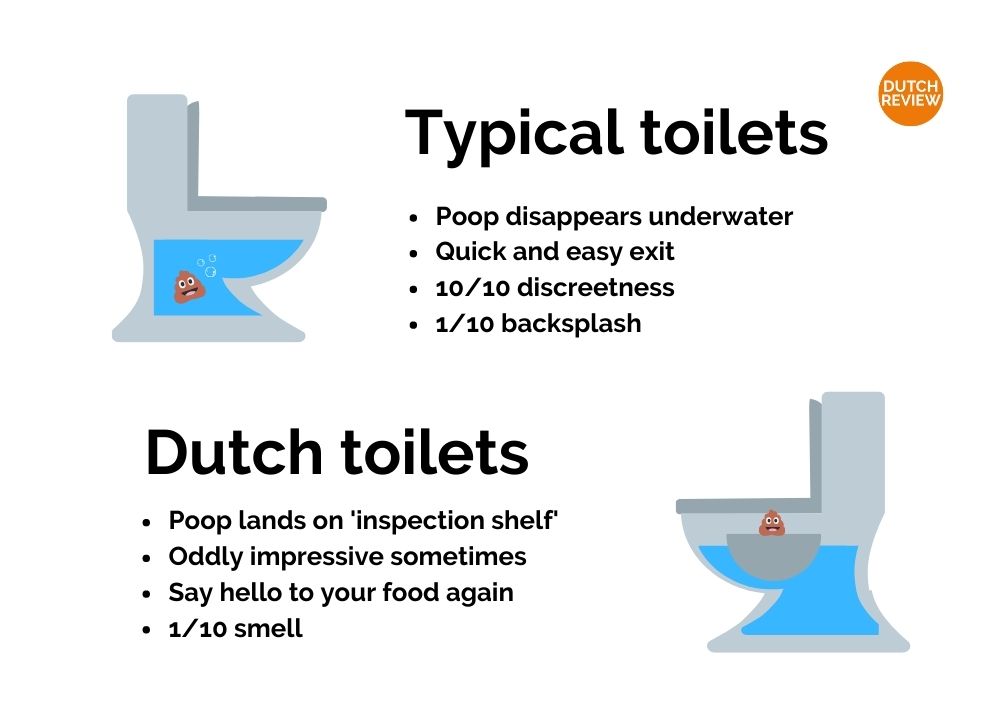
On this subject, I will first quickly get the whole ‘shelf toilet out’ of the way.
Depending on your expectations, it may or may not disappoint. I literally cannot count on my two hands how often I have had a conversation about the design of this particular restroom.
Despite their strange looks, they actually make a lot of sense for several reasons. Firstly, the toilet-goer is provided with a glance at their deposit after the deed (especially useful for those who want to know more about their current health afflictions).
Dutch toilets are a real experience. Image: DutchReview
It also severely reduces backsplash (a source of potential hygiene issues and frequently unwanted wetness).
Setting toilet design aside, the Dutch bathroom is a strange phenomenon in and of itself. The way they are shoved into the smallest spaces imaginable is astounding.
Sitting down in a bathroom like this is a skill in and of itself. Especially for those with average or longer-sized legs, be ready to become a contortionist. I’m personally no longer surprised when I find my feet on either side of my head during bathroom visits.
4. They say helaas pindakaas and other weird things
Take helaas pindakaas, for instance, which literally translates to “too bad, peanut butter.” In fact, the following few examples really speak for themselves:
Van een vlieg een olifant maken / To make an elephant out of a fly.
Wie boter op zijn hoofd heeft, moet uit de zon blijven / He who has butter on his head must stay out of the sun.
Met de deur in huis vallen / To fall with the door into the house.
Nu komt de aap uit de mouw / Now the monkey comes out of the sleeve.
So much so that the phrase “going Dutch” refers to the practice of splitting a bill so that each exactly pays precisely his or her portion of the whole, not a penny more or less.
The Dutch have been raised to count their pennies. Image: Depositphotos
Of course, this penny-pinching practice is often less than practical, and as such, the Dutch have also developed an incredible array of tools to ease the process.
From the removal of one- and two-cent coins in the economy to the development of highly efficient Internet banking and apps like Tikkie, the Dutch are obsessed with making their frugality practical.
6. They have very specific insults
Like many other cultures, the Dutch are not ones to back down from a good argument, and unsurprisingly, we can get very creative.
Among the more everyday categories of insults are illness and disease (because that’s normal, apparently). Take some common examples, such as wishing someone the kanker (cancer), tyfus (typhoid), or tering (tuberculosis).
Swearing with diseases? Only in Dutch. Image: Freepik
But it gets stranger. Among other insults that have met my ears are anusridder (anus knight), klootzak (ball sack), and huppelkut (skipping vagina).
And if you really want to get weird (if not necessarily dirty), then consider the fact that I’ve been called a sprinkhaan (grasshopper).
Other insults include krentenbol (a Dutch bread with raisins), mongol (Mongol, duh), and NSB’er (referring to members of the Dutch Nazi Party).
7. They consume an insane amount of coffee
With the Dutch people’s over-reliance on caffeine, the Netherlands has the fifth-highest per-capita consumption of coffee in the world. That would be fine, but you’d think with their addiction to coffee, they could at least make it…good?
The Dutch are famous for drinking a lot of (not very good) coffee. Image: Depositphotos
Despite all these Dutch quirks, I still love this country. Ultimately, it’s these strange little things that make the Netherlands what it is and make it wonderful (most of the time).
Which of these Dutch quirks surprised you? Which have you witnessed yourself? Let us know in the comments below!
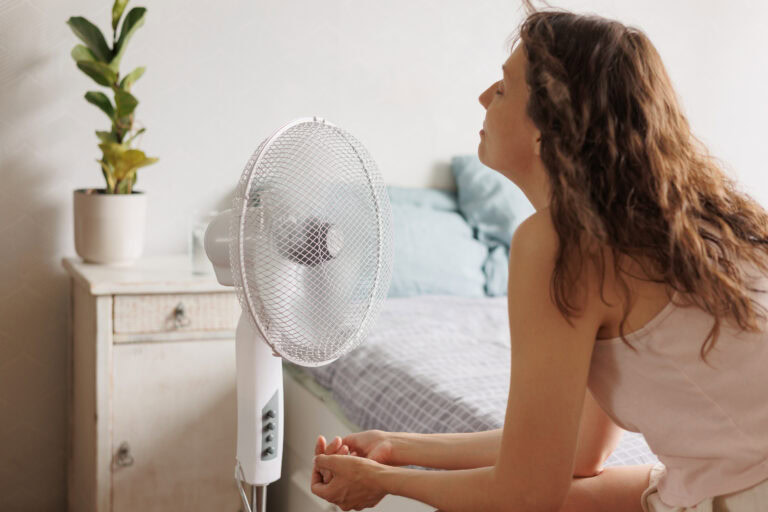
A code yellowweatherwarning for extreme heat is now in force across Limburg, North Brabant, Gelderland, and Overijssel, running until 7 AM on Friday, July 31.
According to the KNMI (the Royal Dutch Meteorological Institute), temperatures “of up to 35 degrees Celsius are expected, particularly in the southeast and east, with a heat index of 7 or 8.”
And this weather warning isn’t the only thing landing on our plate midweek, as the RIVM’s National Heat Plan has also switched on for the same four provinces.
How hot is it going to get this week?
Temperatures in the affected provinces are forecast to sit between a sweltering 28 and 35 degrees Celsius until this Friday, reports the KNMI.
Unfortunately, the nights aren’t going to bring much relief either, with nighttime temperatures expected to hover around 20 degrees in the bigger cities.
The KNMI also flags a “heat index” of 6 to 8 during the day; a measure of how draining the heat actually feels, combining temperature, humidity, sunshine, and wind.
With heat of this intensity, the following groups will need to be extra vigilant, as they’re more sensitive:
people over the age of 75,
pregnant people,
and people with underlying health conditions (such as heart or lung problems).
If you’ve got young children, you’ll also want to ensure they hydrate and avoid the heat of the day.
While we may briefly bid “doei” to the current hot spell on Friday, the KNMI notes that “another very warm period may follow, with temperatures of 30 to 35 degrees in many places on Monday.”
The Nationaal Hitteplan (National Heat Plan) is the RIVM’s way of raising a flag when hot weather is coming. This is the third time it’s been triggered this year, and it’s unlikely to be the last, with Sunday’s hot spell on the horizon.
If you need to head outside, aim for the early morning or later in the evening, and take it easy on anything strenuous during the hottest hours. With a UV index of 6 forecast for the following days, make sure to slather on some sunscreen whenever you leave the house.
How are you weathering the current hot spell? Share your tips and suggestions in the comments below.
If you’ve recently moved to the Netherlands, you might be wondering how to access the new generation of weight-loss medications you’ve seen everywhere. Can you actually get them here legally? You’re not alone in asking.
Navigating Dutch healthcare as an international is its own special adventure at the best of times. Add a prescription medication with strict eligibility criteria into the mix, and it can feel like you need a PhD just to figure out where to start.
Here’s everything you need to know about getting weight-loss medication in the Netherlands as an international: what’s available, whether you qualify, how to actually get a prescription, and what it’ll cost you.
Weight-loss medication in the Netherlands: what’s actually available?
The medications making headlines globally belong to a class called GLP-1 receptor agonists, drugs that mimic hormones involved in appetite regulation, digestion, and blood sugar control.
Some are licensed specifically for type 2 diabetes management, while others are approved for weight loss. All of them are receptplichtig meaning prescription-only, because in the Netherlands, meaning you can’t just walk into a pharmacy and pick one up off the shelf.
Dutch prescribing of GLP-1 medications has risen sharply in recent years, reflecting growing demand for obesity treatment across the Netherlands. Demand is high, and the system is still adapting.
As an international, it pays to know the process.
Can internationals access weight-loss medication in the Netherlands?
Yes, all residents of the Netherlands can access weight-loss medication, but certain conditions apply.
To get a prescription through the standard public route, you need to be registered with a huisarts (GP). Your huisarts is your gateway to virtually all healthcare in the Netherlands, and without one, you’re stuck.
Registering with a GP should be your first port of call. Image: Dreamstime
Most GPs will only register you as a patient if you live within their service area, so sorting that early is important. If you’ve just arrived and haven’t done so yet, that’s your first hurdle.
For newer arrivals who aren’t yet registered, or who simply don’t want to wait, licensed private clinics offer an alternative route. They operate fully within Dutch healthcare regulations and don’t require a GP referral to get started.
Looking for support (with a private and personal touch) with weight-loss medication in the Netherlands? Wellis offers fully online consultations with BIG-registered doctors, discreet home delivery, and ongoing medical and nutritional guidance throughout your treatment.
This means that to be eligible for GLP-1 weight-loss medication, you need a BMI of 30 or higher, or a BMI of 27 or higher with at least one weight-related health condition such as high blood pressure, sleep apnoea, or type 2 diabetes.
For reimbursement through Dutch health insurance, patients are often expected to complete a recognised lifestyle intervention programme first, known as a gecombineerde leefstijlinterventie (GLI).
Exact requirements vary depending on the medication, insurer, and treatment pathway, so it’s worth checking your specific situation before assuming you qualify.
While requirements vary, you’ll generally need to be above a certain BMI. Image: Wellis
Dutch obesity guidelines continue to position medication as part of a broader treatment plan rather than a first-line standalone solution. If you’re new to the Netherlands and don’t have a documented treatment history here, it can feel like starting from zero.
The criteria may also differ slightly between the public and private routes. Private providers like Wellis follow all applicable Dutch healthcare guidelines and work with licensed, BIG-registered doctors, so accessing care this way is still fully compliant, medically supervised treatment.
How do you actually get a prescription for weight-loss medication?
There are two main routes to get a prescription for weight-loss medication in the Netherlands:
Via your huisarts
This is the standard path through the Dutch public health system. If you meet the criteria, your GP can refer you to a specialist or, in some cases, prescribe directly.
Dutch GPs tend to be more conservative with prescriptions than doctors in many other countries, so don’t be surprised if your huisarts wants to explore lifestyle options first. It’s not a brush-off; it’s just how Dutch medicine works.
Via a licensed private clinic
Private providers conduct thorough medical assessments to determine eligibility before any prescription is issued.
For many internationals, the English-language support and the convenience of a fully online process make this a worthwhile option, though costs are out-of-pocket rather than covered by insurance.
A growing number of patients access healthcare providers online. Image: Magnific
Wellis is one example of a private provider that caters to this process.
They offer a complete online approach, from medical consultation to prescription to home delivery, with certified doctors who carefully review each application to ensure the medication is appropriate and safe.
What does weight-loss medication cost, and does insurance cover it?
Here’s the part nobody loves, as weight-loss medication is generally not covered by the basic Dutch health insurance (basisverzekering).
However, that might be changing. Zorginstituut Nederland has been exploring whether certain GLP-1 medications should qualify for broader reimbursement, focusing on people with a BMI of 30 or higher with weight-related conditions, and people with serious or very serious obesity with a BMI of 35 or higher.
Whether and when coverage may expand depends on how that process plays out.
What to watch out for when getting weight-loss medication
With demand this high, grey-market products have become a real problem across Europe.
The IGJ (Dutch Health and Youth Care Inspectorate) and the European Medicines Agency have both flagged a sharp rise in counterfeit GLP-1 products circulating online, with daily reports of illegal websites, social media sellers, and dodgy advertisements. Weight-loss drugs feature prominently.
Only obtain prescription medication through a licensed Dutch pharmacy or a regulated provider with BIG-registered doctors. No medical assessment upfront? Walk away.
The European Medicines Agency also documented a GLP-1 shortage affecting EU member states from 2022 through 2024.
The situation has eased, but stock can still vary by medication, so a regulated provider who can advise on alternatives is always a good idea.
Have you tried navigating Dutch weight-loss treatment as an international? We’d love to hear your experience in the comments: the good, the bad, and the bureaucratic.
Accessing weight-loss medication in the Netherlands: Frequently asked questions
Do I need a GP referral to get weight-loss medication in the Netherlands?
Not if you go via a licensed private clinic. Through the public huisarts route, your GP is your entry point.
Via a private provider like Wellis, you can begin the process directly without a referral, though a full medical assessment is still required before any prescription is issued.
Are GLP-1 weight-loss medications available in the Netherlands?
Yes. Several GLP-1 medications are legally available in the Netherlands by prescription. They’re receptplichtig, meaning a licensed doctor must assess your eligibility before you can access them.
Is weight-loss medication covered by Dutch insurance?
Generally not under the basisverzekering. Zorginstituut Nederland is exploring possible reimbursement for certain patient groups, but for now, most people pay privately.
What BMI do I need to qualify?
The standard clinical threshold is a BMI of 30 or higher. If your BMI is between 27 and 30, you may still qualify if you have a weight-related health condition such as high blood pressure, sleep apnoea, or insulin resistance.
Can I get weight-loss medication in the Netherlands if I’m not registered with a GP?
Yes, via a licensed private clinic. If you haven’t yet registered with a huisarts, a regulated private provider can conduct the medical assessment and issue a prescription independently.
Is it safe to order weight-loss medication online in the Netherlands?
It can be, provided you’re using a licensed Dutch platform with BIG-registered doctors and a regulated pharmacy.
What’s not safe is ordering from unverified websites or social media sellers. The IGJ has flagged a major and growing surge in illegal online medicine sales, and the risks include unknown ingredients and zero medical oversight.
You might have heard that the Netherlands is a super sustainable, climate-friendly country — a green warrior’s dream. The truth, however, is that this country still has a long way to go.
The Netherlands has an image of being as green as its ever-lasting fields, but listen, all praise is in need of some reality checks every now and then.
Step one to get any society moving towards a greener future is the good ol’ practice of recycling. It’s well-established, it’s second nature to most people, and it’s really, really easy. Well, to most people, in most places.
Recycling in the Netherlands can be a confusing affair… Image: DepositPhotos.com
However, in the Netherlands, recycling systems vary a lot, and largely depend on where you live (literally, it might even differ from street to street).
In The Hague, for example, paper waste is collected at your doorstep once a month, while Leiden inhabitants have to make the journey to a paper waste collection point.
The Hague requires its people to separate plastic waste from other waste, while Leiden folks don’t have to worry about that (they have a fancy system extracting it after collection).
In many places, recycling depends on individuals’ willingness to seek out recycling stations, and drag their collected waste there.
For busy bees, this is not only hard to achieve, but also tragically easy to forget.
That being said, while confusing rules might be a hassle, the Netherlands is doing pretty well overall. Roughly half of Dutch municipal waste gets recycled, keeping the country among the ten EU nations that hit the 50% mark or higher.
There’s a catch, though. According to Statistics Netherlands, the amount of household waste collected per person actually ticked up in 2024 — the first rise after years of steady decline.
Still, we can’t help but ask how high it could climb if the Dutch system were just a touch more user-friendly and accessible.
2. Contribute towards global deforestation, in more ways than one
Forests are an incredibly important piece in the puzzle of sucking carbon out of the atmosphere. But that’s just the beginning of the story.
Woods, generally speaking, are also key to mitigating the effects related to drought and flood, and maintaining the world’s biodiversity.
The earth is dependent on its forests to handle C02 emissions properly. Image: DepositPhotos.com
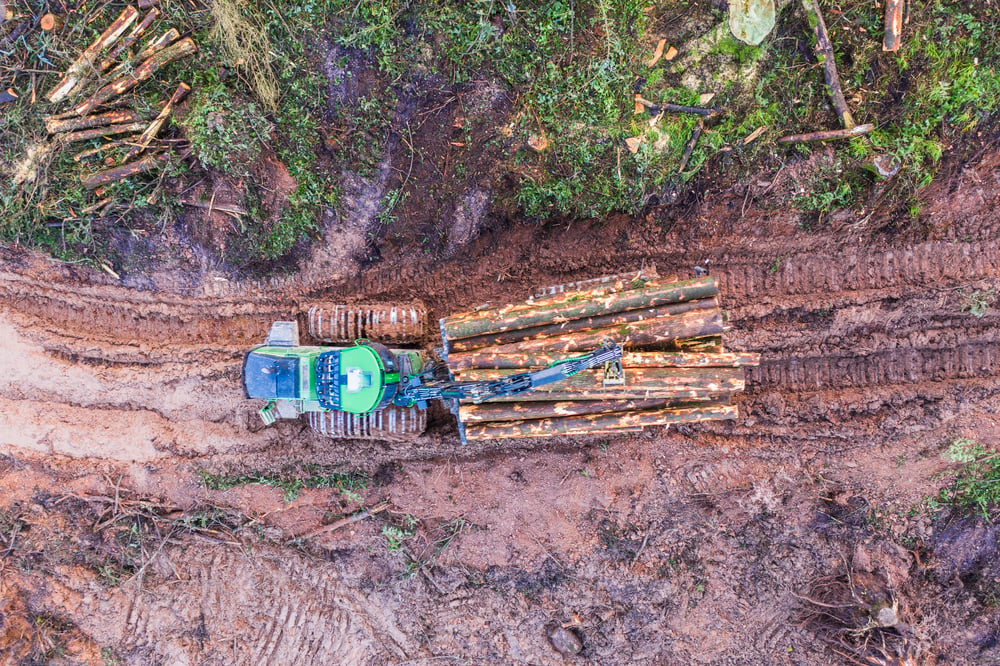
However, between 2001 and 2023, the global tree coverage decreased by 12%. This has been described as a significant climate hazard, brought about by a range of factors, amongst which is wildfires due to climate change, and deforestation related to agriculture.
A group of seven European countries are responsible for 80% of the EU’s combined deforestation — and guess which country is a part of this group? The Netherlands.
Not only that: the Netherlands also snatched a spot among the top three countries when it came to deforestation per capita between 2005 and 2017.
In addition, the lowlands is also a huge driver of deforestation abroad (when importing commodities from countries like Brazil), placing them in fourth place in Europe when it comes to CO2 emissions from tropical deforestation. Yikes.
The Netherlands has one of Europe’s highest nitrogen surpluses, meaning it’s contributing heavily to the slippery slope towards ecological catastrophe.
For years, the plan was to slash nitrogen emissions in half by 2030 — reasonable enough when faced with a crisis of this scale, right?
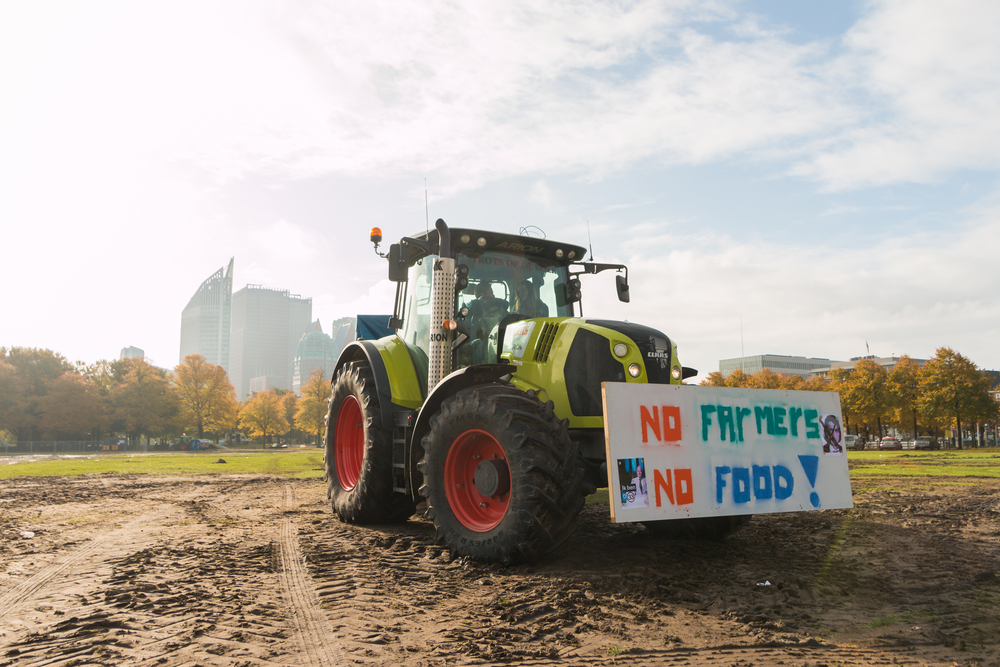
“No farmers, no food” was the campaign that led to empty supermarket shelves last summer. Image: DepositPhotos.com
Not everyone agreed. Cutting nitrogen hits Dutch livestock farmers hard, and they’ve certainly let their dismay be heard.
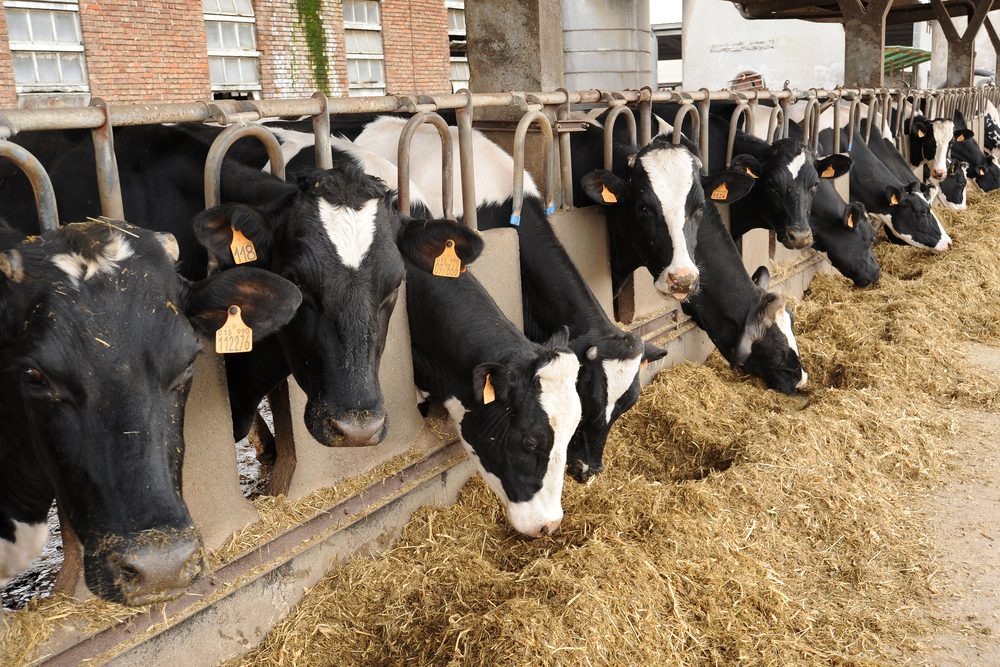
With tens of millions of animals farmed here, the Netherlands is one of the world’s main food producers — a fact Dutch farmers know all too well. That’s why, in recent years, they’ve protested the hell out of the government’s nitrogen plans.
And the target itself keeps shifting. In January 2025, a court in The Hague ordered the government to get at least half of nitrogen-sensitive nature areas below critical levels by 2030, or pay a €10 million fine.
Then, in June 2026, the cabinet unveiled a fresh nitrogen package reframing the headline goal as a 50% cut by 2035, with 2030 downgraded to an interim checkpoint for farming. Under the plan, farmers face ammonia cuts of up to 46% and a nationwide limit of 2.6 cows per hectare.
So the finish line has moved — even as the nature it’s meant to protect keeps waiting.
4. Exist as one of the world’s top meat lovers
Speaking of livestock, it’s probably no surprise that the country which invented the frikandel is also Europe’s biggest meat exporter, and the one of the world’s largest beef exporters.
It’s also no secret that meat production in general, and beef production most of all, is one of the most harmful industries in the equation of fighting climate change.
Feeding animals to feed humans is not the most efficient recipe to take care of the earth’s climate… Image: DepositPhotos.com
That being said, the Netherlands is not the worst country when it comes to actual meat consumption, lying at about 76kg of meat consumed per person annually.
That’s about the average in Europe, but if you think that sounds like too much, it’s because it is — from both a global and an environmental perspective.
Limiting the consumption of meat (and dairy) is the most impactful change you can implement in order to reduce the carbon footprint of your diet.
Yet Dutch people are lagging behind many similar European populations when it comes to adopting a full-on vegetarian diet (what about the bitterballen and kaas?).
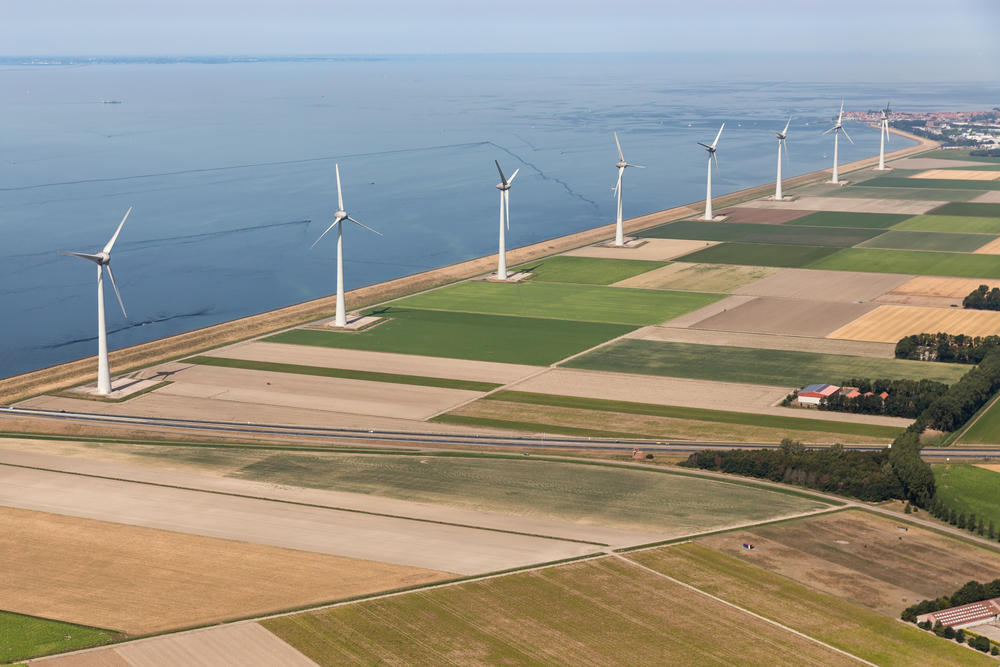
There’s no doubt which country this picture is from, is there? Image: DepositPhotos.com
All this is true, of course, but the rosy-red (or shall we say, green) fairytale of sustainable Dutch energy is sobered by the fact that Dutch people consume surprisingly little renewable energy themselves.
The lion’s share of Dutch energy consumption is still fueled by natural gas and oil — so much so that the Netherlands had the third-lowest ratio of renewable energy consumption of all IEA countries in 2018.
Although the share of consumers opting for a green alternative is rising, the Dutch lag noticeably behind when compared to many other European countries.
6. Scooters everywhere, for no reason
The Netherlands is, famously, the land of bikes. And why wouldn’t it be?
The country is as flat as its pancakes, small enough for all its cities to be reachable by virtually any means of transportation, and has streets safe enough to cater to even the most chaotic cycling beginner.
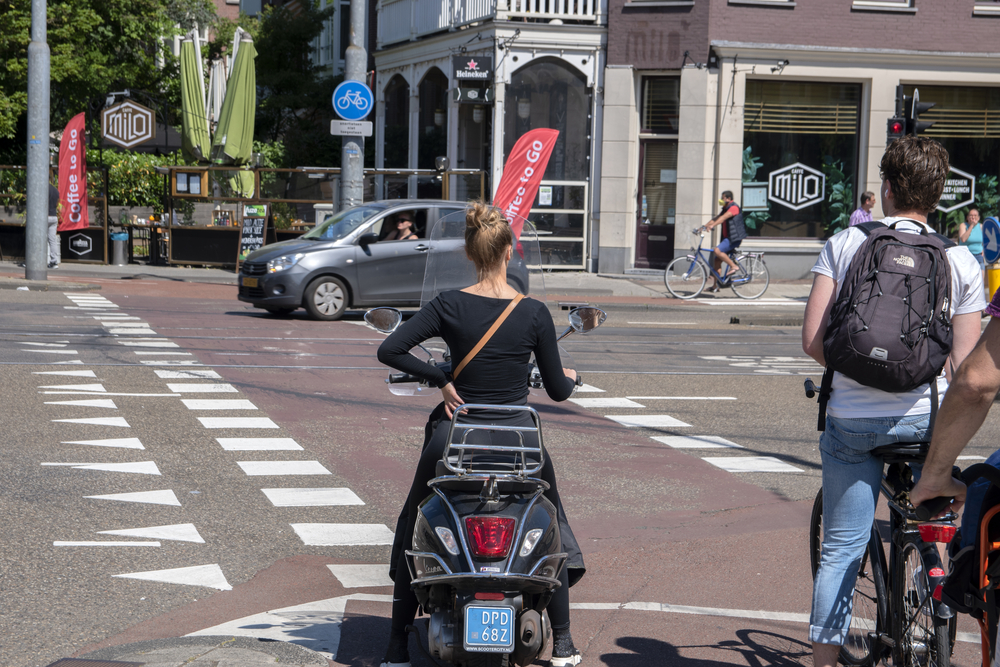
At least some people opt for an electric one… Image: DepositPhotos.com
But if you’ve spent more than a few days in any Dutch city, you’ll know that the humble bike is far from everyone’s favourite ride of choice. 🚲
We’ll give you a hint, it’s like a bike, but much louder and far more damaging to the environment.
More Dutch people than you’d think love to opt for a motorised scooter, even for short trips that are highly bikeable. Why not just bike, when the time and effort saved is so minimal?
The fact that Dutch bike paths are full of scooters is as confusing as it is annoying — both from an environmental and road safety perspective.
That being said, Dutch biking culture is among the best in the world, so the scooter issue might not be worth our worries (yet).
7. Produce tulips like there’s no tomorrow
Don’t worry, we’re not about to call for a nationwide tulip ban. The Dutch would have a collective heart attack. Still, that doesn’t take away from the fact that the Dutch tulip industry is anything but a climate enthusiast’s dream. 🌷
Firstly, although a delightful bouquet of tulips is a lovely gift, it goes without saying that the practice of growing massive amounts of plants, only to cut them down and leave them to die on a kitchen counter, is rather wasteful.
Secondly, the cold, cloudy, and windy climate in the Netherlands sometimes creates a need for greenhouses in order to produce flowers for the rest of the world.
These often require the use of highly energy-intensive C02-producing machines, with heating systems powered by natural gas.
Finally, even without greenhouses, the Dutch flower industry is also very water-intensive, and makes use of enormous amounts of (in many cases) harmful pesticides.
These pesticides are a danger to natural pollinators, soil quality, water quality, and the overall sustainability of the Netherlands’ world-famous flower industry.
8. Throw even more planes up into the air
Schiphol, the biggest airport in the Netherlands and one of the busiest in Europe, has long dreamed of squeezing more passengers through its gates every year. Sustainable? Not exactly.
Scheduling heaps more flights is hardly the most sustainable move the airport has ever made. Image: DepositPhotos.com
For a moment, it looked like things might go the other way. In November 2025, the government capped annual flights at 478,000, down from the previous ceiling of 500,000, specifically to cut noise pollution.
Then came the plot twist. In March 2026, the Council of State, the country’s highest administrative court, scrapped that cap, ruling the government hadn’t properly justified how counting flights would actually reduce noise.
The nighttime limit survived, with no more than 27,000 flights a year in the small hours, but the overall ceiling vanished, reverting to older 2008 rules.
Now the government is pressing ahead with a revised framework, expected around November 2026, that still aims for that 478,000 figure. Environmental groups, meanwhile, argue the number should be far lower.
In spite of all this, Schiphol never misses a chance to brag about its climate credentials: wind-powered buildings, a “zero-emissions airport” goal by 2030, the lot.
That’s all lovely. But more flights, however you dress it up, is unquestionably moving in the opposite direction to where the science says we should be heading.
9. Use plastic. Everywhere.
One aspect of life in the Netherlands that has surprised many newcomers lately is the amount of plastic in Dutch grocery stores.
Cardboard boxes would be a much more sustainable alternative. Image: DepositPhotos.com
Although the Netherlands is not the worst in many aspects when it comes to plastic pollution, it is hard to ignore the piles of plastic used for unnecessary protection of produce. Most of which ends up in the world’s oceans — despite the consumer’s attempts and intentions of recycling.
Furthermore, even though the Netherlands has a ban on free plastic bags, virtually no Dutch stores provide plastic-free bag alternatives.
If you forget to pack an extra tote for your after-work grocery shopping, most stores in the Netherlands will make you choose between a 20-cent plastic bag, and carrying all your food home in your arms.
For most consumers in a time pinch, the choice is pretty simple. 🤷
The Netherlands is doing a lot in the global fight against climate change, but the sad truth is that there’s little time to rest on the laurels. More effort is needed in many aspects of Dutch society, despite its reputation for being a green powerhouse. ♻️
What do you think: does the Netherlands deserve its title as a sustainable superpower? Tell us your opinions in the comments below!
There are plenty of things that will surprise you about the Netherlands — what the frick are frikandels? Why are the seagulls so violent? And is that three people on a bike!? However, most people underestimate the surprises that come with renting in the Netherlands.
Now, some surprises are fun to encounter in the moment, but when it comes to the Dutch rental sector, let’s just say you should approach the challenge as informed as possible.
1. A rental agency can’t charge you for their services
So, let’s take it from the top. You’ve hunted online, had multiple viewings, and now, finally, by the grace of some rental goddess, you’ve found a place to live.
You’ve signed the dotted line, paid the deposit and first month’s rent, and yet, you still have a rental agent standing in front of you with their hand open. Why? It’s the “service fee”, “key fee”, “mediation costs”, or “registration fee”, of course.
A Dutch rental agent often acts as the mediator between you and the landlord; however, if they were hired by the landlord, you shouldn’t pay anything! Image: Freepik
First things first, slap that hand away (metaphorically, at least). Unfortunately, in the Netherlands, many rental agencies will try to source their commission from the tenant, citing some form of “fee” that has to be paid — but this is, say it after us, illegal.
The agency should receive a sum of money for mediating between you and the landlord if they were hired by the landlord to advertise the property. However, this means it’s up to the landlord to pay this fee, not the tenant.
The only exception where you will have to pay fees to the agency is if you hired them to find you a property.
If an agency isn’t willing to turn to the landlord for some money or simply wants more, they may try to sneak in some “fees” for you to hand over. This is where you have the right to tell them no; according to Dutch law, you do not have to pay such fees.
Make sure to ask the agency to specify exactly what the costs are for, and if you really want to show them you’re not messing around, it’s time to turn into Reese Witherspoon in Legally Blonde and say the following:
“As of 2015, according to Article 7:417 paragraph 1 of the Civil Code ‘BW’, it is not legal to charge me the costs for [x,y,z] when you work on behalf of the landlord.”
2. It’s very hard to significantly raise the price of rent in the Netherlands
In the Netherlands, your landlord can’t just turn around and up your rent by 20% every year — or whenever they feel like it.
In the Netherlands, your landlord can’t simply up your rent by a ton of money. Image: Freepik
While it is, of course, standard that a landlord may increase the rent from year to year (we don’t live in a utopia), Dutch landlords are only allowed to raise the rent of their properties by a certain percentage each year.
These percentages are determined by the Dutch government each year and vary depending on whether or not you are renting in the private or social sector.
For 2026, the maximums are:
Social housing (sociale huur): a maximum of 4.4% from July 1, 2026 (until then, the 2025 cap of 5% still applies).
Mid-rent (middenhuur, a regulated segment introduced in 2024): a maximum of 6.1% from 1 January 2026.
Private sector (vrije sector): a maximum of 4.4% from 1 January 2026.
What does this mean in practice? If you rent a private-sector flat for €1,250 a month, your landlord can add at most 4.4% in 2026 — so no more than €55 extra, bringing it to €1,305.
You’ll find the agreed increase in your rental contract. Does it claim a rise above your segment’s cap? Then you don’t have to pay a cent over the legal maximum, according to the government’s own rules on rent increases.
3. The government now decides what your landlord can charge you
Since July 2024, the Affordable Rent Act (Wet betaalbare huur) has fundamentally changed how rent is calculated for a significant portion of rental properties in the Netherlands.
The Dutch government basically said “enough is enough” to landlords charging astronomical rents for mediocre properties.
Here’s how it works: every rental property now gets scored on a points system based on size, kitchen and bathroom quality, energy efficiency, outdoor space, and the property’s WOZ value. Properties scoring 186 points or less have strict maximum rents that landlords cannot exceed.
What does this mean in euros? Properties with up to 143 points are capped at around €932.93 per month. Those scoring 144 to 186 points fall in the regulated mid-rent band, capped at €1,228.07. Only properties with 187 points or more sit in the “free sector,” where landlords can charge market rates.
If you signed a rental contract after July 1 2024, your landlord must provide a points calculation showing how your rent was determined. From January 2025, this became mandatory for all new tenancies. And if landlords don’t comply? Well, municipalities can fine them.
However, there is a catch. This only applies to new contracts from July 2024 onwards. Your 2019 rental won’t magically get cheaper.
But for house-hunters, you now have ammunition to challenge overpriced properties and can even do rough points calculations before viewings to avoid wasting time on places asking €1,400 for basic flats that should cost €1,000.
4. Houses in the Netherlands sometimes come without flooring
Let’s say you’ve found yourself a beautiful apartment in a stunning newbuild apartment complex — congrats! Did you know there’s a chance you’ll have no flooring?
While most apartments and buildings will, thankfully, come with the basics included, you may sometimes be left with the task of putting down the flooring. This is most commonly the case for new builds, but may also apply to older houses.
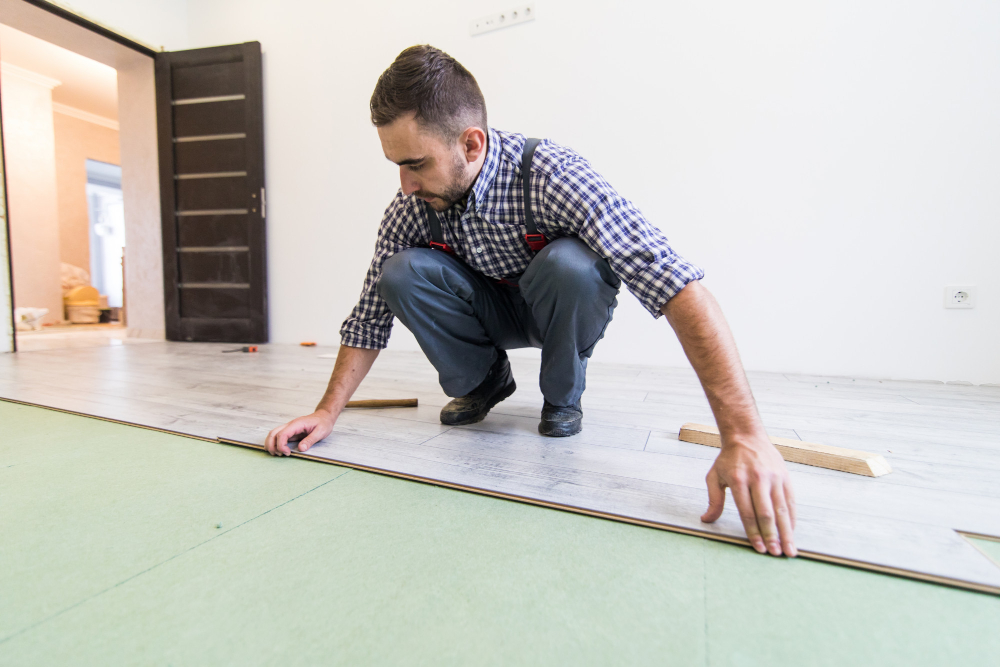
Sometimes, you may have to sort the flooring in your Dutch rental for yourself. Image: Freepik
Yep, in cases like this, it’s not uncommon for a landlord to hand over the key to a completely bare apartment.
If this is a situation you really don’t want to find yourself in, make sure to look at the description of the listing and be on the hunt for the word kaal.
Meaning literally “bald,” if an apartment has ‘kaal’ in the description, it means you are likely going to have to source some of the most basic necessities — think floorboards, curtains and light fixtures — yourself.
Instead, you should opt for properties that have the description:
“Gemeubileerde” (furnished), or
“Gestoffeerd” (unfurnished).
5. Sometimes, the rent listed isn’t the total monthly rent
One of the main things that may surprise you when looking for an apartment in the Netherlands is that the actual monthly rent is often not listed.
What does this mean? When a property is listed on a rental site, the number you are seeing is often just the cost of the ‘basic rent’, meaning the rent without the inclusion of extra costs such as utility fees and service costs.
This is something you should factor in when considering your budget — can you cover the complete costs? Or just the basic rent?
Not sure of the total cost per month? You can expect to pay around €150 and €250 in utility costs per month. Of course, this depends on the size of the property, however.
If the price says something like “incl g/w/e” after it, then you’re in luck! This means the rent per month is already inclusive of the utility costs. Does it say “excl. g/w/e”? Then helaas, you’re going to have to factor in utility costs on top of your rent.
6. The municipality will need money from you too
Another unpleasant surprise that you may be faced with when renting in the Netherlands is that you will also have to pay the municipality for living in your rental property.
As the tenant, you will be expected to pay certain municipal taxes. For most renters, these include a waste collection and sewage tax.
In the Netherlands, renters must also pay municipal taxes. Image: Freepik
These are usually paid once per year. How much you have to pay in this tax depends on several factors, such as the municipality you live in and how many residents there are in your home.
In 2025, the average rental household was expected to pay an average of €480 in municipal taxes — yep, that’s certainly a surprise to take into consideration.
However, one tax tenants shouldn’t be expected to pay is the Onroerende Zaakbelasting (OZB) or “real estate tax.” Since 2006, this is for the property owner, a.k.a, the landlord, to pay — not the tenants.
7. The Dutch government can give you money for rent (if you qualify)
Worrying that your income won’t be sufficient to keep up with your rental costs? Geen stress, did you know the Dutch government offers a housing subsidy?
This is known as the huurtoeslag, and it is meant to help those with lower incomes cover the cost of their rent. However, this subsidy isn’t for anyone and everyone.
Renting in the Netherlands? Surprise! You may be eligible for the huurtoeslag. Image: Freepik
There are several requirements that you must meet to be eligible for the huurtoeslag, including:
Firstly, as of 2026, your basic rent must be no higher than €932.93 a month
If you are under the age of 23, your basic rent can be no more than €498.20 unless you have a child living with you (in this case, it remains at €808.06)
You must be living in an independent living space — meaning you have your own front door that locks, your own kitchen, and your own bathroom
You can have a maximum of €37,395 in assets or €74,790 if you are a couple
How much rental allowance you receive depends on your specific circumstances. However, by having so many requirements in place, the Dutch government ensures only those who really need it will get a housing subsidy.
If you’ve decided to opt for a €4,000 per month apartment on a salary of €4,500, then sorry, you’re not necessarily in need of a rental subsidy, just a budget (and a more affordable apartment)!
8. You can have an oral rental contract (yep!)
Not only is this surprising, but it’s also something to watch out for. Any rental agent will tell you right away that an oral contract is a less-than-ideal way to establish your rental contract, and while it’s very uncommon, it is technically legally possible.
This can be dangerous territory. You have to be careful about what you say, as this could be seen as legally binding and held against you in the future.
If you find yourself in a situation where you believe a landlord is trying to establish a contract verbally, it’s best to just hit the pause button, grab a pen, and hand it over to them with a flourish that says, “no sir-ee, not this international.”
While it may be tempting to seal the deal then and there, it’s important to remember that by having a written contract, you have something to refer back to in the future should anything be disputed.
9. You may have to meet an income requirement
So, you’ve found your dream apartment, attended a viewing and are ready to send that bedazzled acceptance email to the agency — but hold up, your agent hits you with another hurdle “the income requirement is three times the monthly rent, do you meet this?”
Do you meet the income requirement for renting a property? Yep, that’s another surprise waiting for you! Image: Freepik
Now, what on earth is an income requirement, and what does it mean for your rental dreams?
In the Netherlands, many landlords will ask that their tenants meet an income requirement in order to ensure you’re in a position to pay rent. This means that they want your monthly income to be a certain amount before they will allow you to rent their property.
The amount? This is often three or even four times the monthly rent. In practice, it would look a little something like this:
You’ve viewed a property for €1,000 per month, however, the landlord has an income requirement of three times the monthly rent. This means your monthly income should be at least €3,000 in order for the landlord to consider you.
You may be wondering whether or not the requirement concerns your gross or net income — good question! Helaas, this usually depends on the landlord.
The income requirement isn’t always stated in the initial listing of the rental, so make sure you have this in the back of your mind when attending a viewing or speaking with the agent.
10. You don’t decide how many people can live in your home
Fun fact: In the Netherlands, Dutch municipalities will actually put a limit on the number of people who can live at one address.
The result? Even if you find a two-bedroom home, that doesn’t necessarily mean that you, your partner, and your two dating friends can all live there together like you’re in an episode of Friends.
Want to have three housemates? Only if the municipality lets you all register! Image: Freepik
At least, you can’t all live there together while still being able toregister with your municipality.
In the Netherlands, once you have found a place to live, you must register your address with your local municipality. Once you have done this, you will receive a burgerservicenummer (BSN). This identity number is very important if you want to get anything done in the Netherlands.
You’ll need it to apply for jobs, pay taxes, set up Dutch health insurance, and get a DigiD. This means that you’re going to be in quite a predicament if you cannot register at the address you live in because the municipality says there are too many people already registered there.
Make sure to take this into consideration when hunting for that home of yours! Plan on eventually inviting your partner to come live with you? Well then, you better ensure that it’s possible for them to register at your address as well!
11. Scams are around every corner
Unfortunately, the current Dutch housing market is a great breeding ground for scammers. There are too many people looking for housing, and too few houses. As a result, it’s easy for scammers to take advantage of desperate house-hunters.
One unfortunate surprise that many people will face when renting in the Netherlands is that there are many scams out there. Image: Freepik
With so many internationals looking for housing from abroad, they become the ideal targets for these scam artists. After all, you need a property upon arrival in the country, you can’t come to view it, and you probably don’t know anyone in the country who can verify its existence.
As a result, your hunt for housing in the Netherlands is probably going to lead you to a few scams. Here are a few red flags you can look for:
The landlord claims they’re not in the country, so they can’t let you view the property in person
The pictures of the property do not look particularly Dutch/do not reveal what is outside the windows
The property looks too good to be true — in this economy? Red flag!
Check out the landlord’s social media, are they posting the same property all over the Netherlands or Europe? Then it’s a no-go
Moving to a new country is always going to be full of surprises — but hey, isn’t that part of the adventure?
With everything that can surprise you about renting already covered, it’s time to take the leap and look forward to the rest of the fun that you’ll encounter on your new journey.
What surprised you about renting in the Netherlands? Tell us in the comments below!
Rijkswaterstaat is carrying out major roadworks across the Netherlands throughout summer 2026, and extra travel time on the busiest routes can stretch to a full hour.
The national roads authority, Rijkswaterstaat, is working on motorways, bridges, and tunnels in many parts of the country this summer.
Disruptions will be hard to avoid, the news bulletin notes, especially around the Randstad (the densely populated western region that includes Amsterdam, Rotterdam, The Hague, and Utrecht).
In addition to official roadworks, provinces, municipalities, and rail operator ProRail have their own maintenance schedules this summer. Even if you dodge one closure, another might be waiting further down the road.
These Dutch motorways are affected
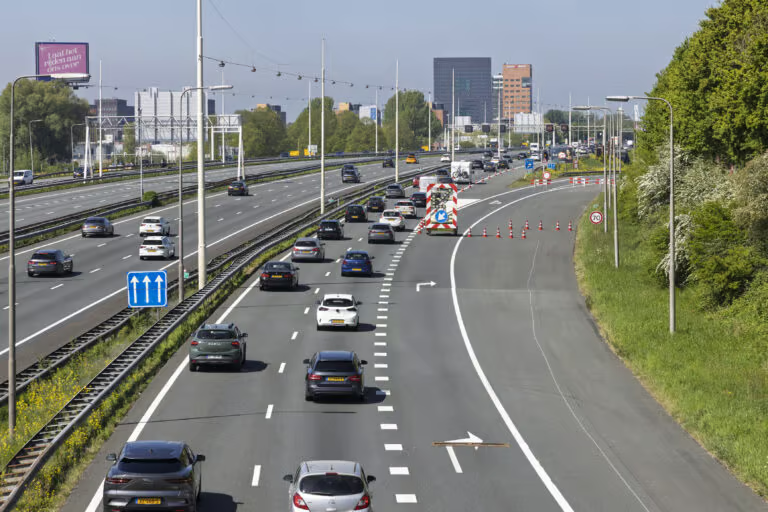
Several big routes are seeing work this summer. Most notably, the A1 towards Amsterdam is fully closed between the Eemnes and Muiderberg junctions until August 17, with drivers warned of up to 60 minutes of extra travel time.
Beyond that, Rijkswaterstaat lists works on:
the A12 between Lunetten and Veenendaal,
the A27 between Everdingen and Gorinchem,
the A7 in Groningen,
the A20 between Kleinpolderplein and Terbregseplein towards Gouda,
the Wijkertunnel (A9),
and the A32 between Steenwijk and Heerenveen.
Add tunnels and bridges to the list, too
The Wijkertunnel on the A9 is shut in both directions from July 12 to August 8 while its ventilation system is replaced. Local traffic is being sent via the Velsertunnel, while drivers from outside the IJmond region are advised to use the Coentunnel on the A10.
Prepare for additional travel time, with Rijkswaterstaat noting: “During the morning rush hour (Alkmaar – Haarlem), there will be delays of approximately 30 minutes on the A9. During the evening rush hour (Haarlem – Alkmaar), delays can increase to up to 60 minutes.”
Dutch News: The Netherlands is facing a massive infrastructure maintenance backlog. Many bridges, tunnel locks and roads were built in the 50s, 60s and 70s. And what’s the problem with that? They are reaching the end of their lifespan. #dutchnews#nederland🇳🇱#livinginthenetherlands
Meanwhile, the Papendrechtsebrug between Dordrecht and Papendrecht (N3) faces a much longer closure, shut to road traffic in both directions from July 17 through April 21, 2027.
Plus, works in the north
Though the Randstad will see the worst of the traffic disruptions, the north isn’t spared in the latest wave of roadworks.
Due to “major maintenance” on the N48 between Hoogeveen and Balkbrug, the road will be closed to all traffic between the Hoogeveen interchange (A28/A37) and the junction with the N377 near Balkbrug. According to Rijkswaterstaat, works are expected to last from August 3 to August 29.
In addition, there will be work on the A7 between Winschoten and the German border, including asphalt renewal and repairs to a bridge near Bad Nieuweschans.
Here’s how to keep your trip moving
Rijkswaterstaat’s main advice is to check your route before you leave, avoid rush hour where you can, and consider working from home or switching to the train or bike.
Plus, each closure has its own timeline, with some about to finish and others stretching into 2027. Before road tripping across the Netherlands this summer, it’s worth checking whether a closure actually falls on your route.
Rijkswaterstaat keeps live updates and planned works on its traffic information site, and you can plan a specific journey through the VanAnaarBeter route planner. (Let op: these are in Dutch, so you’ll want to have Google Translate loaded on your web browser if you can’t read it.)
If your route is affected, travelling outside the morning and evening peaks makes the biggest difference. Rijkswaterstaat singles out the morning rush as the worst time to get caught in it.
Want to make sure DutchReview pops up on your news feed more often? Just add us as a preferred news provider, and we’ll handle the rest.
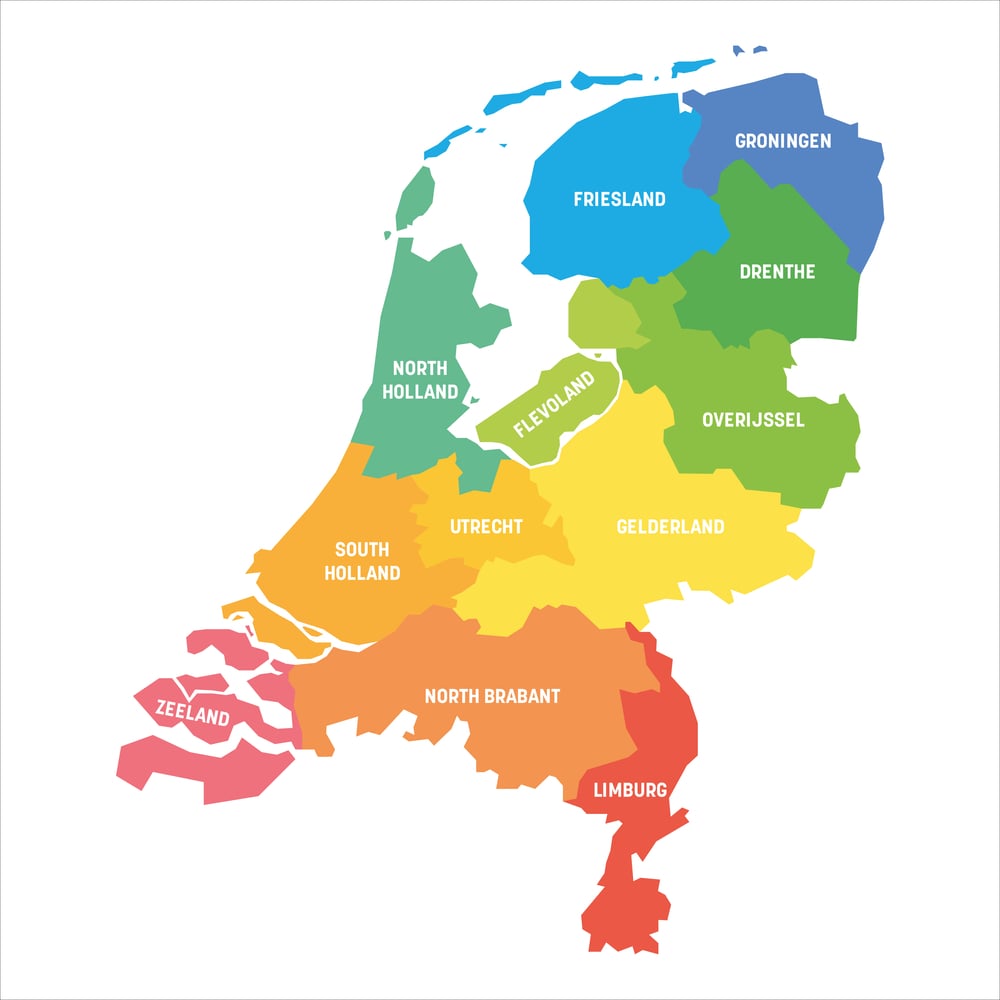
The Netherlands might be a small country, but don’t be fooled! The country is divided into 12 provinces, each one home to unique landscapes and cultures.
Whether you’ve lived here for two or 10 years, you must have wondered about the Netherlands’ history and development as a country at least once, right?
Here’s a handy little map of the Netherlands and its provinces to get acquainted with this lovely country. 😉 Image: DepositPhotos.com
Without further ado, here’s an easy guide to the provinces of the Netherlands — and their must-see highlights!
The Randstad is in the western region of the Netherlands, containing the largest cities in the closest proximity. (Psst: the name is the same as the international company, so don’t confuse them.)
North Holland sits along the coast of the Netherlands. It’s surrounded by bodies of water, including the North Sea, the Wadden Sea and the IJssel lake.
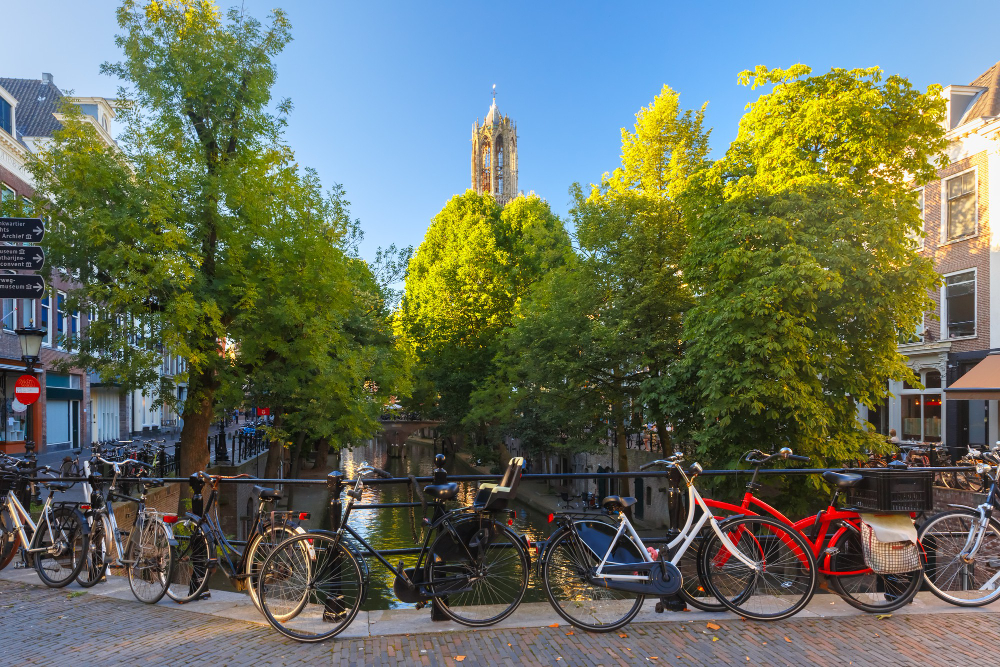
Amsterdam, the cultural and country capital, resides here and is incredibly famous for its museums, bicycles, and weed — but it doesn’t take all the glory in this Dutch province.
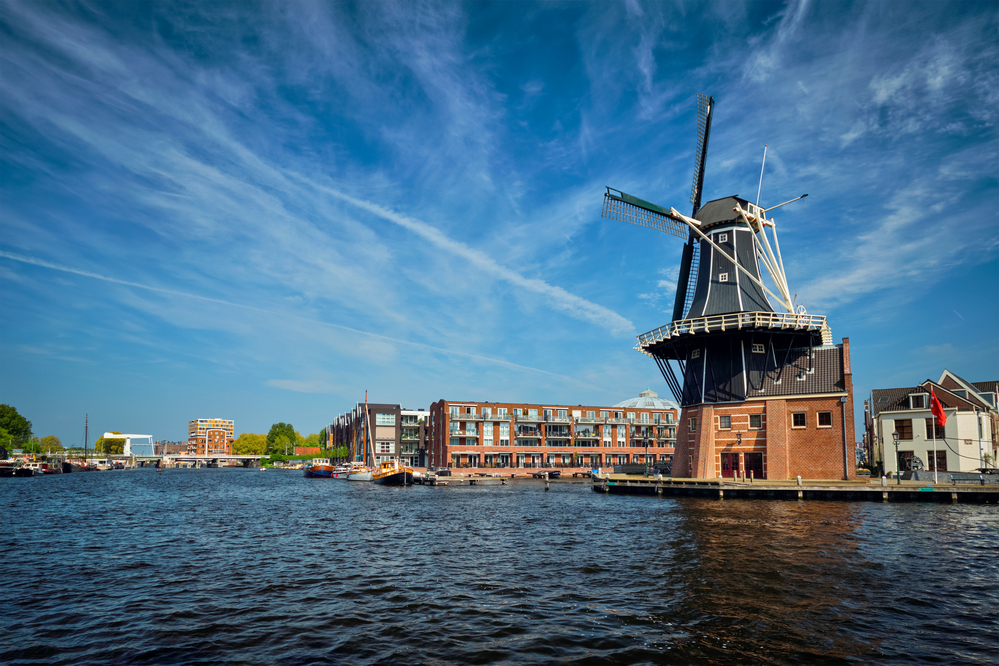
That’s because the next most populated city, Haarlem, is the provincial capital. Haarlem is 30 minutes away from the coast by public transport (hello, beach! 🏖) and is filled with fascinating museums and a bustling city centre.
There are plenty of other popular sites in North Holland, like Alkmaar and its cheese markets, several beaches (a major German tourist destination) and the island of Texel.
Highlights of North Holland
The Netherlands is known for tulips and windmills — and you can find both of them in North Holland!
If you find yourself visiting Haarlem, be on the lookout for De Adriaan, a typical Dutch windmill that makes up the iconic city skyline. Image: DepositPhotos.com
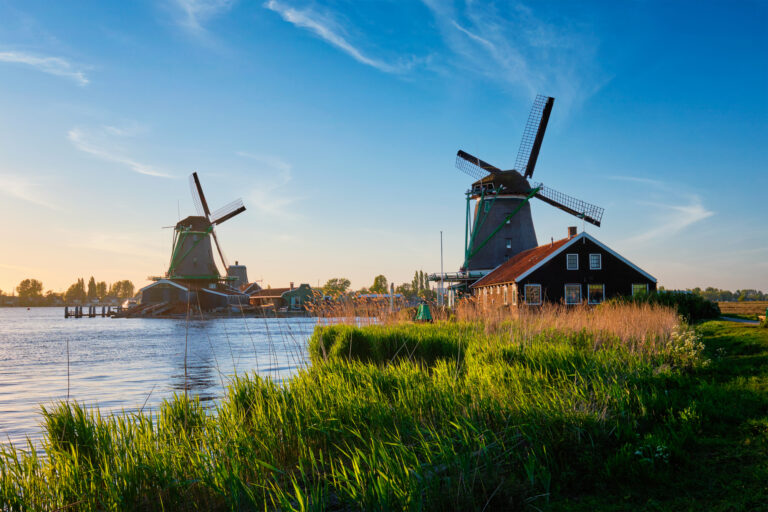
If windmills are more your style, you can find Zaanse Schans in North Holland, famous for its historic windmills from the 1500s.
⭐ Province capital: Haarlem 💁♂️ Population: 3 million 💬 Known for: Amsterdam, tulips, and beaches
South Holland: home of the second Dutch capital (yep!)
South Holland takes up the southern stretch of the Netherlands’ coast (even more beaches to enjoy ☀️). It’s the most populated province in the Netherlands, with about 3.7 million residents. 🤯
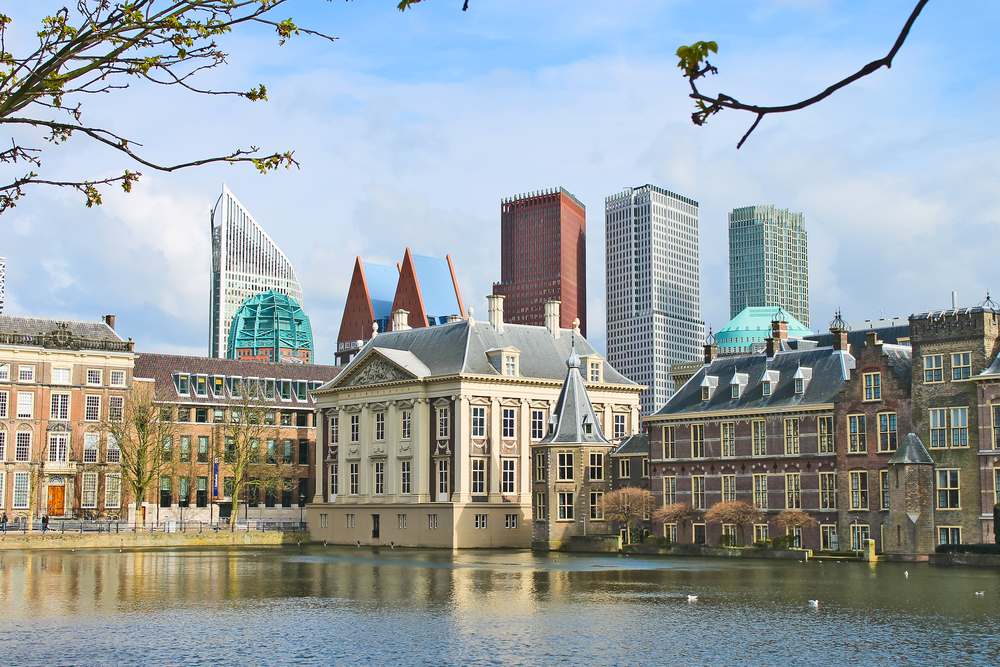
And indeed, this is where the Netherlands has a second capital city: The Hague is the seat of Dutch and international political power, hosting the parliament, the royal family, and the International Court of Justice! 👑
The Binnenhof is the centre of Dutch politics — we can’t help but admire The Hague’s skyline and architecture. Image: DepositPhotos.com
Of course, there are many other beautiful places to visit in the South Holland province.
We particularly like the small-town Delft, which is the hometown of artist Vermeer, the student city Leiden (and DutchReview’s headquarters), and the metropole Rotterdam — a city so heavily bombed in WWII that it had to be virtually entirely rebuilt!
Highlights of South Holland
Rotterdam’s architecture is a sight to see for anyone interested in architecture and history, or perhaps a relaxing stroll across De Pier in Scheveningen suits your taste.
⭐ Province capital: The Hague 💁♂️ Population: 3.9 million 💬 Known for: Modern architecture, student cities, international organisations
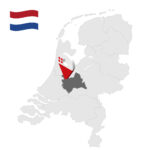
The smallest province of the Netherlands, Utrecht, is the final piece of the Randstad. The province’s largest city and capital also happens to be named Utrecht — how confusing. 😬
Utrecht is the centre-most region of the Netherlands, and for that reason, Utrecht Centraal is the largest train station in the country, connecting the Randstad cities to the north, east, and south — up to 215,000 people come in and out of this station daily!
Beyond the capital, northern Utrecht has many lakes formed by digging peat out of bogs, and most of the region is mainly barren soil, but the local government planted pine trees.
The landscape also features small rivers and vast meadows. ☘️
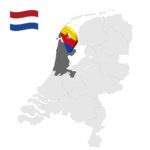
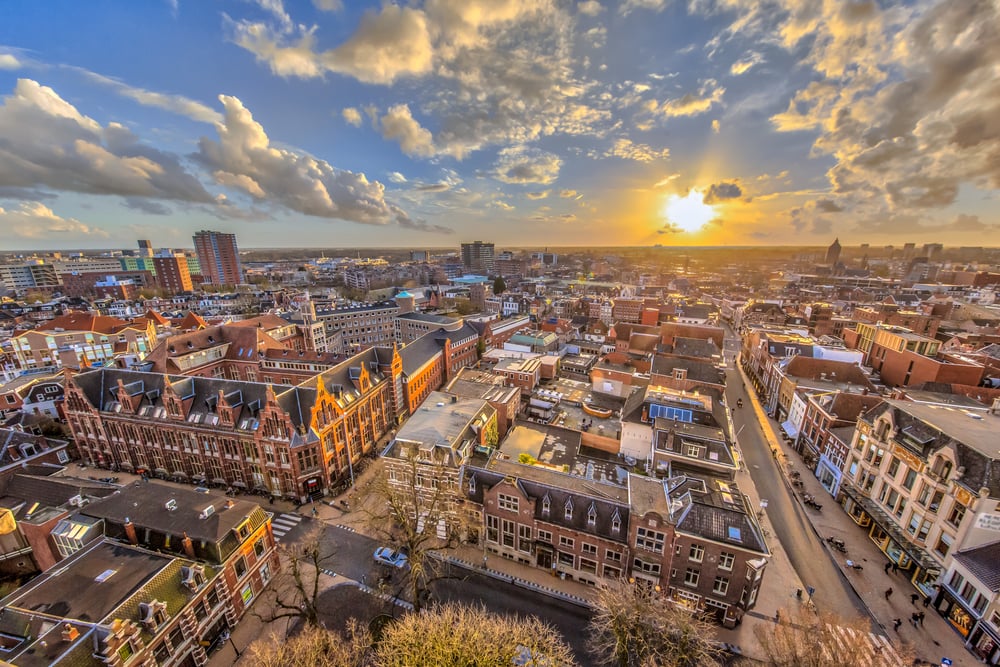
Groningen is another Dutch province that, like Utrecht, shares a name with its capital — even more confusion! The city of Groningen is home to the University of Groningen, one of the most remote student cities in the Netherlands.
Groningen is definitely an underrated city if we’re considering views. 😍 Image: DepositPhotos.com
Highlights of Groningen
For the best views of Groningen’s historical city, climb the beautiful Martinitoren for an equally stunning view of Groningen city from above. The tower is almost 100 metres tall and was built 500 years ago in Grote Markt.
If heights aren’t your thing, you can tour the Menkemaborg in Uithuizen (near the northern coast of the Netherlands), a castle built for nobility back in the 17th and 18th centuries.
⭐ Province capital: Groningen 💁♂️ Population: 601,000 💬 Known for: Remote student cities, earthquakes, sea sports
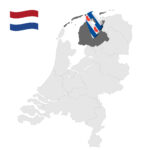
Friesland: the only province with a different official language
One of the most remarkable characteristics of Friesland is the fact that it has its own language!
West Frisian is one of the official languages of this province (alongside Dutch, of course), and the local government has made several efforts to preserve the language.
Fun fact: One of the most popular Dutch last names, ‘De Vries’ and all of its variations, means “The Frisian,” referring to someone from Friesland!
It hasn’t been cold enough to hold it since 1997, but you can visit several monuments near Leeuwarden.
We know the Netherlands is known for its canals, but Leeuwarden is really chock-full of them. Image: DepositPhotos.com
Speaking of Leeuwarden, this hidden gem of the north is Friesland’s biggest city and province capital. You can explore the province’s cultural roots at the Fries Museum or go on a shopping spree in the city centre.
Alright, if we include islands, Friesland is technically the northernmost province in the Netherlands because it has the Waddeneilanden (Wadden Islands) just off the coast of the Dutch mainland.
If you’re feeling particularly adventurous and sporty, you can go wadlopen (mudflat walking) on the Wadden Sea. However, this activity is not ideal for someone looking for a relaxing walk. 😉
Otherwise, if you’re more interested in history and astronomy, check out the UNESCO World Heritage nominee Eise Eisinga Planetarium. It’s the oldest working planetarium in the world, located in Franeker, Friesland. 🌟
⭐ Province capital: Leeuwarden 💁♂️ Population: 665,000 💬 Known for: Ice-skating, islands, the Frisian language
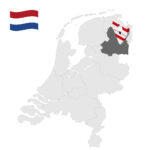
Another primarily agricultural province, Drenthe, is located just below Groningen and borders Germany. There are plenty of interesting landscapes, including peat swamps and sand drifts.
There are quite a few natural sites to see in Drenthe, including the Drentsche Aa, a stream that runs across the whole province and Dwingelderveld National Park.
A few Celtic burial grounds remain, but the park was mainly used for agriculture in the past.
Highlights of Drenthe
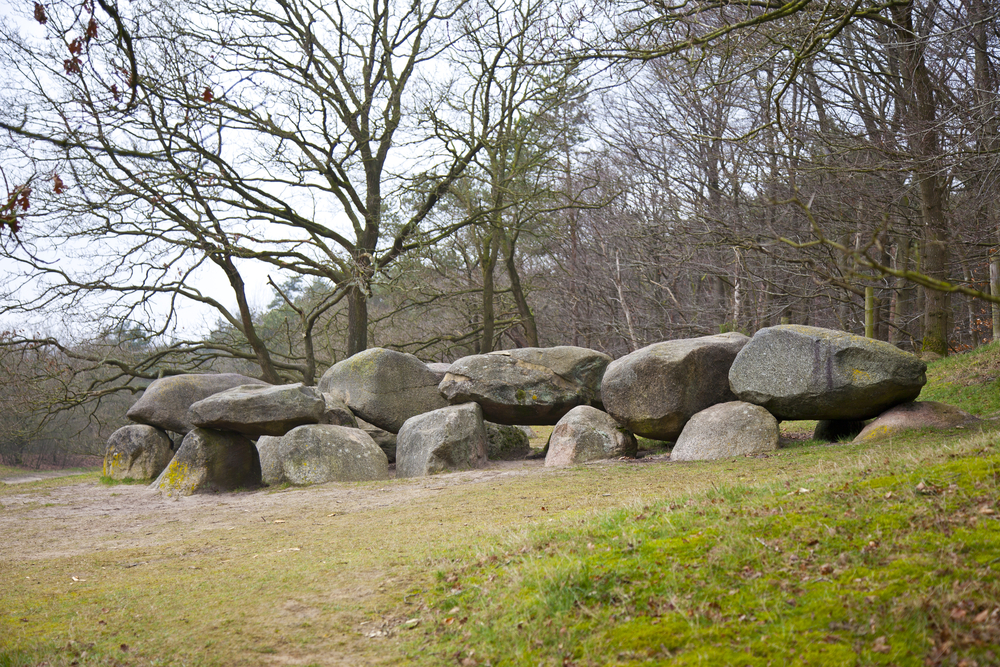
Drenthe hosts mysterious hunebedden, which are 5000-year-old prehistoric graves made from solid stone after the second-to-last ice age.
These stone graves are at least a few thousand years old — in the Netherlands, they’ve only been found in Drenthe. Image: DepositPhotos.com
You can visit the Colonies of Benevolence, areas in the provinces established to help alleviate poverty in urban spaces. It recently became a UNESCO Heritage Site!
⭐ Province capital: Assen 💁♂️ Population: 508,000 💬 Known for: Prehistoric and Celtic archaeological sites, unique terrain
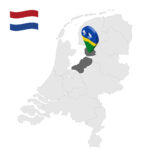
In the late 70s, the Dutch population was growing and real estate was running out. The solution? An amazing feat of engineering!
The Dutch pumped the water out of the Zuiderzee (South Sea) for farmland and more real estate, making Flevoland the Netherlands’s youngest province.
Flevoland hosts Schokland, a mysterious archaeological monument and the Netherlands’ first UNESCO World Heritage site, which was awarded to it in 1995!
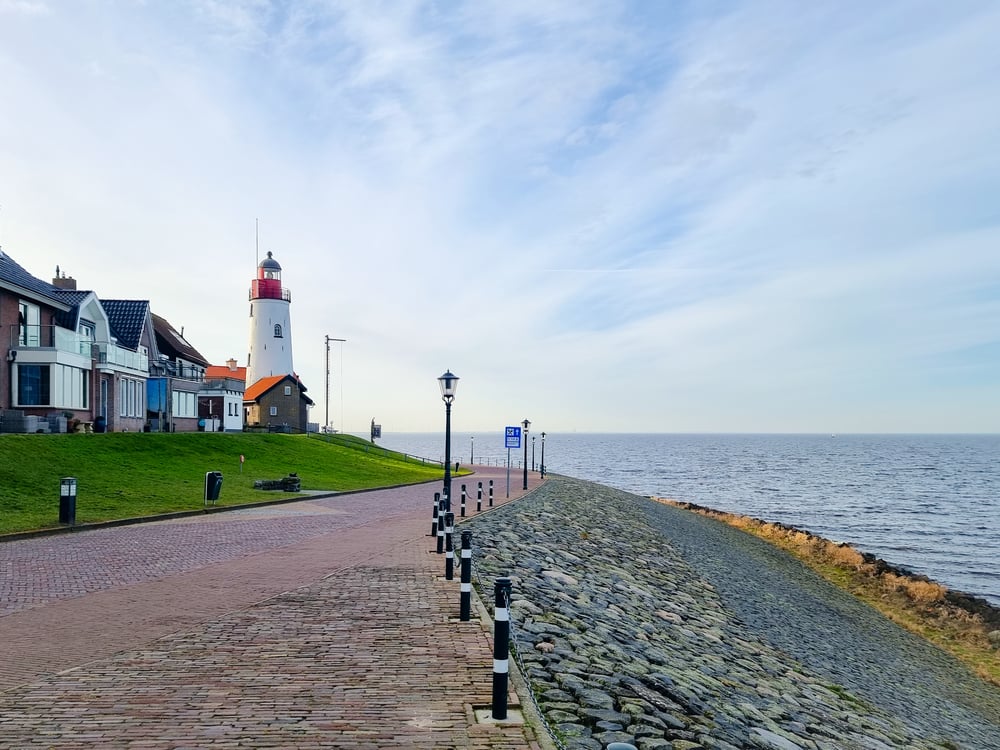
Just around the Northern peninsula, you can also visit the former island of Urk, which became part of the Dutch “mainland” when they reclaimed the sea.
The old fishing town of Urk used to be an island in the IJssel sea before the Dutch reclaimed land around it, turning it into the mainland. Image: DepositPhotos.com
The most populated city in the province, Almere, is also the newest Dutch city — but despite its relative youth, it’s the biggest agricultural centre in all of the Netherlands.
Highlights of Flevoland
Most of Flevoland is used for agricultural purposes, but fear not! There are still some fun day-trip activities.
Fashionistas should head to Flevoland to shop at Batavia Stad, an outlet mall with plenty of discounts for over 250 international brands.
Any more thrill-seekers should also check out the theme park Walibi Holland, which is about an hour and a half away from Amsterdam by train.
⭐ Province capital: Lelystad 💁♂️ Population: 463,000 💬 Known for: Mostly reclaimed land entirely from the sea
The eastern provinces of the Netherlands
The eastern provinces of the Netherlands make up most of the border to Germany, often resulting in a mix of language, food, and culture.
Overijssel: the province of waterworks (no, we don’t mean tears)
This Dutch province’s name translates to “across the IJssel”, referring to the major Dutch river that eventually flows into the IJssel lake.
Overijssel shares a border with Flevoland, Friesland, Drenthe, Gelderland, and stretches pretty far east towards Germany.
Many cities in Overijssel were part of the Hanseatic League — a medieval commercial group of merchant guilds across Europe that traded with Germany and other nations by boat.
Today, the extensive water network connects the major cities of Overijssel, like Zwolle, Deventer, and Kampen — not to mention some charming stretches of forests and moors.
Highlights of Overijssel
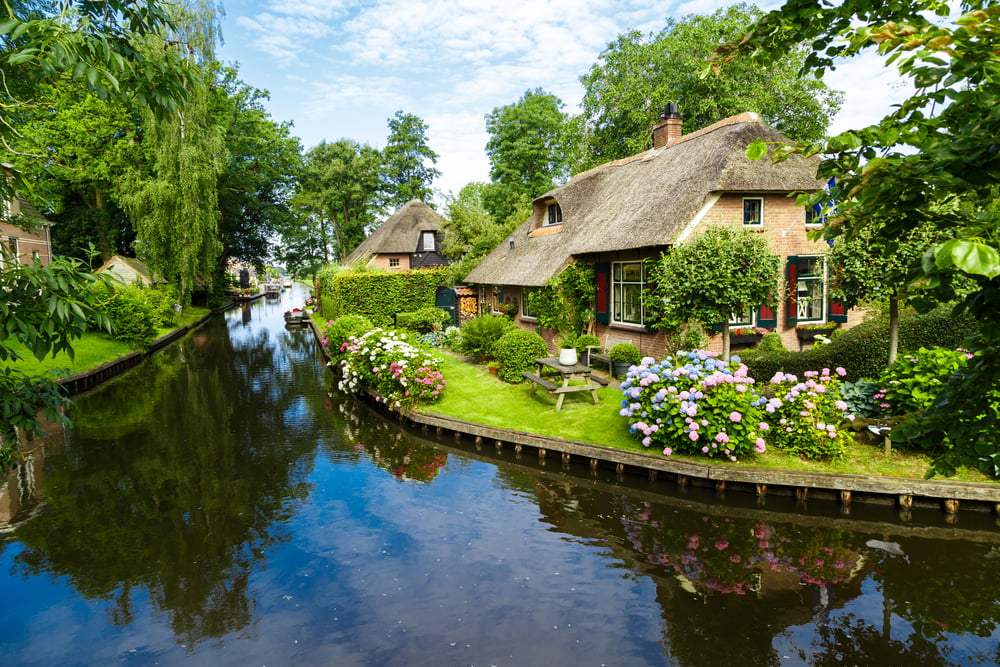
Overijssel is home to Giethoorn, the Venice of the Netherlands. The old part of the village contains no roads, so the main form of transport is by boat! 🛶
Giethoorn village seems like a fairy tale in its own right — picturesque homes, quaint canals, who wouldn’t love it? Image: DepositPhotos.com
You can also spend a day at Slagharen Vacation and Amusement Park, perfect for anyone seeking the thrill of a roller coaster or wanting to spend time with family. 🎢
⭐ Province capital: Zwolle 💁♂️ Population: 1.1 million 💬 Known for Giethoorn and canal networks
Gelderland occupies most of the eastern region of the Netherlands and is the second-largest Dutch province — it’s a biggie!
It hosts three main areas: Betuwe, Veluwe, and Achterhoek, each with unique qualities.
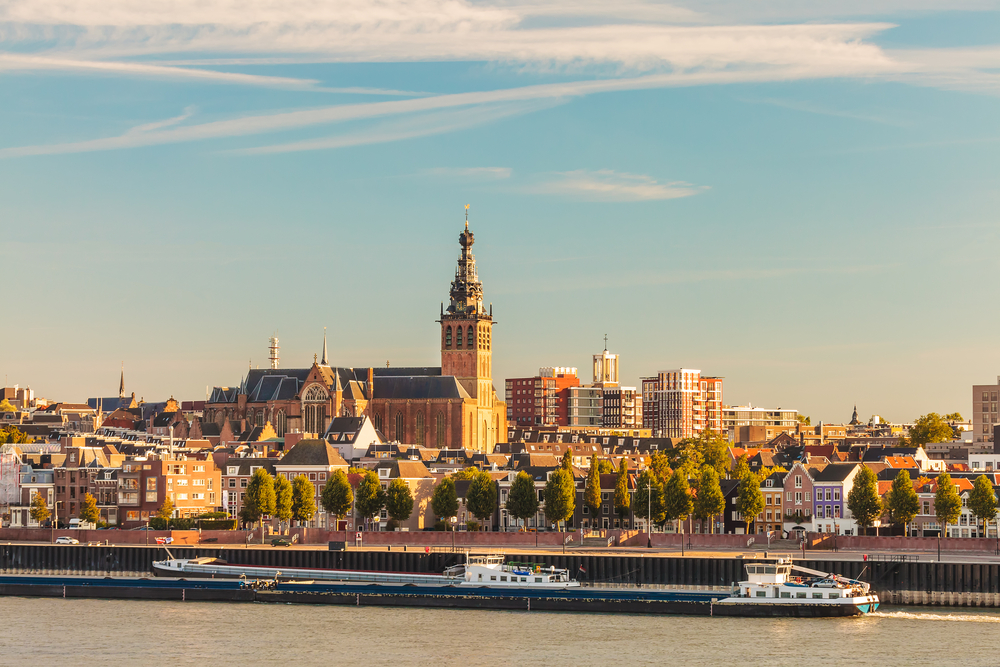
Betuwe hosts the province’s capital, Arnhem, and the oldest Dutch city, Nijmegen. Nijmegen has been around since Roman times, celebrating its 2000th year of existence in 2005!
Veluwe is for all nature lovers — it hosts De Hoge Veluwe National Park, a particularly biodiverse region full of beautiful landscapes.
Nijmegen sits on the river Waal, which connects Rotterdam to Germany. Image: DepositPhotos.com
Finally, the Achterhoek translates directly to “back corner” in Dutch because the region is all the way east, bordering Germany. It’s filled with picturesque farms and quaint camp spots — idyllic!
Highlights of Gelderland
Gelderland is perfect if you enjoy nature and the outdoors — you can visit the Netherlands’ Open Air museum, which gives an impression of the life of an average Dutch person from the past centuries and the Appenheul, a sanctuary and zoo for monkeys.
You can also check out the town of Zutphen, one of the best-preserved medieval towns in all of Europe! 🏰
⭐ Province capital: Arnhem 💁♂️ Population: 2.2 million 💬 Known for: Having the most nature in the Netherlands
The southern provinces of the Netherlands
A wander south in the Netherlands will reward you with the southern provinces. Here, the weather is warmer, the guttural “g” is softer, and the rest of Europe stretches just beyond the border.
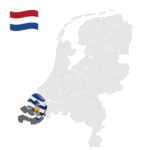
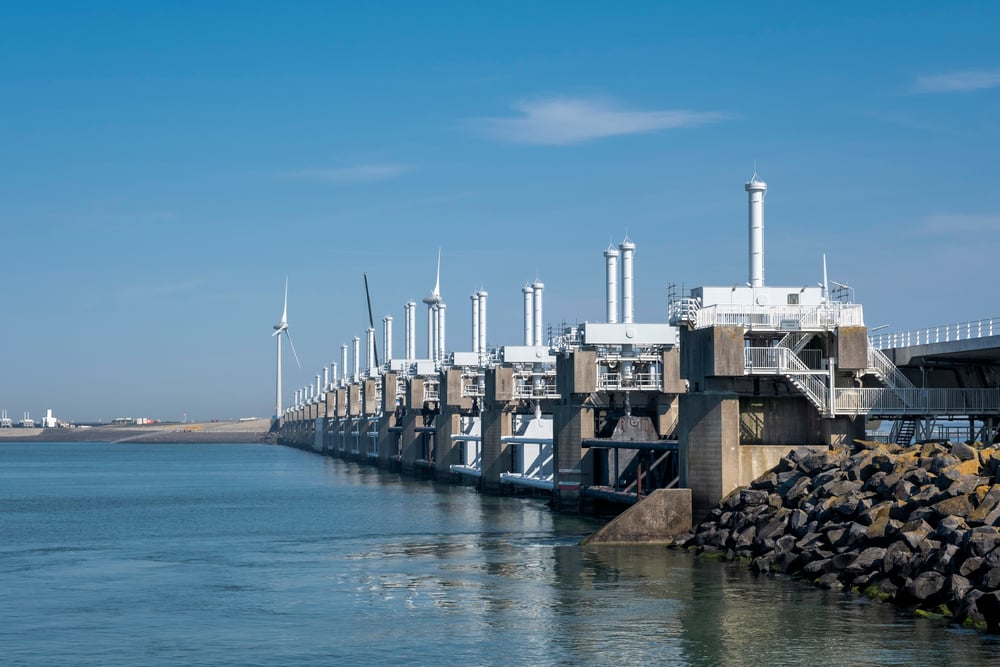
Zeeland: one word — dam(n)
Much of the Netherlands is below sea level, and Zeeland is the Dutch province most well-known for protecting the rest of the country from flooding. This province is home to the DeltaWorks, a massive network of dams, dykes, and levees created to help prevent flooding.
After the Watersnoodramp flooding of 1953, the Netherlands has taken measures to prevent such a natural disaster from ever happening again.
The Dutch proved to be the best at water management and engineering time after time.
Zeeland is home to many beautiful (and quiet) beaches and is the Netherlands’ capital for seafood, from delicious lobster to fresh mussels.
If you’re up for some sightseeing, Zeeland is full of museums about its history, its rich maritime past, and significant military battles.
Highlights of Zeeland
Visit Neeltje Jans, the largest part of the Delta Works. It’s an artificial island built as part of the Eastern Scheldt hydraulic storm surge barrier that closes 40-metre-tall gates in the event of a storm!
The Eastern Scheldt storm surge barrier was named one of the seven modern wonders of the world by the American Society of Civil Engineers. Image: DepositPhotos.com
Zeeland’s coast has remnants of defensive bunkers built by the Nazis as part of the Atlantic wall. Any history buffs won’t want to miss these cool chunks (literally) of the past!
⭐ Province capital: Middelburg 💁♂️ Population: 395,000 💬 Known for: Water, water everywhere
North Brabant was technically part of a larger province called, you guessed it — Brabant!
Previously, there was also Central Brabant and South Brabant, neither of which exists anymore (don’t worry, they just became part of Belgium’s northern region 🙄).
North Brabant is also home to several lively and innovative student cities, including Eindhoven and Tilburg, which you could consider hidden gems off the main radar of tourists and expats.
If medieval history is more your thing, you’ll love Breda: a fortified city filled with architecture that’s a feast for the eyes but that also thrives with restaurants, bars, and thousands of students.
Breda is no longer walled off by the tall city gates and medieval fortifications, but you can still find its remnants around the city. Image: DepositPhotos.com
Highlights of Noord-Brabant
The Efteling is the Netherlands’ largest theme park — it’s twice the size of the original Disneyland in California and is older by three years!
It was the second-most visited European theme park in 2020, after Disneyland Paris.
North Brabant is also quite famous for being Vincent van Gogh’s birthplace, one of the most beloved Dutch artists. Much of his artwork is kept in the Noordbrabants Museum.
⭐ Province capital: Den Bosch 💁♂️ Population: 2.7 million 💬 Known for: Amusement parks, Van Gogh
Limburg: the (laughably) highest point in the Netherlands
The Netherlands is notorious for being a flat country, but Limburg is one of the few Dutch provinces that has a bit of elevation because it’s more inland (and therefore, further away from all the reclaimed land). Cue Vaalserberg.
Vaalserberg is the Netherlands’ only mountain, standing at 322 metres — how shocking for the Dutch. 😱
Vaalserberg is also where Germany, Belgium and the Netherlands meet, known as the Drielandenpunt (three-country point).
This location is a popular tourist destination, and there are a few observation towers to check out this point from above.
The provincial capital, Maastricht, is another popular tourist location in Limburg and a contender for the most remote Dutch student city.
Maastricht feels quaint and is rich in history and culture, with church bookstores, medieval grounds, and a weekly market.
Highlights of Limburg
Limburg has several hiking trails of varying lengths and inclines, so anyone looking for a break from the city or a chance to exercise can find something they like.
The south of the Netherlands is also notorious for its Carnival celebrations, especially in Maastricht and the rest of Limburg. It marks the start of the Christian fasting season of Lent, and Dutchies in these parts go crazy with the parties.
Snow is a rare sight to see in the Netherlands, but it makes Carnival season all the more exciting! Image: DepositPhotos.com
⭐ Province capital: Maastricht 💁♂️ Population: 1.1 million 💬 Known for: Carnival, the only Dutch “mountain”, Limburgse vlaai
Provinces in the Netherlands: Frequently Asked Questions
How many provinces are there in the Netherlands?
There are 12 Dutch provinces: North Holland, South Holland, Utrecht, Groningen, Friesland, Drenthe, Flevoland, Overijssel, Gelderland, Zeeland, North Brabant, and Limburg.
Which Dutch province has the biggest population?
The Dutch province of South Holland has the biggest population with 3.7 million people — it hosts two of the Randstad cities!
Which Dutch province has the smallest population?
Zeeland has the smallest population in the Netherlands with less than 384,000 people living there.
Which Dutch province has the biggest area?
Friesland is 5,749km², including all the water in the IJsselmeer!
Which province has the smallest area?
Utrecht is 1,560km², about 3.5 times smaller than Friesland!
And that’s your breakdown of all the 12 provinces of the Netherlands!
Hopefully, you learned something new about each of the provinces and maybe have some inspiration for where you’d like to live or visit next. 😉
Was there something new you learned about? Tell us in the comments below!