


What is stamppot‘s origin story? How did it become a traditional Dutch staple? And the big question: what the heck is it?
When you think of Dutch food, you probably think of cheese (Gouda, anyone?) and the giant pancakes you’ve had in those wonderful Dutch pannenkoeken restaurants.
However, when it comes to traditional meals in the Netherlands, one of the first things any Dutchie will reference is stamppot.
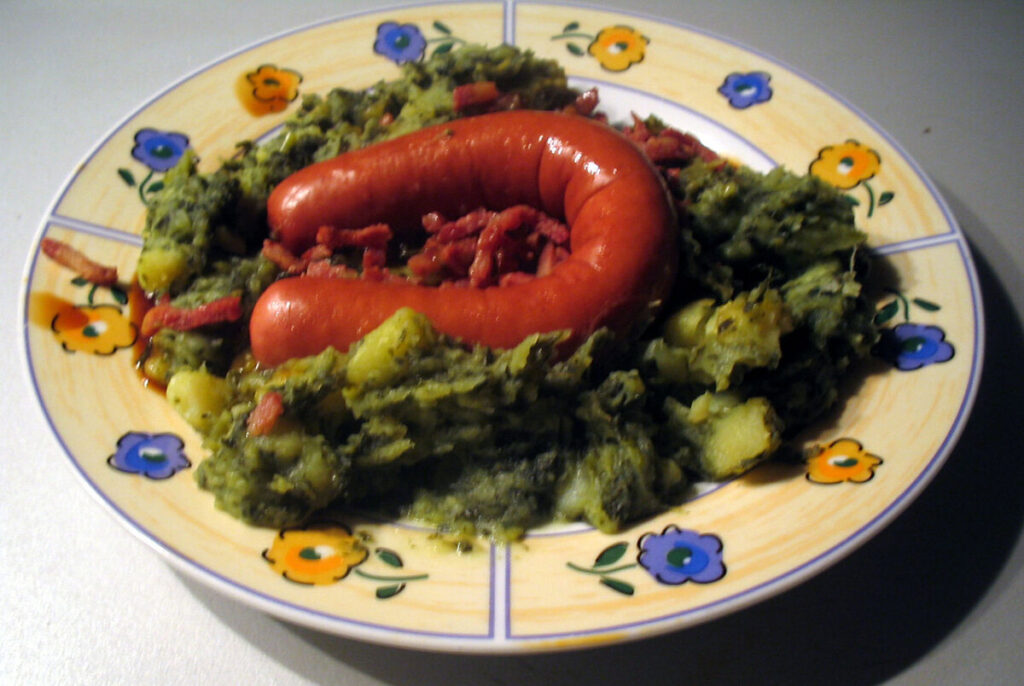
Stamppot is a combination of potatoes mashed with one or several vegetables (and sometimes fruits). These vegetable pairings traditionally include sauerkraut, endives, kale, spinach, and turnip greens. This is then usually paired with traditional Dutch sausage. 😋
Stamppot, through the years
The endurance and popularity of the stamppot are truly mind-boggling. The dish is said to be one of the oldest, and yet still one of the most popular Dutch dishes ever!
To really understand how the dish became such a favourite traditional Dutch food, one must look into the past and understand how it came to be in the first place.
It all started in the 1600s when stamppot first started out as a staple during the cold season and stayed as a winter dish for hundreds of years.
READ MORE | How to survive the Dutch winter: weather, clothing, and more
It’s called a “winter dish” because of the meal’s warmth and ability to immediately fill you up. It was a must-have food during the harvest months because, in this period, potatoes were available in abundance, and many hungry farmers could be filled up quickly and cheaply. 🥔
Variations of stamppot
There are lots of stamppot recipes in circulation, but here are some of the most popular ones in the Netherlands:
-
Boerenkoolstamppot (kale stamppot)
-
Zuurkoolstamppot (sauerkraut stamppot)
-
Hutspot (onion and carrot stamppot)
-
Rauwe Andijviestamppot (raw endive stamppot)
-
Preistamppot (leek stamppot)
Although the Dutch and their affinity for mashing their food is one that’s quite legendary, we have to admit that no one knows who invented the stamppot.
@andy_cooks Stamppot – Dutch comfort food. What’s your favourite childhood dish? Ingredients – 1kg peeled mashing potatoes – 1 bunch of kale, picked, washed and sliced thin – 500g smoked pork sausage – 50g butter – 100ml milk – Seeded mustard to serve – Salt to taste Method 1. Start by placing your potatoes in a large pot of cold water, season with salt and turn on high. 2. In a separate pot, half filled with hot water, place your smoked sausages to warm them through, alternatively, you can pan fry the sausages, but this was the way my mother used to make it. 3. After the potatoes have boiled for five minutes, add the sliced kale to the pot and stir. 4. Once the potatoes are fully cooked, drain and place them back into the dry pot. 5. Add butter and milk and mash the potato with the kale. 6. To serve, slice your sausage and place it on top of a pile of kale mash with some seeded mustard on the side. 7. Comfort food heaven for me! #cooking #food #dinner #easyrecipe #dutch #potato #foodtiktok #fyp ♬ Sure Thing (sped up) – Miguel
One thing is clear, though, the hutspot recipe was discovered when the Dutch resistance succeeded in driving the Spanish away from Leiden. It’s quite a legend in its own right.

Legend of the “free” hutspot
As we know, the Dutch fought a war with Spain called The Eighty Years’ War.
This war was a revolt of the Seventeen Provinces of what are today the Netherlands, Belgium, and Luxembourg, as well as the French region of Hauts-de-France, against King Philip II of Spain.
For those of us who don’t know, the word hutspot is derived from the Dutch words hutsen (to mix) and pot (which is, well, pot).
During the Eighty Years’ War, the Spanish tried to capture the city of Leiden in 1573, as the inhabitants stubbornly defended their city and withstood a one-year siege.
Bye bye, Spaniards
On October 3, 1574, the resistance finally succeeded in driving the Spanish away and liberating the city.
It is reported that the Spanish soldiers fleeing Leiden left cooked bits of an unfamiliar stew of carrots, meat, onions, and parsnips, which the starved inhabitants of Leiden ate up really quickly. 🥕

Not knowing what to call the unfamiliar dish, they named it hutspot, and it has remained a symbol of their victory to this day.
Stamppot and Leidens Ontzet
The anniversary of the liberation of Leiden, known as Leidens Ontzet in the Netherlands, is still celebrated every October 3 in Leiden.
Leidens Ontzet is a happy time full of eating hutspot and drinking booze. It’s definitely an event you shouldn’t miss! 🍻
While the origins of the Dutch stamppot may not be very clear, one thing everyone can agree on is that it is a much-loved dish in the Netherlands. Hutspot still remains a symbol of Dutch freedom and victory in the siege of Leiden. 🇳🇱
What do you think of stamppot? Tell us your thoughts in the comments below!


Your photo looks more like Naakte Kindertjes in Het Gras (Naked Children in the Grass) recipe than one of the stamppot recipes you mentioned. My parents also made brown beans and bacon on those very cold days. We used the bacon fat as gravy on our boiled potatoes. It all got mashed up on our plate because…well, everything gets mashed together, doesn’t it?
Blote Billetjes in het Gras is a mix of potatoes, white beans (looks like bare bottoms) and green beans (the grass). The other dish is Bruine Bonen met Spek.
In Ireland we have Irish Stew which is very similar with same ingredients except the ingredients are cut up and not mashed.
I am Dutch and I have always learned that at the end of the siege of Leiden, the good people of Leiden ate Herring and white bread, Every year in October when they commemorate the end of the siege they eat herring and white brood. There is an old saying that most of the Dutch people will know: Haring en witte brood, Leiden uit de nood.
Haring en witte brood , you are right !!
I am from the US Virgin Islands and we have a very popular dish I am sure is originated from Stamppot due to Denmark once owned the Virgin Islands before the United States. We call our version of Stamppot POTATO STUFFING. This is a delicious dish made with mash potatoes, onions, peppers, raisins and multiple of chopped vegetables with a Caribbean kick to it. Our Potato Stuffing is savory and sweet. Good to know its a big part of our Denmark past.
It might be, but this is about a traditional Dutch dish, not a traditional Danish dish. The Dutch are from the Netherlands, not Denmark.
It was always my understanding that stampot originated because of cooking everything in one pot. I grew up on a small boerderij near the village of Bergentheim, Salland, Overijssel during the late 40s and early 50s. There was no electricity nor running water and my mother cooked on a cast iron stove (fueled by peat). In the summer the stove was dismantled, taken to a shed and cleaned thoroughly and stayed there during the warmest weather.
My mother cooked on a single burner “oliestel”, kerosene stove during this time.
Hence cooking everything in one pot. We had stampot with any available vegetable and on Saturdays it was “bruine bonen met speak”. We also had “karnemelkse pap”, buttermilk porridge or porridge made from a variety of other grains.
I still enjoy these dishes occasionally and have introduced them to my family here in Ontario, Canada.
How funny to read this, my mother did the same, in rural Michigan, USA in the 1940s and earlyv50s, cooking on a cast iron stove that was taken to the barn in summer and cooked on a kerosene stove in the “summer kitchen” in Summertime. Customs may be much the same no matter where in the world we live.
My guess has always been (and it’s only a guess) that most national dishes (i.e. comfort foods) originated by creatively using leftovers.
I made Stampot this evening. We live in the States and mom taught me the one pot method. Her mom taught her to make the different kind. Carrots, onions, was also one she made a lot. Mom said they ate these during the war, wwII, often only the heater to cook on.
Op kostschool kregen wij minstens 1 keer per week HETE BLIKSEM…..
Afschuwelijk vond ik het. Aardappels en Appelmoes met misterieus vlees. Ik proef ‘t nog, na
52 jaar….Bah.
Maar Ik ben gek op Boerenkool en Gelderse worst, Kaantjes en Azijn…Mmmmm
This stinks, it’s Haring and white bread, Welke minkukkel heeft dit geschreven. Hahaha
I love stamppot ever since I spent some time in Wageningen, and I make it here in Israel in the winter. Kale is hard to find here but I substitute cauliflower and/or broccoli and it works fine. In the Netherlands, rookworst (smoked sausage) is the traditional accompaniment and I can find some similar sausages in the Russian grocery shops here in Jerusalem.
One thing is sure – it is quick to make, and really fills you and warms you on a cold, rainy winter night. I’m surprised it is not more widely known.
You will find the same in many countries, but they call it baby food. There is a reason you don’t find many Dutch restaurants internationaly
Go to “winkel” in philidelphia
I want to try this but need a good recipe help please
From a Dutch recipe book I have:
1 farmer-style sausage or 1 lb chuck/round steak.
2/3 lb onions
4 lb potatoes
milk
butter/marg
s/p
Simmer the steak in salted water for 2 hours (if using) until tender.
Peel and chop up the veg and boil together until fork tender. Mash all together and stir in last 3 ingredients. Add meat or sausage slices and serve. A good prepared beef gravy would also be tasty on the side.
Good luck.
Put chopped potatoes and onion in a pot and just cover with water, add some bay leaves and start boiling. After 5-8 minutes add chopped kale. Boil the pot dry. Add a bit of milk to help with mashing. Warm up a sausage on the side. Season with butter, salt, pepper and my favourite, malt vinegar. Enjoy! (You can chop up the sausage and mix in or eat beside with some Dutch mustard for bonus points)
It seems so simple, yet each stamppot is made in a different way.
Kale is steamed on top of the potatoes. Add as much as you can, let it ‘slink’ for a minute or two and add more, till it is al in the pot. Done when the potatoes are soft enough. Drain and mash. Old folks used to tell that kale is best after a first night of frost. This was confirmed by science in my lifetime: kale is winterhard because it produces its own anti-freeze when temperature drops below zero, and this improves the taste. Since cabbage heads don’t die, you can try putting them in the freezer for a while.
Zuurkool (sauerkraut) is fermented. You can buy it plain, with wine or with peppers, or make your own. Just add it after you drained the potatoes and mash. We often add raisins, especially if there will be children at the table. Some even add pineapple… 🍕
Endive is cut and added raw.
Turnip greens are blanched. Since they are more delicate, stir them into the mashed potatoes i.s.o. mashing them together. We also use leaner ‘spek’ for this stamppot, and the tastiest potatoe we can find.
Stamppot peen & uien (a.k.a. ‘hutspot’ – carrots & onions) can be bought precut, but don’t let that stop you doing your own cutting, it’s not a vegetarian dish. Everything is put in the same pot at the same time. The same goes for spruitjesstamppot (Brussels sprouts mash). Mind the timing with peen & uien. The potatoes need to be soft enough, but you don’t want to overcook the onions.
Stampot rode kool (red cabbage) is special. You can buy the rode kool in a jar or a bag (the very same kind of bag that is used for zuurkool) and add it after draining the potatoes, or prepare it yourself á la Flamande (the Flemish way: with apples, cloves and laurel). Stamppot rode kool is one of the most exquisite dishes in the country. It looks so simple, a pink-purplish glob on your plate, but it is very rich in both taste and texture: the bitter bitey cabbage, the sweet apples, the flavour of spices, the salted and smoked brittle crackling, the creamy potatoes, the juicy smoked sausage… add a side of rhubarb and you have the complete picture. Only thing it isn’t is chewy.
Wait, did I say meat? Hang on.
What about seasoning? Well, if you use salt, add it to the potatoes, and rode kool uses clove and laurel. Keep a peppermill on the table (especially with stamppot boerenkool and peen & uien). And yes, mustard sounds fine with kale but it certainly goes well with Gelderse rookworst.
The trick is in the smoothing. There are three options: plain butter added to the pot just before mashing, or jus (yes, that means juice, but it refers to the mixture of the fat you use to prepare meat and the juices that came out of the meat; the Dutch, as a rule, don’t like gravy. Why would you want to add starch (flour) to starch (potatoes)?) or spekvet. Jus us fine for peen & uien and boerenkool. But spekvet is the soul of stamppot. It’s basically lard. In order to make it, you have to go to the butcher’s and order vetspek¹, ‘gerookt en gepekeld’ (smoked and salted), because you don’t see it in supermarkets anymore. Something to do with fat-tax. Given that spekvet was a substitute for meat, this fat-tax is just another word for poverty tax.
Anyway. Dice the vetspek (if it isn’t already diced) and melt the lard out of it, seperating the remaining spekjes (cracklings) when they’re brittle enough. (Lard gets hotter than crackling can stand, they’ll burn if you leave them in too long.) Keep them apart and serve them at the table. Cracklings first, they get mixed into the mash before applying the jus/spekvet.
And now a very important thing: you can pour the jus/spekvet over the mash as you would with potatoes, buth especially with jus this is a big no-no. The jus gets added to the kuiltje (hole). The practise goes like this: you spread your mash out evenly over your plate. You can make a hole in the middle yourself, or you can let ‘mother’ do that for you – which she will, because dinner plates are flat and adding jus to mash will easily spill over the edge – because the jus-lepel (sauce spoon) is perfectly shaped for that. Than with your fork you trace canals to – almost – the edge of your plate to irigate. It’s the Dutchest thing you can do. Water management, jus management, it’s in our genes. If you had a big helping, forget the irrigation system and go for the volcano!
There are exceptions to this. Spekvet is not used for peen & uien/hutspot and stamppot raspsteeltjes, and is optional for zuurkoolstamppot and stamppot boerenkool. Spekjes (again, crackling, not bacon bits) never hurt zuurkool, but the traditional spek that goes with zuurkool is – believe it or not – zuurkoolspek, a leaner spek that is not smoked and less salted. The same is used for raapsteeltjes because turnip stems – which are either real turnip greens or a small herb that tastes and prepares exactly the same – have a very delicate taste. Hutspot is served with klapstuk (beef), jus and freshly ground pepper. If preparing the beef seems like too much work, just fry some coarse (beef) minced meat and mix it through the stamppot.
If you don’t eat pork, you can substitute the spekjes and spekvet for kaantjes and reuzel (the same, but from runderniervet (beef kidney fat) i.s.o. pork belly fat) or minced meat, or go with just jus. The Gelderse rookworst has pure beef variants.
If you’re vegan/vegatarian, my condolences. I’d say there are veggie versions of minced meat and rookworst, but I never got the meat-alike market. If you miss the spekjes/kaantjes in your stamppot, I’d recommend crushed nuts. Walnuts should go well with kale and peanuts are a proven combination with boths carrots and onions, for the rest I’d use crushed cashews.
Some comments confuse hutspot and herring and white bread – all if these foods are associated with Leiden. Leiden was liberated on the 3rd October 1584. Hutspot stems from the pot left by the Spanish when they took off and was found by a boy coming over the wall.
Herring and white bread were brought into the city for the starving population on flat boats manned by the “geuzen” – basically they were guerillafighters – some of them fought as pirates/guerillafighters and some on land.Many of the citizens of Leiden today will go to the townhall on the 3rd October (obviously they have to register for this) early in the morning and get their herring and whitebread rations handed out. At home and in restaurants and in street parties in Leiden people will eat hutspot.
Stamppot isn’t that old. We’ve only had potatoes since the 16th Century (and carrots, for that matter). Hutspot is much older. But the word doesn’t refer to the modern stamppot peen & uien, but to a kind of dish composed of meat and vegetables, all cut down to bite sized pieces. The Leidensche hutspot is a stamppot, not a hutspot. In Belgium they still use hutspot in its original meaning.
I was born i.n Den Haag in 1939;emigrated to Canada with family in 1951. Married a girl born in a mining community in northern Manitoba. One day, sitting in the bathtub, reading the instruction manual for our new pressure cooker, she cam across a recipe for masing potatoes and vegetables together and serving the dish with a sausage. She thought it sounded good. Then she asked me what I thought. Told her I had eaten it many a time, except I knew it as hutspot. We’ve sometimes been confused by the difference between stamppot and hutspot, although I associate stamppot with kale, boerekool which I don’t like much. Carrots and Onions every time, all the time!
I really appreciate how this clip highlights the traditional rookworst sausage that accompanies the mash. The snap of the casing and the juicy, smoky interior look absolutely incredible. It is an indispensable part of the whole experience, and a standard hot dog or regular sausage just cannot replicate that authentic taste.