But the Dutch government doesn’t really persecute drunk cycling. You’re just sort of advised not to do it, but you don’t risk losing your driving licence.
You may face getting a fine of up to €200, or you can be banned from driving or cycling for a number of hours (more common).
Except if you’re a serious hazard to the people driving or cycling around you, which can lead to a lawsuit. 😐
When choosing a school for your children, you’re laying the first stepping stone on their educational journey. As an international parent in the Netherlands, how can you be sure you’re making the best decision when you’re unfamiliar with the local school system?
It’s actually easier than it seems! At least, if you choose a school that not only helps kids obtain great academic results but is also experienced in tailoring its teaching to international families.
Introducing: Nord Anglia International School Rotterdam
All students follow an international curriculum, from Early Years through Primary and Middle Years to the final International Baccalaureate Diploma Programme (IBDP).
Wait, first things first: what is the IBDP? The International Baccalaureate Diploma Programme is a two-year, internationally renowned graduation programme for students aged 16-19. It’s taught at over 5,700 schools in 159 countries and counts almost 2 million students!
While NAISR is a small private school, it is part of Nord Anglia, a global network of 89 schools across 37 countries, with over 100,000 students.
This way, NAISR can draw on the expertise of thousands of outstanding teachers worldwide — and offer unique chances to each student.
A school with an international reach and unique opportunities
So, now that you’ve made your first acquaintance with NAISR, let’s take a closer look at what makes this school so special. 👇
Collaboration with MIT: preparing students for the future
Students get to work on projects that make real change! 💪 Image: Paul Pacey/Supplied
This year, for example, Year 9 students had a particularly exciting project, based on designing solutions with AI. In the words of NAISR’s STEAM teacher, “students took an everyday or recyclable item, and tried to improve the design of the item using AI. Then, if possible, they made prototypes.”
“In the middle of the year, we entered the MIT trip Competition and two of our Year 9 students were put forward for the final round. One project was ultimately chosen, and she attended workshops at MIT in Boston in November 2025.”
Collaboration with UNICEF: projects for change
Through a formalised partnership with UNICEF, students of NAISR also have the opportunity to work on projects aiming towards real-world change.
At 2023’s UNICEF Student Summits in New York City, for example, students learned about the complexity of the Sustainable Development Goals (SDGs). They agreed that taking real action is the only way to ensure progress.
This experience gives them not only enhanced opportunities to become global citizens but also a chance to create a network for their future careers. 🤝
A chance to network through the Global Campus platform
Another benefit of Nord Anglia Education is that its students can expand their network through the Global Campus platform.
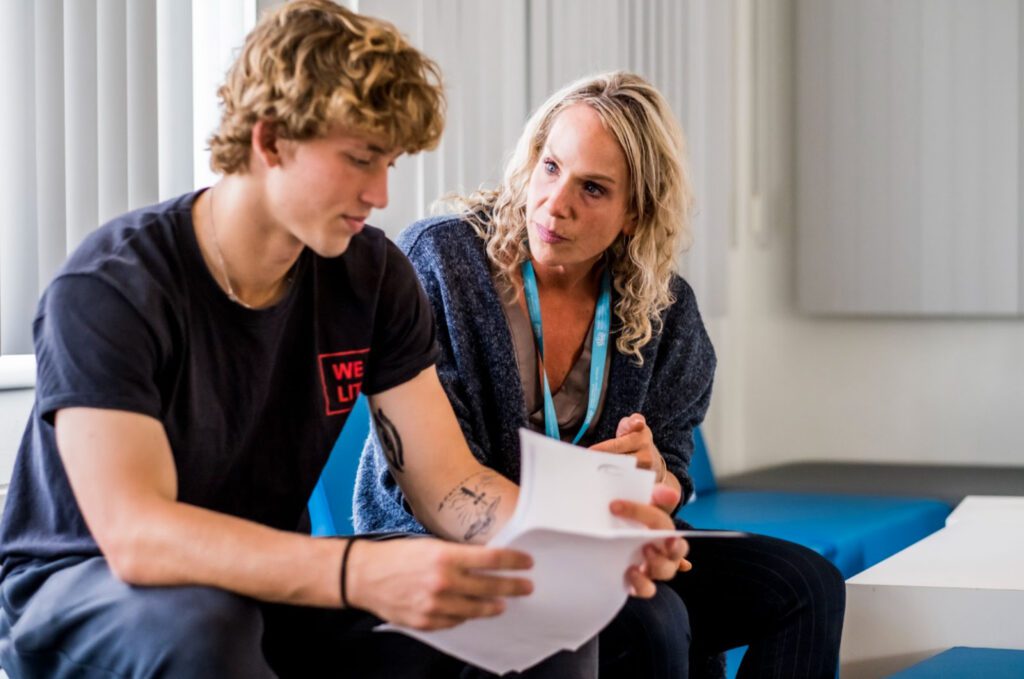
Students won’t be lost in a sea of faces. Image: Lambert de Jong/Supplied
From targeted university planning with counsellors at their desired universities to personal development courses and mental health resources, the Global Campus helps NAISR’s students make connections and draw on knowledge from across the globe.
In the words of Danielle Mashon, IB Diploma Programme Coordinator: “The benefit of being part of Nord Anglia education is that, while we have a small cohort in school, we are part of an expansive global network.”
An advanced “Power of Three Sciences” track
NAISR isn’t just prepping their students for university, their IB diploma programme provides a solid foundation for careers in medicine, engineering, or scientific research.
Dubbed “The Power of Three Sciences”, it allows students to follow three IB science tracks: Biology, Physics, and Chemistry.
“Taking three sciences in the IB is a bold choice,” IB Coordinator Bradley Gooding admits, “it’s for ambitious students with clear university goals, strong academic ability, and the resilience to manage a demanding workload.”
How NAISR supports learning and development — from learning to read to finding the dream university
At NAISR, teachers use a personalised approach that makes every student feel supported. With carefully crafted curricula and engaging co-curricular activities, your child’s years at NAISR will prepare them for the academic world and success far beyond it. 💪
We spoke to some of NAISR’s teachers to find out more.
NAISR’s Early Learning Programme: setting your kids up for success
The Early Years Learning Programme at NAISR introduces children from the age of three to school life in a fun, active, and (most importantly) child-led way — and it’s vastly different from putting them in a regular nursery.
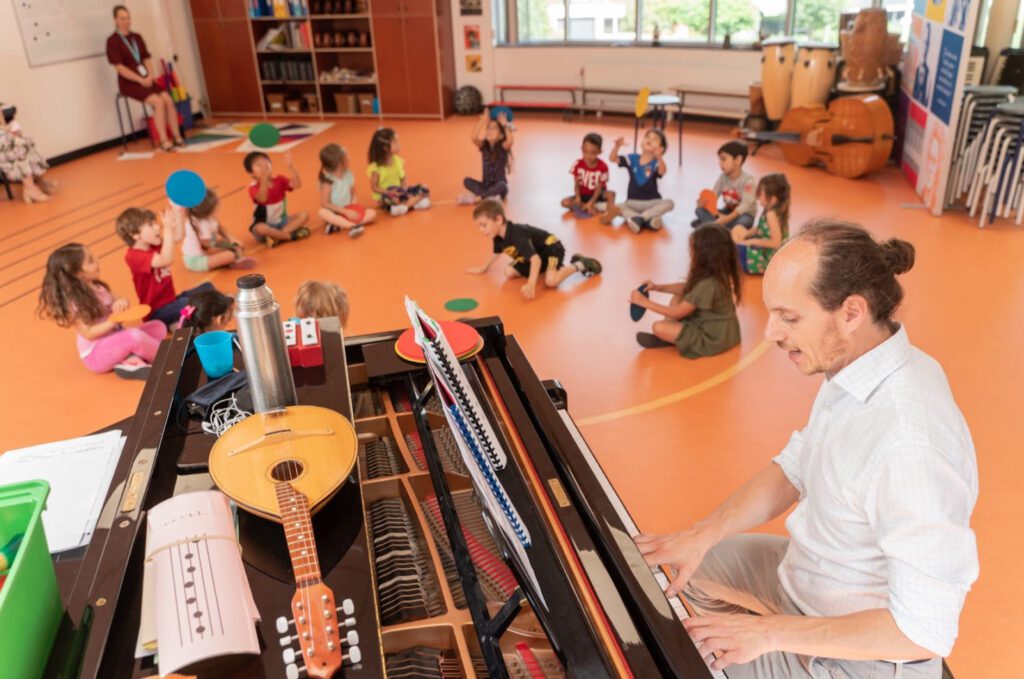
Who wouldn’t want to learn in a classroom setting like this? Image: Paul Pacey/Supplied
How? The dedicated teachers follow the students’ interests to create meaningful topic-based experiences, which are then tied to traditional school subjects such as literacy or maths.
This child-led approach cultivates the young students’ curiosity, teaches them to love school, and even makes them better at regulating their emotions!
The IB and pre-IB Programmes at NAISR
Next, we spoke with one of NAISR’s passionate IB teachers and immediately saw that there are a few main things that make completing the IBDP at NAISR a unique experience.
At NAISR, students can develop their interests both online and on campus. Image: Lambert de Jong/Supplied
So, what makes NAISR stand out?
A close-knit community: With two classes doing the IBDP at a time (Year 12 and Year 13), the small class groups allow for a true sense of community.
Small student-to-teacher ratios: With a teacher-to-student ratio of 1:8 to 1:10, teachers can give their students the attention and support they need to succeed.
High academic outcomes: Having completed the IBDP myself (and knowing how challenging it is), I’m in awe of the grades that NAISR graduates obtain. Not only do they have a 100% pass rate, but their students’ IB points exceed the global average, year after year.
Additional courses offered online: If a course isn’t offered at the school in Rotterdam itself, students can simply follow it online. Handig!
Year-round admissions: With a flexible admissions process, NAISR tailors its education to internationally mobile families. Unlike many other schools in the Netherlands, admissions are open year-round!
Is Nord Anglia International School Rotterdam the right choice for me and my children?
If you’re looking for a school with a personalised approach to learning that will celebrate each student’s success and support them through every challenge, you should definitely be looking into NAISR!
Plus, with Virtual Open Days held every few months, you can always register on the NAISR website and tour their Rotterdam campus from the comfort of your home couch.
Want to get in touch with NAISR? You can!
Do you have any questions about the school or want to discuss your children’s potential future at NAISR? No problem! You can easily contact them or follow their social media.
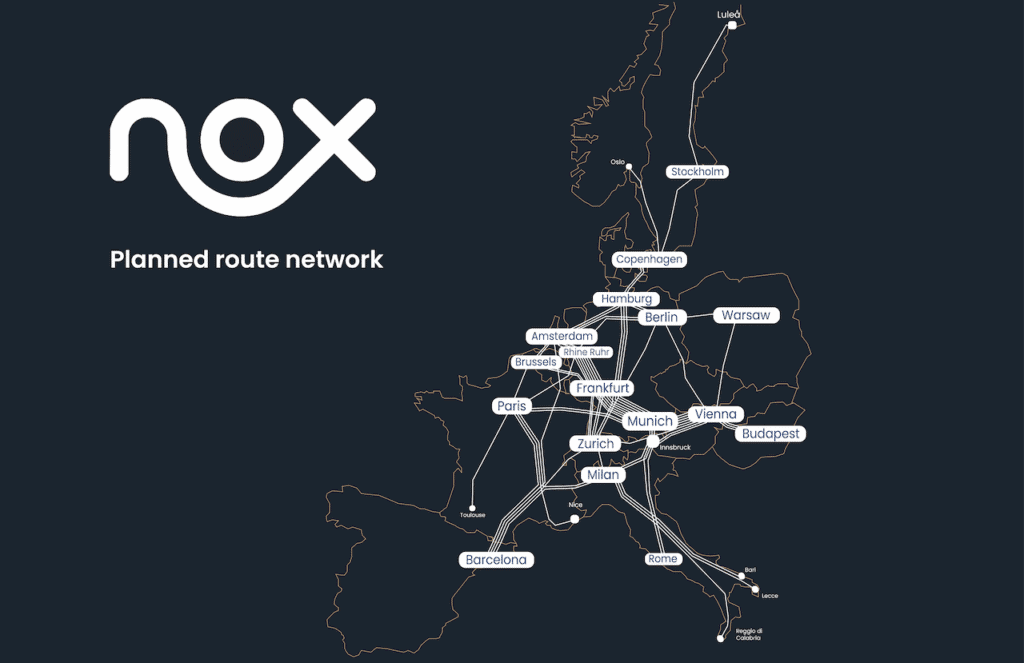
By 2035, Nox hopes to link over 100 cities across Europe, including Amsterdam, Paris, Rome and Barcelona. The company aims to turn overnight train journeys into a first-class way to travel.
The Berlin-based start-up is making sleeper trains cool again — and completely private.
Private and affordable
Scheduled to roll out in 2027, Nox aims to operate a sleeper train network across Europe with fully private cabins.
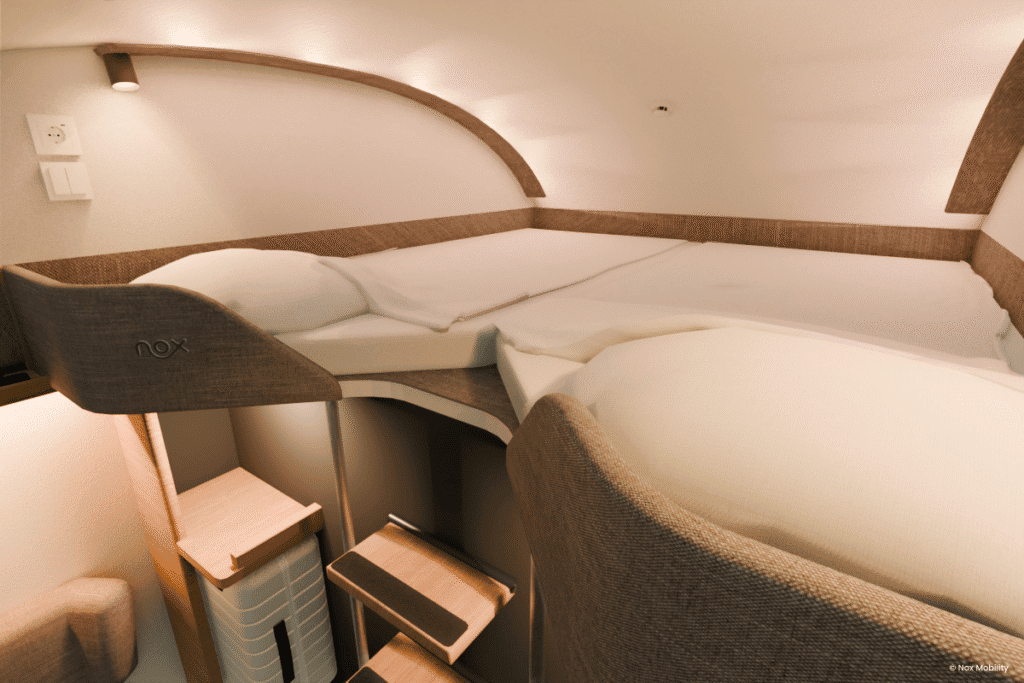
Forget bunking with strangers: every cabin will be either private single or double rooms, featuring armchairs, tables, storage space, beds long enough for actual humans (two metres!), and even panoramic windows.
The team already shared a preview of what the cabins will look like. 👇
Cosy, aesthetic, and private. Image: Nox Mobility
And it won’t cost you a fortune. With prices starting at €79 for a solo cabin and €149 for a duo, it’s a real contender against short-haul flights — and a lot more fun than sitting in a middle seat next to someone eating tuna.
The perfect spot to work and travel. Image: Nox Mobility
Who are the masterminds behind Nox?
A dream team: YouTuber Thibault Constant, who’s ridden over 400 night trains and built a following of 500K train fans, and Janek Smalla, who has co-launched FlixTrain, and until 2024 led the German ridesharing market for Bolt.
Nothing quite prepares you for your child screaming about a “little beestje” in their brand-new school bag — especially when that creature turns out to be a venomous scorpion.
According to Omroep Brabant, that’s exactly what happened to one Tilburg family on Wednesday when nine-year-old Arianna opened her new school bag from Shein.
When online shopping gets a little too exciting
Arianna couldn’t wait to unpack her new backpack on Wednesday when the package arrived from China.
But her excitement quickly turned to terror when she discovered an unexpected passenger inside. “She suddenly screamed very loud: ‘Mama, a little beestje!'” her mother, Jacqueline, tells Omproep Brabant.
What initially looked like a strange-shaped moth turned out to be a Chinese golden scorpion. If you’ve been shopping from international online stores, this story might make you think twice about that next bargain purchase.
A new home for “Snippie”
Jacqueline’s first instinct was understandable: “I grabbed that bag and threw that little creature out the front door, out of pure shock,” she said.
But then she realised the danger a venomous scorpion could pose to local children and pets roaming the area.
She went back outside, captured ‘Snippie’ (as Arianna had already named the scorpion) with a plank and plastic container, and called Dierenpark de Oliemeulen for advice.
Thankfully, the Tilburg zoo agreed to take in their unexpected guest.
The plot twist nobody saw coming
But the story gets even more interesting. The next morning, the zoo called with news — Snippie had given birth to babies.
The family had been housing a pregnant venomous scorpion without knowing it. The good news? The family plans to visit Snippie and her babies at the zoo soon.
Want more juicy Dutch tidbits, quirky culture bites, and behind-the-scenes snippets? 🎉 Follow us on Instagram and TikTok — we’ve got plenty more where that came from. 👀🇳🇱💃
Renting a home in the Netherlands has never exactly been smooth sailing; the housing crisis has been dragging on for years. But lately, it’s gone from difficult to downright nightmarish.
The Dutch Legal Aid Foundation or Stichting Rechtsbijstand Achmea (SAR) has seen a sharp rise in tenant-landlord disputes, with around 2,700 cases in the first half of 2025 alone.
The culprit? A growing trend of landlords trying to evict tenants so they can cash in on the booming property market.
Landlords want to sell
The root cause of the spike is economic. Many private landlords, particularly those who purchased properties as long-term investments or pension plans, are finding the rental market less profitable.
With mortgage costs, stricter regulations, and stagnating rental yields, a growing number of landlords are choosing to sell instead.
Crucially, vacant properties can sell for as much as 30% more than those that are occupied, giving landlords a powerful incentive to evict tenants before putting homes on the market.
The oldest tricks in the landlord playbook
Some landlords are getting, let’s say, creative with their eviction tactics.
From vague claims of “urgent personal use” (are they really moving in, or just moving on?) to peppering tenants with paperwork and hoping they’ll get scared and leave, it’s become a bit of a psychological chess game.
Spoiler alert: not all moves are legal. And then there are the more aggressive tactics. 👇
Think landlords removing central heating systems mid-winter or barging in for surprise “inspections” that feel more like intrusions.
In some truly outrageous cases outlined by Het Parool, tenants are being low-key threatened with noisy renovations or other disruptions designed to make their lives miserable.
Know your rights
The good news? Many of these landlords are not real legal experts.
Tenants who’ve lived in a place for four years or more usually have way more legal protection than their landlords realise. Still, some owners are heading straight to court — not necessarily to win, but to scare tenants into submission.
For tenants, this means staying informed, standing firm, and maybe keeping a lawyer on speed dial, just in case.
Have you experienced anything similar? Been pressured to leave, hit with unexpected inspections, or faced dodgy eviction claims? Tell us your story in the comments below.
In a horrific turn of events, a 39-year-old woman from Eindhoven was found dead in Gouda after being shot by her ex-partner, Driekus K (53).
While the killer initially escaped by car, a lengthy search found him grievously injured in the dunes near Zwarte Pad, Scheveningen, the very same day (July 15).
Despite emergency services rushing to administer first aid, police report that the killer died at the scene. The death is suspected to be a suicide.
The killer left a trail of violence
As multiple sources tell RTL Nieuws, the victim and her two children had sought refuge in a women’s shelter.
As of 2025, the couple had been separated for about nine years, with a troubled history between them. The victim had even filed a police report last month, alleging not only abuse, but the fact that her ex-partner owned a firearm.
However, on June 18, the court decided there were insufficient grounds to hold Driekus K. Then, two and a half weeks after the alarming charges were filed, the man was released.
According to various social media posts made by the killer, he was furious to learn that his ex had taken their children to a women’s shelter.
Driekus K then tracked the victim down and then brutally shot her on the sidewalk.
The Netherlands sees an alarming rise in femicide
With the killer now dead, there will be no public criminal hearing, and no further investigation will take place.
For many, however, Dutch police washing their hands of responsibility after the fact is simply not good enough.
A Booking.com spokesperson has confirmed to NU.nl that the company will be laying off “more than two hundred and fewer than a thousand” people in the Netherlands.
This development comes after Booking.com’s parent company announced in November that it planned to reduce its workforce.
Roughly a thousand jobs are at risk overall, hundreds of which are expected to be lost in the Netherlands.
Booking.com employs no less than 7,000 people in Amsterdam, many of them internationals.
Profits are fine, but there will be job losses
However, this move doesn’t come due to dwindling profits. In fact, parent company Booking Holdings saw its profits increase by 37% last year, enjoying €5 billion in net profit.
Nope, money isn’t the issue. According to the spokesperson, the platform wants to operate more efficiently. 🙄
“We don’t want so many layers in the organisation anymore,” the spokesperson tells NU.nl. “Our people manage the work of other managers. It’s become too bureaucratic.”
How many jobs will be lost exactly?
While the spokesperson confirms that the reorganisation will “certainly have an impact”, aside from a margin between 200 and 1000, they don’t give any specific number for how many jobs will be lost in the Netherlands.
They say the company is “in the middle of the process”, and more will be known in a few weeks.
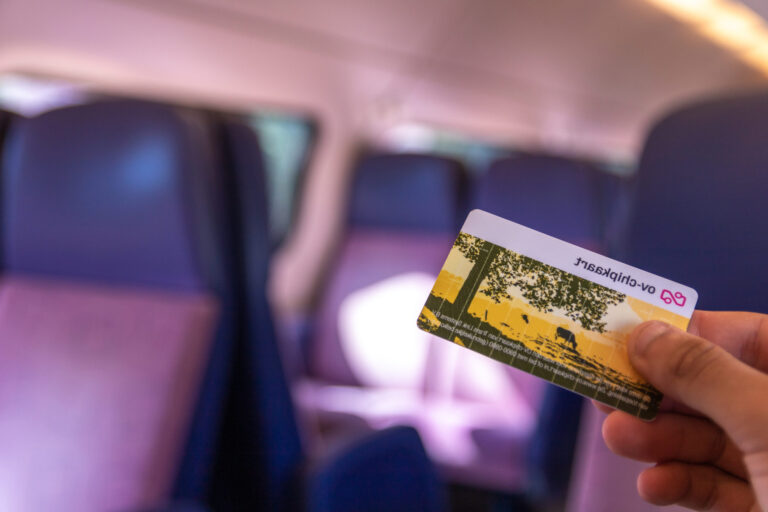
The NS had hoped for some extra funding from the Ministry of Infrastructure and Water Management, but, as the carrier said in a press release, “Unfortunately, the cabinet has not opted for that.”
In a letter to parliament, Outgoing State Secretary Thierry Aartsen says “We’ve done everything we can to limit price increases for travellers. But we also have to be honest: everything is getting more expensive, and financial resources are limited.”
No more fare games
One reason the ministry is moving forward with the increase is to restore stability. “The cabinet does not consider it desirable to have this discussion every year,” Aartsen says in the letter. “Both passengers and NS are entitled to structural clarity.”
But not everyone’s on board. Freek Bos, director of the Rover Passenger Association, calls the hike “unjustifiable” in a press release.
A 53-year-old teacher has been left seriously injured after being stabbed in a fight that broke out during an eighth-grade school musical performance in the South Holland town of Alblasserdam.
The NOS reports that the teacher was likely trying to calm down a fight that broke out between three people when he was stabbed.
According to police, the man from Dordrecht was taken to the hospital with serious injuries.
During an end-of-year musical
The fight broke out at around 8:40 PM last night during an end-of-year school musical performance given by eighth-grade school students.
Witnesses tell Rijnmond that the parents had been arguing for some time before things escalated. However, the exact topic of the argument is not known.
Other witnesses describe the victim as a kind man, saying, “We find it very sad. He was only trying to do what was right.”
Three men have now been arrested. Children and parents who witnessed the stabbing are receiving help from Victim Support.
Turns out, offering dry cheese sandwiches won’t save you from touching down on the list of worst European airlines. Actually, it might just be what lands you there.
According to a comprehensive evaluation by Flightright, KLM is the fifth-worst airline in 2025.
And no, this isn’t simply based on how many people were seen frowning as they stepped off a flight.
How did they measure this?
Flightright carried out its evaluation based on three factors: reliability, payment behaviour, and customer satisfaction.
In order to measure reliability, Flightright looked at airlines’ delay and cancellation figures. Seeing as KLM has recently been battling with its ground staff to prevent strikes, this doesn’t bode well.
When determining payment behaviour, the evaluation looked at how quickly airlines compensated their customers after facing cancellation or delay.
Flightright then surveyed its customers using seven questions to measure customer satisfaction with each airline.
Each of the three factors was scored out of five stars, and the results were used to compile an index of Europe’s 20 worst airlines.
Just how bad was it?
And how did KLM perform? Much like their slightly soggy in-flight snacks: lukewarm.
The airline achieved two stars out of five for reliability, four stars out of five for its payment behaviour, but an average of 2.15 stars for customer satisfaction — landing it with an overall score of 2.72.
Turns out charging high prices doesn’t necessarily mean offering high-quality service. Even an occasional royal pilot can’t save their ratings.
Are you surprised by this rating — or not at all? Let us know your thoughts in the comments below!