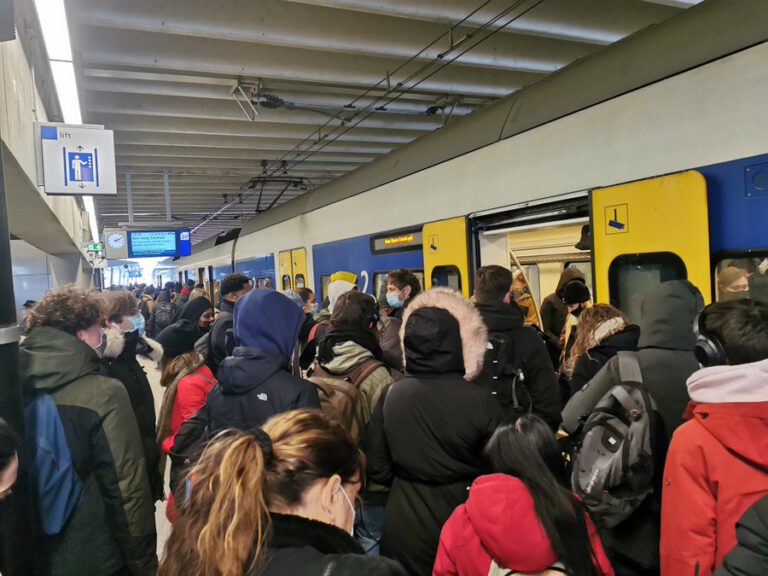
Travellers across the Netherlands have been complaining on social media about overcrowded trains and buses. Some have reported travellers sitting on each others’ laps, or even up to 100 people in a single carriage. Keeping the 1.5 meter distance is nearly impossible.
As the number of complaints continues to mount, the Dutch travellers’ association, Rover, is pressing for action to be taken by public transport companies.
“It has already been busier in the recent days with fewer trains running, but today the crowds are really noticeable,” a spokesperson told RTL Nieuws yesterday.
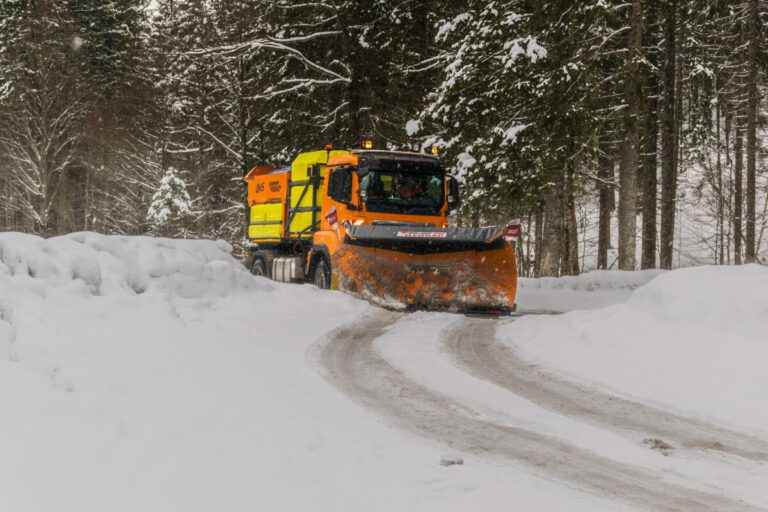
The problem has only increased in the past week, with snow forcing people out of cars and onto trains instead. The number of trains running has also been affected.
Longer trains and replacement buses necessary
Rover is pushing public transport companies to take all the necessary steps to transport passengers safely. They are asking for longer trains and replacement buses to counter the overcrowding.
The public railway company, NS, states that all the trains that can be running are running, and that the longest possible trains are already being used. The company, however, is currently unable to use all the trains in their possession.
“There have been some train switch failures at the depots and not all maintenance companies are easily accessible because of the weather,” a spokesperson explained.
As a result, the NS has issued an urgent plea asking travellers to only use public transport when necessary.
The government has issued repeated requests for everyone to work from home where possible — but we’re not convinced that all those on board are essential workers?
Have you recently experienced this problem yourself? What are your thoughts? Let us know in the comments below!
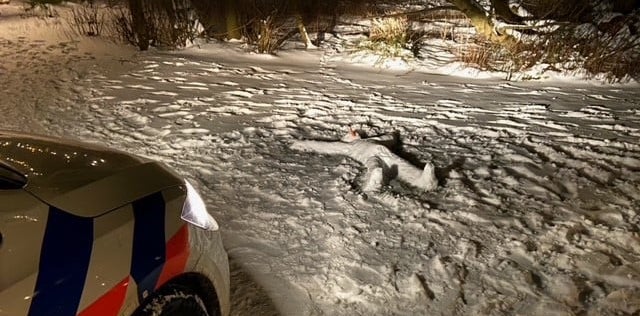
Police in Amsterdam were given a bit of a fright last night. For a moment, they thought they had come across a crime scene as they approached what looked like a lifeless body lying in the snow.
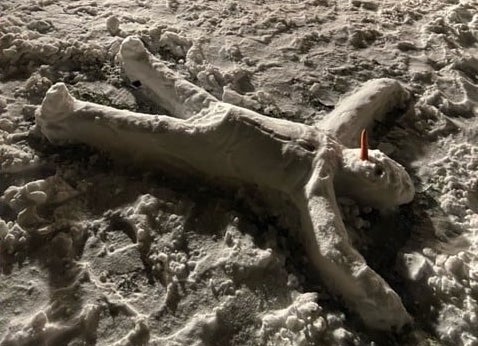
Upon further inspection, they realised it was actually just a creatively made snowman.
The police were amused by the initial mix-up and took to their Facebook page to share the incident — and the offending snowman — with the public.
“Last evening, a car of our team was monitoring the Oosterpark, when they suddenly saw a person lying lifeless on the ground in the distance,” the Politie Amsterdam Oost Watergraafsmeer wrote.
“After our colleagues approached the ‘body’ they saw that the barrier tape or ambulance was fortunately not required… it was a fine example of ‘creative snow'” including the carrot nose!”
Thankfully, the officers could appreciate the humour of the situation as much as anyone else, writing “at least our colleagues could laugh a lot about it.”
Do you find this mix-up as funny as we do? Tell us your thoughts in the comments below!
Dutch books, fiction, literature, whatever you want to call it, there is such thing as a Dutch literary soul. But what can we learn about Dutch identity from the pages written by the people of this little strip of land?
Does Jip or Janneke provide sweet relief when a native is nursing a broken heart? What do the Dutch read for pleasure — thekorting (filled pages of a local supermarket brochure)? They are known for being practical, but is there a catalogue of hopelessly romantic Dutch writers to call upon when necessary?
It came to my attention that, despite a strong love of literature, I know very little about Dutch fiction. Having lived in the UK and Italy — two countries that are aware and incredibly proud of their literary heritages — I am used to literature being present in the very fabric of society. Perhaps it is a mere (and unfortunate) coincidence, but I haven’t felt that reverence here.
I’ve decided it’s time to begin a literary journey to better understand the Netherlands, a journey that I would like to share with you. Moreover, if you are a book aficionado and have already started your own venture into Dutch literature, then your thoughts and suggestions would be greatly appreciated.
“Books are humanity in print”
What can we really learn about the Dutch from works of fiction?
Barbara W. Tuchman once wrote that “books are humanity in print”, and this is a concept that has inspired my current approach to understand Dutch identity. No matter how far-fetched the storyline, human experience is can be found within the pages of Dutch literature.
If you want to indulge your inner nerd, then know that this is debated within academic literary circles through an offshoot of Reflection Theory. It is here that the extent of literature’s influence, or mirroring of any given society, is assessed. For example, Albrecht writes:
“At one time or another literature has been thought to reflect economics, family relationships, climate and landscapes, attitudes, morals, races, social classes, political events, wars, religion, and many other more detailed aspects of environment and social life.’’
Once these reflections have been identified, we can go a step further is to ask: what should we make of these Dutch “National Treasures”? What printed humanity do they hold closest to their hearts, and are most proud of? Better still: what do their choices say about them?
Mind your language
There is, however, an elephant in the room: the Dutch language. Many classics are written in an antiquated version of Dutch. Joost Zwagerman, in an introduction to a collection of translated Dutch short stories, lamented that:
“Many great works of seventeenth-, eighteenth- or nineteenth-century Dutch literature have to be translated into modern Dutch to make them accessible to the average reader, to whom eighteenth-century Dutch — and I do not exaggerate — seems almost like a foreign tongue… consequently, even cultured Dutch readers generally pay mere lip service to their country’s literary canon.”
As for non-Dutch speakers, the situation is changing somewhat through the hard work and dedication of the Dutch Foundation of Literature (Nederlands letterenfonds) who are supported by the Dutch Ministry of Education, Culture and Science.
Together they are promoting Dutch literature through increased availability and quality of translations, and a recent paper suggests that the number of translated Dutch titles is increasing, though translation still remains difficult and very restricted.
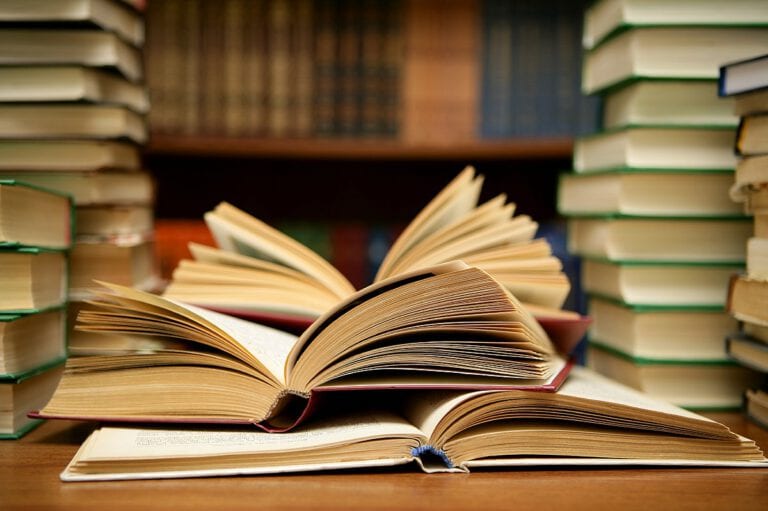
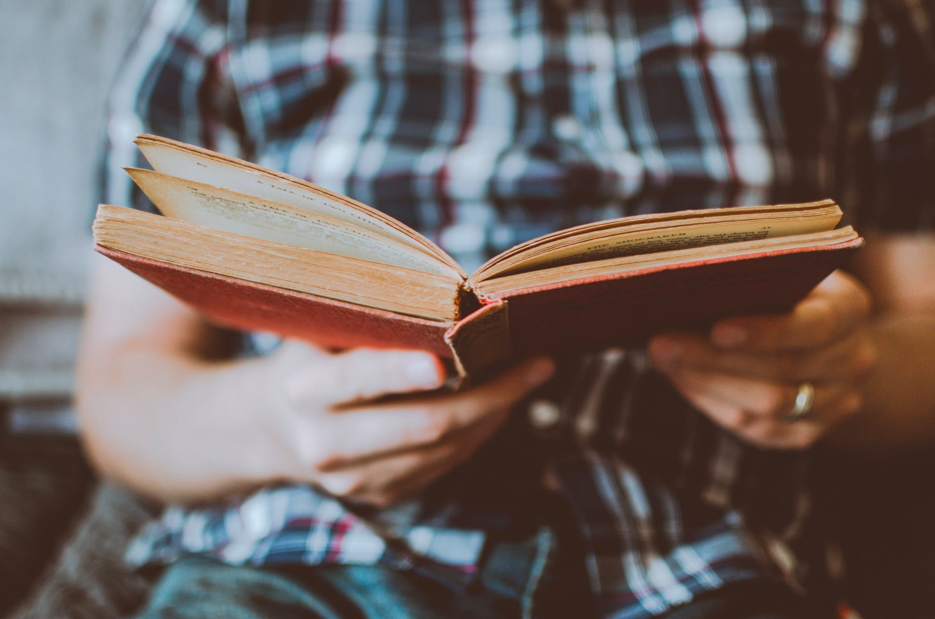
The Dutch literary canon, what is it? Image: Lisa Fotios/Pexels
It is a sad reality that unless you are fluent in Dutch, your access to native literature is restricted and dictated by the decisions of others: most notably those in charge of grants. This runs the risk of reflecting a more commercial rather than a creative incentive.
Though he wrote it in 1899, you can see why Georg Brandes once described translation as a “lamentable necessity” for authors working with smaller languages.
Gender in the Dutch literary world
It seems to be even more of a hurdle, surprise surprise, for female Dutch writers: between 1998 and 2018, only 36% of translated titles were by female authors.
In 2014, just 20% of translated fiction was written by female Dutch writers, rising to 37% in 2018. An increase, yes, but still a huge gender imbalance, and most likely not the only issue of representation.
A call for suggestions
Despite the aforementioned obstacles, my initial research indicates there is a treasure trove of literature that can be found in the Netherlands, such as:
De Grote Drie (Willem Frederik Hermans, Gerard Reve and Harry Mulisch); Jan Wolkers, Hella Haase; A.C. Baantjer are all names to start with, while this year Marieke Lucas Rijneveld became the first Dutch winner of the International Booker Prize with a highly acclaimed (and translated) “The Discomfort of Evening”.
I do hope this article has inspired you to dig a little deeper into Dutch literature and to begin your own journey. If you have already started then please share it. Now if you don’t mind, I’m going to get back to my book.
Have you enjoyed any Dutch Literary treasures lately? Let us know in the comments below!
Feature Image: Abhi Sharma/Wikimedia Commons/CC2.0 Editor’s Note: This article was originally published in October 2020, and was fully updated in February 2021 or your reading pleasure.
Just moved to the Netherlands and need to get the lights on? All the info from regular companies just too much in Dutch? Well, you came to the right spot to arrange all your utilities quickly, neatly and in English (huzzah!)
Partner Pete and DutchReview are happy to team up and help you get through the bureaucratic maze of gas, light, internet and all those other luxuries we call utilities/essentials.
Despite the fact that the Dutch speak great English, that hasn’t quite translated over to setting up utilities, which can be a big problem for expats in the Netherlands. That’s where Partner Pete comes in! Partner Pete is on a mission to hook up expats with all the utilities they need in their new Dutch life in understandable English — and we are so on board.
Let’s get you hooked up!
You can read more about Partner Pete and everything they do right here. Or if you just want some more info on how utilities in the Netherlands work you can get on a call with them and they will tell you everything you want to know — no strings attached! You can plan one of those appointments right here.
But if you just want to power up quickly, then fill in this form, and our friends at Partner Pete will get you hooked up in no time!
The RIVM has released its weekly coronavirus figures for the period of February 3 to February 9. The number of new infections has dropped slightly, but strict restrictions will remain in place.
Despite the number of cases dropping, the Dutch government has announced that curfew will continue until March 2. This is over fear for the new variants of the virus which are far more contagious.
New number of infections
Over the past week, the RIVM reported 24,668 new infections the Netherlands. This is fewer than the previous week’s number of 28,628 new infections.
Deaths
The number of patients who have died from COVID-19-related complications has also fallen slightly. This week 408 people passed away, compared to 418 people the previous week.
Hospitalisations
Hospitalisations are also down, along with the number of admissions to the ICU. The past week saw 1,096 new admissions to the nursing ward and 172 new patients in the ICU. The week before, there were 1,261 and 254, respectively.
In spite of the drop in infection numbers, the Dutch government remains concerned over the new variants of coronavirus, as a result, strict measures remain in place for the Netherlands.
Curfew extended
The Dutch cabinet has made the decision to extend the curfew for two weeks, but has suggested it could be ended before March 2 if the number of infections drops significantly. This was a decision made according to the advice of the Outbreak Management Team.
Vaccinations
Up to and including Sunday, February 7, 327,834 people in the Netherlands have received a first corona vaccination. In total 13,500 healthcare professionals have now received a second vaccination. Last week, the Netherlands also received 191,880 doses of the BioNTech/Pfizer vaccine and 19,200 doses of the Moderna vaccine.
Elfstedentocht may go ahead
The Dutch government is in favour of the Efstedentocht — a long distance ice skating competition — going ahead (weather permitting). The House of Representatives supports the competition taking place, as long as it can be carried out safely.
The government has suggested a number of potential measures that could allow for this. For example, audience members will not be able to attend the event. Along with this, due to issues with social distancing, amateurs will not be able to take part. If the event does go ahead, only professional skaters will be able to participate this year.
The Dutch cabinet will meet with the Eleven City Association before the particulars can be confirmed.
Follow DutchReview on Facebook for the latest news and coronavirus updates.
Did you think you were starting to understand the Dutch weather? Don’t let yourself be fooled. The snow and frost are here to stay. The Netherlands just experienced the coldest night since 2013 — and it’s only going to get colder!
It almost feels like the Dutch weather suffers from schizophrenia. Last week we were basking in the sun, enjoying a rare rainless day. Last night, the temperature in some parts of the country dropped below -15 degrees, reports Weer.nl.
The frost is coming a month later than usual and it is here to stay. January tends to bring more severe frost, but of course, it is 2021. Things are not going as planned.
Bitter temperatures
This morning will be chilly, with temperatures reaching around -6 degrees in the northwest and -12 degrees in the east and the south of the Netherlands.
If you’re hoping for the cold to ease up in the afternoon, you’ll be disappointed. The temperatures will stay around 5 degrees below zero. Luckily, Wednesday promises a lot of sunshine in most regions, so at least we have something to look forward to.
If you’re not a fan of the cold, we have bad news for you. In the coming nights, we can expect to see temperatures between -13 and -20 degrees.
Ice skating on Netherlands’ largest bay?
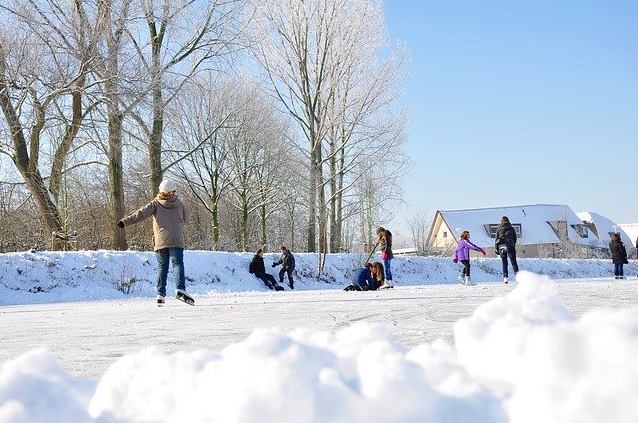
Good news for ice skating lovers — seems like we might be getting that corona proof space for ice skating after all. The IJsselmeer is expected to freeze over completely, shares the Dutch meteorologist Renier van den Berg on Twitter.
De kans op aanhoudende (strenge) vrieskou lijkt me tot en met donderdag 18 februari behoorlijk groot. Daarna (uiteraard) onzeker. Al gaat de zgn controle run (in hogere resolutie) door in diepvriesmodus. Sowieso gaat het IJsselmeer geheel dichtvriezen! pic.twitter.com/srVAn8dPYI
He continues to add: “The chances are that the severe frost will persist until Thursday, February 18. After that, it’s (obviously) uncertain.”
What do you think? Are you already plotting your escape to the Caribbean? Or will you be enjoying this rare sight of frost and snow in the Netherlands? Let us know in the comments below.
It’s probably not the best time to go on that road trip. Dutch Roads and trains are still affected by the icy weather — but those trusty sprinter trains are still functioning!
Frost and snow is still causing trouble for commuters across the Netherlands. Roads have been gritted giving drivers access to most roads with some lane closures. Drivers are advised to be careful on the still icy roads.
Roads are passable
A spokesperson from Rijkswaterstaat says most roads are passable, the advice changing from ‘stay off the roads’ to ‘drive carefully’. The KNMI (Royal Dutch Meteorological Institute) had warned that it would be too cold for road salters to be effective.
However, this is not the case, 900 gritters were working tirelessly last night to keep the roads open. Rijkswaterstraat told NOS that the mix of salt and calcium chloride is effective at temperatures below -12 degrees. Thank god someone paid attention in Chemistry lessons.
Fewer trains running
Sprinters are currently running but NS stops all intercity services. Further delays are to be expected with the temperature dropping over the next week. It is not yet known when intercity trains will restart.
The Dutch Railways and ProRail are watching out for a potential icy build up on the overhead lines. The full extent to which the cold weather will affect railway lines is unknown, probably best to check the NS website for regular updates.
Has the city weather put a stop to any of your plans? Let us know in the comments below!
As the temperature of the Netherlands continues to plummet under a blanket of snow, the decommissioned cabinet has something other than coronavirus to discuss — ice skating. How can skaters remain safe during a pandemic? And what about the Elfstedentocht?
The cabinet will meet with the safety regions and skating unions this week to discuss what to do in the event of skating competitions such as the Elfstedentocht — a classic Dutch long-distance skating event. A majority of the House of Representatives want the Elfstedentocht to go ahead if it is possible to do so safely. In yesterday’s press conference, Rutte offered a few of the cabinet’s current solutions.
Ice skating bubbles
One possibility would be an approach similar to that taken by professional track competitions. In these competitions, the skaters had to live together in one big bubble of 200 people. This way, they could not infect each other with coronavirus.
Of course, this option is not feasible for anyone who wants to take part in skating competitions. For this reason, the cabinet is considering only allowing 120 top skaters to compete. “Perhaps something can be done with top skaters. We are working on it,” Rutte said during the conference.
What about Elfstedentocht?
The Elfstedentocht is a 200-kilometre long Dutch skating tour/competition that is held in the province of Friesland. Participants skate on along frozen canals that run through eleven historical towns of the province.
The Elfstedentocht only occurs when the canals are frozen with at least 15 cm of ice, meaning that they have become less and less frequent over the past few years. In fact, some believe another Elfstedentocht is not possible!
However, with extreme freezing temperatures forecast for the Netherlands this year, the government has to come up with a game plan.
No audience and only top skaters
Due to the pandemic, should the Elfstedentocht actually become possible, only top skaters may be allowed to participate, Rutte has said. “An Elfstedentocht with the public, that’s not possible,” the decommissioned prime minister said. Usually, up to 15,000 amateur skaters would take part — not ideal for social distancing.
Along with many skaters, the event would usually attract a huge audience; again, not ideal for a pandemic. For this reason, in the event of a 2021 Elfstedentocht there will be no audience allowed. “What is not possible is public,” Rutte said.
A long way off
The decommissioned cabinet will meet with the Eleven Cities Association, the association in charge of the Elfstedentocht (yes, that’s a thing) to discuss potential measures further. However, Rutte emphasised that while temperatures are certainly freezing, “an Elfstedentocht is still a long way off.”
How would you feel about a 2021 Elfstedentocht? Tell us your thoughts in the comments below!
The Dutch curfew (avondklok) has been extended until March 2. However, if the number of infections continues to drop the measures may end sooner.
The Dutch cabinet has made the decision after meeting with the Outbreak Management Team this afternoon, according to people familiar with the situation in De Telegraaf.
It means that for the upcoming three weeks, including March 2, residents of the Netherlands will not be allowed to leave the house after 9 PM without a serious reason. The outgoing cabinet will announce the extension of the curfew at the end of this afternoon.
The curfew was introduced on Saturday, January 23, and was supposed to be in effect at least until 4:30 AM next Wednesday.
Prime Minister Mark Rutte already indicated on Friday that extending the measure was an option the government had been seriously considering. The other lockdown measures remain in place.
Are you surprised by the government’s decision? Tell us in the comments below.
While the whole world still holds its breath in the hope that 2021 will see the return to “normal” life, Dutch artist Daan Roosegaarde is lighting the way to an artistic future of sustainable living.
Daan Roosegaarde, founder of Studio Roosegaarde, has been dubbed a futuristic artist who illuminates the relationship between technology and the human environment. While established as the maker of novel, out-of-the-box social designs, the 41-year-old Dutch artist was awarded the Airbnb Design Innovation Medal at the London Design Festival in 2016.
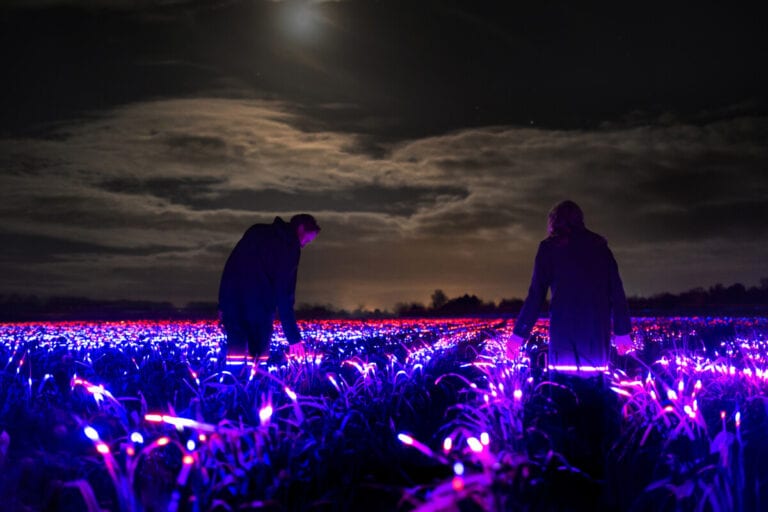
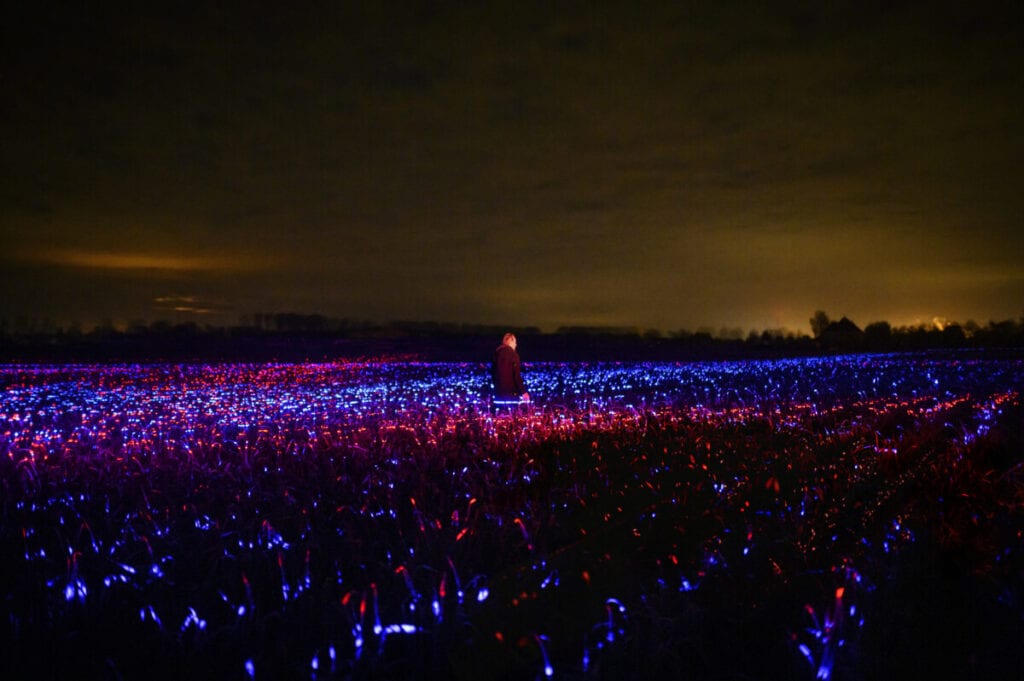
GROW, is the studio’s latest project involving a “light recipe” to help plants grow. Image: Daan Roosegaarde/Press Release.
Roosegaarde has exhibited his works at the Rijksmuseum Amsterdam, Tate Modern and Tokyo National Museum, to name a few, and is now making headlines with his latest agricultural artwork, GROW. Informed by various international and local universities, Roosegaarde and his expert team have been using science-inspired-art for two years to create GROW.
What is GROW?
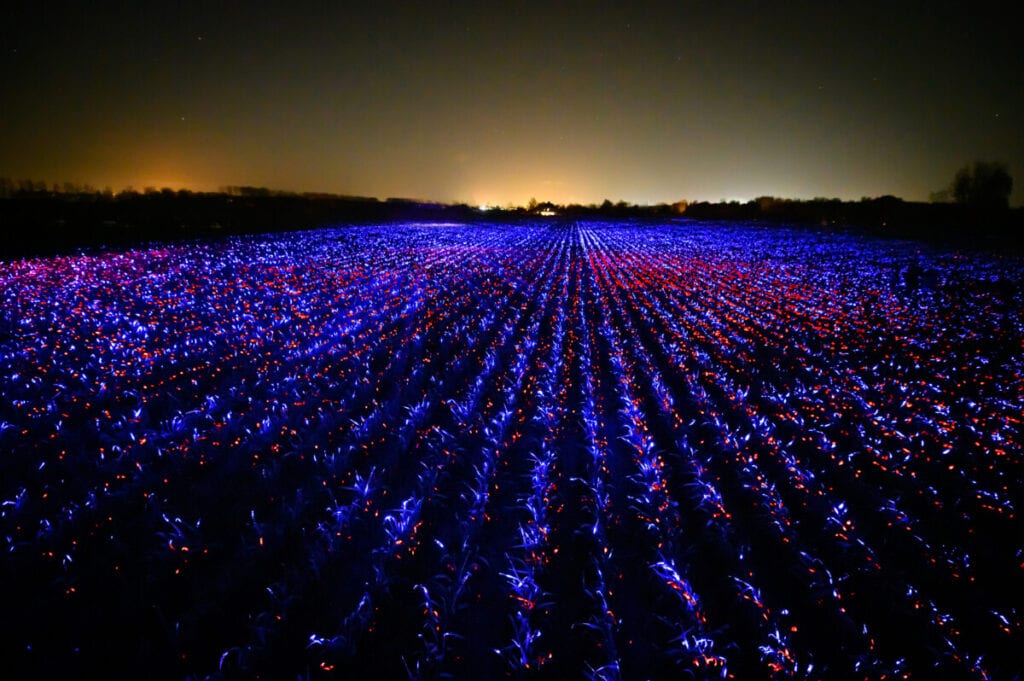
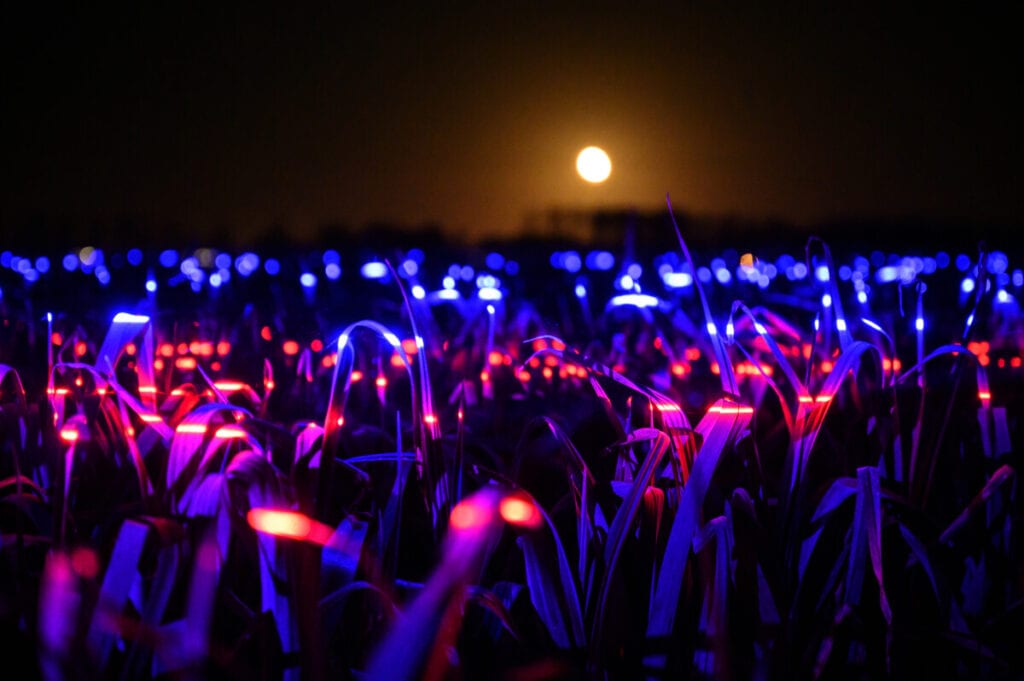
In their wish to make “the farmer the hero”, Studio Roosegaarde combines research on the agricultural benefits of blue, red and ultraviolet light, with the natural environment. This is to make art with a purpose. Consisting of a design-based “light recipe”, this scientific artwork shines vertically across 20,000 meters squared of Dutch farmland.
The project is beautiful but also serves an important purpose. Image: Daan Roosegaarde/Press Release.
While poetic and visually transcendent, GROW utilises the benefits of specific light combinations to help the plants. On the studio’s website, the science and purpose behind this fascinating light project is explained.
The studio writes that GROW is “inspired by photobiology light science technologies which have shown that certain recipes of blue, red, and ultraviolet light can enhance plant growth and reduce the use of pesticides by up to 50%.” This project became world news by incorporating scientific research into what viewers see as a dreamscape of dancing lights in a field.
Found on Studio Roosegaarde’s website, the premier of “GROW the movie” opens with the words “vacant, empty, uninhabited” and spans an empty field — the site of Roosegaarde’s latest invention.
In his wish to emphasise the importance of agriculture, Roosegaarde goes on to explain how light can help crops grow more sustainably while meeting humankind’s pursuit of a more desirable future. The light show looks like a field of glowing stars and truly irradiates the imagination.
GROW: art meets science
Roosegaarde is at the vanguard of brightening the future (literally) during one of the most challenging times the modern world has experienced. While physically lighting up the plant photobiology and scientific community, GROW is also a beacon for the beauty of art and environmentalism.
A “light recipe” helps the plants to grow and reduces the need for pesticides. Image: Daan Roosegaarde/Press Release.
“GROW is the dreamscape which shows the beauty of light and sustainability. Not as a utopia but as a protopia, improving step by step,” Roosegaarde says on the studio’s website.
Roosegaarde’s projects continue to redefine the purpose of art, and he is the beacon of light not only for his home town of Nieuwkoop, but for the urban environmental space as a whole. However, GROW is only the beginning. Studio Roosegaarde writes that GROW is “the first in a series of dreamscapes by Studio Roosegaarde which show the beauty of combining art and science to create a better world.”
It looks like we have something to look forward to! What do you think of this light project? Tell us your thoughts in the comments below!