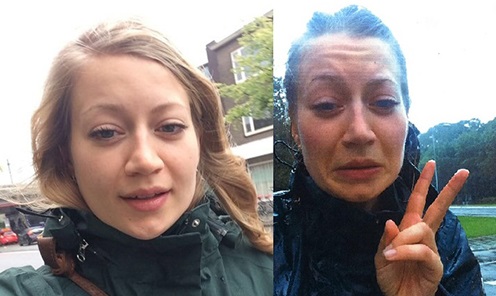
It’s been almost two weeks since Anne Faber was missing, today the case came to an expected but still very sad end. The body of the 25-year-old Anne from Utrecht was found in Zeewolde.
Rutger Jeuken, the deputy chief prosecutor, brought the bad news during a press conference. It is not yet known how Anne, who has been missing for thirteen days, has died. Her body has now been moved from the site and will be transported for research to the Dutch Forensic Institute in The Hague. Then it will be transferred to her family as soon as possible, says Jeuken. The area is reopened after the forensic investigation.
The press conference:
[embedyt] https://www.youtube.com/watch?v=vcZTLfIid0c[/embedyt]
The Anne Faber case earlier today
The police searched for a “specific place” in the vicinity of the Nulderpad for Anne’s body on Thursday because there was a suspicion that her body was hidden there. This was on the instructions of detained suspect Michael P. (27). The judge decided on Thursday that Micheal P. will remain in custody for fourteen days longer since there is enough suspicion against him.
Our thoughts are with Anne’s family
Anne’s uncle states on behalf of the family that “the darkest scenario for them has come true”. “We still have many questions. What happened, why did this man walk around?” – Many in the Netherlands wonder the same.
On behalf of the family he also thanked everybody for all the support and help in the past two weeks. He also requested at the press-conference that media leave the family alone.
Amateur sport will be the next casualty of the government’s measures to tackle coronavirus. Team sports with participants over the age of 18 will no longer be allowed to play.
This measure, among others, will be formally announced tomorrow evening, sources from The Hague told the NOS.
However, the new regulation will only apply to non-professional contact sports. Non-contact sports like tennis will still be possible, and professional sports will continue. There’s no word yet on whether gyms will be affected.
Other expected measures
In tomorrow evening’s press conference, a range of new measures is expected to be announced in an attempt to curb the steep increase of coronavirus cases. Today saw a new record of positive cases in the Netherlands, with over 6,854.
The additional measures could include a rule that people can only travel with public transport if it is strictly necessary. Bars and restaurants may also be subject to further restrictions, but what this could be is currently unclear.
Finally, it is expected that theatres and shops will still be allowed a maximum of 30 people — but current exceptions, such as protests, assemblies, church, or funerals, may no longer be allowed.
The cabinet has met today to discuss the full range of measures that will be announced at tomorrow’s press conference. Minister for Health, Hugo de Jonge, has warned that we must “brace ourselves” for the new measures.
We’ll be covering the full press conference tomorrow from 7 PM. Follow DutchReview on Facebook for news about coronavirus in the Netherlands.
Today the Netherlands has set a new record for daily coronavirus infections, with 6,854 new cases. Rotterdam’s mayor, Ahmed Aboutaleb, is among them. This has been confirmed and reported by the municipality of Rotterdam.
A spokesperson for the mayor says that he’d had complaints since Friday evening and was tested with priority on Sunday, reports AD. Mayor Aboutaleb (59) has only minor complaints and will remain in isolation for seven days. He plans to continue to work from home.
It is not yet clear how the mayor contracted the virus or if he has unknowingly passed it on.
New daily infection record
With nearly 7,000 new daily cases in the Netherlands today, it’s clear that the previous coronavirus restrictions have not had the intended effect.
Update 12 October
6.845 new cases (total: 181.498) 12 new fatalities (total: 6.596) 58 new hospitalisations (total: 13.359) (differences w.r.t. yesterday)
The maps show the cases, hospitalisations and fatalities for the last 3 & 7 days.
A press conference will be held tomorrow night announcing new measures. The objectives are expected to focus on minimising travel and interpersonal contact.
Geert Wilders of the PVV has been at the centre of controversy for years over his views on foreigners in the Netherlands. It seems regarding the pandemic, this is no different.
In a Tweet yesterday, the politician claimed that the treatment of “Henk and Ingrid” are being delayed because the ICU beds are filled with “Mohammed and Fatima, who do not speak our language and do not care about the rules.”
Dus behandelingen en operaties van Henk en Ingrid met kanker, hartfalen of andere ziektes worden weer uitgesteld omdat de IC’s vooral bezet worden door Mohammed en Fatima die onze taal niet spreken en lak hebben aan de regels? Zijn dat de feiten @MinPres Rutte?#corona
The Tweet was in response to a statement made by Armand Girbes, head of the IC department of the Amsterdam VUmc. Girbes believes that the majority of corona patients in the Randstad are of non-Western origins. “If you look at the differences and similarities with the first wave,” he said, “it is striking that we now mainly have patients with a non-Western background, which also means that they do not speak the Dutch language completely.”
“Racist shit”: criticisms of Wilders
PvdA leader Asscher called Wilders’ tweet “racist shit”, saying it was creating divisions in the hospitals. “Every day Henk, Ingrid, Mohammed and Fatima are working hard in our hospitals,” Asscher tweeted in response to Wilders. The CDA was also disappointed by the statements, and wondered how this would go on to affect young people.
Dat je over de rug van mensen die op de intensive care liggen nog verdeeldheid probeert te zaaien. Racistische drek.
Elke dag werken Henk, Ingrid, Mohammed en Fatima zich een slag in de rondte in onze ziekenhuizen. Voor álle patiënten. https://t.co/Euj1DQUWyG
D66 party leader Jetten called for the PVV to find solutions, such as communicating coronavirus information in Arabic and Polish. Wilders replied that he does not intend to do that, saying that those who do not speak Dutch have no business being in the Netherlands.
SP MP Karabulut says that Wilders is only sowing division and fear, whilst bringing no solutions to the the table. “Racism is not a cure for COVID-19. You know that very well.”
Van den Berge of GroenLinks said Wilders is using the unprecedented health crisis to instill division, and asked Wilders if he was suggesting that Dutch people with a migration background are not entitled to medical assistance. “Horrible. My stomach turns. Stomach ache. Every time he crosses a new line.”
Politicizing corona
According to NOS, this is the first time that the origins of corona patients has been explicitly used in the debate on controlling the virus. “This is also polarizing the corona approach and will create more divisions,” NOS reporter Ron Fresen said.
The reporter explains that the relatively large amount of infected migrants has been recognized in politics. While Wilders may use this to push his anti-immigration ideas, other parties are more on board with developing targeted information in multiple languages.
What do you make of all this? Let us know in the comments below.
Today, the cabinet is working on new coronavirus measures, which will be announced at tomorrow night’s press conference. It’s anticipated that the primary objectives will be to limit people’s travel and contact, rather than enter into a new intelligent lockdown.
Over the past month, the number of new coronavirus cases in the Netherlands has been soaring. New policy and measures are needed, and the cabinet has been holding discussions about how to slow the rate of infection. The new package of measures has two primary aims: to further limit people’s contact with one another and to minimise travel, reports RTL Nieuws based on insider information.
Will these measures be effective?
The last new measures announced included a face mask obligation and limited hours for restaurants and bars, but that hasn’t been enough. Yesterday, the RIVM reported 6,378 new coronavirus infections. Compared to other countries, the Netherlands is doing poorly when it comes to preventing the spread of the virus.
Chairman of the Dutch Association for Intensive Care, Diederik Gommers, says a complete lockdown is necessary. “Those measures have not proven to be adequate,” he tells AD. “The intention was to flatten the curve. That has not worked yet.”
Calls for a full lockdown
Gommers is very much in favour of entering a full lockdown as soon as possible. He says tougher measures are needed, otherwise, nothing will change. “As far as I’m concerned, things can be done a little faster in a crisis like this.”
He doesn’t understand why the cabinet hasn’t taken tighter or stricter measures. “Tighter measures definitely have economic consequences, but so does this semi-soft [policy]. Because it is not effective and it now takes longer.”
What would a full lockdown mean?
The partial lockdown the Netherlands saw in the early months of the pandemic meant staying home as much as possible and not attending restaurants or sports clubs. But the full lockdown that Gommers calls for would be more similar to the earlier policies in Spain and Italy — including strict rules for shopping and going to work, and not being on the street without an approved reason.
Tomorrow’s press conference will reveal the government’s plans, but all signs indicate that a lockdown in any form is unlikely.
Do you think a lockdown is necessary for the Netherlands? Let us know in the comments below.
What did you do with your weekend? If it was anything other than drunkenly stealing a bus for a wild joyride on a Greek island, dancing naked, then getting arrested, it was probably more respectful than these guys.
A group of 10 to 13 Dutch tourists decided to take the party to a whole other level last Thursday morning when they stole a bus used for public transport on the island of Poros.
On their surely exhilarating two laps around the island, the group busted out to what we’re sure were some truly bangin’ tunes and decided that clothes were now optional. Dance like nobody’s watching, right?
Unfortunately (for them), someone did end up watching: a security guard who reported the group to the police. Law enforcement stopped the bus, but only managed to catch and arrest the driver. The rest of the group made a slippery escape through the bus windows and door.
The driver has since been released but will head to Dutch court next week, report Greek media. Luckily for the driver, the bus wasn’t damaged. Unluckily for the driver, they, you know, took a stolen bus for a joyride with their closest naked friends.
Wish you were on board with these Dutch partiers? Or pleased as punch that they got caught? Tell us in the comments below!
A 28-year-old train conductor was attacked last night after he asked passengers travelling without face masks and tickets to get off at the next stop.
When asked to disembark, the passengers became confrontational and circled around the conductor. One passenger spat in his face.
Once the train arrived at the next stop, Haarlem Spaarnwoude, the conductor disembarked along with the passengers. Three of the suspects then began to assault him on the platform.
Its is reported that the victim was head-butted, beaten and threatened before the suspects fled the scene. Police were able to arrest the suspects and take them to the station for questioning.
The suspects include three youths from Amsterdam aged 17, 18 and 23, and one 18-year-old suspect from Voorst.
The Netherlands is now among the top three countries in the European Union with the highest number of coronavirus infections relative to size, alongside Spain and France. Other EU countries have been surprised by and critical of the Dutch government’s policies.
In early September, the Netherlands was still comparable to its neighbouring countries in terms of relative infections. The drastic uptick in Dutch infections since then has drawn widespread international attention and scrutiny, reports NOS. French newspaper, Le Monde, calls the mention of face masks in the Netherlands, “the subject of a heated discussion.”
Flemish scrutiny
In regard to the idea that infections would not transfer from young people to the older age group, Flemish virologist Marc van Ranst says, “That was nonsense.” He saw the same misconception in Belguim and says, “The virus passes from young people to their parents and then to their grandparents, we see that happening day after day.”
A Norwegian response
Taking steps based on the number of new infections isn’t the solution. Amrish Baidjoe is a field epidemiologist and microbiologist in Norway, where daily infections are six times lower than in the Netherlands. Baidjoe calls the Dutch approach, “steering in the fog.”
He says the Netherlands needs to look at more than just the numbers. “That is an indicator that is good in itself but has the necessary delay.” He says, “It’s difficult to make a policy on the number of positive cases because in the Netherlands we are running up against the limits of test capacity.” At that point, the cabinet may be too late to intervene. The scientist warns, “We need to see the big picture.”
How do you think the Dutch government has handled coronavirus? Let us know in the comments below.
The rising corona numbers in the Netherlands has lead to an array of travel rules that can be hard to keep up with. Although now is not really the time for that Euro-trip you were planning, for those who need to visit family or take a corona-safe break somewhere, the question is where are the Dutch now welcome?
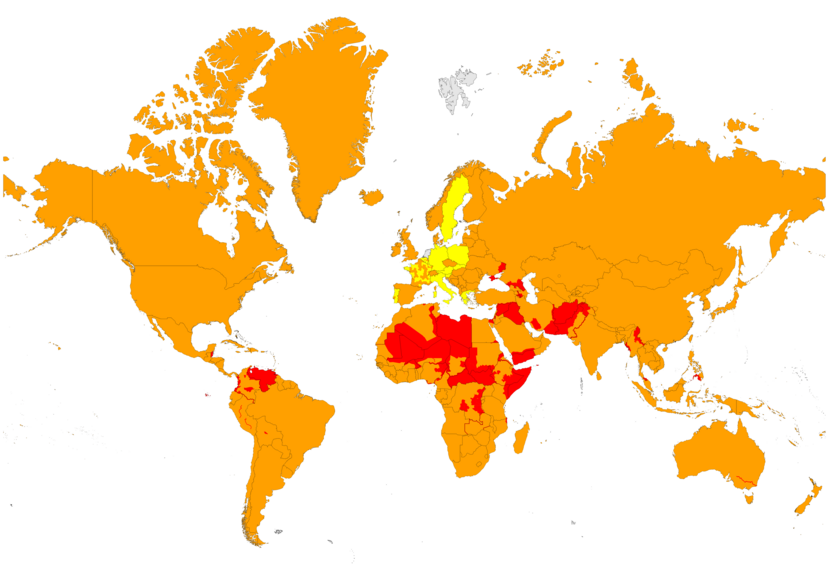
The first step is to check out the Dutch government’s travel advice, so you can see which countries will require you to quarantine when you return.
Yellow means caution, as rules are different to those in the Netherlands so take note of what these rules may be.
Orange means only necessary travel as there are serious risks in this country.
Red means do not travel, as the serious risks in these countries can create life-threatening situations for travelers.
Take note though that the travel advice is not binding, and the way in which you protect your health and the health of others is your responsibility.
European countries keeping the Dutch out
Denmark has tightened its borders against the Dutch, and will now only let you in for a valid reason, such as visiting family. Visiting Hungary is currently not an option at all, as the country is only allowing residents through the borders, reports NOS.
Entry with restrictions
Other countries are allowing the Dutch in so long as they follow certain restrictions. To enter Germany, for example, you must show a recent negative corona test upon arrival. only residents from Zeeland will be allowed to enter without a corona test.
Meanwhile, Belgium has coded parts of the Netherlands (Noord-Holland, Zuid-Holland, Utrecht, Groningen, Gelderland, Flevoland or Noord-Brabant) as red zones, since the numbers in these areas are so high. According to their system, this means that only necessary travel is recommended from these areas. If you arrive in Belgium from one of these areas, you will be tested upon arrival and will be required to quarantine for seven days.
“You have to keep a close eye on the website of Foreign Affairs,” Mirjam Dresmé of the travel industry organization ANVR tells the NOS. “Even if a country is yellow according to the Dutch authorities, you may not be welcome. Especially if you come from one of the regions with a lot of infections.”
List of European countries and their restrictions for travelers from the Netherlands:
Belgium: Travelers must take a corona test upon entry and those from red zones must quarantine for seven days.
Denmark: Entry only with valid reason, including family visit.
Germany: Mandatory 2 weeks of quarantine (residents of Zeeland excluded) unless you have a negative corona test no older than 48 hours.
Hungary: Only residents allowed in.
Italy: Mandatory corona test at the airport, unless you have a negative test result from within 72 hours ago.
Norway: Mandatory quarantine of 10 days.
Poland: No restrictions but you may be checked for symptoms at the border.
Spain: Entry only with a health certificate, and no entry to Madrid unless you have a valid reason.
Switzerland: Must quarantine for 10 days from entry.
United Kingdom: Mandatory quarantine of 14 days. Breaking this rule could result in a fine of about €1,100.
Countries without entry restrictions: Austria, Croatia, France, Greece, Portugal, Sweden.
Last minute sun
For those looking to bump up their vitamin D intake, warmer destinations are becoming increasingly limited. “Where we normally offer 120 destinations, these are now only the Portuguese Algarve and Madeira, the Greek Thessaloniki and Curaçao,” a travel agent from TUI said.
Booking last minute has also become the new norm. The travel agency now sees this happening only about two weeks in advance.
Will any of these travel restrictions affect you? Let us know in the comments below.
Multiple staff members have tested positive for coronavirus at Zuyderland hospital in Geleen and Heerlen, Limburg. So far, 20 staff members have become infected, including three surgeons.
The source of the outbreaks is still unknown but it has lead to the testing of 180 personnel from the hospital’s operating theatre department. Of those who were tested, 20 members of staff were found to have coronavirus.
“[The staff] were all tested by the GGD Zuid-Limburg after the first sickness report. A source and contact investigation was also carried out,” said chairman of the hospital’s board, David Jongen, to 1Limburg. Those who were infected were sent home from work.
Surgeon in ICU
One of the hospital’s surgeons is currently a patient in his own ICU. However, Jongen has emphasised that there is no indication that the virus was spread from staff to patients. Patients also won’t have to worry about significant delays.
“All emergency care continues as usual. Everything that is needed continues. But of course it is extremely annoying for the patients who are waiting for surgery.”
Not as bad as April
He has also pointed out that while there are currently two operating rooms that have had to be closed due to the outbreak, 17 are still functioning.
The hospital has dealt with far worse situations, such as in April, during which only two operating rooms were functional and 17 were closed.
Follow DutchReview on Facebook for the latest news and updates.