Temperatures have definitely dropped in the last few weeks as autumn made her triumphant return. The typical Dutch rain and wind will by no means be leaving completely, but the good news is we’ve got a few dryer, brighter days up ahead.
Weather across the nation is looking pretty dry right up until Sunday, with an incredible 0% chance of rain, according to Buienradar. Today will see a maximum temperature of 13 degrees and a minimum of 8 degrees, so be sure to throw on some extra layers if you decide to go for that autumn stroll through the forest!
The rest of the week will see maximum temperatures of 11 degrees, rising to 13 degrees again on Monday. Winds across the country will die down, so taking your little fluff ball for a walk should be quite pleasant.
Rays of sunshine
Overcast skies will be the norm, but every so often throughout the next few days, we’ll be treated to a few hours of sunlight. By the weekend, we might even see half a day of blue skies and sunshine!
They may not be those warm rays we enjoyed in spring, but we’ll certainly be welcoming them with open arms. So be sure to make the most of the sunshine these next few days.
How will you be enjoying the rays of sunshine these next few days? Let us know in the comments below.
According to the RIVM, 20% of people who tested positive for coronavirus went about their business as usual.
Virologist Aura Timen of the RIVM says, “These positively tested people went to work, for example, or took their children to school.” She told RTL Nieuws this is partly to blame for the rapid spread of the virus in the Netherlands.
Another important factor in the rise in cases is that 70% of people with symptoms of coronavirus are still going outside.
The number of positive tests is also higher than ever. Timen says, “Out of every 100 people, 14 are tested positive.” In early June, the ratio was just one in 100.
Bars and restaurants riskier than schools
The new rules to close down restaurants and bars are not without cause. The hospitality sector is where young people often meet, but Timen explains that extra risks also are present in that setting. “We also see that employees in the catering industry test positive more and more.”
Schools, on the other hand, are safer. According to Timen, the increase in positive infections is less extensive in the school setting than with young people in the older age category.
Are you surprised by these statistics? Tell us your thoughts in the comments below.
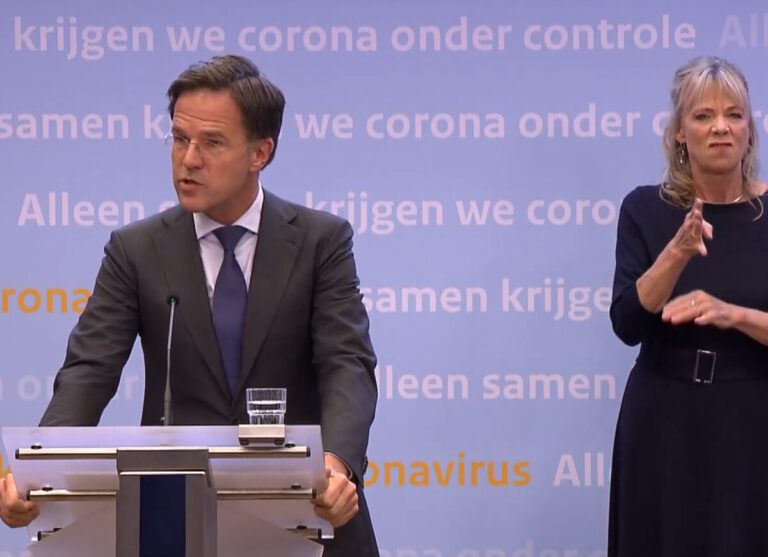
Following the supposed leak of new coronavirus measures in the past 24 hours, Mark Rutte and Hugo De Jonge have once again taken to the podium to formally introduce the latest restrictions. Let’s run through what was announced at the press conference of October 13.
Experts from the Outbreak Management Team (OMT) see the hospitality sector as a prime location for infections to spread, particularly among young people. This has led to much speculation surrounding whether or not the catering industry will face mass restrictions.
A further question was surrounding mouth masks? Will they be obligatory? Tonight, the Prime Minister has announced eight new measures which take a more serious turn.
Rutte’s message for the Netherlands
Rutte spoke of the many stories of corona entering the lives of regular people, and how regular healthcare was being postponed or cancelled because of all the new corona cases. Loneliness, tension, psychological problems and all the challenges for people with a chronic illness; life is harder since corona and that’s why we’re going to a partial lockdown, Rutte stated.
See below for the latest national measures in the Netherlands against coronavirus. These will be set in motion tomorrow, Wednesday, October 14, 2020, at 10 PM. They will be in effect for four (!) weeks but will be evaluated in two weeks (on October 27) Most measures are aimed at limiting all movement and social contacts by people, but Rutte reiterated that these aren’t aimed at the vital educational sector.
Eight new national measures announced in the press conference
All bars, restaurants and coffee shops will now be closed. Takeaway is still allowed and this extends to coffee shops as well. After 8 PM, alcohol and weed will be banned from consumption in public spaces. Hotels can remain open and serve their guests.
The maximum amount of people that are allowed to gather in public spaces remains at 30. Churches and parliaments remain exceptions to this for the moment but Rutte has appealed to these institutions. If meeting with friends there are to be no more than four people. If inviting guests to your house this means you can have a maximum of three guests per day.
Amateur contact sports are no longer allowed. This applies for those above the age of 18. However, professional sports are still allowed so long as there is no audience. Tennis is also still allowed (only singles though) as well as activities such as running, where 1.5 meters distance can be maintained.
All events will be banned. This applies to festivals, concerts and neighbourhood barbeques.
All shops will be closed after 8 PM. There will be special hours for vulnerable people and the government will engage with the retail sector to try and arrange for safe shopping. Where 1.5 meters is not possible and corona measures aren’t followed, shops can be closed.
Working from home is strongly advised. Rutte says fewer people are working from home during the second wave. The government will engage in talks with workers unions to ensure this becomes possible for more people.
It is strongly encouraged that people do not travel abroad. If you do choose to travel within the Netherlands you can only travel with a maximum of four people from different households.
Mouth masks are to be worn by everyone above the age of 13 in public sectors, this includes in schools, MBO’s and University. This will be legally enforced as soon as possible (which can be days, in theory, months in practice).
Rutte closed with a call upon everybody:
“don’t be this cross Dutch person, be a realistic and sober Dutch person who rises when is needed”
Hugo De Jonge’s message
Following up on Rutte’s message was Minister Hugo de Jonge. He had a few other messages. “Don’t be aggressive to those that have to enforce the measures, especially not in these times” and also that the cabinet was very much concerned with the elderly in nursing homes, but that closing them also wasn’t an option.
So what wasn’t said at the press conference?
There was no mention of a roadmap of some kind. All in all, both men wanted to give a stern and serious message to the country. And in some way, it’s also an admittance of the failure of the Dutch government in the past few months.
Furthermore, the Dutch legal system is sometimes more of an obstruction than a help in this fight against coronavirus. Will bars become as exempt as churches? And when will we see an actual law enforcing the wearing of mouth masks? That might take weeks.
This week’s new figures from the RIVM show the grim reality of coronavirus in the Netherlands. A press conference tonight will discuss the new measures intended to slow the spread.
Over the past week, the Netherlands saw its highest increase in new coronavirus infections yet with 43,903 new cases. This marks a dramatic increase of 16,418 from the previous week‘s 27,485 new cases.
The number of daily infections also reached a new record, with 7,378 new positive tests reported in the last 24 hours.
Hospitals admitted 1,144 new patients in the last week, of which 192 are in ICU. This is a sharp leap from the previous week’s 802 hospitalizations and 121 ICU patients.
Coronavirus-related deaths are also on the rise, with 150 new confirmed deaths. Last week’s figures reported 89 deaths.
only using public transport if absolutely necessary;
group gatherings in public places are limited to four people from different households; and,
the current three guests per household rule is being tightened to stipulate three guests per household, per day.
The measures stop just short of an intelligent lockdown, as the Netherlands saw during the early stages of the pandemic. They are expected to take effect tomorrow evening at 6pm and last for two weeks. However, some experts say that a full lockdown is the only way to effectively stop the spread of the virus.
The Volkskrant has published a roadmap containing the cabinet’s plans for managing the coronavirus crisis, though it cannot yet be confirmed as definitive. The roadmap includes the measures to be considered for each risk level, of which there are four: vigilant, worrisome, serious, and very serious. The Netherlands’ risk level is currently assessed as ‘serious’, though quickly approaching ‘very serious’.
Additional developments
First death due to reinfection
In other coronavirus related news this week, an 89-year-old Dutch woman was the first person confirmed by virologists to have died from a second coronavirus infection. There have been only 23 other individuals in the world with confirmed reinfections, each of whom has recovered. The woman suffered from a rare form of cancer and was undergoing chemotherapy.
Dutch vaccine tests halted
Vaccine testing at Janssen labs in Leiden has come to a pause, after a study participant fell ill. Trials will not resume until more is known regarding the cause of the illness.
GGDs phase-out contact tracing
Due to the drastic rise in coronavirus infections in the Netherlands, GGDs have decided to phase out contact and source tracing. They announced today that they no longer have the capacity to call all those infected with the virus. Instead, call centres are beginning to take over the responsibility.
Allow me to tell the tale of how I managed to move from a 130 acre rural property in Australia to live in a spatially challenged 30 square meter apartment in Amsterdam.
Coming from a small town of about 3000 people (plus 2000 cows) and growing up in a quintessential country farmhouse on 130 acres, I’m used to wide open spaces, no neighbours, and stairs so steep that you’d rather use a stairlift than have to scramble up yourself.
that don’t require sucking in your stomach and shuffling sideways to get up them.
That is why — as you can probably imagine — adapting to life in a tiny apartment in Amsterdam (home to some of the tiniest apartments out there) was always going to take me a little bit of time to get used to.
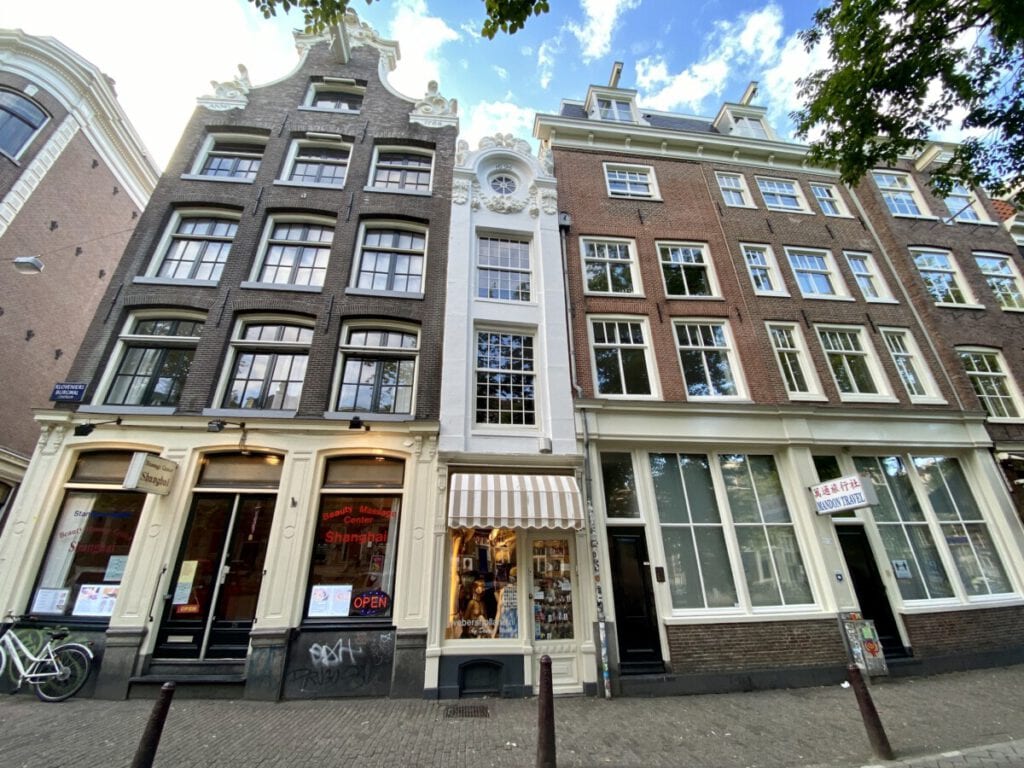
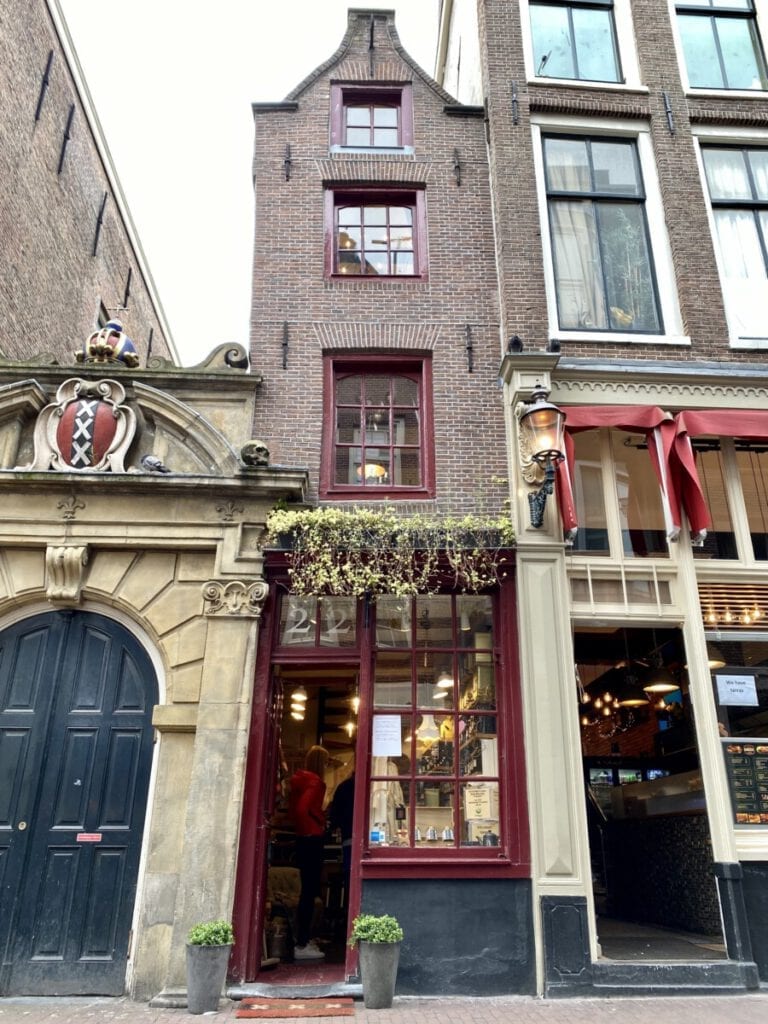
You can find unimaginably narrow houses in Amsterdam. Image: Brin Andrews/supplied.
I’m a positive bloke and I try to take things in my stride, but my girlfriend didn’t mention the fact I was going to have to play Tetris with my surfboards when I moved into her tiny Amsterdam apartment.
Looking down from the plane window at the carpet of lights below I knew it was going to be a bit of a squeeze, and a quick flick through the in-flight magazine confirmed my apprehension. “The Netherlands has a population density of 500 people per square kilometre”. Maybe I should’ve done my research before jumping on the next flight to Amsterdam. Especially considering Australia is about 3 people per square kilometre.
Where’s the rest of it?
To be honest, “barely enough room to swing a cat” was the first thought that went through my head. Just to clarify, for those that haven’t heard this phrase, it’s not to be taken literally. I don’t enter every apartment I intend to rent with a cat in hand that I proceed to swing in a counterclockwise motion by the tail so as to gauge whether the room is an adequate size.
All I’m saying is that when I entered my girlfriends tiny Amsterdam apartment for the first time, I did wonder if I was part of some kind of cruel “prank the newcomer” initiation conspiracy — like there was actually a hidden door behind the bookcase where the other three rooms were located. How naively optimistic of me right?
You make it work. Image: Brin Andrews/Supplied.
Making the most of the situation
But on the other hand, cleaning — the bane of my existence — is now a quick and pain free endeavour. Back home doing a once-a-month (ok, maybe once-a-year) clean of the house meant preparing for battle with spiders that essentially owned parts of your room. Yes Mr. Spider you can have my bed, I’ll sleep in the corner.
It also involved the whole Campbell clan (all six of us) and usually took two whole days, or to be more specific, my whole weekend. Now, a 10 minute whip around the apartment is all it takes to have everything looking spotless.
Many of us came to the Netherlands for love. Image: Ketut Subiyanto/Pexels.
Another blessing that comes with moving into a pint-sized apartment with your significant other is the fact that arguments (or “robust” discussions as my Dad calls ‘em) are now resolved pretty bloody quickly. There’s no chance of having a disagreement followed by (my) retreat back to a bunker of broody solitude. When you practically live in each other’s pocket, you need to identify the problem and hash it out like the semi-civilised adults.
I’ve now also turned into some kind of prodigal MacGyver when trying to utilise furniture for multiple purposes. What some may see as a bland looking office desk, through my eyes becomes a place to do puzzles, a home entertainment platform and dining room table all rolled into one. Eat your heart out Ikea.
Looking back on it all, if you’d asked me a year ago if I could survive in a tiny Amsterdam apartment I’d most likely answer, “Could Bigfoot live in a shoebox?”
Turns out… he can.
How do you find living in Dutch apartments? Are you a bit cramped too? Let us know in the comments below!
Feature Image: Skeeze/Pixabay.
Editor’s Note: This article was originally published in February 2016, and was fully updated in October 2020 for your reading pleasure.
For the first time, a patient twice-infected with COVID-19 has died from coronavirus-related complications. The 89-year Dutch woman suffered from Waldenstrom’s, a rare form of bone marrow cancer, and was undergoing immunocompromising treatments, according to NU.nl.
The woman was first infected with COVID-19 earlier this year and was hospitalised for five days with a fever and persistent cough. She recovered but reported being more tired than usual.
Just two month later, the woman was infected for a second time during a round of chemotherapy. She once again developed a fever and breathing troubles and tested positive for coronavirus. Tests confirmed she had no antibodies to the virus.
Her condition quickly worsened, and two weeks later, the woman passed away.
Results of the research
Virologists have found that the virus had a different genetic makeup in each of the woman’s infections. This proves that the virus did not remain in the woman’s body, but that she did, in fact, become infected a second time.
Recontamination of the virus is extremely rare, with only 23 confirmed cases in the world. However, it’s important to note that studies of these types of reinfections present limitations to researchers, as they must be able to compare quality samples of both infections.
What is especially noteworthy about this woman’s case is that in all the other 22 instances, the patient has recovered from the second infection.
Are you surprised by this new finding? Let us know in the comments below.
Learning the Dutch language can be a challenge and like all languages, it has its own very special quirks. But what is it that makes this language so damn tricky to get your head around?! As an English speaker myself, the Dutch language and its close relation to English and German, should be a walk in the park. Yet, like many Dutch learners you often find yourself lost, tongue-tied, and little frustrated trying to master the oh so gezellig language.
So what is all the fuss about? Here are some of the struggle-city highlights that you may run into whilst trying to pick up the language of the lowlands.
a b c d e f gggggg (what?!)
Let’s kick off with the alfabet! So far so good — the word itself is basically the same as it is in English. So if you’re familiar with the English language, step one should be in the bag!
But step two — moving onto the actual letters — this is where the fun starts. The alfabet itself uses the Latin alphabet, so visually it isn’t too difficult. But there are a few surprises. For one, the Dutch ‘e’ actually sounds like an English ‘a’, and the English ‘i’ is actually the sound for the Dutch ’e’. But it isn’t just the vowels that throw up some challenges. If you spot a ‘d’ at the end of a word, you better remember to actually make the sound of ‘t’! Got it so far?
Great, because now we move onto the sound of the glorious ‘g’ and the harsh ‘sch’. This is the mountain that every non-Dutch speaker must climb. It is the milestone we all lose our voices attaining. It is the ‘G’ in Groningen and the ‘Sch’ in Scheveningen! I personally spent four weeks going to a Dutch class for three hours per week (glass of water by my side) croaking out Groningen and Scheveningen. All the while, feeling like my throat was recovering from a brutal cough before my mouth started to cooperate! Here, persistence is key and believe me, you will get it and you’ll be so proud when you do!
Fun fact: During World War II, suspected German spies were asked to say ‘Scheveningen’. If they fumbled it was an immediate sign that they were not Dutch!
Struggles of learning Dutch: I’m sorry, what did you say?!
Accents, they pop up in every language. Take English — you think you have mastered it and then you find yourself in Glasgow, Sydney, or Liverpool chatting from someone from Boston, Cardiff, or Alabama. Suddenly, the words you know get churned into a confusing sing-song and you now struggle to understand! Well, the same goes for Dutch. In fact, there are not only different accents but also a number of dialects that stray from the standard Dutch. In the Netherlands we have Gronings in the north, Limburgs in the south and a whole other language called Frisian scattered across the northwest of the country!
One of the noticeable differences is the hard ‘g’ sound. As you travel to the south of the country you will notice that the guttural ‘g’ is not as hard and throaty as in the northerly and Randstad areas of the Netherlands. So if you’re struggling to master the linguistic test that is the guttural ‘g’, then perhaps think about settling in the mountains of Maastricht (that’s right, the Netherlands isn’t all flat!).
And watch out for some phrases that mean completely different things when spoken in the different dialects… One such phrase is, “ik ben net aangereden,” which generally means, “I have been run over (by a car),” in standard Dutch. But take a trip to Maastricht and you’ll find people saying it all day long! Now, this isn’t because Maastricht has a high rate of car accidents. Rather, in Limburgs, the same phrase simply means “I’m on my way!”
Going Dutch…or trying to at least!
Much like embarking on a new fitness journey, when learning a new language you find yourself googling, reading blogs, and of course, Pinterest to find the secrets to quick success. The apps that promise fluency in three months are shiny and attractive. You play the games for a few weeks but somehow your speaking and listening ability hasn’t quite matched your ability to finish the Duolingo crossword in record time!
One tip that comes up time and time again is to immerse yourself in the language. Watch TV in your target language, read books in said language, and tune into the local radio. Now when learning Dutch, the radio is a great step. But when looking for some ‘relaxed immersion’ like watching a Dutch movie or TV series, you might find yourself stalling. This is because many of the programmes screened in the Netherlands are actually in English with Dutch subtitles.
No doubt this element of Dutch culture is one of the many reasons the Dutchies are so well versed in English. But it also means that you have to search for your evening Dutch homework a little. Often it’s easy to settle for an English movie or series, because, well they are there! But try, search, and tune into Goede Tijden, Slechte Tijden rather than The Bold and the Beautiful. You’ll start making leaps instead of shuffles towards your Dutch goals!
But if a full program is a bit out of your depth, start with some simple words that will really help you get by…
Still not enough to overcome the struggles of learning Dutch? Here are another 7 words 😉
Any more struggles of learning Dutch? We would love to hear! Share them with us!
Feature Image: DutchReview/Supplied
Editor’s note: This article was originally published in June 2017 and was fully updated in October 2020 for your reading pleasure.
As new coronavirus cases continue to climb towards 7000 per day, GGDs can no longer call with everyone who has tested positive. Instead calls to tell a person that they have tested positive are beginning to be made by call centres.
Sonja Kloppenburg, a spokesperson for the GGD has told the Volkskrant that it is with “a pain in our hearts” that the GGD admits it can no longer call with all infected people.
As coronavirus numbers shot up throughout the Netherlands last week, GGDs decided to phase out source and contact tracing due to a lack of employees.
The organisation currently has the capacity to carry out 1,500 source and contact tracing calls per day, but with daily figures well above 6,000 this is becoming an impossible task.
Kloppenburg explains that “there is no upper limit above which the GGDs no longer conduct source and contact investigations. But it ends somewhere at such numbers.”
Instead, a “risk-based” approach has been adopted and even this is at risk. Through this approach GGD employees will call all infected persons and ask them about who they believe they should call themselves.
During the call it is determined whether or not the person is articulate enough to call their close contacts themselves, and if not, the employee will do it for them.
Unable to even call anymore
However, as the number of coronavirus cases continues to rise, GGDs fear that even this service will no longer be possible.
The GGDs wish to continue the service, but they are under so much pressure now that when a call can be made, it is usually a few days after the person has tested positive.
Usually those who test positive are always called by GGD employees to be given their result but the organisation has already started to pass the job on to call centres.
“We would prefer to continue to have that conversation with all infected persons”, says Kloppenburg, but it seems the numbers are simply too high.
Follow DutchReview on Facebook for the latest news and updates.
Johnson & Johnson have been testing their experimental coronavirus vaccine in the Netherlands for the past month. But their operations at Janssen, based in Leiden, have been temporarily paused.
The American pharmaceutical company announced the decision to pause vaccine testing after a test subject became unexpectedly ill. A private company is investigating the illness of the participant and until more information is known, dosing of candidates in all of Johnson & Johnson’s clinical trials will stop.
The participant’s illness during the vaccine study is classed as an unexpected serious adverse event (SAE), which may or may not be related to the vaccine. The company explained that SAEs are to be expected during any clinical study, but it must now be fully determined whether the illness has anything to do with the vaccine before trials and developments can continue.
Race for a vaccine
Johnson & Johnson’s vaccine was not the leader in the race for a coronavirus vaccine. Four other pharmaceutical companies are already in stage three of development, which entails testing the vaccine on larger groups of people. These include potential vaccines from the University of Oxford, BioNTech and Moderna.
Many companies in the US are pushing to have a vaccine ready for distribution by the end of the year, or early next year at the latest. Achieving this, says Biopharmadive, would be unprecedented in the medical field. No vaccine would have ever been developed that quickly, let alone distributed to the public.
Worldwide, there are currently over 100 COVID-19 vaccine candidates being developed, according to the WHO. As the second wave rises, only time will tell when a successful COVID-19 vaccine will become a reality.
Would you take a coronavirus trial vaccine? Share your thoughts in the comments below.
New coronavirus measures will be announced during a press conference tonight. Insider information suggests that the cabinet is discussing whether to once again completely close the restaurant and bar industry, according to NOS.
They also claim that the sale of alcohol will likely be prohibited in the evening, past 8 PM, and that the restrictions will apply for two weeks.
The cabinet discussed serious measures at the Security Council meeting on Monday night. Experts from the Outbreak Management Team (OMT) see the hospitality sector as a prime location for infections to spread, particularly among young people.
Three guests
Further restrictions may include limited group size to four people, both in and outside the house. The current limit of three guests in the house will also be tightened to three guests per household, per day. This means if a household has three guests in the morning, they may not have any more separate guests for the rest of the day.
Additional measures
Furthermore, it is suggested that the cabinet wishes to limit travel by only allowing use of public transport if it is absolutely necessary. And yesterday, news that recreational sports teams may be cancelled was leaked as well.
The intention is to limit the amount of contact between people as much as possible, as the number of infections in the Netherlands has skyrocketed over the past month.
So far, the information regarding upcoming restrictions is not officially confirmed. Check back later this evening for the reported outcome of the 7 PM press conference.
Do you think these measures will be necessary to combat coronavirus in the Netherlands? Let us know your thoughts in the comments below.