Home Blog Page 615

Breast milk ice cubes could give coronavirus antibodies, Dutch researchers say

Researchers at Emma’s Kinderziekenhuis have found antibodies against coronavirus in the breast milk of women who previously been infected. This has led to research described as ‘hopeful’. 

It follows results from Amsterdam UMC, where analysis of the breast milk of former corona patients found that antibodies were present.

The study began with a question to researchers from a mother who donated breast milk. Director of the hospital Hans van Goudoever has explained on talk show Jinek “On April 1 we received an e-mail from a mother who donates milk to us for incubator children. She asked: ‘couldn’t there be any antibodies in this?'”

The question triggered a study of 40 women, who had previously been infected by the coronavirus, donating their breast milk. Antibodies that were strong enough to neutralise the virus were found and even remained once the milk had been pasteurised.

Scientists have emphasised that this success has been limited to a lab environment and they are still not sure if it will work on humans. However, they claim the results are looking hopeful.

How could frozen breast milk work against corona?

Van Goudoever has also roughly explained the process through which the milk works. ‘What we have seen is that the antibodies from the milk bind to the virus and it can no longer enter the cell. That is important because when the virus enters a cell, it multiplies. But it won’t get that far, that’s the startling thing.’

The effectiveness of the milk will therefore also depend on how quickly patients can receive it, the earlier the better.

Why ice cubes (and not fresh)?

Given that the coronavirus enters mostly through the mouth and nose, the most beneficial approach will be to suck on ice cubes of breast milk, says Van Goudoever. In this way, the antibodies remain in contact with the virus found in the throat for longer.

Volunteers needed

In order to really establish whether or not breast milk will be effective the study requires more volunteers.

Physician researcher Britt van Keulen has explained on Jinek that “it makes a lot of difference whether only one percent of women have antibodies or 10 or 20 percent. If we want to use this as medicine, we need a lot of breast milk.” Scientists are therefore looking for mothers who may have had the virus to donate their breast milk for research.

Mothers, they truly are life-savers. Tell us what you think of this research in the comments below!

Feature Image: DutchReview/Canva

Bol.com bans Zwarte Piet in favour of ‘Piet’, changes references to skin colour

1

The popular online retailer bol.com has announced that starting late September, they will no longer be selling products containing the stereotypical image of Zwarte Piet. 

“Feeling welcome does not go hand in hand with a product range that incites discrimination/hatred and is therefore experienced as hurtful,” the retailer said in a statement. The company has developed its new policy according to feedback from customers, partners, and external experts.

Books containing historical reference to the character will still be sold, in alignment with bol.com’s beliefs about freedom of speech. However, there may be cases where they make an exception for books that incite discrimination.

The company’s new policy reflects changes in terminology as well. In product titles and descriptions, ‘Zwarte Piet’ will be changed to ‘Piet’. When referring to skin tones, where they would previously write ‘white’ they will now use ‘beige.’

The news follows last week’s announcement by Facebook and Instagram that they will be banning photos in support of Zwarte Piet from their platform.

You can follow DutchReview on Facebook for more Dutch news updates. 

Feature Image: Aloxe/Wikimedia Commons/CC3.0

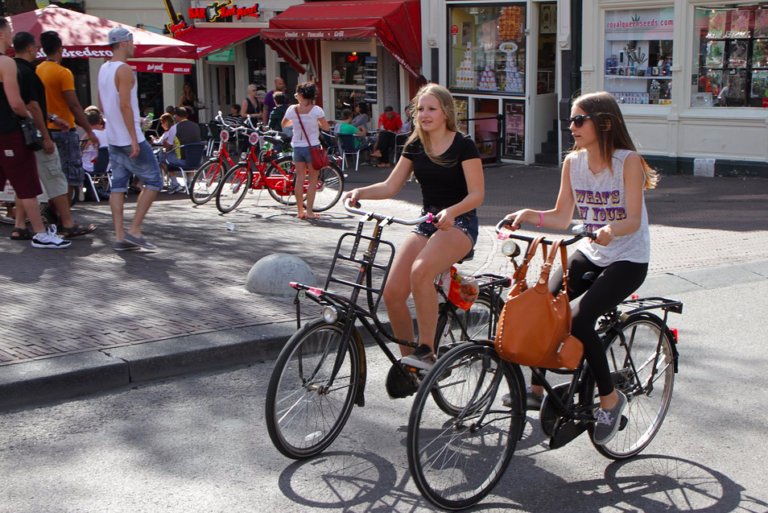
Most Dutch cycle paths are too narrow and too busy, new report shows

0

According to research by Bouwend Nederland (BNL), cycle paths in the Netherlands are often too narrow and too busy.

In Zeeland, the problem is particularly apparent. There, BNL reports that 90% of the busy cycle paths are too narrow: that’s 154km out of a total of 171km in the province. But it’s a problem all over the Netherlands. BNL says that 81% of the busy cycle paths used by schoolchildren in the Netherlands are not wide enough to sustain the traffic that passes through them.

That’s particularly concerning as high school students prepare to return to school during a pandemic, a time in which cycling is encouraged over public transport use. A further problem is the relatively high proportion of cycling paths that are unpaved or have unfinished surfaces: BNL reports that 18% of the busy paths school-goers take fall into this category.

Rectifying this situation will not be cheap: BNL says that depending on the type of solution municipalities choose, the costs will be between €413 million and €2.2 billion. Their report calls for an additional annual budget of €1 billion euros for municipal infrastructure.

“In order to maintain the quality of our municipal infrastructure, such as bicycle routes, and thus the safety of the users, substantial investments must be made,” says Maxime Verhagen, chairman of Bouwend Nederland. “We all want to cycle. That is healthy, good for the environment and helps moderate the pressure on other means of transport. Then we must also be prepared to keep our cycling network in top condition.”

Do you find Dutch cycle paths to be too narrow? Or is this a sneaky scheme by Bouwend Nederland to get some new infrastructure contracts? Let us know your theory in the comments below.

Feature Image: 1681551/Pixabay

National heatwave ends with lower temperatures on the way

The Netherlands can expect lower temperatures within the next few days as the 13 day heatwave comes to an end. 

It looks like the Netherlands has reached the end of its record-breaking heatwave as temperatures have dropped below 25 degrees in certain parts of the country. If you haven’t made it to the beach or lake yet, it’s time to drop all your priorities and run because it looks like Dutch summer is about to end.

Today and Thursday

You have 48 hours. The warm weather will continue for today and tomorrow with daily temperatures reaching the high twenties today, and even reaching into the 30’s tomorrow.

However, cloud cover and rain showers are to be expected this evening and will continue into the night. Thursday will be mostly warm and sunny with a slight chance of showers.

Last chance on Friday

According to Weerplaza, a temperature drop will be expected at the end of this week. The beginning of this drop will be felt on Friday as the day is expected to begin with localised thunderstorms.

For those of us who don’t mind a bit of rain and the occasional thunderclap, Friday may be the perfect day for a summer outing (aka perfect weather for those of us whose complexions will never know the glow of a tan, only the shame of a bright pink face.) It is expected to be overcast but warm with temperatures reaching around 25 degrees.

However, a change in temperature will be felt in the evening as cool wind and rain is expected to creep up from the south.

Increase in wind on Saturday

Saturday will probably be the day that reminds us that we are not, in fact, living in the costa del Hollanda.

Indeed, you may need to hold onto your umbrellas, as coastal and northern areas will experience scattered showers and much stronger winds. This will help bring the temperatures down to the low 20’s (great for those of us who reside in attics).

Inland areas may be slightly warmer, reaching 25 degrees.

Lower temperatures on Sunday and Monday

We’ll be sick of the Sunday weather before it even starts. High winds will continue and bring with them the classic Dutch weather.

Temperatures will drop to around 20 degrees and rain showers are to be expected. Similar weather will also be seen on Monday and the day after, and the day after, and the day after.

Forecasts suggest that next week will be much cooler than the previous week’s. Temperatures are expected to stay in the low 20’s with occasional showers.

It may be disheartening to know the summer is probably over, but let’s not forget how great it can be that Dutch weather is kind of crappy.

We hope you made the best of the heatwave! Let us know how you feel about the cooler weather in the comments below. 

Feature Image: Josh Sorenson/Pexels

No increase in wages for healthcare workers, government says

0

Wages in the Netherlands’ healthcare sector won’t be seeing an increase, according to a new letter from members of the Tweede Kamer (the House of Representatives). They have expressed great appreciation for the hard work of healthcare employees, but hold that current wages are up to standard.

Ministers De Jonge and Van Ark and State Secretary Blockhuis addressed the motion for a structural wage increase for healthcare workers in a letter on Tuesday. They are grateful for the “enormous and indispensable effort of healthcare professionals in this corona period.” The Tweede Kamer is committed to ensuring sufficient and well-qualified personnel in the healthcare sector.

Wages already sufficient

While there is no question healthcare professional should receive a good salary, the representatives argue that wages have grown in step with the market sector. Based on their analysis of data and collective labour agreements, they have determined that the starting salaries of caretakers and nurses are on par with professionals in sectors such as education and law enforcement. Over time, they see that wages in healthcare increase more steadily than in education or government.

In the same analysis, the Netherlands is near the top of the international scale of relative salaries.

Financial and economic hardship

The Tweede Kamer maintains that given recent corona related developments and uncertainties in the economy, “the cabinet currently sees no room for a structural wage increase for all healthcare employees in addition to the extra space that is already being given.” 

The government wants to focus its efforts on limiting the economic damage that has resulted from COVID-19, which will consume a large part of the budget. The development of the economy is ultimately dependent on the course of coronavirus.

Ongoing debate

The letter follows last week’s heated healthcare remuneration debate, during which opposition members were accused of ‘running away’ from the vote. The Tweede Kamer’s debate will continue this afternoon with another motion to vote on increasing pay.

You can follow DutchReview on Facebook for more Dutch news updates. 

Feature Image: Image: Sasin Tipchai/Pixabay

Amsterdam introduces stricter rules for catering industry and for gatherings

0

Due to the high number of infections in Amsterdam, the city has decided to introduce some new measures.

Mayor Halsema has said that in the short term, the amount of supervision of the catering industry and conference centres will increase. More priority will also be given to nuisance reports. People are advised to avoid busy areas.

A letter to the security council about the coronavirus situation in Amsterdam, written by Mayor Halsema, suggested that a potential future measure for the capital would be to urgently advise day trippers and tourists not to come. Visitors to the capital should only be there if absolutely necessary.

Yesterday a spokesman for the municipality caused confusion when he confirmed to NOS that this advice was already in force. It is not: in fact, Halsema says she would prefer it not to be, as it would have a massive impact on the tourism sector. “We are not making that call now, we are keeping that option up front,” she said. Further measures, such a closing the catering industry at midnight, are also on the table if the number of infections doesn’t drop.

Cracking down (lightly)

There will be an obligation to report gatherings of more than one hundred people in the city. To reduce the number of unauthorised parties, the use of sound amplification equipment in the surrounding areas of the city will be banned.

Catering business owners will now receive only one warning instead of two if they violate the coronavirus measures. If their violations are excessive, they can be closed immediately for a maximum of four weeks.

Halsema says the capital is not in crisis yet, but that there are “serious concerns”. Between August 10 and 17, 734 people tested positive for coronavirus in the capital. Most infections are taking place in the private sphere, which is why Rutte announced a six-person cap on the number of visitors you can have to your home at one time last night.

Are these measures enough, or do we need to see stricter rules in place? Let us know in the comments below.

Feature Image: Dimitri Houtteman/Pixabay

Press conference: visitors at home capped, Rutte warns further lockdown possible

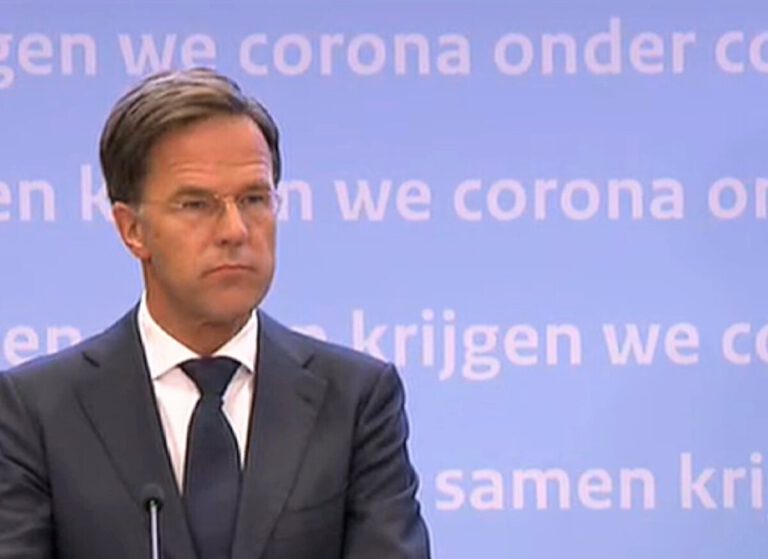
Dutch Prime Minister Mark Rutte and Health Minister Huge de Jonge have again fronted the press about coronavirus. They’ve announced new measures, including a cap on the number of visitors in a home. 

“It’s not going to make your Friday evening dinner nicer but it has to happen,” said the Prime Minister about the new measures. From now on, you may only have six guests in a room (not including children under the age of 12). You also have to confirm your guests are healthy and make sure everyone can keep 1.5 metres distance.

“It’s not a request, it’s a requirement,” said Rutte. The measures come as De Jonge confirmed that the majority of infections occur at home, parties, work, family gatherings, or with friends. “We know that because of contact tracing.”

Rutte confirmed this. “Everywhere people trust each other enough to cuddle, shake hands, that’s where we see the most infections. It might feel safe, but it is not.”

However, it’s important to note that it’s all ‘urgent advice’ and not a new law. Rather, it falls under the Dutch trend of the government hoping that people will think and act in good faith. NOS analysis said that it is unlikely that police will be breaking up larger parties, except in the case of a noise complaint.

Additionally, Amsterdam is also planning further measures to reduce the spread of infection — however, there’s no word on what these will be yet. But during the press conference, the news broke that the famed department store De Bijenkorf is being closed after an outbreak of coronavirus among its staff.

A stern warning from Rutte

Rutte began the conference reiterating that despite the last conference two weeks ago when they warned people to take the virus seriously, the number of infections and hospitalizations has continued to increase. “It’s not rocket science,” he said. “The virus is spreading.” He warned that if the Netherlands is not careful it could end up back in lockdown — and the Dutch statistics agency (CBS) show further jobs will be lost.

Rutte said that for larger parties, people should go to restaurants or bars where there is more space to adhere to the 1.5-meter distance rule. People will need to register their contact details, have designated places, and not change seats. “No polonaise. It’s not fun but it has to happen.”

Contact tracing hard at work

Finally, contact tracing efforts have been undermined by people who became infected at large parties. De Jonge said that some people attended events with up to 60 people, which takes contact tracers days to call everyone. “If you are unlucky, one of those people went to a party with another 50 people.”

Now the government is investigating if they can make those who have been in contact with a positive case go into quarantine for 10 days. “We have to get a grip on this virus to stop it from taking its grip on us again,” said De Jonge.

Work from home

Rutte made a point to mention that too many people are working from the office, and that more are planning to begin working from an office again from September 1 — but that the Netherlands is not ready for this. “Working from home as much as possible is one of the most effective measures,” he said. “Use common sense.”

Schools reopen

Students in the north of the Netherlands have already returned to school. Rutte credited the educators and administrators for making a safe work environment. “But it’s up to everyone to keep people safe as well.”

Rutte said that means children must stay home if they have symptoms. Furthermore, if a person at home tests positive there are zero exceptions.

Cases on the rise

The news comes as a further 4013 new infections were reported in the past week. This was not the expected exponential rise on the week before — in fact, it was 23 less than the week prior. However, 16 people died in the past week, compared to just nine people the week before.

Health Minister De Jonge confirmed there are currently around 50,000 people who are infectious. “The virus is everything but finished with us. It has to be decreased,” he said.

“In the spring we learned that the numbers of today can predict a lot of sadness.”

De Jonge also said that healthcare workers are still recovering from the hard work over March, June, and July.

Prime Minister Mark Rutte ended his speech with a clear message: “In March and June we showed that we could curb infections. Now we have to show that we can keep it that way,” he said.

Follow DutchReview on Facebook to keep up to date with coronavirus news in the Netherlands.

Feature Image: Press conference/DutchReview

The night train from Amsterdam to Zurich will make a comeback soon

Fancy a quick trip to Switzerland by train? Well, plans are finally underway to make that happen. The NS and the OBB (Austrian Federal Railways) have green-lit a project to reinstate the night train between Amsterdam and Zurich. 

The overnight train between the two cities was scrapped at the end of 2016, because it was running at a loss. However, up until the coronavirus, the popularity of overnight trains was increasing, after almost completely disappearing from the European transport scene.

From December 2020, it will be possible to travel by train from Amsterdam to Vienna and Munich. Brussels is also looking into creating an overnight train to Malmö in Sweden. Overall, international train travel has been doing really well in recent years. City breaks by train are the way to go!

Now, call us wishful thinkers, but we’re imagining a glorious, single-person compartment experience (we dislike both coronavirus and other people, honestly), with uniformed waiters at our beck and call, ideally for Ryanair prices.

As to whether this city-break-fanatic’s dream will be fully realized, only time will tell. But by December 2021, we should finally have a chance to try the new trains out. On its way to Zurich, the train will also stop at Cologne, Frankfurt and Basel.

The night train to Zurich from Amsterdam does actually still run in winter, when it brings winter sports enthusiasts to and from ski resorts — but by 2021 it will finally be available year-round.

Would you take the night train to Zurich over a plane? Let us know in the comments below.

Feature Image: Chait Goli/Pexels

Coronavirus update: 4013 new cases, deaths almost double

0

The coronavirus update for this week has been released by the RIVM. 4013 new cases have been reported, slightly less than last week.

In comparison to last week’s 4036 positive cases, this week’s figures will come as a relief to anyone who was worried about another big rise (which is what we’ve seen over the past weeks). The RIVM reports that 16 people have died from coronavirus this week, which is 7 more than the week before.

Most people who have tested positive for coronavirus haven’t ended up in hospital: this week 50 coronavirus patients were admitted to hospital, 12 more than the week before.

Last week, we saw a jump in the percentage of coronavirus tests that came back positive. This week that figure has remained more or less the same, at 3.5%. The GGD has been able to test 102,000 people for coronavirus this week, 3500 more than the week before. The reproduction number remains above 1.

The press conference this evening is expected to clarify whether any additional national measures will be introduced. Regional measures are most likely, with Mayor Halsema of Amsterdam and Mayor Aboutaleb of Rotterdam due to announce specific measures for these cities tonight.

You can follow DutchReview on Facebook for more updates on coronavirus in the Netherlands.

Feature Image: DutchReview/Canva

OMT push cabinet to reduce quarantine requirement to 10 days

0

The Outbreak Management Team (OMT) has advised the cabinet to reduce the current 14 day quarantine requirement to ten days in light of new research. The cabinet’s decision on this will be announced at tonight’s press conference.

The 14 day quarantine requirement was designed around the fact that coronavirus incubates for a period of 12 days. A further two days were added to be certain of preventing new infections. However, the OMT believes this length of time is unnecessarily long, reports NOS.

New insights

Studies have shown that 99% of people who catch COVID-19 show signs of illness within 10 days of infection, sometimes even within seven days. New scientific literature and data from source and contact research of the GGDs show that half of coronavirus patients have incubation periods of less than five days.

Knowing this, the OMT are confident that few cases will be missed if quarantine requirements are shortened to 10 days, calculated from the moment of possible infection.

A tricky decision

Regardless, the maximum incubation time of coronavirus is 12 days. Should the quarantine requirements be reduced as the OMT suggests, it would no longer match this and cases could potentially slip through the nets.

But OMT argues that shortening the time-frame by more than a quarter is a more practical quarantine strategy. It would decrease the social and economic impact of quarantining without risking too many cases being missed.

Do you think the quarantine period should be reduced? Follow DutchReview on Facebook for more news on coronavirus.

Feature Image: Edward Jenner/Pexels