If you’ve been waiting for truly sizzling heat all year, your time has come! Tropical temperatures and regional heatwaves ahead!
On Thursday, temperatures will soar into the high 20s around the Netherlands, so be sure to slap on some sun cream and fill your water bottles before heading out into the hot day. Friday to Sunday will tip over 30 degrees, providing some deliciously tropical summer weather.
The south may even peak to 35 degrees this weekend, so make hats and shade your new best friends. If these numbers continue, the south may very well experience a heatwave in the coming days.
The heat will continue past the weekend, says NU.nl, with a chance of thunderstorms as well. Only after heavy rains will temperatures drop again next week.
Take Care
Sunny days mean fun, sun and sea but don’t forget to also stay safe. Some general tips to keep in mind on hot days include staying hydrated and avoiding strenuous exercise. This means drinking plenty of water, even if you don’t feel thirsty, and skipping too many drinks with caffeine or alcohol — although a cold beer won’t hurt.
The Red Cross advises wearing loose-fitting, light-coloured clothing as dark clothes attract the sun. Taking care of children, animals and the elderly is also critical, so leaving them in cars or confined areas is a big no.
On the bright side — this is the perfect excuse to eat some ice cream and go swimming! There are many wonderful beaches in the Netherlands to choose from, as well as lakes and rivers where you can take a dip. So don’t be shy to slip on your swimmers this weekend!
Keeping cool at home
Keeping the curtains drawn and windows closed is important for keeping your house cool when the heat outside gets intense. Of course, if you have AC now is the time to bask in its refreshing goodness.
What are your plans for this fab weather? Do you have any more tips for staying cool in the heat? Let us know in the comments below.
There will be a press conference regarding the rise in coronavirus cases this Thursday at 7 pm.
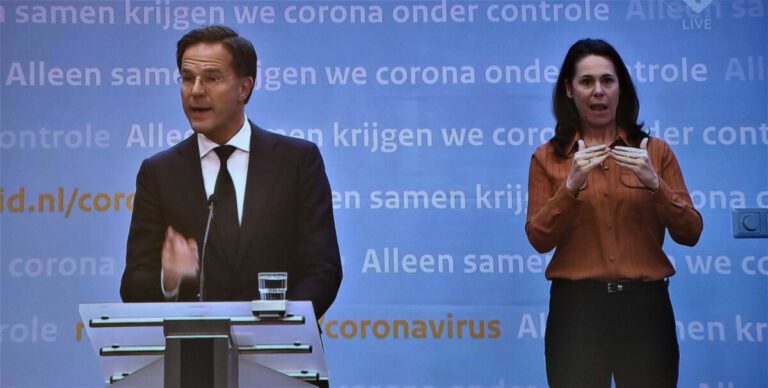
It has been announced by the RVD (Government Information Service) that Prime Minister Mark Rutte will give a press conference regarding the continuing rise of the coronavirus cases throughout the Netherlands. There has been much speculation concerning the implementation of new corona regulations, especially regarding travel and regional lockdown measures, such as the wearing of facemasks in certain areas of Amsterdam and Rotterdam.
This follows the latest update by RIVM (National Institute for Public Health and Environment) which reports that the number of coronavirus cases has almost doubled in the past week with 2,500 people testing positive for the virus in the Netherlands.
Irma Sluis will not be present
Coronavirus in the Netherlands has also led to a rise in affection for sign language interpreter, Irma Sluis. However, a spokeswoman involved in the organisation of the press conference has told AD.nl that “Irma is unfortunately not available” to interpret this Thursday.
Hoe schrijf je 'hamsteren' in gebarentaal? Gebarentolk Irma Sluis krijgt op social media veel lof voor haar vertaling van de persconferentie, en dan vooral voor deze passage. → nos.nl/l/2327203
Sluis’ position as the sign language interpreter for many of the coronavirus press conferences (and particularly the way in which she signs the word ‘hoarding’, as seen above) has led to her becoming a known figure here in the Netherlands. It has been reported by AD.nl that there will be two other interpreters covering the conference instead. One is known to be Corline Koolhof, and the other remains unknown.
Will you be missing Irma Sluis like us? Let us know in the comments below!
Feature Image: Still of Press Conference/DutchReview
As most of you have seen by now, there was a terrible explosion on Tuesday afternoon in the Lebanese capital of Beirut.
It has been reported that at least five Dutch Embassy employees have been injured, as confirmed by the Ministry of Foreign Affairs. One has been seriously injured and the other four received less serious injuries.
As of now, Wednesday afternoon, at least 100 have been found dead and 4,000 are wounded, while the numbers continue to rise. BBC News reports that rescue workers are currently searching for more than a hundred people who are still missing.
Dutch aid workers and dogs to leave for Beirut tonight
Tonight, 63 Dutch aid workers are scheduled to leave for Lebanon with eight rescue dogs. The majority of the aid workers are experienced in emergency rescue, but medical personnel are also accompanying them.
“The Netherlands has special expertise to search for survivors and remains in the rubble. Which is so important now that the clock is ticking,” said Minister Kaag to the NOS Radio 1 News. According to Kaag, the Netherlands will assist the Red Cross in Lebanon “because the corona crisis also plays a role.”
Vreselijke beelden van de explosie in Beirut, een stad die mij dierbaar is. Mijn gedachten gaan uit naar collega's en hun familie, en allen die zijn getroffen. Nederland staat klaar om Libanon bij te staan met search en rescue, en onmiddellijke steun aan het Libanese Rode Kruis.
Yesterday’s explosion in Beirut has shaken up the port area of the city, and officials are still piecing together the exact trigger of the blast. President Michel Aoun says that the explosion was caused by ammonium nitrate, which is used mainly as an agricultural fertiliser. The warehouse that exploded had been storing 2,750 tonnes of it unsafely. Ammonium nitrate is not explosive on its own but ignites only under the right circumstances.
Video footage shows a large grey cloud rising above the city, followed by a shockwave throughout the vicinity. Destruction can be seen throughout the city.
In a brief televised speech, Lebanese Prime Minister Hassan Diab says, “We are witnessing a real catastrophe.”
“The international community stands with you”
King Willem Alexander and Queen Maxima shared a message of solidarity with the people of Beirut on social media:
Prime Minister Mark Rutte also offered his sympathies on Twitter.
Our deepest sympathies are with the Lebanese people, the victims, and survivors after the horrifying disaster in #Beirut. Among them are five injured colleagues from our embassy. We will be monitoring the developments closely.
Our thoughts here at DutchReview go out to the people of Beirut, and we hope that all our readers who have friends and family there are safe. There’s an account dedicated to missing persons and fundraising on Instagram, check it out here.
Starting from today, face masks are obligatory in some busy areas in Amsterdam and Rotterdam.
As the number of cases in the Netherlands is steadily picking up again, wearing face masks in the two cities has become obligatory in an attempt to curb the spread of the virus, reports RTL Nieuws.
Amsterdam
In Amsterdam, face masks are obligatory in five areas. The red-light district in De Wallen, on Kalverstraat, on Nieuwendijk as well as on Albert Cuypstraat and the markets on Plein ’40-’45.
The measure applies only to people aged 13 and above. During the weekends, there’ll be a team of enforcers reminding people to wear a mask and giving them one if need be. Those who do not respect the rules risk a fine of 95 euros.
Rotterdam
In Rotterdam, face masks must be worn on streets around busy shopping areas. This included Coolsingel, Nieuwe Binnenwegplein, Lijnbaan and Meent. People must also wear face masks in the following market areas: Visserijplein, Binnenrotte, Afrikaanderplein and the covered shopping areas of Zuidplein and Alexandrium. Two other shopping areas are considered for obligatory face masks, Binnenhof and Keizerswaard.
The obligation to wear a face mask in Rotterdam starts at 6 AM and will end at 10 PM daily. The same age of 13 and above applies when it comes to who needs to wear face masks.
Warning before giving out fines
A spokesperson from the security region stated the following yesterday. “We are going to speak to people first and do everything we can to encourage them to voluntarily put on the mask in the designated areas. Handing out fines is not an end in itself, we expect people to comply with the obligation to contribute, for their own health and that of others.”
The American company, Booking.com, will fire a quarter of its employees worldwide.
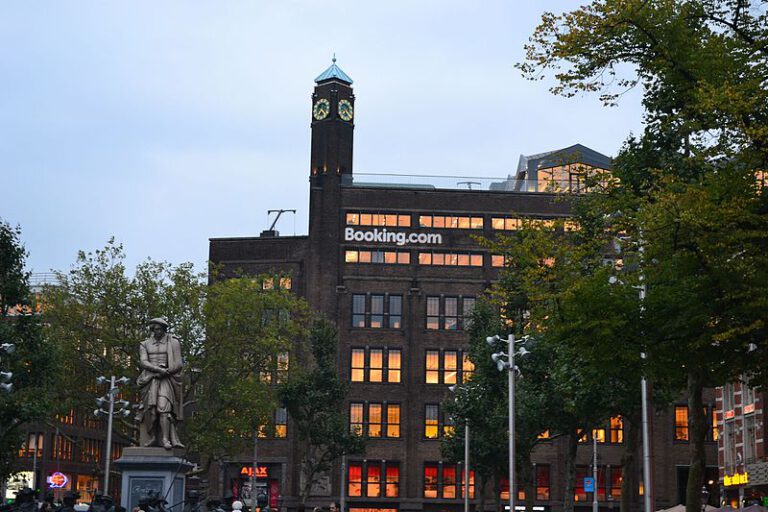
The hotel booking site has its headquarters in Amsterdam. It has 17,500 employees across the world. Out of them, 4000 to 5000 of them will be fired, reports NOS.
“Unfortunately, due to the corona crisis, like many other travel organisations, we have to take the very difficult step of shrinking our global workforce,” said a spokesperson.
One of the biggest employers in Amsterdam
In Amsterdam, there are around 5,500 employees in the head office and 10 other side-offices. The company is one of the largest employers in Amsterdam, and it is currently unknown how many people will be fired. They are in the process of building a new office complex in the city.
Their new massive office under construction in Amsterdam. Image: Supplied
The company has been hard-hit by the coronavirus crisis and the lack of tourists. Their number of bookings fell by 85% in April. The company made use of the NOW support package for a wage subsidy, receiving €64.5 million. According to a spokesperson, without the NOW scheme, even more company employees would have suffered from the economic fallout.
The number of confirmed cases of coronavirus in the Netherlands has increased to 2588. That’s 1259 more than the increase reported last week. Noord Holland and Zuid Holland, in particular, have seen a dramatic increase in cases.
This comes after more than 100,000 tests were performed in the last week — almost 10,000 less than the week before. While last week 1.1% of tests came back positive, but this has increased to 1.3.
A further 44 people have been hospitalized within the past week. This is an increase of 21 cases compared to last week.
Unfortunately, the virus continues to cause casualties. Another six people have passed away from the virus this week, three more than the week before.
The reproduction number, which details how many people are infected by one person, has dropped slightly from 1.4 last week to 1.2 this week.
Press conference on the coronavirus situation this Thursday
This week on Thursday a press conference will be held to discuss the situation of the coronavirus in the Netherlands. The conference will be held with Prime Minister Mark Rutte and the Minister of Health. The specific points on the agenda are as of now unknown.
Number of flight passengers who test positive for coronavirus is on the rise
It’s believed passengers did not contract the virus while on the flight, but on their way home from Schiphol. A spokesperson stated that given the holiday season, an increase of coronavirus cases is to be expected.
It has been confirmed that 76 people have tested positive for coronavirus after flying into Schiphol Airport between June 1 and July 30. A further 26 infected passengers travelled through Eindhoven airport since June 1.
A GGD spokesperson confirmed to Het Parool that the number of passengers who have tested positive for coronavirus after travelling through Schiphol has increased to 76. This follows a previous report on July 17 which claimed that 38 flights carrying infected passengers had flown into Schiphol airport between June 1 and mid-July.
Contracted while flying?
The figures are based on those who tested positive for coronavirus no more than two days after travelling. However, the GGD spokesperson has clarified that the passengers may not have been infected on the plane but may have instead encountered the virus “on the way home from Schiphol.”
Many of the positive cases travelled through Schiphol. Image: Skitterphoto/Pexels
Multiple Airports
The majority of infected passengers have travelled through Schiphol Airport. However, positive coronavirus cases have been traced back to airports throughout the Netherlands, including Eindhoven and Rotterdam The Hague Airport.
Details surrounding the flights on which travellers tested positive have not been disclosed, but the GGD has performed contact tracing based on seat numbers and the corona patients confirmed infected. Passengers who were considered to be at risk due to their proximity were also told to isolate themselves and monitor their symptoms.
Rise to be expected
Unfortunately, the rise in numbers is to be expected. “The holiday has only just started here, so we expect an increase in the coming weeks,” a spokesperson for the GGD has told Het Parool.
The RIVM has reported that as of July 1, the international travel history of those who test positive for coronavirus has been recorded. In the past week, 218 of those who tested positive for coronavirus had travelled abroad within 14 days of being infected. However, that is not to say for certain that the virus was contracted while abroad.
Whilst a rise in corona cases is to be expected during the holiday season. It is important to abide by corona regulations while travelling through airports. How do you feel about air travel during a pandemic? Let us know in the comments below!
After months of online learning, which promise to stretch into the upcoming academic year, many students in the Netherlands insist that they are paying too much for the education they receive. As a result, petitions for partial refunds have been building momentum across Dutch universities.
With distanced learning, textbooks become the primary source of study, Tilburg University student Sema Keskin told NOS. Lectures are chaotic, she says, resembling simple PowerPoint presentations that add little value. Professors are mostly unavailable and fail to promptly answer the questions of struggling students. “If you also cannot use the facilities of the campus,” she asks, “why are you paying the full amount?”
For these reasons, Keskin believes that €2000 is an illogical tuition rate during these times. Given that opting for online learning before COVID-19 was a third of the price cheaper, Keskin’s petition calls for this amount to be refunded to students for previous and future distanced semesters.
The impact on non-EU students
Tuition fees instantly multiply by up to seven times for non-EU students who find themselves unable to return to their home countries due to the coronavirus. Gleb Podorozhnyy, also of Tilburg University, started a petition for this very demographic who did not come to the Netherlands for Skype lectures.
“I want to show that non-EU students in the Netherlands are having a very hard time financially,” Podorozhnyy told U-Today. “They live from month to month. Students come from less wealthy countries, such as India, as well. They are supported by their whole family. They cannot return to their home country. This situation makes them very anxious. I just want to say with this petition: please, keep us in mind.”
The government’s response
According to Erasmus Magazine, the Dutch government has promised students who graduate between September and January a refund worth three months worth of tuition fees. However, whether this applies to Dutch students, EU citizens or all students is currently unclear. Compensation for study delays caused by coronavirus will also be granted, but the details of this are yet to be determined.
Do you think that students should receive refunds for their tuition? Let us know in the comments below.
Perhaps thought a thing of the past, discrimination is still alive and well in the Dutch labour market. Recent surveys show that a large percentage of job applicants have felt discriminated against because of their gender, origin, and age.
In a survey by Intermediary and Nationale Vacaturebank, over 2,100 respondents were asked about their experiences with discrimination in the labour market. The respondents included employees, employers, and jobseekers.
According to the survey, 55% of current employees report being discriminated against during the hiring process. The most frequently reported source of discrimination is age (53%), followed by origin (27%), and then gender (18%).
The highest percentage of discrimination regarding origin was among applicants with a Turkish, Surinamese, Moroccan, or Antillean background: 76% report experiencing discrimination during the application process.
One survey respondent, Eveline Gillot (33) says that she was turned down for a job because of her pregnancy. She tells Intermediair, “Eventually I was called back with a member of the board – the company then had a three-headed male board – and I was told: yes, super annoying, but we decided to do the second choice. We think it is a risk that you are pregnant and we don’t know how to come back after that.”
An interesting note is that employers share a quite different perspective: while 73% of the unemployed and 57% of salaried employees view discrimination as a problem, only 43% of employers consider it an issue.
On July 3, a diversity bill was approved by the Council of Ministers for a growth quota for women on the supervisory boards of large public and private companies. Their aim is to balance the proportion of men and women at the top and bottom of the company. The bill will be evaluated after five years.
We’ve lived through uncertain times these past few months, so you might be wondering whether you should still go ahead and buy a house in the Netherlands during these weird times. Coronavirus has impacted us all in different ways and the housing market is also a tad bit different, so we sat down with Wouter Hofstee Holtrop from Expat Mortgages to have a chat about buying a house in corona times.
Expat Mortgages is a Dutch mortgage agency operating all across the Netherlands, and helps internationals navigate the Dutch property market. They’re the experts on the housing market here, so we’ve teamed up with them to bring you this article about what you can expect if you want to buy a house in the Netherlands during the coronavirus crisis. We asked Wouter some of the questions we’d been wondering about when it comes to what the Dutch housing market looks like during the coronavirus crisis.
What is the housing market like at the moment in the Netherlands?
When you’re buying a house, your first question is probably about what the housing market looks like at the moment. That can massively influence where and what kind of house you decide to buy, as well as if you can buy what you want. The importance of this question has only increased in recent times, as everything has been uncertain due to coronavirus- so of course, it was the first thing we asked Wouter when we had our chat with him.
Luckily, according to Wouter, the housing market in the Netherlands has remained relatively stable; and, as the country (hopefully) comes out of the crisis for good, that doesn’t look set to change. Although some experts and banks believed that house prices would crash at the beginning of the coronavirus crisis, they’ve been proved wrong by the evidence, Wouter says. House prices around the country have remained steady or even increased. This is really all down to the fact that there has been a housing crisis in the Netherlands for the past few years, and even with coronavirus at play, that shortage isn’t going anywhere (more below on what the housing market in the Netherlands might look like in the long term).
Meet Wouter! Wouter lives in Overveen, a small beach city near Haarlem, which is attracting lots of expats to live there as well. Ask him everything about mortgages in the Netherlands if you’re in that region (and don’t worry if you’re not in that region, Expat Mortgages has advisors in every region of the Netherlands). Image: Supplied
How do house viewings work during the coronavirus crisis?
Given that the Dutch government has been encouraging people to stay home as much as they can, another question you might be wondering about is how house viewings work. “At the beginning of the crisis, house viewings dropped by 65%, but that number has now risen again,” Wouter says. Generally speaking, how houses viewings work hasn’t changed all that much, though of course you can’t shake hands when you meet your estate agent. You should also keep a 1.5m distance from each other and wash your hands often.
Something you might not realise, Wouter notes, is that house viewings are a bit more pleasant than usual at the moment. If you’ve ever gone to a house viewing before coronavirus, then you might remember that sometimes you would have up to 25 people crowded into a small apartment. Now, of course, that doesn’t happen. You’ll have a viewing alone with your estate agent, and this can really work to your benefit, Wouter adds. “You can ask more questions, take your time, and you’re alone in the property.”
There are actually some advantages to buying a house during the coronavirus crisis in the Netherlands. Image: Carina Persson/ Pixabay
Are banks still giving out mortgages in the Netherlands during coronavirus?
Now, unless you’re in a very good financial position, you’ll probably need to get a mortgage to buy a house in the Netherlands. Many of us will have panicked memories of the 2008 crisis, when it became more difficult to get a mortgage from most banks. However, this hasn’t happened with the coronavirus crisis, even though there have definitely been fears that this was a possibility.
Banks are definitely still loaning money to people who want to get a mortgage. The usual requirements will, of course apply: among others, that you have either an indefinite contract or proof that you’re otherwise in stable employment. Banks also have more questions than usual, and require a bit of extra documentation. You’ll be asked to provide a document explaining how coronavirus has impacted the company you work for, and they might also check to see if you have extra savings, so that you could pay the mortgage for a few months if you were to lose your job, for example.
However, Wouter says that not a single client of Expat Mortgages has been turned down by a bank as a result of these new requirements. One of their clients was even a freelance hospitality worker, and was still able to get a mortgage. The most important thing is to approach the right bank, which is exactly what Expat Mortgages can help you with. They don’t work with any particular bank: instead, they do all the research to make sure that they know what each bank can offer you.
If you feel like your situation is a bit special, or just that you’d like a second pair of eyes on it before going to a bank, then we really recommend getting a mortgage broker like Expat Mortgages.
Banks are still giving out mortgages in the Netherlands- you just need to know which to approach. Image: na4ev/Pixabay
New rule makes it easier for renters to become homeowners in the Netherlands
Also, in some ways, getting a mortgage might be a little easier these days, Wouter pointed out. Some of us might have already experienced the frustration that is not being able to get a mortgage, even though you would pay less for it than what you currently pay in rent. Celebration time: that’s no longer the case for many people! A new workaround now makes it possible for an “explain” document to be submitted to the bank.
This document basically allows you to get a slightly higher mortgage if you can show that you’ve been paying €1000 a month in rent (or more) and still managed to save alongside. That could also apply if you’ve been paying back a student loan every month, and also managed to save alongside. Basically it’s all about showing that you can definitely pay your mortgage with cash to spare.
What is the housing market like in Amsterdam?
Now, we know our audience: you guys are often interested in Amsterdam specifically. So how is the housing market looking in Amsterdam at the moment? After all, the Dutch capital is often an exception to the rest of the country in a whole host of ways. The housing market in Amsterdam is often a bit faster to react to economic changes, and things also just tend to move faster there when it comes to buying a house. “The whole process can take 5-6 weeks in other parts of the country,” says Wouter, “but in Amsterdam you’re looking at 3-4 weeks.”
Generally speaking, not much has changed in Amsterdam. In the first quarter of this year, which includes the first month of the coronavirus crisis, house prices rose rather than fell. The only sector of the market that is functioning a bit differently at the moment is the higher segments, which have been imaged by the ban on Airbnbs in the city centre and by fewer international buyers. But high demand continues, so you probably won’t be finding your dream Amsterdam house for a few euro any time soon.
The role of digital signatures during corona times
One other thing which has changed a little in the process of buying a house in corona times is signing documents. Digital signatures are more commonly accepted by banks, at least as a temporary measure. This was actually something that was already in progress, Wouter explained: for many years banks and notaries have been encouraged to accept digital signatures, but have been slow about doing so. Coronavirus has finally encouraged a wider acceptance of the practice.
Digital signatures extremely helpful if you’re buying a house while abroad, for example (many expats returned to their home countries at the beginning of the crisis). It’s also helpful if you have an underlying medical condition that makes you feel unsafe physically meeting people at the moment; or if you need to quarantine for other reasons. Something you might also not think about is how often you would usually have to meet up with your notary and the bank: at least twice with the notary and about the same with the bank. It’s really great to see this sort of contact being minimised while we fight coronavirus.
What can we expect from the Dutch housing market in the long run?
One thing you can be sure when it comes to the housing market in the Netherlands: the aesthetics are perfection. Image: Chait Goli/Unsplash
What can we expect in the long run from the Dutch housing market? Some analysts think that we could see a slight drop in housing prices as a result of coronavirus, particularly if we get a second wave, or the expats who have left the Netherlands do not return in the long term. However, the housing shortage in the Netherlands is also pretty severe, so Wouter says it’s a possibility that house prices wouldn’t drop regardless.
The housing crisis has been a long-term problem in the Netherlands, and has arisen because of several factors. Over the past decades, we’ve seen the number of people who live together in a house decline (smaller families are becoming more common), while the population has continued to grow. The regulations brought in to deal with the nitrogen crisis made it temporarily more difficult for new building work to take place. The Netherlands is also just a small country with a rising population and not a lot of free space. Airbnb rentals have also cramped the market in major cities like Amsterdam, though this shouldn’t be a problem any more.
We can also expect Brexit to play a role (remember Brexit?). Major companies are already relocating to the Netherlands, and that trend is likely to continue. They will bring at least some of their workers with them, which means that there will be an increase in demand for housing for expats. All this together means that even if there is slightly less demand for houses as a result of the coronavirus crisis, the prices of houses probably won’t be changing much in the near future.[td_smart_list_end]
Navigating the Dutch housing market with Expat Mortgages
It’s always good to have an expert on your side when you’re making a major life decision: and I think we can all agree that buying a house is certainly that. Especially in these uncertain times, when everyone has a theory on what’s going to happen to the economy, it’s so worth talking to someone who really knows their stuff. Even though we’re not personally buying a house, sitting down (virtually) with Wouter and asking him all our questions made everything so much clearer. If you’re in the process of buying a house, or are just curious about the possibilities, definitely head over to Expat Mortgages and ask them for advice.
What are your experiences of buying a house in the Netherlands? Let us know in the comments below.