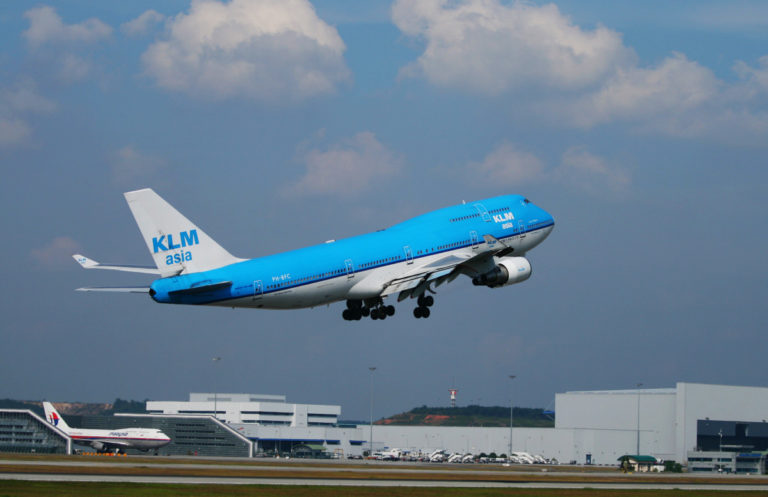
From Amsterdam to Berlin in just over an hour? That could seriously be a possibility by 2030, following more research on hyperloop possibilities in the Netherlands.
Schiphol is under pressure at the moment, given how few flights are happening as a result of the coronavirus crisis. However, that isn’t stopping them from keeping an eye on the future. In collaboration with the Delft company Hardt Hyperloop, Schiphol has presented a study, which outlines the idea for a hyperloop train between the major cities of Western Europe.
The proposed infrastructure would connect Schiphol, Amsterdam and Eindhoven with Brussels, Paris, London, Cologne, Düsseldorf, Berlin, Hamburg and Frankfurt. Over time, it would aim to transport 12.5 million people per year.
Benefits for the planet and the airport
Apart from the sustainability benefits, Schiphol hopes the hyperloop would also benefit the airport itself, by decreasing overcrowding. The airport would then handle long-haul flights, allowing Schiphol to maintain its worldwide hub position. It would function as a gate to Europe.
Despite how sustainable and innovative this all sounds, it does come with some problems. “The hyperloop has the same disadvantages as the train compared to aviation,” says transport economist Albert Jan Swart of ABN Amro. “Major investments are required in fixed infrastructure, making construction costly and time consuming.” It’s also unlikely, he says, that governments will want to invest a lot while high-speed train technology already exists.
What are your thoughts on a hyperloop in Schiphol? Good idea or a waste of money? Let us know in the comments below.
The latest numbers for coronavirus in the Netherlands have been released.
184 people have tested positive for coronavirus in the Netherlands over the past 24 hours. Although that’s a higher number than what we’ve been seeing over the past month or so, the increase is to be expected as more people get tested. This latest update brings us to a total of 48,087 cases of coronavirus in the Netherlands since the outbreak began.
The number of deaths and hospitalisations has remained low again, with 11 people passing away as a result of coronavirus over the past day. 5 people have been admitted to hospital with the virus.
Social policing in the times of coronavirus
The Dutch are an odd mix of rebelling against authority, and pressure to conform to the norm. From gentrification in architecture to oddly similar dressing styles, there is a certain need to conform, and this is ensured through wide-spread social control. It could be accusatory looks in the local Jumbo as you buy an eight-pack of toilet paper. Perhaps it’s grannies shouting ‘anderhalve meter!’ at you if you dare breathe in their direction. Or, being yelled at for walking outside with more than one person. No matter the form, social control is rampant in the Netherlands — and has only been amplified by the pandemic.
These are the “corona-free” regions of the Netherlands
Coronavirus is not affecting all regions of the Netherlands equally, as several municipalities have not had any new cases for over a month. There have been no confirmed cases of coronavirus in almost forty municipalities for over a month, especially in the north of the Netherlands. In the municipalities of Loppersum (Groningen) and Dantumadiel (Friesland), no corona was found for more than two months. No one has had coronavirus at all on the islands of Vlieland, Ameland and Schiermonnikoog since the Dutch outbreak began in March.
Follow DutchReview on Facebook for the latest coronavirus news in the Netherlands.
The Dutch are an odd mix of rebelling against authority, and pressure to conform to the norm. From gentrification in architecture to oddly similar dressing styles, there is a certain need to conform, and this is ensured through wide-spread social control.
It could be accusatory looks in the local Jumbo as you buy an eight-pack of toilet paper. Perhaps it’s grannies shouting ‘anderhalve meter!’ at you if you dare breathe in their direction. Or, being yelled at for walking outside with more than one person. No matter the form, social control is rampant in the Netherlands — and has only been amplified by the pandemic.
The history of social control
Although social control is perhaps especially visible now, it is not something new to the Netherlands. During the 16th century, village life was mostly controlled by social mechanisms, rather than the central government. Social mobility was low, and social stratification meant that people often remained within the same community their whole life.
This is often referred to as the ‘pillarization’ of society, where society is stratified by distinct values. Each pillar would thus have its own institutions and cultural identity which is reproduced throughout. Especially in protestant areas, older generations often dictated values and behaviour.
Albeit often in a joking way, the fact that my dad (a catholic) married my mum (a protestant) is still something that is brought up at every family reunion. Take this one generation back, and a protestant marrying a catholic would have been unthinkable.
This changed in the 1960s, when the Netherlands started making headlines for youth movements, the permissiveness of drugs, and liberalization of prostitution: in short a very liberal and open society. This image now lives alongside the historical image of the Dutch as tidy, diligent and hard-working citizens. Pot-smoking teenagers are seen walking alongside obsessively trimmed hedges (because you can’t just let weeds grow all over your garden, what if the neighbours complain?!).
The Dutch view of Europe: in the north, smart busy blonde people working hard. And in the south, lazy lotharios drinking wine and playing with their phones. Just needs some lechery and long vacations and that’s offensive stereotype bingo! (ht @oli4vb) pic.twitter.com/Okq0M3ovyZ
Living in Utrecht it sometimes seems like you have a façade of liberalism, where you can be different, but only within defined categories of ‘different’. There are several styles of clothing (Flared pants, white sneakers, and leopard print??), and ways of acting that you can choose from, and if you fall outside of these categories, you quickly draw stares or comments. Loud shouting or noises on the streets of Utrecht quickly draw negative attention, and people will tell you ‘doe even normaal’.
Social policing exists everywhere in the world, and in most countries, social policing of public and private life is much more prevalent and ingrained than in the Netherlands. Luckily, in the Netherlands, most of the current social control applies to the public space. Try putting your feet on the chairs in the train, or speaking on the phone in the silence compartment, and see how fast you’ll be called out.
Liberal thinking, open-mindedness and tolerance
With 17-million people living in a small place, it is perhaps inevitable that some measure of social policing exists. Especially in current times of coronavirus, it can be very beneficial to have self-appointed virus police reminding you with dirty looks to keep to RIVM regulations. Having said this, it is the values of liberal thinking, open-mindedness and tolerance that draw me, and many others to the Netherlands.
My international friend the other day was told to “return to your own country!.” There’s a thin line between social policing for your own health and outright hostility of those who do not comply with standards. Reminding one another of public health restrictions is one thing, but we must be careful that a global crisis such as this doesn’t become an excuse for further control of the public space.
What’s your opinion on the social policing of the Netherlands? Tell us your thoughts in the comments below!
Coronavirus is not affecting all regions of the Netherlands equally, as several municipalities have not had any new cases for over a month.
There have been no confirmed cases of coronavirus in almost forty municipalities for over a month, especially in the north of the Netherlands, RTL Nieuws reports. In the municipalities of Loppersum (Groningen) and Dantumadiel (Friesland), no corona was found for more than two months. No one has had coronavirus at all on the islands of Vlieland, Ameland and Schiermonnikoog since the Dutch outbreak began in March.
Now, of course, this is based on people who have been tested: it is possible that someone in one of these locations could have had coronavirus, and simply not been tested for it. But nonetheless, it does seem that coronavirus is definitely not spreading equally through the Netherlands.
This seems to be the case based on hospital admissions as well. In over half of the municipalities in the Netherlands, no one has needed to go to hospital with coronavirus. The majority of infections seem to be concentrated in the large cities: which of course, makes sense.
Frustration with coronavirus rules in less affected areas
However, the disparity in infections has caused frustration among some entrepreneurs and business owners, who believe that places with lower infection rates should not need to obey the strict coronavirus rules. In an interview with RTL Nieuws, UMCG professor of microbiology Alex Friedrich says this might not be a bad idea.
Relaxing rules in some areas first would basically function as a test run for a more widespread relaxation. “If you notice that it is increasing, you can adjust again. If you notice that it is decreasing or remains the same, you can also relax in other regions.”
Would you support relaxing the coronavirus rules in the least affected areas first? Tell us your thoughts in the comments below.
Close your eyes and consider this question: on a global list of 200 cities, how expensive is Amsterdam for expats to live?
If your answer was anywhere in the top 10, top 20, or even top 50 — you were wrong. If you guessed number 64 however, you’re right (and should have your own psychic TV show).
The 2020 Cost of Living Ranking by Mercer has seen Amsterdam drop even further down the list of the most expensive cities for expats to live in. Wait a minute — “even further?” Indeed, our expat readers! Amsterdam has been on a steady decline for years. Last year the Dutch capital came in at number 58, but dropped six places in 12 months.
Sadly no. In reality, other cities have just become far more expensive — Amsterdam’s prices were just slower to increase. In addition, the euro got weaker against the US dollar, which is good news if you get a US salary in the Netherlands.
What countries are the most expensive?
The ranking counts the costs of housing rental, transport, food, entertainment, and security in over 200 cities.
Hong Kong finished in first place for the third year in a row. However, Tokyo had to settle for third place after Ashgabat, Turkmenistan jumped from seventh place. Some of the other places you should definitely avoid moving to are the Swiss cities of Zurch (4), Bern (8), and Geneva (9). New York came in at number six.
But Amsterdam isn’t alone in its decline. Our neighbours Belgium and Germany all dropped, and Paris and Milan fell from 50th and 47th respectively. If you’re looking for a bargain, catch a plane to Tunis, Tunisia — it came in cheapest for the second year in a row.
Top 10 most expensive cities for expats 2020:
1. Hong Kong, Hong Kong (SAR)
2. Ashgabat, Turkmenistan
3. Tokyo, Japan
4. Zurich, Switzerland
5. Singapore, Singapore
6. New York City, United States
7. Shanghai, China
8. Bern, Switzerland
9. Geneva, Switzerland
10. Beijing, China
The RIVM has published the latest count of coronavirus numbers in the Netherlands for today, June 9.
The newest count reveals 164 new confirmed cases of coronavirus, just over a week since widespread testing became available. Since the outbreak began, there have been 47,903 total cases in the Netherlands.
Severe cases of coronavirus lead to 6 people ending up in the hospital.
Unfortunately, the coronavirus has also caused the deaths of 15 people since last count. 6,031 people have passed away since the start of the outbreak.
Halsema calls for inquiry over Amsterdam protest
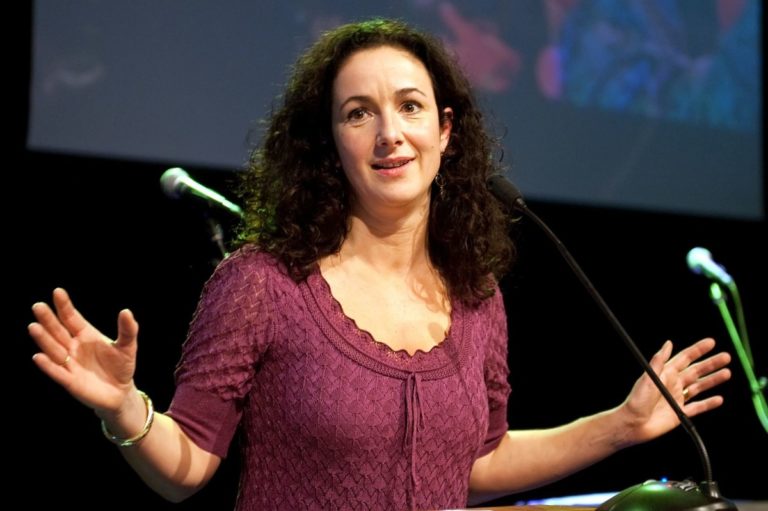
Amsterdam Mayor Femke Halsema has called for an independent investigation into the anti-racism protest on the Dam last week. The Dam Square protest was widely criticised because protestors were not able to keep 1.5m from each other, particularly towards the centre of the crowd. Halsema wants an independent investigation into how many people were there and the protest’s potential for spreading coronavirus.
Coronavirus testing after a holiday
With summer around the corner, holidays are on everyone’s minds. The CNV trade union is proposing that all people going abroad on holiday must take a coronavirus test before returning to work. The reasoning of the union is to prevent a potential second wave of coronavirus infections from people going on holidays abroad.
Follow DutchReview on Facebook for the latest coronavirus news in the Netherlands.
It really feels like summer in Eindhoven at the moment. June 1 was a moment of celebration, as cafes and restaurants could finally reopen after three months of being closed to customers.
So now that we are allowed to enjoy a nice meal at a restaurant, which place should you pick? What’s out there to eat in The Netherlands’ city of technology and innovation? We’re here to help you again!
Last Monday was a big day for the horeca industry, since almost all restaurants, cafes and pubs faced real challenges in the past 3 months. This week was truly a week of reunion, as you could gather around with your friends again and celebrate it by having a pleasant summer night outside.
All restaurants and customers must respect the RIVM rules, and if you have even the smallest sign of a cold, please stay at home. But if you know you’re healthy, then you can take advantage of it and go out. Make an online reservation and take your family and friends (but not too many of them) and pick one (or all!) of these 5 awesome places in Eindhoven where you can experience small bites of Heaven.
Vintage Restaurant
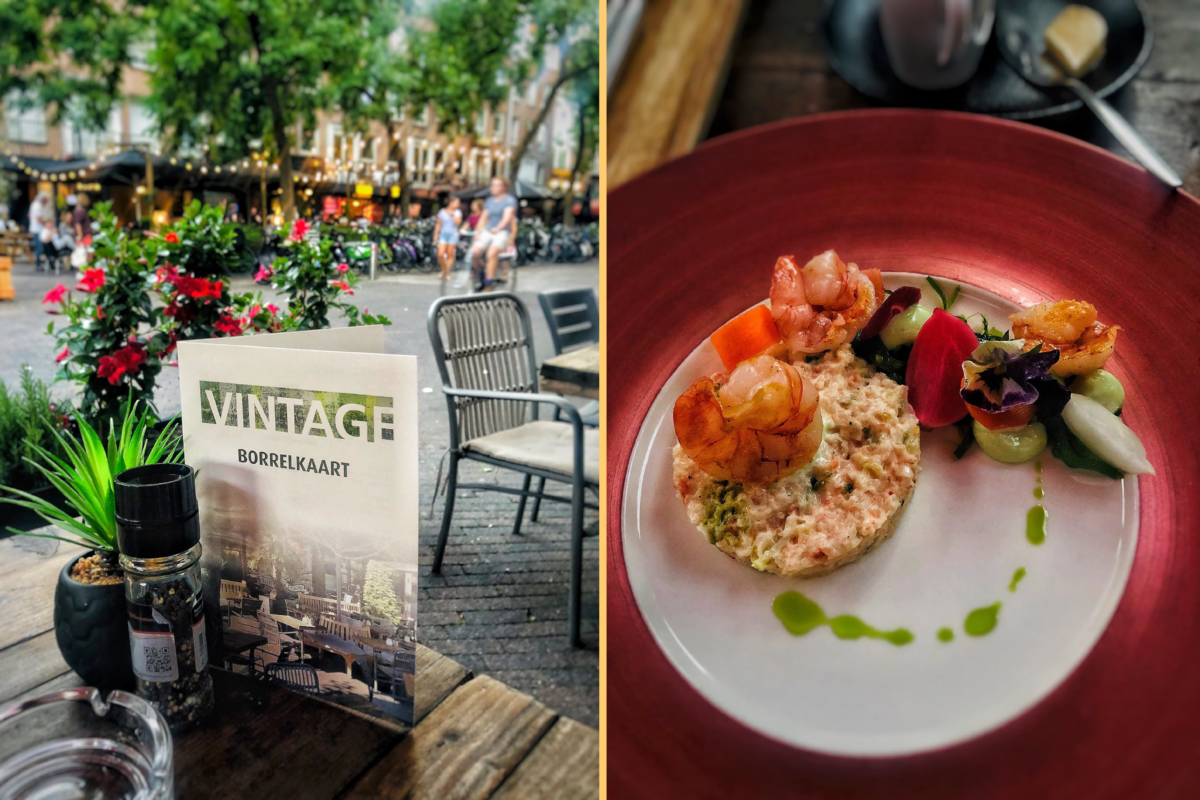
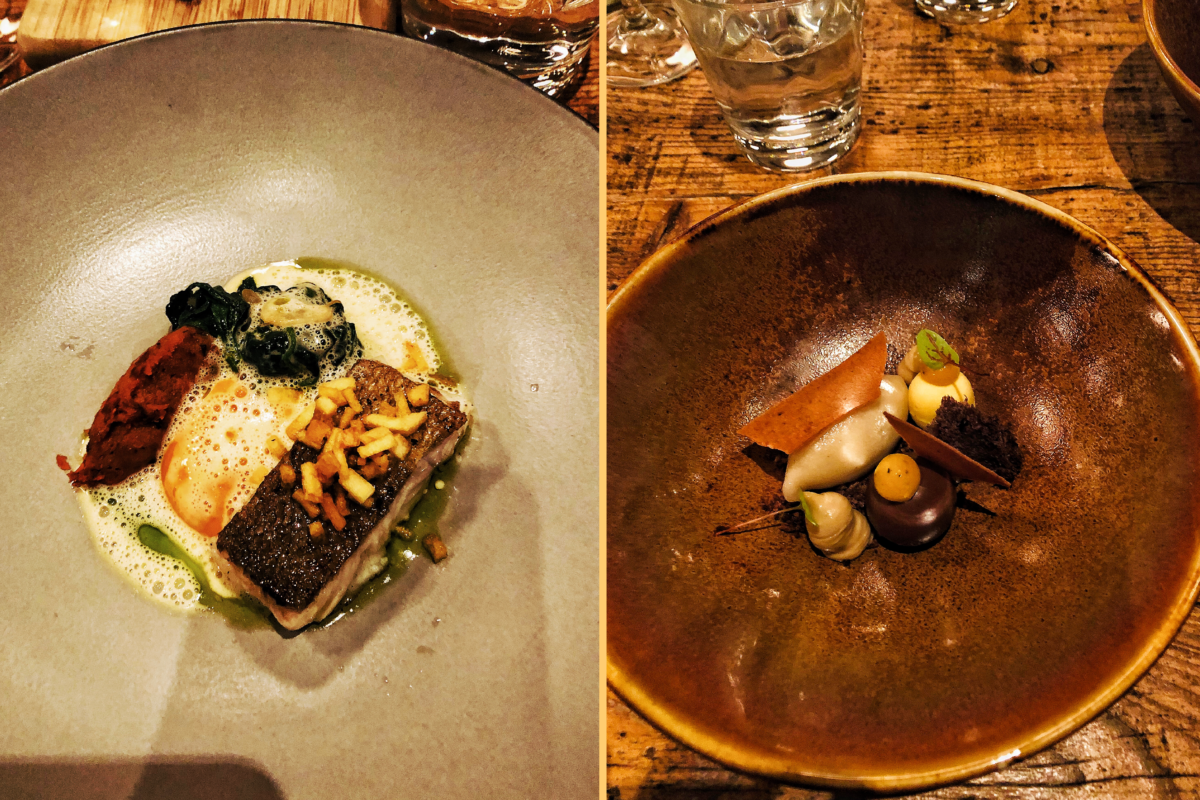
“It’s so good to use plates again!”, the chef of Vintage Restaurant in Eindhoven said to me in the afternoon of June, 1. Now that the summer is here, it’s hard to miss the Vintage terrace. It’s one of the first things you see when you enter on the Kerkerstraat. This place offers a good view of the city hustle without being too much part of it. Cozy and intimate place, Vintage Restaurant has delicious food at a very affordable price. And the surprise menu is always a very good choice. Word!
Vintage terrace is perfect for a summer night. Image: Cristina Damian/Supplied
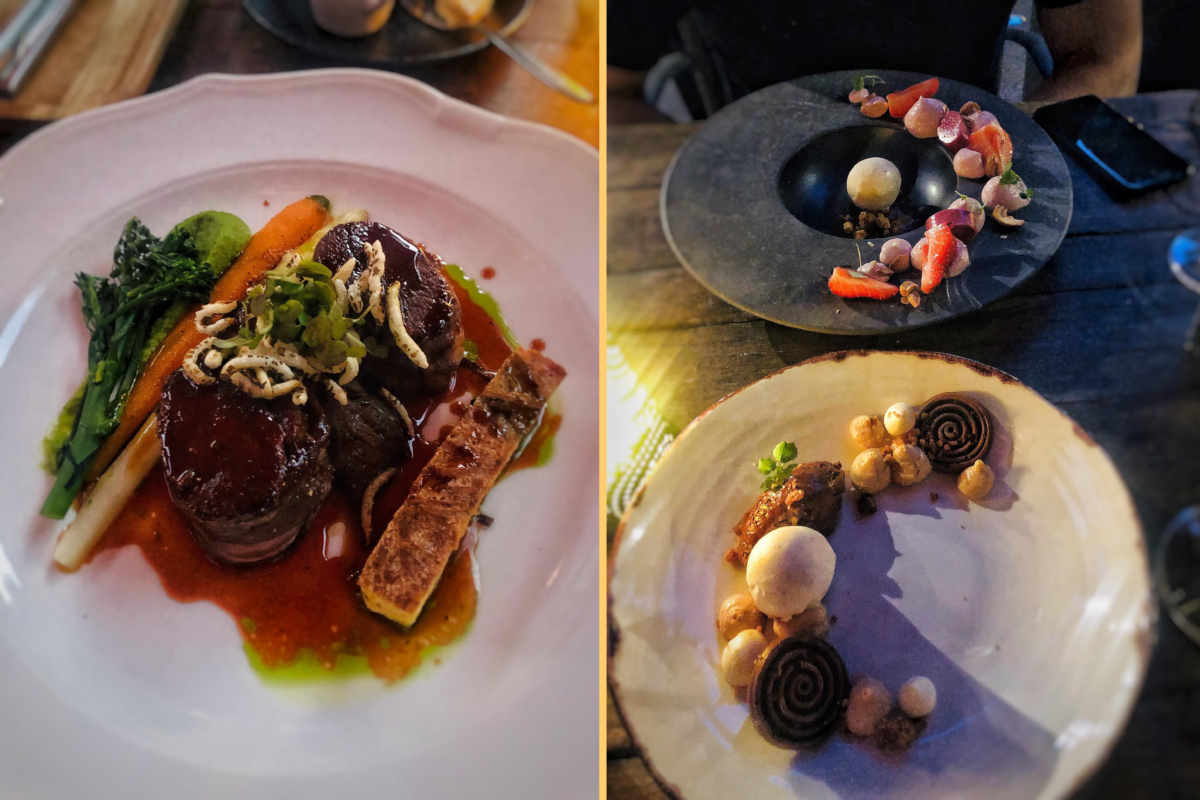
So, what’s there to eat, you ask? For starters, you can choose tuna/pork belly/steak tartare and they come with sweet and sour vegetables, crème fraiche, fennel, ponzu, or wakame. Main courses include them all: deer, beef shoulder, duck breast, halibut, Iberico pork. Of course, you always have options for vegetarian dishes. The desert is the best part: sweet or salty, whatever you’ll have it will make you feel in Heaven.
Main course and dessert at Vintage. Yummy! Image: Cristina Damian/Supplied
You will often find the owners there and all the staff will make sure you have everything you need. The food here will make you thank personally the chef and the drinks will give you Italian and Spanish vibes.
In order to avoid crowding, it is preferably to make reservations either by phone (040-237 79 97) or by email (reservations@vintagerestaurant.nl). Vintage is a 100%-and-more gezellig place.
Address: Kerkstraat 3, 5611 GH Eindhoven
Lucie Cocina
Bienvenidos! “Strong essences are kept in small bottles”, goes the saying and I think it was meant for Lucie Cocina. For people out there who grew up with Spanish telenovelas, you must remember that “Cocina” is the Spanish word for “Kitchen”. And not only the name is Spanish, but – you guessed it! – so is the food and the staff. How awesome is that? Situated in the heart of the shopping street in the city-centrum, it’s hard to miss this place which has a perfect Latin vibe.
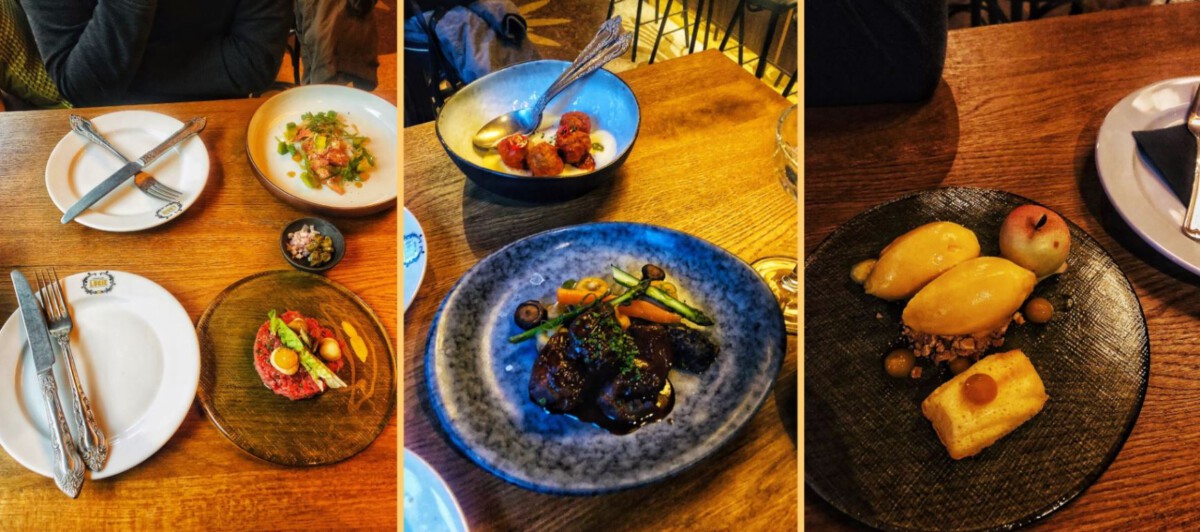
So, what can you eat here? Spanish food, what else?! Their breakfast (starting at 9:30 AM) includes Tostada and Tortillas, but it’s best to check their full breakfast & lunch menu. Starting 12 PM delight your senses with an entire range of Spanish lunch and dinner dishes. Everything you choose to eat at Lucie Cocina will be just great. Personally, I had lobster salad, steak tartare, veal balls, pork cheek and dessert with mango and passion fruit. Yeap, I had to try them all. I recommend you do the same.
Bites of Heaven at Lucie Cocina. Image: Cristina Damian/Supplied.
What’s more, you can bring Spain into your house, by buying from them olive oil, Bellota and Campo Iberico ham and Spanish wines, either for yourself or as a gift for someone else.
Be sure you go there and enjoy this piece of Spain right in the heart of Eindhoven! If you don’t want to risk it, you can always go for the take-away option and you get 10% discount.
Address: Kleine Berg 34B, 5611 JV Eindhoven
Bistro Sophie
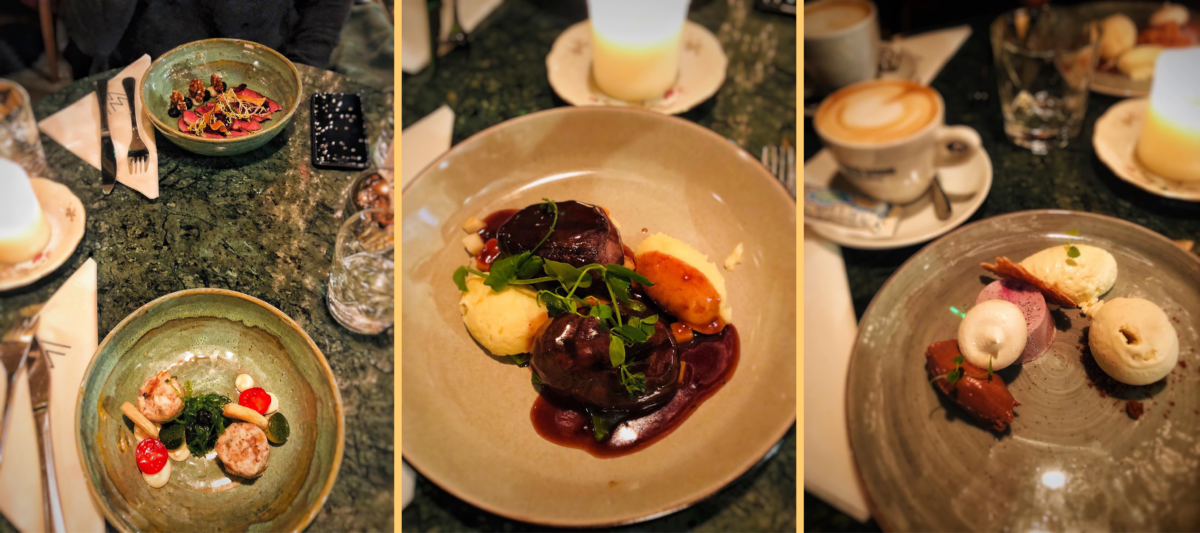
Bistro Sophie is the perfect choice for a fancy dinner. You won’t find a place that pays more attention to details than here. The staff is always making sure that the food is the best, and you always have something to drink, be that a cold beer, a cocktail or a delicious glass of wine. The atmosphere here is something special and the warm ambiance and light contribute to a romantic dinner.
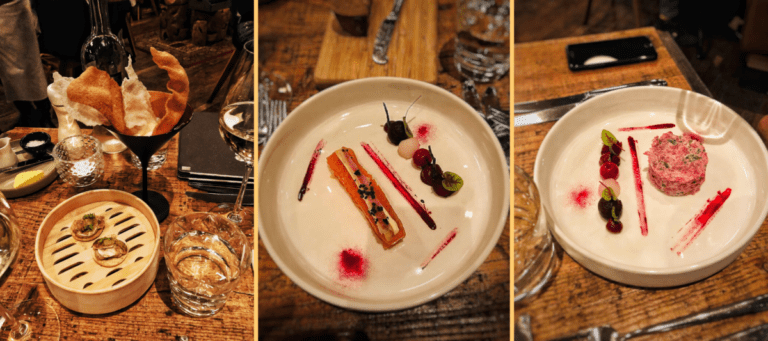
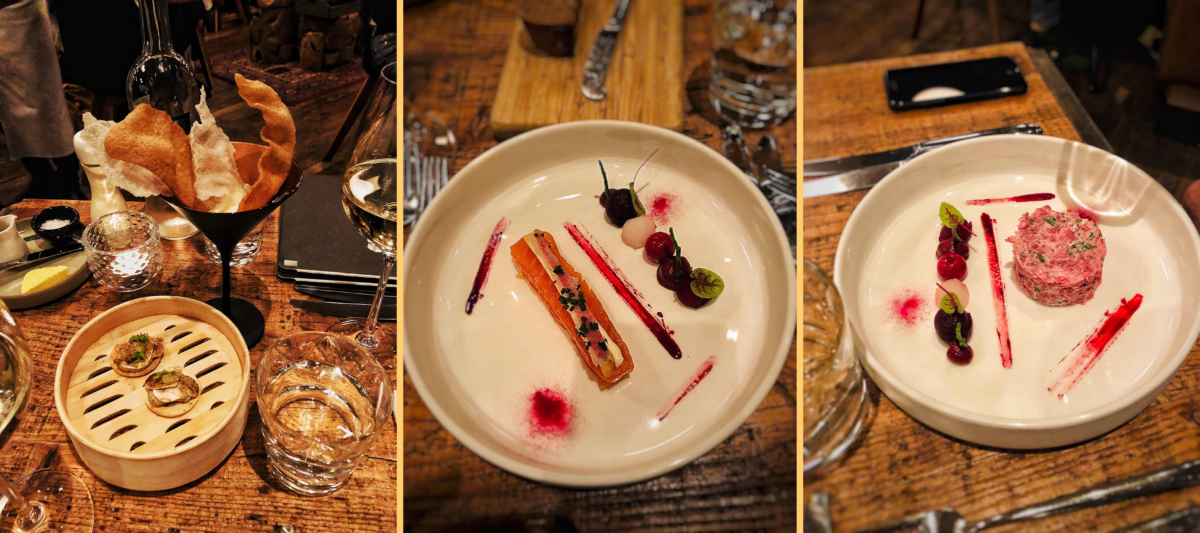
How fancy are these? Appetizers and starters at Bistro Sophie. Image: Cristina Damian/Supplied.
The staff is more than happy to help you select the right wine for your food. What food you ask? So much of it, truly! Start with either gamba, eendenlever or cremeux Old Amsterdam. Continue with amazing dishes made of halibut, duck or pick only veggies plates. Don’t forget to save some space for desert: amazing combinations of either tropical fruits or delicious cheese. Or do like me, and ask for a chocolate-special dessert! They also have a take-away menu during this period.
Main course and dessert at Bistro Sophie. Image: Cristina Damian/Supplied.
If you don’t live in Eindhoven and want to spend a night here, they can offer you a place to sleep. Right above the restaurant, there is the Auberge Nassau Bed and breakfast with affordable prices.
Address: Wilhelminaplein 14, 5611 HE Eindhoven
Welp
Welp is in the De Bergen neighborhood in Eindhoven. That is, the centre of this city. Their 3-course surprise menu costs €35 pp and you will definitely be surprised. They have international cuisine and if a bottle of wine is too much for you, you can drink by the glass. 20 different glasses, to be precise. Sounds like a fun night, am I right?
The cool thing that won my heart at Welp was that their menu is actually a magazine. While waiting for your food, you can discuss with whoever you’re going there the things you see in the magazine. They are in Dutch, but hey, you can still chat about the pictures.
Their motto during Corona is “Stay at home, we deliver.” What are you waiting for? Give them a call (06 38 31 16 34).
Stay at home, Welp is bringing its food at your door. Image: Cristina Damian/Supplied.
Address: Kleine Berg 35, 5611 JS Eindhoven
Down Town Gourmet Market Eindhoven
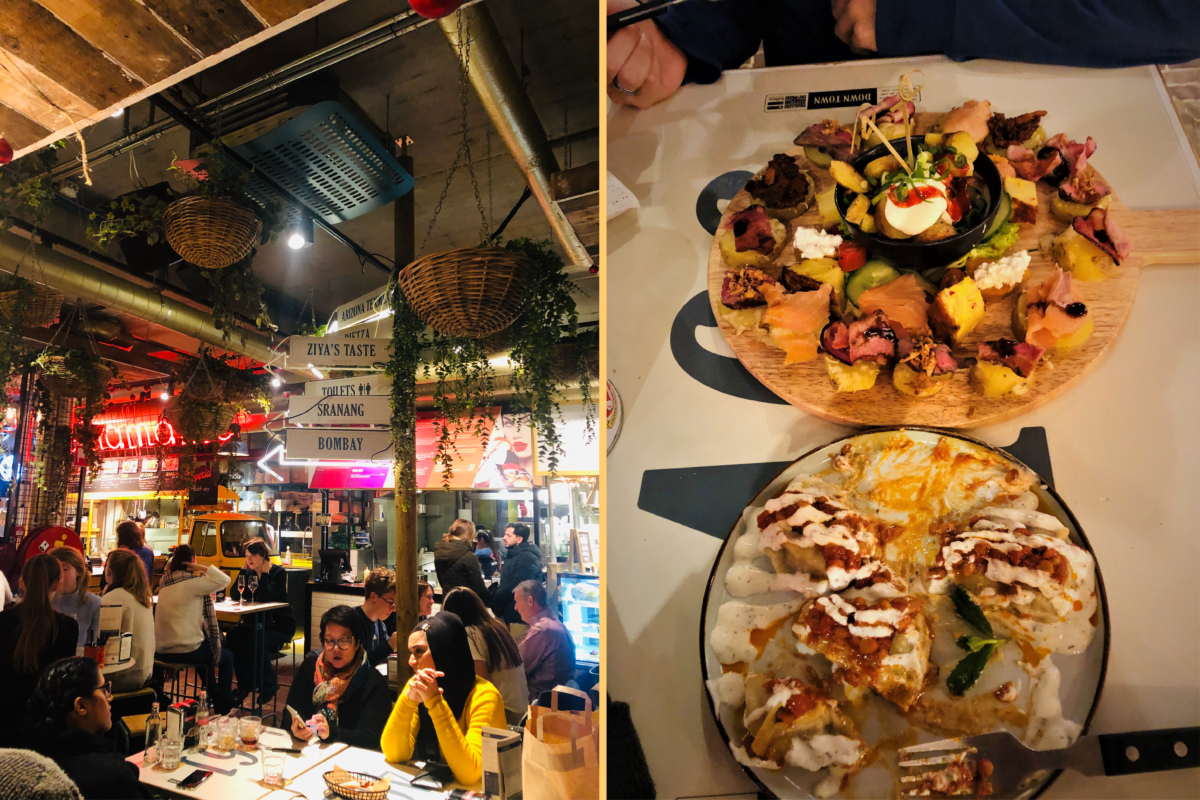
Woah, is this heaven on earth or what? Before Corona, it was a bit too crowded to be heaven, but the food surely still is from there!
Down Town Gourmet Market Eindhoven. Image: Cristina Damian/Supplied.
What are you craving? Mexican, Italian, South-American, Spanish, Greek, Japanese, Dutch? This place has got you covered and there’s no need to make a reservation during this period. Just show up there and the staff will provide you with your personal QR code needed for orders. That’s right! Down Town Gourmet Market has an internal ordering app. With Butlaroo, you can both order and pay online, but this shouldn’t be too surprising. We are, after all, in Eindhoven, the city of technology. You can only spend 2 hours there, but nobody is stopping you to come several times per week! And you will definitely need to come again and again and again since you must try all of their food.
Address: Smalle Haven 2-14, 5611 EJ Eindhoven
Even if going to a restaurant will be a different experience from what we’re used to, we think enjoying awesome food is completely worth it. Despite all these adjustments, all restaurants will do their best to help you enjoy their great atmosphere and delicious food!
Where else could you enjoy Brabant hospitality in Eindhoven? Let us know in the comments!
A library in Groesbeek in Gelderland has finally been reunited with one of its books after almost 40 years.
Jan Wolkers’ book Back to Oegstgeest was supposed to be back on March 5, 1981. Clearly, the borrower was really, really enjoying this book. Or at least, they were taking the time to really appreciate it. 39 years, 13 weeks and 5 days, to be exact.
Luckily for the borrower, the library has a cap on the maximum fine that can be given for a late return. The cap is at €5, so this lucky borrower didn’t really have much of a punishment waiting for them. If there hadn’t been a cap, however, the total fine would have gone up tp €1,530.75. So uh. Let’s all be grateful for libraries, shall we?
Amsterdam Mayor Femke Halsema has called for an independent investigation into the anti-racism protest on the Dam last week.
On June 1, between 5,000 and 14,000 people gathered on Dam Square in Amsterdam, to protest against racism and police brutality in the US and EU. It was followed by lots of other protests across the country, in The Hague, Breda, Utrecht, Eindhoven and Rotterdam, to name just a few.
The Dam Square protest was widely criticised because protestors were not able to keep 1.5m from each other, particularly towards the centre of the crowd. The vast majority wore face masks. Mayor Halsema has come under fire for allowing the protest to continue. Some further protests were able to maintain the distance; in Rotterdam this was not the case, and the protest was shut down half an hour early.
No connected infections yet
Now, Mayor Halsema wants an investigation to take place into how many people were on the Dam and what the consequences of the protest will be for infection rates. As of yet, no one who went to the protest has tested positive for coronavirus, but the incubation time for the virus is 14 days. That means we still have a while to go before we can assuredly say that the protest had no impact on infection rates.
Such an investigation will be challenging to carry out. The GGD cannot tell who attended the demonstration; that’s something protestors themselves will need to be open about. “Someone could also be tested in a different region. It may then take longer before that information is also known to GGD Amsterdam,” writes the Amsterdam College of Mayors and Aldermen. Nonetheless, the municipality thinks that the risk of infection to most protestors is low.
Did you go to any of the protests last week? Let us know in the comments below.
With summer around the corner, holidays are on everyone’s minds. The CNV trade union is proposing that all people going abroad on holiday must take a coronavirus test before returning to work.
The reasoning of the union is to prevent a potential second wave of coronavirus infections from people going on holidays abroad, reports RTL Nieuws.
Proposal based on research
The CNV surveyed 1900 workers and a third of respondents stated that they expect new infections once colleagues return from their holidays abroad. A further 28% responded that they expect a second wave of coronavirus to emerge.
The chairman of the CNV, Piet Fortuin, told RTL Nieuws that a second corona wave must be avoided. “Social interactions are starting up again at the workplace and the chance of new infections is high.” We, therefore, call on all workers who have gone abroad and who have minor complaints to corona test, before they return to work. This way we prevent a new wave of contamination.”
A reported 46% of those surveyed reported that they believe it is unsafe to go abroad on holiday. Half would rather prefer to do their holidays within the Netherlands.
Employers put no pressure on employees not go on vacation
The survey also revealed that not many employees feel any sort of pressure from their bosses not to go abroad. Fewer than 1% reported that their boss explicitly prohibits them from traveling abroad. Around 5% report that their employers prefer that they would not go.
A further 8% also reported that they do not have money to go on holiday, which for better or for worse, at least solves the dilemma.
Follow DutchReview on Facebook for the latest coronavirus news in the Netherlands.