A 24-year old Dutch-Chinese woman was attacked on her way to her student flat in Tilburg after she asked some youth in an elevator to stop singing a racist song.
The woman, named Cindy, went in an elevator with a couple of young boys, who were singing the infamous Radio 10 song “prevention is better than the Chinese”, which has already caused controversy through its explicit racism towards Chinese people. When she asked them to stop singing the song, she was attacked by the group.
Cindy states that the next thing she remembers is waking up on the floor of the hall, with slashes on her body. She then reported the incident to the police, reports RTL Nieuws.
“Cutting the coronavirus out of her”
After awakening, she also noticed that the boys had slashed her with a knife, in order to “remove” the coronavirus from her body. Cindy has said that she is shocked that a remark about the song could lead to such violence, and she asks the perpetrators to report to the police.
She has also said that she wishes to speak with them, in order to combat the ignorance of these individuals. She has seen first hand what happens in regards to racism caused by the coronavirus, as people avoid going to Chinese establishments and restaurants in the Netherlands.
This story will be updated as more details emerge.
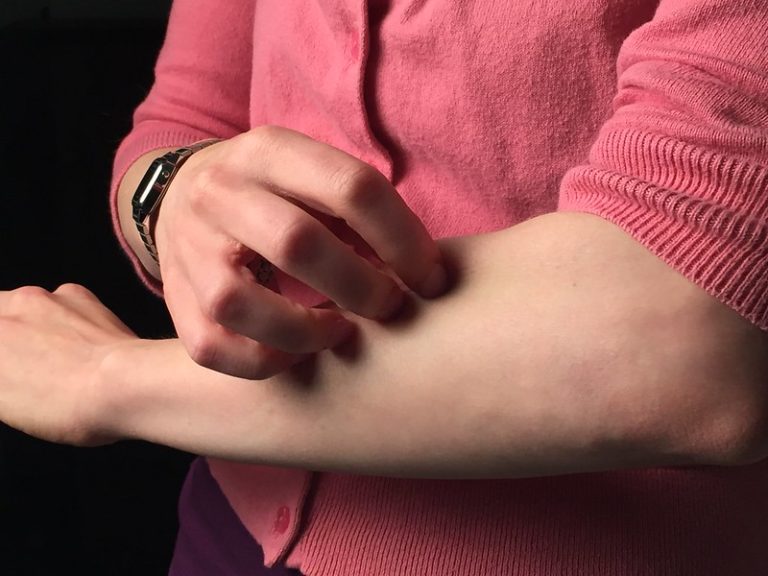
Are you being kept awake at night by itches? In the morning after, do you notice flakes and red bumps on your skin. It might just be possible you got an unwanted visitor, in the form of the itch mite, a pesky and tiny organism, which causes scabies, a condition which has become more common in the Netherlands.
The RIVM (National Institute for Health and Environment) has expressed concern that more and more cases of scabies have started to appear in the Netherlands, as reported by RTL Nieuws.
What causes scabies, in what circumstances and what can be done to treat it?
Scabies is caused by the itch mite, which in a very rude manner, decides to dig inside your skin and lay eggs there. Your skin then gets an allergic reaction, which explains the intense itching people experience, especially during night time. Thankfully, it is harmless, but it will definitely cause some intense annoyance.
Scabies is passed through skin contact, but also through other surfaces that might contain the itch mites, such as your bedsheets, or your couch.
The treatment given by the doctor usually involves a cream called Permethrin which is then applied to the affected areas. It’s also highly recommended that you wash your clothes and bedsheets and linen afterwards to remove any mites.
Cases of scabies have tripled in the Netherlands
The RIVM reports that in the last five years, scabies cases have tripled in number, and now there are tens of thousands of cases per year. The use of Permethrin, the cream used to treat scabies, has also doubled in the period between 2014 and 2018.
It is unclear as of now what has lead to the sharp increase in scabies cases, but the RIVM has set up a special working group to find an explanation, train doctors and dermatologists to better diagnose scabies, as well as to register any new cases.
Student houses and nursing homes report a lot of cases in the Netherlands
Scabies seems to be more widespread within student housing and nursing homes. This is especially problematic in nursing homes, as patients who have dementia can go unnoticed for weeks until the symptoms get noticed. Once an outbreak is recorded, it also takes a long time for the house or place to be cleaned until it is scabies-free.
Have you been feeling itchy lately? Let us (and your doctor) know in the comments!
In 2018, the Netherlands consumed 20% less material than it did in 2000, according to the publication Circular Economy in the Netherlands by the Central Bureau of Statistics (CBS). According to the study, material consumption per inhabitant is generally less than the the average in the European Union, and the raw-material footprint per inhabitant is also lower, nu.nl reports.
This broad term, “material” includes the following: biomass (i.e. milk and wood), fossil fuels and their derivatives (i.e. gasoline and plastic), metal (i.e. cars and other machines) and non-metallic materials (i.e. sand and concrete).
Now during this period, the Netherlands consumed less than its neighbours, Belgium and Germany, beaten only by Spain, the UK and Italy according to CBS.
Fewer minerals are needed
Generally lower material consumption in the Netherlands is due to several reasons. For instance, fewer raw materials – or materials are needed to make semi-final and final products- and used compared to other EU countries.
This is because fewer minerals are used, and also because the Netherlands is a relatively small country with a dense population, meaning that less material is needed per capita for infrastructure construction, like roads.
Room for improvement
Although this little country is excelling in these areas, it’s less successful at dealing with waste- although waste production has fallen recently, it totals 2500 kilos per capita, exceeding the EU average of 1800 kilos. But the Netherlands is also a leader in recycling (surpassed only by Luxembourg and Belgium. So a lot of waste is recycled. That helps too.
The Dutch government aims to have a completely circular economy by the year 2050. So lower material consumption and recycling are both steps in the right direction.
Do you think the Netherlands can be completely circular by this time? Let us know in the comments!
We’ve all experienced the joys of online shopping: the tiresome trawling through endless webpages, flipping and flopping over shipping charges, then finally pressing ‘Complete Transaction’ and rushing immediately to your window even though PostNL could take days to arrive.
Then, your item appears at your doorstep—hurrah! You tear open the packaging, and throw on your new clothing item or plug in your new gadget: and, the excitement fizzles. It looks wrong on your body, it doesn’t turn on, or maybe it’s not even the right item.
Well, congratulations, you may have just scored yourself a free, unwanted object! Trends show that more and more Dutch companies are letting you keep items rather than go to the trouble of return shipping. Instead of ‘you broke it you buy it,’ web-stores now prefer ‘you hate it, you keep it’ – and you’ll even get your money back.
The study by Financieel Dagblad (FD) found that dozens of consumers reported they were allowed to keep things they wanted to return regularly—even if it just because of a change of mind.
Why are web-shops not taking items back?
The Dutch are notorious penny-counters: so why don’t they want their stock back? The answer lies in the postage costs.
“It is probably an economic consideration, because the costs of a return add up fast, especially since webshops have chosen to cancel the shipping and return costs,” explains FD journalist Lisa van der Velden. “It becomes too expensive for them to process returns.”
However, electronic retailer Coolblue maintains that it’s the environmental aspect. Fewer returns means fewer vans on the road. But, Van der Velden doesn’t agree with Coolblue’s explanation.
“If you tell people that they can keep it, they will order more often and you will also get more vans,” she writes.
In fact, web-shops don’t even like to discuss the concept. While Bol.com customers said they had experienced not having to send back a return, Bol.com flat-out denied that this took place.
What can we do instead?
If you’ve been watching a bit too much Marie Kondo and know that you don’t really need that unwanted product, you can still make a sustainable (read: smart) decision.
Web-shops like BuyBay takes items that you’ve ‘returned’, clean them up if necessary, and then sells them to a new home. It’s like a second-hand shop, for first-hand items, reports RTL Nieuws.
“Our mission is to prevent waste,” says Thijs Bosgoed of BuyBay. “We may open and clean a product that arrives at us so that it is ready for the next customer. We sell it online and in stores.”
Have you ever not had to return an item but been refunded the money? What do you think of the practice? Let us know in the comments below!
For employers in the Netherlands, drug testing of their employees is almost impossible. The Dutch government is looking into the possibility of allowing drug testing for certain professions, such as in the chemical industry, reports RTLZ.
In most cases, it’s usually not allowed at all for employers to test for alcohol and drugs use with their employees, and this is laid down in the legislation and by the AVG privacy law (General Data Protection Regulation), which has been implemented in all countries of the European Union.
When can drug tests be conducted on employees?
In order for drug testing to happen in the workplace, a lot of special conditions must be met. There needs to be a legal reason for testing and the violation of privacy must be kept to a minimum.
The law does allow testing for some professions, namely aircraft crews, train drivers, pilots, motorists and skippers. Otherwise, unless specified by the law, no drug testing can be conducted.
Nevertheless, some Dutch companies have been illegally testing for drugs in their employees. In a typical 21st Century fashion, these companies have excused themselves by saying that security comes after privacy (America would be proud).
Employers feel limited in their options
Due to the current legislation, employers feel limited in their options, as it is hard to take action against employees who show up smashed drunk or high at work. Research has shown that quite a big percentage of employees who were randomly sampled and tested for drugs and alcohol had these substances in their bloodstream.
“Testing should be allowed in dangerous industries, such as the chemical industry” State Secretary states
The State Secretary of the Netherlands of social affairs and employment, Van Ark, considers that for an industry such as the chemical industry, alcohol testing should be allowed to prevent any potential accidents in the workplace. As such, safety concerns come first for the push for allowing testing in the workplace.
Specifically, BRZO companies (companies that work with hazardous materials) are currently being investigated to see if drug and alcohol testing can be permitted.
Research is also done to see if there can be a legal basis for this new implementation. Van Ark has stated that this is a complicated process, as checks need to be done in order to see for what professions and under what circumstances can testing be done.
Should drug testing in the workplace be allowed, or is that a violation of privacy? Let us know in the comments.
The southern Dutch festival, Carnival, can expect very typically Dutch weather this weekend. Storm Ellen will bring heavy rain and wind on Saturday and Sunday.
Carnival-goers will face wind and rain this weekend, so although it might not be the costume du jour, bringing an umbrella or a rain jacket with you to the celebrations would be advisable. After all, being soaking wet is infinitely worse than having to carry an umbrella, at least in my opinion.
Wind and rain could disrupt Carnival parades
There will be strong gusts of wind, which could cause a problem for the Carnival parades, particularly on Saturday. And, of course, heavy rain to top it all. The good part is that you don’t need to worry about freezing: it’s going to be once again unseasonably warm this weekend, with temperatures well above 10 degrees. This will only drop down to 8 from Tuesday onwards.
No cold winter this year
A cold winter is really and truly not on the cards for us this year, says Nicolien Kroon from Buienradar in an interview with RTL Nieuws. If you’re craving snow and ice, you ought to head abroad- though not by plane if you want to see snow and ice anywhere in the future. Check out our winter breaks by train for some inspiration in that regard.
Got any Carnival plans yet? Let us know in the comments below.
4200 new jobs will be coming to the Netherlands as a result of companies relocating from Brexitland to the Netherlands. Compared to the year before, double the number of companies from the UK relocated to the Netherlands in 2019, RTL Nieuws reports.
The majority of these companies are multinationals looking to continue trading within the EU after Brexit comes into effect next December. The Netherlands Foreign Investment Agency (NFIA), a part of the Ministry of Economic Affairs and Climate has been working hard to attract these Brexit refugees to the Netherlands.
Mostly companies in the service industry
Most of these companies provide services, ranging from Fintech to IT to media and advertising. The TV channel Discovery and the credit rating agency AMBest both relocated to Amsterdam as a result of Brexit.
How much money will these companies actually bring to the Netherlands?
So what about the hard figures? How much money will these companies actually bring to the Netherlands? Well, quite a bit, if estimations are to be believed. Since the Brexit referendum, 140 companies have transferred from the UK to the Netherlands, with over half of them making the move just last year- 78 in total. Over three years, the new companies are expected to add 4200 jobs and 375 million euros to the national economy.
If we look at the amount of international companies coming to the Netherlands in general in 2019, the figures are even more impressive. Over 400 multinationals started operating out of the Netherlands, creating 14,000 jobs and 4.3 billion euros worth of investment.
More companies are likely to follow over the next year
NFIA is currently talking to over 400 companies who are thinking about relocating to the Netherlands from Britain, and expects a large portion of them to eventually do so. Although the UK is attempting to negotiate a new trade agreement with the EU, both NFIA and the companies themselves are sceptical about this being completed before the year’s transition period is up. Accordingly, NFIA guesses that many companies will move to the Netherlands just to be safe.
Which company would you want to see relocate here the most? Let us know in the comments below.
New research shows that the time spent commuting has increased in the Netherlands since the year 1995. This trend has also seen the rise of more and more people working at home, reports NOS.
The research on commuting in the Netherlands was done by the Netherlands Environmental Assessment Agency (PBL), with their focus being for the years between 1995 and 2016. The average distance for commuting has increased, from 15 kilometres in 1995 to 19 kilometres in 2016.
Not only has the commuting distances in the Netherlands increased, but the number of people commuting has also increased as well. In 1995, a quarter of people commuted to work, while now, in 2016, over a third do.
Commuting in the Netherlands: What causes the higher commutes?
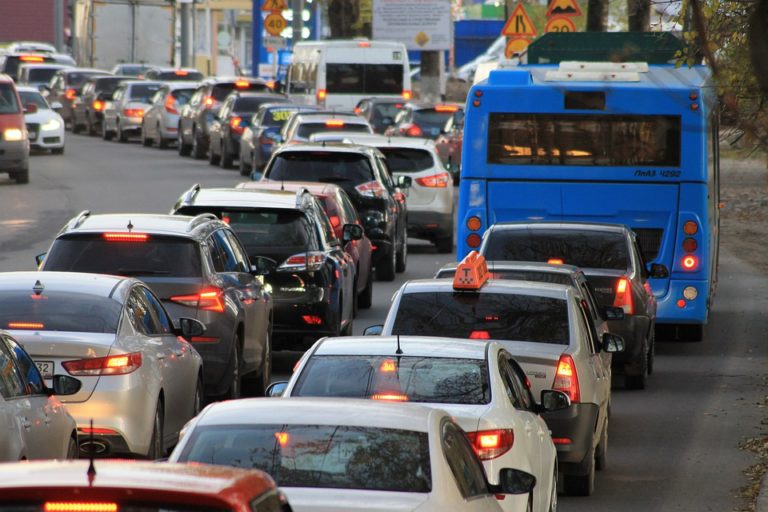
There are several factors at play that determine the increase in commuting in the Netherlands. According to Jan Ritsema van Eck, a researcher at the PBL, more people own a car, allowing them to travel further. Furthermore, in dual-income households, at least one of the members might choose a job that is further away.
Another factor is the ability of people to work from home, making it simpler for individuals to accept a job that is far away. The housing market crisis also makes people have to pick a job that might not be in their city, as they cannot afford to move closer to their respective jobs.
Another finding of the research is that highly-educated people, as well as those in full-time employment, tend to commute longer distances than those with a low level of education.
Benefits and disadvantages to the increase in commute
Ritsema van Eck argues that there are economic benefits to the longer commutes, as people have a bigger variety of jobs to pick from and are not as impeded from working in a different city, given the increase in work at home positions. According to him, one of the disadvantages is that the roads are busier.
That is clearly not the only disadvantage, as busier roads mean an increase in CO2 emissions. Not only are the roads busier, but trains have become increasingly busy as well. A work psychologist named Floris van Emmerik says that the increase in commutes can affect people’s mental health, as individuals feel they do not have as much control over their lives.
Companies are therefore implementing more work at home possibilities, such as VodafoneZiggo, which stated that they allow their employees to work from home anytime they wish so, as long as they schedule it beforehand.
Should commuting times be reduced, or should work at home become more widespread? How do you feel about commuting in the Netherlands? Let us know in the comments.
It could soon be the end of the Red Light District in Amsterdam as we know it. Radical changes have been proposed for the workplace of the world’s oldest profession. An ‘erotic department store’ has been suggested as the best alternative.
Imagine a five-story building, brimming with room for one-hundred sex workers, but also cafes, a hairdresser, a beauty salon, and a tanning studio. It may even include a sex club and theatre. Once inside the centre, customers can walk past the famous windows, and partake in other activities.
Mayor of Amsterdam, Femke Halsema, has called this vision the best option for the future of the Red Light District. It’s not perfect, rather the erotic centre has slightly more advantages than disadvantages. But, the plan will assist with reducing the problems confronting the historic centre of Amsterdam around over-tourism and nuisance.
Halsema believes that by offering everything the Red Light District has in a one-stop-shop, the pressure in Amsterdam’s historic area will decrease. It will push party-tourists out of the historic centre, but also keep sex-workers in business in a safe environment, Het Parool reports.
Why are they changing the Red Light District?
As tourism in Amsterdam booms, the business in the cities most famous district has fallen. The number of window brothers stood at 1300 in 2006. By 2014, it had fallen to just 800, according to a municipal market survey.
Halsema and the city council do not want to just close brothel windows without a safe and legal alternative, and many Amsterdam sex workers don’t want to leave the district. But, a choice has to be made.
🚫 | Sekswerkers zijn geen bezienswaardigheid. Daarom worden rondleidingen op de Wallen en langs andere prostitutieramen verboden. De nieuwe regels gaan 1️⃣april in.#dewallenhttps://t.co/JlYjsepNkv
Halsema proposed several alternatives for the Red Light District last summer. They entered discussions with sex workers, operators, and other stakeholders to create new plans. These ideas varied wildly: some saw more windows in the Red Light District, others none at all.
In addition to the erotic centre is a ‘light’ version: a prostitution hotel where sex workers can receive customers. Customers could even purchase services and book online. However, Halsema is worried about the effect on tourism of this option, reports AT5.
What types of visitors come to the Red Light District?
Halsema has identified three types of visitors:
The ‘Demand-oriented customer’
These are the people attracted to the Red Light District specifically for sex workers, and not for socialising, food, or coffee shops. They want the district to have an accessible location and a good price, but are less concerned about how it is presented.
The ‘Available supply customer’
Ever had a drink near the Red Light District and thought ‘well, why not?’ We haven’t, but there is a specific type of customer who may be enthralled by the atmosphere and decide to knock on a window. However, these customers are less likely to head to an erotic centre as a destination.
The ‘Viewing tourist’
We’ve all taken a stroll along de Wallen at some point to sneakily or not-so-sneakily have a look at what’s happening there. It’s a rite of passage for tourists in Amsterdam and is mostly made up of women or families. This group makes up the majority of visitors.
How do types of visitors affect the Red Light District’s future?
It’s important to balance a lot of priorities when deciding the future of de Wallen. What’s more important: a steady flow of tourism, or a steady flow of business? For example, when changing the location of the Red Light District, will tourists still attend? What will happen to the current location? Will sex workers businesses suffer, or will their working conditions improve?
The city council now must choose between the erotic centre or the erotic hotel. Halsema says the erotic hotel would mean losing the ‘viewing and party tourists’ who want to walk past the windows. Both this tourist group and the impulsive party tourist need to be accounted for. According to Halsema, the erotic centre would be achieve balance. However, finding the right building for so many functions could be difficult.
What does history tell us?
Amsterdam has tried to relocate sex workers back in 2009, with terrible results. Alderman Lodewijk Asscher headed Project 1012, but a report from the Court of Audit in 2018 ruled it a failure.
The city had also tried to relegate sex work to a tipple zone on the Themsweg 25 years prior. But, it closed after just a few years amid consistent trouble.
A necessary decision
Amsterdam city council will likely come to a decision on the plan this summer. However, issues such as location and business model could take much longer.
What do you think about the proposed changes to the Red Light District? Let us know in the comments below!
You may be stuck at home during the coronavirus outbreak, but that doesn’t mean you can’t get your culture fix! Explore these seven museums and art galleries — while still helping to flatten the curve.
Admiring and enjoying art can be a highly enjoyable activity during hard times. Thankfully, museums have been quick to (digitally) open up their doors to visitors, all for free!
So sit comfortably in your pyjamas, put some classical tunes in the background and indulge yourself with some tours of museums and art galleries around the Netherlands!
Van Gogh Museum, Amsterdam
Vincent Van Gogh’s art is almost synonymous with the Netherlands, and many people flock to the Van Gogh Museum in Amsterdam each year.
For better or worse, now you no longer need to queue up in long lines and raise your arms above crowds of people to take photographs of his works of art. The museum is offering virtual tours, so you can enjoy all that is has to offer from your own privacy.
You can also have your children join on the fun with colouring pages that can be printed or by going on an interactive adventure through the museum.
Passionate about our distant past and the many fascinating civilisations of the days bygone, with their rich cultural heritage and antiquities?
So this is my museum @RM_Oudheden (National Museum of Antiquities), Leiden/Netherlands. Founded in 1818 we are 200 yrs old! Collections on Egypt, the Near East, the Classical world and the archaeology of the Netherlands. A very cool place to work and we have a temple! #Museum30pic.twitter.com/wiisePvfrf
Then the National Museum of Antiquities is just for you. Like the rest of the museums on this list, you can now have a digital view using StreetView around the place.
The centrepiece of the museum is its permanent Egyptian exhibition, which even includes a full 2000-year-old Egyptian temple. There are also exhibits on the classical world, archaeology in the Netherlands, the Dutch and the ancient far east and more.
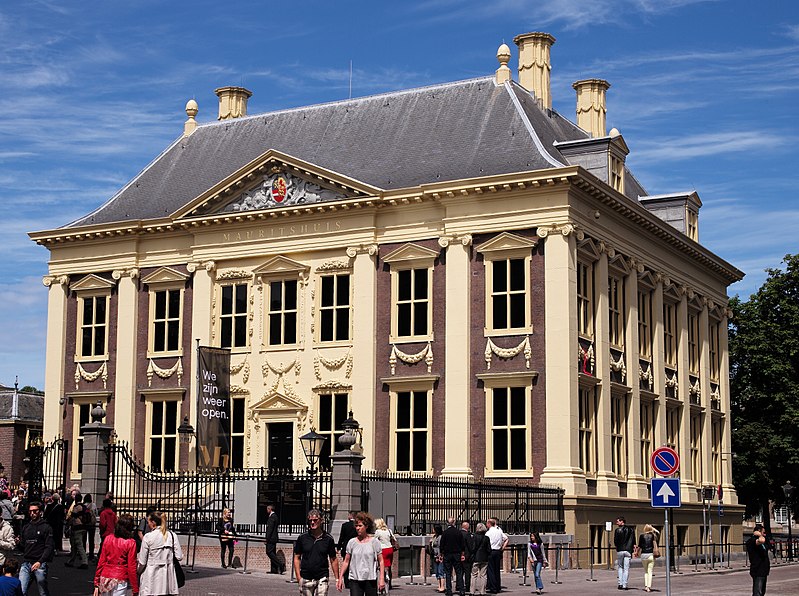
The Mauritshuis is probably one of the most famous museums in the Netherlands. Located in a beautiful Dutch Golden Age mansion in The Hague, close to the country’s picturesque Binnenhof, the Mauritshuis has a great collection of paintings.
The Mauritshuis is a beautiful Dutch Golden Age mansion. Image: Roman Boed/Wikimedia Commons/CC3.0.
Among the most famous paintings exhibited at the museum is “Girl with a Pearl Earring” by Johannes Vermeer, whose captivating gaze is akin to a Dutch Mona Lisa. You can also find many other celebrated Dutch painters like Rembrandt and Steen.
History is often difficult, but it is also an opportunity for learning and for reflection. All crisis situations are also a moment of proving human resilience and Anne Frank’s story and house is an example of survival and creativity during hard times.
While she lived in a very different and inarguably more difficult context than what we are going through today, the Anne Frank Museum is certainly a sight to see and can provide useful insights.
Anne Frank’s house as seen from the streets. Image: dronepicr/Wikimedia Commons/CC2.0.
You can take a stroll through her house from the comfort of your home and you can even go exploring using a VR headset if you have one laying around. You can go through her hiding spot in the attic where she wrote her famous diary and you can also visit the house where she lived in before the war, with her family.
Exhibiting artwork from the Dutch Golden Age, with masterpieces such as the “The Night Watch” by Rembrandt, a digital tour through the museum is sure to satisfy your cravings for paintings.
Besides the digital tour you can take, the website of the museum offers a lot of educational tools if you wish to learn more about the works of art. So get out there (from home) and explore!
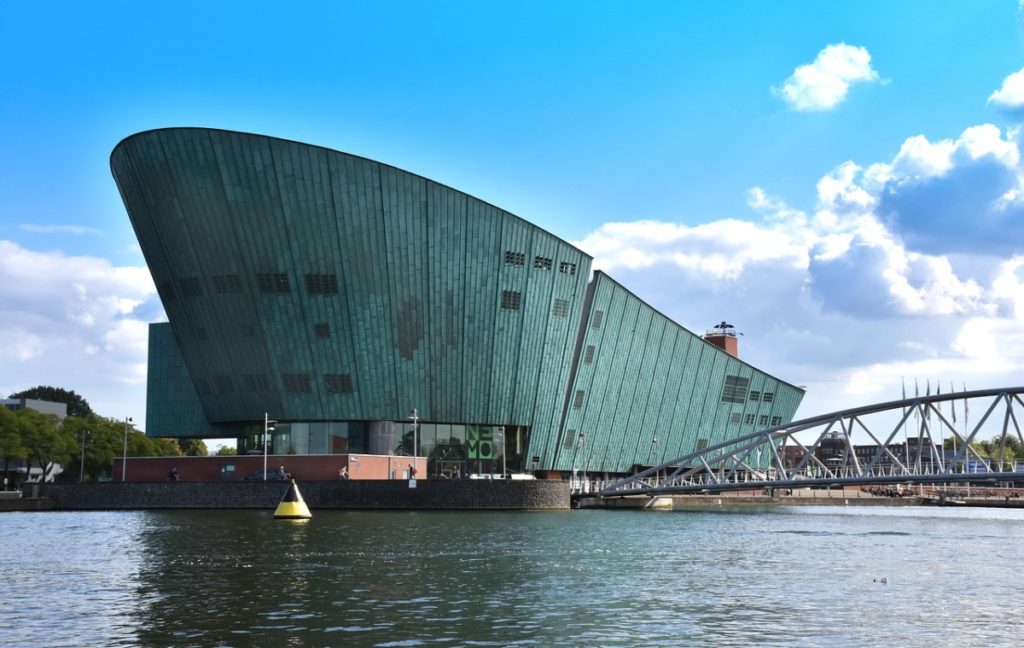
Perhaps arts are not your thing, and you are more of a science fan. Then, this one is for you! The Nemo Science Museum has something for all types of lovers of science, from the human body, physics and gravity, space and much more.
The modern building of the NEMO museum. Image: Anemone123/Pixabay
While unfortunately, you cannot go on a digital tour of the museum building, you have another fun activity you can participate in through their website. You can do home experiments, learn new scientific knowledge and test yourself on what you know.
Finally, another (digital) must-see is the Teylers Museum in Haarlem. Displaying a wide range of artefacts, ranging from paintings, books, coins, medals, fossils and minerals, the museum has a bit of everything for everyone. It comes as no surprise that it’s called the Museum of Wonder.
There you have it! Seven Dutch museums that you can still check out from the comfort of your own home, a good way to pass time that must be spent indoors.
What are your favourite museums to digitally explore? Let us know in the comments below!
Feature Image: Polina Zimmermanm/Pexels. Editor’s Note: This article was originally published in April 2020, and was fully updated in February 2021 for your reading pleasure.