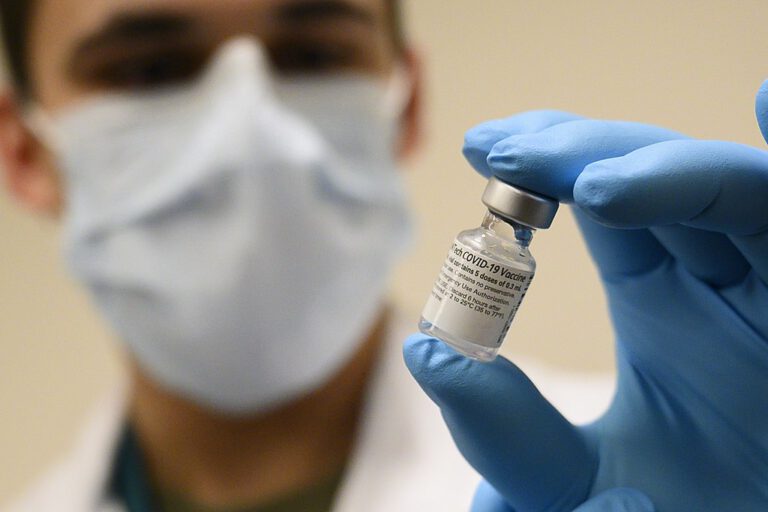
Each vial of the coronavirus vaccine contains six full doses. However, once the doses are taken, a small amount of the vaccine still remains in the vial. Hospital staff use what is leftover and top it up with a small amount from the next vial, allowing for seven doses of the vaccine. However, due to strict regulations, GGD staff may not do so.
Chair of the National Acute Care Network, Ernest Kuipers, and vaccine coordinator of all hospital pharmacists, Noortje Swart, believe that this sort of waste needs to stop.
Swart explains to AD that “this is standard practice in hospitals and completely safe.” She and Kuipers believe that the GGD should be adopting this practice as well. “We are in a time of crisis so we all have to be in a crisis position. We must not waste any vaccine,” she says.
Strict regulations
However, the umbrella organisation of the GGDs claims that the RIVM and Youth Health Care have strictly forbidden them to mix doses from different vials. “This is very strict protocol and, under strict conditions, it is allowed to hospital pharmacists,” Kim Roetert of the GGD Ghor tells AD.
Inspection spokesperson, Mariël van Dam, elaborates further on the issue: “[mixing] is not allowed, no, because they work according to a guideline from the RIVM. We just have an agreement about this and we cannot make new agreements every week.”
Van Dam also explains that GGD staff do not have the same level of training as hospital staff. “Sifting out of a bottle is only reserved for hospitals because their people work with a certain education and skills.” However, Swart has pointed out that pharmacy staff are ready and willing to help train GGD staff on how to make use of the excess vaccine doses.
What do you think about the GGD’s guidelines? Tell us your thoughts in the comments below!
Dutch coronavirus patients who refuse to voluntarily isolate themselves after testing positive may now be forced to quarantine.
Ever since the coronavirus first came to the Netherlands, it has been advised that those who test positive for the virus must go into quarantine and avoid all contact with other people.
However, according to outgoing Minister for Health Hugo De Jonge in the press conference of January 12, more than a quarter of Dutch people who test positive for coronavirus still go out in public.
The government can now take matters into their own hands. Those who pose “a serious threat to public health” and “cannot be otherwise effectively averted” will now be forced to quarantine in University Medical Center Groningen, says a decree published in the official Government Gazette.
The measure can only be taken once the chairman of one of the 25 safety regions has been consulted. The quarantine would then be carried out under Article 31 of the Public Health Act.
De Jonge says “due to the outbreak of Covid-19, it is necessary to designate a hospital where patients can be isolated who are (suspected) infected with this infectious disease and who do not voluntarily cooperate in isolation.”
What do you think of a forced quarantine for those who refuse to isolate? Tell us your thoughts in the comments below!
There is an effort on both sides of the Dutch-German border to decrease the amount of travel time between Amsterdam and Berlin.
The Germans are working on plans to increase their train’s speed and to cut down the number of stops between the two cities. In doing this, they hope to cut the almost six and a half hour journey down by a whole hour.
We may be about to lose our precious Amsterdam-London route, but at least the German capital will start to feel closer!
However, let’s not get too excited. This process will take some time. Currently, the German Ministry of infrastructure hopes to achieve this one hour cut by 2030.
What will the Germans do?
The plan on the German side is to reduce the number of stops between Amsterdam and Berlin. Under this plan, the faster train would only stop at Rheine, Osnabrück, Hanover and Berlin Spandau in Germany.
This shaves down the route considerably and allows the train to get from A to B (literally) much faster.
What is also great about this plan is that the current stops between Amsterdam and Berlin will still need to be covered, so a second, slower train (which will still run 35 minutes faster than the current route) will remain running to serve these regions.
The people in areas such as Bünde, Bad Oeynhausen and Minden will not be forgotten and even better, trains between Amsterdam and Berlin will run approximately every hour instead of every two hours!
What will the Dutch do?
This is a two-sided project and so the Dutch also hope to decrease the travel time between the two cities by half an hour. While this is not as drastic a cut as the Germans, the Dutch hope to have these changes implemented much sooner — in the year 2024 (who knows, maybe the pandemic will even be over by then!)
Indeed, “the plans are well aligned,” a spokesman for the Dutch Ministry of Infrastructure and Water Management tells Treinreiziger.nl. This is certainly helped by the fact that the Dutch cabinet has set aside €50,000,000 to improve the infrastructure between the two countries.
New trains that run in both countries
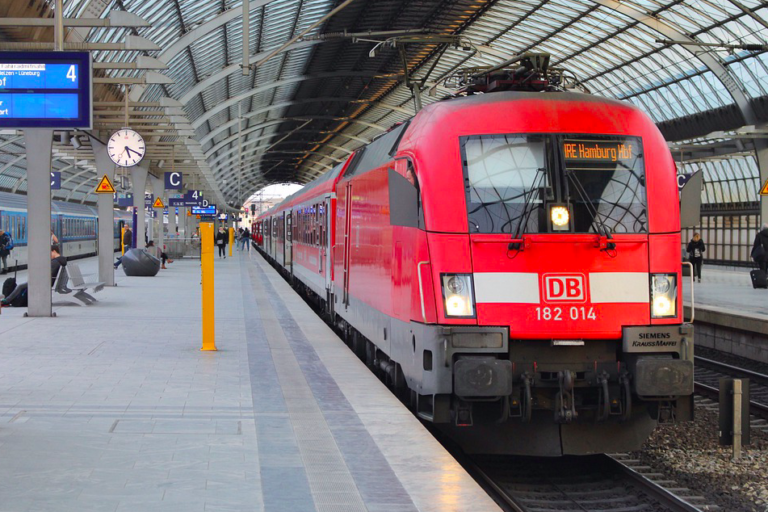
Both Dutch and German train tracks will also enjoy brand new trains on the Amsterdam to Berlin route by 2024. “According to Deutsche Bahn, which has ordered the trains, production is on schedule and the trains will be available in time to run on the 2024 timetable,” the spokesman says.
The trains are supported on both German and Dutch tracks meaning that a locomotive change will no longer be necessary — another time saver!
Will you be rejoicing after hearing these plans for the Amsterdam to Berlin route? Tell us your thoughts in the comments below!
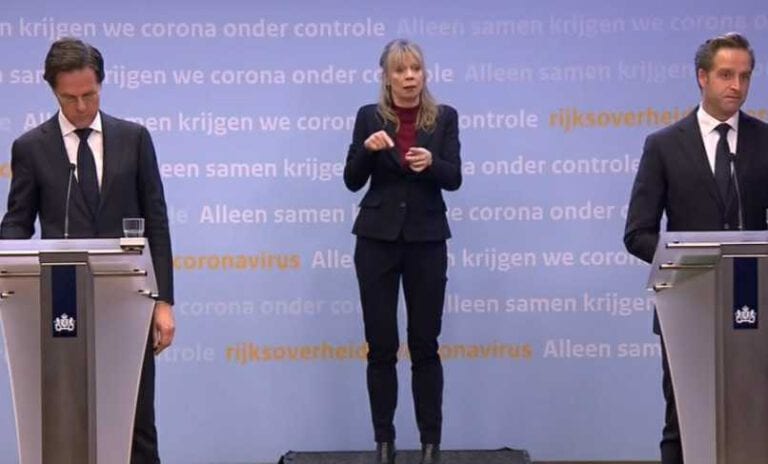
The past few days have seen the Dutch government lean towards an easing of the current coronavirus restrictions — however, some experts worry this is all happening too quickly. We know for certain that primary schools and childcare will reopen on February 8. Rutte and De Jonge have now addressed the further easing of restrictions in a traditional Tuesday press conference on February 2.
During the last press conference, the British variant was the star of the show, with Rutte impressing the danger of the new mutation and arguing that a strict lockdown was needed as a result.
Now, with the variant continuing to spread, it seems the government has adopted a new stance. This has left many questions for the decommissioned prime minister and decommissioned minister of health to answer.
Rutte and De Jonge’s message on February 2
Rutte began by addressing the uncertainty of the current situation in the Netherlands, saying “we are in a tense and also uncertain phase of the corona crisis.” However, he offered us some hope, in the shape of a roadmap.
“We all long for certainty, for a clear plan. We can show which direction it is going. We have captured that in a roadmap.”
De Jonge also addressed the roadmap. He has said there are three ways out of the corona-crisis: restrictions, testing and vaccinations. “The way back is going cautiously, in small steps”, says De Jonge. However, it seems the roadmap has not yet been released to the public.
Lockdown extended to March 2
From the beginning, the outlook is not positive, with Rutte saying “a third wave seems inevitable to come to us.” He has confirmed that “it is inevitable to extend the current lockdown to March 2nd.”
Will curfew end?
For now, it is expected the curfew will end on February 10. However, this may still be extended, Rutte has said. He explained that two weeks have not yet passed since the curfew came into effect and as a result, the effects of the measure are not known.
He said that the Dutch government has asked for the advice of the Outbreak Management Team (OMT) and expects an answer by the end of the week.
When will shops reopen?
Shops will reopen for click and collect and delivery on February 10. However, customers must order from their own homes. This is in accordance with the OMT’s advice, who claim that so long as there aren’t too many people inside a shop, the risk of infection is low.
By ordering products online, the hope is that people will spend as little time as possible inside the stores. Shop doors must remain ajar and people may only enter to collect their order.
What about the British variant?
Tonight, the British strain was once again central to discussion. Rutte explained that due to the various new strains of coronavirus — British included — the Netherlands cannot afford to relax too quickly. “The R-value of the British variant is 1.3”, said Rutte. “We cannot avoid this rapid turnout. We will be billed if we are too optimistic now.”
Experts think it’s too soon
It seems the experts are of a similar opinion to the Dutch cabinet. Epidemiologists Patricia Bruijning, Alma Tostmann and Amrish Baidjoe have told the NOS that they believe it is too soon to begin easing restrictions in the Netherlands.
“I think it is still a bit early,” says pediatrician epidemiologist Patricia Bruijning of the UMC Utrecht. “With the current measures it is already complicated to get the R-number below 1, let alone if you are going to relax.”
Alma Tostmann of Radboud UMC believes that the government should wait another two weeks. “Then you lift it over the spring break and you can see how things are going,” she says.
Only the primary schools will be opened — with extra measures
Rutte has explained that primary schools and childcare will open as planned on February 8. He emphasised that extra strict measures will be implemented in order to prevent the further spread of the virus. “If a child has a positive test, the entire class or group will be quarantined and tested on day 5. We will also conduct more intensive testing and source and contact research.”
He also added that the risk of contamination is lower when children are involved. “Adults usually get the virus from other adults, not from children.” He then briefly addressed the issue of secondary education, saying that secondary schools will not be opening this month and only at the beginning of March if the 1.5-meter rule can be followed.
A restructured approach?
The decommissioned Dutch cabinet has asked for the help of the OMT in order to restructure its approach to the new variants of coronavirus. “Because of the great concerns, we ask the OMT to advise again on the entire package of measures,” he said, “then we will take stock again.”
What are your thoughts on the message by Rutte and De Jonge? Leave a comment below!
The RIVM has released its weekly figures for the period of January 27 to February 2. We’ve only seen the number of new infections drop slightly, but it’s enough that the government believes it will soon be possible to start lifting restrictions.
Over the past week, 28,628 new infections have been reported in the Netherlands. This is fewer than the previous week’s 35,635 new infections.
Hospitalisations are also down, though admissions to the ICU are up slightly. The past week saw 1,216 new admissions to the nursing ward and 254 new patients in the ICU. The week before, there were 1,382 and 244, respectively.
The number of patients who have died from COVID-19-related complications has also fallen slightly. This week 448 people passed away, compared to 512 people the previous week.
There have been several other developments on the coronavirus front over the past week. In case you missed anything, here’s a quick recap:
Two-thirds of new Dutch infections are B.1.1.7 strain
This was shared in a letter from the cabinet to the Lower House, which described the strain as having a 65% higher rate of reproduction than the original strain.
Primary schools and childcare to reopen February 8
The cabinet has decided to reopen schools and childcare on February 8. The decision was made under the consultation of the Outbreak Management Team (OMT), the majority of whom are in agreement.
The government is also discussing the possibility of reopening shops as early as next week, but for pickup only. If approved, the change would take place on February 8.
Still, it would only be possible to make orders online or by phone.
The Netherlands on track to end curfew by February 10
When the curfew was implemented on January 23, it was set to expire on February 10, provided infections continued to drop. According to sources in The Hague, it’s now looking like this will be possible.
The cabinet will announce its plans regarding all of these measures in a press conference tonight, which we’ll be covering via our live blog — be sure to check back in at 7 PM.
What? We can’t share our pride in the best little country in the world? Well, we’re doing it anyway! Why? Because despite all our complaints, we really genuinely love the Netherlands.
We hope you’ll enjoy this article and specially made video and discover something new and interesting among the seven things the Dutch are great at!
The Netherlands persistently ranks as one of the highest countries for child happiness. The United Nations rated Dutch children the happiest in the world in their 2020 UNICEF Child Happiness Index of the 41 wealthiest industrialised nations.
The researchers assessed the children’s mental health, physical health, and academic and social skills. They also spoke to children themselves to find out how they themselves feel about their lives, without just using scientific data. Guess what? 93% of kids said they were happy! What’s not to love about that?!
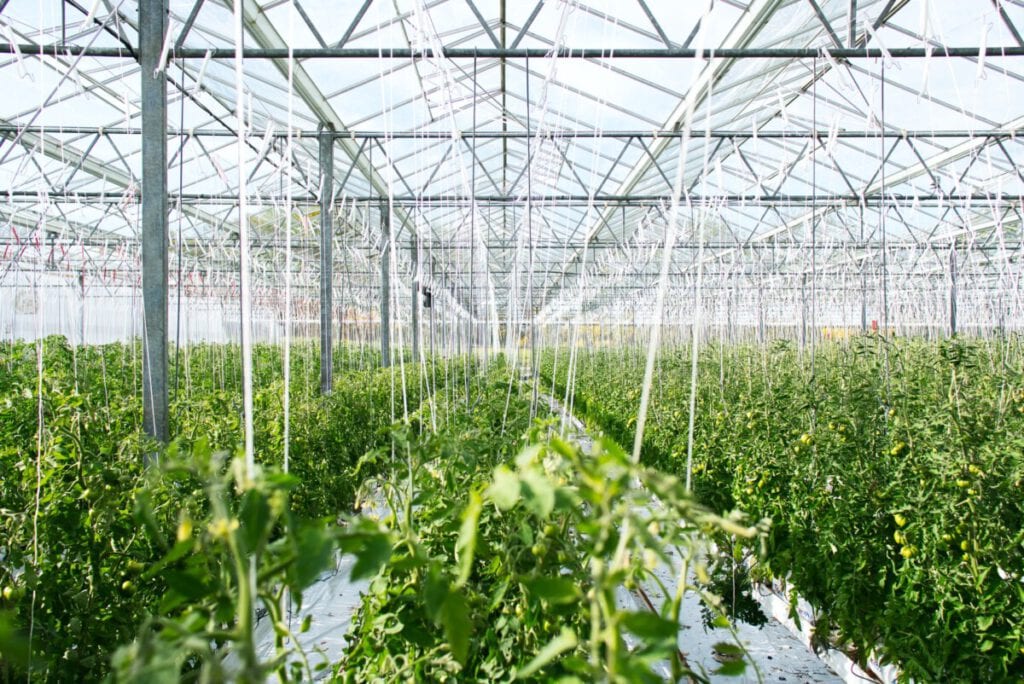
The Dutch are great at greenhouse farming. Image: Erwan Hesry/Unsplash
Yep, a country so small you can drive through it from its northern to southern tip (the largest distance) in just about two hours if you don’t hit any heavy traffic. And somehow the Dutch still manage to crank out enough food to feed the world!
In comparison, the US is the largest food exporter but is also 230(!) times bigger than Holland. Can you imagine that medal ceremony? On the highest block stands a buff American waving a massive flag, and next to them stands nothing but a tiny little Dutch flag, on a toothpick, that gently waves back and forth. That little flag is being held by a stubborn, but very happy, little ant — that’s Holland for you!
The Dutch have built their own little agricultural powerhouse, no bigger than Maryland, upon some of the most fertile soil in the world. It’s carefully divided into countless farm plots, all conspicuously irrigated by means of the typical Dutch polders.
Sex education and having the lowest rate of teen pregnancies in the EU
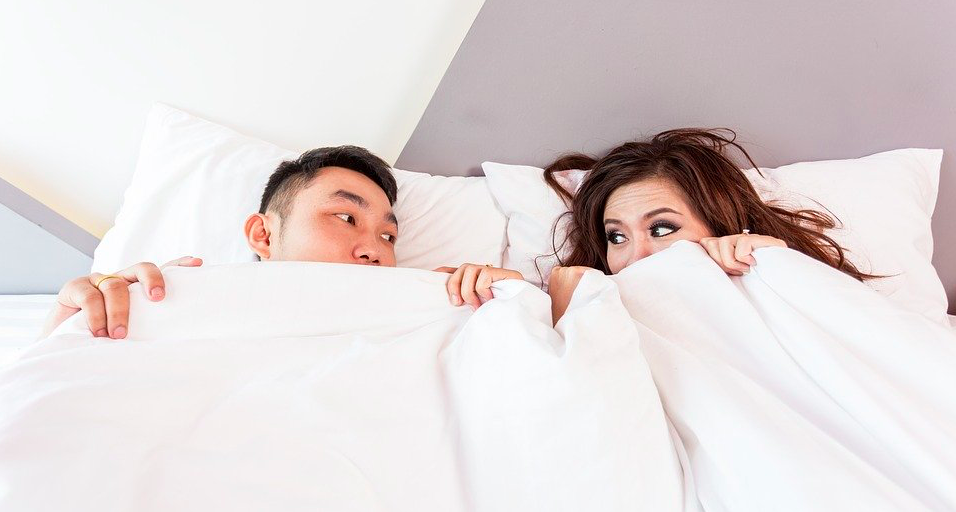
The Dutch talk about the birds and the bees from a young age. Image: sasint/Pixabay
You know how it goes, ‘If you don’t want babies, don’t have sex!’ Or, ‘If kids are exposed to sex ed, they’ll want to have sex and get pregnant!’ Well, if there’s one country proving these ideas wrong, it’s the Netherlands!
The Dutch don’t believe in forbidding things or keeping things secret and hushed up. In little Holland, it’s all out in the open. The Netherlands has been giving teens, even children, sex education for decades, giving them a heads up about what it’s all about and what the risks are. No, don’t worry — they’re not showing them porn!
We had more sex-ed classes in high school and even a visit from the Rutgers Foundation (set up in the ’70s to spread awareness of anti-conception) which gave us a clear understanding of what was going on with us internally and externally. And though we had a good laugh or two, we became even more aware that even though sex was fun, it could come with a price tag. One that screams, cries, vomits, and poops…
The point is that the Dutch have proven that sex education and an open attitude help young men and women understand things ahead of “experimenting” without any guidance – teens try things out because they can. If you give them a heads up about what matters, you’ll be surprised how many of them do listen! If it works for Holland, don’t you think it’d work elsewhere too?
Good food, good environment, and good genetics — the Dutch are TALL. Image: Andrea Piacquadio/Pexels
Do you like tall men? Welcome to Holland! Where men grow to astounding heights! Yours truly stands less than an inch shy of six feet tall which actually makes me just below average in the Netherlands. In fact, some of my college buddies were so tall, I only reached to their shoulder! Yes, really. And it’s not an uncommon sight in the streets of Dutch cities to meet men, and the occasional woman, of such height.
The reason behind Dutch height isn’t just being genetically lucky, it’s all about food and good health. The Dutch have been able to provide themselves, and especially their youngsters, with a proper diet, a healthy environment and great access to medical care.
Other than a short, but harsh, Hunger Winter after WWII, the country has persistently become healthier and focused on trying to improve things for each successive generation. With success, the Dutch have gained 20 centimetres (8 inches) of the last century and a half!
More bikes per capita than any other European country
You like bikes? The ones with the pedals and the exercise? If the answer is yes, you came to the right place! The Netherlands has almost as many bikes as it has people. That’s no joke. In fact, many of us own multiple bikes. There’s one of them in the shed outside and two parked on the carport of my house. One for me, one for my mom, and one for a friend from Spain.
In 2017, 68% of work and school traffic in Amsterdam was by bike! Cycling counts for 36% of all forms of traffic in the city.
Of course, it helps that Amsterdam, and almost all cities and towns in the country, are extremely “bike-friendly.” You have your own lanes, you often have right of passage, you can rent them, and you have parking accommodations.
Plus, if something goes wrong with your bike, there’s a pretty good chance a fellow cyclist will show up and help you with that flat tire or broken light.
Another added benefit is that cycling is great exercise, which is one of the secrets to the Dutch being relatively slender and healthy. You will see Dutch toddlers ride bikes before they can even walk properly. The Dutch are, so to speak, born with a bike between their legs.
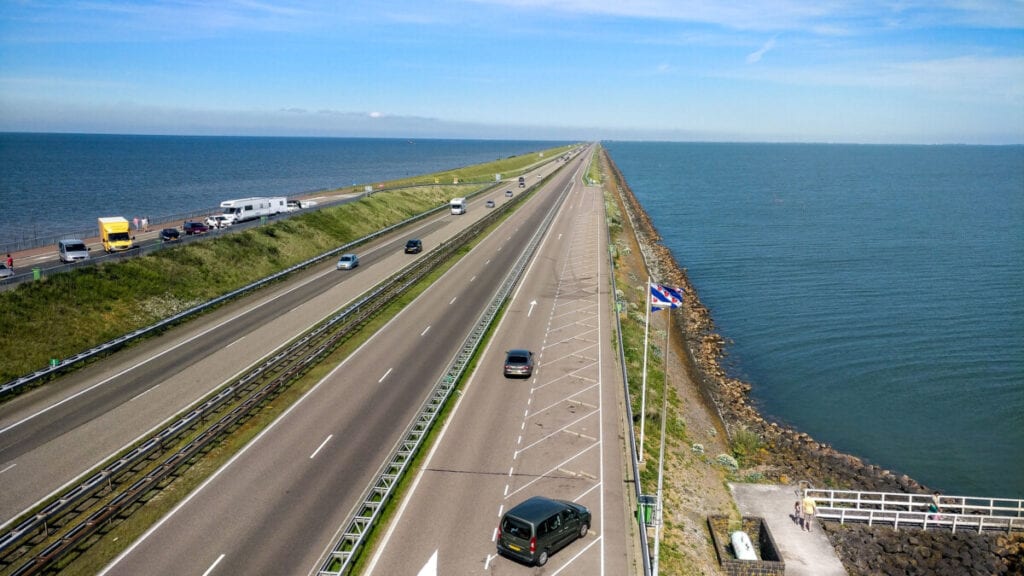
The Afsluitdijk has been protecting The Netherlands from the force of water for over 90 years. Image: jbdodane/Flickr/CC2.0
You probably figured there’s some dark secret behind the Dutch keeping all that water out, didn’t you? Well, it’s not as dark as you might think, even though we forged a deal with the devil, but it has cost us some real effort.
The Dutch have fought, with success, against the rivers, lakes, and seas for centuries. They’ve used their iconic windmills as pumps to clear the area, and re-shaped entire rivers, and even part of the sea, to make space.
The Netherlands, largely, is below sea level. This is both because the Dutch directly build new lands from the sea but also because of digging out the many layers of peat from the soils, which was necessary for people to make it through the cold winters.
As a result, the country suffered many floodings and loss of lives. As recent as 1953, a major amount of dikes gave way during a superstorm in the province of Zeeland, taking 2000 lives with it.
The Delta Works
After this great catastrophe, the Dutch, stubborn and steadfast as always, decided to turn the tides once and for all (quite literally in this case). They began construction on the biggest, most advanced water management system known to mankind: the Delta Works.
The Delta Works are an almost endless collection of dikes, water locks, bridges and storm barriers that interconnect across the Zeeland/Zuid-Holland region. They are built to withstand storms and waves currently unseen in history. But with the rising seas because of climate change, the Dutch are already planning further improvements.
The Delta Works is considered one of the ‘Seven Wonders of the Modern World’ by Quest magazine and the American Society of Civil Engineers.
So, if you have trouble with water, call a Dutchman! Or just put your finger in the dyke. Just your finger though, nothing else – don’t be a pervert…
The best non-native English speakers on the globe.
Speaking English? Geen problem! Image: Buro Millenial/Pexels
“Yes, but, also! Dat is also a ting I can do, also!” Okay, sure, it’s not always the easiest accent on the ears but overall the Dutch speak their English very well. They’re almost always capable of understanding what you are trying to get across. That is, if you speak it properly too.
The Dutch also enjoy speaking English, which can be very frustrating to newcomers who are trying to learn the local language. When a Dutchman notices as much as a hint of an accent in your ‘finest Dutch’ many of them will automatically switch to English.
It’s spoken (almost) everywhere
English is also spoken at most important places, such as higher education institutes, as well as in hospitals, police stations, city halls, and public transportation facilities. Of course, that doesn’t mean you shouldn’t learn Dutch. For advancing your career it’s vital. And of course, friendships grow tighter if you can converse in the native tongue.
Here’s some Dutch for you:
Dutch, English, and German all belong to the same branch of languages, West-Germanic. They all originate from Germanic roots. Dutch, being in between Germany and the British isles, is actually quite close to English.
In fact, Dutch is the closest popularly spoken language to English in the world. In other words, apart from actual English itself, Dutch is the closest thing to it. There is Frisian, however, which is even more closely related. It’s also spoken in the Netherlands, but only has a few hundred thousand speakers in limited regions. Dutch, however, is spoken by 18 million Dutchmen and millions of Flemish in Belgium.
So, despite the fact that people like Louis van Gaal occasionally embarrass Holland on a nationwide scale with their English ability (or lack thereof), you should do fine with it in Holland. Above all, the Dutch, curious and tolerant by nature, are almost always happy to figure out a way to communicate with you, whether your English is perfect or not.
What do you think are the best parts of living in the Netherlands? Let us know in the comments below!
Feature Image: djedj/Pixabay Editor’s Note: This article was originally written in December 2017 and was fully updated in February 2021 for your reading pleasure.
The past few days have seen the Dutch government lean towards the easing of coronavirus restrictions — but some experts worry the Netherlands is moving too quickly.
Epidemiologists Patricia Bruijning, Alma Tostmann and Amrish Baidjoe have told the NOS that they believe it is too soon to begin easing restrictions in the Netherlands.
“I think it is still a bit early,” says pediatrician epidemiologist Patricia Bruijning of the UMC Utrecht. “With the current measures it is already complicated to get the R-number below 1, let alone if you are going to relax.”
Alma Tostmann of Radboud UMC believes that the government should wait another two weeks. “Then you lift it over the spring break and you can see how things are going,” she says.
What about primary schools and childcare?
Both Bruijning and Tostmann believe, however, that primary schools can be opened exclusively if stricter measures are in place. “This variant is more contagious for everyone, including children. But children of primary school age are still much less contagious than adults,” says Tostmann.
“Primary schools are now opening with a much more extensive package of measures than before,” says Bruijning. “The expectation is that we will be able to limit the spread in schools and that the effect of reopening on the R-number will remain limited.”
However, the third expert that the NOS spoke with, field epidemiologist and microbiologist Amrish Baidjoe, believes that even opening the schools is too much of a risk at the moment. “Without a plan on how to do it responsibly, the schools shouldn’t open. It happened in September and it’s happening again,” he says.
Social pressure
Baidjoe believes that the decision to reopen schools and begin easing other restrictions can be attributed to social pressure. “The fact that we are opening primary schools is not because things are going very well — although they are not going very badly — but because everyone feels the social pressure.”
He believes that in reopening schools, the cabinet feels it must relax other measures. “That [decision] should not be translated into: ‘if you open primary schools, other measures can also be relaxed.'”
Tostmann has a similar opinion, but understands the cabinet’s decision. “The best thing you can do to stop the virus from spreading is to lock everyone up and wait until we are all vaccinated, but that is of course not socially responsible. I therefore think that the cabinet is implementing these easing to comply with social pressure. As long as it is done responsibly, it is fair. ”
Do you believe the Dutch government is easing restrictions too quickly? Tell us your thoughts in the comments below!
Yesterday, it was revealed that half of the latest coronavirus infections in the Netherlands are estimated to have been caused by the British variant of the virus.
This was stated in a letter that the Dutch cabinet sent to the Lower House last night, the NOS reports. In the letter, it was written that the rate of reproduction (R rate) of the British variant was 49% higher than that of the initial coronavirus strain.
A higher rate of reproduction
In mid-January, it was estimated that the British variant has an R rate of 1.27, meaning that, on average, those who contract the virus will pass it on to at least one other person — if not more. In comparison, the R rate of the original coronavirus was estimated to stand at 0.85 in mid-January. In order to eradicate a virus, it is required that the R rate remains below 1.
Half of all new infections
In mid-January, it was estimated that a third of all coronavirus infections in the Netherlands could be attributed to the British variant. However, the letter stated that using the above figures, it is now estimated that of all Dutch infections with a first day of illness beginning on January 26, half are caused by the British variant.
What do you think of the government’s decisions? Do you think the Netherlands should be more worried about the British variant? Tell us your thoughts in the comments below.
Keen to enter a store that’s not your local Albert Heijn? Keep that chin up — the government wants to reopen shops as early as next week.
However, if you’re hanging out for a shopping spree you’ll need to be a little more patient. Shops will only be allowed to reopen so customers can collect orders made online or by phone.
The change could take effect from February 8, but whether it will happen or not isn’t set in stone. The cabinet remains concerned over the British coronavirus variant and will announce their final decision tomorrow.
It comes after RIVM reported 3714 infections yesterday, the lowest number seen since October 1.
The move is in line with two other recent coronavirus restriction easings made by the government. Yesterday it was announced that primary schools would also be allowed to reopen on February 8.
Meanwhile, sources from The Hague say that the government is planning to retire the 9 PM curfew from February 10.
Follow DutchReview on Facebook to stay up to date with all the coronavirus news in the Netherlands.
When talking of sex — and the Dutch do that a lot! — one cannot ignore the practice of safe sex, consent and open-mindedness. It is no wonder, then, that the first speciality condom shop in the world originated in… you guessed it! Amsterdam!
As we know, there are many niche and novelty concepts and ideas that originated in Amsterdam. The famous Red Light District in De Walletjes is synonymous with the culture of experimentation and barrier-breaking of the Netherland’s capital city.
As the leader of sexual liberty, Amsterdam opened the world’s first shop dedicated solely to all things condoms in 1987. On a Saturday in May, 34 years ago, the Dutch media set the stage for the worldwide attention centred on the first condom speciality store in the world. As if this store wasn’t ground-breaking in itself, this shop was opened by two women!
Amsterdam’s first condom shop — opened by women!
The idea to open this novelty store was born in a restaurant in Amsterdam, around which discussions about the AIDS pandemic were literally the talk of the town. Since the early 1980s, stigmas and insecurities surrounding the deadly virus caused a new infatuation with safe sex.
Although condoms were available in pharmacies and sex shops, there was no choice of useful, informative and easily-accessible information. And so, on an April evening in 1987, Riddle Marijke, Ricky Janssen and Theodoor van Boven made the decision to challenge the stigma and implement the idea of a shop dedicated solely to safe sex. Thus, Condomerie was coined.
No judgement
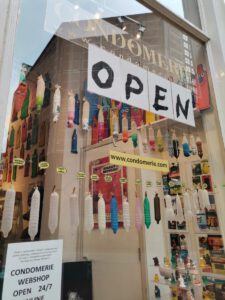
Check out those bad boys. Image: Kathryn van den Berg/supplied.
The philosophy of Condomerie is, ultimately, that safe sex is not a compromise and can be just as exciting and fulfilling as unprotected sex. The AIDS virus, and other sexually transmitted diseases, don’t discriminate on race, sex or status. To this day, Condomerie is committed to an atmosphere of acceptance and “service with a smile.”
In addition to offering tested condoms, the Condomerie also offers fun and fantasy condoms along with advice, and an environment of “no judgement.” Not only does this store offer a safe space in which patrons can explore and inquire (the staff even advise on condom sizes and ask about personal preferences!) but it also, naturally, breaks the taboo of sex which accompanies many international visitors.
Sex happens, even during lockdown
Condomerie’s physical store is decorated with fun, tongue-in-cheek and exotic art and illustrations. They even have a section dedicated to “Lockdown Love,” with humorous posters on their doors promoting their quirky take on the pandemic regulations. One such sign reminds passers-by that “inside, you must wear a face mask and in bed…wear a condom!”
Condomerie’s online webstore offers choices of flavoured condoms, ribbed condoms or glow in the dark condoms under the tab “Serious Fun.” As if this is not an enticing enough reason to visit the online store, custom condoms are also available for order and come with instructions for measuring the penis.
In evolving with the times, Condomerie has also taken to social media to ensure that the world’s first condom shop remains the most inviting. The Condomerie Instagram Page keeps up to date with the politics, weather, and trends of the day with humorous anecdotes and advice.
Along with quirky illustrations and dirty-humour sayings like “our favourite quarantine activity is going (lock)down”, they also provide information on latex allergies, debunk condom-related myths and, most importantly, invite open, interactive discussions around sexuality and safety.
Did you know about Amsterdam’s thriving condom shop? Tell us your thoughts in the comments below!