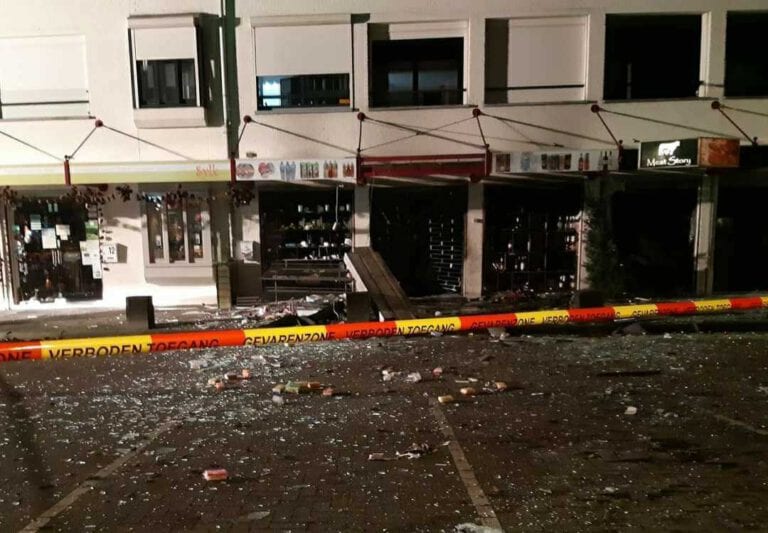
Two Polish supermarkets belonging to the Biedronka chain were damaged in separate explosions last night. The first explosion occurred in Aalsmeer and the second was in Heeswijk-Dinther.
At roughly 3 AM last night, the first explosion caused the Aalsmeer supermarket to erupt in flames. The entire shop was burned out, the NOS reports.
In addition to the supermarket, a car went up in flames as well as the apartment located directly above the supermarket, which has now been deemed uninhabitable.
An hour later
Approximately one hour later, the Heeswijk-Dinther branch of the Polish supermarket chain also suffered an explosion. The facade of the building was blown out and debris was scattered onto the street.
All residents of the apartment building above the supermarket had to be evacuated. Roughly 20 residents of the apartment building have been told not to return inside their homes for the time being.
The fire department must now ensure that the structural integrity of the entire building has not been affected by the extensive damage to the supermarket.
There have been no reports regarding the cause of the two fires.
Follow DutchReview on Facebook for the latest news and updates.
It’s long been known that volunteering in your local community can have a positive impact on you and the community you live in.
Whether you have newly arrived in the Netherlands or have been at home here for longer, by volunteering you can forge links between you and your community, improve your language skills and widen your network.
Volunteer the Hague works to facilitate engagement of internationals with the local community in The Hague and surrounding areas, while NL Cares and Stichting Present have offices in Utrecht, The Hague, Rotterdam and Amsterdam. On the websites of these organisations, local nonprofits can post their vacancies and volunteers can find ways to help.
Last week I spoke with Tetyana Benzeroual, project manager at Volunteer The Hague, to get more insight into volunteering in the Netherlands: what you can do as a volunteer, what volunteering can do for you and how coronavirus has impacted volunteering in the Netherlands.
Volunteering allows you to create a support network
Tetyana spoke of building a support network in the local community through volunteer activities. This is perhaps especially important for those who have just arrived in the Netherlands. “They need that feeling of belonging somewhere or to something bigger or greater than they are.”
Making real-life connections is valuable and important for all of us, no matter how long we’ve been living in a community.
Alongside the social and health benefits of volunteering, it’s also a great way to boost future career prospects. If you aren’t having much luck on the hunt for a job, why not dedicate some time to a volunteer role?
Volunteering can really enrich your CV. Image: fauxels/Pexels.
Often, volunteers already have the skills and expertise organisations need, such as PR or accounting skills. In this way, a volunteer can develop their skillset and add valuable experience to their CV.
How does volunteering benefit organisations?
And what about the organisations? How do they benefit from the work of volunteers?
Tetyana notes that the organisations looking for volunteers are most often very small, local non-profits who really need support.
Volunteers bring new ways of thinking, creative ideas and a range of useful skills to the organisation.
Even if your Dutch is not yet perfect, there’s no reason to hold back as there are opportunities to volunteer regardless.
Here at DutchReview we’ve got plenty of articles on how to get to grips with Nederlands, and, of course, as a volunteer you will have plenty of opportunities to brush up on language skills while on the job. Fellow volunteers might even be able to help you make sense of Dutch grammar!
Volunteering in the corona times
It goes without saying that many events have been called off or postponed as a result of COVID-19 restrictions. Nonetheless, there are still many volunteer opportunities out there.
A number of campaigns have been set up to reach those who may be lonely or especially in need of help right now.
Have you got a musical talent you’d like to share? Then check out these open air performances, or perhaps you’d rather contribute to this ‘Happy Newsletter’ or use your creativity to write a postcard.
Many organisations are also realising how useful online technology and social media are, meaning there is ample opportunity for tech-savvy volunteers.
So what are you waiting for? Reach out and see where you can offer assistance, there are boundless opportunities to engage with the community, to mobilize yourself for a cause you care about or one that will improve society.
Have you volunteered in the Netherlands before? Tell us about your experience below.
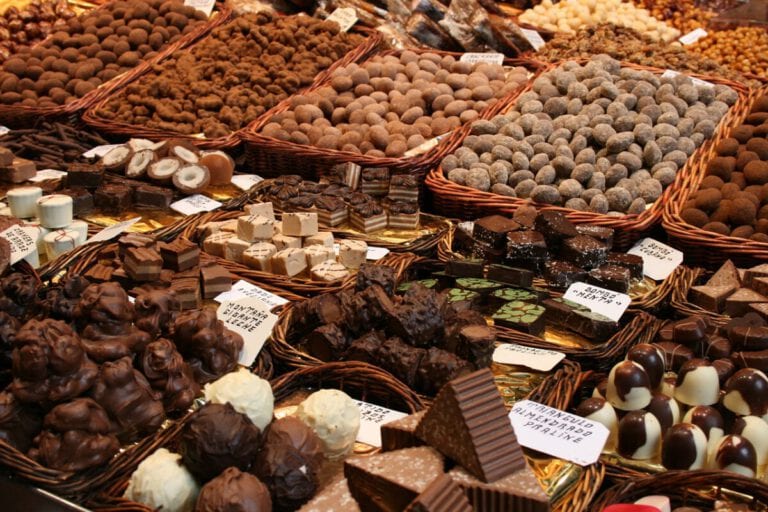
It is that time of the year when fairy lights twinkle and chocoladeletters enter our shopping baskets. Speaking of chocolate, did you know about its history in the Netherlands? Grab a hot cup (or cold cup, you do you) of Chocomel and gather around children.
As Holland prepares to dress up as winter wonderland, the Dutchies prepare to get all gezillig indoors. The must-haves include pantoffels (if you are Dutch) or fluffy socks (if you aren’t), a hunk of chocolate and warm Chocomel.
Despite being several years older than the legal age for drinking, hot chocolate remains my comfort drink. And now I can wolf down my third cup of chocolate without being judged!
The Dutch actually holds a significant spot in the history of chocolate. Image: Jessica Laoiza/Unsplash
Amerika to Europa: chocolate’s history
It is amazing how the nondescript cacao bean native to tropical Mesoamerica has made its way into every street in the world. While the word chocolate conjures an image of silky, brown heaven, it wasn’t always the sweet, luscious treat we know today.
The Aztecs and Mayans made a bitter, frothy and spicy drink with it, often laced with hot chili peppers! An idea that probably inspired Lindt and other chocolate makers.
Can you imagine, Switzerland, now the face of luxurious chocolate, once had no idea about its existence?! Come to think of it, the whole of Europe was oblivious to this food of Gods for the longest time. That is until 1500s when the Spanish invaders took back sacks of cacao beans.
There are many theories about how cocoa entered this continent; some say it was a gift, others say Columbus intercepted a ship to sneak a haul of beans, but one thing was for sure — after one taste, Europeans were hungry for it. As other sailors set out to bring home the riches, Spain lost its monopoly over this exotic food.
Chocolate h(e)aven
During the Golden Age, Amsterdam wielding all its power and wealth came in possession of this trade, thereby making chocolate an essential luxury for the Dutch nobles. For a while, chocolate had touched only the lips of aristocrats.
But then, the thrifty Dutch mind worked to cut costs and made this luxury economical. The Van Houten’s, an innovative father-son duo came up with a process rather like a chemical inburgering or ‘Dutching’ of cacao beans. Resulting in the super-rich, extra dark cocoa powder, which has taken the culinary world by storm.
Dutch ingenuity combined with their keen business sense spiraled the port city of Amsterdam into becoming the chocolate capital of continental Europe. And for the longest time, the country minted money through this trade.
Realizing the worth of these exotic cacao fruits, Europeans started to colonize the tropics with Dutch at the forefront, acquiring vast areas of West Indies. In fact, the Dutch were also instrumental in the spread of cacao trees to Asia.
All is fair in cocoa fair
While it is true that the grandeur of the Golden age came at the price of slave lives, Holland today has rebranded itself as the face of sustainability and fair-trading.
Every year something akin to Charlie and the chocolate factory happens in Amsterdam. It is called Chocoa, and is THE event for chocolate lovers, chefs, connoisseurs and traders. Organized in the historic exchange market of Beurs van Berlage in Amsterdam, the fair serves to celebrate not only chocolate, but also the faceless farmers who grow them.
So, apart from the microscope, stock market and of course the unnaturally (now natural) orange carrots, the Dutch also owe thanks from the world for making chocolate affordable. The next time you reach for chocolate or hagelslag on korting, think of the Dutch who helped us buy it without burning a hole in our pockets!
Chocolate. Where would we be without it? Did you know about the Dutch’s role in making this delicious dessert? Tell us your thoughts in the comments below!
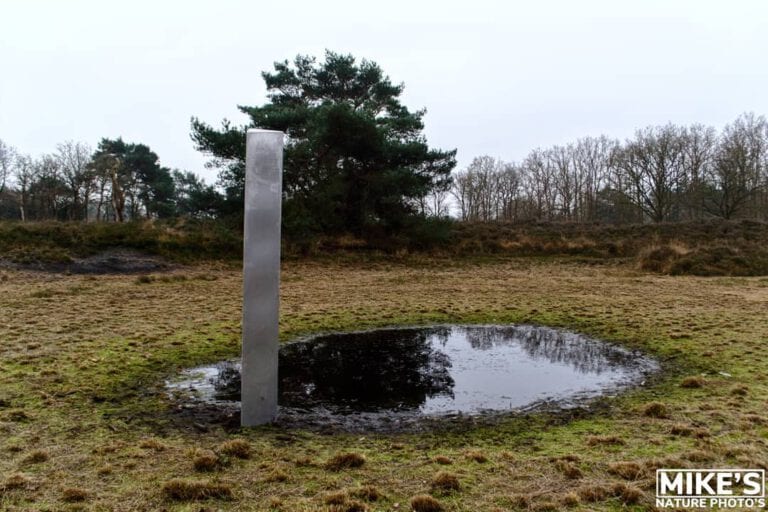
Following the sudden appearance and disappearance of mysterious metal monoliths in the US, Romania and Colombia, a monolith has been found in the Netherlands.
Walkers in a nature reserve near Oudehorne, Friesland made the surprising discovery on Sunday morning. Unlike the previous monoliths, the structure that has appeared in the Netherlands is not made of a shiny material.
The Dutch organisation for the management of forestries and national reserves, Staatsbosbeheer, tells NU.nl that they have no idea where the construction came from.
While the appearance of the object is a mystery, a representative for the Staatsbosbeheer tells NU.nl that the arrival of the monolith in the Netherlands is “not a big problem relatively.” The appearance of the object will be extensively examined today.
A New Year’s Eve stunt
When asked by AD, walkers in the area said they believe the construction is simply a New Year’s Eve stunt. It is believed the monoliths are a reference to similar structures that appear and disappear in the film, 2001: A Space Odyssey.
In A Space Odyssey, the structures are built by unseen extra terrestrial creatures and appear and disappear in different regions of the world.
What do you think of the mysterious monoliths? Let us know your thoughts in the comments below!
Are you dreeeaming of a whiiite Christmas? Well, the best the Dutch can do right now is rain, with chilly weather entering the Netherlands overnight.
It was hoped that Limburg, in the south of the Netherlands, would already receive some snow last night. However, despite Limburgers best attempts at a snow dance, the region just remained wet and cold.
Regardless, the Dutch meteorological institute KNMI has issued a code yellow warning for slipperiness in the Limburg hills.
In the meantime, residents of the rest of the Netherlands will have to cross their fingers and toes that they’ll get more than just those crippling cold winds that whip through their bodies and a frozen bum from sitting on a wet bike seat.
Wet today, and a chilly week ahead
Temperatures across the Netherlands are even chillier than expected at the moment. While the yearly average is normally around seven degrees, the next few days will only be just above freezing. The mercury may even drop below zero overnight.
Today, it’s raining. But you already knew that, because you probably have windows. What we can tell you is that it will keep raining all day long. A lot of rain. Like, a lot.
“There is a disturbance, which drops a huge bowl of rain in the country of about 20 to 30 millimetres,” explains meteorologist Brian Verhoeven of Buienradar to RTL Nieuws.
From tomorrow, it will be dry until Thursday, says Verhoeven. But don’t get your hopes up, because tomorrow will be the only day we can see real sunshine. “For the rest, the weather is usually grey and grey, really the dark days before Christmas.”
Are you hoping for snow this winter? Tell us in the comments below!
When a Rotterdam family’s Sinterklaas gifts were stolen from their front door, the police didn’t just go after the thief; they made a heartwarming gesture and bought new presents for the children.
On Saturday, a Rotterdam man was celebrating Sinterklaas with his family when he received a text from his parents — they had left some gifts at the front door as a surprise for their grandchildren.
But when the father arrived at the door, the presents were gone.
The Rotterdammer hoped perhaps a neighbour had moved the gift inside to keep them safe but camera footage from a local resident showed that the gifts had indeed been stolen.
The man posted about the incident on Twitter, which quickly received an enormous response.
Wil de meneer die geheel “per ongeluk” de #sinterklaas kado’s van mijn kinderen heeft mee genomen vanaf het schulpplein in #Charlois zo vriendelijk zijn om deze weer terug te brengen. Gewoon even kloppen en hard weg rennen. Zoals het hoort op #pakjesavondpic.twitter.com/4XVEXhzdM2
In English, the Tweet reads: “Would the gentleman who completely ‘accidentally’ #sinterklaas took my children’s gifts from Schulpplein in #Charlois be kind enough to bring it back? Just knock and run away. As it should be on #pakjesavond.”
Poetic justice
What happened next was “super sweet,” according to the Rotterdammer. The police caught wind of the Tweet and posted a response in classic Sinterklaas rhyme form.
Op 5/12 was in Charlois een feest, totdat er een boef langs is geweest. De deur ging open en wat een pech, de zak en kado’s waren weg. De politie vond dit naar,en zette een zak met kado’s klaar! En ook al hebben wij nieuwe kado’s gekocht, naar de boef wordt natuurlijk gezocht! pic.twitter.com/7UlodJlZEk
The (obviously cuter in Dutch) poem reads: “On December 5, Charlois was a party, until a crook came by. The door opened and what bad luck, the bag and presents were gone. The police thought this was unpleasant, and prepared a bag of gifts! And even though we have bought new gifts, the crook is, of course, searched for!”
“A very sweet gesture”
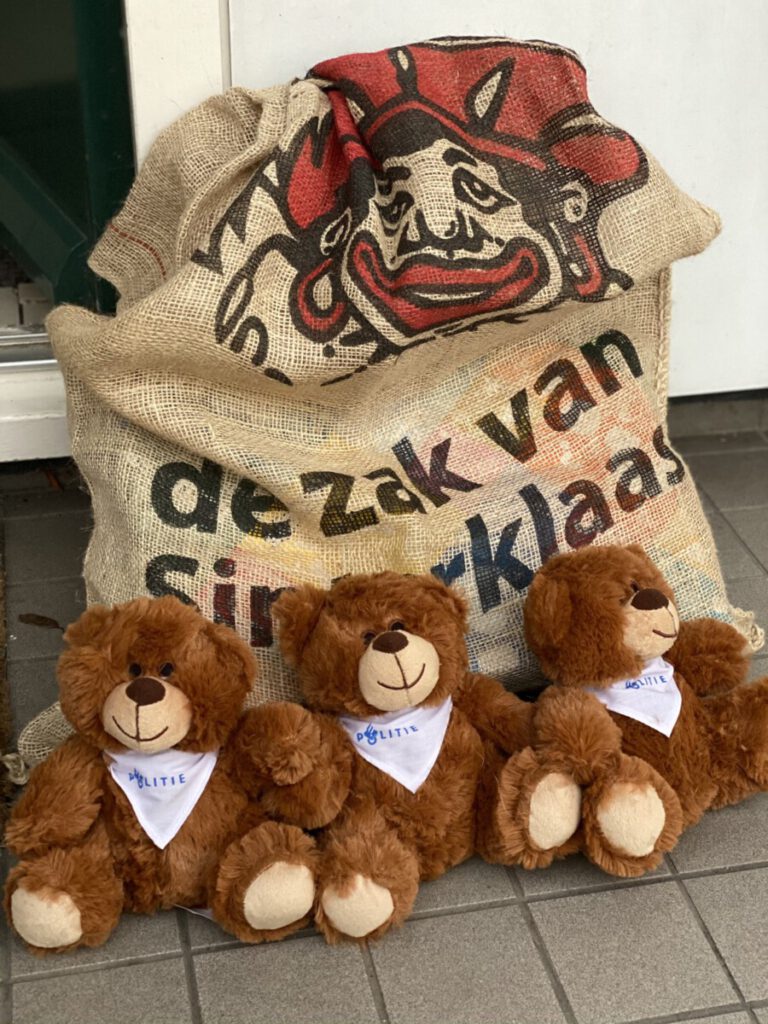
The police asked the children what they wanted, and arrived at the Rotterdam home with a bag of gifts: Monopoly Cheaters Edition, Scoubidou strings, and an animal quartet, along with three teddy bears.
“We are absolutely not pathetic or needy, so when they told us about this plan, we said it really wasn’t necessary,” the Rotterdammer explained. “But they really wanted to give something. A very sweet gesture and the children are very happy with it too.”
Many on Twitter have been touched by the kindness as well. “Great how you handled this. Thank you very much,” writes one Twitterer. “I am deeply moved,” says another.
What do you think of this holiday gesture? Tell us in the comments below!
Dutch political party, GroenLinks, has returned to their plan of giving every Dutchie €10,000 when they turn 18 years old — with some key differences.
Now, instead of the money being given as cold, hard, cash it can only be used for study and training — for the first five years at least.
However, from the age of 23, the lucky youth will be able to spend the cash on whatever they want.
New and improved
The original plan was announced two months ago but received a lot of criticism. In the original version, the recipients could do what they wanted with the money from the get-go.
Groenlinks leader Jesse Klaver says the plan has now been improved. “Young people indicated that 18 years old is sometimes too young to make wise choices and that at this age it can put too much pressure on families with a debt problem.”
The first plan received a lot of criticism on all fronts. According to RTL Nieuws, some critics believed that it is character-building for a young person to start out “poor” and that this amount of cash could disrupt families. Others believed that €10,000 wasn’t enough money.
Who foots the bill?
With stacks of cash going toward every young person, you may be left wondering whether taxpayers are left footing the €2.2 billion bill.
The answer is, yes — but only the very rich taxpayers. Millionaires will pay an extra one percent tax on their assets each year, and multi-millionaires will pay an extra two percent.
Fight against inequality
Groenlinks is focusing their upcoming policies on young people and their future. “In the past decade, insecurity and inequality among young people have increased,” says Klaver.
The party, therefore, wants to promote equal opportunities for young people. “For an increasing number of people, the penny has dropped that, also in the Netherlands, opportunities are determined by where you were born, what your parents earn and whether you are going to study.”
What do you think of this renewed plan? Tell us your thoughts in the comments below!
In the US, former presidents are being vaccinated on camera to show the public that the vaccine is safe. Now the question in the Netherlands has risen: should Prime Minister Mark Rutte and the Dutch royal family follow suit?
The three most recent former US presidents, Barack Obama, George W. Bush, and Bill Clinton hope to promote public confidence in the new coronavirus vaccine with their new awareness campaign. They want to do what they can to encourage people to get vaccinated.
Former President Obama says he may end up getting the vaccine on TV or having it filmed, as soon as it’s ready for people who are less at risk.
“People like Anthony Fauci, who I know, and I’ve worked with, I trust completely,” he said in a SiriusXM interview. “So, if Anthony Fauci tells me this vaccine is safe and can vaccinate, you know, immunize you from getting COVID, absolutely, I’m going to take it.”
Should Rutte and the king do the same?
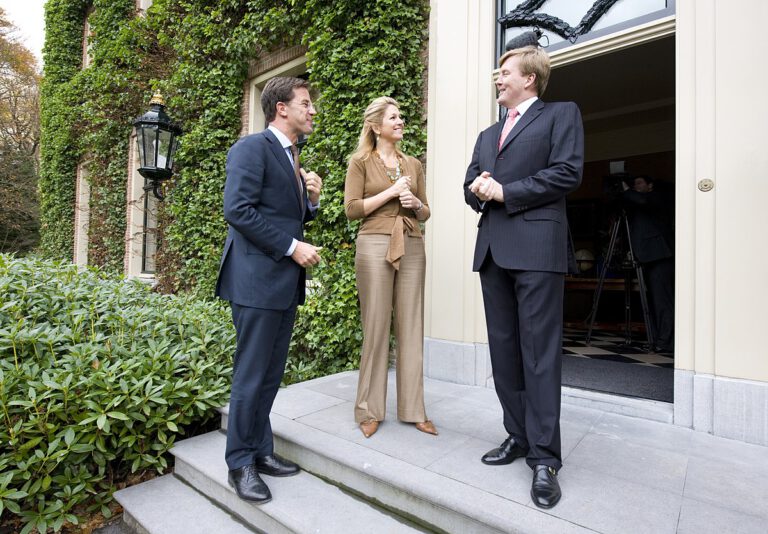
Some people in the Netherlands are now suggesting a similar campaign would benefit the Netherlands, according to RTL Nieuws. Prime Minister Rutte was asked if he would be vaccinated in front of TV cameras.
A spokesperson for the prime minister responded that “In the Netherlands, we are following the vaccination policy properly.” He says that when the time comes, Rutte will be vaccinated “but how that will happen, we will not anticipate yet.”
Minister of Health Hugo de Jonge doesn’t want to commit to a public vaccination yet either. Neither of the ministers is particularly vulnerable and they will not be in the first group vaccinated in the country.
Balkenende on-board
Former Prime Minister, Jan Peter Balkenende, on the other hand, might just go for it. He tells RTL that “Any action can, of course, only be taken in consultation with others, but I would consider it.” Balkenende says he feels very positive about the vaccine.
Too personal for the royal family
For the Dutch royal family, representatives say simply that the vaccination “is a private matter.” Neither the 53-year-old King Willem-Alexander nor the 82-year-old Princess Beatrix (who falls into the first round of vaccinations), will likely be filmed receiving their vaccinations.
“That is too personal. Even if it may help a little, they are not going to do it,” says royalty reporter Rick Evers.” He says they will likely publicly urge people to get vaccinated “but they will not put themselves in the spotlight while they are vaccinated.”
Not too personal for royals elsewhere
However, while it may be too personal for this royal family, this type of public health display is not uncommon. In 2016, for example, Prince Harry of the British Royal Family had an HIV test performed on live TV to highlight the importance of testing.
The British royal family has also been very vocal regarding their family’s vaccinations for MMR, and polio vaccinations in 1950.
Even as far back as 1805, Indian queens modelled for the world’s first vaccine to encourage participation in the smallpox vaccination programme, captured in a painting commissioned by the East India Company. Suffice it say, vaccinations aren’t such a personal matter for royalty in the rest of the world.
Do you think the prime minister and Dutch royal family should receive vaccinations publicly? Tell us your thoughts in the comments below.
Students from the Groningen fraternity and sorority Vindicat have been suspended for the rest of the year after throwing a party on a bus against all coronavirus measures.
A video of the party that came out on social media shows that the students did not wear face masks or keep their distance. Between thirty and forty students took part in the party which the bus company called “completely out of hand,” reports RTL Nieuws.
Buses are allowed to be at full capacity, but passengers must remain seated throughout the journey and wear face masks. Boostbussen, the company who these students rented from, advertises “corona-proof tours throughout the Netherlands.” But in the video, an employee can be seen who does nothing about the party, reports AD.
The owner, Nico Kooistra, explained that they do not normally see things like this. “This didn’t go well. Nobody wore a face mask. Normally we are very keen on that.” She added, “We organize more of these types of trips, but they always go according to the measures. For example, we do a health check and we, therefore, have the duty to mask. That didn’t go well last night.”
Vindicat comments
The student association emphasized that the party was not arranged by them, but that they are investigating who was involved. Chairman Wessel Giezen says holding such a party was “bizarre”. The chairman says, “We must first identify who is involved. There are penalties for this.”
Since then, some suspensions have been made but investigations are still ongoing as to who organised the party, as well as which individual was heard telling people to stop filming on one of the videos.
What do you make of this student party? Tell us in the comments below.
I hail from one of the most populous countries of Asia (read most polluted), and to me, even the cigarette smoke outside Schipol airport smells fairly clean. Call it being eco-conscious or even thrifty — cycling as a way of life, along with tiny electric cars and gleaming solar panels contribute to the charming outdoors in the Netherlands. But in this seemingly eco-conscious culture, something else I’ve noticed doesn’t add up.
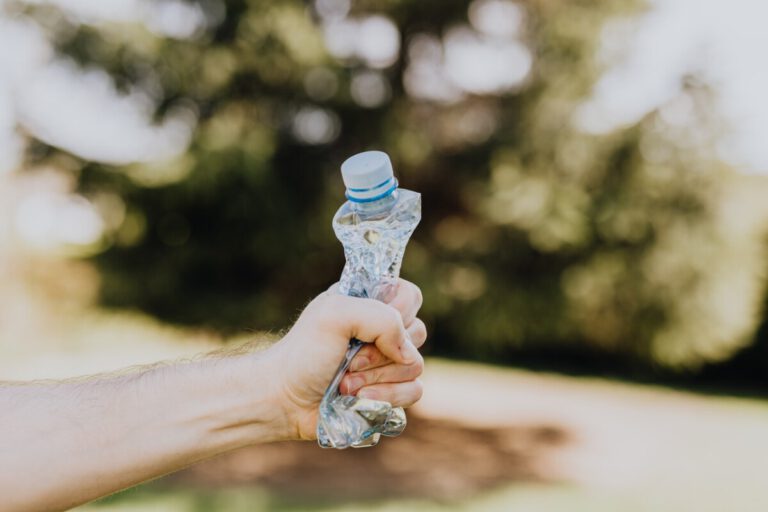
In my early months in the Netherlands, I’d spends hours in the neighbourhood supermarkets where even the not-so-authentic Indiaase gerechten made me feel closer home. However, while local Albert Heijns and Jumbos helped alleviate some homesickness, they did make me sick of something else — the omnipresent plastic.
Plastic, plastic everywhere
Rows of cling-wrapped aubergines and cucumbers resembling a certain condomed something, buckets of snoepgroente, citrus, and onion families sitting in plastic wicker, corn cobs packed in plastic with a plastic tray and bananas staring glumly out of the hideous Chiquita bag; all adorn the supermarkets. Broccoli, cauliflower, and cabbages are given the same plastic treatment.
When the eco-warrior in me had screamed herself hoarse, I tried to choose only loose produce. The result? I had to completely give up certain veggies. (Try finding coloured bell peppers without plastic). Also, I had to bring my own produce bags, or else use the clearly harmful (and free!) clear plastic bags.
Food, stationery, and household cleaners; everything is touched by the curse of polyethene. Even the very few bulk bins force us to buy stuff in plastic boxes of various sizes.
Plastic laws too elastic
It is astonishing that a country so developed could be so lax about plastic consumption. Many shops warrant mindless consumption of single-use plastics. In fact, in their seasonal magazine, one of the supermarket giants justifies their use of plastic by terming food wastage a bigger problem than plastic.
Neighbouring Germany and Sweden are pioneers of efficient recycling and reduced rubbish. Whereas the Netherlands uses less than 10% recycled plastic in a year. (I wonder where all the plastic waste I painfully segregate goes. Floating happily on the high seas?)
Among other attributes, the Netherlands is possibly also one of the biggest lovers of bureaucracy. When mandating a facemask during a raging pandemic takes over a month, the government might well debate the plastic issue for the next few years. Also, the cabinet has ruled that all plastic needs to be recyclable by 2025, but will it?
Bursting the plastic bubble
In a land that is pro-choice, consumers are given no choice but to buy plastic in some form or the other. As the supply chain ends with us, the onus of dealing with the waste also falls on us. And in the present scenario, after living several hours of professional lives from home, we just cannot muster the energy to do much separation, plastic or not.
What if businesses are made responsible instead? Perhaps then will our local AHs and Jumbos look closer at Asian supermarkets that use indigenous materials for packaging. Or take inspiration from package-free grocery stores that are mushrooming in trendy LA.
Meanwhile, we might have to moonlight as superheroes to combat the caustic plastic. I, for one, on learning about food miles, took advantage of this time to grow my own veggies. Also, jogging to the supermarket armed with cloth bags finishes my weekly dose of exercise. And those who treat themselves to chips after all the hard work (as I do), you could actually convert all non-degradable crisp packets to blankets. Food for thought, eh?
What do you do to save the world? Tell us in the comments below!