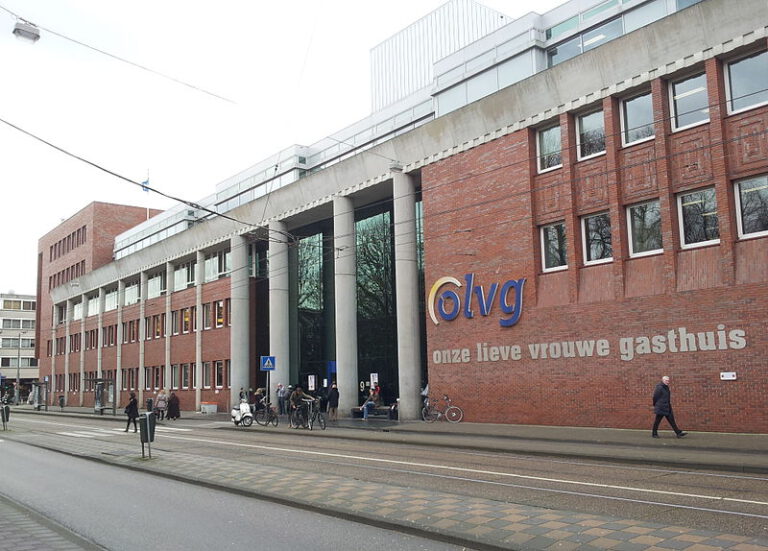
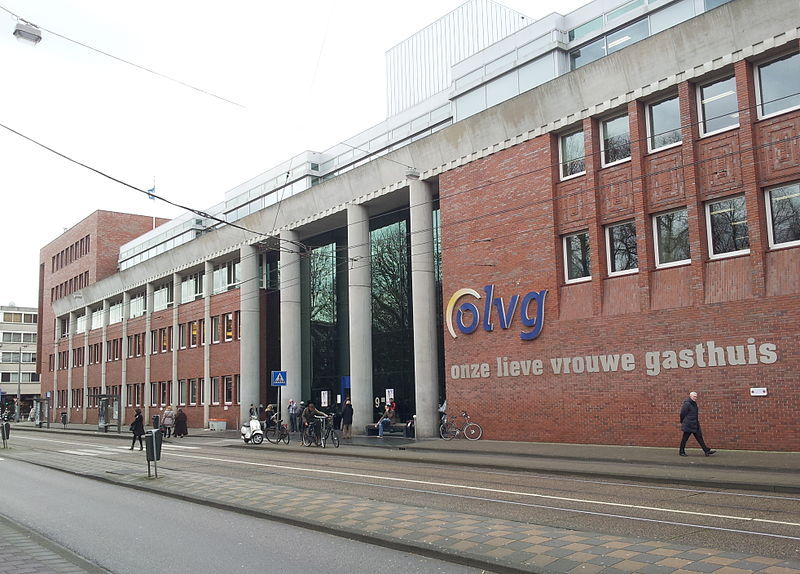
An employee of the OLVG hospital in Amsterdam has probably contracted the coronavirus. The employee tested positive during the first test, a second test by the RIVM will now follow.
The employee had returned from a holiday in northern Italy, an area that was later labeled as a risk area. He or she then spent four days working at the OLVG, both at the East and West locations. If you’re now at home wondering if this was a smart move by the employee and the OLVG, well, yours truly is also wondering.
The employee works in the department of oral diseases, dental and facial surgery (MKA is the abbreviation in Dutch). These departments of the East and West locations are closed as a precaution.
After the employee had some complaints, a test was performed. The employee is now put in quarantine at home and shows slight symptoms of Corona.
Contact investigation – have you been to the OLVG?
Channel AT5 writes that there will be a contact investigation among colleagues and patients. Colleagues who have had contact with the employee are requested to wait for any symptoms of illness at home. There are information meetings at both locations between 12:00 and 12:45.
Coronavirus numbers in the Netherlands have jumped to 24, the Public health institute RIVM has confirmed, according to NOS. All patients are quarantined at home, as reported by the health service.
Although much still remains unknown about the origins of COVID-19, what is known is that in the Netherlands, those diagnosed have either travelled to northern Italy or have had close contact to previously diagnosed patients.
In the Netherlands, 200 people have been tested and the health service is continually doing research to ensure which areas are affected so that residents are up-to-date on all that is being done.
Furthermore the Dutch Ministry of Foreign affairs is also providing information regarding the coronavirus. For instance, it has updated its travel advice regarding Japan, which has been hit by coronavirus.
Follow DutchReview for the latest updates about coronavirus in the Netherlands.
With 18 confirmed cases of the coronavirus COVID-19 in the Netherlands, people have started to express concern over using public transport, reports RTL Nieuws.
People have been tweeting these past days about their fears in regards to getting the virus on public transport. The tweets especially show up after the morning and evening rush hour, with some people jokingly referring to the train as the ‘corona express’. If anything, gotta appreciate some good humour.
Er is Corona in Nederland en de trein conducteurs pakken per treincoupe 90 pasjes vast. That’s a flaw.
According to virologist Ab Osterhaus, as everyone is very close to each other on public transport, one small cough in your face could potentially get you sick. However, he says we are not yet at the level of avoiding public transport due to the coronavirus. If an epidemic does happen, then the advice goes to vulnerable groups, like the elderly and young children to avoid public transport.
How does the virus spread exactly?
Virologists, including Osterhaus, are currently researching other viruses, like the influenza, to determine how the coronavirus might spread.
Osterhaus says that viruses spread faster in places with many people, such as in aeroplanes, where the virus is also transmitted through the air-flow.
There’s people who avoid touching the handles in trams, and for good reason. If someone who is sick coughs into their hands and then touches the handle, the next person who touches the handle can get the virus.
However, the virus does not survive long outside a body, therefore the transmission period is quite short. Osterhaus suggests that we avoid touching our faces while in public transport and that we wash our hands afterwards.
Why is no one concerned about the regular flu?
Osterhaus makes the point that people who take the coronavirus seriously ought to take the flu seriously as well. Every year, around 300,000 to 500,000 people die around the world from the flu, thus, you have a greater chance of dying from the flu, rather than from the coronavirus.
He continues by saying that when there is a flu epidemic, people don’t avoid public transport, so why would they avoid it now?
And after all, with a hint of amusement, as one twitterer commented, the coronavirus should be seen as an opportunity in public transport. ‘Sneezing now in the train is just an extra seat for my bag.’
Should the Netherlands take more measures against the virus or should they have a more relaxed approach? Let us know in the comments.
The Yazidis, Islamic State’s genocide and sexual slavery victims, haven’t necessarily found a safe haven in the Netherlands.
In August 2014, the world’s eyes turned to a mountain plateau in northern Iraq known as Sinjar. The headlines captured the Islamic State’s (IS) brutal attack on the Yazidis, one of Iraq’s oldest religious minorities.
Thousands of men and boys were executed and dumped in mass graves. Thousands of women and girls, some as young as nine, were kidnapped and sold into sexual slavery. Meanwhile, many more boys were taken from their families and forced into IS training camps.
The United Nations would later determine that the attack on Sinjar, and the ongoing enslavement, constitutes genocide.
Who are the Yazidis?
The Yazidis are mainly of Kurdish ethnicity, and their religion is a mix of Christianity, Islam, and Zoroastrism, an anciant Persian religion. A long-persecuted minority, the Yazidis worship a fallen angel, Melek Tawwus, or Peacock Angel. Contrary to Satan’s fall from grace in the Judeo-Christian tradition, Melek Tawwus was forgiven and returned to heaven.
Due to the importance of the Peacock Angel in the Yazidi’s faith, they received an unjust reputation as devil worshipers. In the times of religious extremism led by IS, professing such faith became a death warrant.
The aftermath
Despite the end of IS’ so-called caliphate in Iraq, the Yazidi plight continues. They are scattered, but the collective trauma that bounds them together is unfathomable. In total, almost 10,000 people were murdered, and about 6,000 women and children were abducted and sold. Around 3,000 of those are still missing.
"I cannot even imagine that I once was a happy man with a family."
Part of the women who were rescued shared shocking accounts of being sold and resold into sexual slavery, constant beatings and rapes, and other extreme forms of abuse suffered at the hands of IS fighters and their wives, many of whom had fled Europe to join the group.
Nobel Peace Prize
One of these women is Nadia Murad. She won the Nobel Peace Prize in 2018, which she shared with Denis Mukwege, a gynaecologist from the Democratic Republic of Congo who also fights against sexual violence in war. Nadia was captured alongside her sisters and lost six brothers and her mother when IS attacked Sinjar.
She decided to tell her story, constantly reliving the horrors of what she was put through, in order to seek justice and bring awareness to the fate shared by so many Yazidi women. She called her autobiography The Last Girl, because her fight is to be the last girl in the world with such a story.
Lingering in and around camps
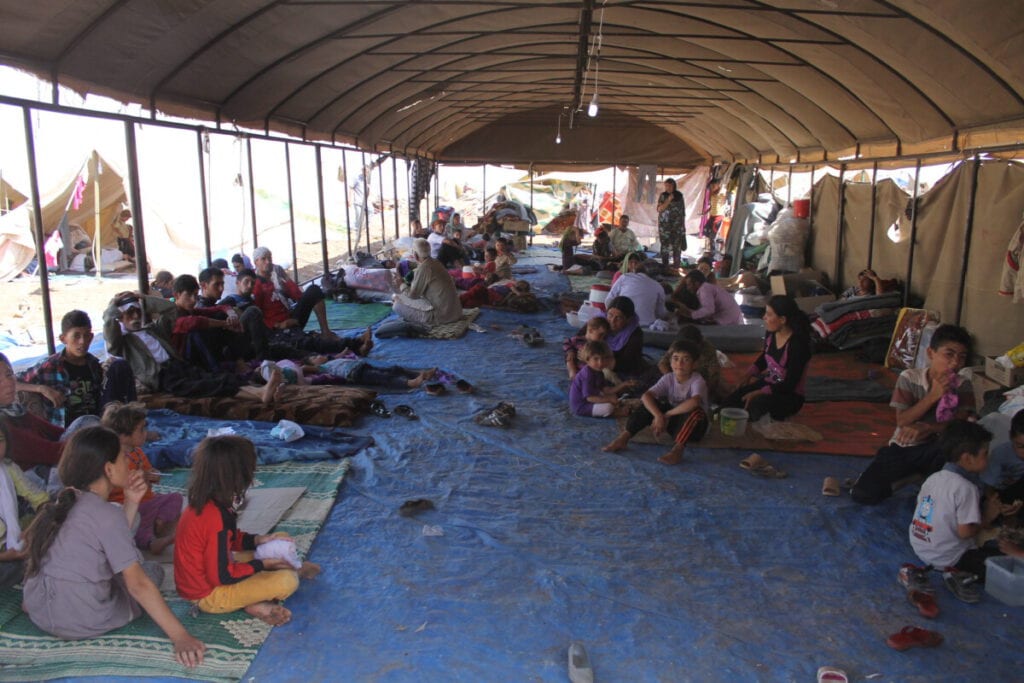
The majority of the internally displaced Yazidis live in the Kurdish region of Iraq, in or outside refugee camps. The standards of accommodation vary from precarious tents without cement bases and abandoned buildings, to more comfortable rented apartments. Economic destitution and poor infrastructure are the norm.
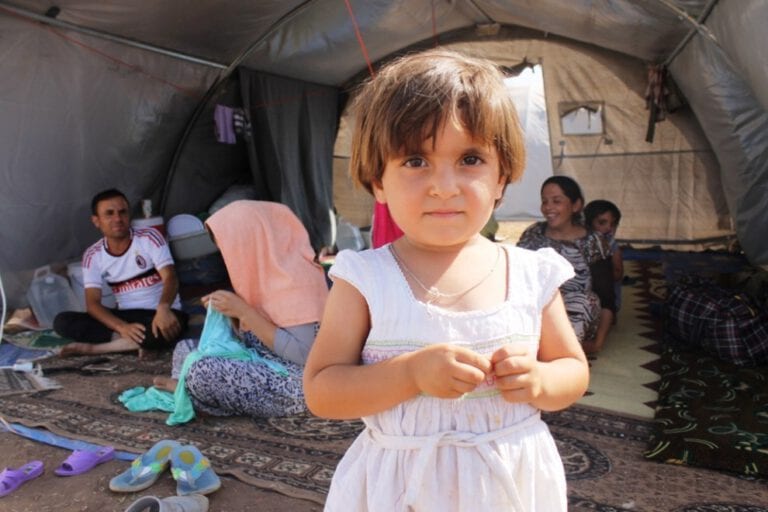
Yazidi refugees at this camp in northern-Syria walked up to 60km in searing temperatures through the Sinjar mountains, while many suffered severe dehydration. Image: Rachel Unkovic/International Rescue Committee/Flickr
The refugees had walked up to 60km in searing temperatures through the Sinjar mountains and many had suffered severe dehydration.
There are currently around 400,000 Yazidis living in Iraqi Kurdistan. This means that humanitarian help and local services are stretched over the limit, leaving people in dire circumstances with no means to cope with such traumatic experiences. Doctors without borders has blown the whistle on a severe mental health crisis among the Yazidi, which includes high numbers of suicides and suicide attempts.
Brainwashed youth
The Yazidi boys who were abducted and forced to join IS’ as child soldiers underwent an extreme brainwashing program. IS laced the boys’ food with amphetamines as a way to reduce fear, and trained a part of them as suicide bombers. Many saw their father being murdered before being taken. Numerous were sent to the bloodiest frontlines.
"As we are talking here, 3,000 women and girls of Yazidi villages are still in the hands of ISIS. They are sold, they are raped."
Watch the exclusive interview with Nobel Peace Prize laureates Nadia Murad and Denis Mukwege https://t.co/Xt8smRj5Z6#AJNobel
Many were bought back by their families from IS for large sums of money, but as they return a deep identity crisis unfolds. A vast number of them are still indoctrinated and renounce their families and their faith, oftentimes violently. Suicide is rampant in what has been described as “a mental-health crisis unlike any in the world”. Some very young Yazidi girls who were abducted and sold into IS’s families to be raised as Muslims are now back with what remains of their families and face a similar crisis.
The forgotten people
Dutch writer and freelance journalist, Brenda Stoter Boscolo, has written a book in which she details the Yazidi genocide through personal stories. The book’s title, The Forgotten People, is grim and seems accurate. Brenda has been to the region many times and has conducted extensive interviews with the Yazidi.
In an interview with DutchReview she expressed the Yazidi’s disbelief in the slow response of the international community. “They are very proud of Nadia’s Nobel, but they feel it is clearly not enough.”
1) I’m gonna ask for help regarding family reunification for a Yazidi boy again. Maybe this time the power of twitter will work. It’s about the boy on the cover of my book. He was 11 years old when IS kidnapped him and his whole family in 2014. #yezidigenocidepic.twitter.com/btt2McaCDO
According to Boscolo, the debate around the repatriation of European IS women living in camps in the Middle East is a sore point in the Yazidi community. “We have also been living in precarious camps for years, why don’t they pick us up?” she often hears. Through her writing and reporting, Boscolo is on an active campaign to remind the Dutch public to include the Yazidi plight when discussing what should be done with Dutch IS fighters and the women who chose to join them. “It is an often-neglected topic,” Boscolo points out.
The quest for justice
When asked what is the best way forward, Boscolo becomes silent for a few seconds on the phone. “There is no easy, clear solution,” she says. “The world needs to acknowledge the genocide and punish the perpetrators. That’s the only way to bring peace to the Yazidis. In order to move on from the trauma, there must be justice.”
This is a sentiment shared by other people fighting for Yazidi rights in the Netherlands. Pari Ibrahim was studying law in the Netherlands when news of the genocide broke; a Yazidi herself with 40 members of her family missing, she soon founded the Free Yazidi foundation. Nowadays she travels the world raising awareness and seeking justice for the Yazidi. Her foundation has also established women and children centers in refugee camps, offering much-needed services for the displaced population.
The number of accepted asylum requests from the Yazidi community in Europe has fallen sharply since the height of the crisis. The Dublin accord, which requires asylum seekers to stay in the first country where they are fingerprinted, has also meant that people who know each other and could act as a support network, may end up faraway once in Europe.
Asylum in the Netherlands
In the first semester of 2019, the Dutch immigration and naturalization service, the IND, announced it would send Yazidi asylum seekers back to camps Iraq. The argument the IND offered was that there was enough food and shelter in the camps. The United Nations High Commissioner for Refugees (UNHCR) immediately condemned the decision. The UN body released a statement stating that it was unreasonable to assume that resettling in Iraq was a viable alternative when there are clear issues regarding their safety, protection of basic rights and economic destitution.
After wide condemnation, including from many political parties, the Dutch State Secretary for Security and Justice, Ankie Broekers-Knol, said that the government was backtracking its decision. The Secretary recognized the extremely challenging situation the Yazidis face in Iraq, and said that from now on they would be seen in the Netherlands as a vulnerable minority group. This new classification, consistent with the recognition of the Yazidi genocide, means that residency permits would be a little easier to get. Even though this policy reversal is good news, it is far from fast-tracking resettlement programs in place in other countries, such as Germany and Canada.
What is your opinion? Should the Dutch government take similar steps and open its borders to the resettlement of larger numbers of Yazidi survivors? Let us know your opinion in the comments below.
Did you make the bold decision to purchase (or even better, rescue) a pet since living in the Netherlands? Maybe now you fancy a trip to the UK? Then forget EasyJet (who don’t even allow pets on their flights), or the prices of KLM! After all — why fly, when you can take the ferry?
Beats leaving little Milo in a hondenhok pension, right? Last month, my partner and I took the ferry to the UK. Here’s the low down on a very British travel adventure with your pooch.
What to know before travelling from the Netherlands to the UK with your pet
Make sure they are microchipped
Sure sure. You got them microchipped when you first bought them home so what’s left to do right? Well, I always say go back to the dierenarthuis (vet) and double-check.
Sometimes they ‘update’ the system and you go back to find the change of address incorrect or they forgot and said details were not updated. Or, albeit rare, microchips have been known to do a Harry Houdini under the skin on occasions so best go make sure the little bugger has stayed put.
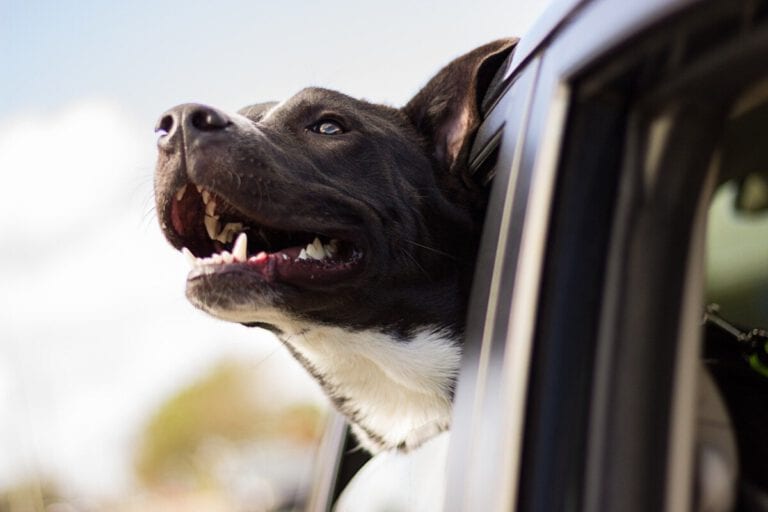
it’s impossible to leave your furry family member behind! Image: Pexels/Pixabay
Get their rabies shot
The dog is going to need a rabies shot, that’s a given. No one likes the thought of fluffy getting foamy at the mouth because they happen to come across some random stray in the streets of London, no matter how low the chance is. “No rabies, no fur babies” — I totally just made that up, but it’ll catch on don’t you think?
Complete their tapeworm treatments
Tapeworm treatment is needed if you are coming into the European Union (excluding from Finland, Ireland, Norway and Malta), and is to be given 24 hours before or no more than 5 days before travel.
Easy enough for now, but with new laws coming into force after Brexit regarding blood tests for your beloved pets re-entering Europe, be sure to get the information you need before re-boarding. We travelled back post-Brexit, but luckily the blood test rule wasn’t required as of yet.
Get your pet’s passport
Just like us. Your pet will need a valid passport to travel. This must be issued in the country in which your pet resides. So for most, it’ll be an EU passport from the Netherlands or if your pet moved with you from the UK they will likely still have their EU issued UK passport. Just check it’s up to date and still valid, or your furry friend may just have to stay behind.
Now that the UK has left the European Union, what does that mean for us expats travelling back and forth with our furry friends?
Well, the good news is you’ll still be able to travel with your pets under the current rules until December 31, 2020.
After that, the UK have stated that the current rules will remain unchanged. Your pet will still need an identification chip, a rabies vaccination, their pet passport, and proof of their treatment against tapeworm (Echinococcus). The tapeworm treatment is only applicable to dogs.
Returning to the Netherlands from the United Kingdom? Your dog (or cat – we saw a few on our trip!) must meet the same requirements in terms of valid travel documents:
a European pet passport issued by an EU Member State (including the United Kingdom until the end of this year) or a health certificate issued by an official authority in the UK.
A valid microchip;
and that all-important rabies vaccination.
Proof of tapeworm treatment
So, travel rules will not vary much?
The likelihood is that all of these rules will see some small, if not significant changes during this transition period. Continue to check the UK and Dutch government’s websites throughout the year as these will surely be updated regularly.
Overall, changes to pet travel will be similar to their ‘pawrents’. The airports may become busier. The volume of traffic from queuing in ‘non-EU’ immigration lines will increase. The ferry port line may take longer to pass through. Your cars may be pulled over for ‘random’ checks every time!
But ultimately, keep travelling. Keep visiting those all-important people back home. Just make sure you check the paperwork and are all stocked up on treats for little Rex.
Have you travelled with a pet from the Netherlands to the UK or vice-versa? How did you find the process? Let us know in the comments below!
Eight more patients have tested positive for coronavirus, bringing the total in the Netherlands to eighteen. The first patient was diagnosed just four days ago.
Companies have been sending workers home, a hospital in Gorinchem has been closed, and dozens of Dutch people remain in quarantine in the United Arab Emirates as the Netherlands responds to the viral outbreak.
The National Institute for Health and Environment (RIVM) reports that they are reviewing the source of all patients infections.
“Almost all new persons diagnosed with the new coronavirus are travellers from northern Italy or are family contacts from a previous patient,” said a statement on the RIVM website. So far, almost 1700 people in northern Italy have tested positive for coronavirus.
The newest Dutch cases are in Houten, Dalen, Nieuwendijk, the Tilburg region and Helmond.
European Union on high alert
Meanwhile, there are 2100 total cases throughout Europe. 20 of the 27 EU countries have reported cases of the viral infection. The only countries holding out are Hungary, Bulgaria, Slovenia, Slovakia, Latvia, Malta and Cyprus. Non-EU countries Serbie, Ukraine, and Albania also have no infections yet, NOS reports.
The European Commission has raised the risk of coronavirus virus infection from moderate to high. Iran has the most deaths after China, with 66 deaths from 1501 infected people.
Two men escaped from a TBS clinic in Gederland, in the neighbourhood of Ochten. One of the men was shot and killed by the police, and the other was arrested, reports RTL Nieuws.
The men escaped from De Kijvelanden clinic yesterday, after threatening an employee with a knife and a firearm. The employee was slightly injured, according to the Rotterdam Public Persecution Office.
Car pursuit on the A15
After leaving the clinic, the two men hopped into a taxi and drove off on the A15 highway. A police chase ensued, and they were stopped at Kesteren.
A firefight with the police ensued in a nearby business park, and one of the men, aged 37, died after the shootout, and the other man was arrested, alongside the cab driver.
An investigation into how the men acquired a firearm is being conducted
The taxi driver was let go after it was established he had no connection with the two men, as he was just responding to an order.
The clinic is currently investigating how the two men managed to acquire a firearm, with the local judiciary also being involved in the investigation.
Mayor of municipality expresses shock
The clinic from which the two men escaped falls under the jurisdiction of the Albrandswaard municipality. The local mayor, Jolanda de Witte, expressed shock over the news of the incident. She expressed sympathy for the community who watched the events unfold.
She stressed that the investigation will be conducted, and expressed sympathy towards the employees of the clinic.
Have you visited the Natuurmuseum Brabant yet? Tilburg is filled with gems and sights to see, so if you ever find yourself in the city, why not visit some of its museums?
One of our favourites is the Natuurmuseum Brabant, a favourite for all fans of nature. So get your family and kids, and embark on a journey into the natural world and its history.
What is the Natuurmuseum Brabant in Tilburg all about?
Natuurmuseum Brabant has been around since 1935 and aims to encourage people to appreciate and learn about nature. The museum showcases a variety of different exhibitions which have been bringing visitors back to the museum for many years. It’s also the perfect place for children and the whole family, young and old.
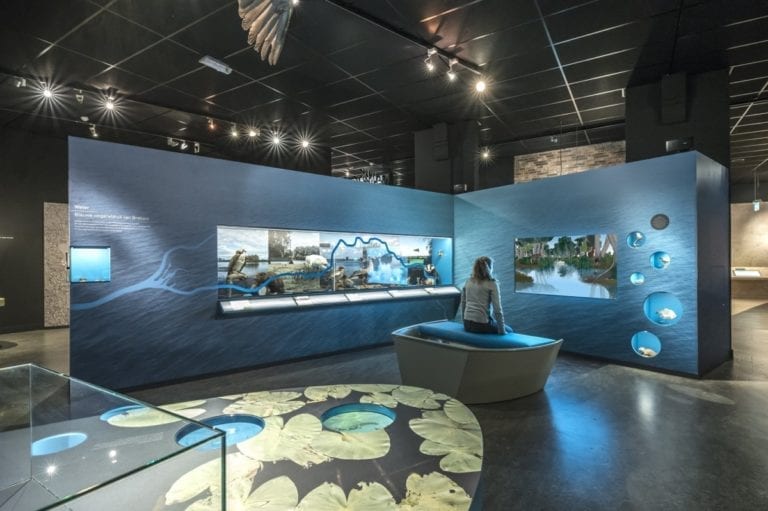
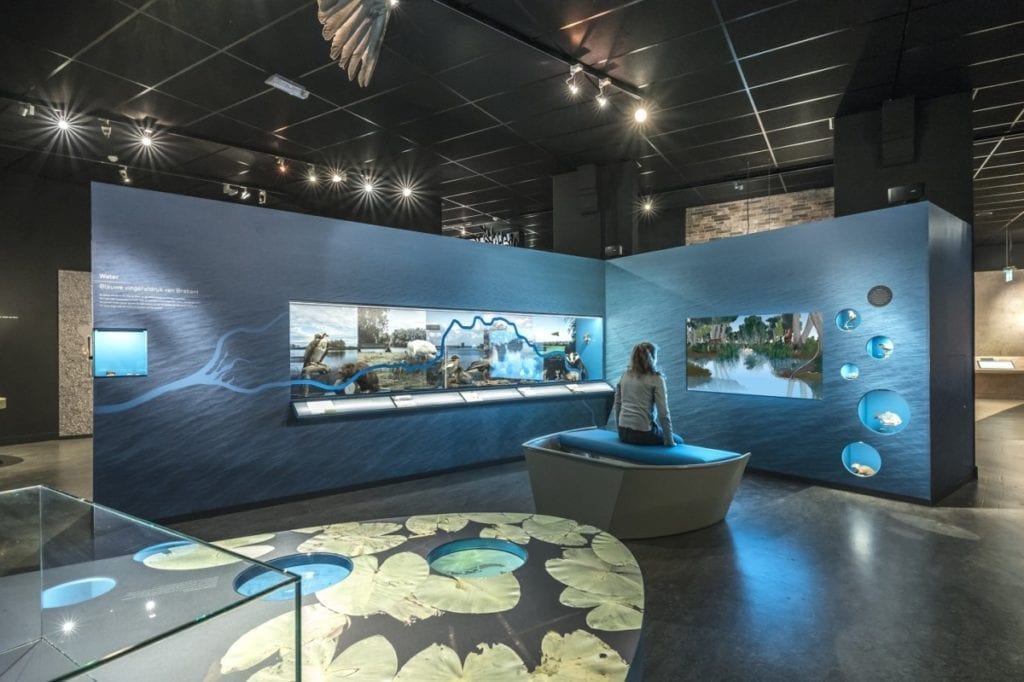
Natuurmuseum Brabant has a lot of dynamic and interactive exhibits. Image: James van Leuven/ Supplied
Natuurmuseum Brabant is first and foremost a family-friendly museum about the lives of plants and animals, and it does a great job of explaining the awesome history of nature to you and your little ones to gain a better understanding of the natural world around us.
What does that come down to? Observe wolves in the Real Wolf exhibition or become a detective in the OO – ZONE, where you will find over 2000 objects in an accessible museum depot. For the youngest visitors, there are the exhibitions BOS and Frog & Friends where they can visit Frog’s house and play a variety of games. The youngsters can also ‘hunt’ a virtual woolly mammoth and learn about hunting tactics. Afterwards, they can rest in a skin tent and relax around a makeshift ‘homemade’ fire.
What do you really need to see at Natuurmuseum Brabant in Tilburg?
Two exhibits at the nature museum are not to be missed and would draw millions of visitors if this excellent museum was located in Amsterdam.
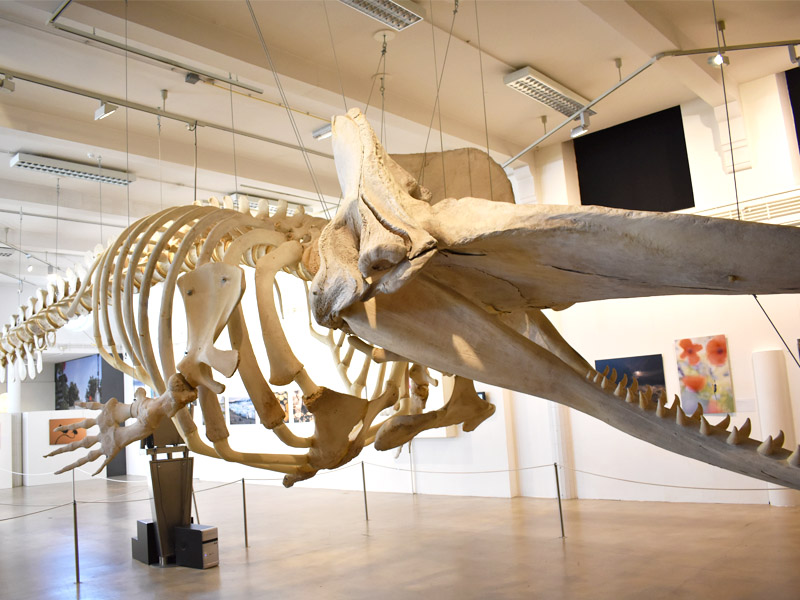
First, and you can’t miss it, is the giant whale skeleton. This skeleton (15 meters long, 1000 kilos heavy) comes from one of the three sperm whales which washed ashore in Scheveningen in 1995. The size is mindboggling for young and old!
This huge whale skeleton in the Natuurmuseum Brabant is a must-see! Image: Maria van der Heyden/ Supplied
The other one is equally gigantic:
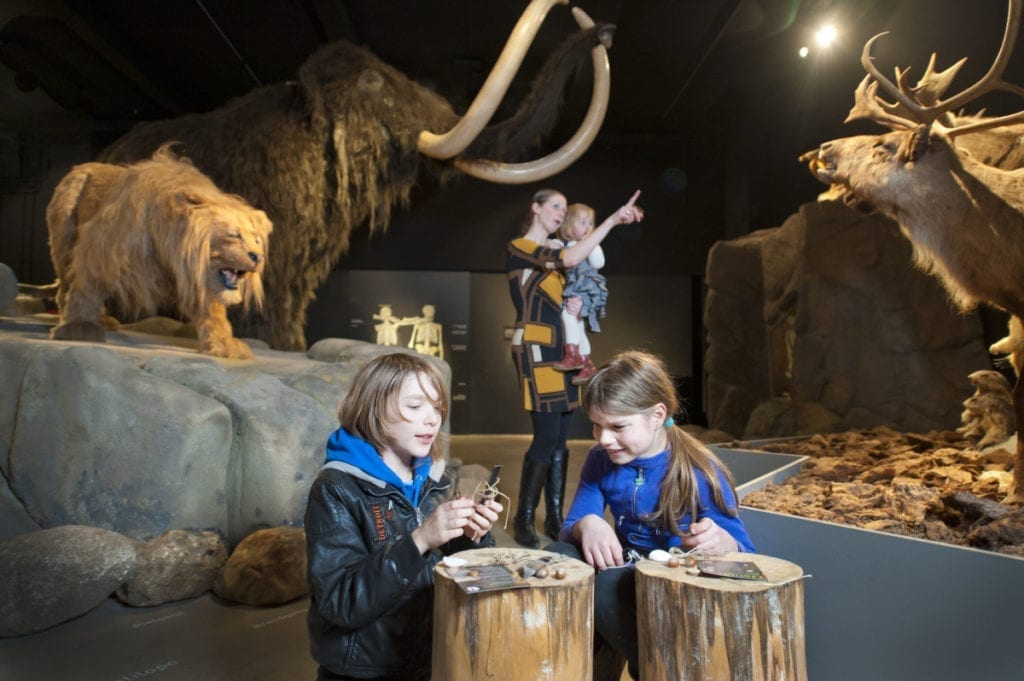
Yep, that’s a giant mammoth in the background. Image: Maria van der Heyden/ Supplied
Behold this life-size model of the woolly mammoth, at least three-and-a-half meters high and six meters long. The designers who made the model put the mammoth together on the spot because of its epic size. The woolly mammoth is one of the most famous ice-age animals and the best known of all mammals from the Pleistocene.
The Ice Age exhibit of the Natuurmuseum Brabant in Tilburg is surely worth a visit
Besides the model of the woolly mammoth, the Ice Age exhibit contains a lot of interesting artefacts of this bygone age. You can find a sabre-toothed tiger, cave lions, wolves, and other fossilized animals.
One of the showcases is a Neantherdal called Noezal, whom you can visit in his cave. Neantherdals used to be seen as little more than monkeys, but discoveries have revealed that this genetic cousin of ours was much more similar to us than initially thought, and this exhibit demonstrates exactly that. You can take a look at Noezal’s toolbox to see what he was using to survive in the wild, as well as his eating menu. It wasn’t a Michelin restaurant, but it was fair work.
Learn more about dinosaurs at the “early birds, those dinos” exhibition in the Natuurmuseum Brabant
Do you sometimes look at a chicken walking only to be struck by the fact that you are looking at this dumbed-down version of a Tyrannosaurus Rex? Well then, this exhibition is just for you.
The exhibit is about the family of theropods and how they slowly, over millions of years, evolved into birds. You’ll see skeletons and eggs, and there are plenty of assignments to do as well. This exhibit is well-suited for children, and there are assignments for youngsters aged four to seven, as well as children over eight years old. This is also the first exhibit of the museum which is entirely bilingual, with English provided, so go give it a look!
Not one for indoors? Check out a nature site in Tilburg!
Perhaps you want to experience some outdoor nature, rather than visiting a nature museum. Tilburg has plenty of these awesome nature sites to offer, so here’s a great example for all of you nature aficionados.
“Wandelbos”
Wandelbos is a picturesque forest, located halfway between Tilburg and Reeshof. You can go biking there, or just for a lovely stroll through the many hiking paths. There are many places to lay out a gezellige picnic with your friends, and in general, it’s an ideal location to go with your family and with children.
For the little ones, there’s even a petting zoo, so go out there with your loved ones and pet some animals!
For more places all nature-related in Tilburg, check out our article on the nature in Tilburg.
With 10 cases of the coronavirus COVID-19 detected in the Netherlands, institutions have started to implement measures to prevent its spread.
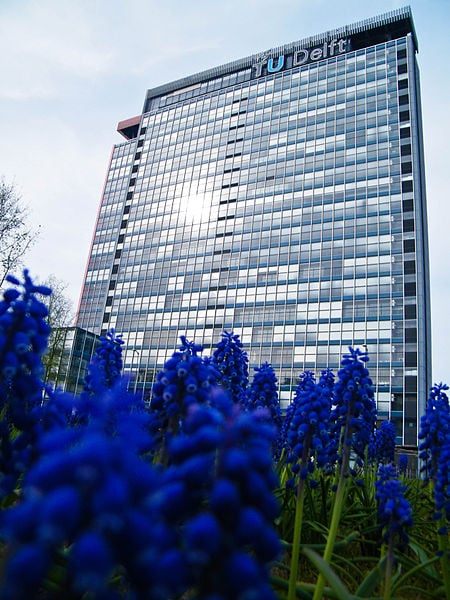
The University of TU Delft has declared that students or staff who are coughing, suffer from shortness of breath or have other respiratory problems should best stay at home. This also applies to people who suffer from fever, the University stated to RTL Nieuws.
As of now, it is not clear how many students and staff of TU Delft have decided to stay home. There’s a total of 28,000 people who work and study at the University.
Follow DutchReview for the latest updates about the coronavirus COVID-19 in the Netherlands.
As of now, there are 10 confirmed cases of the coronavirus aka COVID-19 in the Netherlands. The first case emerged last week.
So far, cases have been detected in Loon op Zand in Noord Brabant, in Amsterdam, Tilburg, Rotterdam, Delft and Coevorden, reports NOS.
Is there a risk of an outbreak in the Netherlands?
Mariet Feltkamp, a virologist at LUMC, considers the situation manageable. Ira Helsloot, a professor of safety management at Radboud University, has also stated that the situation can be managed, but if cases start to develop as they did in northern Italy, there might a valid reason for concern.
Closing down municipalities?
The RIVM (Netherlands National Institute for Public Health and the Environment), is considering the possibility, in case the virus spreads, to close municipalities, especially if it is not possible to trace potentially infected people through investigations.
There seems to be a debate over what are the best measures to take in the context of the virus. Professor Hesloot considers that we should not take extreme measures in containing the virus, as the outbreak of the coronavirus worldwide is starting to look more and more like a normal flu outbreak. The costs of isolating patients and implementing quarantine then outweigh the benefits.
Virologist Feltkamp does not believe that professor Hesloot’s approach is wise, because if no measures are taken, there is a risk that the virus will overwhelm the country. She also urges that people coming back to the Netherlands from northern Italy should be tested for the coronavirus.
Hospital and Nike headquarters are closed in the context of the virus
In Gorinchem, the Beatrix Hospital has been closed, as a patient there was found to have the coronavirus. The Nike headquarters in the Netherlands, located in Hilversum, has also been closed, as one of the employees of the company has contacted the virus, reports RTL Nieuws.
Follow DutchReview for the latest updates about the COVID-19 virus in the Netherlands.