On 3 September 1944, Anne Frank and her family were transported from the Westerbork transit camp in the Netherlands to Auschwitz-Birkenau in Poland along with 1,011 other Jews.
They ended up in Westerbork transit camp after their Secret Annex in Anne Frank’s House on the Prinsengracht in Amsterdam was raided and everyone hiding in it was captured on 4 August 1944. Anne Frank’s parents, Otto and Edith, her sister Margot as well as Hermann and Auguste van Pels, their son Peter and family friend Fritz Pfeffer were all in hiding.
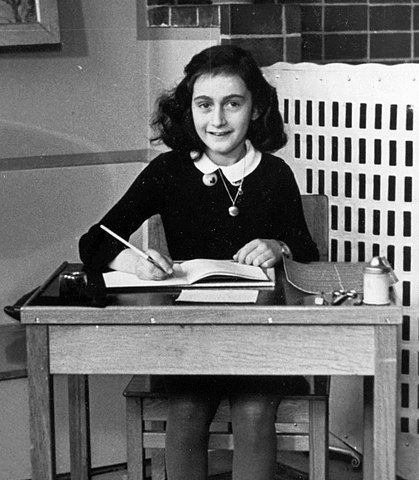
Anne Frank at school Source: Website Anne Frank Stichting, Amsterdam on Wikipedia
During the journey to Auschwitz, men and women were separated. Anne Frank and her boyfriend Peter van Pels saw each other for the last time. It was also the last time that Otto Frank saw his wife and daughters.
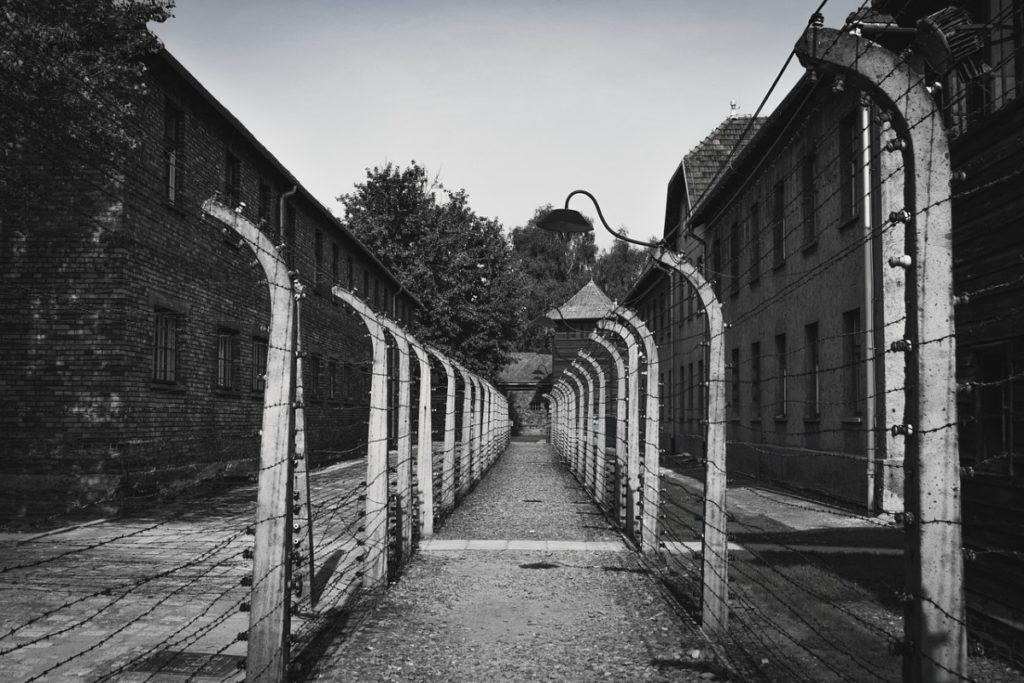
Auschwitz. Source: dimitrisvetsikas1969 on Pixabay
Edith, Margot, Anne, and Auguste remained at Auschwitz-Birkenau camp and ended up in a barracks for forced labourers. Otto, Hermann, Peter and Fritz were ordered to walk to camp Auschwitz I which was three kilometres away. They were forced to do heavy labour.
Anne and her sister are thought to have died from typhus in February 1945, just months before the camp was liberated by the Red Cross.
Anne Frank’s life is now encapsulated in The Anne Frank House in Amsterdam. Tickets can be purchased online for the museum which is open daily.
Have you been to the Anne Frank House? Have you read her diary? Or have you read any other good literature from the Holocaust? Let us know in the comments!
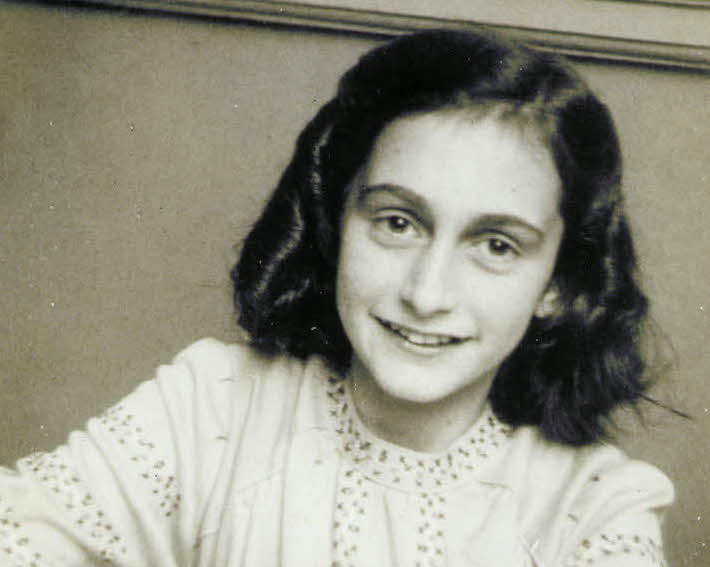
Feature Image: AnonymousUnknown author [Public domain] on Wikimedia
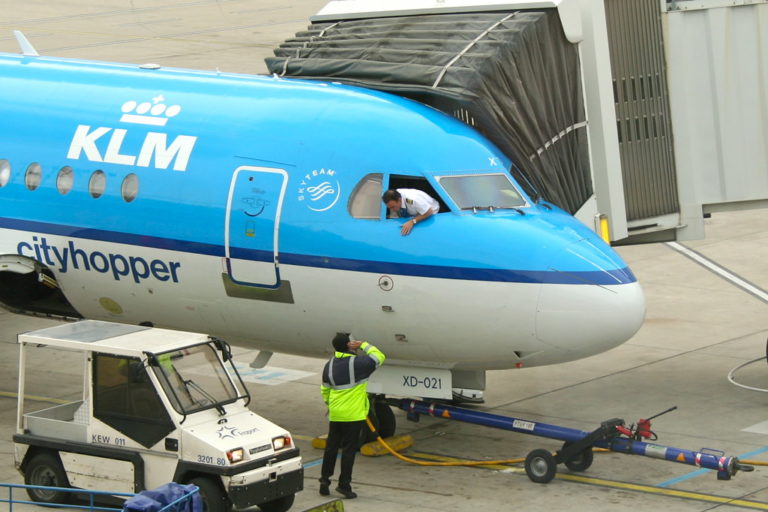
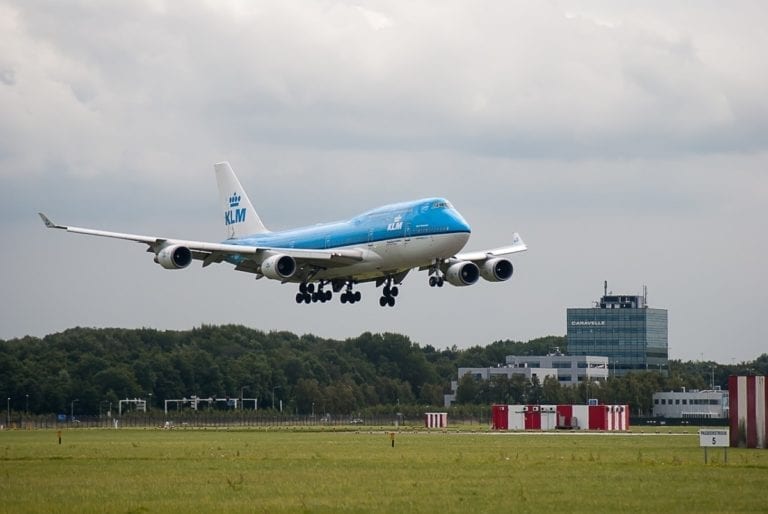
Ongoing strikes by KLM ground staff have been recently causing chaos and interruptions at Schiphol Airport. On Monday, around 500 employees stopped work. After failing to reach a resolution with their employer they will strike again on Wednesday.
The FNV trade union made the announcement on Monday as part of their fight for better working conditions.
“After the first work break on Monday morning, no response has yet been received from KLM. That is why we will continue with the next action on Wednesday,” FNV director Jan van den Brink told nu.nl.
When will the strike take place?
The ground staff will stop working Wednesday morning between 8am and 10am, so if you’re planning on flying out anywhere near these hours it’s best to double-check with your airline.
The strike by KLM ground staff may affect your flight. Travellers are advised to keep an eye on current flight information by checking their airline’s website, as well as Schiphol's website and app. https://t.co/yO7ik6PBUg
Monday’s strike caused 67 flights to be delayed or cancelled, with only 11 of these announced in advance.
What will happen next?
The union is threatening more strike action if KLM does not come to the table, said FNV campaign leader Joost van Doesburg.
Onze boodschap aan @KLM is helder. Het belangrijke werk dat het grondpersoneel uitvoert, verdient een goede cao. Daar gaan we voor. Daarom is er woensdag van 8.00u tot 9.00u weer een werkonderbreking. https://t.co/gScKzlxmUspic.twitter.com/7BKu8XAWgg
FNV is fighting for better working conditions for the 15,000 workers. KLM have offered up to a 3% pay increase in one year, but the union wants to see 8% in two years, a more predictable roster, and more permanent jobs. Sounds fair enough to us – where can we get some of that?
What does KLM think?
Well, they’re not a fan of the strikes obviously. In a statement they described the action as ‘incomprehensible’ and ‘unnecessary.’
“Striking is a constraint for the traveler and costs money that we would rather invest in our company and an attractive profit share for our employees,” the statement read.
KLM have invited the unions for discussions early next week, with several agreeing to attend so far.
What do you think of the strikes so far? Have you been inconvenienced? Let us know in the comments below!
Do you look out your window to nothing but sad, grey clouds? Are you playing Adele in the evening while staring wistfully up at your ceiling? Do you feel your cheek muscles sagging with the crippling weight of a lack of hilarious jokes in your life?
Oh DutchReviewer, we’ve been there! But then we heard the news. What news? Oh boy. The best news! The Hague is getting its first dedicated comedy club, ComedyCity!
“But I don’t get Dutch jokes,” we hear you murmur as you turn away dejectedly. Our dear DutchReviewer, that’s the best part, because why else would we be here? The most excellent part of ComedyCity is (drumroll please) …..
… they have shows purely in English! No listening to the gutteral gurgles that emerge breathless from a Dutch persons mouth (we’re subjected to that enough!) For us, only the straight-shootin’ English language will do.
Who’s bringing us comedy in The Hague?
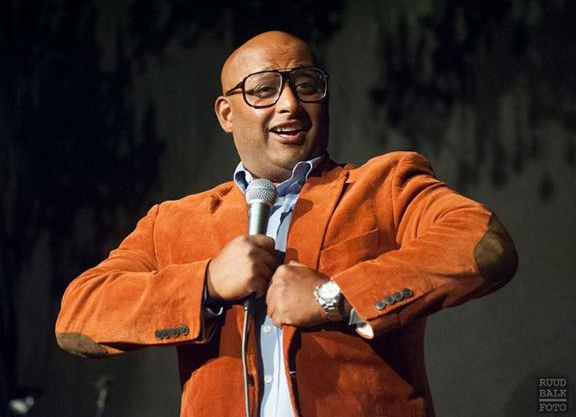
ComedyCity is the brainchild of Mino van Nassau. Who cares, right? Well, you should. this comedian/founder was a finalist in the Funniest Person in the World competition. Let’s repeat that. Mino van Nassau was in the running to be the funniest. person. in. the. WORLD. What have you done today?
After his run in the big leagues, Van Nassau has returned to crank up the comedy knob in the political centre of the Netherlands (because those politicians sure could use a few laughs that don’t involve blonde, fat, international politicians right now).
Why do we need comedy in The Hague?
If you’re asking this question, you need comedy in The Hague more than anyone else. But, Van Nassau has a pretty good answer for this question anyway.
“The Netherlands was originally a cabaret country and loves theater with a beautiful story and a song,” he explained. “But the new generation is more charmed by the quick humour with a high joke density.”
As a result, Van Nassau is promising quick humour, hilarious stories, and top-shelf stand-up comedy from the best national and international stand-up comedians. We give that promise a standing ovation.
What is the Smile Guarantee?
We know that those living in the Netherlands want to get their money’s worth. So ComedyCity has got something to make you smile: a smile guarantee!
Simply put, if the comedians make you fall short of your laughter expectations you’ll get your money back. Seriously (unlike the rest of this article). Is that making you smile? We think we can see one!
Mino van Nassau says that he only wants to see and hear the best in his club. If the audience isn’t in uproar over the daring humour delivered by the international comedy acts he isn’t doing his job right (and he’ll do his job right – that’s the smile guarantee!)
Enough talk: when is comedy in The Hague?
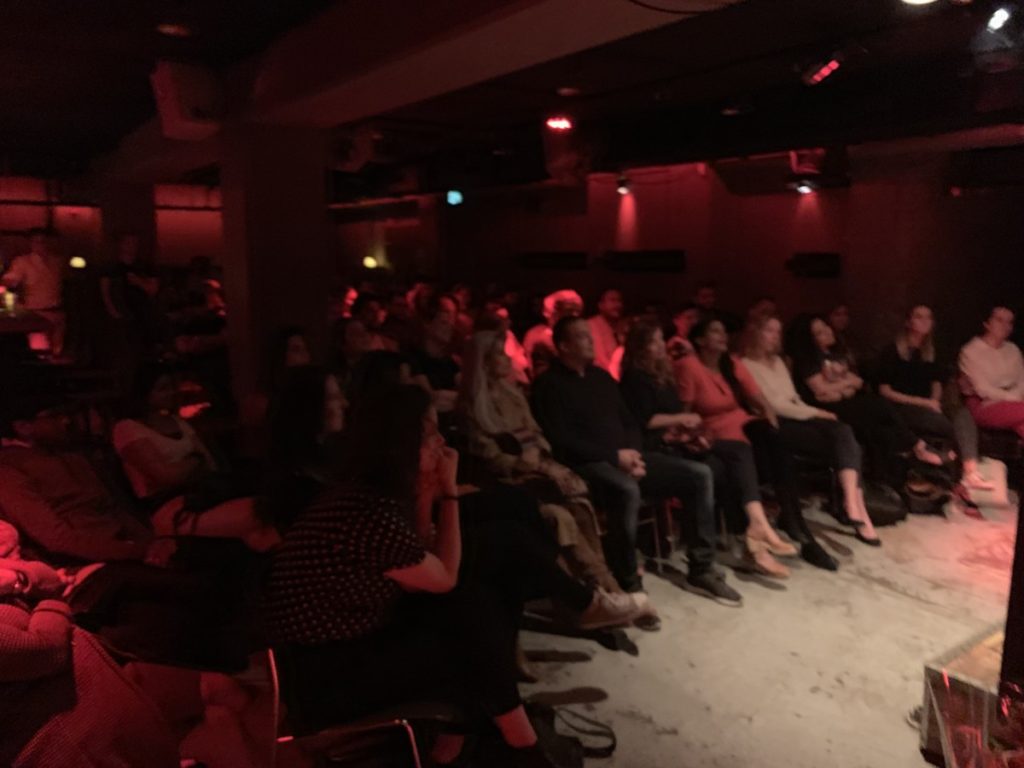
Ladies and gentlemen, the time has come! On Friday September 6th 2019 the curtains will open on the inaugural ComedyCity show in The Hague!
Buuut, we’ll be honest. Unless you speak awesome Dutch, you’ll want to wait until the following night, Saturday September 7th 2019!
Where is comedy in The Hague?
The location is more breathtaking than hilarious. This warehouse of entertainment is located in a literal warehouse: Bleyenburg, previously a great market of none other than wallpaper has been turned into a hub for delicious food, shopping, and now: bloody hilariouscomedy.
“In addition to delicious lunch, dinner, swinging and lounging, Bleyenberg can now also laugh very loudly,” Mino van Nassau said.
Okay, we want it. Where can we get tickets?
We’ve hidden the tickets inside chocolate bars that are shipped all over the world. You will probably only find one if you’re very rich, very lucky, or really like chocolate. Alright, alright, we’ll leave the comedy to the real comedians! Head over their way to grab your tickets and see the itinerary!
Will you be heading to get all your laughs at ComedyCity in The Hague? Got a favourite Dutch comedian? Let us know in the comments below!
We all know the Netherlands is a city of bikes, but when you have to go long distance those two-wheeled beauties just ‘aint gonna cut it. Thank god the Netherlands has a trusty public transport system, right?
Well, maybe not. Public transport costs have risen faster over a ten year period than the costs for driving a car, according to a new report released by the Central Bureau of Statistics.
Even after calculating in all the costs associated with owning an automobile like purchase, fuel, servicing, parking costs, insurance, and taxes, the report found that public transport had risen by an additional 5% compared to owning a car, reports nu.nl.
What was the change?
Over ten years, the costs of driving a car rose by 25%. Meanwhile, prices for public transport increased by 30% based on prices for train, tram, metro, bus and taxi.
This is despite cars being particularly expensive to own in the Netherlands, with insurance premiums and parking costs rising sharply (why do we have to pay €45 euro to NOT use a car in Amsterdam?) Around ten times more money is spent on car costs than on public transport costs, while fuel accounts for about a third of this.
So why have public transport costs risen faster?
The main reason is an increase in VAT rates (let’s all say a big thank you to taxes!). In January this year the tax on public transport rose by 3%, making it the largest of all the countries in Europe. That’s probably not something we want to brag about.
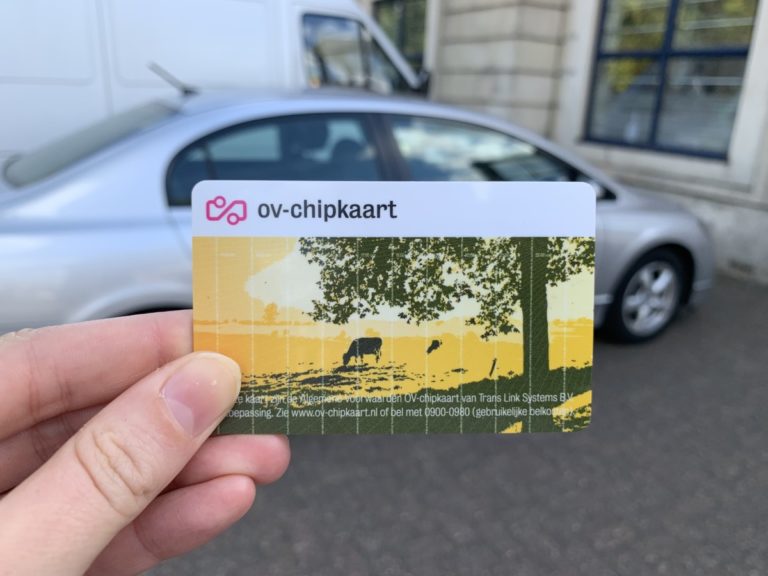
Luckily, there are heaps of ways to get public transport at a discounted price so you can save those shiny coins for when you arrive at your destination.
Do you think the price of public transport in the Netherlands is justified? Is owning a car expensive or affordable? Let us know in the comments below!
A strike began this morning by KLM staff at Amsterdam’s Schiphol Airport, one of the busiest airports in Europe. Many flights have already been disrupted including Air France, Transavia and EasyJet.
Why are KLM staff striking?
The 15,000 KLM staff are wanting a four percent pay rise, better job security created by fixed contracts and more flexible working time, Bloomberg reports.
The union has been in discussions for months with KLM management which resulted in staff rejecting an offer of a 2 percent pay rise.
KLM management believe the 2 percent pay increase does not warrant such a reaction and the strike is unnecessary.
Schiphol airport has issued the following warning to passengers to keep an eye on their flight for any disruptions. Make sure you check your flight times for any delays and cancellations!
The strike by KLM ground staff may affect your flight. Travellers are advised to keep an eye on current flight information by checking their airline’s website, as well as Schiphol's website and app. https://t.co/yO7ik6PBUg
In 2015, worldwide outrage was sparked when it came to light that a United Nations intern was camping on the lake shores of Geneva as he couldn’t afford accommodation. Now, in 2019, the student organisation of Tilburg University has set up a summer camp for internationals unable to find permanent accommodation.
Hundreds of students from all over the world have arrived in Tilburg eager to start the academic year. Accommodation is competitive (seemingly like everywhere else in the Netherlands) and to help people get on their feet the student organisation has came up with a plan; a 25-day camping facility until they find accommodation.
Summer camp provides more than just a roof
Approximately 50 students at the camp are provided with a sleeping bag, an air mattress, pillows and lights. Volunteers are also on hand to help students in their quest to find a room and assist them with contract and translation queries. As one student said “At least I have a place to stay”.
There is a strong practical element to the camp and given finding a room is harder and is only getting harder so why not have a stop-gap in place to prevent new students being completely homeless upon arrival? “We have lots of activities planned. We’ll have bonfires, sports games, a movie night, a party at Club Smederij and much more” Univers reports.
Finding accommodation is hard
Not only do the students have to move to a whole new country, but they have to contend with all the difficulties that arise with an accommodation shortage – hiked prices, “Dutch only” exclusions and scammers eager to prey on vulnerable and desperate students.
“We are aware that this is a very difficult situation for new students,” I.S.A.T. board member Antonia Telbizova tells Univers. “We want to bring security to these students and welcome them in a way that allows them to have fun and explore Tilburg during their first month here.”
VICE investigates the camp for students in Tilburg:
Amsterdam isn’t just an attractive, artistic and progressive city but can now also claim the title of being the safest city in Europe and fourth safest globally, according to the latest report by Economist Intelligence Unit (EIU).
The criteria
So what criteria was measured to conclude that Amsterdam, is in fact the most safe city? The report included 60 cities around the world and analysed 57 indicators contained within four types of safety. These four main categories were digital, infrastructure, health and personal security.
Digital security refers to citizens’ awareness of digital threats and a city’s privacy policy. Infrastructure security is about the safety of buildings, roads, bridges and other physical infrastructure and the ease of transport. Heath security looked at the accessibility and affordability of health services, environmental policies and life expectancy. Lastly, personal security means the trust in the criminal justice system, police control and overall crime statistics.
Resilience criteria added
To cope with modern day pressures like climate change, this year the EIU added a “resilience” criteria. This criteria measured cities ability to “bounce back” from shocks – both natural and man-made.
The report concluded that transparency and understanding how a city works were deemed essential in a city’s resilience potential.
European and Global comparison
The Dutch capital’s best performing category was infrastructure security where they scored 92/100 (all that cycling!?) This was followed by 89.4 for personal security and 89 for digital security. Their worst score, which brought down their average of 88 out of 100 quite a lot, was 81.6 for health security.
Source: na4ev on Pixabay
Other ranking European cities were Copenhagen which placed 8th, Stockholm 12th and London which came 14th.
Tokyo, Singapore, and Osaka took first, second and third place respectively, just beating Amsterdam to a “medal” in the global ranking. The top three places have remain unchanged since the 2015 report. Asia-Pacific cities made up 60% of the top ten safest cities globally but the report insists that “geographic location does not have a statistical link with results”.
The report emphasised the importance of getting the basics like accessibility to healthcare and community police patrolling right. So even Tokyo, despite being the most populous city on the planet, got the basic infrastructure in place, creating a strong foundation on which to build a flourishing city. One can imagine a strong base makes it more manageable to handle a large volume of people with competing desires and needs.
The report stresses that a rich city does not automatically translate to being a safe city. For example, despite Nigeria having the strongest economy in Africa, Lagos was ruled the least safe city in the world, with an overall score of only 38.1.
Want some free things to do in September in the Netherlands? Are you depressed that the summer is nearly over? Or maybe all of those summer festivals and beers on the beach in this gorgeous weather has bled you dry of money?
Never fear, loyal DutchReviewers! Not only is September due to be a sunny month, but there are plenty of free events for you to attend too. If a beautiful mish-mash of cultures, kiting, boating, cheese and the royal family is your thing, then you’re in luck.
There’s no need to cry about how summer is basically over because here are 6 amazing free things to do in September in the Netherlands!
#1 Embassy Festival
When: Friday 6th 2019 – Saturday 7th September 2019
Where: Lange Voorhout in The Hague.
Are you lusting to travel to other countries? Why not bring the other countries to you?! Set against the illustrious backdrop of the supremely international city Den Haag is the annual Embassy Festival. This two-day event brings together over 70 different countries for a gathering of tantalising food, a myriad of music, and traditional dance.
Image: Alina-Krasieva (supplied)
Almost 60,000 people attended the free festival last year, tickling their tastebuds from food from across the globe, being caught up in South African dance parties, and browsing the international market.
Even better? It’s kid friendly? If you’re ready to take the plunge into this sea of culture and unity and head out on a cultural exploration, then take a look at their full program to plan your day.
#2 International Kite Festival Scheveningen
When: Saturday 28th 2019 – Sunday 29th September 2019
Where: Scheveningen Beach
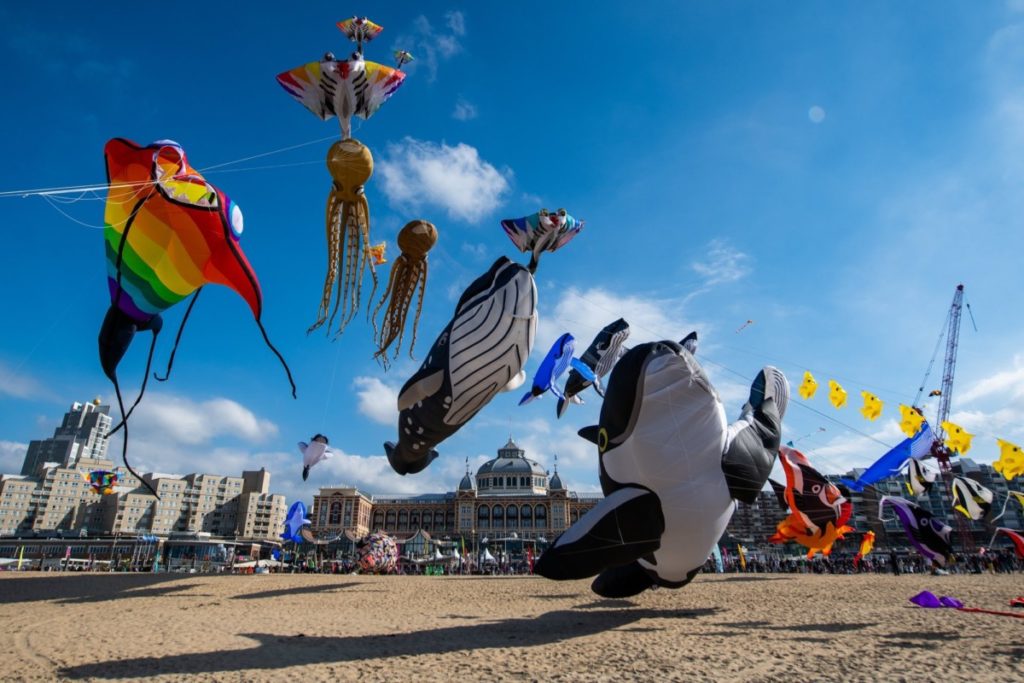
The International Kite Festival in Scheveningen is back for its 41st year! If you know Dutch beaches well (or the Netherlands in general), then you’ll know that there is no shortage of wind. Therefore, this is the perfect location to see some incredible kites floating around the shore.
Kite enthusiasts and kite builders will literally gather from all corners of the earth to showcase their work and you will see a variety of different cool shapes and colours. Some of them will be some of the biggest kites ever flown in the world. You then have the opportunity to attend kite workshops.
You’ll be flying high at Vliegerfeest! Image: Supplied
At night, there is a light show, so it’s literally a whole day of this incredible free event. Don’t be fooled though, it’s not a kids event and we won’t judge you for going. 😉 It’s a perfect event for young and old. See you there!
This years themes: Top sports, history, nature, culture, science, art, technology and science fiction.
#3 See the King at Prinsjesdag
When: Tuesday 17th September 2019
Where: Between the Noordeinde Palace to the Ridderzaa
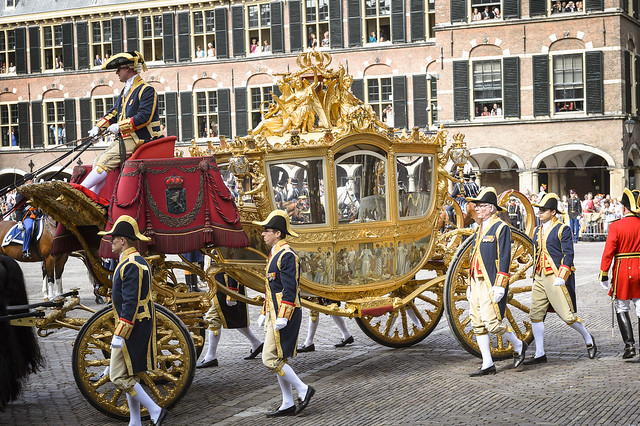
Prince’s Day is held every year on the 3rd Tuesday of September. This is the day where the King conducts his speech about what the government policy will be for the next year. It’s definitely one of the most important days for Dutch politics (apart from election day of course). In order to conduct his speech, the King rides in his Golden/Glass Carriage, from the Noordeinde Palace to the Ridderzaal and then back again.
For anybody who loves a royal visit, this is the perfect opportunity for you to see the Golden/Glass Carriage. People gather at the palace and all along the whole route in order to see this amazing ceremonious occasion. It’s well worth a watch!
#4 World Port Days
When: Friday 6th September 2019 — Sunday 8th September 2019
Where: Rotterdam – Maas River
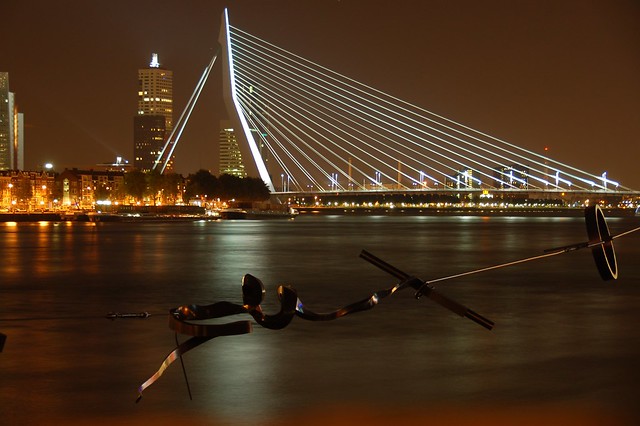
Rotterdam doesn’t take celebrating being the biggest port in the whole of Europe lightly. Annually, in the first weekend of September, Rotterdam celebrates its port over a whole weekend. During this weekend members of the public can see for themselves how the port runs, with behind-the-scenes tours and activities. These include excursions, seminars, demonstrations and naval activities.
Rotterdam will be lit up with giant boats and fireworks. Image: Krzysztof Belczyński on Flickr. CC2.0.
There are also shows and performances along with a spectacular firework display and then a DJ on the Saturday night. So be sure to attend this celebration, as it’s going to be a big one!
#5 Heritage Days (Open Monumentendag)
When: – Sunday 15th September 2019
Where: All over the Netherlands!
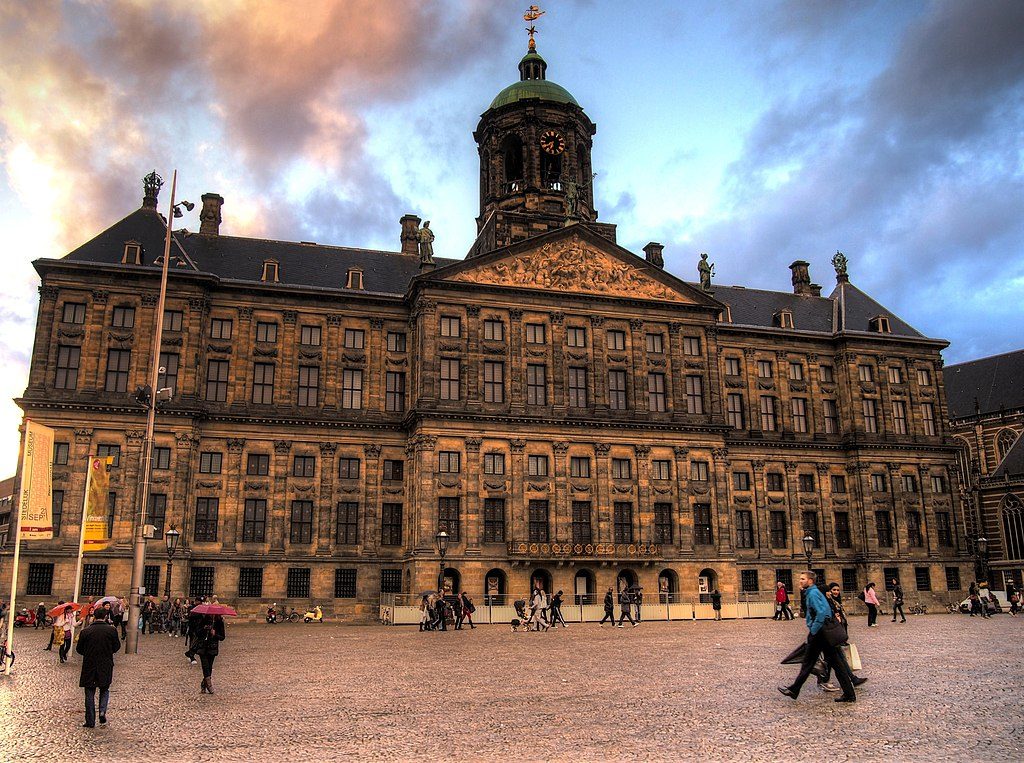
Heritage days are celebrated all over Europe, but for the Netherlands, which is jam-packed with amazing historical sites, it’s an incredible weekend for us all. Around 4,000 historical buildings open up to the public during this period. There will be different activities, guided tours, music and more. Best of all, during this period, you are free to enter – so you can learn so much about the Netherlands and Dutch heritage, free of charge!
Amsterdam Royal Palace is one of the attractions open over the Heritage Days. Image: Hcmholme [CC BY-SA 3.0], via Wikimedia CommonsThe difficult part is then deciding where to go, as most municipalities participate, so in each place, there will be tons of different sites open to the public (look out for the Open Monuments Day flag outside). Make sure you get down there early too, as thousands of people participate every year. Check your municipalities website for more information on what they will be holding on this weekend. This cultural event is not one to be missed.
#6 Alkmaar cheese market
When: Now – 27th September 2019
Where: Alkmaar, of course! On the Waagplein.
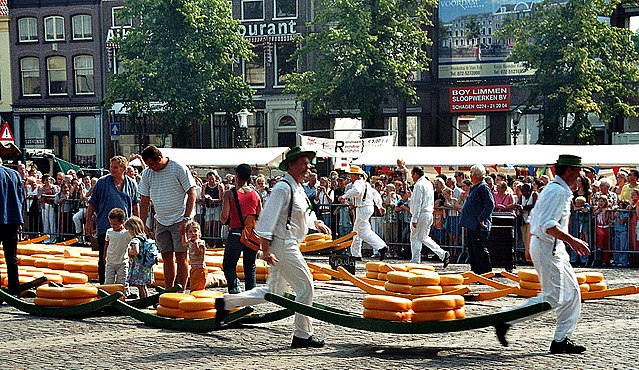
Yes, it’s time! The cheese markets are making a come back. This cheese market is on every Friday from 10am – 1pm (and every Tuesday evening in July and August from 7pm – 9pm). Cheese markets are a traditional Dutch experience, with lots of different Dutch cheeses layering the streets and cheese hauling carriers.
Something smells cheesy. Dguendel [CC BY 4.0], via Wikimedia CommonsThis includes witnessing cheese maids walking around the market and traders trading their cheeses. There also have a variety of programs and performances on. This cheese-market tradition is said to have gone on since the 1500’s. So if you’re after a traditional asf experience, head to Alkmaar at the end of this month! One of my favourites out of all of the free things to do in September in the Netherlands.
So there you have it: our 5 free things to do in September in the Netherlands. Stay tuned for our next instalment next month!
What will you be doing this month? Let us know in the comments! If you want more of this, don’t forget to join our Facebook group… you know you wanna.
A Dutch teenager has undergone an operation in Veldhoven after his height became a tall order to overcome. Yannick Pinas stood at 2.15 metres tall despite only just breaking into his teenage years. After the operation, he dropped 7 centimetres (where did they go? Can I have them?).
The tall 13-year-old knew he was short-changed in the height department when his towering stature started making it impossible for him to complete everyday tasks – like going through doors without stooping, flying on airplanes, or going on a long car ride. Now, thanks to his operation, he’ll stand 7 centimetres shorter.
The now 2.08 meter-tall teen had an operation on his growth discs just above the knee and in his feet. Despite sounding like a dramatic last resort, the operation lasted only an hour – and he could go home the very next day. Now he can go through a standard 2.11 door without putting his posture (or brain cells) at risk.
It’s unsurprising that this teen was headed for big heights – his father stands at 1.98 metres and his mother is above average at 1.78. His mother says that his nine-year-old sister may need a similar operation later in life as she is growing fast with no sign of slowing down.
Yannick’s situation is not entirely unique. However, the Máxima Medical Center in Veldhoven is one of just a few hospitals where pediatric orthopedics can perform the procedure.
Lang is hij al, en hij zal nog langer worden. Maar Yannick Pinas wordt geen 2,15 meer. Hij zal blijven steken op ‘slechts’ 2,08 dankzij een ingreep in het Máxima Medisch Centrum in Veldhoven. Dat lijkt weinig, maar maakt voor hem veel verschil. [Premium]https://t.co/PzLfuhM6tA
Regardless, the number of height operations have increased five-fold in less than four years, from 28 in 2015 to 151 last year. This has ended the previous method of treatment which involved utilising hormones to inhibit growth after it was discovered to cause infertility in girls.
Why stop growing?
There are a lot of advantages to being tall, like not having to pluck the low-hanging fruit or being really, really, really close to the basketball hoop. In fact, being tall is not harmful to a person’s health at all.
However, it can affect a person’s comfort when all other furniture is designed for shorter people, have social ramifications, and limit shopping options and job prospects.
Are you really tall, really small, or somewhere in between? What do you think of the tall people in the Netherlands? Let us know in the comments below!
Dutch media companies are in talks about joining forces to make one joint platform for all video and audio streaming in the Netherlands. According to AD.nl, an agreement is in the works. There has been increasing pressure on them as their ratings are falling, and their advertising revenues are coming up dry. The culprit? Services like Netflix.
What can we expect from this streaming service?
Audio, video and news broadcasts will be available in one place. Each person will be able to tune into their favourite regional radio shows or update themselves on the happenings in the world from their trusted news sources. All the big names are signing up, including NPO, RTL, Talpa, NOS, and De Persgroep, so be rest assured that you’re going to have quite a big pool to choose from.
However, it is still unclear how this service will be set up. They’re still deciding how to generate revenue through it – whether it would be through ads or through subscription programs. AD.nl reports that “research shows that Dutch people are willing to take out two subscriptions”. With this new streaming service, the Dutch media companies hope that the second subscription would be the Dutch one (because let’s face it, everyone already has a Netflix subscription).
When will it be launched?
That is difficult to say. Each of the media corporations has been looking out for their personal interest and so it has been difficult to even reach this stage. Previous, similar video services haven’t been quite as successful because individual media companies have their own subscription programs. Going forward from here will also be difficult, reports AD.nl. However, there is a chance that the government will be stepping in if they won’t be able to come to an agreement. Arie Slob, Minister for Primary and Secondary Education and Media, will be presenting their “cooperation agenda” in the Lower House soon.
What do you make of this? Do you think a Dutch streaming service will be successful? Let us know in the comments below!










.jpeg)
