Make sure to soak up the last few rays of sunshine. The summer weather is expected to leave for good on Wednesday.
This September has seen unexpectedly warm weather, which will continue until Wednesday. Temperatures will quickly jump from lows of 12 to highs of 22 degrees today. Tomorrow will be similar with temperatures reaching between 9 and 22 degrees.
These past few days of sunshine have had us all believing that summer was enjoying a nice stretch of the limbs this year. However, the nights have reminded us that Autumn has in fact, snuck up on us.
September frost begins
Indeed, whilst the past few days have been spent in the company of balmy 20 degree weather, the nights have been cool enough to welcome the first frost of the season.
Unlike the warm weather, the frosty mornings have been nothing unusual. Brian Verhoeven of Buienradar has said that frost is to be expected in September. Indeed, temperatures reached a low of -1.3 degrees at the weather station on Saturday morning.
Wednesday: say goodbye to summer
The tables are set to turn on Wednesday as a cold front will sweep across the country in the afternoon. This cold front will bring with it the weather that we have all been trying to forget.
Temperatures will be no higher than 16 degrees and thunderstorms are also expected on Thursday. Buienradar has said that they see no further sunny weather on the horizon “There will be no really sunny, dry periods for the time being. So just enjoy it now, before the long pants have to be put on again.”
Looks like that was our summer! Will you miss the sunshine? Let us know in the comments below!
With coronavirus cases skyrocketing across the country, the GGD has opened a telephone line for testing exclusively to healthcare and education personnel.
This priority testing is only a temporary measure, put into effect because of increased demand and waiting times. People calling for priority testing will need proof from their employer. “Just saying that you have a cold and that you are in front of the class is not enough,” says Minister De Jonge in a NOS report.
Netherlands infections soar
According to data from RIVM, 11,705 people tested positive for coronavirus last week. That’s 60% higher than the total from the week prior. The upward trend is expected to continue.
New measures were announced on Friday to help curb the spread of the virus in six key regions. These include the early closure of bars and restaurants and limiting group size to a maximum of 50 people.
Recent routine police checks found one-third of Amsterdam taxi drivers who were tested to be driving under the influence.
On Saturday night, police stopped 18 taxi drivers at random for scheduled drug and alcohol checks. Of them, six drivers tested positive for THC, amphetamines and/or other drugs.
The six drivers were arrested and blood was taken for further investigation. It is not clear at this stages whether consequences will be more serious because they drive professionally.
Afgelopen nacht controleerden we i.s.m. VHT 18 taxi's. Alle chauffeurs ondergingen een speekseltest; 6 chauffeurs testten positief op o.a. THC en amphetamine en werden aangehouden op verdenking van rijden onder invloed. Bij alle 6 werd bloed afgenomen voor onderzoek. pic.twitter.com/ypmnlJvP1c
Taxi drivers working under the influence has been an increasing issue in Amsterdam. “During a check in February, one in eight inspected drivers had a positive test result, so now one in three. That is very significant, especially since they are professional drivers,” a spokesperson told NOS.
Do you take taxis in Amsterdam? Will you continue to?
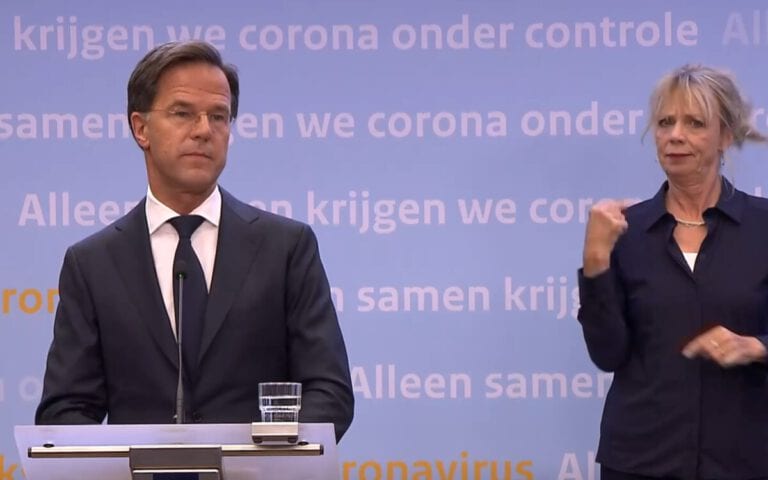
Prime Minister Mark Rutte and Minister for Health Hugo de Jonge have fronted the press. A new range of regional measures have been announced amid skyrocketing coronavirus numbers.
Rutte warned that the reproduction number, which measures how many people one person with the virus infects, has already grown to 1.4. “Yesterday we had over 1700 infections,” said Rutte. “With an R number of 1.4 that number will grow to 10,000 a day within three weeks. We can’t do that to healthcare workers. Not again.”
The government has created a risk three-level system for measures in different parts of the Netherlands. “We want to target the virus hard, with an angle toward certain regions.”
Level One — Vigilant: subject to normal measures
Level Two — Worrying: infections are rising, worrying situation with additional regional measures that would help to stop the spread.
Level Three — Serious: Strict measures to protect vulnerable people and manage the healthcare system.
Already, six regions will be classed as a Level Two: Amsterdam-Amstelland, Rotterdam-Rijnmond, Haaglanden, Utrecht, Kennemerland and Hollands-Midden. New measures will apply in these regions from Sunday at 6 pm.
“We want to hit the virus hard, and the region and economy not hard,” explained Health Minister De Jonge. “That’s why we chose a regional approach.”
What are the new measures?
Additional measures announced this evening for the Level Two zones include:
Bars must close at 1:00 AM, and no new people can be let in after midnight (when the music also stops)
No more than 50 people in one group, including for weddings.
However, demonstrations, funeral, religious events, and schools can have more than 50 if they can demonstrate how they will abide by measures. These must have authorization.
However, local municipalities will announce their own measures from 8:00 pm this evening. Municipalities that have announced their new rules are below, we’ll continue to update this article as others release their new measures.
Amsterdam-Amstelland (including Amsterdam)
Shopping baskets will be counted and disinfected again.
Public buildings such as libraries, city district offices and swimming pools will be open at certain times of the day to the elderly and people in poor health. Shops and museums are asked to do the same.
To prevent illegal parties, places like parks will be preventatively closed off at night.
Measures to prevent excessive crowding in public space will be implemented, for example by setting up one-way traffic, (temporarily) closing off streets to car traffic or dosing at the entrance if it gets too busy.
Enforcement and the police will continue to carry out targeted checks at places where people gather, such as party and conference locations, cafes, restaurants and sports canteens.
Rotterdam-Rijnmond (including Rotterdam)
The Rotterdam Rijnmond Safety Region will focus more on enforcement of the corona measures, including in markets and in places where many young people gather.
Supermarket owners are also called upon to pay more attention to compliance with the corona measures.
Mouth mask requirements have not been re-implemented, but Mayor Aboutaleb has not ruled out the possibility.
Haaglanden (including Den Haag)
there will be a crackdown on the enforcement of coronavirus measures. Catering establishments, party halls, sports facilities and student societies will be subject to inspections. If the rules are repeatedly broken, it will be closed for a month. If the measures are subsequently ignored again, it will be closed for a period of three months.
Hollands-Midden (including Leiden)
no additional measures except for the widespread measures announced above.
Kennemerland (including Haarlem)
no major additional measures, but the safety region stressed that it will approach institutions and businesses for enforcement measures.
Utrecht
the Safety Region will investigate the possibilities and need for setting window times in shops and government institutions such as libraries and community centres, so that vulnerable groups can visit them at a quieter time.
Where possible, there will be stricter enforcement of compliance with the measures, including the accelerated closure of institutions or locations where a source of infection has arisen.
There will be further supervision and enforcement in parks and other areas with a risk of illegal parties, and sectors where excessive contamination takes place.
New national measures
In addition, general measures that apply nationally include:
Student houses need to make rules about how they are going to reduce the spread.
Supermarkets will potentially open only for vulnerable people at certain times.
More checks outside, illegal parties will be stopped (all regional measures)
For children under the age of 12 with mild symptoms, there’s no need to be tested, and they may attend school. This avoids missing school or taking up valuable testing capacity.
Shortage of test appointments
De Jonge also addressed the testing delays occurring throughout the Netherlands. “If you try to make an appointment there is a long wait time. We’re working very hard to get some more lab capacity,” he said.
“We’ve bought new machinery, new materials, and we’re making deals with labs and looking for new ways, like a quick test.” However, he warned that this will take a few weeks, so only people with symptoms should get tested. Teachers and healthcare workers now have priority for testing.
Current figures
The past four days have seen record-breaking infections for coronavirus in the Netherlands. A total of 1977 infections were reported to RIVM before 10:00 am today for the 24-hour period beforehand. The highest daily number before this week was on April 10, with 1327 infections. However, it’s important to note that at the time not all of the population could be tested.
Hospitalizations have been slower to increase. But the number has risen by 67% in the past seven days. There are currently 58 patients in ICU, and a further 230 COVID-19 patients in hospital.
Ernst Kuipers, chairman of the National Acute Care Network, says that the greatest crowds are in Amsterdam and Rotterdam hospitals. “Appropriate measures are needed there to stem the increase in the number of new patients,” he said.
Where are the majority of infections occurring?
The government identified several worrying areas where clusters are emerging. Geographically, areas in the Randstad have had the highest numbers of infections, leading to the level two rating above.
Young people who are more relaxed about distance are also contributing to the rise in cases, said De Jonge. People partying on a Friday go to the supermarket on a Saturday and visit their grandmother on a Sunday. “That’s how the virus spreads,” he said.
Het gaat niet goed met het coronavirus in ons land. In de regio's waar het aantal besmettingen het snelst toeneemt, worden aanvullende maatregelen genomen om de verspreiding van het virus tegen te gaan.
Translation:The corona virus is not going well in our country. In regions where the number of infections is increasing fastest, additional measures are being taken to prevent the spread of the virus.
However, Rutte also stressed that over 10% of infections occur in the workplace. He urged everyone to work from home. Restaurants, bars, and cafes are also responsible for clusters of infections.
“If we don’t turn the tide, shops and cafes will have huge consequences. For the people that work there and entrepreneurs, it will be terrible,” Rutte warned.
Stress on healthcare
The government wants to avoid a situation where the hospitals are overrun. “The hospitals are less full, the time in the ICU is shorter, and we know more about treatment,” said Rutte. But he warned that hospitalizations are increasing.
“With the increasing amount of patients, the nurses and healthcare workers have more pressure on them in Amsterdam and Rotterdam,” he said. “They’ve started special COVID sections in the hospitals. In nursing homes, numbers are also increasing. That’s where the most vulnerable people are who we have to protect.”
“It’s not the second-wave yet in hospitals, but we have to work together or the virus will spread again,” said De Jonge. “We know more about the virus, so we can slow this second wave.”
People encouraged to keep up with measures
Rutte acknowledged that people are tired of following basic rules like keeping distance or hand washing. “People are getting hungry for contact, they want to go out and have fun, we understand that. But it’s not clever,” he said.
He stressed that when numbers lowered, it was not because of testing or contact tracing, but because of urgency from the people to bring the numbers down. “In the end, it’s not the measures that kill the virus, we have to do it,” said Rutte. “We have to follow the measures and keep going, only then can we break the second wave.”
King Willem-Alexander and Queen Máxima will receive a raise worth €68,000 — almost twice the average Dutch income. This year’s Budget Memorandum also reserved 1.6 million (yes, I said million) for Princess Amalia once she turns 18 in December next year.
With the raise, King’s Budget will pay the royal couple a €7.2 million salary, which includes compensation for “personnel and material expenses”. As for the princess, her monthly salary of €111,000 will begin on December 7, 2021.
The king’s budget is no stranger to criticism, which usually remains within the digital world of social media. The Prime Minister will defend the budget next month, which follows constitutional guidelines for payments to the Royal House. Salary increases to the royal family are proportional to the salary increases of civil servants, in this case, 5%.
Economic difficulties
The king himself warned in his recent Budget Day speech that the Netherlands’ economy has been hit hard by the coronavirus and to prepare for more economic setbacks. Explaining the king’s salary increase and the hundreds of thousands going to an 18 year old during such times will be hard.
Already there is controversy over the new speed boat that the royal couple were seen with this summer in Greece, reports NOS. Last year, criticism fell on the king after he auctioned off royal paintings, causing the public to question whether he was paying off some kind of debt. In May, subsidies received by the king for maintenance and management of the Kroondomein Het Loo estate, amounting to 4.7 million, also fell under public scrutiny.
Making amends
The king has clearly been putting effort into cleaning up the face of the royal family. This year the golden carriage, which the king traditionally made his annual appearance in, was instead placed in a museum over the much-debated “slave panel”. During his visit to Indonesia in March, the state head apologized for the violence during the decolonization wars.
The final say
Regardless of public opinion, it is the House of Representatives led by Prime Minister Rutte who will have the final say on royal allowance. When Willem-Alexander turned 18, there was talk of increasing the age of kingship to 21 to delay his state benefits, but this did not go ahead in the end. As to Amalia’s income, this discussion could continue in the King’s budget debate in October.
What do you think of the king’s budget and Amalia’s soon-to-be salary? Let us know in the comments below.
Starting as early as this evening, cafe and bars in the west of the country will be required to close early and limit their capacity to 50 guests.
Coronavirus cases have continued to rise in western parts of the country, particularly in the Randstad region. Last night, a meeting was held between the cabinet and the chairs of six regions with the highest number of cases to discuss a new plan of action.
Decreased capacity and earlier closure
What is now known is that restaurants and bars will be affected by the new measures. They will be required to limit their capacity to 50 guests at a time, halved from the previously allowed 100 guests, reports NOS.
Further, late-night establishments will now have to stop allowing in new guests at midnight, and ensure that the place is cleared by 1 AM. Cities affected by the new measures will include Amsterdam, Rotterdam, The Hague, Haarlem, Leiden, and Utrecht, possibly among others.
New infections skyrocketing
Yesterday, 1,756 new infections were reported in the Netherlands, a new record for daily new cases. The government aims to prevent another national lockdown by taking action at the local level.
Details about the new restrictions will be explained tonight at a 7 PM press conference — check back in with DutchReview for the story.
Every time serious crimes are committed in the Netherlands, we always hear about judges passing a sentence of a stipulated amount of years and compulsory TBS. A lot of people, especially ex-pats, sometimes wonder what TBS is. Well, this article is just for you.
TBS is an abbreviation for ter beschikking stelling (literally meaning: “making a person available for psychiatric treatment.”) It is a kind of measure that a judge can impose on people who have committed a serious crime and who have been declared “insane” in whole or in part. These crimes may include murder, manslaughter, assault and rape, arson (that endangers or results in death), aggravated assault, armed robbery, the making of child pornography, etc.
When determining whether an offender may undergo TBS, the judge takes into account the interests of everyone involved: those of the victim(s), those of the perpetrator, and of course, those of the society.
Those with severe mental disorders are not healthy enough to be responsible for their actions. Image: Ehimetalor Akhere Unuabo/ Unsplash
In a lot of cases, offenders cannot fully be blamed for the crimes they’ve committed because they suffer from a personality disorder and/or a serious psychiatric disorder. As a result, there is also the risk that they may repeat the offence if they are made to only serve a prison sentence. That is why it is important that they not only serve time but also undergo TBS.
Insane and not fully responsible
In the Netherlands, a judge can only impose TBS on an offender if it is certain that they have a mental disorder, addiction and/or intellectual disability. This requires a psychiatric examination of the suspect.
A TBS patient is one who has a disorder and cannot be completely blamed for the crime they have committed. Some types of disorder that an offender could have, are; borderline, Asperger’s, a psychosis, or some other psychiatric disorders. Many TBS patients are also addicts, and as a result, need rehabilitation.
It does not make sense to punish addicts, as punishment is not going to help them get rid of their addiction. An intellectual disability can also cause someone to be insufficiently accountable for a crime. And someone who is completely insane is not legally guilty. In such a case, the judge will only impose a hospital order and not a prison sentence.
Judges can also declare a perpetrator to be less insane which makes them legally guilty and therefore, he or she is also partly responsible for the crime. The verdict is usually a combination of firstly, imprisonment, and then TBS.
The purpose of TBS
The main purpose of TBS is for the safety of society. It is important to understand that punishment as a form of incarceration does not work. Take the United States as an example. There, they focus more on the punishment of prisoners, and it has proven unsuccessful in the actual purpose of ultimately rehabilitating convicts to eventually become law-abiding citizens and productive members of society. The US Department of Justice reports that 68 percent of prisoners released, return to prison for committing a new crime within three years of leaving.
Prison systems are not always rehabilitative. Image: Benjamin Gremler/ Unsplash
There are reasons why people offend, and it is always important (for the good and safety of society) to find out why. When people become dangerous to others, we restrain them regardless of who they are. Some of their freedoms are taken away from them as punishment by the result of their restraint. Ideally, TBS and a prison sentence would force them to reflect on their crime(s), which would ultimately deter them from repeating the offence once they’ve been released.
Imagine a person with a personality disorder committing a crime and only serving a sentence in a prison where they are ultimately punished, humiliated, and made to suffer every single day. After the sentence, they will be released into society, and the truth is that nothing would have changed.
That is why while serving their sentence, it is important that they also undergo TBS treatment. This treatment reduces the risk of recidivism. In the Netherlands, offenders with disorders are allocated a TBS officer who helps them return safely, and eventually independently to society.
Types of TBS
There are two types of TBS in the Netherlands:”TBS with compulsory guidance, or nursing” and “TBS with conditions.”
“TBS with an order for guidance” requires the patient to be (forcibly) admitted to a TBS clinic for their treatment. This is more strict and could come with rules such as no alcohol and drugs, and frequent checks to make sure that the patient is following these rules.
“TBS with conditions” is a lighter form of TBS. The patient is not required to be admitted to a clinic — but he or she must also follow the rules, and adhere to the conditions set by the judge. The probation service is tasked with supervising them. If the TBS patient does not comply with the conditions, the judge can decide to convert the TBS with conditions into TBS with a compulsory guidance order.
In practice, many of these TBS patients still stay in an institution or clinic, it doesn’t matter what type of TBS has been imposed on them. This is because the judge often sets the condition that the TBS patient is temporarily sent to a mental health care institution (GGZ).
Note: The geestelijke gezondheidszorg (GGZ) is an institution for mental health care and addiction care in the Netherlands. There are some agencies affiliated with it, like the Regional Institution for Assisted Living (RIBW), addiction clinics or psychiatric hospitals.
Treatment in a TBS clinic
A TBS clinic is all about treatment and security. TBS patients receive treatment that is tailored to their disorder and their personality. The starting point is to hold them accountable as much as possible about their responsibilities.
The treatment consists of different types of therapy, and sometimes medication. In the clinic, TBS patients are sometimes allowed to work or receive an education. This is necessary to prepare them for their return to society.
What is the duration of TBS treatment?
Treatment in a TBS clinic takes an average of seven to eight years, but in principle, no pre-agreed end date is known. Once every two years, there is an extension session about whether or not to renew the TBS. The patient is personally present, together with a lawyer. The measure can then be extended for a maximum of two years.
A TBS patient can only be released into society if treatment has been deemed successful. Successful means that the chance that a patient will commit a serious crime again has become very small. It is important that when they are brought back into society, the patient no longer a danger to themselves and others.
“Long-stay” TBS clinics
If someone does not cooperate with their treatment, it means that the chance of recurrence does not decrease and that security of society remains necessary. The judge will therefore always renew the TBS. Ultimately, this may mean that the patient is placed in a long-term hospital ward, also called a “Long-stay TBS ward.”
In this type of TBS clinic, the offender no longer receives treatment aimed at rehabilitation. However, they still get psychological and medical care and necessary security. Every three years, a special committee assesses whether they should remain in the ward or perhaps be transferred to a different clinic where treatment with the aim of rehabilitation can be resumed. This committee is called the National Advisory Committee Long-stay Placement Forensic Care (LAP).
Do TBS patients still have rights? — a Dutch debate
For years, human rights advocates in the Netherlands have criticised the Long-stay ward, claiming it as a place where TBS patients go to be locked up, forgotten, and die. The National Advisory Committee Long-stay Placement Forensic Care (LAP) released new figures in 2020 to show that half of the TBS patients who are brought into the ward, eventually leave.
Sometimes confinement is necessary. Image: Matthew Ansley/ Unsplash
LAP reports that between February 2011 and November 2019, they issued advice on 223 TBS patients in long-stay wards. 98 patients are still in that ward, and 99 have left. 26 others have since died, in or outside the TBS clinic.
Everyone has rights, and normally those rights are set out in the Dutch constitution. But some rights no longer apply to TBS patients. This is because security is of paramount importance. For example, they are given mandatory urine control. That is contrary to the fundamental right to “inviolability of the body”. The rights of TBS patients are set out in the Nursing Principles Act.
What happens at the end of a TBS treatment?
The judge decides whether the TBS can be terminated. This will only happen if the judge finds that the patient can return to society, without the risk of reoffending. The TBS clinic and the probation service first advise the judge if it is safe for the TBS patient to be released, and then the judge further decides if it is independently or not.
What does the probation service do at the end of a TBS treatment?
There are three probation services in the Netherlands: the Dutch Probation Service, the Salvation Army Youth Care and Probation Service, and the GGZ Addiction Rehabilitation Foundation. Together they ensure that ex-TBS patients return to society reformed and ready to contribute positively.
They do this through monitoring and guidance, among other things. The probation service considers it important that offenders understand (fully) what their behaviour (or reformation) might mean for their victim(s)/next of kin. They are made fully aware of how their actions (going forward) impacts their communities and society as a whole.
Step-by-step integration of TBS patients
The transition from a TBS patient who is under guidance, to an independent life in society, is not an easy one. It works best if this is done step by step. The probation service and the TBS clinic often monitor the patients for some time before they can have their independence.
What about the victims and their relatives?
A lot has been said about TBS, TBS patients, and how they are gradually reintegrated into society, to make sure they do not become repeat offenders. But it is also important to talk about the victims and their loved ones.
In the Netherlands, the Custodial Institutions and agencies involved, do take the interests of victims and next of kin into account. To help, they organise victim-offender contact, together with the Perspectief Herstelbemiddeling foundation. For example, if you have questions for the offender, or are curious as to who it is, and why you were the victim, Perspectief Herstelbemiddeling helps bring victims and offenders together.
Contact is always voluntary and may take the form of a conversation or an exchange of letters. This is done under the guidance of a professional and independent mediator from the organisation. Both the victim or next of kin and the offender can take the initiative. The contact between the victim or next of kin and the TBS patient is prepared very carefully and in consultation with the treatment officers of the patient.
Where else can victims (and/or their family and friends) go for help and information?
Victim Support Desk
The police, the Public Prosecution Service, and Victim Support work together in the Victim Support Desk. Victims may contact the Victim Support Desk for answers to questions that precede the prison sentence. For example, about reporting the crime, tracing the suspect, the lawsuit, and the decision made by the judge.
There are 10 Victim Support Desks in the Netherlands: in Amsterdam, Arnhem, Breda, The Hague, Haarlem, Hertogenbosch, Groningen, Maastricht, Rotterdam and Utrecht. A national Victim Desk has been established for appeals in ‘s-Hertogenbosch. The addresses and telephone numbers can be found on Slachtoffer Loket.
The Victim Information Point for Compensation Measures (SIS) provides information on requests about the status of the payment of compensation by the offender if this has been imposed by the court. The Victim Information Point for Compensation Measures can be reached on telephone number: 0900 753 7537 (every working day from 8.15 am to 5.15 pm).
TBS is not a punishment, but a treatment
TBS is a custodial measure aimed at protecting society from the danger of the convicted person. The TBS patient has often already served a prison sentence for the crime committed. While they may not be fully responsible for the offence, the prison sentence is aimed at retaliation for that part of the offence that can be attributed to them. The TBS order must ensure — after the prison sentence — that the psychiatric illness or disorder is treated so that the chance of recurrence is prevented as much as possible.
The Dienst Justitiële Inrichtingen (DJI) (Custodial Institutions Agency) publishes reports in figures about TBS every year, and this includes information about the implementation of the TBS order. The latest report shows that TBS works and is indeed more effective than just punishing prisoners and making them suffer. There is also data backed by research that the percentage of ex-prisoners who re-offend within 2 years of release is 47%. And after TBS, it is less than 34%.
Certainly, this system is far more effective than its international contemporaries.
What do you think about TBS? Do you believe that it keeps society safe and secure? Let us know in the comments below.
It looks like while the Dutch are known for their liberalism when it comes to sex, corporate logos are taking it too far. The Dutch football club, Emmen, were told that they could not accept sponsorship from the erotic webshop EasyToys.
The club had been on the hunt for a willing sponsor and were happy to receive an offer of sponsorship from EasyToys. However, when they sought approval from the Royal Dutch Football Association (KNVB), they were denied permission for sponsorship.
When a football team has sponsors, they wear the logo of the company on their shirts. The KNVB argued that the logo for an erotic website would not be appropriate. “It is not appropriate to display sponsorship from the sex industry on match kit. We must take in account that football is for both young and old.”
I never knew people could get hot and bothered about a corporate logo! Capitalism, you sexy thing.
Sex toys are uncomfortable in the Netherlands
In spite of the casual regard with which someone can pop in and watch a sex show, or solicit sex from someone else, it seems that the Netherlands is not ready for to go as far as sex toys yet. Especially the ones that are hidden behind a corporate logo.
EasyToys has said that they were surprised by the denial of sponsorship. Especially given that they already sponsor FC Groningen.
There are too many eyes on the backs of FC Emmen and it appears the KNVB doesn’t want them looking at this particular sponsorship. “We hoped that more positive attention for our webshop would contribute to breaking the taboo that still rests around our industry. The fact that eroticism and sexuality are still uncomfortable subjects for many is evident in the decision of the KNVB” chief executive officer Eric Idema, has said.
Hush, hush: KNVB didn’t even want to speak about it
Idema was particularly irked by the fact that KNVB didn’t even want to speak with him regarding the matter, reports RTV Drenthe.
“I had enough arguments to show the KNVB that the deal would be one out of good decency. I have a healthy company, where a lot of people work very hard. We have a turnover of 60 million and 200 employees. I really wanted to mean something for a club that I have a feeling for, I am a native of Emmen myself.”
FC Emmen for sex toys
FC Emmen has said on their website that they were disappointed to have the sponsorship denied and that they will continue to pursue it. “We will study the KNVB’s arguments and consider what to do next. In any case, we do not intend to drop a party that wants to become the main sponsor.”
It is uncertain whether EasyToys will take any further action but the company has been receiving offers of help, Idema says. “It is clear that I have already received a lot of phone calls and messages from lawyers who would love to assist us should we follow that process.”
The vast majority of Dutch municipalities lack adequate public toilets or policies on them. As a result, half of those with urinary or abdominal issues avoid going out to prevent unpleasant situations.
Today marks National Plasdag (Pee Day), an incentive by the Continence Foundation Netherlands (CSN) and Maag Lever Bowel Foundation (MDLS) to help remove the social stigma around urinary problems. Roughly 3.5 million people in the Netherlands suffer from continence problems. For these people, the lack of public toilets often drastically limits their lifestyles.
Over-active bladders and under-active municipalities
We’ve all been caught out in public with a full bladder, desperately trying to find a loo that will provide some relief. But the apparent deficit of potties and poopers in the Netherlands was put into hard numbers by the MLDS and CSN. These researchers want a public toilet every 500 metres in the busy public areas of every Dutch municipality.
MLDS and CSN interviewed 111 municipalities about their public toilet policies, and the results of the study were disappointing. 53% had no budget planned for improving the amount of public toilets, and 39% did not think this was necessary in the first place. On the plus side, 75% claim they are working on the problem to accommodate those with urinary and abdominal difficulties.
Violation of UN convention
The lack of public toilet policy is in fact a violation of the UN Handicap Convention that the Netherlands signed in 2016, according to CSN. “We are far from reaching our goal of a publicly accessible toilet every 500 meters. We continue to chase municipalities. Making policy is fun, but you can’t go to the toilet with that,” a MLDS spokesperson told RTL Nieuws.
To court for public peeing
This afternoon, the military subdistrict court in Arnhem will rule on the case of Major Marco Kroon, a man fined €140 for urinating in public during the Den Bosch carnival. Kroon argues that he did not have time to reach a toilet because all of the portable public toilets were too busy.
“I did everything I could, but I couldn’t stop it. It was pure force majeure,” Kroon said. His lawyer argues that there are far too few public toilets available, especially during carnival, and that this is unacceptable for those dealing with urinary problems.
Of course, the corona-crisis has only reduced the number of available public toilets as many restaurants no longer let people into theirs.
Have you ever been caught out in need of a public toilet and unable to find one? Share your experiences in the comments below.
A sharp increase in figures has prompted the Dutch government to implement new measures for some regions of the Netherlands.
Amsterdam-Amstelland, Rotterdam-Rijnmond, Haaglanden (The Hague), Utrecht, Kennemerland (Haarlem) and Hollands Midden (Leiden) are likely regions that will be subject to the new measures. However, additional areas have not yet been ruled out.
What the measures will be comprised of is currently hush-hush, according to Minister for Public Health, Hugo de Jonge. “On Friday we will enter into consultations with the regions that turn orange and we will announce the package of measures,” he says.
By implementing regional measures, De Jonge is hoping to avoid another large-scale national lockdown.
“There is not a silver bullet to reduce the number of infections,” says De Jonge. “We want to hit the virus hard, but the economy and society as little as possible.”
There were 1542 new infections reported yesterday, a record for daily infections since widespread testing was introduced on June 1. The majority of new infections are found in 20-29 year-olds.
“We are increasingly seeing where the infections are and we will therefore take targeted measures,” explains De Jonge. “We see that the infections are mainly among young people, among students. The catering industry is also growing slightly more.”
Potential new measures for restaurants, cafes, and bars
The association for the hospitality industry, Koninklijke Horeca Nederland (KHN), is concerned that the government will implement new measures for the industry. Among these, a mandatory closure from midnight in some major cities could be on the cards.
However, KHN is worried about the negative impact on establishments — and that it won’t solve the problem. A spokesperson points out that only 113 people in the last week were confirmed to have become infected from the catering industry. Prime Minister Mark Rutte has previously confirmed that the majority of infections take place in the home.
“KHN expects with this disproportionate measure that additional unrest will arise in the street, as people will move to public spaces, such as squares, parks and streets. In addition, guests can also move to neighbourhood municipalities,” said a KHN spokesperson.
Will you be impacted by the potential new corona measures? Do you think the government is reacting fairly? Tell us your thoughts in the comments below.