The grey, rainy, and somewhat windy Dutch “summer” will continue to haunt us for a few more days. However, as the weekend comes closer, so will summer weather, reports AD.
Yup, you know what that means: it’s time to dust off the swimsuit again baby! This weekend will bring sun and 25 degrees. 😎
Sunny start to the week
While today and Tuesday aren’t going to be the warmest days of the week, they look promising for those who are tired of the Dutch rain (and aren’t we all 🙊). The first two days of the week will have a high of 19 degrees in the northern and coastal regions, while the inland and especially more southern regions can enjoy up to 22 degrees.
However, it’ll seem warmer than the past few days of similar temperatures as the wind will remain a moderate breeze. Monday and Tuesday are also the days with the least chance of rain — leuk!
Nevertheless, local showers can bring a lot of precipitation in a short time in some areas. The south and southeast of the country, especially South Limburg, can expect 20 to 30 millimetres of rain.
Colder nights
The clear skies today and tomorrow can cause some cold nights at the beginning of the week. In fact, temperatures could go as low as seven or six degrees — a drop that’s unexpected this time of year.
For early birds (or those willing to become one for a day) though, the colder nights can be a blessing in disguise! Namely, they bring beautiful dawn. So we recommend grabbing a blanket and your favourite person and watching the sunrise! 🥰
Warmer towards the weekend
As the weekend draws closer, so will the warmer air from Central Europe. From Thursday, the Netherlands could benefit from these southern winds and temperatures could rise to 24 degrees in the southeastern part of the country.
The heat, however, will also bring an increased chance of rain and thunderstorms. BUT on the weekend, we can look forward to 25 degrees and seriously sunny weather. 🥳
For those living near the coastal regions, the opportunity for sunny beach walks comes at the cost of a few degrees. Overall, the weather in those regions will remain slightly cooler throughout the week with 20-22 degrees being the weekend high.
How are you planning to enjoy the weekend sun? Tell us in the comments below!
A new London attraction, designed by Dutch architectural firm MVRDV, has temporarily closed shortly after opening, after receiving much criticism from the visitors.
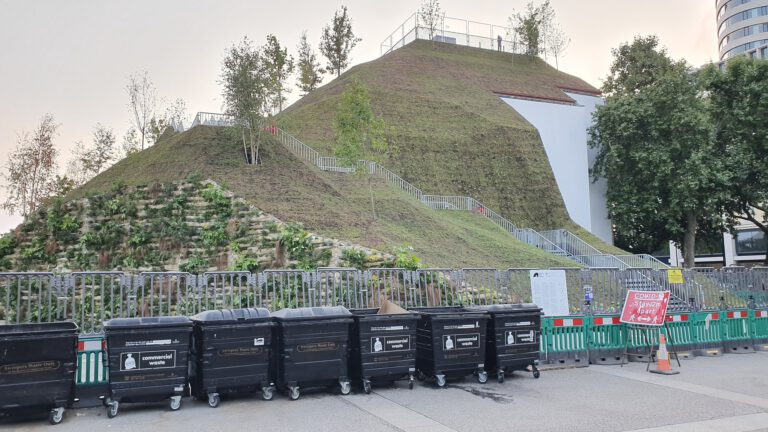
March Arch Hill promised panoramic views over London’s Oxford Street and Hyde Park — but since its opening on July 26, visitors have relegated it to a ‘mound of dirt’.
In summary: I enjoyed it. More as you might enjoy a bad statue of Christiano Ronaldo, or a car park Santa's Grotto, with dogs pretending to be reindeer, than as a dazzling spectacle.
As long as you go with that expectation it is ok – just a shame it cost 2 million pounds. pic.twitter.com/Jyu90EQKFr
The 25-metre-tall temporary attraction was supposed to bring life back to Europe’s busiest shopping street, which was hit hard by the number of lockdowns.
The vision of MVRDV was that the hill would “redefine the connection between Oxford Street and Hyde Park” and create an opportunity for residents to experience nature in the city centre.
Disappointment
However, so far it’s brought nothing but disappointment. Visitors felt that the attraction looked like a construction site, looked unfinished, and was nothing like the original designs, reports the NOS.
I ran to the shit hill at Marble Arch today and it did not disappoint. It’s literally just scaffolding covered in patchy sod and plastic sheeting and from tomorrow you can pay £8(!!) to climb the stairs to marvel at the busy intersection from a height. Omg it’s so bad. pic.twitter.com/leVnHmHG6W
People who have already booked their £4.50 ticket (Є5.30 — a bit of a rip-off if you ask us considering it’s a short walk up a hill) for the first week of opening will be offered a replacement ticket free of charge, states the Westminster City Council.
“We are aware that elements of the Marble Arch Mound are not yet ready for visitors. We are working hard to resolve this over the next few days,” the council wrote in a statement.
Needs time
The architectural firm MVRDV, which is known for Rotterdam’s famous Markthal, as well as the newly built Depot of Museums Boijmans van Beuningen, has been defending the project.
According to a spokesperson, the attraction was opened too soon. “It’s always unpredictable when you work with plants and trees. We need to give nature some time,” they said.
Have you heard of this attraction? Do you think it was worth the investment? Let us know in the comments below!
Over the past year, the NS has received close to 2,500 reports by passengers of nuisance on trains. The NS took action in about half of the cases, with warnings or arrests being made
Last year, the NS made the number 06-13181318 available for travellers who feel unsafe or experience nuisance on trains to report their experiences. In that time, 2,500 reports of passengers feeling bothered or unsafe were made, the NOS reports.
This new system has been received positively by travellers because it’s subtle and effective. Imagine how awkward it would be having to approach the conductor while the person making you feel uncomfortable is right there in the carriage with you….
How does this system work?
The reports are received by the railway’s safety centre. When a complaint is received from a passenger on a train, they are immediately sent an answer via WhatsApp. The safety centre then decides whether action needs to be taken.
According to Eelco van Asch, a member of the executive board of the NS, “the chief conductor can act immediately. In addition, people from the Safety and Service department of the NS and possibly the police can be called in.”
What have people reported?
The majority of the 2,485 reports involved people breaking the house rules on the train. In second place were messages were about harassment of passengers or disagreements. Many instances of begging on trains were also reported.
Last, and certainly not least, 26 reports were made about people violating the coronavirus measures, for example by not wearing a face mask.
A greater need during coronavirus
Van Asch says that “because of coronavirus, the need for the alert was extra great.” With fewer travellers “stations and trains were quieter.” This can sometimes be unpleasant. As a result, this was the perfect time to introduce the alert.
Have you ever experienced a nuisance on a train? Tell us in the comments below!
Brits in the Netherlands rejoice! The UK government has announced new travel restrictions that waives mandatory quarantine for fully vaccinated travellers from Europe and the US.
The new regulations go into effect at 2 AM on Monday, August 2.
Reopening international travel
Ending what was previously a strict mandatory quarantine with a required PCR test on day eight is the UK’s latest step towards reopening its borders to international travel.
The new regulations also mean international cruise ships will head for the water once again — all aboard! 🛳
Note: If you haven’t been fully vaccinated (or who are arriving from France) you’ll still need to quarantine for 10 days upon arrival.
Who can travel to England without quarantining now?
Anyone who’s been fully vaxxed and is coming from an orange or green European country or the US can enter — that includes the Netherlands! 🇳🇱
Before arriving in England, you’ll still have to take a coronavirus test within three days of departure. Even people who are fully vaccinated will need to provide a negative test result.
After arrival, you’ll need to take a PCR test on the second day of your stay. You should book your testing appointment before you leave for England!
To enter England, you’ll also need to fill out a so-called passenger locator form. This can easily be done online within 48 hours of your arrival.
⚠️ INTERNATIONAL TRAVEL UPDATE ⚠️
TRAVEL FROM 🇳🇱 TO 🇬🇧
from 4AM on 2/8, travellers to England who have been fully vaccinated in Europe, will be able to travel from 🟡countries (including 🇳🇱) without having to quarantine
Every once in a while, we all get letters from the almighty, all-knowing, and all-seeing gemeente.
It could be a letter demanding your gemeentelijke belasting (municipal tax), or payment for a boete (fine) for cycling in the city centre, or maybe a love letter from the mayor just because they miss you and wanna check up on you. Just kidding.
However, many people, especially expats in the Netherlands, don’t know what the gemeente is or how it works. But don’t worry, we gotcha covered!
First of all, what is the gemeente? If you ever needed an example for the Dutch’s obsession with structure, hierarchy, and control, then voilà, you’ve got the gemeente!
Gemeente is the Dutch word for “municipality”. It’s basically a group of residential areas (villages, cities, or townships) jointly controlled by a political apparatus. The number of gemeenten or municipalities has decreased considerably in recent years as many small ones have been merged. On January 1, 2020, the Netherlands counted 355 municipalities compared to 913 in 1970.
In the Netherlands, the gemeente is the lowest layer of the political governance structure. At the head of this governance structure is the mayor who works with The College of Aldermen and Alderwomen and the Municipal Council. Together, they’re called ‘the municipality’ and are responsible for the day-to-day management of your gemeente.
The structure of the gemeenteraad (municipal council)
Elections for the municipal council are held in the Netherlands once every four years. The next municipal elections will take place on Wednesday, March 16, 2022.
The gemeenteraad is usually concerned with matters that are directly and exclusively of interest to their inhabitants. This includes the provision of several services and facilities. They can decide on many matters independently but are also expected to implement some national laws. Examples of this are implementing the National Assistance Act, the Unemployment Insurance Act and the Environmental Management Act.
In the past few years, the Dutch cabinet (central government) has transferred more and more tasks and powers to local municipalities, and they are also often given a lot of room to perform these tasks as they see fit. Still, sometimes the government also imposes specific guidelines for said implementation.
What does a gemeente do?
Don’t worry not (all) government officials are vampires. Image: christophe.cappelli/Depositphotos
The municipality has many different tasks but often does it in collaboration with other public or private bodies. Take the collection of household waste or the construction of roads and other infrastructures as examples. These are usually outsourced to private companies and organisations.
Some of a municipality’s tasks can be found in the following areas:
Civil Affairs
The municipality keeps track of everyone who lives in the municipality. This is done in the Personal Records Database (BRP). They’re also responsible for issuing all kinds of official documents, such as a passport, an identity card, and a driver’s license.
Public order and safety
The mayor in the municipality has authority over the police and the fire brigade. They can exercise this authority whenever necessary for the safety of the municipality. Municipalities also have enforcement officers and inspectors. You often find them in uniform on bikes and scooters patrolling and, like Chamillionaire said, often “trying to catch you riding dirty”.
Their job is to mostly ensure that as many inhabitants as possible comply with the rules in the city. They also give out fines when they catch inhabitants breaking the rules. Every municipality also has a General Municipality By-Law (APV), which contains rules about, for example, setting off fireworks (during New Year’s Eve and other holidays), the closing times of cafes and the installation of surveillance cameras.
Commerce
The municipality is in charge of the day-to-day commercial activities in the municipality. They understand the benefits of beautiful shopping streets as well as the importance of weekly local markets. Infrastructure meant to make commerce easier are then built by the municipality. They also determine the opening hours of shops.
Social affairs and (un)employment
The municipality is responsible for the implementation of the Participation Act. While it may try to get as many people as possible to work, it also has to provide unemployment benefits or assistance to those who cannot work. These benefits often come with demands.
Welfare and public healthcare
The implementation of the Social Support Act (Wmo) is an important task of the municipality. This law regulates, among other things, all kinds of tasks in the field of care for those who can’t care for themselves (home care mostly). Under certain conditions, the municipality may award a personal budget (PGB).
You can use this sum to pay for your own care support services. The money is not transferred directly to your own account but to the Social Insurance Bank (SVB), which is expected to manage your PGB and pay your care provider’s bills. In addition, every municipality has a GGD, a municipal health service. GGDs in certain regions often work together in providing free healthcare to the populace.
Municipalities also have to accommodate asylum seekers with a temporary residence permit per specific guidelines from the central government. After five years, these asylum seekers may apply for a permit for an indefinite period. If they also want to become Dutch citizens, participation in a naturalisation ceremony is mandatory. Such a ceremony is organised by the municipality with the Mayor making an appearance.
Education
The most important task in the field of education is housing the schools. The building of schools, paying teachers, and acquiring the needed materials for teaching are all municipality tasks. In addition, municipalities are also expected to spend some extra money on students who need extra guidance. They also monitor the populace’s compliance with the Compulsory Education Act (leerplicht).
Spatial planning and public housing
Infrastructural visions and zoning plans must be drawn up, and a clear layout of the municipality determined and presented to the inhabitants. In a zoning plan, the city determines precisely what an area should look like. Which parts are intended for houses, nature, playgrounds, and which parts are intended for companies? The municipality also supervises the construction of houses and makes agreements about this with housing associations.
Traffic and transport
Accessibility and the easy movement of people and goods is an important task of the municipality. Streets and roads, footpaths, canals, parking areas and bicycle routes: all have to be planned, designed, built, and maintained by the municipality. To ensure that all traffic runs smoothly, many municipalities draw up a traffic and transport plan. This states which roads are for cars and which roads are for cyclists and pedestrians only.
It turns out the gemeente is in charge of maintaining these beauties. Image: Zveiger/Depositphotos
Environmental management
An important national law is the Environmental Management Act. This regulates, among other things, the separate collection of household waste and air quality. The municipality ensures the implementation and compliance with this law, mostly by issuing environmental permits to companies.
Culture, sports, and recreation
This often involves subsidies and making spaces available for cultural, sporting, and recreational events. Think of theatres, public sports fields, skate parks, or a municipal swimming pool. The municipality also often takes care of nature reserves, where people can spend their free time in peace.
Income generation
Carrying out municipal tasks always costs a lot of money. Just ask Mayor Femke Halsema, whose municipal council is currently overseeing the construction of an underground bicycle park in Amsterdam Central station that started in 2018 and is expected to be finished in 2021.
Infrastructure costs money, and that money has to come from somewhere. The municipality receives about 60% of its income from the government. Depending on the number of inhabitants, the surface area, and several other circumstances, each municipality receives a contribution from the so-called Municipalities Fund. Sometimes, in certain special circumstances like disasters, the cabinet may also give some extra money to some municipalities.
In addition to the income from the central government, municipalities also receive money from their own residents and businesses who operate there. Some of the methods of income generation are:
municipal taxes: for example, real estate, dog, car, and boat parking tax;
levies: for example, sewerage and cleaning levies;
fees: for example for the public swimming pool;
official fees: for example for issuing building permits, ID cards, and passports, and of course, boetes: Every municipality’s favourite. Municipalities just love to dish out boetes;
equity, assets and companies, for example, a municipal port authority. Think about the ports of Rotterdam and Amsterdam.
Budget and annual accounts
Every year, The College (Mayor and Aldermen and Alderwomen) presents a budget, which the Municipal Council subsequently adopts. The budget debate is an important event for the municipal council. This takes place on two occasions. The main points are discussed in the spring, and then the budget is adopted in the autumn.
At the end of a budget year, The College must report to the Municipal Council on how its policies have used the budget to better the populace’s lives. The College does this in its annual accounts and annual report. The Municipal Council may then approve these reports if they find them satisfactory.
Organisational structure of the gemeente
Each municipality has a ‘Municipal Council’ and a ‘College of Mayor and Aldermen or Alderwomen’ or Burgemeester en Wethouders (B and W) in Dutch. Together, they form the governing structure of the gemeente. An important task of the Municipal Council is to check The College (sweet checks and balances, right?). The College is, therefore, accountable to the Municipal Council.
Are municipal councillors elected?
The Municipal Council, also known as ‘The Council’, is elected directly by the municipality’s inhabitants. This happens every four years during the municipal elections. The next council elections will take place in 2022. The number of councillors depends on the number of inhabitants of the municipality. The smallest municipalities have nine councillors, the largest 45.
Tip: You can vote in municipal elections if you’re an international living in the Netherlands as long as you’re registered as a resident with your municipality and have a BSN (Burgerservicenummer).
Mayors have such pretty offices. Image: TeoLazarev/Depositphotos
What are municipal council duties and committees?
Municipal council meetings are usually held monthly. They can be more frequent in large municipalities. These meetings are always very public, and the agenda is announced well in advance, often via the local newspaper and the municipality’s website. The municipal council is the highest body of a municipality and has three main tasks.
The council determines the broad outlines of a municipality’s policy. Council members often focus on what the municipality should look like in the future. For example, what are the infrastructural ambitions of the municipality for the future? Should there be more roads or bicycle lanes? Should the municipality become more attractive to tourists? Should the municipality do more to go green and increase air quality?
The council checks whether the college is carrying out its administrative tasks properly. Does the college’s policy fit within the guidelines set out by the council? Is the college doing everything the council has asked of it? To properly assess this, the college must be accountable to the council.
It’s the task of municipal councillors to represent the inhabitants of the municipality. That is why it is good for council members to talk a lot with the inhabitants — at meetings and on the streets. Inhabitants are also encouraged to send letters with their demands and suggestions to their municipal councillors. By the way, when last did you send a letter to your municipal councillor? Do you know who your municipal councillors are?
The municipal council can set up its own committees. These council committees prepare the decision-making process in the council and consult with the college. The mayor and the aldermen and alderwomen can’t be members of a council committee. Still, a council committee can ask them to participate in the consultation on a certain subject. When things go wrong and the council feels that the college must be held responsible, the council must always set up committees of inquiry to properly carry out an investigation.
How is a majority formed after elections?
The College of Mayor and Aldermen and Alderwomen forms the governing body of the municipality. The Mayor is the Chairman of The College. The number of aldermen and alderwomen, like the number of councillors, depends on the number of inhabitants of the municipality: a minimum of two and a maximum of nine.
The College has its own administrative powers based on all kinds of national laws and regulations, for example, the implementation of the Participation Act and the application of the Environmental Management Act. In addition, The College is responsible for the preparation of matters on which the Municipal Council decides. The College is also responsible for the implementation of council decisions and demands.
After municipal elections (gemeenteraadsverkiezingen), various parties, which form a majority in the council, sit down to discuss and negotiate an executive council or college formation. The council that has a majority of the parties is called a majority council.
But there is also the option of a minority college. In that case, one or more parties that don’t have a majority in the council may form a coalition and become a council. Such a scenario can only occur if the (majority) parties can’t agree on forming a majority coalition (college).
Aldermen and Alderwomen
The city council elects the councillors. If they come from the city council itself, they resign from council membership after taking up their position. It’s also possible to appoint aldermen and alderwomen from outside the council, even if they live in another municipality. In such cases, the council must permit the relevant alderman or alderwoman to continue living there.
Each alderman or alderwoman has their own area of responsibility or portfolio, for example, education, finance, housing, sports, and culture. At the same time, the municipal policy is a matter for the college (collegial management). These college policies are discussed during board meetings and decided upon by majority vote. Board meetings are not public.
The College is accountable to the Municipal Council, and as such, has to explain and justify all of its policies to the council. If the college no longer has the confidence of the council, then it must resign. If early elections aren’t possible at the municipal level, a new college must then be formed based on the existing distribution of seats in the municipal council.
What are the duties of a mayor?
The mayor chairs both The College and the Municipal Council. As chairperson or president of the college, the mayor has the right to vote on adopting policies. A mayor’s vote can even be decisive if the aldermen and alderwomen in the college come to a tie during voting. As chairperson of the Municipal Council, the mayor doesn’t have the right to vote. They may, however, participate in the council meeting discussions.
The mayor is responsible for maintaining public order and safety in the municipality and has some portfolios, such as administrative organisation and automation. In addition, they have several statutory duties and powers, such as promoting the unity of college policy and the ability to put topics on the college agenda. Many mayors are also active in promoting their municipalities to the outside world to bring in foreign investments and tourists.
Are mayors elected or appointed by the Crown?
Unlike municipal councillors and aldermen and alderwomen, mayors aren’t elected but appointed by the Crown, specifically the King or Queen and ministers. This is on the recommendation of the Minister of the Interior and Kingdom Relations.
If there’s a vacancy in the mayoral position, a ‘Confidential Committee’ of the municipal council is set up. This usually includes the leaders of all parties in the council. The committee draws up a list of requirements or criteria that a new mayor must meet. The confidential committee then conducts interviews with candidates and then makes a recommendation to the minister. The minister almost always follows the recommendation of the municipal council, so in reality, the municipal council actually appoints the mayor and not the King or Queen.
Mayors are expected to hold office for a period of six years. When their term expires, the municipal council will review whether the mayor and if they are satisfied, they will be recommended for reappointment. The municipal council can’t fire or dismiss the mayor; only the Crown (the King or Queen, and the ministers) can do that.
Running a municipality is no easy feat. While it is actually imperative, many people tend to either ignore the tasks of their municipal councils or even not take any interest at all. Most people only care about the gemeente when they are slapped with a fine and have to pay or appeal, have to apply for a passport, or want to pick up their brand new drivers licenses? Some don’t even bother to vote in the municipal elections. Use your vote, people!
But maybe if more people knew how their gemeente works, they would be more interested in it. And who knows, they might even want to join their municipality’s gemeenteraad. The decisions that your mayors and municipal councillors make daily affect you more than the decisions from the prime minister and the cabinet.
Have you ever voted in a municipal election? Do you know your municipal councillors? Tell us in the comments below!
A week before the Dutch government tightened measures again, 20,000 people attended the techno festival Verknipt on July 3 and 4. However, beats and good vibes weren’t the only things going around — 1,100 people returned home with coronavirus.
The high infection rate at the festival sparked a so-called source and contact investigation by GGD Utrecht reports NU.nl.
Not talk of a ‘superspreader’
The investigation revealed that the dramatic outburst of the virus after the festival wasn’t due to a ‘superspreader’ as first suspected. Instead, the GGD concluded that at least 130 people were probably already infected before attending Verknipt — and they somehow got in.
This result came about from research conducted amongst 400 of the infected attendees — of whom 34% had probably been infected before attending Verknipt.
The question then remains: How could 130 people attend a festival with access testing — while being positive for coronavirus?
Lax measures to blame
There are two answers to this. Firstly, 90% of the people investigated told GGD Utrecht that they’d attended other festivals before Verknipt and, most likely, that’s where they contracted the virus.
Secondly, the festival site used Testing for Access. Not only have there been problems with the early Testing for Access system but, at the time of Verknipt, test results were allowed to be up to 40 hours old.
As a result, there was a higher chance that people could contract the virus between testing and attending the festival. (Shortly after the festival, this was reduced to 24 hours).
People could also attend the festival without a test as long as they’d been vaccinated. However, “fully vaccinated” at the time of Verknipt meant the second you’d received your second jab (or first with Jannsen) — no two week waiting period necessary. This likely contributed to the number of infected attendees.
Thankfully, the investigation by GGD Utrecht didn’t show any signs of large-scale fraud with the QR codes generated in the CoronaCheck app.
Did you get to attend any festivals before measures tightened in the Netherlands? Tell us in the comments below!
While it might still be early in our part of the world, today — Wednesday, July 28 — is already the most successful Olympic day for the Netherlands in almost 100 years. The Dutchies have won six medals in just three hours.
Many people across the nation will be waking up to the great news of the Dutch Olympic team’s successes — yeah, you probably wouldn’t have seen them play out live (unless you’re a night owl or a super-fan) because Tokyo is seven hours ahead of the Netherlands.
Will the Dutch break their record?
Two golds, two silvers, and two bronzes have been won today so far, reports Nu.nl. However, there are still more Dutchies competing today, meaning that a historic record could still be equalled or even improved on.
The Netherlands had their most successful Olympic day ever on August 11, 1928, on their home turf. That’s right, the games took place in Amsterdam — never underestimate the power of the home crowd and abundant supplies of cheese.
On this historic day, the team won seven medals in one day — four golds, one silver, and two bronzes.
Notable successes in cycling and rowing
Remember the cyclist who thought she had won gold earlier this week but it ended up being a silver — oops, huge difference!? Well, she finally got it! Annemiek van Vleuten has contributed two medals to the Dutchies spot on the leaderboard — a silver in the road race, and gold in the time trial cycling event.
🚫Annemiek van Vleuten wins gold medal in women’s time trial, Tokyo Olympics 2021Annemiek van Vleuten wins gold medal, Annemiek van Vleuten wins gold medal for Netherlands#olympics2021#olympics#olympics2020#OlympicsGames
The time trial was a particularly successful event for the Dutchies with Anna van der Breggen also bagging a bronze medal. Seems all those years of biking everywhere really paid off for them. 😉
The Dutchies also shone in rowing. The men’s quadruple scull won a gold medal — woohoo! While the men’s double scull and the women’s sweep four each snatched a silver.
That’s not all, the women’s double scull also powered their way to a bronze medal. These Dutchies are on fire!
Medals on previous days
Including these successes, the Netherlands has so far won a total of nine medals in these games.
Prior to Wednesday, Gabriela Schloesser and Steve Wijler won a silver medal in the archery mixed doubles, and Annamiek van Vleuten won her much talked about silver. Arno Kaminga also swam his way to a silver in the 100-meter breaststroke.
The Olympic Games will be on until August 8. The Netherlands record haul was 25 medals at the Sydney Games in 2000. Wonder if they’ll get close to that this year.
Are you following the Olympics this year? What’s your favourite event? Tell us in the comments below!
What we don’t love though, is when they top the ranks of least affordable places to live. This time around, a study by CIA Landlords found that Amsterdam is the sixth most expensive place to buy a home in Europe.
Let’s break down the numbers. The average price of buying a house in Amsterdam is €411,245 — sheesh! That means just one square metre in the city centre costs approximately €7,598.
Meanwhile, the average monthly rent for a one-bedroom apartment in the city centre comes at €1,583.
Most expensive cities to buy a house
The most expensive city to buy a home in Europe is the French capital. To get your Parisian dream home, you’ll pay a staggering €627,490 on average.
This is followed by London with an average price of buying a house of €587,652. What other cities made the list?
Paris (€627,490)
London (€587,652)
Luxembourg City (€564,268)
Stockholm (€430,972)
Bern (€415,177)
Amsterdam (€411,245)
Oslo (€408,822)
Copenhagen (€375,940)
Helsinki (€368,484)
Dublin (€356,390)
Note: The average prices of buying a home were converted from GBP.
Least expensive cities to buy a house
On the other side of the spectrum is Chișinău in Moldova and Skopje in North Macedonia where the average prices for buying a home are €58,390 and €66,434 respectively — we know where we will be buying our summer house.
Looking only at Western Europe, the top three most affordable places to buy a home are Brussels, Lisbon, and Madrid.
Are you surprised by this ranking? Let us know in the comments below!
Dutch crime journalist Peter R. de Vries will be remembered with a street named in his honour inhis hometown of Aalsmeer.
The prolific journalist was shot in the head while leaving RTL Studios in Amsterdam on July 6 this year. He died in hospital nine days later.
Now, his hometown, just south of Amsterdam, has unveiled plans for Peter R. de Vriesstraat. The street is located in Studios Aalsmeer, an event and TV studio location — a nod to De Vries’ many years in the TV world.
Aalsmeer Mayor Gido Oude Kotte said that De Vries already has a tile in in the Aalsmeerse Zijdstraat ‘Walk of Fame’. The new street, part of a new residential development around Studios Aalsmeer, will take this one step further.
“This is a beautiful tribute to a special personality who continued where others stopped,” said the mayor.
An earlier Twitter appeal was made to rename the Amsterdam street that the shooting occurred on in Peter R. de Vries’ name. De Vries’ family are also strongly backing the call.
What do you think of this tribute? Tell us your thoughts in the comments below.
Due to a shortage of staff members working in traffic control today, Dutch rail company, ProRail had to make the tough decision to cancel certain train routes today — they simply don’t have enough people.
The company explains that they have been struggling with understaffing for the past year and as a result, a single person calling in sick can lead to trains being cancelled.
While they write that this is very frustrating, ProRail explains that the decision to cancel trains in these cases comes down to safety. “In the event of understaffing, we have to choose to run fewer trains, because there are not enough colleagues who can guarantee safety during normal crowds.”
Region of Utrecht badly effected
The effects of the staff shortage will be seen mostly around the region of Utrecht, “Due to personnel problems at traffic control Utrecht, we, unfortunately, had to decide not to run any trains or fewer trains on some routes until 3 PM. this afternoon,” the company wrote.
So sorry Utrechters, today there are:
fewer Intercities between Amersfoort and Amsterdam,
fewer Sprinters between Utrecht and Almere Centrum, and
no Sprinters at all between Utrecht and Baarn.
In announcing these disruptions, ProRail took a moment to show some appreciation for their hardworking staff who have powered through the shortage, saying “thanks to committed and flexible colleagues at the traffic control posts, we almost always manage to provide all services.”
We hope whoever took a sick day feels better soon! Will you be affected by the shortage? Tell us in the comments below!