Dutch dictionary Van Dale has announced the 15 new words battling it out for the prestigious title of Word of the Year 2021. Just four of the nominees are non-coronavirus-related. 🦠
Intimiteitsvacuüm (intimacy vacuum), Deltavariant, prikspijt (pricker’s remorse), and finfluencer (financial influencer) are all in the lead to win this year!
The majority of last year’s nominations also consisted of words related to the coronavirus crisis. The winner? Anderhalvemetersamenleving, aka one and a half meter society.
Here’s a full list of the 15 nominees, loaded with a ton of fun Dutch wordplay!
Boosterprik: Also known as a booster shot, is the repeated injection of a vaccine, pretty straightforward.
Deltavariant (Delta variant): the contagious coronavirus variant that was dominant in 2021. We’re wondering if Omicron is going to make the list in 2022?
Doorbraakinfectie(breakthrough infection): a virus infection that occurs in someone who has been fully vaccinated.
Finfluencer (Finfluencer): someone who gives investment advice to their followers via social media, combining “finance” and “influencer”.
Gevoeligheidslezer(sensitivity reader): reader or editor who reads a manuscript before publication for potentially offensive passages, stereotypes, or politically incorrect statements.
Grotsyndroom(cave syndrome): an anxiety complex experienced by someone who is able to participate in social life again after prolonged isolation — we’ve probably all had a taste of this phenomenon. 😳
Intimiteitsvacuüm (intimacy vacuum): the temporary or long-term lack of connection and intimacy (both mental and physical) between partners within a romantic relationship. As the second year of the pandemic clearly continues to put relationships to the test.
Memeaandeel (meme stock): a share of a relatively small company that is bought en masse by a horde of small investors to manipulate the price.
Pandemocratie(pandemocracy): a democracy that is affected and (permanently) changed by a pandemic — never heard of her. 😉
Prikpolarisatie (prick polarisation): a phenomenon in which proponents and opponents of a large-scale or general vaccination of the population are diametrically opposed and fight each other verbally. Could never be us. ✋
Prikspijt(prick remorse): a person’s regret for having been vaccinated against a particularly contagious disease. Bit of a strange one.
QR-samenleving(QR society): a society in which people only have access to certain places if they can prove that they have been vaccinated by means of a QR code. As we’ve seen in the past weeks, QR-samenleving can contribute to prikpolarisatie.
Vaccinatievoordringer(vaccination queue jumper): someone who, according to the vaccination schedule, should not yet be vaccinated, but abuses their position or falsifies information to jump the queue. We do not approve.
Wappiegeluid (wappie sound): misleading opinion, not based on facts or generally accepted scientific insights, about a social or political issue — similar to last year’s nominee viruswappie!
Woonprotest(housing protest): tens of thousands of people across Amsterdam, Rotterdam, The Hague, Utrecht, and beyond, took the streets to demand fair housing starting back in August. The demonstrations were spurred by grievances over the astronomical housing prices, rising rents in the private sector, and the shortage of social housing. As Yuri Veerman’s poster campaign put it, Je bent te laat.
Make sure to check out some untranslatable Dutch words that have absolutely nothing to do with coronavirus.🤒
Which one of these words is your favourite? Tell us in the comments below! 🤗
Students at Dutch universities are attending physical exams, despite suffering from coronavirus symptoms. This is against the general health advice from educational institutions— but for many, it’s the only way they can pass their exams.
This is due to the fact that Dutch educational institutions don’t offer an extra chance to take the exam if a student misses the first exam due to coronavirus symptoms, reports AD.
Basically, instead of having two chances to take an exam (the normal exam and a resit), many institutions simply tell their students to just go take the resit.
However, this “ensures that a number of students have fewer opportunities to pass their exams and that the coronavirus measures are not complied with,” says Lisanne de Roos, the chair of the Dutch National Students Association (ISO). 😱
A widespread issue
According to the ISO, the problem is widespread in the Netherlands. At least three universities and three colleges have made it evident that students in quarantine don’t have as many opportunities as other fellow students in terms of exam opportunities. Wat jammer!
Some universities are offering “replacement moments” where students get another chance at taking the exam, but only if they submit a request to the institution’s Exam Committee.
ISO wants to give students a second chance
ISO is calling for every student to be offered another chance to take the exam if a student is infected with the coronavirus. 🤗
A spokesperson for the Universities of the Netherlands says that their institution is looking for solutions on a “case-by-case basis.” They also said to adhere to the rules for the meantime and to stay at home if students have coronavirus complaints.
What do you think about students taking exams with coronavirus symptoms? Tell us your thoughts in the comments below!
Tiny living is becoming increasingly popular as people strive to spend less on their homes and, in turn, free up money and time for their true passions. But the tiny house pioneer movement has only just started in the Netherlands and the laws that govern tiny houses are playing catchup.
We live in a consumerist culture where many of us criticise materialism. Some have decided to practice what they preach and remove all the items in their house that don’t ‘spark joy,’ a term coined by Marie Kondo, a Japanese organising consultant, whose tips and tricks for a well-organised home has gained her international appraisal.
Why tiny homes?
So why are tiny houses on the rise? Some say it is simply another trend, people eager to prove they can live big in a small home. Many others are turning to tiny houses amongst the housing crisis and the inability to afford a full-size home. Some, just want the challenge of living in a different way. Whatever the reason, the tiny house movement is rapidly growing.
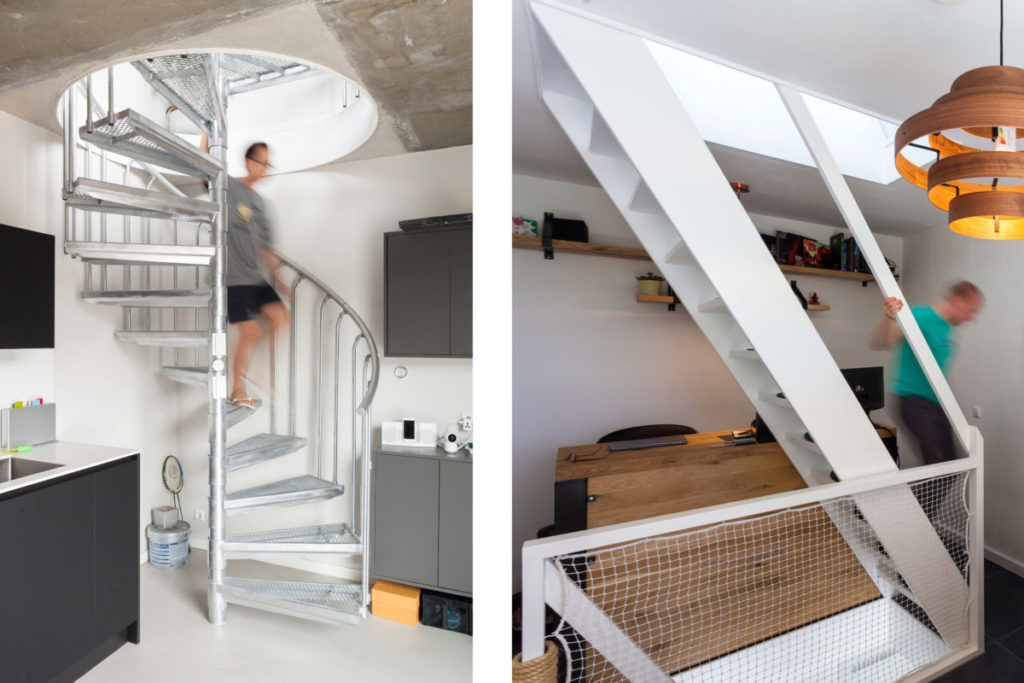
Tiny houses come in all shapes and sizes but one universal trait is that they are intricately and cleverly designed and utilise every space possible. Stairs fold out to provide storage underneath, lofts are added to create dividers in the house to give the illusion of separate rooms and big windows are installed to create natural light and brighten the space.
Stairs in one of the tiny towers of Almere. Image: Adrienne Norman/Supplied
They are far cheaper to run and maintain which allows the owner to spend the extra money on travelling or extra-curricular activities. Remember that badminton team you’ve never been able to afford? Or that book club you always wanted to attend? Downsize your home and you may be able to!
We got in contact with tiny house architects and tiny house owners and dwellers and asked them some key questions. We hope the information will help you to better understand tiny living!
What are the measurements of a tiny house?
A tiny house needs to be built as a primary and stand-alone dwelling on a small scale. A small house is a dwelling that is less than 1,000 square feet (93 m2). By comparison, a tiny house is a home that is less than 400 square feet (37 m2) and some are even as small as 80 square feet (7.4 m2).
Where can I find tiny house initiatives in the Netherlands?
On this map you can see all of the tiny house initiatives that are taking place in the Netherlands. Get in contact if you are interested in visiting or are considering building a tiny home.
Can you get a mortgage for a tiny house?
As it currently stands, it is not possible to get a mortgage for a tiny house. However, if the tiny house is anchored to the ground you can register the property with your local council and some mortgage providers such as Triodos and Obvion may be willing to give you a mortgage.
How much does a Dutch tiny house cost?
There is no fixed price as it depends on how big you build the tiny house and what amenities and features you include. Some people say €25,000 is doable for a basic home. But it can cost as much as €100,000 if you use more expensive materials and include the latest technology.
Show me those Dutch tiny houses!
Curious about what living in a tiny house in the Netherlands is really like? Here are some tiny houses (with big personalities).
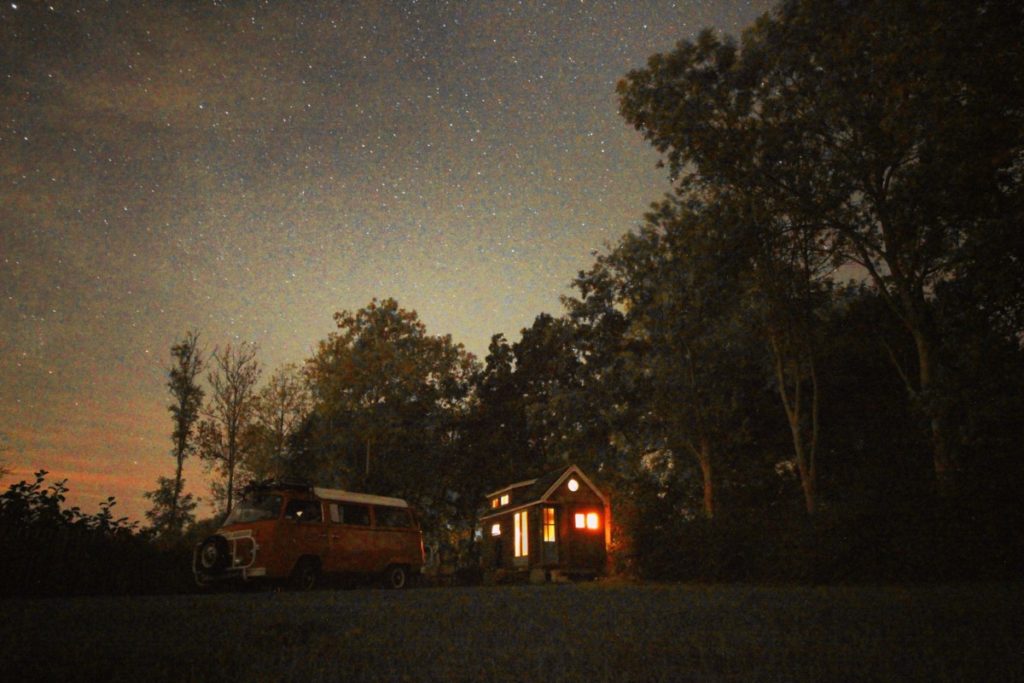
Martijn and Irena’s stand-alone tiny house in Ouddrop
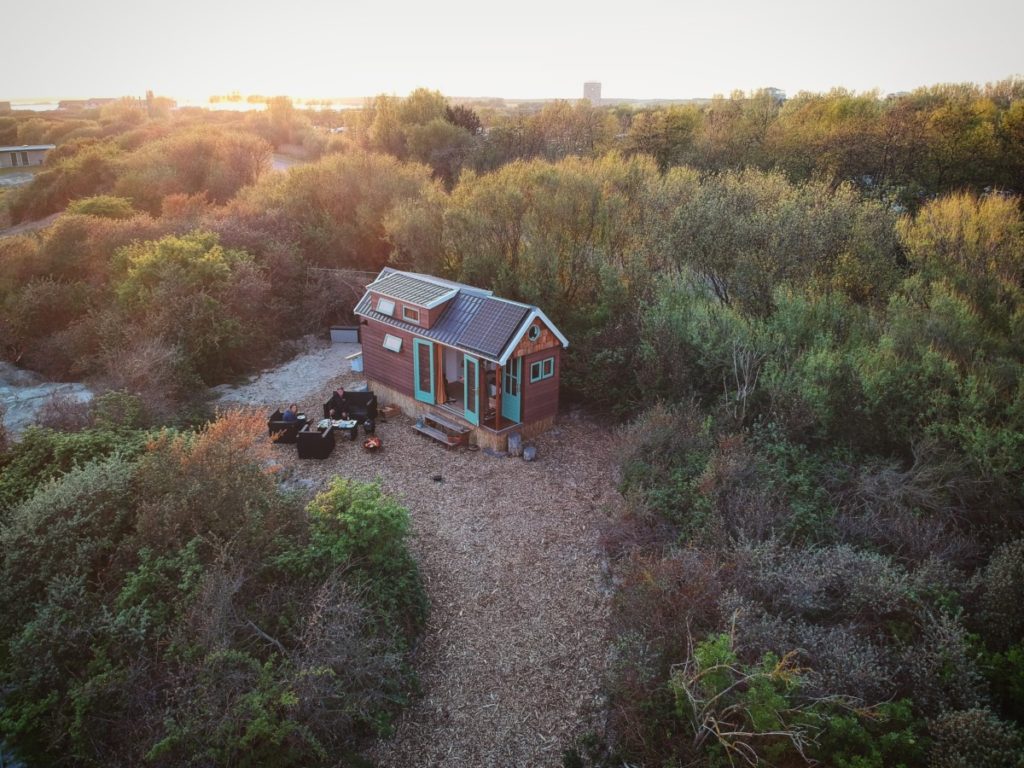
Aerial view of Martijn and Irena’s tiny home. Image: Martijn/Supplied
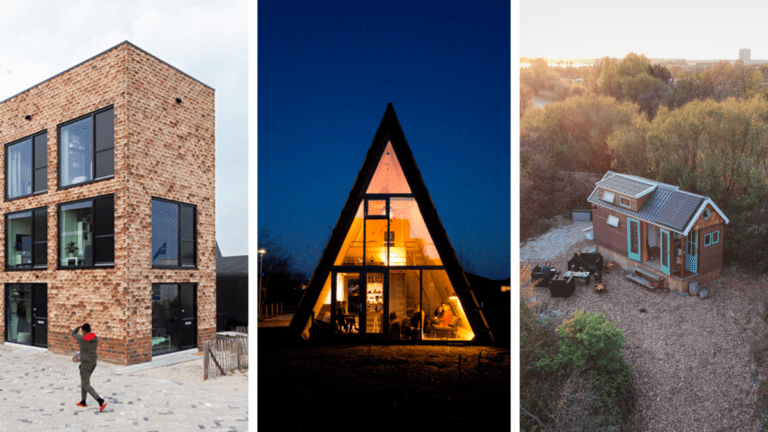
Martijn and Irena built a tiny house in Ouddrop, a village situated in Holland on the Kabbelaarsbank. Their house, 20m2, is considered very small by tiny house standards. But they adjusted relatively easily as they lived in a caravan for three years prior to moving into the tiny home.
“We were used to life without a lot of stuff” they told DutchReview. “For us, the tiny house felt more like upsizing. We’ve travelled a lot, and lived in campers and tents so we are used to not having much stuff.”
The most challenging aspect of tiny living
Martijn and Irena agree that the most challenging aspect of living tiny is the inability to host parties. When they do have people over, it has to be outside or in a small group. “Luckily, most of the time it is okay weather to be outside,” the said. “Bad weather doesn’t exist, only bad clothing.”
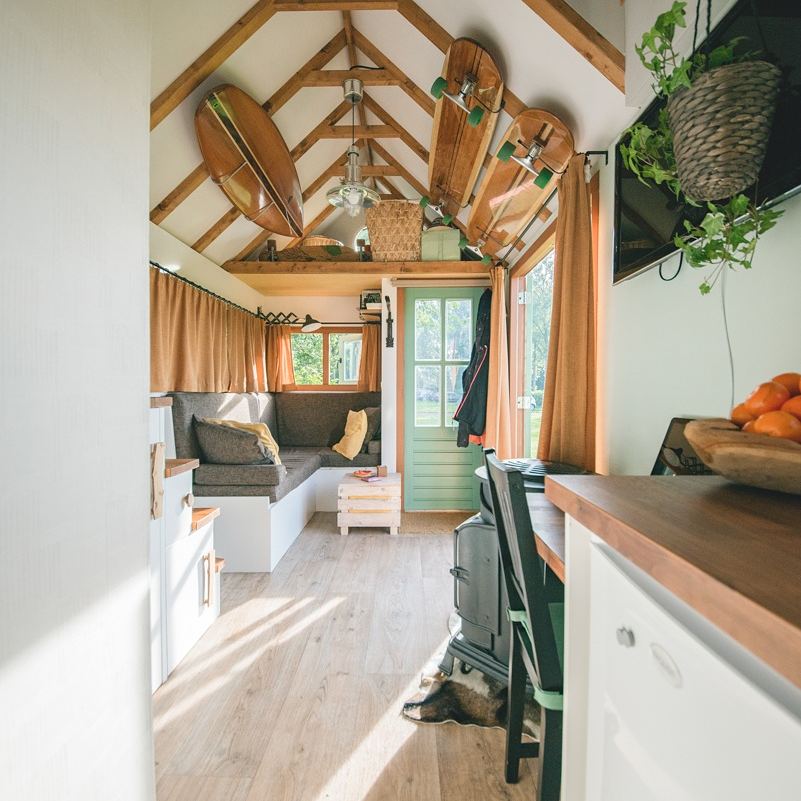
The stylish interior of Martijn and Irena’s tiny home. Image: Martijn/Supplied
Did the building go according to plan?
When you build anything from scratch there are obstacles. Especially because Martijn and Irena’s tiny house was one of the first built in the Netherlands.
“Everything was pioneering and we didn’t had any building experience which made it harder. But with YouTube and Google you can build whatever you like,” they told DutchReview.
The most difficult legal barrier was that the tiny house can only weigh 3500 kilos.
Evening looks pretty special with the clear night sky. Image: Martijn/Supplied
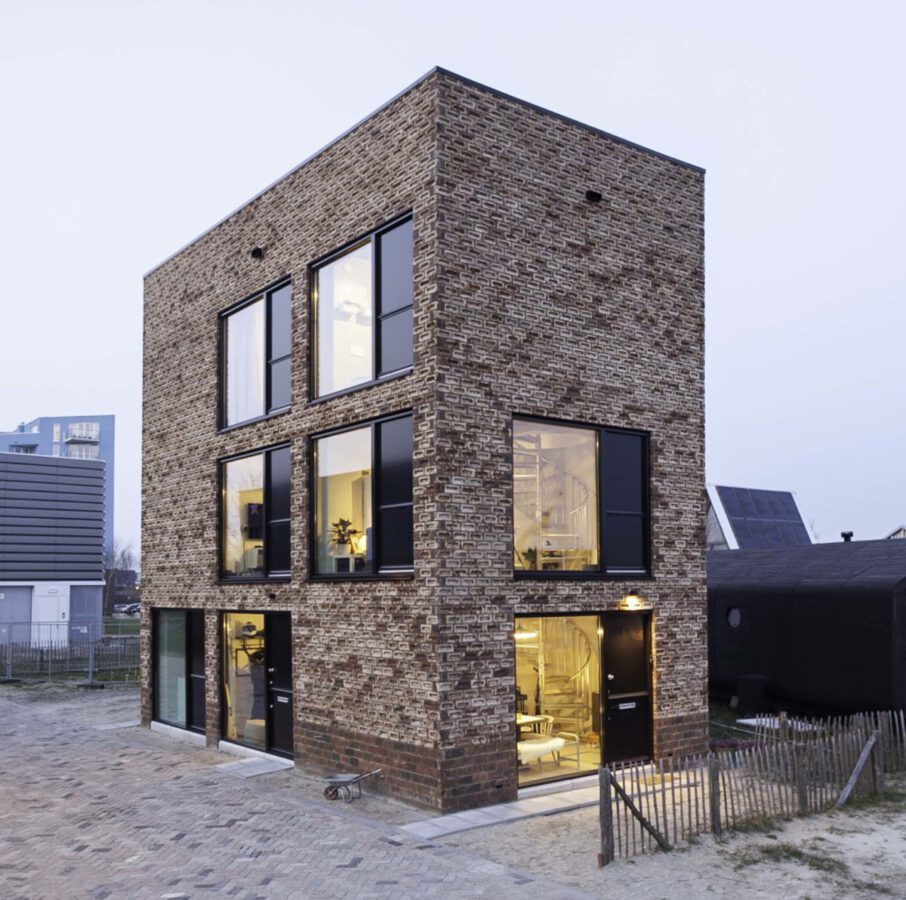
Tiny ‘towers’ of Almere designed by House of Architects
Niek decided to downsize as he wanted to have more control over the costs of his utilities and what he spends money on. Niek bought one of three Tiny Towers, which are designed by House of Architects. He has a three-floor apartment with a roof terrace but each floor is only 3 x 4.5m2.
The tiny towers. Image: Ricky Rijkenberg/Supplied
He reasoned that if he had less electricity costs and more solar panels then he can spend more time doing what he truly loves. “I don’t want to have to do maintenance for space I don’t use,” he told DutchReview.
Niek noticed patches of land for sale in Almere and saw that tiny houses were being built there. That kick-started his interest in tiny living. The problem was, there was a massive list of people who signed up for the Almere Houses so he was unsuccessful in his bid for land. “But it planted the seed in my mind,” he told DutchReview.
Sometime later, while Niek was browsing housing website Funda, he saw an architect selling a concept for tiny house towers. The build was to commence once they found a buyer “I contacted them and I was lucky enough that I got the house” Niek explained.
The small space is not a problem
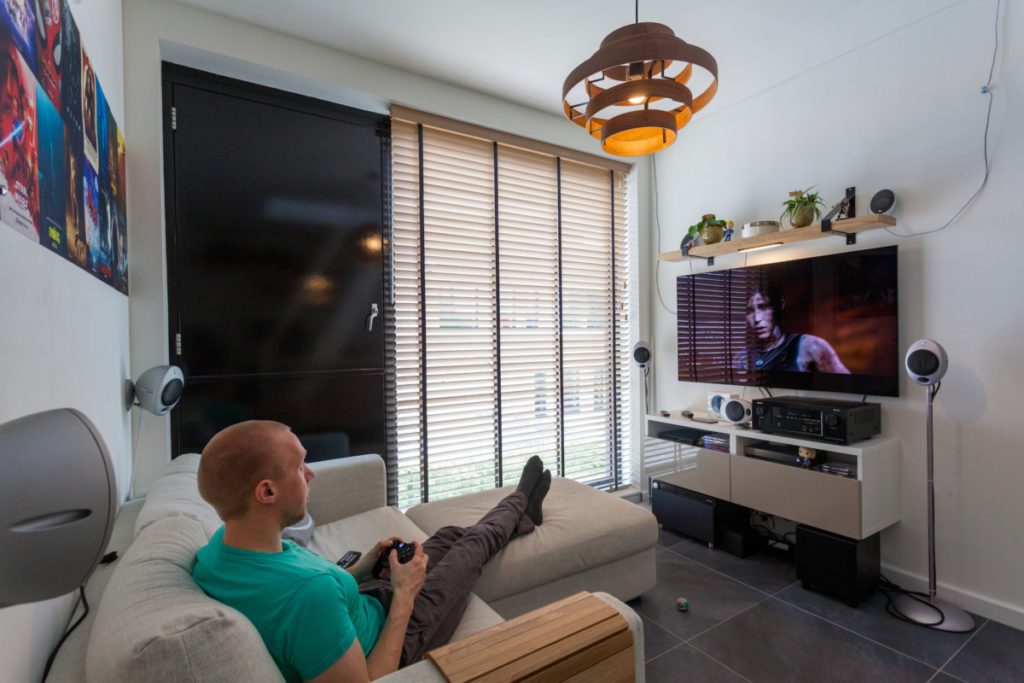
Niek doesn’t find the small space a problem. “I have never owned a lot of possessions. The room layouts are so smart that I have more space than ever before.”
He said the only frustrating aspect of tiny living is “when I need to put something big together like a couch, then I really miss some space” he laughs.
Niek in his living room. Image: Adrienne Norman/Supplied
Any advice for those considering downsizing?
“Try to ask some tiny house owners if you can look inside their houses. It will change your perspective about how small it is. It feels a lot bigger inside than people often imagine because the spaces are so well designed and executed.”
The Tiny A house
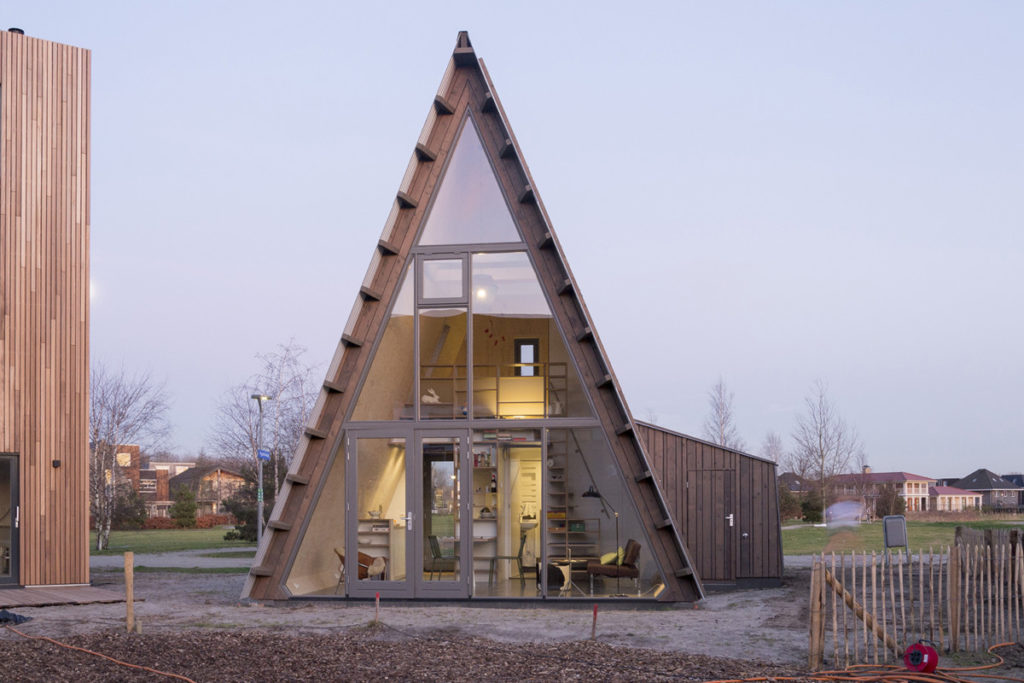
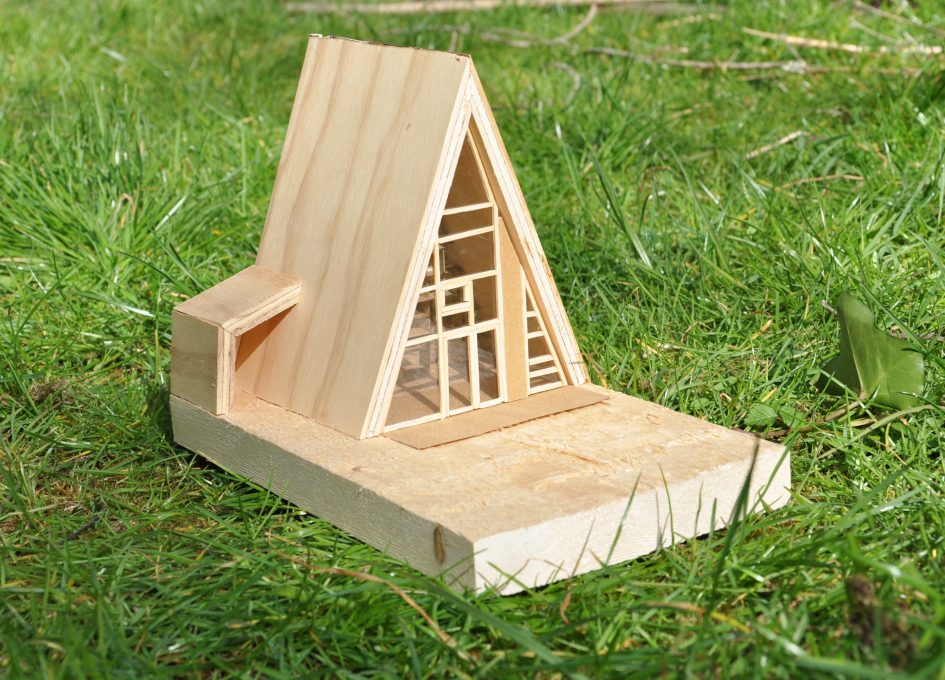
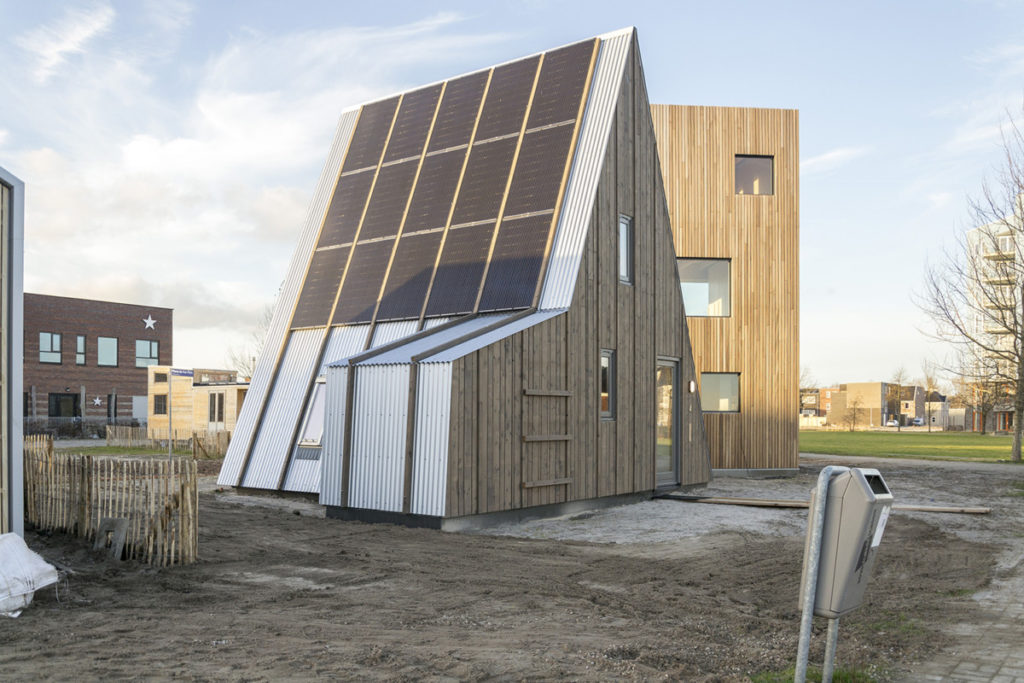
The outside of the Tiny A house. Image: DaF-architects/Supplied
Tiny A is located in Almere Oosterwold, a large patch of land located between the Waterlandse Weg and the A27. Architects who submitted ideas were given the opportunity to realise their dreams through the 2016 Bevrijd Wonen competitions organised by the municipality of Almere. The tiny-A house was one of the award-winning concepts from the competition.
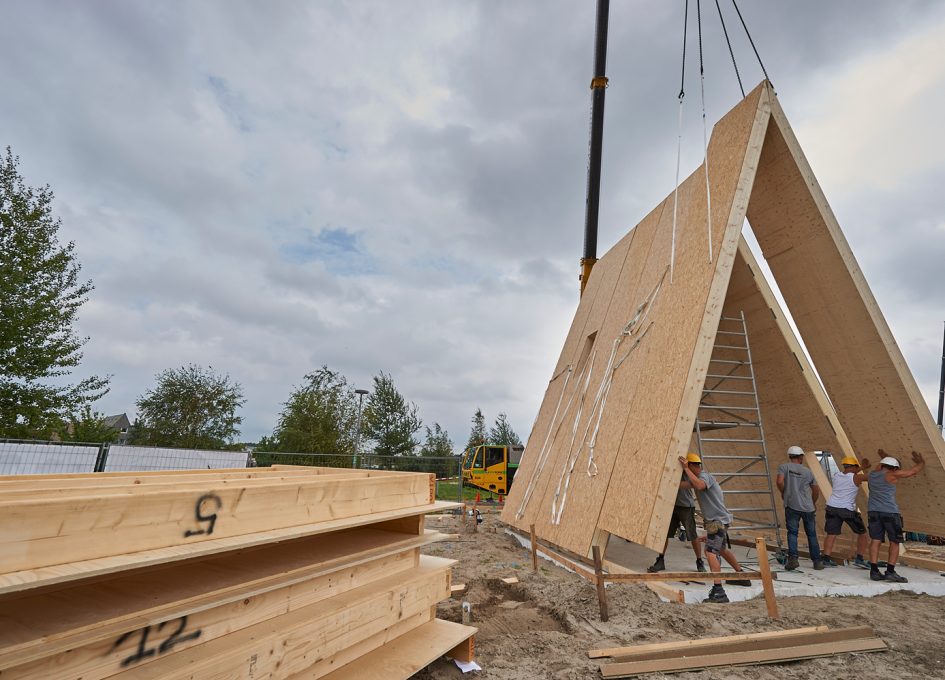
Tiny A house in concept stage. Image: DaF-architects/SuppliedConstruction of Tiny A house. Image: DaF-architects/Supplied
Food, water and a roof?
The Tiny-A house is just a roof that stretches down to the ground to create a triangle shape. Given a roof is the cheapest building element of a house, the architects harnessed this and created one large roof that is anchored to a foundation plate.
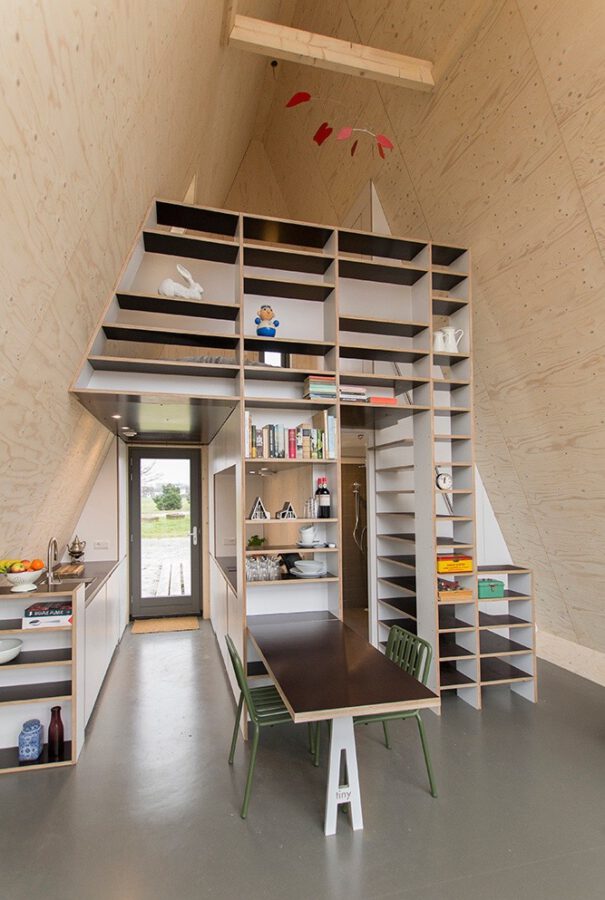
The Tiny-A house is a mere 50 m2 but has lots of height due to the seven-metre roof. A large piece of furniture that doubles as a bookshelf and set of stairs, divides the interior and gives the feeling of separate rooms. An intimate mezzanine rests above the kitchen and bathroom where owners can sleep and study.
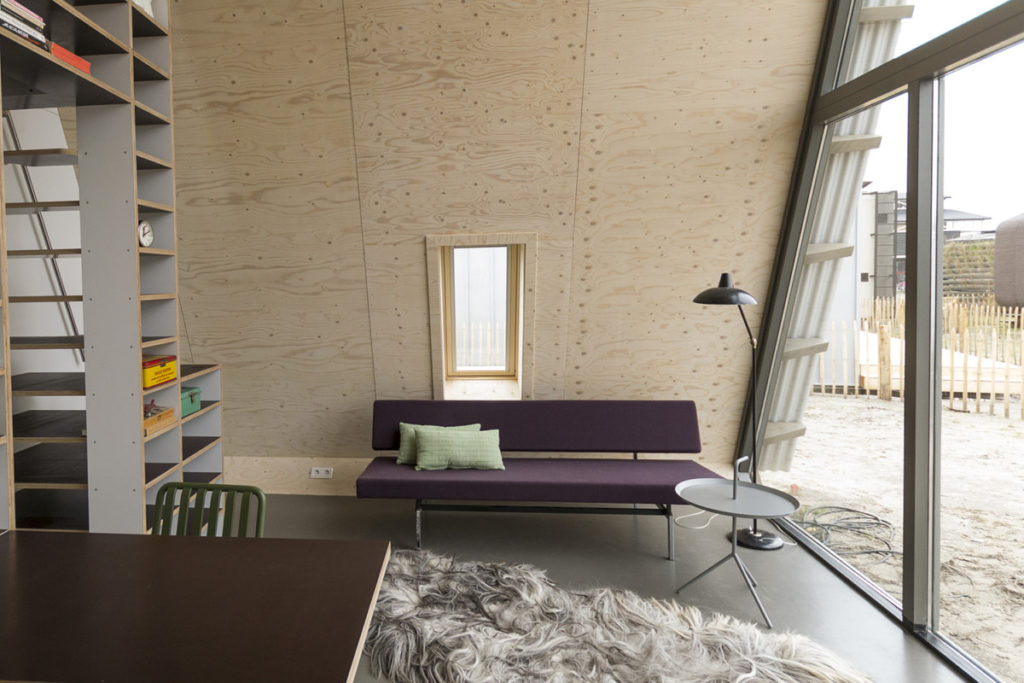
The bookshelf doubles as storage and stairs. Image: DaF-architects/SuppliedThe living room. Image: DaF-architects/Supplied
All-electric, energy-neutral and sustainable
15 solar panels are installed along the one side of the roof which provides all the energy required for the house.
The solar panels covering one side of the building. Image: DaF-architects/Supplied
The house also boasts infrared underfloor heating, an E-shower, a Quooker (a kitchen tap that provides both cold and boiling water) and a balanced ventilation system.
Daan Bakker, an architect from the Tiny A project, is currently developing the “Tiny-C” by using a sea container as the foundation, which is far cheaper to build. He hopes to develop a do-it-yourself kit to fit the small budgets of those who want to build a tiny house.
Did this article spark or encourage your curiosity in the tiny house movement? Have you ever considered downsizing? Let us know in the comments below!
Feature Image: DutchReview Editor’s Note: This article was originally published in November 2019, but was fully updated in December 2021 for your reading pleasure.
Jose-Luis Jimenez, a professor of chemistry and biochemistry at the University of Colorado and one of the most-cited scientists in his field, is hardly impressed by Dutch coronavirus measures.
Like many vocal critics of coronavirus policy from within the scientific community, Jimenez, who specializes in aerosols, is deeply frustrated with basic — and frankly misleading — coronavirus regulations.
In a series of tweets on Wednesday, he claimed that recommendations to wash your hands regularly, wear facemasks, and practice distancing can hardly prevent the spread of the virus without proper ventilation.
Maybe he’s seen Rutte say “wash your hands” one too many times. Or perhaps he finds refuge in criticizing other nations’ mishandlings after two years of careless US leadership amidst the pandemic.
Air quality is the single most important factor
Jimenez is far from alone in thinking this. TU Delft’s own building engineer Philomena Bluyssen also believes that greater action needs to be taken. Much of the Dutch health recommendations mirror that of the World Health Organization, but these “are the minimum,” she tells Nature.
Bluyssen and other critics are not shy to point out the Dutch governments’ failure to provide comprehensive guidance and to allocate the necessary funding to ensure people’s safety in indoor spaces.
So while the government relies on the avondklok to keep the COVID-19 bogeyman away, many scientists worry that significant portions of the population — from schoolchildren and students to office workers, restaurant-goers, and prisoners — remain extremely vulnerable in the absence of effective ventilation.
Reaching boiling point
Some find Jimenez’s words are fueled by frustration, even though his opinion is in line with the scientific consensus.
As Charifa Zemouri, a Dutch expert on infectious diseases and public health told RTL Nieuws: “What I sense with him, and what I sometimes catch myself similarly feeling, is frustration. Why can’t we just go along with the scientific consensus? Sometimes it drives you to use more severe language.”
Would you like to see the Dutch government pay more attention to ventilation to prevent the spread of coronavirus? Tell us in the comments below!
The third week of this winter season’s lockdown is approaching and it’s re-negotiation time. Which begs the question — what will the Dutch government be giving us for Christmas this year-round?
With Christmas gatherings coming up and a new variant in town, Dutch politicians remain concerned. Over the weekend, they will discuss a possible extension of the lockdown. Here’s what’s on the cards.👇
Evening curfew here to stay?
For the past two weeks, non-essential businesses were obliged to close at 5 PM, while essential stores such as supermarkets could remain open until 8 PM.
However, the chances of you being able to head out for a lukewarm Heineken after your Christmas dinner are slim. It’s likely that theevening lockdown will continue but there is no consensus yet on when to start it — 6 PM, 7 PM or 8 PM? We just pray that late-night supermarket runs will be possible again soon. 😩🍦
Proof of vaccination
The cabinet has also already agreed on making QR codes mandatory to enter non-essential shops such as hairdressers, cafes, furniture stores and so forth. The idea is to potentially ‘swap’ stricter measures such as these for the evening lockdown and relieve businesses, RTL Nieuws reports.
What about Christmas?
As we’ve seen last year, the holidays tend to be followed by spikes of coronavirus infections. As of now, the advice is to only host four people at home at a time. But is that really feasible during Christmas time?
The cabinet is debating whether or not to officially restrict visits or simply keep regulations in place. Another debate is to extend the Christmas holiday for school children. We don’t think there’ll be too many complaints about this from the kids — but perhaps from their poor parents.
When will we know for sure?
This weekend is discussion time, so there will probably be announcements (cough, cough, leaks) on either Sunday, Monday or Tuesday. A 7 PM Tuesday press conference is the usual time for coronavirus related announcements by the cabinet.
But with the new cabinet being formed at the moment, things are a bit more unclear. We’ll keep you updated and make sure to check out our summary of the press conference on Tuesday!
What do you think about these potential new measures? Tell us in the comments!
Moving to a new country always involves a bit of culture shock. You might not like the food (think slippery, slimy herring) or you may need to get used to the cultural norms and practices. But never fear, with this starter pack you’ll be acting like a true Dutchie in no time.
We’re not saying it’ll be easy or that you’ll feel at home from day one. However, these tips will help you keep up with all the Dutch quirks you’ll meet in the Netherlands and make your relocation process much more enjoyable! 🎉
1. Learn some Dutch
While many Dutchies speak impeccable English and you can get away with communicating through English most of the time (especially if you live in the Randstad), we can guarantee that your experience of living in the Netherlands will be much easier and more enjoyable if you put in the time and learn een beetje Nederlands (a bit of Dutch).
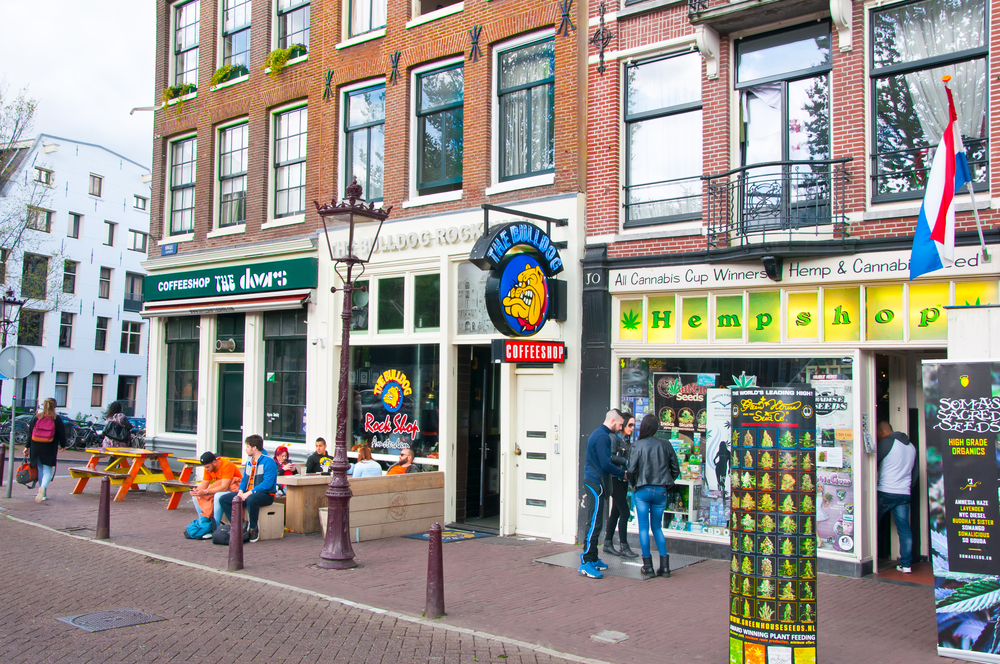
Sure, Amsterdam is known for its Red Light District and coffeeshops, but the Netherlands’ liberal attitude towards sex and drugs isn’t about carelessness or tourism.
So before you make assumptions about sex work in the Netherlands or buy into myths about weed, educate yourself about the policies behind these controversial practices — and hear what Dutchies have to say.
Drugs
First of all, drugs aren’t legal in the Netherlands (nope, not even weed!). 🙅♀️ However, there are 33 legal drug testing locations spread across the country where people can get their drugs tested — and yes, people get them back after a small educational talk about drug use.
Though this may seem contradictory from a legal point of view, the primary concern is public health and safety. So, the Netherlands makes sure drugs are used in a safe way, through coffeeshops and test locations.
Another thing that might take some getting used to when arriving in the Netherlands is how openly Dutchies talk about sex. With age-appropriate sex education starting already at age four, it’s no surprise that most of the taboos and giggles have been stripped from the subject by the time Dutchies reach adulthood.
It’s no secret that Dutchies don’t beat around the bush. Living in the Netherlands requires thick skin. Sometimes, the Dutch can seem a bit arrogant or harsh — but despite the blunt delivery, they’re usually just interested in hearing your opinion and getting to know you better.
Plus, most of the time they’ll switch from intense discussion to cracking a joke in the blink of an eye, so we wouldn’t take it personally. 😅 In the end, being direct does save time and Dutchies will respect you for it.
4. Surround yourself with Dutchies
Being around Dutch people will help you learn things about the country and the culture, as well as pick up some local tricks to make life easier. There are simply some things you’ll never learn if you spend all your time with internationals.
So, head along to your local sports club, introduce yourself to your neighbours and go to a borrel. Before you know it, you’ll have found a ton of new friends in the Netherlands. 🥰
5. Inform yourself about cultural sensitivities (and the lack thereof) in the Netherlands
Despite their directness, the Dutch are recognised as tolerant and welcoming people. However, the country’s colonial past tends to trigger discussions — both between Dutchies of different generations, and internationals.
So, to understand the Dutch traditions and opinions better (and avoid getting caught up in a Zwarte Piet debate), inform yourself about some of the deeper roots of Dutch culture.
It’s heavy stuff but read up on things like the VOC and the life of slaves in the Dutch colonies. This is a part of Dutch history that’s talked about more and more and it’s important to understand where the Netherlands’ wealth originally came from. However, it’s just as important to remember that it wasn’t the fault of any currently living Dutchie.
In present-day Holland, some people pride themselves on living in a multicultural society and some want stricter immigartion laws. Learning to fit in doesn’t have to mean agreeing with the majority or what your neighbour thinks. Instead, listen to both sides and form your own opinions once you’ve done your research.
6. Get yourself an agenda
“Want to grab dinner tonight?” isn’t gonna fly in the Netherlands (or at least it’s not very likely). The Dutch swear by their agendas and perhaps you should as well — to be fair, being organised is never a bad thing. 💁♀️
A tip for combating some of the potential cultural differences you’ll run into in the Netherlands is to plan, plan, plan when meeting up with Dutch friends or acquaintances.
Time to dig the washi tape and stickers out again. Image: GaudiLab/Depositphotos
7. Embrace the gezelligheid (cosiness)
Gezellig is an untranslatable Dutch word and it’s safe to say that it captures a feeling quite unique to the Netherlands. What the Netherlands lacks in mountains, it certainly makes up for with a “cosy” atmosphere. There’s nothing like having a biertje at a canal-side terrace or strolling Amsterdam’s wintery streets with a cup of mulled wine.
8. Look for discounts
Dutch people are known for being stingy. You’ll notice this when you inevitably receive a Tikkie for a negligible amount. But this also comes with its perks. Dutchies are sensible with their money, avoid debt, and they always know when there’s a sale on — cha-ching! 💃
So, scope out a good sale, direct your eyes to the bottom shelves of the supermarket aisles (where the housebrand goods are usually kept), and get yourself an Albert Heijn Bonuskaart. Even if your friends and family find it cheap, your wallet will thank you!
9. Celebrate your birthday like a true Dutchie
If you haven’t felt the culture shock since moving to the Netherlands, this might change when your birthday comes around, or you get invited to your first Dutch birthday celebration.
To say that Dutchies celebrate birthdays differently is a bit of an understatement, and there are some pretty non-negotiable birthday norms. Expect to be trapped in a circle of felicitations as the whole party literally sits in a circle and congratulates each other on knowing the birthday person. Yes, it’s cute and weird at the same time. 👀
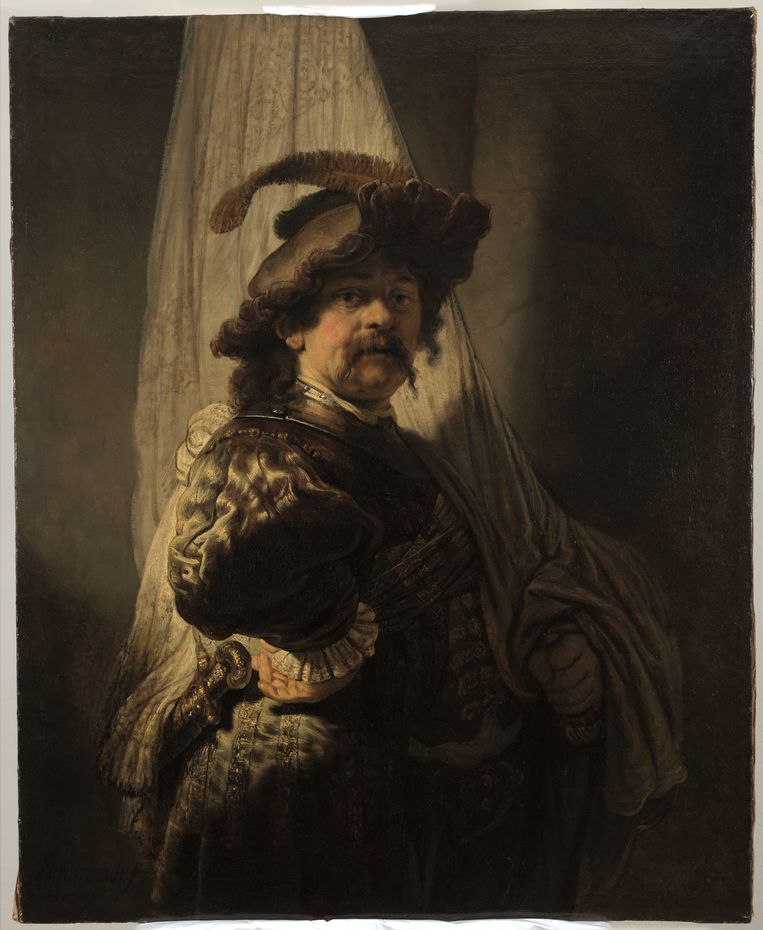
Last night, outgoing culture minister Ingrid van Engelshoven pledged €150 million for the purchase of Rembrandt’s painting, ‘De Vaandeldrager’ or ‘The Standard Bearer’ (1636), which will tour go on tour in each of the Dutch provinces.
And just to clarify, this isn’t coming from Ingrid’s own funds — nee, this amount will be paid by the Dutch government.
An insane amount of money
On top of the €150 million, an additional €15 million has been pledged by the Rijksmuseum Fund and the Rembrandt Association, making this the largest amount the state has paid to buy back a single work of art, reports de Volkskrant.
Rembrandt’s masterpiece has been in the possession of several major private collectors for centuries, from England’s King George IV to the Rothschild family. However, after almost 200 years of ownership by the Rothschild’s and as art historian Wouter Kloek says, thanks to “an insane amount of money,” the painting will, at last, be in the hands of the Dutch again!
Rijksmuseum director declares victory 🎊
Rijksmuseum director Taco Dibbits regards the purchase as a ‘unique opportunity‘, as he believes it is the single most important of Rembrandt’s paintings still privately held.
Additionally, the painting depicts a scene from the Dutch War of Independence, and is thus a historically significant piece, claims Dibbits.
But not everyone agrees..
Volkskrant art critic Wieteke van Zeil is not convinced, she’s waged several critiques at the rather hasty — and exceedingly expensive — move.
For one, van Zeil argues that the was decision made in the absence of a public debate, for a sum that totals more than 10 times the total spending budget of all museumsof the Netherlands combined! Many of which are struggling to stay open two years into the pandemic.
Van Zeil also finds the historical relevance claim a bit overdone. She says that while the job of standard-bearer was indeed one of honour for elite members of the militia, Rembrandt used himself as a model.
This makes the painting yet another self-portrait to be added to the four portraits the Rijksmuseum currently displays, bringing the total number of Rembrandts at the museum to 24.
Not to mention Baron James de Rothschild only bought the painting for a mere £840 at an auction in London in 1840!
Is this a total waste of money or are you happy to see more Rembrandt’s returned to the Netherlands? Let us know in the comments!
Under a new initiative by digital learning centre Cybersoek, low-income residents of Amsterdam with a municipal discount card can get a laptop at quite the reduced price, reports NU.nl.
They can keep or return it after use; in the latter case, they get the money back. Talk about practical! 🙋🏻♀️
Futuristic food bank 💸
Similar to a food bank, the “Cyberbank” will open this Friday in Amsterdam East to help residents with their digital needs.
Any old or new equipment can be donated by individuals, companies, and the municipality — while second-hand devices get repaired by young people at a distance from the labour market.
Digital city 💻
Amsterdam is becoming an increasingly digital city and has been developing faster since the start of the pandemic.
However, a digital divide is also developing between Amsterdammers who have access to the internet and technology, compared to others who don’t, according to alderman (municipal member) of Amsterdam, Touria Meliani.
With the Cyberbank, Amsterdam hopes to bridge the gap and make the city a place for “digital self-reliance”.
Where else would you like to see a cyberbank? Tell us in the comments below!
Mandatory vaccinations in the Netherlands? It’s a big, fat NO for the majority of Dutchies, according to a national survey commissioned by the NOS.
Austria and Greece already have it and Germany is seriously considering it: a vaccine mandate. But Dutch politicians have been discussing it since last year to no avail.
Well, if it were up to Dutchies, this is just fine. At least for some of them.
Dutchies really aren’t on the same page
‘Non-vaccinated people should be obliged to get vaccinated now.’ This is the question survey respondents were asked to reply to.
And the answers are all over the place:
43% disagreed
36% agreed
19% weren’t sure
Generally, Dutchies over the age of 65 are endorsing mandatory vaccinations with almost 60% voting in favour. On the other hand, 60% of younger Dutchies voted against a vaccine mandate. It’s a clash between generations. 👵⚡👧
And what about the other issues?
And many questions remain unanswered. What about vaccinations for children? Almost half of survey respondents (49%) don’t think that’s a good idea.
Or the booster shot? Health minister De Jonge has announced that, potentially, international vaccination certificates will only be valid after a third booster shot starting February 1. So…those disagreeing with the vaccine mandate might not be able to make it to their ski holidays in Austria or Italy?
We don’t know about you but our head is certainly spinning a little. 😳
What do you think about a vaccine mandate? Tell us in the comments below!
Rethink booking tickets for a ski vacation in Austria or a beach trip to Greece — next year, you might not be able to travel anywhere without getting your next prick. 💉
Minister of Health Hugo de Jonge has announced that starting February 1, international vaccination certificates will only be valid if people have received a booster shot in time, the NOS reports.
Anyone who has not received a third vaccine jab (or a second shot for those who got Janssen) within nine months of their last vaccination will no longer be able to generate a QR code for travel.
But here’s some good news to the travel buffs out there: if you haven’t had the chance to get your next shot, it will remain possible to obtain an international QR code based on a negative corona test or a valid recovery proof.
EU regulations
The European Commission initially decided to put this travel rule in place on January 10, but countries now have an additional three weeks to administer booster shots.
The Netherlands happens to be one of the countries lagging behind in this area (they even called the big guns), so with these extra few weeks there is still hope for any upcoming trip you’re planning. 🤞🏼
State of the vaccine
As of this week, more than half a million people in the Netherlands have received their booster shots against the coronavirus.
That’s a 174,000 increase in booster shot vaccinations compared to last week, according to RTL Nieuws.
What do you think of these new travel measures? Let us know in the comments!