Home Blog Page 477

Fancy a hamburger? Dutch municipalities don’t think so

The municipalities of Amsterdam, Rotterdam, Utrecht, The Hague, and Ede have proposed a new strategy in the fight against obesity: they want a legal avenue to ban suppliers of unhealthy food.

In order to promote a healthier living environment, the four large municipalities (plus Ede?) want more options to prevent the supply of unhealthy food, RTL Nieuws reports.

Earlier this year, city council members from these municipalities wrote to the State Secretary asking for more resources to curb the supply of unhealthy food. How exactly do they want to do this though? Well, they want to see an amendment to the Environment Act or the Commodities Act.  

More fast food than ever before?

The number of fast-food outlets (think the usual culprits McDonald’s, KFC, and Burger King) has increased in recent years. There are now 470 such locations in this little corner of the world. 🍔

In true Dutch fashion, there are also way more snack bars popping up on street corners. So if you fancy walking across the road to grab some warm bitterballen on a cold winter’s night, that’s no problem at all — there are on average 7.2 snack bars per kilometre in the Netherlands. 😱

READ MORE: Snackbars in the Netherlands: the ultimate guide

Can the government really regulate this?

No one forces you to have a hamburger though, so what can the government do about this?

Anniek de Ruijter, associate professor at the UvA, tells RTL Nieuws that “because we see food as an individual choice, it is not possible for municipalities and governments to intervene via the Environment Act.”

The municipalities have other ideas though and are trying to broaden the interpretation of the Environment Act so that the food environment comes to be considered as part of a healthy and safe physical environment. Goodbye McDonald’s, hello fruity snacks. 🙅‍♀️ 🍊

What are your thoughts on this debate? Does the government have a duty to look after us, or is this infringing on our freedom of choice? Tell us in the comments below!
Feature Image: radub85/Depositphotos

Concealed Cupid uncovered in iconic Vermeer masterpiece

The artworld is in shock after the restoration of one of Vermeer’s most famous works exposed a painting of a full-length Cupid hanging on the wall where previously there was nothing. Even more shocking is that evidence now confirms Cupid was likely painted over by someone other than Vermeer.

Known as the “Master of Light” and the “Sphinx of Delft”, Johannes Vermeer is perhaps the most famous painter in Dutch history. He has painted the iconic “Girl with a Pearl Earring” (1665) which currently hangs in the Mauritshuis, and “The Milkmaid” (1657–1658) displayed in Amsterdam’s Rijksmuseum.

Vermeer’s use of colour to give the illusion of movement is astounding. He makes the viewer believe that he has captured light and, in so doing, immortalises a moment.

A painting within a painting

A painting within a painting has been uncovered by Gemäldegalerie Alte Meister (Old Masters Picture Gallery) in Dresden, where Vermeer’s “Girl Reading a Letter at an Open Window” (1657-59) was housed for over 250 years in its unrestored state.

The restoration has revealed that the painting’s central female figure is not alone as was thought for centuries. Instead, she is accompanied by a detailed, chubby Cupid looking directly at the viewer.

Although the presence of a Cupid painting in “Girl Reading a Letter at an Open Window” has been known for some time, very recent studies done on the original confirm the cover-up was not undertaken by Vermeer. 😱

The restoration project

The Cupid painting hanging behind a tapestry in “Girl Reading a Letter at an Open Window” was initially thought to have been covered up by Vermeer himself. However, laboratory tests done in 2019 discovered the opposite to be true. In fact, the Cupid imagery was covered up by someone other than the artist decades after its completion.

The restoration and research project began in 2017, and involved X-rays and infrared reflectography recordings. These were carried out alongside microscope examinations of Vermeer’s original.

Colour samples and studies

At the Dresden University of Fine Arts, several colour samples were taken and analysed from Vermeer’s painting. Samples of layering and consistency were also studied in Dresden’s laboratory for archaeometry, as well as a detailed analysis of the picture carrier canvas and research into the restoration history.

The findings of these processes highlighted the need for a reassessment of the extensive overpainting of Cupid in Vermeer’s masterpiece, and lead art historians to believe that there was more to the covered Cupid than meets the eye.

The truth revealed

After tests spanning several years, a full-area X-ray fluorescence examination of the picture, combined with state of the art technology assistance (pun intended 😉), experts concluded that the overpainting of Cupid was not done by Vermeer. Instead, this covering was undertaken several decades after Vermeer completed the painting and well after the artist’s death.

The Rijksmuseum Amsterdam confirms the new findings of the overpainting, and images of the completed restoration were released on August 24 2021, by Gemäldegalerie Alte Meister. These images show Vermeer’s intended design: the now-exposed Cupid attests to Vermeer’s hallmark style in being dubbed a picture within a picture.

A new Vermeer exhibition

After the restoration was completed in early 2021, Vermeer’s “Girl Reading a Letter at an Open Window” will be displayed as it was when it left the artist’s studio almost two and a half centuries ago. This painting, fully restored, will be the highlight and centrepiece of a Vermeer exhibition titled “Johannes Vermeer: On Reflection” at the Gemäldegalerie Alte Meister.

The rooms of the Semper Building will be set aside for this special exhibition, which will feature nine other paintings by Vermeer, including the “Woman In Blue Reading A Letter” (Amsterdam, Rijksmuseum) and “The Lady Standing At A Virginal” (London, National Gallery).

These two pieces have been included for their close relation to “Girl Reading a Letter at an Open Window”. The collection will be on show from September 10, 2021, through January 2, 2022, wherein some 50 works of Dutch genre painting from the second half of the 17th century will be on display

What are your thoughts on this restoration and the discovery of Cupid? Tell us in the comments below!
Feature Image: Johannes Vermeer/Public Domain & ©Gemäldegalerie Alte Meister, Staatliche Kunstsammlungen Dresden, Photo: Wolfgang Kreische

Universal basic income in the Netherlands: would it work?

Universal Basic Income is a hot topic in the world at the moment. But would it work in the Netherlands?

A two-year basic income experiment was carried out in Finland in 2017-2018. The evaluation study is now available. The register data on employment now cover both years of the experiment and a more thorough analysis has been made of the results of the survey. The basic income recipients were more satisfied with their lives and experienced less mental strain than those who had no access to it. They also had a more positive perception of their economic welfare.

The results of this experiment have once again raised the question: would universal basic income work in the Netherlands?

In recent years, especially with the financial support from governments all over the world during the coronavirus lockdown, calls for a basic income have become louder than ever — and rightly so. The global coronavirus crisis required radical measures and has seen some governments all over the world step up to the challenge.

Here in the Netherlands, there were bailouts for some companies and lots of working taxpayers were financially supported while they observed quarantine. Even the US government distributed money (lots of it), which is strange, considering how much the Republicans dislike social security.

In times of crisis, radical ideas suddenly become the order of the day. For years, economists and sociologists have amassed a good amount of evidence that universal basic income, or “free money” as it is often called, will be more effective than traditional forms of social security and development aid.

photo of wallet with euros between knife and fork as a tip in the netherlands
“Free money” for all. Image: Peter Stanic/Pixabay

But what exactly is universal basic income?

A basic income is an unconditional income. It’s basically money to which you are always entitled, regardless of your assets, social status, or income. Although a basic income does not yet exist in the Netherlands, there have been some experiments in certain cities and municipalities, and the recent results of the Finnish experiment have encouraged people in the Netherlands to start talking about it again. But whether this “radical” alternative to the current Dutch welfare state has a chance of actually being introduced, totally depends on public support for basic income.

The difference between a basic income and a benefit

The Dutch welfare state makes it possible for people to get benefits in the Netherlands. The main difference between a basic income and a benefit is that there are conditions attached to a benefit. Whether someone is entitled to benefits is determined on the basis of their health, financial, or work status. Depending on the type of benefit, the rules on, for example, the obligation to apply for a job, may differ.

Does universal basic income work?

Studies from all over the world have now shown that universal basic income works. Dutch historian and philosopher Rutger Bregman is an advocate of the basic income — an individual, unconditional allowance for everyone. He believes that a universal basic income won’t just help reduce crime in the Netherlands, it would also eradicate poverty and increase creativity — especially in the entrepreneurial world.

Bregman told The Correspondent, “We have recent behavioural economic research and psychological research showing that people living in poverty lose 14 points of IQ due to the stress they live in. If you eradicate poverty, then you suddenly get an explosion of energy, an explosion of entrepreneurship, the gross national intelligence flies up.”

He also believes that in a free and liberal country like the Netherlands, the freedom that is really missing is financial freedom. “In the first place, a basic income is about freedom. We live in a society with many freedoms: freedom of speech, freedom of association, freedom of religion, and these are all milestones of civilisation.”

“What we don’t have yet is real freedom to choose what you want to make of your life. A lot of people are currently stuck in a job that they don’t really see the point of — a third call their job a bullshit job. But in the end, you have to pay your bills, and you have to earn a living. The alternative is that you apply for benefits, but then you end up in an extremely humiliating system and you have to give up a lot of your freedoms” said Bregman.

Freedom to choose

He added that “A basic income gives everyone the freedom to choose how they want to contribute to their country, what they truly want to make of their lives, to realise their dreams. That it would finally give everyone real freedom is by far the most important argument for a basic income. Another reason why basic income really appeals to me is that it is the most efficient, effective and actually cheapest way to eradicate poverty. I really see basic income as an investment. it’s just cheaper to eradicate poverty than for it to exist, and I think a basic income is a very important tool for that.”

Fortunately, to support Rutger Bregman’s claims, there has already been a demonstrated link made between universal basic income and a drastic reduction in crime, child mortality, malnutrition, teenage pregnancies, truancy, and also better school performance, higher economic growth and more emancipation, especially for marginalised and oppressed groups.

Finnish basic income experiment

During the Finnish experiment, 2,000 unemployed Finns received a basic income of €560 per month for two years. They didn’t have to work or look for work at that time. The results showed that the participants were not tempted to work substantially more. Most worked less and decided to pursue interests that made them happy. Some decided to spend more time with their families (especially their young children), learn a new skill, or just relax and engage more in sports, and general wellbeing.

Would a basic income work in the Netherlands
A demonstrated decrease in crime, poverty, and malnutrition. Image: Lena Balk/ Unsplash

Arguments against universal basic income in the Netherlands

The opponents of the basic income point out that several surveys have shown that people would work less when they get free money. They also argue that the costs are monumental and would financially cripple the country. A lot of right-wing and conservative politicians have also stated that it would attract more “illegal immigrants” to the country, who would seek to misuse such an opportunity. The problem with their claims is that they are all based on “a feeling.” There are no actual figures to support those claims.

A few frequently asked questions about adopting a basic income in the Netherlands

Why is basic income so much in the news, we have it pretty good in the Netherlands, right?

Yes and no. The Netherlands is, without a doubt, one of the most prosperous countries in the world. At the same time, the economic and social policies here usually have a devastating effect on the lives of many people. For example, discrimination in the labour market has resulted in minority groups struggling to get by. The coronavirus pandemic has also put a lot of people in economic uncertainty. And it is no secret that more and more jobs will disappear due to technological developments.

Social security is, therefore, becoming more expensive and ineffective. A new mechanism to maintain the living standards of large groups of people is desperately needed. Basic income is the only social policy that is guaranteed to reach everyone, unlike current schemes based on behavioural and income tests.

How high should the basic income be?

The basic income must be high enough to guarantee a minimum subsistence — even for the most vulnerable groups. Think of people without other sources of income or those who need permanent care. In the Netherlands, this could be an amount of approximately € 1,500 per month.

How would a basic income be paid for?

There are several ways to pay for the basic income in the Netherlands. The Federation of Trade Unions of the Netherlands (FNV) projects that if the Netherlands were to switch to a basic income system, it would cost the treasury €105 billion annually. This money can easily be recouped with the abolition of tax cuts (especially for huge corporations); such as tax and labour tax credit, the scrapping of the self-employed person’s allowance and new tax brackets and percentages.

Basic income can also be paid through an increase in the VAT rate or in the wealth tax (which is currently below the international average and has steadily declined in recent years). So there are several ways to finance the basic income.

Ultimately, it is mainly a matter of political will. After all, there somehow seems to be money available for saving huge corporations during these coronavirus times. If there is one thing the coronavirus pandemic has shown us, it’s that nothing is impossible. And when politicians say that something isn’t possible, they just mean that they don’t want to do that thing. The kind of financial support and bailouts that huge corporations have received during this pandemic has shown that it is very possible to pay for a basic income in the Netherlands.

Will people still work if they receive a basic income?

Experiments with the basic income in Canada and Finland have shown that people do indeed work less (in paid hours). But is that such a bad thing? How many of us wished we weren’t doing our current jobs or doing fewer hours so we can go back to school and get that degree we’ve always wanted, learn a new skill, spend more time with our children, or just travel the world?

The groups that choose to work less are generally married women (not the breadwinners in their families) who choose to take longer maternity leave and young adults who decide to study a little longer. They, therefore, continue to make a meaningful contribution to society.

The value of all unpaid work in the Netherlands is already estimated at more than half of GDP. And by the way, would you spend the rest of your life on the couch if you received €1,500 per month of basic income? That is not a real criticism of the basic income. No one who gets “free money” every month, would choose to spend their whole life on the couch.

worker netherlands migrant
Important considerations. Image: Free-Photos/Pixabay

What about “illegal” immigrants and refugees misusing such an opportunity?

This is a very popular critique of the basic income from right-wing and conservative politicians. There is no evidence that such a thing would happen. “Illegal immigrants” do not have social security numbers, and one way such a scenario can be avoided is to tie the access of the basic income to either citizenship or the possession of a residence permit or a working visa.

No human is “illegal” and in an ideal situation, a universal basic income (in every country on earth) would reduce poverty and in so doing, drastically reduce the number of people jumping on boats to make it to the west.

Should rich people also receive a basic income? They don’t need that, do they?

Basic income is a right, not a form of charity. A system that only helps the “poor” would maintain the divide between rich and poor. In addition, it would then have to be determined on a case-by-case basis whether someone is “poor enough,” which in turn leads to an inefficient control device. It is not okay for people to live in a society where they aren’t rich enough to live well, and they aren’t poor enough to get help.

A basic income for everyone actually contributes to social cohesion and solidarity, after all, everyone receives it. It can also lead to more tolerance and altruism. The cost of providing a basic income to millionaires, for example, could potentially be recouped through higher taxes on top incomes. It is, of course, also possible that a wealthy recipient might refuse the basic income because they consider themselves rich enough.

Benefits of a universal basic income

Extra income beats benefits

When you receive benefits and want to start working, you often lose out financially. The money earned is taxed and deducted from your benefits. Looking for and finding a job also entails all kinds of hidden costs (childcare, transport to job applications, purchase of clothing, etc).

In addition, the jobs are often temporary and precarious, which means that you run the risk of having to apply for benefits again within a short period of time. With a basic income, it always pays to work, even if it’s low-paid or temporary jobs. You always have something extra for you and your family.

Employees

It doesn’t matter how much anyone in the Netherlands loves their job, it is not a secret that most people with a full-time job would rather work less. The constant pressure, dirty office politics, overtime, burnout, lack of quality family time, etc., are some of the reasons why most people would choose to work less.

The real reason people don’t work less is that they are afraid of losing their jobs, or because it is not financially possible. Most people have bills to pay and only a 40-hour per week job can make that possible. In addition, a full-time contract doesn’t just offer them job security, it also makes buying a house or renting an apartment easier and more possible.

With a basic income, employees have the choice to decide for themselves whether they want to work full-time or part-time. They can also choose to go back to school and gain more knowledge that would help in the advancement of their careers. Many may also go back to school and switch careers entirely. Another bonus is that their negotiating position will improve immensely. They can finally say “no” to poor working conditions, or even quit when they feel that the job or company isn’t right for them.

Employers

People who don’t work overtime perform better. The same goes for people who don’t work exclusively for money. With a basic income, employers get more motivated and productive employees. This will reduce absenteeism and is also good for the company’s growth and development, as well as the employee’s.

Women

Despite the fact that the labour participation of women has increased significantly in recent years, their economic independence is still considerably lower than that of men. The Central Bureau of Statistics (CBS) reports that in 2019, the wage gap between men and women narrowed further in the Netherlands. Women’s average gross hourly earnings were 14% lower than men’s.

Many women also have to deal with the so-called triple burden: they raise children, work (part-time or full-time), and take care of older family members. When a woman chooses (or is forced) to take on caring duties and do less or no paid work, she becomes dependent on a partner or an agency. With a basic income, women get financial security and thus more control over their own lives.

Finally

The corona crisis is turning our world upside down. At the same time, it has had some positive effects on the world. The pandemic shows even more clearly what was already going wrong for a long time. And due to the conservative nature of human beings and world leaders, it had tragically remained the same. The rich keep getting richer, and the poor keep getting poorer. Unsustainable and unchecked capitalism has greatly enriched a few people in the world, all to the detriment of the environment. The corona crisis thus reveals what our society has become in years of growing income inequality, securitisation, and the rise of populist nationalism.

For the first time, the world took a pause, Mother Earth breathed a sigh of relief. Some governments rose to the challenge to protect their people from the disease and the economic effects of the lockdown, and now, some are calling for some of what they’ve seen during the lockdown to become the “new normal.”

A Green New Deal or a universal basic income may sound radical, but in lots of countries where so much is spent on the sponsoring of wars, and the acquisition of weapons of mass destruction, paying for such an endeavour would be like a walk in the park. Just like the virus, we are experiencing an acceleration of these radical developments, and a basic income in the Netherlands would be a welcome “radical move.”

The question is therefore not what the world will look like after the coronavirus crisis. The future depends very much on what we do today. Do we go back to the ways of old, or do we rise from the ashes; a much fairer, better, and more sustainable world? The future is right now — this very moment. One thing is certain for us: a basic income helps eradicate poverty.

Of course, there are situations where a basic income alone will not be enough to tackle poverty. You will not solve much with “free money” when there are no other basic facilities such as clean water, free and quality education, and free healthcare.

If a basic income is to be introduced in the Netherlands and other countries, certain factors must also be carefully considered. Which facilities are needed to make sure that it is effective, efficient, and generally a success? Each municipality, province (and country) must carefully look at the situation of their people and what is already in place, what more can be added to make it a success. Think of good and affordable housing, education, etc.

There is strong research to support the fact that a basic income can create a more just and sustainable Netherlands, with less crime and poverty. And the same applies to the world. Dutch historian, economist and philosopher, Rutger Bregman believes that financial freedom is the truest kind of freedom. Imagine such freedom in the Netherlands. Imagine such freedom in the palm of your hand. What would you do with it?

What do you think about the idea of universal basic income? Would it work in the Netherlands? Tell us in the comments below!
Feature Image: Markus Spiske/Unsplash

Editor’s Note: This article was originally written in August 2020, and was fully updated in September 2021 for your reading pleasure.

The Netherlands sold the second-highest amount of e-bikes — so who came first?

The Dutchies’ interest in e-bikes leapt from a mere 6% of total bike sales in 2007 to 42% in 2019. 🚴‍♀️ 

By May 2020, this new purchase habit took an additional leap of 38% compared to the previous year, with Dutchies purchasing as many as 58,000 new e-bikes. 💰 This was the second-highest number of e-bikes purchased, with our neighbour, Germany, taking out the top spot. 

Naturally, e-bikes don’t come cheap: the latest data shows that Dutch consumers are willing to spend as much as €2,000 to purchase an electric bicycle.

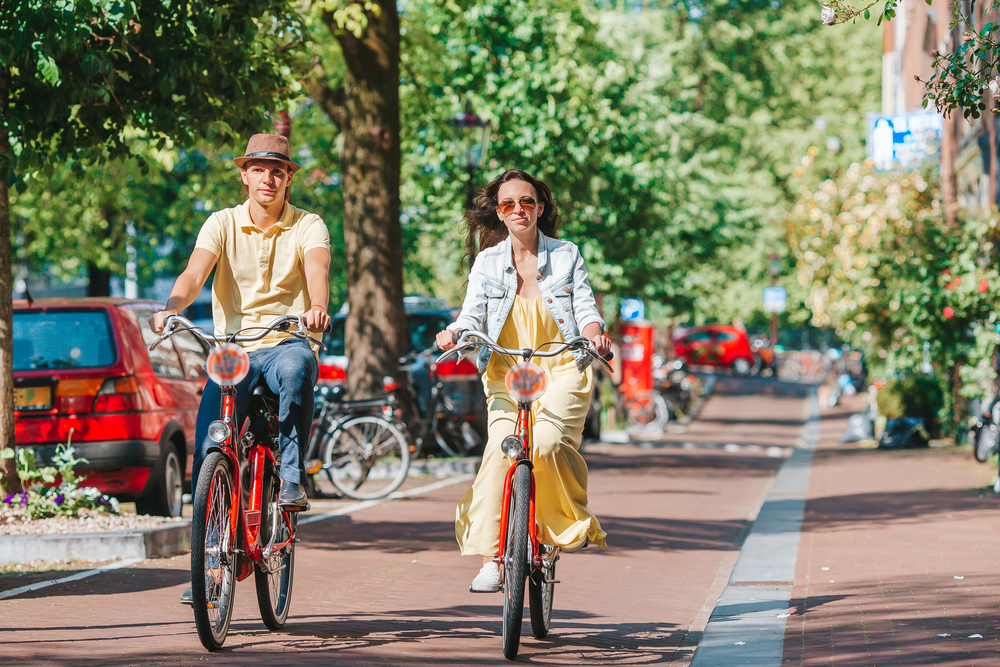
Of course, are we surprised? After all, the Dutch and their bikes made the Netherlands THE cycling country of the world where 22.8 million bicycles are shared by 17 million people! (and no helmets.) 😎

Two-wheeled benefits

The emerging e-biking subculture means good news. For Dutch commuters, e-bikes can improve how fast and easy their trips will be in the future, especially with transportation preferences changing now that more people want to avoid crowded public transport in light of the coronavirus crisis.

With almost 50% of employees who live within a radius of 7.5 kilometres of their work are still travelling by car, the environmental impact is a key consideration in this shift. More and more people may be open to making a switch from their non-bike transportation method towards an e-bike.

Additionally, the biking industry will also benefit from this retail shift. In 2019 alone, the Dutch bicycle retail industry recorded an annual turnover of approximately 1.36 million euros.

What are your transportation preferences? Tell us more in the comments below.

Image Credit: microgen/Depositphotos

Who’s to blame for the fumbling of the corona crisis: the government or other Dutchies?

Dutch people are pointing the finger at their own countrymen for the outbreak of the corona crisis much more than residents in other European countries. 

A survey by the European Council of Foreign Relations (ECFR) found that 63% of Dutch people are blaming other negligent Dutchies for the poor Dutch response to the coronavirus crisis, RTL Nieuws reports. 😱

In particular, they believe that the continued spread of the virus is due to people who didn’t follow the coronavirus rules. They also blamed people who travelled or came from abroad during the pandemic. ✈️

What about the Dutch government?

So what about the Dutch government — are they to blame for the pandemic? According to Dutchies, the answer is no. 🙅

(Cough, Dansen met Janssen, cough).

While other European countries like France, Spain, and Poland blamed their government for the pandemic, the survey shows that three-quarters of Dutch people have confidence in the cabinet’s approach. 

What do you think about Dutch people blaming other Dutchies for the pandemic? Let us know your thoughts below! 

Feature Image: VitalikRadko/Depositphotos

Turns out that rainy summer we had…was a completely normal Dutch summer

Talking about coronavirus in the Netherlands is so 2020 — this year’s hot topic has been the shocking Dutch summer.

In fact, we’re even questioning if we can call it summer because it feels like it never started. Our days have been populated primarily by grey skies, pouring rain, and cool breezes.

Our shorts, skirts, and dresses have remained neglected in the back of our wardrobes, waiting for the day they can see the sun. Dreams of plunging into canals, lakes, and beaches have been placed in a deep freeze. And with the news that meteorological summer ended this week, that just added insult to injury.

But hol’ up, was this summer actually echt bizarre? Nup! The Dutch Meteorological Institute (KNMI) has confirmed that this summer was actually warmer than an average Dutch summer.

Okay, it was only warmer by 0.2 degrees, but still.

“Because we have had exceptionally warm and dry summers in the past three years, it may now look like a bad summer,” says NOS weather forecaster Willemijn Hoebert. “But if we look at the temperatures of the past thirty years, this summer has really just been an average Dutch summer.”

READ NEXT | It’s official: experts confirm that climate change caused extreme flooding in Limburg

Warmest June in over 100 years

If you cast your minds back to June you may remember a smattering of warm days that filled us with hope for a great summer. Well, turns out these days contributed to June 2021 being the warmest June since records began in 1901.

In a case so typical of the Netherlands, the hottest June day and coldest June day were both put in the record books. On June 13, it was only 4.8 degrees overnight in Twente, but just four days later Hupsel in Gelderland recorded 34 degrees.

How did you find the Dutch summer weather this year? Tell us in the comments below!
Feature Image: Madrabothair/Depositphotos

Weekly update: Dutch COVID-19 infections have stabilised

The RIVM has released its weekly coronavirus figures from August 24 to August 31. The number of infections has stabilised.

Over the past week, the RIVM has reported 17,575 new infections in the Netherlands. This is a slight increase compared to last week’s report of 17,315 infections.

In a stabilised state, the percentage of positive tests decreased slightly to 13.1% from 13.7% the week before.

Deaths

The number of patients who have died from COVID-19-related complications has decreased. This week, 43 people passed away, compared to 48 people the previous week.

Hospitalisations

Hospitalisations have also remained stable this week. The past week saw 415 new admissions to the nursing ward and 97 new patients in the ICU. The week before, there were 426 and 97 respectively.

We’re in the best place to be — apparently

All is not too grim though! According to Bloomberg’s Covid-19 Resilience Ranking results, the Netherlands is one of the best places to be in the world during the Delta outbreak.

The Netherlands scored as the second-best place to be based on containment, quality of healthcare, vaccination coverage, overall mortality rate, and progress toward restarting travel and easing border restrictions.

Calling it quits over measures

Not everyone agrees with the resilience ranking though. 👆 A lecturer from the University of Amsterdam quit over the relaxed Covid-19 measures which he perceived to be irresponsible.

For literature lecturer Matt Cornell, the relaxed measures and self-testing done by staff and students are not enough, in his eyes, to keep the pandemic situation at bay.

Dutch COVID-19 savings

According to De Nederlandsche Bank (DNB), Dutchies managed to save over €46 billion in the first quarter of 2020 due to the coronavirus pandemic. Alas, with no plans to spend it anytime soon.

Fear of needles

The GGD’s report that an estimated 20% of young people in the Netherlands do not want to get vaccinated against the coronavirus due to their fear of needles. With schools and universities resuming soon, these numbers are worrisome.

Follow DutchReview on Facebook for the latest news and coronavirus updates.

Feature Image: Ayelt van Veen/Unsplash

Calling all film fans: the Leiden Shorts Film Festival is waiting for you

Love film? Feel at home at the cinema? Or is it simply time to give Netflix a break? Good news, dear reader: the 13th edition of the Leiden Shorts international film festival is taking place from September, 2-5 in Kijkhuis, Leiden.

The Leiden Shorts international film festival is a hugely popular annual event. Don’t believe us? This year alone, the team received 1,458 films from 85 different countries. 😱 Of these, 118 were selected and organised within thematically linked sessions — all for your viewing pleasure.  

If fascinating films alone wasn’t enough for you, there’ll be a number of mentally stimulating and extremely socially relevant discussions happening around Leiden.

But first, what is Leiden Shorts anyway?

Founded in 2009, Leiden International Short Film Experience (LISFE) was created by five cinema-loving expats with a purpose — pretty cool, huh? In collaboration with national and international filmmakers, the festival “aims to create a conversation that has far-reaching impacts and can be sustained outside of the festival.”

The founders “believe in cinema as a tool for social change” and through this festival “want to become an outspoken figure in both Leiden and the Netherlands cultural scene.”

Rooted: Dutch Multicultural Society

This year’s theme aims to reflect upon 2020 (what a year) and how social and environmental emergencies worldwide have increased and/or worsened pre-existing issues such as inequality, discrimination and fear of “the other.”

However, (less depressingly! 😅) the festival will also attempt to explore our future society with a positive and hopeful approach.

Here’s an overview of what’s going on

As for the films themselves, they’ll be split up into themed sessions such as:

Doe Normaal (being like everyone else is just plain boring.) 🕺
Anthropocene (is human nature one with nature?) 🌳
Human Capital (what’s the value of human labour?) 🔨
man /’man| n: (what does it mean to be a man?) 👨‍🦳
Reframing Desire (let’s talk about sex.) 👩‍❤️‍💋‍👨

Curious about what else will be going on? The additional events are as follows:

Bound to Space (free online exhibition)

This digital exhibition aims at tackling debates about race, religion, and polarization in Dutch society through the eyes of five artists and their work, as well as interviews led by academic researchers who reflect on the intersection of abstract concepts and artistic practices.

You can watch this exhibition for free, from the comfort of your own home during the festival.

Dutch Grassroots Movement (panel discussion)

Have you ever wondered about the struggles and achievements of different grassroots movements in the Netherlands? On September 3, from 6 PM to 8.30 PM at the Leiden University Academy Building you can find out more about this fascinating topic.

In this discussion, three panellists will chew over their fight against anti-Asian, anti-Muslim, and anti-Black racism, as well as illuminating the “necessity and value of grassroots movement for the Dutch multicultural society.

Black-Lives-Matter-protest-Amsterdam
Black Lives Matter protest, Amsterdam, 2020. Image: Korantin Grall/Unsplash

Multi-Media Makers (panel discussion)

This event will explore new trends in the Dutch media landscape through the work of three young multimedia creators. The panel will touch on various fascinating subjects, such as “journalism in the “Gen Z” era, institutions vs. grassroots organisations, gentrification, music and social justice.”

As well as diving into the processes occurring “behind the scenes” of the media we consume, the panellists will also discuss the “responsibility connected to the narratives that are being promoted.”

The talk will take place on September 4, from 11 AM to 1.30 PM in Leiden University’s Lipsius Building, and costs €3.50 to attend.

Envisioning New Institutions (panel discussion)

During this panel discussion, which will be held on September 4, from 2.30 PM to 5 PM at the Lakenhal Museum, Afrispectives will explore and envision new institutions in the Netherlands in light of the Black Lives Matter (BLM) movement.

They’ll dive into topics, such as how “Black imagination means recognizing and looking beyond the shaped reality we live in, by envisioning a present and future that centres black healing, joy, love and dreams.”

De Animatiebus (workshop)

This is one for the kids. In this creative and inspiring workshop organized with De Animatiebus, kids (in age or in spirit) will create an animation film from start to finish. (Pretty cool, right!?) This year’s animations will be about multiculturalism.

This event will take place on September 4-5, at 11.30 AM at Marktsteeg 10, and will cost €3.50.

Woman-holding-pencil-illustrating-on-an-iPad
Get ready to animate! Image: Kelly Sikkema/Unsplash

Time to get booking!

What are your thoughts on these events? Tell us in the comments below!
Feature Image: Joseph Pearson/Unsplash


Five things to know about third-party insurance in the Netherlands in 2020

0

You may be looking at this article and wondering why you need to worry about third-party insurance on top of all the other things that have been thrown your way this corona ridden year. 

But perhaps of all the years, 2020 is the year make sure you’ve taken out third-party insurance. Not to jinx anyone, but let me just say it would be in keeping with the theme of the year if one of your morning commutes was to involve you driving into your neighbor’s expensive garden gnome.

If the fear of rear-ending an expensive object is one of the many things that keeps you up at night this year, well then this is the article for you. 

What is third-party insurance?  

So, what is third-party insurance? Put simply, third-party insurance is insurance that you take out if you own any sort of vehicle, be that a car, a motorbike or a moped. It is mandatory to take out. 

The insurance is meant to cover any damage you might do to the belongings or the bodies of other people while driving.  It’s important to note that the insurance doesn’t cover your vehicle, but the vehicle that you have caused damage to. 

But don’t worry, should your morning commute end with you getting rear-ended by a fancy Mercedes, their third-party insurance should cover any damage done to your vehicle. 

Third-party insurance is often confused with liability insurance in the Netherlands, because these two used to have the same name. Third-party insurance is called WA-Verzekering in Dutch, and is mandatory. Third-party insurance covers any damage you do to someone else’s car while driving. Liability insurance is called Aansprakelijkheidsverzekering (AVP), and is not mandatory (but encouraged). Liability insurance basically covers any damage you do in your everyday life to other people’s belongings, or their bodies.  

Will everything be covered by third-party insurance? 

In short, no. The coverage for third-party insurance depends on the policy that you take out. However, third-party insurance at its most basic is only meant to cover damage that has been done to the vehicle of the person you have crashed into. 

This means that if you happen to crash into a sneaky wall or a discombobulated cow, no one is going to be paying you out (walls and cows do not have third-party insurance.) 

This is why third-party insurance websites such as WA.nl suggest that you take out insurance policies that offer slightly more comprehensive cover. For example, you can find policies that will also cover you should your car explode or get struck by lightning (again, 2020 would be the year). 

Is it mandatory?  

Third-party insurance is mandatory in the Netherlands if you own a car, scooter or moped. In fact, your vehicle should be covered for third-party before you even leave the place from which you bought it.

This goes for internationals and Dutchies alike. So for any expats who dream of driving a bright pink moped along the autumnal canals of Amsterdam, take out third-party insurance first, then carry on living the dream. 

The Dutch and insurance 

Mandatory third-party insurance comes as no surprise in a country in which bikes, cars and mopeds can all be found on the same, unbarriered stretch of road. Liability insurance is probably also a good idea in this country. While you may roll your eyes at the idea of covering yourself for future damages you may cause, it’s actually quite a smart move. 

Also, if you’re thinking that 2-3 insurances are good enough in this safe little country then you’re missing a very important part of the Dutch experience: living your life to the fullest without a thing to worry about because there is always an insurance coverage for every aspect of your life. The Dutch just love their insurances! A typical Dutch person would be contributing to the 6 or 7 types of insurance every month easily, sometimes going with double cover.

Am I covered internationally? 

If you should decide to take the pink moped for a trip to the Italian countryside, then you need to understand that third-party insurance only covers you for the Netherlands. However, there are policies that can cover a Mr.Worldwide-on-a-pink-moped lifestyle.

Not to worry you any more than you already are this year, but maybe 2020 is the year to look at third-party insurance. Let us know what you think in the comments below!

Feat image: SplitShire/Pexels

Dodgy Dutch landlords: temporary tenants forced to stay longer

As if finding a place to live in the Netherlands isn’t hard enough already, many Dutch landlords are breaking the law by forcing tenants with temporary rental contracts to pay rent for longer notice periods than are legal.

These landlords expect temporary tenants to pay a minimum rental term — usually of around six to twelve months — which is not a legal action. 🙅‍♀️ 

If a tenant in short-term accommodation wants to end their contract early, the landlords simply don’t allow it. 😤

According to an inventory by de Volkskrant, in which over 300 tenants of temporary homes were surveyed, more than 100 people reported experiencing this unlawful practice. 

Many temporary rent contracts are unlawful. Image: AndreyPopov/Depositphotos

How and why is this happening? 

In 2016, a law was passed which allowed landlords to temporarily rent out homes for a period of 24 months.

This led to a boom in the short-term housing market and made it possible for homes that would previously only have been rented out for short periods (just a couple of weeks or months) to be rented out for indefinite periods.

In addition, many tenants are not aware of their own rights — mainly because of how complicated and confusing the laws surrounding rental periods and contracts are.

The laws even confuse some landlords, who are often not well-informed about the legislation surrounding the topic (what?!). 

A tough housing market made tougher

The housing market is already highly competitive, expensive, and limited. Unfortunately, many people have no choice but to accept these dodgy, “temporary” contracts because there aren’t many affordable options available to people. 

What do you think about this situation? Tell us your thoughts in the comments below!
Feature Image: rfphoto/Depositphotos