Rotterdam restaurant Joelia has found an escape clause around the catering ban that came into effect on Tuesday.
The Michelin starred restaurant is doing some creative interpretation of the government’s new measures. While all restaurants, cafes, and bars are now closed (with the exception of take-away), hotel restaurants are allowed to continue serving their guests.
This is where Joelia secured their loophole: the one-star restaurant is attached to the Hilton Rotterdam.
A tenner for a loophole
Restaurant-goers can register with the hotel for the measly sum of €10, granting them access to the hotel’s facilities: including the restaurant. For this, you book part of the day at the Hilton — from 12 PM to 5 PM for lunch, or from 6 PM to 10 PM for dinner. If the guest want to indulge on a bit too much fine wine without drink-biking, they can even stay overnight from just €75.
“I am a hotel restaurant and that is allowed. I am not doing anything wrong”, chef Mario Ridder told RTL Nieuws. “This is within the rules. We’ve made a razor-sharp deal with the Hilton. We’re in the same building.”
Apart from that, Ridder says that the restaurant adheres to all of the rules by keeping their distance, allowing a maximum of 30 people inside, and not serving alcohol after 8 PM.
One star reviews
Not everyone is happy with Ridder’s creative interpretation. Dutchman Tom Wintermans had a reservation for Saturday. He expected Joelia to cancel the booking — but instead was told he could still come for the extra sum.
“That registration with the Hilton, supposedly with a room, was necessary should there be a police raid, the restaurant said,” Wintermans told AD. “At first, I thought it was a joke. But no, it was serious and completely legal. I did not know what I heard.”
“Take responsibility, said Rutte at the press conference, do not seek the loopholes of the law. So it really went down the wrong way. Maybe you can do it, but I do not want it,” Wintermans continued.
The defensive chef
But Chef Ridder says he’s not doing anything wrong. “Everyone in the hospitality industry is looking for opportunities and is creative. I’m in a hotel and this is my way of trying to keep afloat.”
All guests with current bookings have been offered the option, says Ridder. While booking is unavailable on the Joelia website, a deal on the restaurant website Heerlijk is still available. “The reservations are pouring in.”
The Rotterdam-Rijnmond Safety Region is now investigating whether the loophole is legal.
Do you think this loophole should be allowed? Tell us your thoughts in the comments below!
Feature Image: Michael Browning/Unsplash (for illustrative purposes only)
The Utrecht neighbourhood of Lunetten has been thrown into the spotlight once again, after a potential attack today and yesterday led to heavy police presence in the area. This follows two attacks against women in the past month, which prompted police to encourage women to not cycle alone.
Yesterday, local residents noted a large police presence. Earlier this morning, police returned again to conduct a major investigation for what they described as a “suspicious situation”, RTV Utrecht reports.
The two assaults in the park last month has people believing the current events may be related. Police are yet to confirm or deny any link.
Suspicious man
The report of suspicious behaviour in the park was received in the early hours of this morning. Police were deployed to the park and a police helicopter circled the area.
An appeal was sent out through Burgernet at 7:30 AM asking that local residents keep an eye out for a man acting suspiciously. The man was described as wearing dark clothes and left the area on a bike.
The area where “suspicious behaviour” occurred was cordoned off but a forensic investigation yielded nothing. Police left the area at 11 AM.
Did you spot any suspicious behaviour in the area? Stay safe out there!
Revellers in The Hague and other cities used their final hours to make the most of open catering businesses, and steep discounts — like 50% off draught beers.
While the parties had an expiration date of 10 PM, when bars, cafes and restaurants all closed for the next four weeks, not everyone was happy to see the fun shut down.
In The Hague, tents of partygoers were full to the point where police had to step in. Images that emerged of the gatherings on social media elicited furious reactions.
For context. Video shot this evening (by me) between 2135 & 2210. I’m equidistance between bar & entrance to Dutch parliament. NL has one of the most rapidly rising infection rates in the world. At least 6,663 Dutch people killed by #COVID19 report running @BBCWorld#Netherlandshttps://t.co/cIXwEcvyGWpic.twitter.com/CutnBEewDE
A council spokesperson said coronavirus rules were violated, but it is unknown whether any fines were issued. Meanwhile, Mayor Jan van Zanen described the parties as “completely irresponsible.”
“These people don’t care about hard-working healthcare workers, patients who are in ICU or whose surgery is now being postponed,” he said. “Of course people want to party again, but this kind of selfish behaviour only makes the measures last longer.”
Morgen laatste kans om onze taps leeg te maken we hebben er nog 17 met héérlijke speciaalbieren. Help ons en jezelf en…
Hospitality industry organization, Koninklijke Horeca Nederland, have also frowned upon the images. “It is unacceptable,” director Dirk Beljaarts told RTL Nieuws. “This is not the hospitality industry. The hospitality industry is crying tonight and has given everything in recent months to offer a safe place to go out.”
Did you head out to the bars last night? Did people behave? Tell us in the comments below!
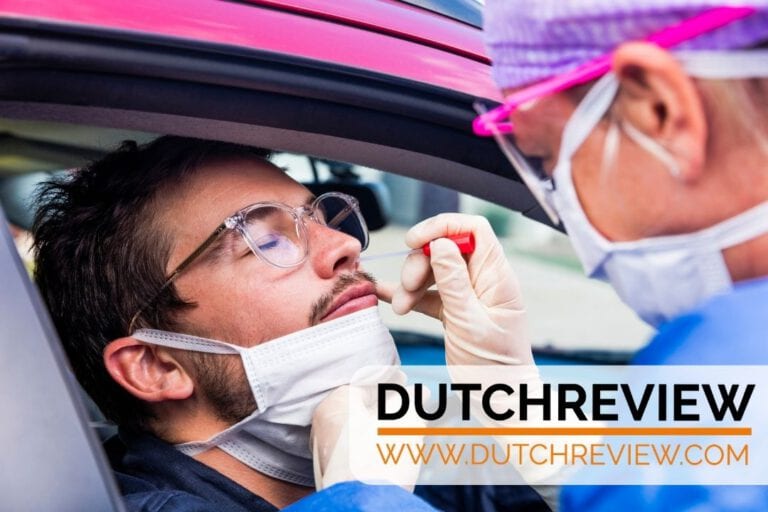
Leiden pharmaceutical company Breathomix has developed a breathalyzer that frees up testing lines by quickly detecting if someone is free from coronavirus infection. A test street in Amsterdam has been using the breathalyzer for the past few weeks with favourable results.
The breathalyzer works by detecting particles in the air that people exhale. The Electronic Nose (E-nose) — as it’s called — was tested by GGD Amsterdam, the Franciscus Gasthuis & Vlietland and the Leiden University Medical Center. It could immediately determine that three quarters of people in the line were clear of corona.
Much needed relief
The device can massively alleviate the increasing pressure on GGD COVID-19 testing facilities. Of the 1,800 people who used the breathalyzer prior to the regular swab test, about 1,350 of them were deemed fit to be removed from the line. “The test is an important addition to the tests that are currently available,” lung specialist Hans in ‘t Veen of Franciscus Gasthuis & Vlietland said.
But the breathalyzer’s fast results also mean that many people can go home and continue to work or go back to school, without having to first wait for days. The test will therefore potentially help to lower the social and economic effects of slow testing times.
Although the E-nose cannot yield results that are 100% accurate all the time, Hans in ‘t Veen believes it is a highly valuable screening test which makes the testing process smoother for everyone.
Breathalyzers to be rolled out across the country
The Ministry of Health has ordered hundreds of breathalyzers that will be distributed to the test streets of GGDs across the Netherlands. The test takes about 45 seconds, as test subjects simply breathe into the device for 30 seconds and then wait for the result. The breathalyzer is then disinfected, and the mouth piece and filter are replaced.
Finnish breathalyzers
Finland is currently producing about 100,000 devices similar to the Leiden breathalyzer. Breathomix’s device was actually created to detect asthma, COPD and cancer in test subjects, but was found to also work for COVID-19.
Would you use this new breathalyzer test? Let us know in the comments below.
A 25-year-old woman faces 10 years in prison for the shooting of Dutch woman Grietje (72.) Grietje had been having an affair with the woman’s husband for a number of years.
The shooter, known as Summer A, and her husband Imraan Ayub (31) both regularly visited Grietje at her home. The affair began when Imraan was just 18-years-old and worked as Grietje’s gardner.
Grietje is said to have enjoyed Imraan’s sexual performance and he enjoyed expensive gifts in return. One such gift included a white BMW X6.
When Summer and Imraan were married, she was made to believe that the affair between her husband and Grietje was over. However, the couple still visited the woman to help with housework and gardening. Summer said that she pitied the woman.
The shooting
However, on one such visit, it became apparent that Imraan and Grietje were still having an affair. This infuriated Summer A. She told the court that “they turned on me, laughed at me, called me too fat, that I had to accept their relationship. I couldn’t bear them doing that to me after all that I did for them and the humiliations. I had already accepted that Grietje would stay in Ayub’s life and even felt sorry for her” AD.nl reports.
At this point Summer A took a gun (which she claimed she had found in the car earlier) from her jacket pocket and shot Grietje twice. Grietje sustained shot wounds to her chest and head but survived.
Regret
Summer A has said that she is glad Grietje is alive and that she regrets shooting her.
“I am glad that Grietje is still alive and I am very sorry. I wish I could turn back time ”, Summer sobbed. “I had never seen or used a weapon, I didn’t know how. I hope that after my release I will be able to receive guidance, finish my studies as a nurse and take care of my 5-year-old daughter.”
Follow DutchReview on Facebook for the latest news and updates.
The discussion of mandatory masks in the Netherlands has been a heated one. Today, Health Minister Hugo de Jonge has explained in a letter to the House of Representatives just exactly how he intends to regulate the requirement of masks.
After last night’s press conference, which introduced far stricter coronavirus measures, there has still been some confusion around face masks. It has been unclear exactly when and where people will be required to wear them, and how and when the rules will be enforced.
In Minister De Jonge’s letter, he references the COVID-19 law, which has not yet come into effect, but includes the possibility of a mask obligation. The bill for the new law was passed in the House of Representatives yesterday, however, it will be another two weeks before it comes under the scrutiny of the Senate. Therefore, we are still weeks out from any definitive mask mandates.
The intended date of the vote in the Senate is on Tuesday, October 27. If the bill is approved, De Jonge intends for the mask requirement to come into effect “the moment the bill is passed and enters into force.” He is also pushing for masks to be made available to people who are tight on income.
Until then, the cabinet’s ‘urgent advice’ stands — everyone over the age of 13 is urged to wear a mask in public indoor spaces.
What do you think of the cabinet’s plan to enforce masks? Let us know in the comments below.
Let me guess, like many other expats, you arrived here, snapped up the cheapest contents and liability insurance policy in the Netherlands you could find, and called it a day. But did you know that insuring your stuff can be easy? And affordable?
If not, let us introduce you to Lemonade. Not the drink; but your new contents and liability insurance.
What is Lemonade? Cover yourself for damages in the Netherlands
Ok so, let’s imagine you have settled into life in the Netherlands — you’ve registered at your local municipality, opened up a Dutch bank account, found yourself a decent health insurance and maybe even applied for some lovelytoeslagen.
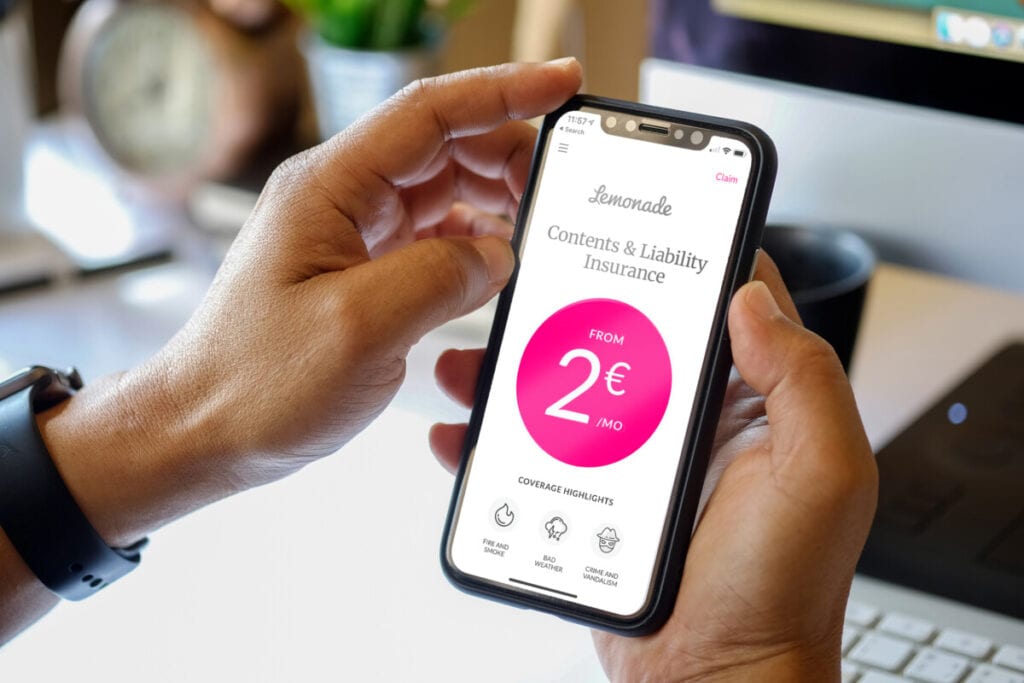
You probably felt that was enough, but did you know you can insure things like your phone and bike from €2 a month? Or you can cover yourself for any damages caused if you cycle face-first into the back of a market stall? Lemonade offers contents and liability insurance for precisely these situations.
Sort your insurance from the comfort of your own home. Image: DutchReview/Supplied
What is covered by Lemonade’s contents insurance?
Lemonade’s contents insurance covers items that are usually kept in your home should they become damaged. On top of that, this policy also covers your phone and your bike.
Your mobile phone will be covered both inside and outside of the house for damages caused by things such as fire, vandalism, burglary or windstorms. However, there are some cases where your mobile will not be covered, like if you accidentally drop or break it.
If you need extra protection, e.g. for your phone and bike, Lemonade made sure to include an anti-theft add-on in its contents insurance. This covers all your belongings against theft inside and outside your home, even when you travel around the world.
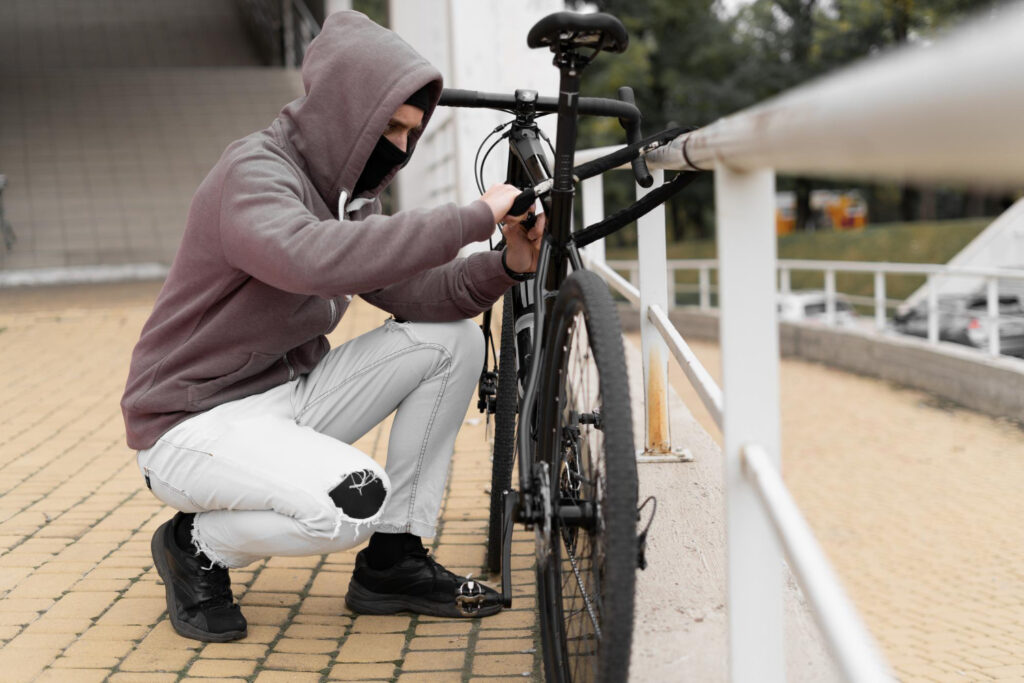
Bike stolen? Lemonade’s got you covered. Image: Freepik
According to Lemonade’s Policy 2.0, this means — for your bike for example — that as long as you use an ART-approved lock with at least a two star rating, your bike will be covered should someone decide to take it for a late night joyride.
What is covered by Lemonade’s liability insurance?
Let’s say you are cycling along the canals, contemplating the picturesque turn that your life has taken when BAM — you knock the side-mirror off of poor oma’s mobility scooter.
It’s fair to say it was your fault, and now oma has a broken side mirror that needs paying for. While Lemonade cannot help you to translate the tidal wave of Dutch profanity that crosses the poor woman’s lips, it can help you to cover the cost of damage you may have done.
Lemonade’s liability insurance covers you for damages you make to someone else or their property. You can either choose a €1,250,000 liability coverage or a €2,500,000 option.
However, you are not covered for damages if you were borrowing someone’s stuff, and you break it. Borrowed Jeroen’s snazzy mountain bike and crashed it? That’s on you my friend.
Why Lemonade is a great choice
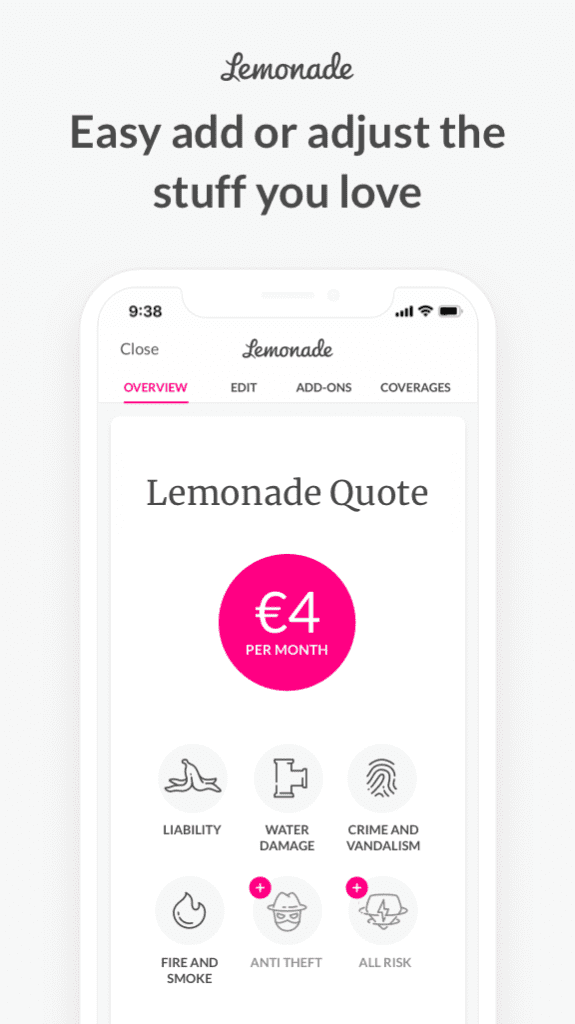
As an expat, there are many reasons why I would choose LemonadeLemonade. This insurance has much more to offer to the next generation of adults and expats in the Netherlands. They’ve taken into account our shift in values to offer us an experience different from any other insurance company.
Set it all up on your phone. Image: DutchReview/Supplied.
Insurance at your fingertips
With Lemonade, there’s no paperwork, no office visits — everything is online.
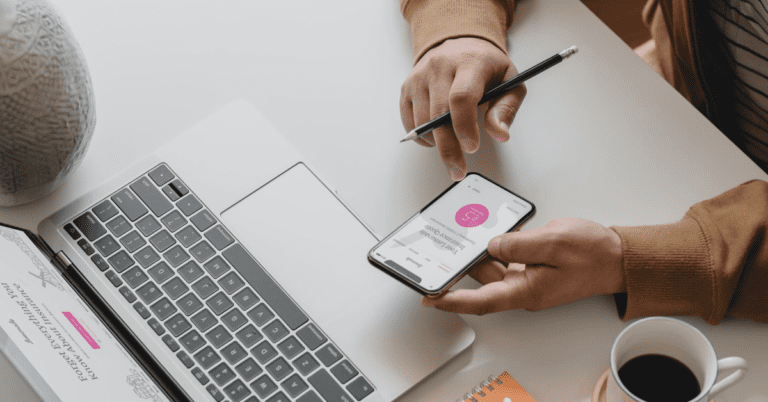
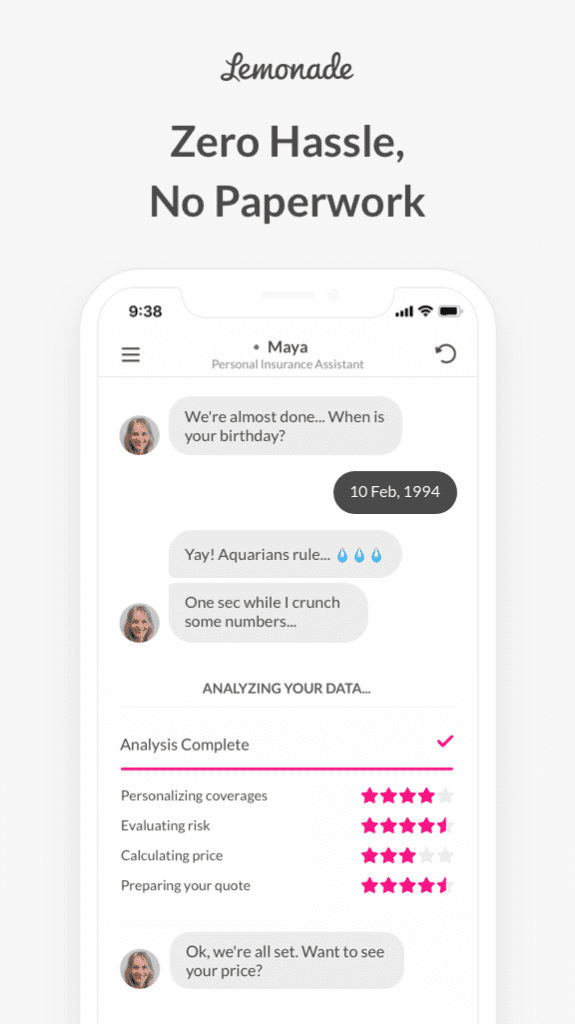
Signing up is simple: just grab your phone or laptop and tell Lemonade’s AI, Maya, what you want to cover. A few questions later, you get a personalized quote you can adjust for deductible, start date, coverage amounts, and more.
Filing a claim is just as easy. Tap the claim button, tell AI Jim what happened, and you’re done. Claims can be processed instantly, and about a third are paid immediately. If Jim can’t decide, a real person steps in. Either way, no leaving home, and payment goes straight to your bank account.
No Dutch? No problem
Starting life in the Netherlands can be tricky for expats, and Lemonade knows it. That’s why their services are offered in both Dutch and English.
If Dutch isn’t your strong suit, you can still select coverage for the Netherlands and handle everything in English. No more Google Translate or worrying about misinterpreting terms, as claims and correspondence are all carried out in a language you actually understand.
Insurance has never been easier. Image: Dreamstime
Lemonade’s ethical approach to insurance
Think the innovation stops there? Not at all. Lemonade takes a fixed fee — a set percentage of your monthly payments — and uses the rest to pay claims. Whatever is left over goes to charities that customers choose. Unlike traditional insurers, Lemonade doesn’t profit from denied claims, so you can rest easy knowing they’re on your side.
Nobody’s perfect — my personal cons
We like to keep it real with you, so here are some reasons why you might be reluctant to take out insurance with Lemonade.
No physical branches
Since Lemonade is entirely online, there’s no physical branch that you can point a finger to when you need to just look someone in the eye and ask them a question, which can be off putting for some.
The only way to access Lemonade is through a device and wifi. However, this means also that Lemonade is accessible anywhere, anytime from the comfort of your sofa.
Speaking with AI
Whilst Lemonade’s AI is great for getting you insured quickly and adjusting your claim hassle-free, some people just need to feel assured by a human. AI technically eliminates room for human error, but sometimes you just want to know that your personal stories are being heard and handled by another human.
However, rest assured you can always reach out and talk to Lemonade’s Claims Team, and have your case reviewed by a (human) specialist if needed.
Sign me up! What are my options with Lemonade?
If you’re impressed by all this, sign up is simple, just head on over to Lemonade’s website and tell Maya what you would like to cover. You can customise your policies so what you pay really depends on your own personal situation.
Curious as to how it all works? Lemonade offers an easy and comprehensive rundown of how they operate on their website.
Maya will get you all set up. Image: DutchReview/Supplied.
Sometimes life gives you crises and you need to turn to Lemonade. Are you ready for your new life in the Netherlands?
You’ve probably seen their bright blue aeroplanes sitting at a terminal (especially if you’ve ever been to the Netherlands), but did you know that KLM is in fact the world’s oldest airline?
Well, it is. It’s been operating continuously since 1919, and it now has flights to about 135 airports around the globe.
I’ve had plenty of fresh cheese sandwiches served to me by smiling flight attendants in blue, but it hasn’t always been that way. Haven’t you ever wondered how it began?
But wait! A quick note: Of course, with a pandemic in the air, KLM isn’t taking to the skies much anymore, and has had to resort to contentious government bailouts. In the meantime, let’s reminisce back to the days when we could hop on a plane and take a look at this iconic Dutch airline.
Wait, what does KLM stand for?
Before we get any further, we should clear up this whole acronym situation. After all, what does KLM stand for? As any Dutch person could tell you, those are the first three letters of Koninklijke Luchtvaart Maatschappij, which obviously means Royal Aviation Company. The ability to be called royal is thanks to Queen Wilhelmina, and she gave this title nearly a month before the airline was actually created. Always the forward thinker.
In my humble opinion, using the letters instead of the full name was a wise decision. I can’t really imagine becoming the world’s oldest airline with that tongue twister of a title.
Not the first, just the oldest
To be clear, KLM is the world’s oldest airline, but it wasn’t the first company offering commercial air travel. There were multiple others (operating airplanes and Zeppelins), but none of them were able to stand the test of time. Except for KLM, of course.
Foundation of these flying Dutchmen
It started to become obvious that flight was the transport of the future, and an aviation exhibition in Amsterdam spurred some Dutch businessmen to pool their money together and start an airline. They officially registered the company on October 7, 1919, but the inaugural flight didn’t take off until May 17, 1920. This was only a short trip from London, but it proved successful enough to launch their first intercontinental flight to Jakarta in 1924.
If you want to get a visual explanation of their history, go through the decades with this series of videos by KLM.
KLM in 1964. KLM bestaat 100 jaar! Op 7 oktober 1919 werd de Nederlandse luchtvaartmaatschappij KLM opgericht. KLM is daarmee de oudste internationale luchtvaartmaatschappij ter wereld die nog opereert onder haar eigen naam.#KLM100jaar #NLtrots
Geplaatst door Oud Amsterdam op Zondag 6 oktober 2019
KLM Merger with Air France
After 70 years of flying solo, KLM decided they were a little lonely hopping around above the clouds. Fortunately, their friendly neighbours to the south felt the same way, and KLM merged with Air France. This little example of European collaboration has allowed for both airlines to remain successful in an extremely competitive industry.
Image: Alex Hoskinson
Dutch tradition in the clouds
It’s been hundreds of years since the Dutch made a name for themselves by sailing around the world and conducting business, so is it really surprising that they took to the skies so successfully? This sort of thing is in their blood.
Are you a KLM fan? Tell us in the comments below!
Feature Image: KLM/Supplied Editor’s Note: This article was originally published in March 2016, but was fully updated in October 2020 for your reading pleasure.
The governmental parties have agreed to allow new regulation that will make children between the ages of 1-12 eligible for “active termination of life.” The children must be suffering terribly and without hope of recovery.
The agreement follows pleas by doctors who were unable to assist in situations where children were suffering immensely. An investigation into the matter was launched a few years ago and found that the majority of paediatricians were in favour of the possibility.
However, they also requested that there be more clarity surrounding the alleviation of suffering in the latter stages. The study found that there were approximately 5 to 10 children each year in the Netherlands who would be eligible for “active termination of life.”
A sensitive topic
The study was completed last year, however the coalition were reluctant to address the issue given the sensitivity of the subject. Rutte and Minister of Health, Hugo De Jonge, reintroduced the issue and while parties were initially divided on the topic, an agreement has finally been reached.
Under the new regulation, De Jonge has proposed that the Groningen Protocol should be expanded to include children between the ages of 1-12. He will consult with doctors about this.
What is the Groningen Protocol?
Currently, the Groningen Protocol only applies to newborns and babies under the age of one.
The protocol states that following consent from multiple people including the parents, social workers and the medical professionals in charge of the infant, an infant who is suffering unbearably may have their life ended by a medical professional.
The suffering must be so much that even under sedative and palliative drugs, the infant suffers immensely and will never experience independence or a good quality of life.
Children between the ages of 1-12 do not fall under the Groningen Protocol. This means that their parents can only wait for the child to die and place them under heavy sedation so that they won’t experience suffering towards the end of life.
How would the Groningen Protocol change?
De Jonge has proposed that those eligible for the Groningen Protocol should be expanded to include children between the ages of 1 and 12. This means that euthanasia law does not have to be changed, as euthanasia is only available to those above the age of 12 who are considered old enough to request it (although it must be approved by multiple entities.)
Following an agreement by the coalition, the proposal is expected to receive a majority of votes in favour in the House of Representatives.
Follow DutchReview on Facebook for the latest news and updates.
We’re sure you were planning on being a top-notch Nederlander and staying home regardless, but if you were planning to sneak out for a tasty waffle, buttery croissant, delicious pierogi, or tea with the Queen, you’ll have to take a raincheck.
The Dutch government has decided that with cases in these countries rising, Dutch people travelling to these countries simply wouldn’t be a good idea (never mind our own 43,901 cases in the past week). All of the above countries are now “travel only if necessary.”
Can I still travel to Belgium?
You may be keen to drop by our nearest and dearest neighbour. Technically, it is still possible. However, the Dutch government has classed Belgium with an orange colour code, and if you do travel there you’ll not only be subject to restrictions from the Belgium side like a coronavirus test after five days (unless you’re from Zeeland), but you’ll also be “strongly advised” to go into a 10-day home quarantine upon your return to the Netherlands from the Dutch side.
What about France?
Like the Netherlands, France is also breaking records for daily coronavirus infections. Six areas, including Paris, have become designated “red zones.” This means that regional authorities in these areas have the power to restrict the freedom of movement of any Dutchies travelling there. In addition, you’ll need to quarantine for 10 days once you return to the Netherlands.
Okay then, Poland?
Rising cases in Poland has contributed to the Dutch government’s classification of the entire country as orange-risk. Wearing a face mask in Polish public areas is now mandatory, and you’ll face a 10-day quarantine when you come back to the Netherlands.
And the United Kingdom?
The UK is also locking down further, as cases continue to rise in the country. While the majority of the country is still below the lowest risk level, areas at high risk have given regional governments the power to declare lockdowns. In addition to a 14-day quarantine in the UK, you’ll also need to complete a 10-day quarantine when you cross back to Holland.
Will you be heading beyond the Dutch border? Or are you happy to stay inside? Tell us in the comments below!