A judge has ruled that a Dutch company must pay €2,000 to two former employees after a manager violated their privacy.
Ever taken a moment to vent your frustrations to a co-worker? Now, imagine if your boss found those messages.
Two chefs working for a café-restaurant in Haarlem, run by hospitality company De Jaren, were fired after their employers discovered negative messages about the company in their private WhatsApp messages.
According to RTL, the men had been highly critical of the management and other staff in their exchange.
Why the negativity?
While we can’t read the messages themselves, it’s clear there were real reasons behind the employees’ frustrations.
The two chefs were hired by the company to create a new concept for the kitchen in question back in 2024. Pretty straightforward, right?
However, issues with management and organisation stalled this plan several times. The chefs were left exasperated and expressed this in their messages.
What happened?
Apparently, one of the chefs was using the company laptop to send private WhatsApp messages. You have to admit, that’s a risky move.
As a result, when the manager used the device, she was able to access the private chat. The manager claims the conversation was left open on the laptop when she went to use it.
After reading negative messages about herself and other staff, she took photos of the chat and forwarded them to her superiors.
The men claim damages
The company requested a meeting with the chefs the next day to discuss the messages, who initially agreed, but then called in sick.
Following this, they were informed that their contracts would not be renewed due to the incident.
Ouch! Bad move: the men filed a lawsuit, claiming €30,000 in damages for privacy violation.
In particular, they disputed their manager’s claim that the messages were left open on the laptop.
The company responded in court, arguing that the negative and insulting comments made by the employees led her to continue reading. Is this a thin argument? Some would say yes.
Including a judge.
So, what was the verdict?
The court found that, in addition to being illegally acquired, using the content of the messages as grounds for the employees’ dismissal was definitely illegal.
In addition, taking photographs of the messages and distributing them further constituted an unjustifiable violation of privacy, according to the ruling.
However, the judge did cut the company some slack. The ordered payment of €2,000 for each employee is nothing compared to the initial demand of €30,000.
This is partly because both chefs found new employment in September of the same year. As the incident occurred in June, their income loss was considered minimal.
Lesson learned: read the room, not the DMs.
What do you think of the ruling? Let us know in the comments!
Yep, you read that right — this Dutch guy sparked quite the conversation after having to explain Dutch work culture to his American manager.
In the Netherlands, work-life balance is a non-negotiable. So when this Dutchie was asked to work outside hours, he was shocked.
What happened?
Posting to Reddit’s r/WorkReform subreddit, the Dutchman recounted how he’d been called in to a meeting with his American manager to discuss his ‘commitment to the team.’
To his surprise, though, the complaint was that he was only working within his paid hours. What a crazy thing to do, right?
The manager explained his frustration that the Dutchman was signing off of Slack at precisely 5 PM (the end of his workday) and was unreachable before 9 AM the next day.
His reaction? Pure shock
The author of the post explained that he gave the manager “a reality check” about how things are done here in the land of clogs.
In his own words, “I looked him in the eye over Zoom and told him that in the Netherlands, if you can’t finish your work by 5 PM, it doesn’t mean you are dedicated. It means you are inefficient or understaffed.”
Boom! Direct hit.
American vs. Dutch work culture
The post’s virality can be traced to a known issue: American work culture clashes with Dutch culture.
As we know, our tall friends are direct, to the point, and ridiculously punctual. While that may be frustrating when planning brunch, it’s certainly an asset in the workplace.
Dutch labour law states that working outside your hours is not required, and the general culture of precision means that if your hours are 9-5 PM, you sign off at exactly 5 PM.
In fact, there is even a movement to adopt a ‘right to disconnect’ law that would make it illegal for employers to contact employees outside their working hours. Many European countries have already codified this, writes AD, so really, the Netherlands is lagging behind.
But to the American work-horse, this sounds (no pun intended) unreachable — the red-white-and-blue work culture is that the grind don’t stop.
But like the Dutch, we think, why grind if you’re not getting paid for it?
Happy ending (this time)
Thankfully, this employee stood his ground. After explaining the situation to HR, he received the support he needed.
“She literally laughed when she read it and told me to ignore him,” he said of the Dutch HR representative.
He also expressed sympathy for his American peers, however. “The fact that you have to apologise for a life outside of work is insane to us,” he said.
A code orange weather warning now applies to several northern Dutch provinces, with a code yellow applying to the rest of the country.
In a live blog published by the Dutch Meteorological Institute (KNMI), the provinces of Friesland, Groningen, and Drenthe — in addition to the Wadden Islands — are now subject to a stronger weather warning.
This code orange was announced at 7:55 PM yesterday (January 8) and will be in effect until noon today (January 9).
Expect strong winds and potential snowdrifts in the north
Thanks to continuous snowfall and strong winds in the north, the KNMI warns that conditions could be ripe for snowdrifts.
These are banks of deep snow that occasionally form with wind forces above 6 or 7, which can be a significant hindrance to traffic and public transport if they form on roads.
Even worse: this lifting of snow will hamper visibility and can be comparable to dense fog. Should the snow be especially heavy, we could see visibility drop to 500m — or even 50m in the worst conditions.
A code yellow weather warning remains in effect for snow, rain, and slippery conditions across the rest of the country.
Wind chill could drop temperatures to -20
Not living in the north? Helaas, you won’t be spared this winter’s deep freeze.
The KNMI reports that wind chill could drop temperatures to an icy -10 degrees Celsius this evening — and it’s only getting colder from there.
Saturday evening will see the wind chill drop temperatures even further, and there’s a possibility of wind chills below -20 degrees in certain areas on Monday.
How are you faring with the Netherlands’ blast of unexpectedly icy weather? Share your thoughts in the comments below.
So you’ve just arrived on Dutch soil, suitcase in hand, ready to study in the Netherlands. You may have some questions about what to do first — but fear not! Here are seven main things you need to set up once you arrive.
“Should I buy a Dutch SIM card? How do I get health insurance? How do I even go about paying rent, for that matter?” — I’ve been through it all, let’s walk through it.
This post might have affiliate links that help us write the articles you love, at no extra cost to you. Read our statement.
1. Utilities for your apartment
One thing we know for certain is that at some point, you’ll come home after a long day of lectures and want a relaxing, steaming hot shower.
You’re also probably going to crave a warm mug full of something or other. ☕️
You’ll need those utilities to get your coffee break while studying! Image: Freepik
But imagine if the shower head’s water was freezing cold and the kettle refused to switch on because you forgot to arrange heating and electricity? 😱
This can be an issue that you’ll face if you have an exclusive rental contract (utilities not included in your rent) or have bought your own home.
If so, you’d better sort out those utilities the second you arrive in your new home!
2. A Dutch bank account
Once in the Netherlands, you’re going to want some basic amenities. You know, food? A roof over your head? Clothes and IKEA furniture? You might even want to get a job upon your arrival.
A Dutch bank account will make your life in the Netherlands much easier. Image: Depositphotos
To set up a Dutch bank account, you can either make an appointment online or simply rock up to a bank with the following items in your possession:
A BSN
Proof of address (such as a signed tenancy contract)
A residence permit if you’re not from the EU
A valid ID
The Netherlands has many international-friendly banks and financial platforms like Trade Republic. We find the latter especially handy if you want a Dutch IBAN, but would like access to high interest rates and stress-free savings options.
Once that is done, the bank will send you a shiny, new pinpas (bank card) that’s ready for you to start swiping. 💳✨
3. Internet and television
There will be times when, after a long day of classes, studying, and socialising, all you want to do is kick back your feet, turn on the telly (or Netflix), and chill.
What do you need to do so? You guessed it, a good internet and television connection! Just like with your utilities, you will usually have to find your providers on your own accord.
The good news is that these two services are often offered as part of a package deal, meaning you pay a flat monthly fee, and in return, you get both working WiFi and television.
Don’t need a TV connection? Geen probleem, you can also opt for an internet-only subscription.
From Ziggo to Odido to KPN, there are countless great providers out there, as well as various tools that let you compare prices, internet speed, and available television channels. Happy deal-hunting!
4. All the important insurances
Sh*t happens, even in the magical country of windmills, canals, and stroopwafels.
The best way to be prepared for bad scenarios is by setting up essential insurances as soon as you arrive in the Netherlands.
Visiting a doctor in the Netherlands? Make sure you’ve got your health insurance sorted! Image: DutchReview
Most importantly, you should consider getting health insurance, liability insurance, and home contents insurance.
Health insurance ensures that you have access to necessary healthcare services and provides financial coverage for your medical expenses in the Netherlands.
Liability insurance protects you in situations where you could be held responsible for injury or property damage.
Home contents insurance is vital for your personal belongings and valuables. It provides coverage against theft, fire, or other unexpected events.
Good to know: While health insurance is mandatory in the Netherlands, only some international students will be required to take out Dutch health insurance. EU students, for example, will usually be fine with their European health insurance cards.
According to Dutch law, you must take out Dutch health insurance if:
You are a permanent resident of the Netherlands (students are generally considered “temporary residents”)
You are working alongside your studies (this includes paid internships and volunteer work!)
5. A Dutch phone plan
First things first, we would recommend getting your hands on a local phone number by purchasing a SIM card at one of the many Dutch stores available — Albert Heijn is one of them!
Depending on how often you call and use mobile data, you can pick and choose which Dutch phone subscription best suits you.
Remember, you’re probably not going to want to make a long-distance phone call every time you need to contact your landlord. Image: Freepik
The options are endless, but here are some of the more popular providers in the Netherlands:
Simyo for sheer affordability and great customer service
KPNfor an expansive, reliable network and unlimited data
Odidofor some of the fastest mobile internet speeds in the Netherlands
Vodafonefor excellent coverage, even in rural areas
6. A social life
Take it from me: moving to a new country as an international student can be tough. You have no family around you, no friends, and often you don’t even speak the local language.
That’s why one of the most important things to set up as an international student in the Netherlands is a supportive social circle.
Good friends can make everything a blast! Image: Freepik
Sign up for your university’s orientation week (I met some of my best friends there!)
Take a class — be it in a sport, pottery, painting, or cooking
Join Facebook groups for international students
Attend events planned by your university or student associations, such as ESN
Interact with your neighbours and the people in your course
7. Your Burgerservicenummer (BSN)
To set up all of the most important services and utilities listed above, you’ll usually be asked to provide your Burgerservicenummer (BSN).
A BSN, which translates to “citizen service number” in English, is a number that helps the government process your personal data.
Imagine how happy you’ll feel when you get that BSN in the mail a few days after the appointment! Image: Freepik
Without this unique, personal sequence of numbers, identifying yourself for your healthcare provider, educational institution, bank, and employer is damn near impossible.
To get yours, you must book an in-person appointment to register at the municipality where you will be living for the next four or more months.
8. Your DigiD
Next up, to log in and out of all the various bureaucratic databases, you’ll need to set up your own DigiD.
In short, DigiD helps you verify your identity when you log in to online portals. Think of it as the ID card that you virtually flash at a virtual bouncer — you’ll be needing it a lot.
Want to log in to your healthcare website? DigiD required. Got to pay your taxes? DigiD alert. Need to access literally anything government-related? Bam! DigiD.
See that screen? You’ll notice it pops up when you want to log in to most government portals. Image: DutchReview
You can register for a DigiD using the online DigiD application form. You must provide your BSN, the address you’re formally registered at, as well as your phone number.
Once you’ve submitted the form, you should receive a letter at your address containing an activation code within three business days. Once you have input this code, your DigiD should be up and running!
9. Any government allowances you’re eligible for
In the Netherlands, international students are actually eligible for several different Dutch allowances (called toeslagen).
If you’re eligible, the government will help you pay for some of your most vital monthly expenses, such as healthcare, rent, and child-related expenses.
Benefits you can claim from the Dutch government as an international student include:
Depending on your situation, you may also be able to claim Dutch student finance, which gets you free public transport and makes you eligible to borrow money from the government.
To access these benefits, be sure to log onto the Mijntoeslagen portal using — you guessed it — that DigiD of yours!
While moving to the Netherlands to study can be both exciting and nerve-wracking, there are plenty of people and services ready to help out as you traverse these cheese-filled lands. Go forth and conquer!
Do you have any other advice for students who have just arrived in the Netherlands? Share your tips in the comments below!
When it comes to Dutch food, many people would agree that most of it is simply a little…weird. Pannenkoeken, however, are a fan-favourite among Dutchies and internationals alike!
Just like their Queen is loyal to the Dutch football team, many Dutch people are loyal to their chosen go-to pannenkoeken restaurant. 👨🍳
What is it?
A pannenkoek is the Dutch version of an American pancake (or a French crêpe?) — but also not really. It’s thinner than a pancake but thicker than a crêpe and can be topped with anything you wish. Lekker! 🥞
And well, the Dutch take their pannenkoeken very seriously — to the point where the spelling of the word causes heated debates in the government.
So, with the high number of restaurants specialising in this simple Dutch delicacy, people make it their lifelong mission to find the very best restaurant, and they stay loyal to it until the day they die.
Why do they do it?
Well, because pannenkoeken are just heerlijk! And why not enjoy the best of them? 🤤
A dish that offers as much variety as the Dutch pannenkoek is guaranteed to be a hit with young and old. Though some combinations are highly questionable (yes, we’re talking about you, frikandel pannenkoek).
While others might prefer to go out to a fancy steakhouse or a sushi restaurant, Nederlanders would rather stick with what they know and love — so, pannenkoeken at the regular joint it is.
Should you join in?
Finding your go-to restaurant is the best excuse to visit all the pannenkoeken places in your city — so, natuurlijk, you should join in! 👏
Consider your options carefully and eet smaakelijk!
What do you think of this Dutch quirk? Have you experienced it? Tell us in the comments below!
For most Dutch learners, speaking Dutch in the Netherlands — especially in the Randstadarea of Amsterdam, Rotterdam, the Hague and Utrecht — can be a rather difficult endeavour.
If your Dutch isn’t perfect, chances are you will get a response in English — we’ve all experienced it, including myself.
As a consequence, most Dutch learners get demotivated at best, scared off at worst, and consequently settle for finishing the conversation in English.
However, as a non-native Dutch teacher, I know how it can be, and I know how to overcome it.
We got some help from the experts to bring you this article.TaalBoost is a Dutch language school based in Amsterdam, so they know how tricky it can be to get the Dutch flowing. Thankfully, they’ve also got some tips on how to keep the Nederlands going! Let’s start gargling those g’s, baby!
1. Gargle the g’s (and shorten the a’s)
The best way to make people think you mastered their language is to get a grasp of not just the words, but the sounds.
When it comes to the Dutch language, the instantly recognisable sound is the rolling or gargling ‘G’. So, how can you master it?
The first thing you need to do in order to fake your way into speaking Dutch is to gargle those g’s. Image: Freepik
To begin, you place your tongue in the same place as when you pronounce the G sound in the English word “goal” — against the roof of your mouth.
The only difference is that to roll the Dutch ‘G’, the air needs to flow between the tongue and the roof of your mouth. Can you try it now? If you still don’t have it, this wikiHow has even more details.
While you are exercising the Dutch ‘G’, it’s also worth practising your pronunciation of the Dutch ‘H’ as this tends to be a bit more throaty.
The Dutch ‘H’ is not formed in the mouth but in the throat, just like the ‘H’ in the laughing sound of ‘haha’.
Listen to the examples hoor/goor (listen/disgusting), heel/geel (very/yellow), haan/gaan (rooster/to go) below and repeat to master the pronunciation:
When you substitute one sound in a word for a different sound, and it leads to a difference in the meaning between the two words, like in the g/h examples above, this is called a minimal pair.
That’s why — aside from the ‘G’s’ and the ‘H’s’ — the correct pronunciation of the 16 (!!) Dutch vowels are fundamental to making yourself fully understandable.
TIP: If you stand in front of a mirror and say hoor, heel or haan, the mirror should steam up. If there’s no steam, then your pronunciation was probably closer to goor, geel or gaan.
Short and long sounds
Out of the 16 vowels, five have their short and long version, like:
man/maan (man/moon),
zon/zoon (sun/son),
ben/been (am/leg),
wil/wiel (want/wheel),
and zus/zuur (sister/sour).
TIP: The long vowels in the latter examples (maan, zoon, been, wiel, zuur) are pronounced as what could be considered a normal length, and the short vowels are pronounced extra short (man, zon, ben, wil, zus).
One of the first giveaways that your Dutch will get a reply in English is that you’re pronouncing the short vowels too long.
Listen to the audio below and repeat:
2. Glue the words together (but remain understandable)
If you faked your way into speaking, let’s say Italian, odds are high that you’d make every sound overly clear and understandable with that final ‘a’ like Super Mario does.
That’s because the Italian language follows a staccato consonant-vowel rhythm, often described as melodic.
However, when it comes to the Dutch language, the opposite is true.
The key is to talk Dutch with confidence and speed! Image: Freepik
Instead of adding vowels to make the language more musical, the Dutch compress multiple sounds, words, and even whole sentences into one word in spoken Dutch.
We call this constricted speech, and it works similarly to the English “you’ve” (you have), “don’t” (do not) and “gonna” (going to).
For example:Kweenie (pronounced as quay-nee). Although you actually say one word, it is a contraction of four words: ik weet het niet (I don’t know, or dunno!)
How do you know what words to glue to the neighbouring word?
Pronouns are most commonly ‘incorporated’ into other words.
In written Dutch, we already do this with je for jij/jou/jouw (informal you/your), ze for zij (she or they), and we for wij (we).
Exclusive to spoken Dutch, ik would commonly be shortened to ‘k (I), hij to ie (he), and het to ‘t (it/the). Hem would be pronounced as ‘m (him), and haar as d’r (her). Finally, mijn often becomes m’n (my) and zijn becomes z’n (his) in the spoken language.
Interested in hearing how this sounds in real life and up for an exercise in Dutch constricted speech?
3. Use many meaningless words (in a meaningful way)
The Dutch are notorious for their directness. For a non-Dutchie, it’s commonly a “damned if you do, damned if you don’t” when trying to hit that sweet spot of directness.
In fact, chances are you’ll either come across as not direct enough, too direct or even impolite.
Dutch directness is something you have to overcome and master when learning to speak Dutch. Image: Freepik
Example: One might think that a short answer, such as ja or nee, conforms to the Dutch standards of directness since the message is clear and short.
Sure thing, but it’s also too short, too direct, and, therefore, impolite. You want to go for at least two or three words in your reply: nee, dank je wel or ja hoor/lekker.
The word hoor in the above example does not have any particular meaning as a word — its function is purely pragmatic, to keep the speaking partner at ease.
Other ‘meaningless’ words with a similar function as hoor are maar, eens, even, and toch. The Dutch language is teeming with these pragmatic fillers.
For example: if you are requesting something more imperatively, a command such as kom hier (come here) or ga zitten (have a seat) should be used without fillers only when you’re directing it to a dog or a child that just won’t listen.
In other social situations, you must throw in one or more of the meaningless words for it to become socially acceptable: kom maar/eens (even)hier, or if you’re feeling extra: ga toch maar eens evenzitten!
In Dutch, as is the case with many languages, polite questions are always longer than direct questions. Compare the following examples:
Impolite directness
Kom hier!
Socially-acceptable directness
Kom maar/eens even hier!
Polite directness
Zou je hier willen komen, alsjeblieft?
4. Express yourself (the Dutch way)
In case actual words or sentences fail, you can resort to exclamations.
To use them, you don’t really need any knowledge of the Dutch language, making them a very useful strategy when you need to fake your way into speaking Dutch.
It’s not just words you should be learning — exclamations are equally important! Image: Freepik.
The exclamations commonly consist of two sounds that are repeated and can be used in various situations.
They can be categorised as:
Words of exhalation — poeh poeh, hè hè
Words of evaluation — nou nou, zo zo, ja ja
And words that precede lifting or moving a heavy object — hopla, huppeke, hupsakee, huppakee.
Exclamations are riddled throughout the Dutch language. Just think of how we say ‘hi’ and ‘bye’ in Dutch — hoi hoi and doei doei.
Faking your way into anything can be exhilarating, but also quite exhausting after a while. So why not take the next step and learn Dutch properly? TaalBoost offers both in-class lessons at their Amsterdam location as well as online lessons.
Whether you’re a budding beginner or a seasoned Scheveningen-sayer, their courses will help you dumbfound the Dutch with your language skills.
5. Throw in a couple of phrases (but do this with caution)
Using expressions when learning a new language should, in all honesty, be the last thing to resort to.
Using Dutch phrases is a great way to up your Dutch skills — but do so with caution! Image: Freepik
Expressions and idioms
Expressions or idioms are culture-specific, used only in certain contexts, and follow a specific word order. Use them with caution if you want to fake your way into speaking Dutch!
If not, you may ‘fall through the basket’ as a non-native (In Dutch, door de mand vallen means ‘to become exposed’).
Needless to say, a big no-no when using idioms is to literally translate them from another language.
Still, the literal translations of the expressions are often funny or, at times, even weird.
Dutch
English
Ik hou je in de gaten
Literal: I hold you in the holes (I’m watching you)
Helaas, Pindakaas
Literal: Unfortunately, peanut butter (That’s too bad)
Meedoen voor spek en bonen
Literal: Participate for bacon and beans (Participating for the show)
Het loopt in de soep
Literal: It goes in the soup (It’s failing)
Over koetjes en kalfjes praten
Literal: Talk about cows and calves (Small talk)
Ik zal ze een poepie laten ruiken
Literal: I’ll let them smell a poop (I’ll show them)
Linguistic commonplaces
Even more useful than the expressions to fake our way into Dutch are the linguistic commonplaces.
These ready-made sentences are used in certain situations, but they’re not exactly metaphors.
The linguistic commonplaces are used to create a familiar surrounding for the conversation and your speaking partner(s), either by putting them at ease (similar to Step 3) or teasing them.
Of course, there are enough linguistic commonplaces to warrant a book (in fact, there is one), so let’s focus on just one for now: how to find comfort in the fact that it’s raining.
Dutch
English
De meeste druppels vallen ernaast.
Most droplets are falling next to us.
Wat nu valt, valt straks niet meer.
What is now falling will soon not fall anymore
Tussen de buien door is het droog.
It’s dry between the showers.
Het is goed voor de plantjes.
It’s good for the plants.
De boeren zijn er blij mee.
It pleases the farmers.
Het koelt wel lekker af zo.
It cools off nicely like this.
Do you have any tactics for tricking the Dutch? Tell us about them in the comments below!
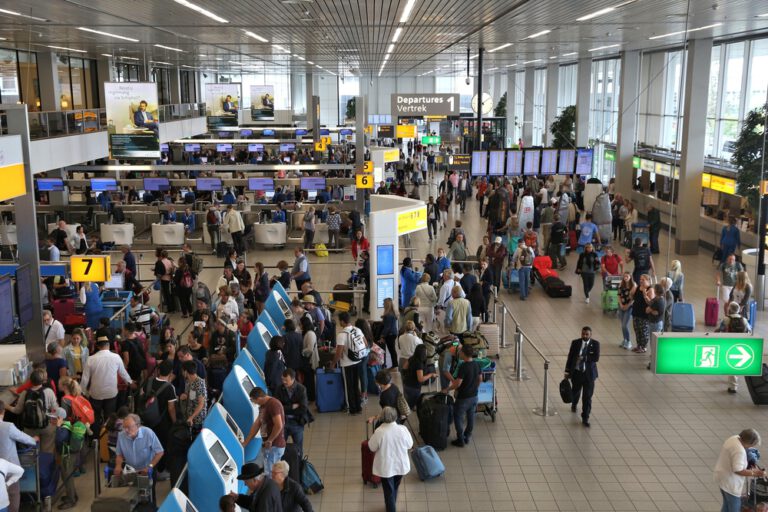
Schiphol Airport warns of crowds and chaos again today, asking travellers to be prepared and expect sudden changes. Hey, at least the disorder is consistent…
As stated on the official Schiphol Airport website, crowds are expected, along with delays due to winter weather.
Gate changes and a power outage add to the chaos
While yesterday’s cancellations were a bloodbath, far fewer departures have been axed this morning.
Although it might be good to double-check or even triple-check your departure information, as many flights are also subject to gate changes.
But be warned, this may be tricky as well. All information boards and check-in computers in Hall 2 were down earlier this morning due to a (very conveniently timed) power outage, reports NOS.
Here’s hoping that doesn’t happen again! God forbid you get on the wrong plane…
Roads are expected to be extra slippery today due to the incoming rain, putting drivers in potentially perilous conditions.
Several municipalities are also running out of salt and will be treated less roads as a result. The past week of snow and slush has reportedly drained these resources.
A code yellow is still in effect, warning vehicles to adapt to these slick roads.
And the trains aren’t super reliable, either
Train routes are still fickle this morning and will likely remain disrupted throughout the day.
NS is currently running on a winter schedule, which already means fewer trains are running on many routes.
Services to and from Schiphol remain subject to this schedule today, and travellers are being told to expect delays and cancellations of trains due to winter-related disruptions.
Get ready for another round of winter chaos with Storm Goretti, set to bring heavy rainfall, icy conditions, and slippery roads that’d make even the most confident Dutch cyclist say, “Nee, I’m taking the bus today.”
You’ll want to take things slow on the roads this morning, as Weeronline reports treacherously icy roads thanks to freezing temperatures and previously fallen snow.
Temperatures will continue to hover around freezing until the afternoon, by which time they’ll rise to around 1 to 3 degrees Celsius.
Temperatures could feel -20 degrees colder
If you thought the current icy temperatures were bad enough, things are about to get much colder.
And just how cold is ‘much colder’? Well, speaking to RTL Nieuws, Buienradar meteorologist Jordi Huirne reports that the wind chill could drop to a staggering -20 degrees in the north.
However, the rest of the country isn’t spared either, as the phenomenon of blowing snow (i.e. snow picked up and carried by strong winds) is spread across the Netherlands.
“That combination makes it feel much, much colder, perhaps as cold as -15 degrees Celsius,” Huirne warns.
This cold will result in snowfall in the north, with the south and centre of the country having an equal chance of snow and rain.
While the wind chill is forecast to lessen by Sunday afternoon, we’re not out of the woods yet. You’ll still need to wrap up, as Huirne says: “temperatures will remain low everywhere, likely below freezing.”
Roads will get dangerously slippery
Storm Goretti is forecast to move along the southern coast of England, making landfall in the Netherlands this evening (January 8).
With its arrival, we’ll likely experience heavy rainfall across the country. As Weeronline meteorologist Matthijs van der Linden tells NU.nl, this rain “will make many residential areas slippery.”
“The snow that has been driven in forms a hard layer, and rain on top of that makes it treacherous,” van der Linden explains. “Braking or swerving can easily cause you to overshoot.”
To make matters worse, more and more municipalities are running out of road salt. Helaas, AD reports that a decision has been made to “spread salt on fewer roads”, requiring motorists to be extra careful while driving.
We’ve all noticed that the train system here is seemingly fragile, not least when a dusting of snow starts to fall. But why is that? In fact, why is everything else crumbling as well?
As usual, the answer lies in the money.
Currently sitting in a 40-kilometre stretch of standstill traffic? Let’s break down the breakdown. 👇
Firstly, how are the trains falling victim to snow?
Speaking with RTL Nieuws, associate professor of Public Transport at Delft University of Technology, Niels van Oort, explains the train chaos.
According to van Oort, the fortifications required to make trains in the Netherlands snow-and frost-resistant are wildly expensive and could cost up to a billion euros.
As the heavy snowfall we’ve been seeing lately only occurs every five or so years, this would be quite the financial undertaking for potentially very little reward.
And we all know the Dutch aren’t big spenders.
Who decides?
Ultimately, like most things, this is a political decision.
The railways in the Netherlands are a public service, and any investment decisions would require political backing to authorise the Ministry of Infrastructure and Water Management to spend that money.
And, once again, the decision to invest millions of euros could be difficult to justify given the infrequency of frost and snow, especially in recent years.
If you asked the train-goers, though, you might get a different answer.
Was it always like this?
Short answer: no.
Winters here have been getting milder compared to fifty years ago, but bizarrely, this has not translated into less chaos during the rare snowy winters.
This is due to the changing travel and transport needs of the Netherlands.
Reinier van den Berg, a former weatherman, explains to AD that the country is simply much busier these days. More trains are required to run, as more people need to travel.
When the infrequent but beautiful snow flurries arrive, the impact is larger; more lives are affected, and more discontent is voiced.
So even though there’s less snow and ice, the scale of disruption when things inevitably go wrong can make it seem like the chaos has only been worsening in recent years.
More than just trains
The snow affects more than the railways. As you may have noticed, roads are also treacherous, and traffic jams are plentiful during the snowy periods.
But why? In the end, it’s a similar issue to that with the trains. The sheer amount of cars, trucks, and delivery vehicles on the roads makes smooth travel impossible in harsh weather.
The unavoidable increase in traffic incidents results in more traffic delays for more people than before.
But can’t they just salt the roads?
You’d think the tried and true solution of salt would help, right? Alas, once again, it’s not that simple.
While there is apparently a significant stockpile of salt available in the Netherlands, it’s difficult to replenish the roads.
In the past freezing temperatures might have persisted throughout the day. But now? The snow is melting.
This means any salt treatments get swept away with the water, and workers have to start from scratch.
Why is Schiphol frozen?
And as we have all seen on social media, Schiphol Airport also crumbles into chaos at the first fall of snow.
Surprisingly, though, it’s not a lack of knowledge or tools that prevents planes from taking off in the cold.
Speaking with de Volkskrant, Joris Melkert, a senior lecturer at Delft University of Technology, explains that airports simply don’t find it worthwhile to keep the staff and equipment needed to tackle the snow readily available, since snow and ice are so rare.
But hey, at least the staff can build some snowmen to keep us entertained.
Getting your rental deposit back in the Netherlands should be pretty straightforward. But alas, landlords are not always the fairy godmothers we wish they were.
So, what can you do in the Netherlands if a landlord refuses to return your deposit?
Handling large sums of money in a country you’re not familiar with can be nerve-racking, to say the least. You may be wondering if the deposit fee your landlord is asking for is normal, or if you’re being ripped off. And if they refuse to return it — what then?
Fear not: even as a foreigner, there are steps you can take to ensure you get your rental deposit back. 💪
What is a rental deposit and when do you need to pay it?
When you rent property in the Netherlands, the landlord or agency will generally require you to pay the first month of rent as well as a one-time security deposit before you move in.
Rental deposits are a standard practice when renting a house in the Netherlands. Image: Pexels
This deposit is to ensure that if you damage the space during your stay, you can pay for the repairs, rather than the landlord or agency.
However, if by the end of your contract, you have not damaged the rented space, you are entitled to receive this money back in full.
How much is a rental security deposit in the Netherlands?
Usually, the rental deposit is about one month of basic rent (excluding utilities).
However, in the Netherlands, there are no laws which set the maximum rental deposit amount. A deposit equivalent to three months’ rent, for example, is considered acceptable in a Dutch court.
How to get your rental deposit back in the Netherlands
Assuming you have maintained the place well, haven’t smashed any windows, cut through drain pipes, or caused any other damage, you are entitled to a full return of your security deposit when you vacate the property.
In most cases, you will definitely be able to get your deposit back. Image: Freepik
Regular wear and tear does not count as damage for which the landlord can keep your money. But if it is agreed to at the beginning of your contract, the landlord may deduct unpaid rent from your deposit.
Ultimately, the tenant (you) is only responsible for inexpensive maintenance, such as painting the interior walls.
However, the landlord is required to pay for larger issues like water pipes or the heating system — unless they can prove you are directly responsible.
✅ What a Dutch landlord can deduct from your rental deposit
What are those larger items? Some things a landlord can claim a portion or all of your rental deposit for include:
holes in the wall from hanging photos
broken tiles or fixtures in the bathroom
clogged toilet due to misuse
broken walls
removing paint put up by the tenant
tears, holes, or burn marks in carpets or curtains
animal stains in the carpet caused by domestic animals or leaking fish tanks
broken windows and window screens
broken doors and locks
appliances broken by negligence
excessive filth in the oven or on the stove by the burners
clogged drains from misuse or negligence
broken or missing window blinds
flea and pest extermination
excessive mildew and mould in the bathroom
excessively filthy bathtub, shower, sink, mirrors or toilet
❌ What a Dutch landlord cannot deduct from your rental deposit
The following things would be considered general wear and tear, which the landlord can generally not charge you for:
faded paint or wallpaper due to sunlight,
broken plumbing caused by normal use,
dirty blinds and curtains,
carpet wear caused by normal use,
furniture marks on the carpet,
warped doors caused by age, temperature or moisture,
warped windows caused by the flow of the glass,
dents in walls from door handles,
broken appliances (if not from misuse),
dusting,
faded curtains,
broken light bulbs,
replacement batteries for smoke detectors,
picture or pinholes in walls, as long as not excessive.
Passing inspections: how to avoid your rental deposit being kept
There are three inspections which should take place when you rent in the Netherlands: one at the beginning of your contract to record the condition of the space before you move in, a pre-inspection shortly before you leave, and a final inspection.
Important note: A landlord cannot enter the property without your permission. If an inspection is carried out without notifying you or without your presence, the landlord is in the wrong.
First inspection (before moving in): make an inspection list and take photos
At the start of your rental contract in the Netherlands, you and your landlord/agency should walk through the space together and record the property’s condition in an opnamestaat (inspection list).
Inspecting the flat before you move in is very important. Image: Freepik
Any holes in the walls, broken taps, or anything that can be listed as damaged must be noted.
If your rental is furnished or partially furnished, make sure to record the condition of all furniture.
It’s important for you also to take photos of everything at this stage. Photos and the inspection list will protect you if the landlord later falsely accuses you of causing damage.
Pre-inspection (before moving out): a chance to fix things
About two weeks before you leave the property, a pre-inspection should take place.
Here, the landlord/agency will determine whether any damage has occurred compared to the inspection list from the beginning of your contract.
Again, both parties should be present for this. If the landlord/agency decides you need to make some repairs or complete any deep cleaning, a report will be drawn up detailing what needs to be done, which both parties should sign.
Of course, if you do not agree with the report, don’t sign it.
But if you do, you legally have until the end of your contract to fix any issues. If the landlord doesn’t give you enough time to make these repairs, you are entitled to receive your deposit back in full.
Final inspection
This normally happens a few days before or after you move out and is an opportunity for the landlord/agency to check whether you have made the required repairs.
Any repairs you did not make will be deducted from your deposit. The landlord can’t request new repairs at this point unless they were not seen in the pre-inspection.
But, if either no damages are listed or all damages have been repaired after the final inspection, you have the right to get your full security deposit back.
Of course, that doesn’t always happen.
What to do if a landlord/agency in the Netherlands won’t give you your deposit back
If the landlord finds damages that you don’t agree with or comes up with some crazy excuse for keeping your deposit, things can get pretty tense pretty quickly.
A landlord denying you your deposit back may be annoying — but it’s not the end of the world, and there are ways to make them pay up. Image: Freepik
If after a month (or a previously agreed upon deadline) you still don’t have your deposit back, you’ll need to take some action.
Send a registered letter demanding your deposit back (aangetekend)
First, you need to write a registered letter (aangetekende brief) to your landlord or agency/agency in which you demand the rental deposit.
In this letter, you should first explain in detail why you disagree with the landlord. Then, clearly state that you will take legal action if they do not return your deposit within five working days.
Send the letter by mail, but be sure to keep a copy for yourself. If you would like to send it in Dutch (recommended), you can use a sample letter.
If you still can’t get your deposit back, get legal help
If your registered letter is ignored or the landlord still refuses to pay, it’s time to get legal help.
Keep in mind that if the landlord is accusing you of causing damage, they will need to provide photographic evidence.
With the photos you (hopefully) took yourself during the first inspection, you should be able to counter this.
Normally, a letter from a lawyer is enough to scare a landlord or housing agency into paying up, as going to court could cost them more.
But if they’re adamant you don’t deserve your deposit back, then legal help may be the only way forward.
Need assistance, or no money for a lawyer?
We get it, lawyers are expensive! If you need help getting your security deposit back in the Netherlands, you can try these free options first:
!Woon — a government-funded tenant support agency.
Juridisch Loket — a foundation financed by the Ministry of Justice and Security.
Check the Google Review and Facebook ratings of any agency you’re interested in working with because people are sure to post about any bad experiences they’ve had.
If the agent tries to charge you one month’s rent as a fee to lease you the apartment, that’s a big red flag. This is the responsibility of the landlordto pay, not the tenant. It is illegal to charge renters.
Now that you know what precautions to take and what is in your right to ask for, we hope you won’t have any stressful situations when it comes to getting your deposit back.
Have you had any bad experiences with landlords in the Netherlands? How did you solve them? Tell us in the comments below!