Home Blog Page 670

Turbulent times approach: first storm since August expected next week

1

According to weather forecasters, the first storm since August last year is expected to hit the Netherlands early next week. You can expect a “great chance of strong turbulent weather” on Tuesday, with coastal winds of up to 100km/h, nu.nl reports.

As you can probably imagine, such stormy weather will likely have an impact on traffic in the Netherlands. “It is really too early to make concrete statements about possible consequences for traffic or water levels,” a spokesperson from Rijkswaterstaat said. But she predicted that if there were indeed winds of 100 km/h, then there would definitely be an impact on drivers.

Storm could last for a couple of days

Although the storm is still five days away, meteorologists reckon it will last longer than a day, because of another low-pressure area approaching from across the Atlantic. So it could really be a stormy week- perhaps to make up for the mild, snowless winter we have seen so far (who are we kidding, storms are no substitute for snow).

Biggest storm since August on a week with train disruptions

The last time a storm of this magnitude hit the Netherlands- back in August- the roof of the AZ stadium in Alkmaar collapsed. There were also severe disruptions to traffic. It’s possible that the disruptions next week will have an even greater impact on people, as at the same time, there will be big disruptions on the train lines between The Hague, Rotterdam, Leiden and Amsterdam. Basically, the world is telling you to stay in bed next week.

What is the biggest storm you have experienced in the Netherlands? Let us know in the comments below. 

Feature Image: Anandu Vinod/Unsplash

Dutch prisoners to have own phone and key to cell

0

In a letter to the Lower House yesterday, the Minister for Legal Protection, Sander Dekker, said that these new reforms would decrease the workload for prison staff, and allow prisoners to feel safer, NU.nl reports.

Prisoners will feel that their belongings are safer

Not all that much will actually be changing, despite the revolutionary sound to these changes. Although prisoners will have a key to their cell, there is no keyhole on the inside of the door, so prisoners will not be able to open their own door from the inside. The advantage to the change is that prisoners will no longer have to wait for guards to close their rooms when they leave them. This will allow the prisoners to feel that their belongings are safe, and will decrease the amount of theft that occurs.

Translation: If all prisoners have a key to the front door of the prison they will be able to sub-let their cells to Dutch people who have been waiting ten years for a place to live. 

Phones will still be blocked during certain hours

When it comes to the phones, the main advantage is stopping fights over the communal phone. Although the prisoners will now have their own phone in their room, the prison staff will still be able to block numbers, have prisoners enter a code before using the phone, and be able to shut off the phones during certain hours.

In essence, both of these changes allow for increased efficiency without any real change to security. There have been changes to the prison system in recent years in the Netherlands, mostly in the form of prisons closing because there are not enough prisoners to fill them. However, judges have been punishing most crimes more severely in recent years.

What other changes would you make to Dutch prisons? Let us know your ideas in the comments below. 

Feature image: Matthew Ansley/Unsplash

What to do in the Netherlands when friends and family visit: An expat guide

0

I’ve been fortunate enough to have eighteen different guests come to visit in 2017, with more on the way before the end of the year. Some even coming two or three times. It can seem hectic, but it’s also a great way to re-experience the best parts of the Netherlands and introduce your guests to a home different from their own.

I remember when I had my first visitor last year I was stuck on what to do, there were almost TOO many things to do. Things to do can also entirely depend on what season it is, especially if your guests have booked well in advance, so it’s good to look at your options now. So hopefully this simple, yet sassy expat guide with places to visit in the Netherlands will give you some ideas. I’ll try and keep it as short and as sweet as I can.

*Warning, anyone who know me, knows that I like puns… puns and memes ahead.

places to visit in netherlands

Places to visit in the Netherlands; Autumn

In my opinion, Autumn is one of the best seasons in the Netherlands. The canals and streets are coated in shades of brown leaves. The place just looks sort of magical when this happens. I’ll keep this one to a minimum, seeing as autumn is almost over.


  • If your guests are into house music, ADE (Amsterdam Dance Event), is an awesome event to go to in the Autumn (Mid-October 2018). It involves 5 days of artists playing in various locations in Amsterdam. It’s hugely popular and attracts guests from all over the world. Nestled amongst this period is also AMF (Amsterdam Music Festival), held in Amsterdam Arena.


  • Annually, different cities in the Netherlands hold a museum night. In Amsterdam it’s the first Saturday of November. This involves around 50 different museums opening from 7pm – 2am, putting on workshops, tours, concerts and other special events. One museum ticket gains you access to all of these museums all night. It’s a great way of doing them all on the cheap.


  • Eindhoven GLOW is a free event held in November in Eindhoven (this year 11th – 18th Nov). It is a lightshow, which involves over thirty light sculptures (mainly outside), which illuminate Eindhoven as you walk through the city. It’s a really cool event, and probably not something your friends and family have seen before (plus, like I said, it’s FREE).

Winter in the Netherlands


 Not meaning to go all Christmassy on you – but lets be honest, that’s the best part about the winter season.

  • Valkenburg holds an amazing Christmas market and it’s close to the border of both Germany and Belgium (from 17th Nov – 23rd Dec). It’s in a cave! It’s a must visit during the Christmas period, as it’s so unique. It’s perfect for gifts and has all the Dutch favourites, like a load of cheese stalls, so your guests will have lots to bring home.
  • Another beautiful place for a Christmas market is held in Heemskerk (situated between Alkmaar and Haarlem). It’s held in the castle grounds of Assumburg Castle. The perfect place to enjoy a mulled wine and Dutch doughnut treats (between 7th-10th Dec).


  • If you are after something a bit different, in Deventer on the 16th and 17th December, there is a Christmas market and Charles Dickens festival. This is to celebrate the British authors most loved characters. More than 950 of his characters come to life, with music, market stalls and other high street shops being open all day.


Enough about Christmas…

  • Similar to Eindhoven Glow (but on a much smaller scale), Amsterdam also holds it’s own light festival (1st Dec – 22nd Jan). These lights are spread all over the centre of Amsterdam – in the canals, on buildings, in parks and more. It’s the perfect excuse to explore Amsterdam at night.


New Year’s Eve!

How could I forget. It’s probably worth mentioning that New Year’s Eve can be different to other countries. One main point being that there is a national ban on the purchasing on fireworks, apart from three days leading up to New Year’s Eve (with the exception of professional displays). As a result you will see more fireworks than you have probably ever seen in your life. I’m from a city in England which hosts the British Fireworks championships, so I thought I was well prepared. I wasn’t. It’s definitely something for your guests to experience at least once!

Also don’t forget to introduce them to the tradition of eating Oliebollen at midnight. They are a delicious food not to be missed out on.

Obviously celebrations will be held everywhere in the Netherlands, but if you are looking from something bigger, then look no further. Here are my top three:

  1. Amsterdam: Being the obvious choice, the capital has a lot of celebrations going on. The official celebration takes place at Oosterdock, with VOC The Ship Amsterdam as the perfect backdrop for a firework display. Lots of fireworks are set off all along the main canals and squares unofficially by the visitors and locals too, and the whole city sky is just flooded with light.
  2. Rotterdam: Rotterdam holds a spectacular New Year’s Eve (being the 2nd biggest city and all), with a professional firework display being held on the iconic Erasmus Bridge. Outside there is music and bars and the atmosphere is top. There are also lots of after parties in nearby clubs.
  3. Scheveningen: Held on Scheveningen beach, is one of the largest New Year’s Eve bonfires. It was so big in 2015 that it was a Guinness World Record. So it’s certainly impressive to go and see, especially if you are after something a bit different from the other main cities.

Spring in the Netherlands

  • Spring the Netherlands is just how you imagine it. Tulips! Every year the Keukenhof in Holland opens its doors to the public throughout March until May (2018: 22nd March – 13th May). This is basically a huge garden full of tulips and spring flowers and is especially gorgeous on a sunny day. This is a must visit, and is close to Amsterdam, so it is easy to get to. This is also a perfect opportunity to take a car, bike or train ride around this part of the country – the fields are filled with rows and rows of different coloured tulips.


  • A lot of people don’t know about Kings Day (unless you’re Dutch or live here of course), so if your guests are after a party, then here it is. You can either go to the capital, or another Dutch city to watch the celebrations from the streets, or go to a large event such as Kings Land (if they are into house music). If you’re reading this and have no idea what I’m talking about, Kings Day is the celebration of the Kings birthday. Most of us have a day off and we attend parties throughout the country to celebrate (and wear lots of orange).
Party with Willem-Alexander


  • 2 weeks before the official dates of summer begin, the European Championship Sand Sculpture Festival begins. This is held from June all the way through to the end of November. It showcases impressive sand sculptures all around Zandvoort aan Zee. It’s a spectacular event, so a must see.

 Summer in the Netherlands

  • If your guests are after a ‘Dutch’ experience, visiting Gouda cheese market would be a perfect way to fill that void. This is available in both spring and summer. Every Thursday morning From 6th April – 31st August, Gouda town square, goes back in time. People are dressed in clogs, there are ‘cheese girls’ and cheese farmers and traders negotiating cheese prices. There is music and lots of market stalls. What more could you want?


  • If your friends and family are into fireworks and couldn’t make it for New Year’s Eve, then there is another opportunity to watch a spectacular firework display. Scheveningen International Fireworks Festival is a firework festival which showcases displays from different countries in competition with one another. What makes it even better is that it is held just off the shore, so everybody sits on the beach and watches. I ended up taking guests, and they all loved it. Here is a photo I took this summer. It really captures how amazing it was!
places to visit in the netherlands
It really went out with a bang 😉
  • Whether you are a fan of flowers or not, Corso Zundert is an amazing display of moving sculptures, made almost entirely out of flowers. It follows a route all around Zundert, and the streets are lined with visitors watching as the floats go past. I’ve been for the past two years and it really is an impressive scene.


  • On during the same weekend as Corso Zundert (first weekend of September), is World Port Day in Rotterdam. This is to strengthen and celebrate the bond between the port and the country. During this period there are many market stalls, behind the scenes tours of the operations of the port, demonstrations on the Maas River and then a firework display. It’s definitely worth a visit to Rotterdam (totally not being biased seeing as I live there).

Day trips

Holland is the most popular province to visit and therefore probably the most likely place that your guests would want to go to (with the obvious choice being Amsterdam). This is somewhere everyone should visit at least once, as it is so different from the rest of the country – even if it isn’t your cup of tea. This is also a great time of year to do it too, as the summer season has just finished so the city isn’t so rammed with tourists. You can also get hold of Anne Frank tickets easier (you don’t have to queue all day, like in the summer). Another good time to go is just after Christmas, as this is another quieter period to do all of the touristy things. It’s important to remember though, that there is a lot more to the Netherlands than just Amsterdam, so hopefully this article gave you a few ideas on what to do.

*Despite all of the events listed (it’s impossible to list every event in the country!!) there are dozens of places to visit within the Netherlands for a day out. These include: Amsterdam, Rotterdam, The Hague, Scheveningen, the Island of Texel, Leiden, Delft, Groningen, Utrecht, Eindhoven, Maastricht, Amersfoort, Giethoorn, I could go on…

If nothing goes to plan, there are always coffee shops and trendy bars after all.

I’ll leave you with this.

places to visit in the netherlands


Oh, and one more thing. Don’t forget to educate them on how “Holland” and the “Netherlands” are not the same thing. ?


Cancer in the Netherlands: more occurrences, but higher chance of survival

Cancer: it’s sneaky, insidious, and can affect anyone at any time. Despite the Netherlands focus on cycling and access to quality healthcare, the Dutch continue to have some of the highest cancer rates in the EU.

The Netherlands had the second-highest rates of cancer in 2015, with over 30 per cent of all deaths being attributed to a form of the disease. The EU’s average was just over 24 per cent.

Meanwhile, the number of cancer cases in the Netherlands has continued to increase, with 118,000 new cases last year. That’s double the amount compared to 1990. However, cancer survival rates have been on the increase.

So what’s the most common type of cancer in the Netherlands? What’s caused a rise in cancer cases? And what are the chances of survival? We’re doing a deep dive into cancer in the Netherlands to figure out what’s been happening.

Why are cancer cases increasing in the Netherlands?

In five years, the number of cancer patients in the Netherlands increased by 13,000, according to the latest figures from the Integrated Cancer Center the Netherlands (IKNL).

Special professor Valery Lemmens told AD that the rise can be attributed to an ageing population. “This increase is due to population growth and the ageing population because people at an older age have a higher risk of cancer.”

The actual number of cancer diagnoses is much higher than the figures above. Those with relatively harmless skin cancers, such as basal cell carcinoma aren’t counted in an effort to compare different types of cancer better. However, those patients numbered about 50,000 last year alone.

What types of cancer afflict people in the Netherlands the most?

Cancer remains a broad umbrella term for a variety of things that can go wrong in the body. At a base level, it refers to a disease that comes from changes at a cellular level, causing uncontrolled growth and division of cells.

For the Netherlands, the most common cancer is skin cancer, followed by breast cancer, prostate cancer and colon cancer.

Skin cancer in the Netherlands

Skin cancer continues to be the biggest culprit when it comes to adding to cancer cases in the Netherlands. More than half of all cases of cancer in the Netherlands are skin cancer.

Why, given the Netherlands cloudy climate, is skin cancer the biggest issue? Well, the clouds could actually be more of an encouragement than a hinderance, with Dutchies instead looking towards sunbeds to get their desired tanned skin.

Interior of a sunbed. Image: Whatsername/Flickr

Sunbeds: a good tan or a substantial health risk?

Peter Huijgens, who is the former chairman of the country’s cancer research institute, considers sunbeds to be a strong factor in the explosion of skin cancer cases, and even advocates for their ban.

His opinion is backed by European research done on the topic, which found that regularly using a tanning bed increases the risk of skin cancer from 16 to 20%. Marlies Wakkee, a biologist at Erasmus MC, has stated that the risk of skin cancer increases to 40% if a person regularly tans in a sunbed when they are under the age of 35. That makes sunbeds a whole lot less appealing to us.

Political controversy over sunbeds

Dutch Minister of Health, Hugo de Jonge, declared last year that he regularly uses tanning beds. Peter Huijgens considers this a highly controversial statement, given the new research and statistics showing the upward trend of skin cancer in the Netherlands. He gives the Minister as an example of a great advertisement for not using tanning beds.

“A brown-burned minister is a bad example,” Huijgens told AD. “That is the best advertisement for not using a sunbed.”

Huijgens would like to see a government campaign that encourages people to not glamourise tans. For example, complimenting people on their tans when they return from a holiday would be discouraged. (That’s okay, we know it’s probably all Instagram filters anyway, right?)

Breast cancer in the Netherlands

Breast cancer is the second-highest contributor to cancer rates in the Netherlands. Approximately 15,000 women in the Netherlands are diagnosed with the disease every year. Men are not immune either, with around 120 diagnoses each year.

Of 16,209 new cases in 2018, one in five succumbed to the affliction, according to WHO statistics. Approximately one in eight women in the Netherlands will develop breast cancer at some point in their lives, says the National Institute for Public Health and the Environment.

In an effort to catch cases early, the Dutch government offers screening for women between the ages of 50 and 75 once every two years. During this process, mammography of the breast is completed. Early detection is particularly important, because it can lead to a better prognosis, less invasive treatment options, and increases the chance of survival.

Prostate cancer in the Netherlands

For men in the Netherlands, the most common cancer is in the prostate. Thanks to early-testing for prostate cancer many men are diagnosed early, Lemmens told AD. “But there are also men who may need to be treated unnecessarily for prostate cancer because their tumor is growing slowly or has few or no symptoms.”

Colon cancer in the Netherlands

There were 13,000 people were diagnosed with colon cancer in 2019. However, the rates for this cancer have significantly dropped in recent years.

The reduction is largely thanks to a colon cancer screening program, introduced in 2014. As people continue to be tested, more polyps that could have caused cancer are detected early and removed before becoming a problem.

Cancer survival rates in the Netherlands increasing

The good news is that overall there is a greater chance of surviving cancer in the Netherlands than in the past.

Survival rates from the Dutch Cancer Registry show that around 90 per cent of patients with breast cancer, skin cancer, or prostate cancer are still alive after five years. While survival rates in 1990 were just 43 per cent, that has since raised to 65 per cent. This is partially due to early diagnosis, but also thanks to new targeted treatments like immunotherapy.

Once patients pass the five-year mark, the chance of cancer coming back is relatively small. It’s estimated that the chance of making it to the five-year mark is increasing by around one per cent a year – that’s very good.

For all types of cancer, two in three patients are still alive after that five-year mark. However, for more rare forms of cancer, the prospect of survival hasn’t changed much over time.

Patients with stomach cancer or bladder cancer have hardly increased their chance of survival. If someone is unlucky enough to be diagnosed with pancreatic cancer their survival rate is less than five per cent.

Do you have a story you want to share about cancer in the Netherlands? Do you think that sun beds should be banned to reduce the risk of skin cancer? Tell us your thoughts in the comments below.

Feature Image: Vidal Balielo/Pexels
We teamed up for this article! Co-written by Vlad Moco-Grama and Samantha Dixon. 

Snow has finally arrived in the Netherlands! (Okay, in the mountains, but still)

0

It has snowed again once more in Limburg, and this time WAY MORE! Seems like Limburg is not only blessed with the most snackbars in the country, now the winter is showing its true white colours there as well.

After this disappointingly mild winter, a bit of snow is very welcome to remind us of what a true winter feels like.

Snow-capped mountains (or rather hills)

One of the reasons why it snowed today especially in Limburg has to do with its altitude, as Limburg is one of the highest regions in the Netherlands, meteorologist Magdel Erasmus said to RTL Nieuws.

He explains about the snow line, the point where 0 degrees is reached, which causes it to snow. This happens especially in places with higher altitudes, like in Limburg. Sure, you might laugh, coming from the Swiss Alps, about the so-called ‘Dutch mountains’, but don’t judge. A small hill is better than an endless flat land.

Don’t get excited about snowmen, the snow will melt today

Unfortunately, as with most miracles, the snow won’t last for too long. It is already 3-4 degrees in Limburg, and coupled with some incoming rain, the snow is bound to disappear by tonight.

Speaking of, expect rainy days to come. There might be the odd wet snow happening in Brabant, and maybe some more occasional snow during the night, but otherwise, expect the regular Dutch rain and wind.

This has been, after all, one of the mildest winters on record, with January 2020 making it in the top ten mildest winter months since weather measurements have started here, back in 1901.

Would you like snow to happen more often in the Netherlands, or is it more of a nuisance for you to bike through the snow? Let us know in the comments below!

Feature Image: skeeze/Pixabay

How to survive rats in the Netherlands

Suffering from rats in the Netherlands? So, you just moved to your new apartment. You’re feeling a bit lonely perhaps, a foreigner in a new country. Fear not. Your human neighbours might not give you a knock at the door to introduce themselves, but your furry neighbours definitely will, even if a bit rudely and without permission.

Rats and mice have become big a problem in the Netherlands in the past few years. It is not yet clear what has caused such a spike in their numbers, but if you are living in the Randstad odds are you might get a couple of these unwanted visitors.

How many rats are in the Netherlands exactly?

Well, in all honesty, nobody really knows. There is no collective system to deal with the rat problem, and thus the issue falls on the individual municipalities. RIVM (Netherlands National Institute for Public Health and the Environment), has attempted to make a database of rats for professional pest control, yet there is not enough information to have an accurate picture of the situation. As a rule of thumb, if you see just one, there’s probably at least 10 more in your walls or under the floorboards (don’t panic, maintain composure and keep breathing).

What types of rats are in the Netherlands?

The most common type of rat you will probably bump into is the brown rat, also referred to as the Norwegian rat, despite its origin being from Russia (we don’t understand either). They’re around 22-30 centimetres long and are easily distinguished by their long, bald tail. They live only for one year, and to make up for it, let’s just say that the female rats really get it on, making several batches of tiny rat babies per year.  They’re adaptable animals, well-suited for the urban environment, and have a keen sense of smell. That helps them detect the Chinese leftovers you lazily decided to leave on the floor.

Oh, and they also carry diseases. Quite a lot, as a matter of fact. For the most part, you don’t really need to worry about getting any from them, unless for whatever reason you decide to grab one by the tail and let it bite you. In the Netherlands, the worst disease you can contract is Weil’s disease, which happens when you drink water contaminated by rat urine. The best way to avoid this is to not eat or drink from any foods or beverages you left on the floor if you have rats around. Even if you do get Weil’s disease, you can mostly treat it with antibiotics at your local hospital. You should be more worried about rats chewing electric cables and causing fires rather than getting a disease from them.

What to do if you have rats: prevention

Before we get to exterminating rats or disposing of them in a pacifist way, it’s best to think first of prevention.

The common practice to avoid getting rats is to make sure there are no cracks in your walls. Check your apartment thoroughly for any cracks or crevices, no matter how small. It doesn’t matter if the hole seems too small for a rat, because they will make it work. And if rats won’t fit in, their cousins, the mice, will surely do. You can use expanding foam to seal off any crevices, and for extra-measure, place steel wool in the holes, as the rats will not be able to chew through it.

Now the other step in prevention is to obviously not leave any food out in the open. The rats are a lot like international students, so they live off left-overs. Keep your food in air-tight containers, put bags of food in out of reach shelves, and hide all the cheese.

Let’s say that prevention has failed, and now these furry visitors are wreaking havoc in your household. You can either declare a violent war or attempt more peaceful methods.

How can I get rid of rats in the Netherlands?

You can always get the classic rat trap, yet as rats are intelligent animals, they might see through your deception, steal the cheese and leave the trap untriggered. Plus, if it does work and it kills them, then you have to throw out a dead rat right before breakfast, which might not be the best way to start the day.

You can find humane traps in pet shops, which trap them safely. Then you can just go to your local forest and park and let them loose. But, they may eventually come back to haunt you later.

Some people use poison, but it’s a problematic solution especially if you have other pets or children around. Some of the poisons are also bad for the environment, so it’s probably best to avoid them

Top solutions to get rid of rats in the Netherlands

Calling the exterminators is a more viable option, as they are probably the most well-suited individuals for the job. A quick Google search should take you to the closest exterminator services in your area.

The most natural of all solutions is probably to get another furry friend, namely a cat. Besides giving you affection when it feels like it and scratching your sofa, cats are also expert predators who love to catch rats and mice, so you are probably best-off to get yourself these tiny deadly felines.

I found a solution against a mouse in my room that worked twice in moments of complete panic. I played a video of ultra-high frequency sounds against mice and rats. Thankfully enough, they left, never to return again. I cannot vouch if these videos work equally for both rats and mice, but it is well worth a try.

Do you have any creative methods of dealing with rats? Let us know in the comments.

Feature Image: Vincent M.A Janssen/Pexels

It’s finally (almost) here: direct train from Amsterdam to London from 30 April

3

It’s finally (almost) here! The long awaited direct train from Amsterdam to London will be chugging away from 30 April onwards, NOS reports.  

While a direct train in the opposite direction, from London to Amsterdam, has been running since 2018, it is only in April of this year that passengers will be able to make the journey from the Netherlands to London without stopping over in Brussels.

45 minutes will be saved for passengers

The switchover in Brussels always took passengers at least 45 minutes, but was necessary for passport control and security checks, as well as switching to a new train. Train stations in Amsterdam and Rotterdam did not have the facilities to perform these checks- until now.

New terminals built at Amsterdam and Rotterdam Centraal

New “terminals” have been built at Amsterdam Centraal and Rotterdam Centraal for passport control, so passengers can now take a completely direct train from either Dutch city to London. Agreements between France, Belgium, the UK and the Netherlands also needed to be concluded before the trains could run.

Rotterdam train will operate from 18 May onwards

The train from Rotterdam will start operating from 18 May and will take only 3.5 hours to get to London. But if you have urgent plans in the English capital, then there will be a direct train from Amsterdam from 30 April onwards- that will take 4 hours and 10 minutes.

Test train from Amsterdam this morning

A test train set off this morning from Amsterdam Centraal to London at 07:48 to try out the new route, NS announced.

Excited about this new direct train? Let us know in the comments below. 

Feature image: Abuzer van Leeuwen/Supplied. 

Sign language in the Netherlands: high time for proper recognition

2

The fact that relatively few Dutch people know Dutch sign language does not make communication between deaf and hearing people easy in the Netherlands. In the United States, for example, sign language is currently “hip and trendy” and is the fastest growing and fourth most popular language there. Yiddish, Frisian and Roma are all legally recognised as minority languages in the Netherlands. The deaf community in the Netherlands is currently fighting to get that status for Dutch sign language (NGT).

It is not that the deaf community cannot achieve greater heights without official recognition from the Dutch government: it is more about equality and being part of an inclusive society. No one ever tells a hearing child that they need to learn the Dutch language, because it is already part of their upbringing. Deaf children also need their language to be recognised because sign language is so much more than just a tool for them, it is a way of life for them.

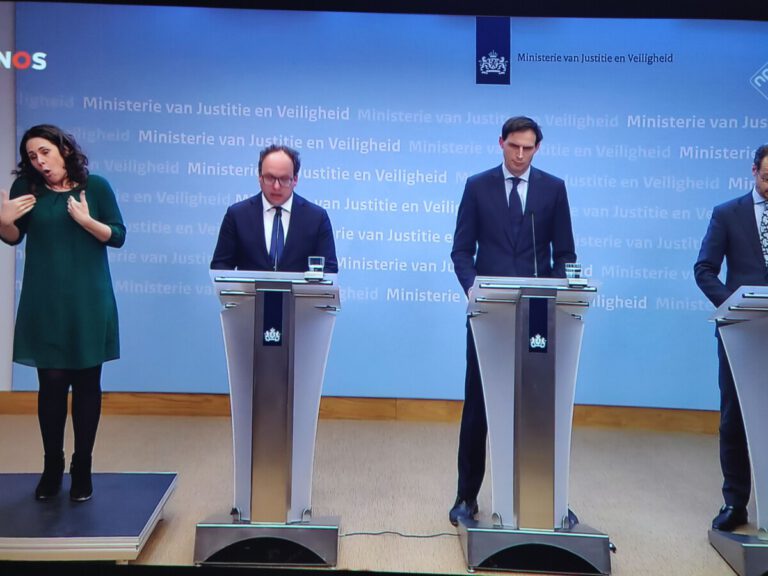
This is why members of the House of Representatives (PvdA, D66 and ChristenUnie) have introduced a bill to officially recognise the Dutch Sign Language (NGT) as an official language in the Netherlands. This will, for example, make it easier for the deaf community to follow debates in the House of Representatives, the weekly press conference of the prime minister and the Christmas speech of the King through a sign interpreter.

There are approximately 1.5 million deaf and hearing-impaired people in the Netherlands, of which more than a third use hearing aids and around 150,000 people purchase hearing aids every year. “People see sign language as just a tool for people who are deaf,” says ChristenUnie MP Carla Dik-Faber, who, together with the PvdA, has been working to gain recognition for Dutch sign language for some time. “But for people born deaf, it is their native language — a full-fledged language to communicate with. It has to be recognised.”

It gets really lonely when you’re deaf: sign language in the Netherlands will help

Jessica van Eijs is another MP from the D66 party supporting the initiative. Van Eijs herself is hard of hearing but does not know sign language. “I know how it feels to be so excluded from society because of your hearing, how lonely that can be. And also how beautiful it is if you can participate a little bit through the use of gestures,” she says.

“In the Netherlands, deaf children do receive some amount of support in school and are also entitled to interpretation hours, but because of the relative unfamiliarity with sign language, it can sometimes be difficult to get them the help they need,” says Van Eijs. “For example, it should be normal for deaf people to be provided with an interpreter at school, or if they want to communicate with a potential employer while applying for jobs.”

Deaf people find it difficult to vote in elections in the Netherlands

Due to the unrecognised status of sign language in the Netherlands, the deaf community finds it very difficult to vote during elections. They have the right to vote and by casting their votes, they get to have an influence on how the government provides them with all the facilities and assistance they need. But how can they know the right candidates to vote for if the information is not accessible to them? They can’t follow political debates, and political rallies are no-go areas for them. The law provides for the right to use sign language, to receive information in that language and to promote and develop sign language in the Netherlands. Unfortunately, this is not currently being fulfilled in the Netherlands.

sign language in the netherlands
The rights of Deaf people in the Netherlands are not currently being fulfilled. Image: Andrei Lazarev/Unsplash

Deaf people have to fight to be acknowledged

Deaf people also run into lots of problems in daily life. When they tell people that they are deaf, they are usually treated differently — as if they are helpless and there is no use conversing with them. Most deaf people often have to fight to be acknowledged in gatherings — which must be tiring and take a lot of energy. For example, when deaf people attend meetings, most of them have to arrange their own interpreters and also explain how it all works to the event organisers. During conversations, they also have to make sure that people talk to them, and not their interpreters. A lot of everyday folks in the Netherlands have no idea how to act around deaf people. All of these are things that can be addressed if deaf people are recognised as participating members of society.

Sign language in the Netherlands: preserving the Deaf identity

It’s a little disappointing that no attention is given to the identity of deaf children within the medical sector in the Netherlands. Language and culture are intertwined and being deaf shouldn’t be an obstacle to forming an identity. Imagine a situation where hearing parents have a baby and the doctor tells them that their child is deaf. For most parents, it usually comes as a shock, and somehow, the child is seen as a failure. Most deaf children are never told that there is a deaf community, with deaf culture and a language of its own. They grow up missing out on the strength, support and social contact that comes from being part of the deaf community.

More parents need to expose their deaf children to the deaf community, where they can be supported in forming an identity because deafness comes with being part of a cultural minority group. As a cultural minority group, the community has its own language, culture and history. The official recognition of sign language would be seen as a confirmation for the deaf community that they are equals with their hearing counterparts and can enjoy the same rights as everyone else, such as accessibility to Dutch society via a language that is their very own.

An example is the frequent visits to museums that are organised by schools all over the Netherlands for their pupils. Almost all museums in Amsterdam have audio guides, but what about deaf children? Imagine visiting a museum on the history of the Netherlands and not having access to all the information because you cannot use an audio guide, because you’re deaf. And there are no other provisions to help you! For deaf children, the formation of cultural identity is important. Additionally, 95 per cent of deaf children are born into a hearing family and lack adult role models they can identify with and look up to. Most deaf children have hearing adults around them all the time, and sometimes they think their hearing would come when they become adults.

There is a lack of awareness in the Dutch hearing society. It’s not that hard to notice if you pay attention. Travelling by train can be quite a hassle for deaf folks. If a train fails or is delayed, the train driver or conductor usually announces it over the intercom, but there is no information on the electric signs boards, so when everyone gets off the train, deaf folks follow the herd like sheep, without knowing what is going on. If there was an emergency and a deaf person had to be rushed to the hospital, how will the doctor(s) know what is wrong with them? How many doctors and nurses know Dutch sign language? Does your huisarts know Dutch sign language?

Sign Language in the Netherlands: its role in Dutch schools

It is strange that adults so often forget that written language is a derivative of spoken language — something that every toddler understands well because they struggle daily with converting sounds into drawings and vice versa. There are now research institutes in the field of deafness and sign language and training for sign language teachers, but the lack of official recognition continues to derail the achievements of the deaf community. People forget that working with written text or subtitles can be quite difficult for the deaf folks. Deaf people can also be dyslexic or have trouble with reading, so telling them to “stop complaining and just read subtitles or lips” is both insensitive and rude.

sign language netherlands
Dutch schools should be teaching sign language to their students. Image: Flickr/ U.S. Department of Agriculture.

Nowadays, we see more sign language on TV and on social media. Sign language shouldn’t just be a trend, it should be officially recognised as a language, and Dutch schools should be teaching it to their students. It only makes sense that it is introduced to Dutch elementary schools. If it becomes a subject in regular elementary and secondary schools, hearing pupils get to share classrooms with their deaf counterparts, make friends with them and see firsthand what they go through, and also learn how to act around them. Moreover, this would make it easier for deaf children to follow classes and communicate with their teachers, school counsellors, therapists, etc.

Sign language in the Netherlands: recognise Deaf people as a cultural minority

More recognition for sign language in the Netherlands will go a long way in opening doors for the country’s deaf community. It will help the deaf and hard of hearing become more involved in society. Family counsellors, audiologists, family doctors (huisarts), etc., do not always see the benefits of the use of sign language, some of them even think that it is bad for the child’s development.

For years, the Dutch sign language (NGT) was banned; children who dared to communicate by gesturing were even punished at home and in school. In those days, Dutch folks thought that communicating via gestures made people stupid. This is why the recognition of Dutch sign language has great emotional value to the deaf community, especially for older deaf people, because they were deprived of the privilege of learning sign language in the years it was banned in the Netherlands. Recognising Dutch sign language is a confirmation of their language, culture, identity and the existence of the deaf community.

The deaf community isn’t a burden. It is a cultural minority group that has definitely earned their recognition.

Are you a member of the deaf community, and what is life like for you in the Netherlands? Let us know in the comment section.

Feature Image: Andrei Lazarev/Unsplash

What is the Randstad? The complete explainer

Chances are, if you are reading this, you are doing so from within the Randstad. And no, we do not mean the Randstad company, but the region. But what is the Randstad exactly?

Well, it’s a megalopolis (meaning a collection of large cities in close proximity). Stretching from Utrecht in the east, Amsterdam in the north, and the Hague and Rotterdam in the south, the Randstad is the most heavily populated and developed region in the country.

But besides the simple geographical definition, how did the Randstad come to be? How is the culture here different from the rest of the Netherlands? What industries are here that make it such an economic powerhouse? Is it true that the people in this region consider people from the East peasants?

Read on to find more about the nitty-gritty details of the Randstad and more!

map showing the randstad in the netherlands
A map of the Randstad for all of you geography geeks out there. Image: Junuxx/Wikimedia Commons

History of the Randstad

The Randstad’s name comes from ‘rim city’ or ‘border city’. The term was first used by the founder of KLM, Albert Plesman, while he was flying over the region in 1938. As the interior of the Randstad is dominated by the Groene Hart of the Netherlands, a large agricultural and nature zone, he used the term in reference to the big cities that border with the “Green Heart”.

However, the Randstad as we know it today emerged only after World War II, with the development of urban planning in the ’50s and ’60s. With the rise of material wealth, people in the cities wished to move in the rural areas. Part of this exodus to the rural areas was the state of decay that the cities were experiencing at the time. The canals of Amsterdam weren’t always the hip, fancy place to live it is nowadays, and back in the day, it was more desirable to live in the suburbs. Thus, urban planners channelled this exodus either by creating new towns outside of the big cities or through movement in pre-existing villages.

An example of one of the suburbs developed during the latter half of the 20th Century, in Bijlmer. A true beauty! Image: Hilton Teper/Wikimedia Commons

The urban planning philosophy around these developments is known as the garden city movement. Started in the UK in the ’20s and used extensively in the Dutch urban planning during later half of the 20th Century, the principle is to build smaller towns around big cities, surrounded by green belts, with just the right balance between industry, residential areas and agriculture. This way, you can get the benefits of the countryside while still having easy access to the big cities.

This development is quite obvious in the Randstad of today, as the endless Dutch suburbia seems to go on for miles. How people manage to live in these satellite towns which are arguably quite boring and architecturally bland is a whole different issue, but we guess that infrastructure is the saving point, as you can just jump in a train and reach a more dynamic bigger city.

Current status of the Randstad

So how is the Randstad faring nowadays? Well, despite the efficient urban planning, it is still a very busy area, as anyone who has taken the train during rush-hour would know. It has a population of 8.2 million people, compared to the total population of 17 million, and a population density of 1,500 people per square kilometre, making it one of the most densely populated areas in Europe. It has not just one metropolitan area, but two, the Amsterdam and The Hague-Rotterdam metropolitan zones.

Some urban planners even refer to the Randstad under a different name, Deltametropool, which divides the Randstad in two, depending on the metro zones. The north part is referred to as Noordvleugel (North Wing), which includes Amsterdam, while the south is Zuidvleugel (South Wing), Rotterdam and The Hague.

So what powers all the economic development of the Randstad? Well first, there is Amsterdam, which manages to attract more tourists in a year than the entire population of the country. Then there’s Rotterdam’s port, which is the biggest in Europe and one of the busiest in the world. Many of the biggest universities in the country are located in the Randstad, from Leiden, to TU Delft, Amsterdam University, you name it. A lot of industry is also here, with greenhouses so bright they light up the night sky, and endless tulip fields.

Culture of the Randstad

The Randstad is certainly distinct from the rest of the country, especially the eastern rural areas. People also refer to the Randstad as being part of Holland (which is partially true, as North and South Holland are located fully within the Randstad area). The focus on Holland over the whole country of the Netherlands does not sit well with everyone, and this can also be seen in the latest re-branding strategy by the Dutch government. People from the east are also not big fans of being called Hollanders, because, in geographic truth, they are not.

The divide between the Randstad and the rest of the country is visible in more ways. In my first months in the Netherlands, more than once I heard people from the Randstad describe people from outside the region as peasants. One can then understand why the Dutchies from the east might not want to associate themselves with the snob city dwellers of the west. 

There are differences in attitudes as well. People from the Randstad are generally considered to be more open-minded and liberal in their values, while rest are considered to be generally more conservative. For example, while nowadays in the debate with Zwarte Piet it’s more likely to find Soot Piet (using smudges on the face rather than full black-face) in the Randstad, in the east it is more common to find the traditional Zwarte Piet.

Overall, the Randstad remains a vaguely defined area, with no official boundaries. There is not a unified cultural landscape, and people tend to feel more attachment to their individual cities rather than the area as a whole. An influential urban planner called Niek De Boer even famously said that the Randstad does not even exist. As such, it’s never a bad idea to visit the lesser-known paths in the country, as a way to gain a better understanding of the place as well as avoiding all the pesky drunk tourists.

What’s your favourite thing about the Randstad? Or, do you rather prefer the rural east for a more authentic Dutch experience? Let us know in the comments below!

Feature Image: nschaten/Pixabay

Amsterdam announces plan to build 10,000 new rental houses

The housing crisis in Amsterdam is notorious, given the scarcity of available apartments and exorbitantly high rent. A new deal could signal a change in the housing situation.

This afternoon, a declaration of intent was signed between the Amsterdam municipality and the real estate representatives from IVBN and Vastgoed Belang. It’s now promised that 10,000 new houses will be built for rent. This is achieved by relaxing laws and the regulation regarding new rental properties, reports RTL Nieuws.

Limit on rent increase

Part of the deal is a cap on the increase of rent, equal to that year’s inflation plus one percent. The apartments will be built within the next five years. They will be mid-range, with the price going from 740 euros to 1030 euros a month.

The limit on the rent increase is similar to an older plan called the ’emergency button’, with the government intervening by setting the maximum monthly rent. This solution, for obvious reasons, upset the landlords, so the declaration of intent that was recently signed might turn out to be a landmark deal.

Apartments for middle incomers, like caregivers and teachers

The plan for new apartments is mostly targeted towards those are considered ‘vulnerable groups’. These include teachers and caregivers, who despite playing an important role in society often find themselves struggling to find decent rent in the city centers.

Not everyone agrees that the new apartments will necessarily help middle incomers. Nic Vrieselaar, a housing market economist from Rabobank, explains that someone who has a net income of 2300 euros, while also supporting a family, will struggle with giving an additional 900 euros on rent. Part of the usefulness of this new housing project will be given by the size of the apartments because if they are too small, they are arguably not helpful for people who earn a middle income.

Time will tell the efficacy of this project, and whether or not the plans involved will help fix the current housing crisis.

What are your experiences with renting in the Netherlands, and especially in Amsterdam? Let us know in the comments below!

Feature Image: 0805edwin/Pixabay