The infamous Dutch drop: some salivate at the thought of it, while others wince and pucker. Dutchies love it, but it can be a real shock to the system for those not accustomed.
Opinions of drop tend to be black and white, but the liquorice itself comes in all colours and flavours. Many are even delicious, fruity, and sweet, so it’sworth doing a bit of experimenting. But how is one to differentiate the sweet from the salty, the delight from the anguish?
That’s what we’re about to find out, so use this guide to courageously ease into the weird world of Dutch drop. 🍬
So what makes drop unique?
Dutch drop is essentially black liquorice, though it’s done quite a bit of shape-shifting over the years. What makes it so interesting is its immense variety — it can be sweet and chewy, hard and burning, a delicious treat, or an assault (“a-salt” 😂 ) on your palate.
The salty liquorice you probably associate with the Dutch is flavoured with a very special ingredient called salmiak. It’s ammonium chloride (yum). The chemical adds bitterness and astringency to the candy and is harmless when used in a small, food-grade amount.
Now, this salmiak is the definition of “an acquired taste.” Plenty of people who love liquorice may never come around to it. In the absence of ammonium chloride, though, the traditional drop is good old-fashioned black liquorice.
Nowadays, liquorice is often mixed with other milder, fruitier flavours and appeals to a wider audience.
A brief history
The Dutch (along with other Northern European countries) long ago acquired the unique taste for salmiak liquorice. The candy, and salmiak in general, used to be sold in pharmacies as cough medicine.
Salmiak pastilles, which have a higher concentration of ammonium chloride, are still considered a traditional medicine to assist in loosening the airways.
Liquorice is the root of Glycyrrhiza glabra, which has been used medicinally for over 4,000 years. Its soothing properties and natural sweetness make it a perfect accomplice for the abrasive salmiak.
In the 13th century, salmiak drops became the go-to remedy for a sore throat and many other minor ailments (like the paracetamol of yore).
For reasons incomprehensible to the rest of the world, people got hooked on the sharp chemical flavour of the medicine. By the 1930s, salmiak liquorice had become a regular Dutch household treat. Even today, Dutch people will suck on drop when they have a sore throat.
Drop categories
Dutch drop comes in all shapes and sizes. There’s a vast range of flavours and textures, so it’s important to know what you’re getting. Most drop fit into four categories: soft and sweet, hard and sweet, soft and salty, and hard and salty.
#Dutch junk food night! Big flavours! Including Dubbel Zoute Drop (double salted licorice, stroopwafel (waffle cookies), paprika chips (which I am STOKED to try), and assorted nasty (wonderful) candies. #dubbelzout#dutchlicoricepic.twitter.com/idOFaTOOjC
In Dutch, zout (salt) and zoet (sweet) might sound similar coming off the tongue, but there’s an alarming difference on the tongue. To spare you the pain of having to learn the hard way, here are some of the more popular varieties you’re likely to come across:
Soft and sweet
These are the furthest escape from the traditional drop, making them the most palatable to those who don’t fancy the salty black stuff.
These are 50% wine gum, 50% liquorice, and 100% enjoyable. They can bridge the gap between the comfort zone and adventure for the liquorice-leary.
Drop Revolver
Shaped like a gun barrel, these are less dangerous than their look might lead you to believe.
Kritzli
This cylindrical liquorice usually has a soft, fruity filling, though sometimes you’ll find caramel, mint, or other varieties.
Allsorts
Also known as Engelsedrop (English liquorice), these are a mix of shapes with pastels. They have a slightly acquired texture but are nonetheless delicious.
Nothing like Engelse drop to give you your daily sugar rush! Image: Depositphotos
Hard and sweet
These sweet treats will keep you chewing. They might be hard on the jaw, but they’re much easier on the palate, that is, if you like the flavour of liquorice.
Trepidation is only natural in this category. The plus side to the softer salmiak varieties is that they require less chewing so you can get the experience over with more quickly.
Griotten
Light brown salty-sweet blocks. They may look like sugar cubes but don’t be fooled.
TV Pastilles
These old-timey pill-shaped salmiak tablets look more like medicine, and they taste like it too. They should probably require a prescription.
Zakkenrollers
Zakkenrollers translates to “pickpockets” in English. A bitter assortment of keys, watches, cell phones, and more. It’s salmiak liquorice with an extra salt coating. About as aggressive as an actual hold-up.
Salmiakrondo
A liquorice ball with chewy salmiak inside. Fantastic texture but terribly burney.
Salty candy? That is definitely an acquired taste! Image: Depositphotos
Hard and salty
It’s hard work eating Dutch drop in its most traditional hard and salty form. Not only does it burn the mouth, but it also exhausts the jaw — that is, if you can manage not to spit it out (good luck 😬).
Dubbel zoute
The most pungent of all, these are most commonly coin or diamond-shaped. They’re often stamped with a DZ, so you can’t say they didn’t warn you.
The Netherlands. Nothing beats dubbel zoute drop (or “Dutch licorice from hell” as one expat colleague referred to it). pic.twitter.com/tPCRhiwv3z
— Olivier Slabbers @ik@mastodon.social 🇺🇦 (@Oli4K) February 10, 2022
Oceaandrop
Various ocean creatures like seashells and seahorses. They might look friendly, but they’re as salty as the sea.
Tikkels
Hard on the outside but soft inside (also available in non-salmiak varieties). They’re like weird little jelly beans. They’re nobody’s favourite, but everybody’s familiar with them.
Mintnopjes
Minty candy coating on the outside with a sharp, chewy salmiak centre. Looking festive in red and white, like an ill-intentioned holiday prank.
Laurierdrop
Hard and salty with menthol for an additional level of discomfort. Usually, coin or rectangular-shaped and imprinted with a Laurier leaf.
So, now you can explore the world of drop fully informed. Don’t say we didn’t warn you!
Have you tried Dutch drop? Do you fall on the love or hate side of the spectrum? Tell us in the comments below!
What was supposed to be a relaxing holiday in Turkey turned into an expensive lesson in airport parking for one man from Overijssel.
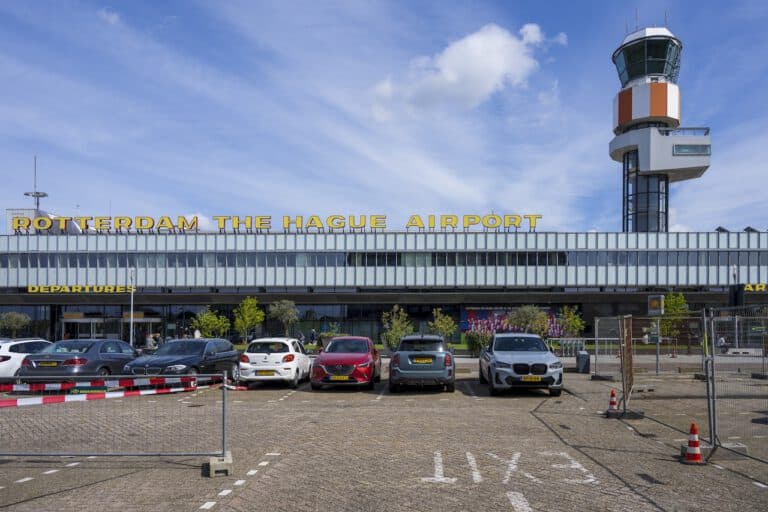
His mistake? Parking in the wrong spot at Rotterdam The Hague Airport and not realising it for over a month.
He didn’t double or triple-check
Omroep West spoke to the man who had reserved a parking space at the P3 parking lot for €175. Upon his arrival at the airport, things took an unexpected turn.
He drove in front of the P1 lot, and obviously, the barrier didn’t open automatically.
Did he question it? Nope. He grabbed a ticket and drove in, convinced it was the P3 parking lot.
What he didn’t realise was that he cruised straight into the VIP business parking lot located in P1 right in front of the terminal. The most expensive lot at the airport.
Fast forward after five glorious weeks in Turkey, and our man returns, relaxed and tanned — until he sees the bill at the payment machine: €1,140.
Yep, because P1 charges €50 per day for unreserved parking. That’s not just premium, that’s “you could’ve bought another holiday” premium.
Initially, airport staff told him to pay the full amount or leave his car behind. He indeed opted to pay the fee.
Someone took pity on him
Luckily, after some negotiations, the airport refunded most of the charges, admitting this mix-up happens “occasionally” thanks to stressed travellers.
The man now laughs about it, reports Omroep West, though he admits he should have realised something was wrong when the barrier didn’t open for his reservation.
He tells the outlet that his wife, unfazed, delivered the ultimate supportive line: “There are worse things in the world.”
Lesson learned: If the barrier doesn’t open, question it. Check the signs, or risk paying business-class rates for your car’s little vacation.
Did something like this ever happen to you? Or are you the type who’s too stressed and double-checks a million times before doing anything? Tell us in the comments below!
A mother has taught her son a tough lesson after she recognised the teenager in the released footage of an armed robbery in Berkel en Rodenrijs.
The robbery, which took place in the South Holland town on July 4, left residents shaken after two men broke into a home in broad daylight and threatened the owners with a firearm.
The perpetrators fled with jewellery, watches, and phones — but they left some evidence behind, Nu.nl reports.
Spotted in doorbell camera footage
Before the robbery took place, one of the perpetrators spread something across the doorbell camera of the home to obscure the footage.
However, his face was captured by the camera as he did this. When police released the video, his own mother recognised him.
Sent him to the police
According to Rijnmond, the woman then confronted her son about the robbery and pointed him in the direction of the police station.
The teenager turned himself in on Saturday, and an investigation is ongoing. Further arrests have not been ruled out.
So you’ve decided to start learning Dutch — good on you! Learning a new language is hard enough as it is, but people’s responses to your learning can be even more challenging.
I could quite comfortably write reams and reams on this topic. Therefore, I thought limiting myself wasn’t such a bad idea.
I am going to talk about five typical English responses and five Dutch responses you can expect when you tell someone you’re learning Dutch. 🤓
Typical responses from English-speakers
Hopefully, most English speakers are respectful and supportive when someone decides that they want to learn Dutch.
But sometimes they aren’t, and these are the possible things you might hear when you tell them about your language-learning adventure:
1. “Why?”
The standard English response to anything that is out of the ordinary: “Why do you want to do that?” “What’s the point?” Well, the point is that personal development is a choice, and my choice is to do it via languages! The language I chose is Dutch. 🤷🏼♀️
“Why am I learning Dutch? Because I want to!” Image: Depositphotos
2. “That’s interesting.”
This is the response from any other multilingual person. I’ve noticed myself doing it when someone says they are learning Spanish or Hindi or any other language.
I think there’s a mutual understanding of the struggles of learning a language that makes for a “That’s really interesting” response. Maybe you can share tips or experiences on your language-learning journey.
3. “What for?”
Similar to #1, people always assume there is some end goal. They are never happy with a response like “just because.” The standard expected answers are work or love.
Most people think you are either learning Dutch for work or to impress a loved one. I have still not developed a good enough comeback to this kind of question. 😢
4. “Is that the same as German?”
This frustrates me. Dutch and German aren’t the same. Dutch is a Germanic language, BUT it isn’t German. To be honest, I was a little naive at first about Dutch, as there is some crossover.
However, when you hear the two together, you’ll almost instantly notice that Dutch sounds much softer and bouncier, whereas I always feel that German sounds more harsh.
5. “Say something in Dutch, then.”
The response of people who don’t believe you. It’s almost as if these people want to catch you out.
Me anytime someone asks me to speak Dutch with them. Image: Depositphotos
What should your response be? I end up going along the super predictable lines of “Hallo! Goedenmorgen, ik ben Maria. Hoe gaat het met jou?”
(Yes, that is my standard, on-the-spot, Dutch sentence. I have used it that many times, so people think that’s all I can say. 😕)
Responses from Dutchies
Dutch speakers can be even more intense when they hear that you’re learning their language.
Normally, you’d expect them to be impressed or flattered that you’re trying to learn a language that not many people speak — but that’s not always the case. Some Dutchies are just plain rude about it. 😤
1.”Why? Everyone here speaks English.”
This is a cop-out. I often get this response because some Dutchies like the fact that not many people speak their language. They can talk about you almost to your face, and you’d be none the wiser.
Sure, everyone speaks English here, but some people prefer a more native experience! Image: Pexels
This is sneaky, but I must admit I like it. I can’t wait to go on a package holiday and overhear a Dutch family and their secrets. It will feel like they are talking in a code only we know, and I can give them the node! (Or not, am I getting too carried away here?).
2. “Really? It is a super hard language to learn.”
That’s no reason not to bother, though, surely. Similar to the “Everyone speaks English” response, just because I don’t need it doesn’t mean it’s acceptable not to know the basic polite gestures.
In my experience, shop assistants like to have a small exchange of words at the till, and I like to leave the store knowing I’ve said my bit.
3. “That’s really good!”
This is from the nice, supportive Dutchies. They acknowledge the difficulty of learning the language, similar to the previous response, but they appreciate the commitment to learning something that sometimes feels unnatural.
4. “Say something in Dutch then”
Similar to the reasons I gave for the English response, the Dutch do the same, only this time they really do want to catch you out and correct your poor pronunciation.
I had the Dutch test of saying the word “Scheveningen”, which is how Dutch people figured out whether someone was actually Dutch or German in World War II.
This has happened to me on more than one occasion. Or the best is when they say, “Say this then…” and then judge you on your delivery of an insult to someone.
The best thing on those occasions for me is that 80% of the time I know I’m saying something rude, so the joke is just as much on them as it is on me!
5. They carry on in a lightning round of Dutch
They start speaking Dutch quickly and expect you to fully understand everything that is being said by everyone, like a native. 🙄
There is either that response or, indeed, a pop quiz on all the hard words, similar to the previous response.
The quiz is partly malicious in that it expects you to get it wrong and embarrass yourself (that’s normally my response. I feel the colour rising in my cheeks, and all of a sudden, EVERYBODY is looking at me).
What responses have you received when you say you’re learning Dutch? Tell us in the comments below!
Let’s set the scene! You’re at your first Dutch Carnival in your costume or maybe supporting your first Nederlands football match and bopping along to Dutch music you don’t understand.
And what’s next in the queue? Links Rechts. 🕺
Dutchies go wild, jumping from left to right in a line during the chorus, holding each other’s shoulders.
You can’t help but laugh at how ridiculous it looks — buuut also how fun, so you decide to join in, having your toes squished in the process with all the jumping and beer spilling all over your shoes.
What is it?
It’s a well-known Dutch song that came out in 2015 by the Dutch party act, Snollebollekes.
While the song wasn’t a hit at first, you can find it in the Dutch Single Top 100 during every Carnival. It gets a fair few streams if the Netherlands is playing football, too.
The oranje fans know how to show support, turning Snollebollekes into a viral sensation across Europe (even taking #1 on the German Spotify chart).
It’s a fun and social song that makes Dutchies grab their beers, grab their friends, and start dancing and hollering the lyrics at the top of their lungs.
Carnival in the Netherlands usually runs from late February to early March, but some festivities may happen before or after those weeks!
Why do they do it?
Carnival is a time when Dutchies can let loose, have fun dressing up, go out with their friends, and simply enjoy drinking and dancing the night away with no stress or worries. 🕺
Links Rechts is a rite of passage that is played multiple times every single year.
Got beer? Seeing Dutchies dance to this song when they’re drunk is a sight you don’t want to miss during Carnival.
Why is it quirky?
Links Rechts is anything but ordinary, just like true Dutchies. 😜
This song makes Dutchies come together and show their true love for their country. If you ask any Dutch people if they know this song, most likely the answer is: ‘tuurlijk!
But since it was such a hit at the 2024 European Champs held in Germany, there’s actually talk of releasing a German version… 👀
Should you join in?
Want to be truly integrated into Dutch culture? Singing and dancing to this song will make that happen.
someday, I hope Tomorrowland plays Snollebollekes’s “Links Rechts”. That is massive crowd control from the Netherlands.
You’re seated in a tastefully decorated Dutch restaurant, where a linen tablecloth brushes your legs, a candle flickers gently on the table, and mouthwatering, artfully designed food is placed in front of you.
Your attractive Dutch date sits across from you. As they take their first sumptuous bite, their pupils dilate in approval.
Then, chaos: their hand drops the fork on the plate, swings up to their ear, and frantically waves back and forth next to their head.
Are they choking? Are they experiencing a seizure?
Nah — they just think the food is really damn delicious.
What is the lekker wave?
Welcome all to the lekker wave, a simple motion performed in the Netherlands that says “Yum!”
The rules of the lekker wave are simple: if something is delicious, you bring your flat hand to your ear or cheek and give it a little wave. It looks a little like this:
As an optional add-on, you can simultaneously choose to say “lekkerrrrrr” to show your undying approval of the dish that you’re eating. 👋
Why do they do it?
Apart from being ridiculously handy when your waiter has the impeccable timing to ask, ‘How is your meal?’ directly after you’ve taken a ginormous bite, no one knows the true origin of the lekker wave.
Anne Baker, professor of General Linguistics and Dutch Sign Language at the University of Amsterdam, told Rijmond in 2014 that the famous sign actually isn’t a sign at all — it’s a gesticulation.
What’s the difference (apart from eight letters?) A gesticulation is a gesture that’s used in addition to spoken language. Does it change anything?
Not really — because the origins are destined to remain a deep, Dutch secret. 🤫
Why is it quirky?
The lekker wave is ridiculously Dutch — but Dutchies just don’t know it.
Many Dutchies, over time, have been caught waving their hands next to their face, only to be met by mystified international faces across the table.
Some overly enthusiastic Dutchies abroad may have even been unluckily met by an unwanted Heimlich manoeuvre.
Should you join in?
Absolutely! The amazing thing about this Dutch quirk is that almost anyone can do it, and it will be understood — as long as you’re in the Netherlands, of course. 😉 🇳🇱
What do you think of this Dutch quirk? Have you experienced it? Tell us in the comments below!
Editor’s note: This article was originally published in November 2021 and was fully updated in September 2023 for your reading pleasure.
Not even PostNL seems to know how the new process is supposed to work. “To date, US customs has not given any clarity on how these packages should be allowed to enter the US,” they write in a statement.
On August 22, Deutsche Post and DHL Parcel Germany also put a temporary pause on sending business parcels to the US through their regular postal network.
But don’t panic completely: letters are still safe! So your handwritten postcards from Amsterdam can keep flowing.
Can my package still reach the States?
Yes, it definitely can. Not all hope is lost.
Even with PostNL hitting pause, there are still ways to get your packages to the US (they just might be pricey).
If you don’t want to spend too much, the sole option left is to post your package via DHL in Germany, but only if the package is registered as a gift and it’s worth less than $100. Anything above that will require costly express shipping.
When will this mess get sorted?
PostNL says they’re working with European partners and USPS (United States Postal Service) on a fix, but… no ETA yet.
So, Americans: you might have to wait a little longer for your favourite Dutch treats.
Will you be affected by this change? Tell us your thoughts in the comments below.
Last week, the Netherlands was shaken by the murder of 17-year-old Lisa, who was violently killed on Tuesday night while cycling home from a night out in Amsterdam with friends.
Her death has sparked outrage across the country and brought to light the ongoing conversation about violence against women in the Netherlands.
marking one week since Lisa’s death, Amsterdam’s nightclubs and the A’DAM tower will be illuminated on Tuesday night to raise awareness for violence against women.
Right to the night
According to the NOS, the nightclubs and tower will be illuminated with the colour orange. Orange is used by the UN to raise awareness about the violence women face across the world.
The clubs will also project the words “Recht op de nacht” (right to the night) across their venues.
These are the words that many of us have seen across our Instagrams over the past few days, and are taken from an Instagram post written by Dutch author, Nienke ‘s Gravemade.
The post was shared widely, saying, among other things: “I claim the night. I claim the streets. I demand that the fear be shifted. I demand 24 hours in my day. I demand that 17-year-old girls come home safely.”
This initiative was organised by Amsterdam’s Night Mayor Freek Wallagh, along with the Amsterdam Club Consultation. The action will start at 10 PM on Tuesday night.
We claim the night
Another message is also spreading across the country through the use of billboards. Many advertisements near stations and along motorways are displaying the message “Wij eisen de nacht op” (we claim the night).
Speaking with NU.nl, organiser Danique de Jong says, “Now we have to keep talking about it and make some progress. We need to offer men perspectives for action. Because it’s a male-dominated issue.”
If you’re considering getting a driving licence in the Netherlands, your first question is probably: “But how?”
And let us tell you: it’s not always simple. The answer depends on your situation. You might:
Be able to use your home country’s driver’s licence with no need to swap
Be able to swap your home country’s driver’s licence for a Dutch one
Need to take lessons, a theory exam, and a practical exam (yikes!) — even if you already have a licence.
After three years of living in the Netherlands, I finally went through this process, including taking the theory exam, driving lessons, and the practical exam. I’m now the proud owner of my very own Dutch licence!
So how can you skip the bike and hit the roads like a driving Dutchie? Here’s the ultimate guide to getting your Dutch driver’s licence.
🙋♀️ Who can get a Dutch driving licence?
In the Netherlands, from 16.5 years old, teenagers can begin taking driver’s lessons. Anyone aged 17 or older can take the Dutch practical driving exam. A basic car licence lets people hit the road in either a car, moped, or high-powered e-bike (speed pedelec).
Naturally, if you’ve moved to the Netherlands as an international, it’s likely that you’ve already gone through the rite of passage of getting your driving licence in your home country.
Here’s the thing: even if you’ve been driving for 30 years, the Netherlands only allows some people to directly switch their foreign license. Whether you can depends on the license your country is from and, sometimes, your visa.
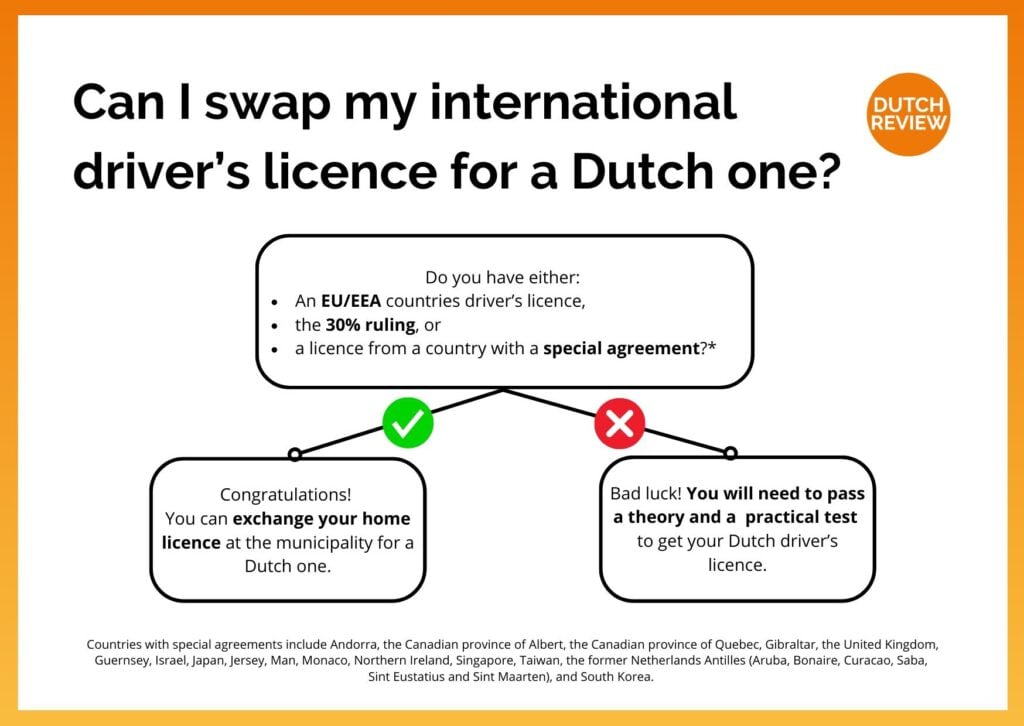
Not everyone can drive on their home country’s driving licence. Image: DutchReview
Members of EU/EEA countries
Are you the holder of a lucky EU or EEA state driving licence that was issued before you registered in the Netherlands? Then congratulations: you can use your current licence to drive in the Netherlands — at least for a while.
Once your licence has expired or needs to be reissued, you must apply for the switch at your local Dutch gemeente (municipality), where you’ll be issued a shiny new licence complete with the Dutch language. The driving licence category on your EU/EEA license must match the vehicle you intend to drive in the Netherlands.
Need a reminder of those EU/EEA countries? Here you go:
EU: Austria, Belgium, Bulgaria, Croatia, Republic of Cyprus, Czechia, Denmark, Germany, Estonia, Finland, France, Greece, Hungary, Ireland, Italy, Latvia, Lithuania, Luxembourg, Malta, Netherlands, Poland, Portugal, Romania, Slovenia, Slovakia, Spain and Sweden.
EEA: Iceland, Liechtenstein, Norway and Switzerland.
People who can swap their driver’s licence in the Netherlands
Not a holder of an EU/EEA country driving licence? No problem, it’s possible you’re still eligible to swap your licence to a Dutch one without having to take the theory and practical exam — but only if you fall into two main categories:
Under the 30% ruling
Do you have the 30% ruling for highly skilled migrants? Then congrats! Your visa and tax status grant you a huge benefit: the ability to switch your home country’s driving licence to a Dutch one.
Try to do this within 185 days of registering in the Netherlands. Just apply at your local municipality, they’ll take your foreign licence, and you’ll be issued a nice Dutch card instead. Makkelijk! (Easy!)
A Dutch driving licence is super handy to have. Image: DutchReview
After 185 days, your foreign driving licence is no longer valid, and you won’t legally be allowed to drive on Dutch roads until you formally make the switch.
Even better than this cosy 30% ruling benefit is that if you have a partner who came to the Netherlands with you, they get the same advantage. Leuk!
Eligible individuals will receive a new driving licence after the swap process.
Special inter-country driver’s licence agreements
In some ultra-special cases, the Netherlands has signed agreements with other countries or regions that agree that they think their citizens drive pretty well.
These places are Andorra, the Canadian province of Albert, the Canadian province of Quebec, Gibraltar, the United Kingdom, Guernsey, Israel, Japan, Jersey, Man, Monaco, Northern Ireland, Singapore, Taiwan, the former Netherlands Antilles (Aruba, Bonaire, Curacao, Saba, Sint Eustatius and Sint Maarten), and South Korea.
If you hold a foreign driving licence from one of the above places, you’ve won the jackpot and can exchange your home licence for a Dutch driving licence. Woo-hoo!
If eligible, you can submit your documents to the municipality to exchange your licence. Image: Freepik
How to exchange your licence
If you’re one of the lucky ones above who can exchange their driver’s licence, what you need to do is pretty easy.
Head to your local municipality (where you’re registered) with the following documents:
A colour passport photo
Your valid foreign driving licence
Your 30% ruling notification from the Belastingdienst (if applicable)
Your passport
Your Dutch residence permit and (if applicable) 30% ruling statement
A completed Health Declaration from the CBR (you’ll need to do this in advance)
Request to exchange your foreign driver’s licence and fill in the appropriate form
Your municipality will send the documents to the Dutch licence authority, the RDW
If approved, you’ll receive a letter within 10 days advising when to collect your licence from the municipality
Some municipalities also allow you to start the exchange process for your driving license online. Check with your municipality to see if this option is available in your area.
Let op! Your home country’s driver’s licence will be returned to the country that issued it — so kiss it goodbye (unless you want to take the Dutch tests!) 😘
People who need to pass the Dutch driver’s licence tests
Uh-oh — if you’ve read this far, that means you’re not in one of the exemption categories above.
Perhaps you’re from Australia, South Africa, India, New Zealand, or one of the other many countries that didn’t make the list?
Here’s where we’re the bearer of bad news. If you:
do not have a licence from an EU/EEA country,
don’t have the 30% ruling,
and don’t have a licence from a specially-exempted country above,
you cannot exchange your driver’s license in the Netherlands. Instead, you’ll need to pass your theory and practical driver test and will likely need to take lessons to do so.
The good news? Getting your Dutch driver’s licence is very achievable! In fact, this Australian writer did just that.
The other good news? (Yes, there’s more!). You can likely drive on your home licence for 185 days after registering in the Netherlands.
Take our advice: these 185 days are a great time to practise on Dutch roads and start the process of getting your Dutch driver’s licence.
Driving in the Netherlands as a tourist
Not registered in the Netherlands because you’re only in the country to gaze at canal houses, wander through tulip fields, or chow down on cheese?
If you’re not living in the Netherlands, you can drive on your foreign licence. If your licence isn’t issued by an EU/EFTA country, then your licence needs to have categories on it: A, B, C, D, E.
If it doesn’t have these categories, it’s highly recommended to get an international driving permit from your home country to use with your licence before you visit the Dutch.
🪪 How to get your Dutch driver’s licence
Alright — you’ve drawn the short straw and can’t switch your home country’s driver’s licence. Or, perhaps you’ve never had a driver’s licence.
Either way, to drive on Dutch roads, you need to get a Dutch driver’s licence. While the process is a little time-consuming and can be expensive, there are some tips and tricks to make it faster and easier.
Here’s how to get your Dutch driver’s licence in six easy steps.
1. Find a driving school
Hear us out: even if you’ve been driving for years, you almost definitely need Dutch driving lessons.
It’s one of the cold, hard truths of the Netherlands. The country is known as being one of the hardest countries in the world to get a driver’s licence.
In fact, the average Dutchie has to take 43 hours of professional driving lessons before getting their licence.
Luckily, you’re not an average Dutchie. 🍀
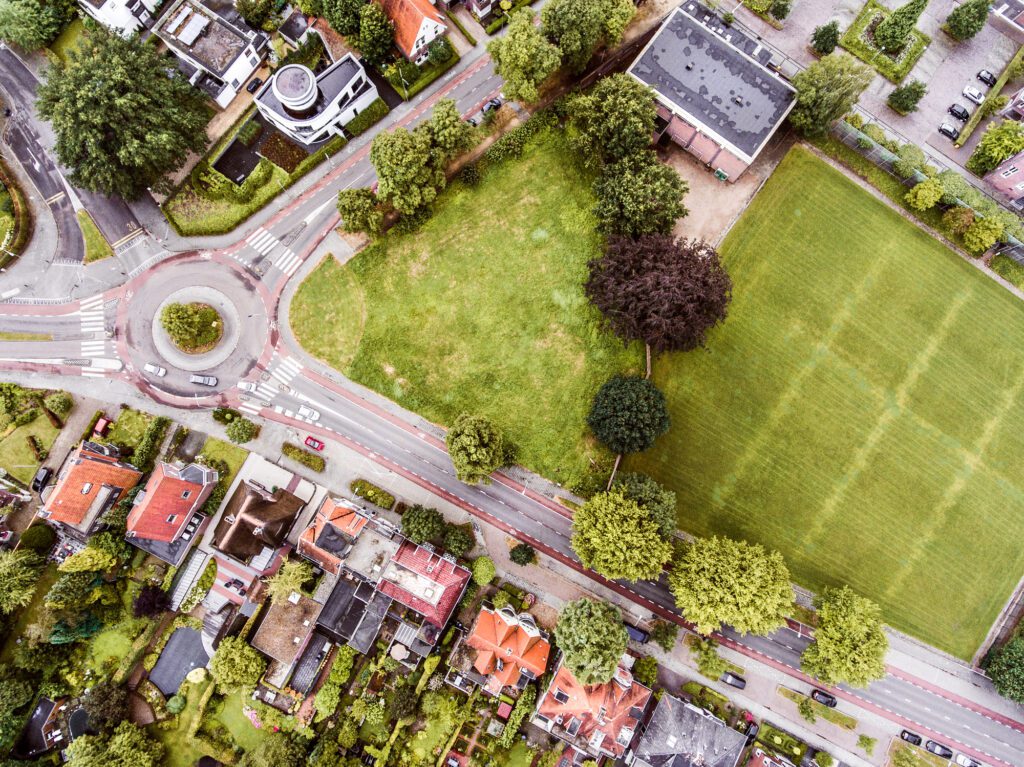
If you’ve been driving for years, you shouldn’t need 43 hours, but you will need more time than you might expect. Driving in the Netherlands is just different: there are priority and non-priority roads, turbo-roundabouts, and millions of bikes.
This is a simple roundabout in the Netherlands. The road markings, signs, and bike paths just make things different! Image: Depositphotos
The extensive Dutch road infrastructure takes a lot of getting used to, and it takes some time to develop awareness of the other road users. You’ll need to flex those neck muscles!
Plus, in the Netherlands, only licenced driving instructors can give unlicensed drivers lessons — there’s no Learner’s Permit. That means you need to sign up with a driving school.
But not all driver’s schools are created equal. Many internationals have reported being squeezed for far too many unneeded lessons, unscrupulous instructors, or instructors who have difficulties with English.
A good Dutch driving school will estimate how many lessons you need and take you to practice in a variety of settings. Image: Freepik
Take your time to select a good driving school with great reviews and a high exam pass rate. Even if the price is a little bit higher, it’s often worth it. As the Dutch say, “Cheap is expensive” (Goedkoop is duurkoop).
Once you’ve chosen your school, they’ll take on the task of booking your exams and will do everything they can to prepare you for Dutch roads.
Driving schools will also help you prepare for the practical and theoretical tests required to obtain your Dutch driver’s licence.
Want to get your Dutch driver’s licence fast? With Arrive and Drive, you can get your licence ultra-fast, even with the long waiting lists for practical exams! LesDirect’s English-speaking instructors watch constantly for new appointment openings so they can help expats get on the road fast. See the course.
2. Prepare for and pass the Dutch driver’s licence theory exam
Passing the driving theory test is a prerequisite for scheduling your practical test — so there’s no skipping this step or leaving it for later.
But here’s a fun fact: over 50% of test-takers fail their theory exam on the first attempt.
Alright, maybe it’s not so fun. The Dutch driver’s licence theory exam is heralded as one of the hardest in the world and is made up of three parts:
‼️ Let op: The theory exam will change format from April 7, 2025. See the changes.
Part one: Hazard perception
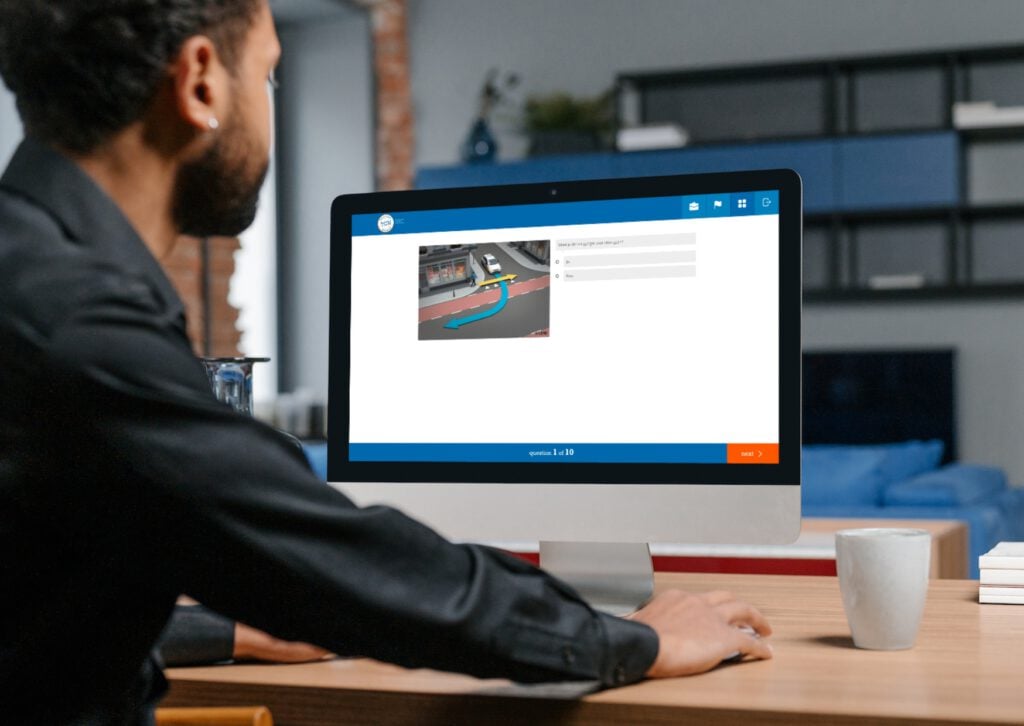
In the first part, you’ll be shown an image from the perspective of the driver in a car. You’ll have to look through the “windshield” at the situation, your speedometer, and your rearview mirror before making a decision to brake, reduce your speed, or do nothing.
The catch? You only get eight seconds per question and have to do 25 scenarios in a row. It’s intense, and it will often feel like multiple answers are correct.
Luckily, you are allowed to get 12 of the 25 questions wrong. However, this is a tricky part of the exam and requires a lot of online practice.
Part two: Traffic knowledge
Whew, made it through the stress of hazard perception? Now, you’re onto the next set of questions: traffic knowledge.
In this section, you’ll be asked 12 questions about speed limits, traffic signs, types of roads, the positioning of your car, and more. But beware! You can only get two questions wrong, and they can be tricky.
You’ll need to practice hard for the theory exam. Online platforms simulate the test environment. Image: DutchReview
Part three: Traffic insight
Finally, the third part of the Dutch driving licence theory exam consists of applying the rules and understanding how to act. There are a massive 28 questions here, and you’ll need to answer 25 correctly.
TIP: Worried? The good news is that you can take the Dutch driver’s licence theory exam in English or with a translator if needed.
3. Submit your Health Declaration
This is an easy step on the path to getting your Dutch driver’s licence: you’ll fill in a simple questionnaire online about your health history. Expect questions about your eyesight, general health, and even psychology.
The health declaration is necessary and mandatory for all types of motor vehicles.
Once complete, the CBR will let you know if they need further information. Sometimes, you might be sent for a check-up with your huisarts or a specialist.
4. Take driving lessons
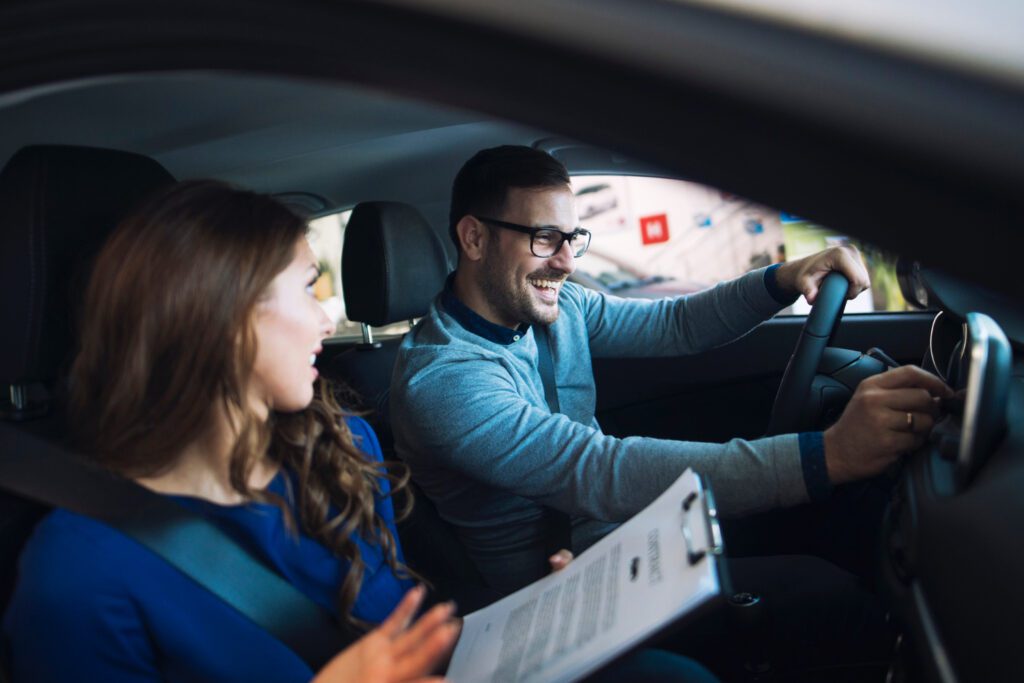
Alright, this is where it gets fun! Jump behind the wheel of a car with your instructor, and they’ll coach you on driving the Dutch way.
A lot of this involves “Het Nieuwe Rijden,” introduced in 2013, which is a more economical and environmental way of driving modern cars. It involves rolling up to stoplights, turning off your engine in certain traffic situations, and changing how you use your gears.
Your driving instructor will teach you the Dutch style of driving that you need to pass the exam. Image: Freepik
Most of all, your instructor will prepare you for both the Dutch driving exam and generally driving on Dutch roads safely. There’s more than you expect to get used to, so enjoy!
While the average Dutchie takes 43 hours of lessons, as an “experienced driver”, you’ll likely need a lot less. Expect to take at least 10 hours of driving instruction (normally completed in three to four lessons), while some internationals might need 20 hours or more.
These lessons will prepare you for the practical exam so you can get your new driving licence.
5. Pass your practical exam
Feeling confident? Strut your stuff for a CBR driving examiner. In your 30- to 40-minute practical driving test, you’ll need to:
Prove you can drive confidently on Dutch roads
Demonstrate awareness around traffic situations, particularly bikes and pedestrians
Merge onto and exit off a highway
Perform at least two special manoeuvres (like a three-point turn or reversing around a corner)
Use a navigation program (for example, Google Maps) to direct you somewhere (this can be used in your preferred language)
The Dutch driving exam doesn’t require a perfect score. Image: Freepik
It’s important to know that you don’t have to drive perfectly, and small mistakes are okay. Did you:
Touch the curb with your wheel while parking? All good!
Drive five kilometres an hour over the speed limit? It happens!
Tear through a red light because you stopped by an Amsterdam coffeeshop before your test? Um, we’ll draw a line there; that’s a fail.
The most important thing is to make your driving examiner feel comfortable letting you drive on Dutch roads. So, keep a balance between traffic flow and safety.
Tips to pass your Dutch driving exam
Try to drive the maximum speed as much as possible (where it’s safe)
Use the right speed when approaching all different priority junctions and traffic situations
Change gear at the correct time and fully release the clutch before entering a bend
Avoid using the clutch and brake pedals unnecessarily
Maintain a balance of traffic flow and safety
TIP: Need some moral support? Your driving instructor is allowed to ride along for your test — if you wish. 😉
6. Apply for your driver’s licence
Gefeliciteerd, you passed! Your examiner gave you the go-ahead, your driving instructor gave you a huge high-five, and now you’re ready to hit the road — almost.
Before you can legally drive, you have to apply for your new driving licence, a process that takes about a week. Luckily, it’s pretty painless. You’ll need to:
Get some fresh-lookin’ passport photos taken
Take them to your local municipality (at least two hours after your exam) to request your licence who will send the information to the RDW, the Dutch licence authority
Wait about a week for your fresh Dutch driver’s licence to arrive (or pay a priority processing fee to pick up your licence within one to two days).
That’s it! You can hit the road with your wallet one card heavier and weighed down with your huge ego after passing the Dutch driver’s licence exams. You go, schat!
TIP: You can only collect your official Dutch driver’s license after you’ve been registered in the Netherlands for at least 185 days. Before that time, most internationals can drive using their foreign driver’s license for their first six months!
💰 Costs to get a Dutch driver’s licence in 2026
We’re not going to sugar-coat it — getting a Dutch driving licence can be expensive.
If you’re lucky enough to be able to swap your home country’s driver’s licence for a Dutch one, your costs will be pretty minimal — approximately €170.
If you are unable to swap your old licence for a Dutch licence, the costs begin to stack up. Expect to pay between €750 and €1500 for the exams, lessons, health declaration, and licence fees. Here’s the breakdown:
Item
Approximate cost
English theory exam
€55
Theory exam preparation materials
€40 to €125
Health declaration
€45.25
Driving lessons with an instructor
€650+ (Based on 10 hours of lessons at an average price of €65 to €70)
Practical exam
€138.50 + additional driving school fees of approximately €138.50
Driver’s licence fees
€52.10 + cost of passport photos
⏰ How long does it take to get a Dutch driver’s licence?
If you’re lucky enough to be able to switch your home country’s driver’s licence for a Dutch licence, you’ll receive the licence within a week or two.
If you can’t switch your home licence, it is possible to qualify for a Dutch driver’s licence in as little as one week after passing your theory exam. However, only if you’re very committed, have a good driving school, and have luck scheduling exams.
In general, most internationals who have previously held driver’s licences in other countries can get their licence within two months, including studying for the theory exam.
If you need to go through the whole process but have previously held a licence, most people typically allow:
Of course, you can stretch that over as long a period as you like. After passing your theory exam, the result is valid for 18 months.
🔄 Maintaining your Dutch driving licence
To keep your Dutch driving licence valid, remember these key points:
Renewal: Renew your licence every 10 years at your local municipality to avoid legal issues.
Health Declaration: Complete a Health Declaration form from the CBR during renewal to confirm you meet medical driving standards.
Update information: Report any changes in personal details, like address or name, to your municipality.
If your licence is lost or stolen: Report immediately to authorities and apply for a replacement, possibly needing a police report.
By following these steps, your Dutch driving licence will remain valid, allowing you to drive legally in the Netherlands and abroad.
🚗 Dutch driving organisations
In the Netherlands, there are two main organisations responsible for issuing driving licences and conducting driving tests: the RDW (Rijksdienst voor het Wegverkeer) and the CBR (Centraal Bureau Rijvaardigheid).
Ready to hit the road? Getting your driver’s licence in the Netherlands can be a pain, but it’s not impossible — and it’s well worth it when you’re cruising down the A2 with Snelle beats blasting.
Have you gotten your Dutch driver’s licence? Tell us your experiences in the comments below!
⁉️ Getting a Dutch driver’s licence: Frequently asked questions
How long are Dutch driver’s licences valid?
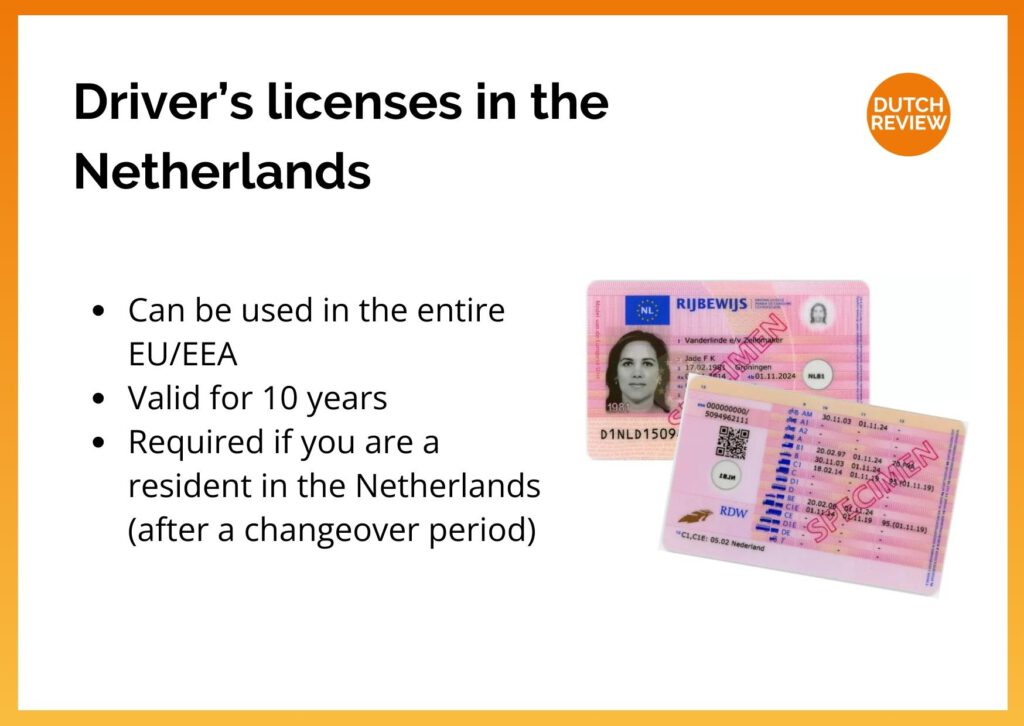
A Dutch driver’s licence is valid for 10 years from the date of issue. After this, it must be renewed at your local municipality.
Can I drive in the Netherlands on an international licence?
You can drive in the Netherlands on a non-EU/EEA international licence, but only temporarily. If your licence is recognised in the Netherlands, you have 185 days after your arrival to use it on Dutch roads.
Can foreigners get a driving licence in the Netherlands?
Yes, internationals in the Netherlands can get a Dutch driver’s licence. If they’re eligible, they may be able to swap their home country’s licence for a Dutch licence. However, ineligible internationals will have to take the Dutch theory and practical exams.
How much does it cost to get a Dutch driver’s licence?
A Dutch driver’s licence can cost anywhere from €170 if you are eligible to switch your home country licence, up to €1,500 or more if you need to take the Dutch driver’s licence exams.
How long does it take to get a driving licence in the Netherlands?
If you need to take the theory and practical Dutch driver’s licence exams, expect at least a few weeks to a few months. Special expat-oriented driving schools offer one-week programs. If you are eligible to switch your driver’s licence immediately, you can get a Dutch driver’s licence in less than a week.
How hard is the Dutch driving test?
Both the theory and the practical Dutch driving tests are considered some of the hardest in the world. However, with good preparation, training, and professional instructors, it’s very achievable to pass the exams.
A 22-year-old suspect has now been arrested for the brutal murder of 17-year-old Lisa from Abcoude.
According to police, the suspect was originally arrested last night (August 21) for his suspected involvement in a separate incident at Weesperzijde.
What happened?
The arrested suspect is a 22-year-old man who was staying at a site run by the Central Agency for the Reception of Asylum Seekers (COA) in Amsterdam, reports the NOS.
Police have confirmed that there are no indications that Lisa was sexually assaulted in this case.
A nation grappling with violence against women
Lisa’s death has intensified ongoing conversations about femicide and violence against women in the Netherlands.
The 17-year-old was violently killed while cycling home from Amsterdam, a case that has deeply shaken Dutch society.
Her murder has contributed to widespread public discourse about women’s safety and has led to heightened sensitivity around how violence against women is portrayed in media and advertising, as seen in recent backlash against Walibi Holland’s controversial advertisement.
Got anything to report?
You can call 0800-6070, use the online tip form, or remain anonymous via 0800-7000. Confidential tips can also be shared with the National Intelligence Team at 088-6617734.