Looking for a great place to eat in The Hague? The political capital of the Netherlands has a buzzing culinary scene, with great options for everything from breakfast to cocktails.
So without further ado, let’s get started with our top 7 places to eat in The Hague.
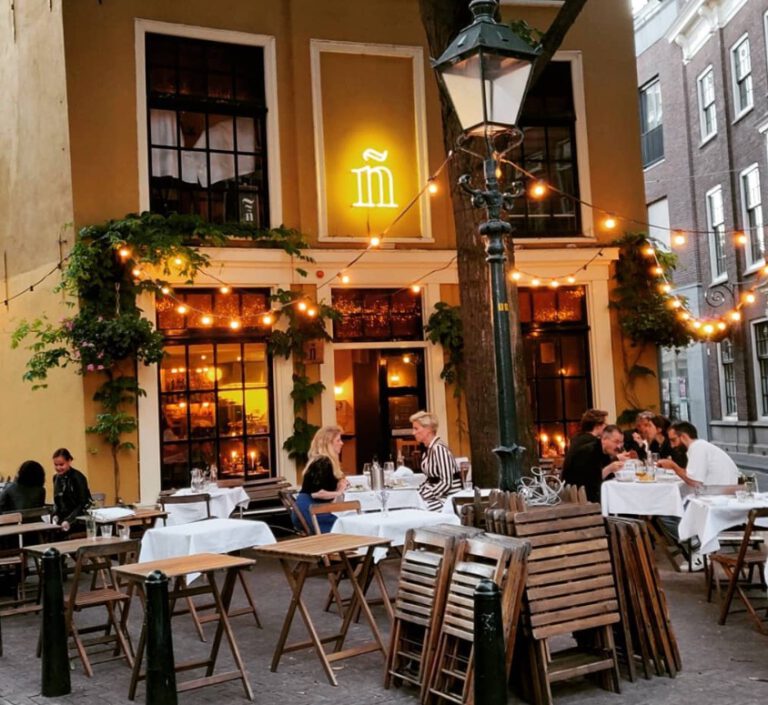
Just a few streets from the Grote Markt and the Grote Kerk in the centre of The Hague, you can find the atmospheric Restaurant ñ.
This Spanish-themed hidden gem in The Hague serves some amazing food for some very good prices.
It’s giving southern European summer vacation! Image: DutchReview
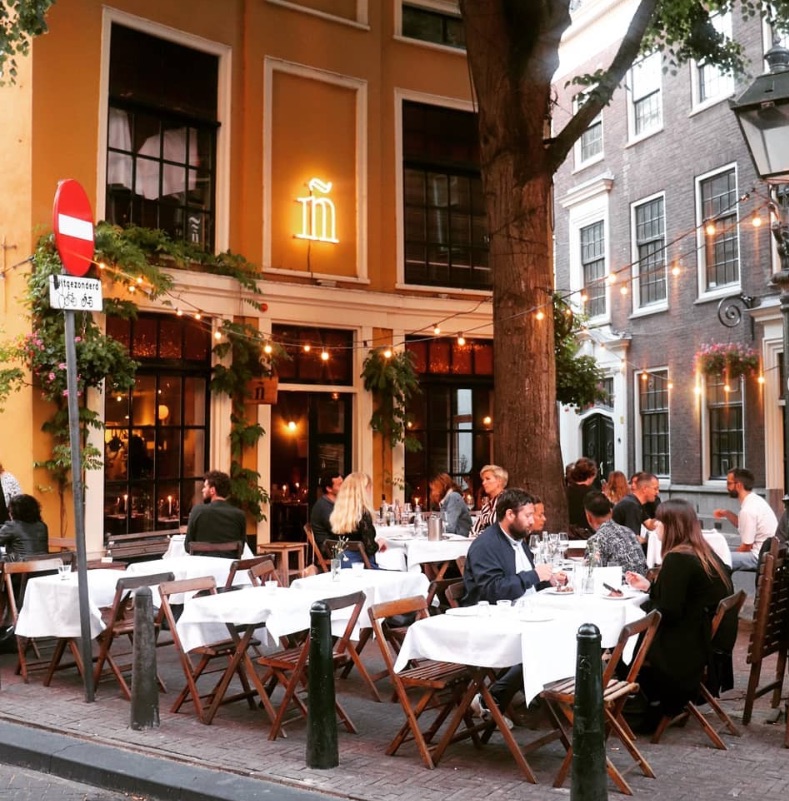
The atmosphere on the terrace gave a romantic, vacation-like feel, with the fairy lights and greenery.
But the atmosphere wasn’t the only thing impressing us this late summer evening. This place boasts an amazing tapas-like menu, which also changes quite often, and all of the entries were sensational.
Arguably the best summer vegetable there is. Image: DutchReview
The wines were very nicely paired with the dishes, and the dishes themselves were neatly priced (between €6 and €13, an absolute steal).
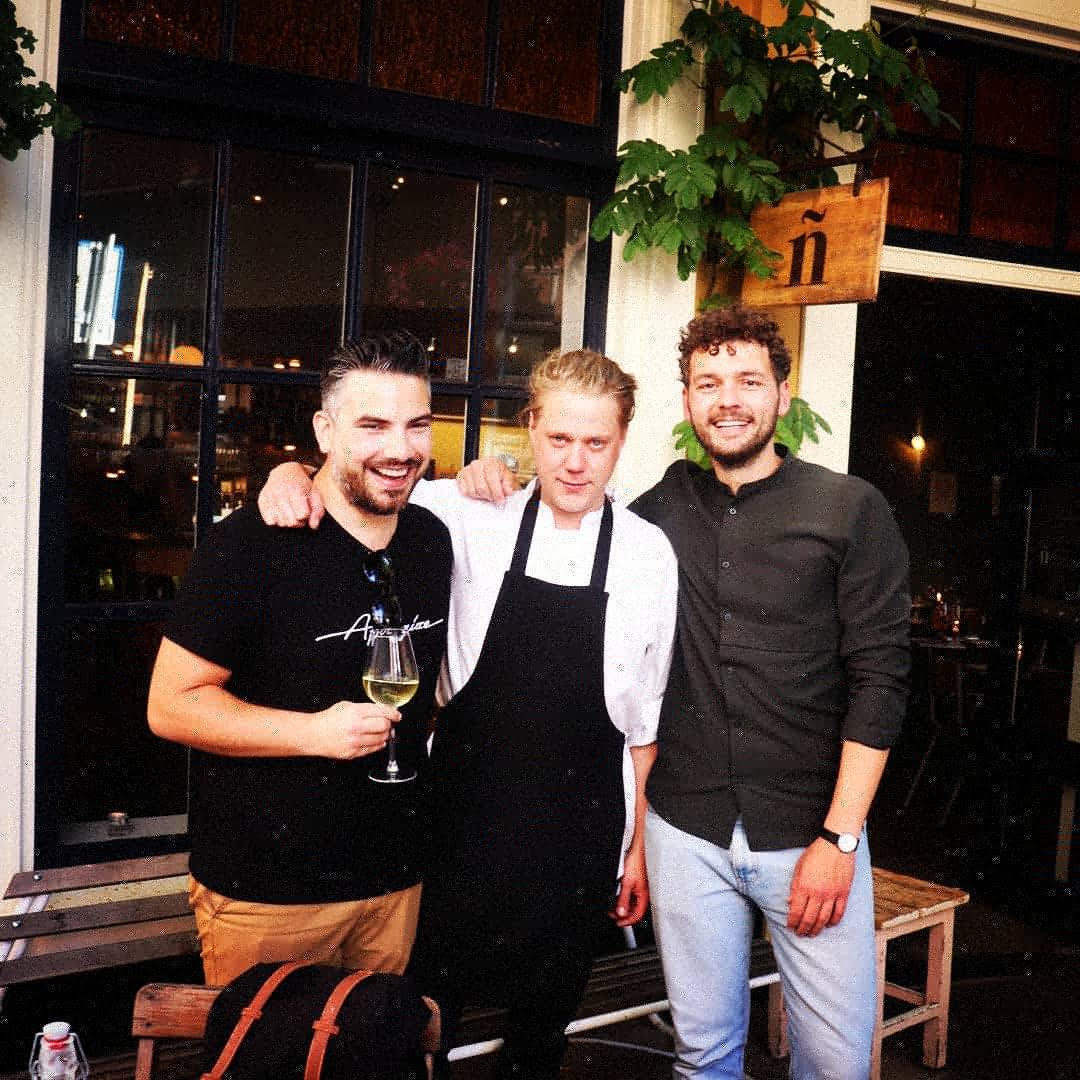
The night was perfect, thanks to the young and talented chef Thomas Vandenhecke who’s doing some amazing work there.
That young blond chef in the middle of the pic, Thomas Van Den Hecke, brought us the magic. Image: DutchReview
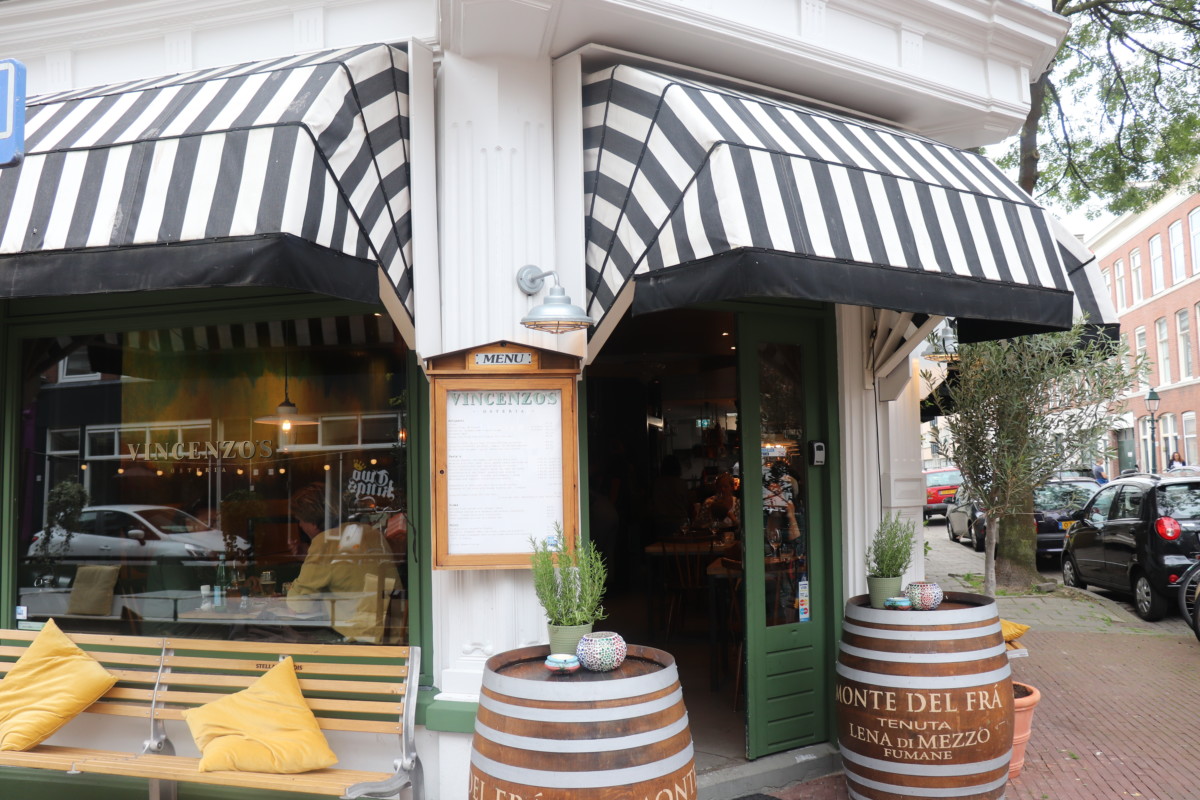
Located in the trendy and warm district of Zeeheldenkwartier, you’ll find this pearl of an Italian restaurant — Vincenzo’s.
First of all: they use cognac to flambee tagliatelle with truffle in a block of giant parmesan cheese. That’s really all you need to know.
Vincenzo’s has a lovely inviting entrance. Image: DutchReview
I’m always a bit sceptical of Italian restaurants in the Netherlands after my own expat time in Italy. But I heard Vincenzo’s was good, even great and did things differently.
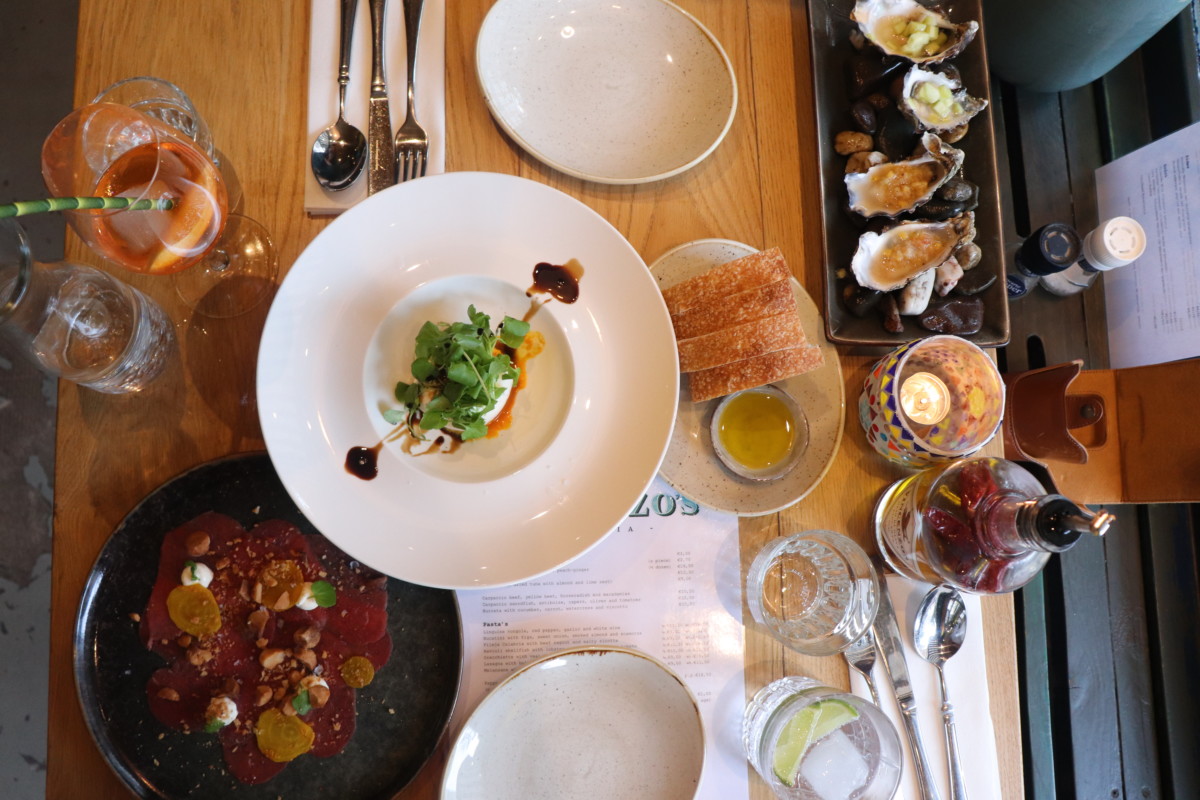
Vincenzo’s started us off with Oysters and Carpaccio. The carpaccio was accompanied by nuts, and all the oysters had different flavours added to them. Enough to make anyone smile, really.
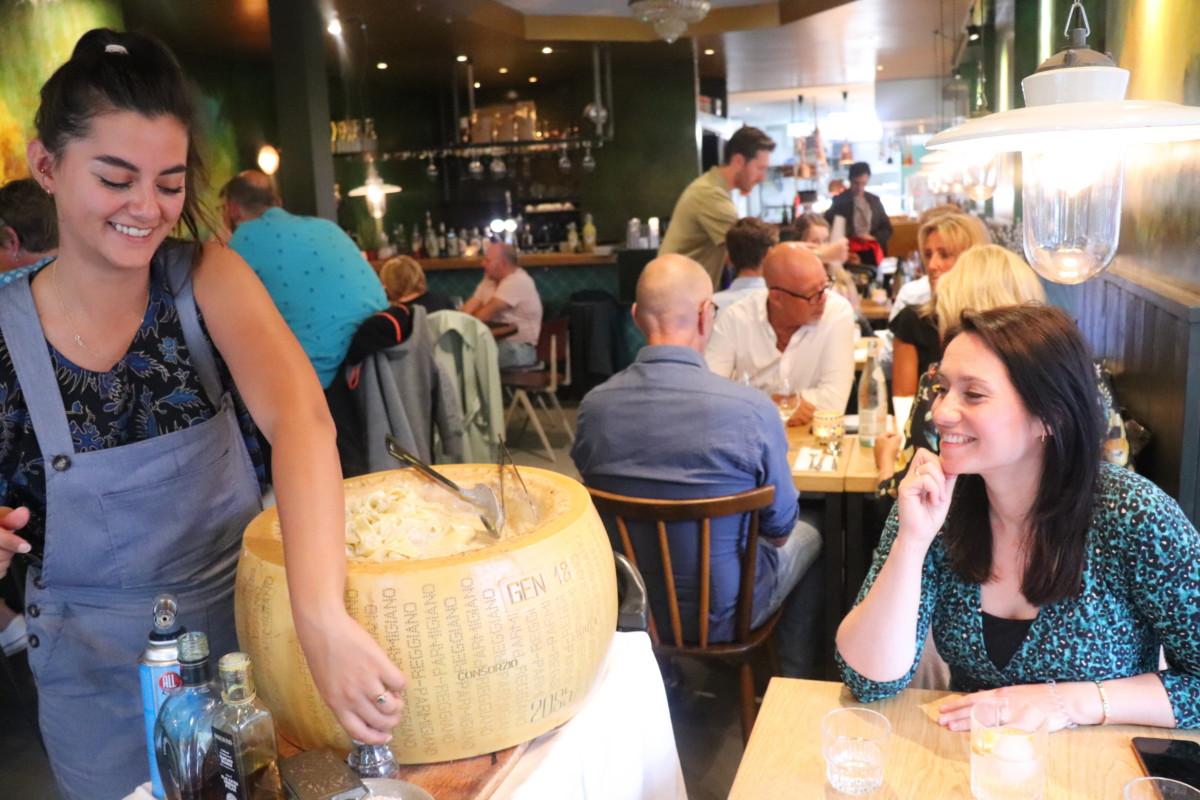
Not onboard the pasta train…yet. Image: DutchReview
Next up was the showpiece of Vincenzo’s; their Pappardelle al Parmigiano, with black winter truffle. The large Parmigiano is roasted at the top, causing the cheese to melt, before the fresh pasta is stirred in the cheese itself.
Now THAT’S what we call cheese! Image: DutchReview
After the fresh truffle was added, it tasted just as epic as you would expect. Rest assured, you can order half portions, in case you want to be able to try more of the pasta on the menu.
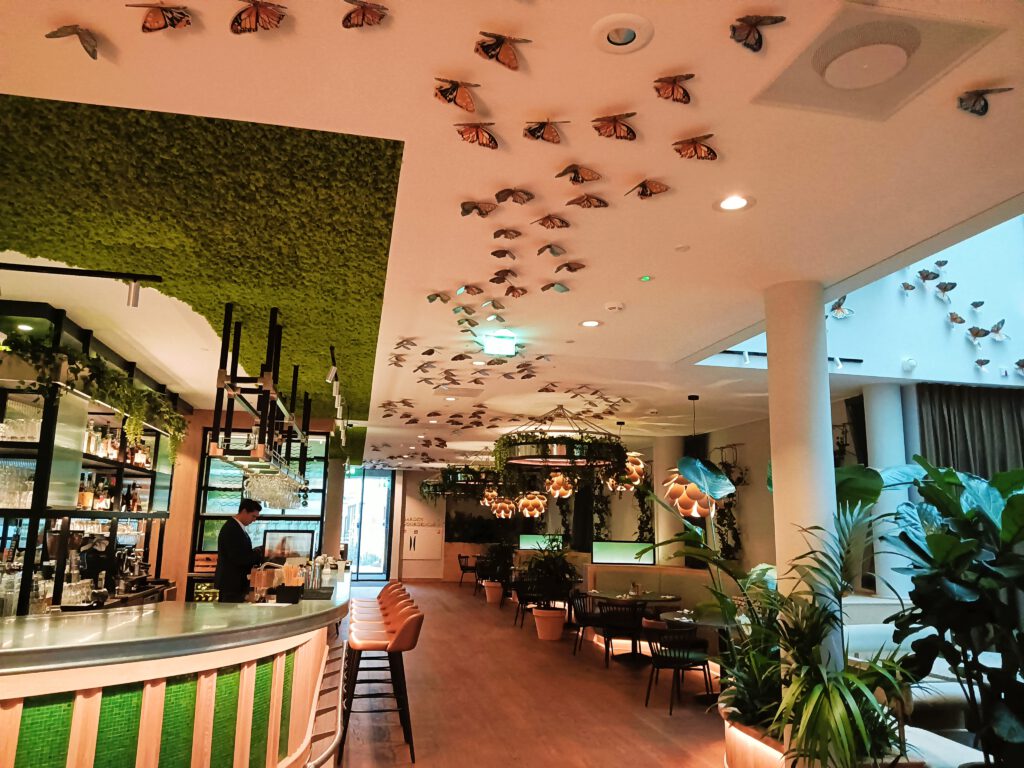
Botanica is located in the newly renovated Voco Hotel, but it is far more than a hotel restaurant. The sleek interior creates a delicate yet down-to-earth atmosphere — with a menu that matches this vibe perfectly.
It’s giving classy and hippie at the same time. Image: DutchReview
Centred around Dutch cuisine, Botanica is a great spot for those seeking an authentic Dutch food experience without having to eat 9 different varieties of fried snack-bar bites.
What makes Botanica extra unique is its twist on the traditional: at least 80% of all its dishes consist of vegetables, and all vegetables are seasonal. I’s a vegetarian’s dream!
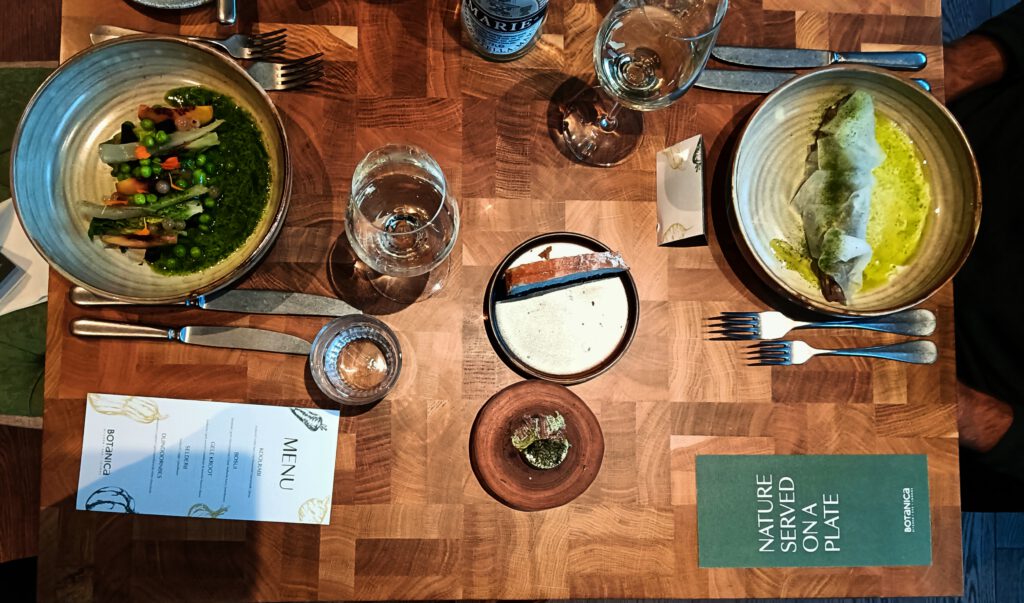
A lovely summer salad for the vegetarian and fresh mackerel for the meat-eater. Image: DutchReview
We started the five-course evening with a delicate summer salad and fresh grilled macarel before continuing with a robust beetroot dish and lovely fowl. All courses were paired wonderfully with unique wines from all across the world.
The frozen yoghurt with pumpkin and mandarin sauce was a perfect ending to what can only be described as a love letter to Dutch cuisine — and vegetables!
Who would’ve thought pumpkin could be this nice in a dessert? Image: DutchReview
STAN has become a household name across the Netherlands, and the Amsterdam branch recently opened its doors in Buitenhof, The Hague.
This place somehow makes a neon sign feel warm and cosy. Image: DutchReview
Their menu has a nice and trendy set-up of fusion-like dishes, following all the latest culinary trends (as you’d expect).
We started off with some delicate appetizers on a wooden platter, matched with some extra gyoza. Apart from the tasty gyoza, a highlight from the board was the smoked Duck breast.
Moving on to the main, STAN is working with the famed Josper Grill. They’ve got a bunch of amazing meaty options, and when you go for the chef’s special, you can taste them all.
Yepp, I did have them all :). Image: DutchReview
STAN surprised us with delicious food from across the globe for decent prices with a dynamic yet intimate atmosphere.
📍 Address: Buitenhof 5, 2513 AG, The Hague 🌐 Website: STAN
5. Hotel Des Indes: a grand food experience
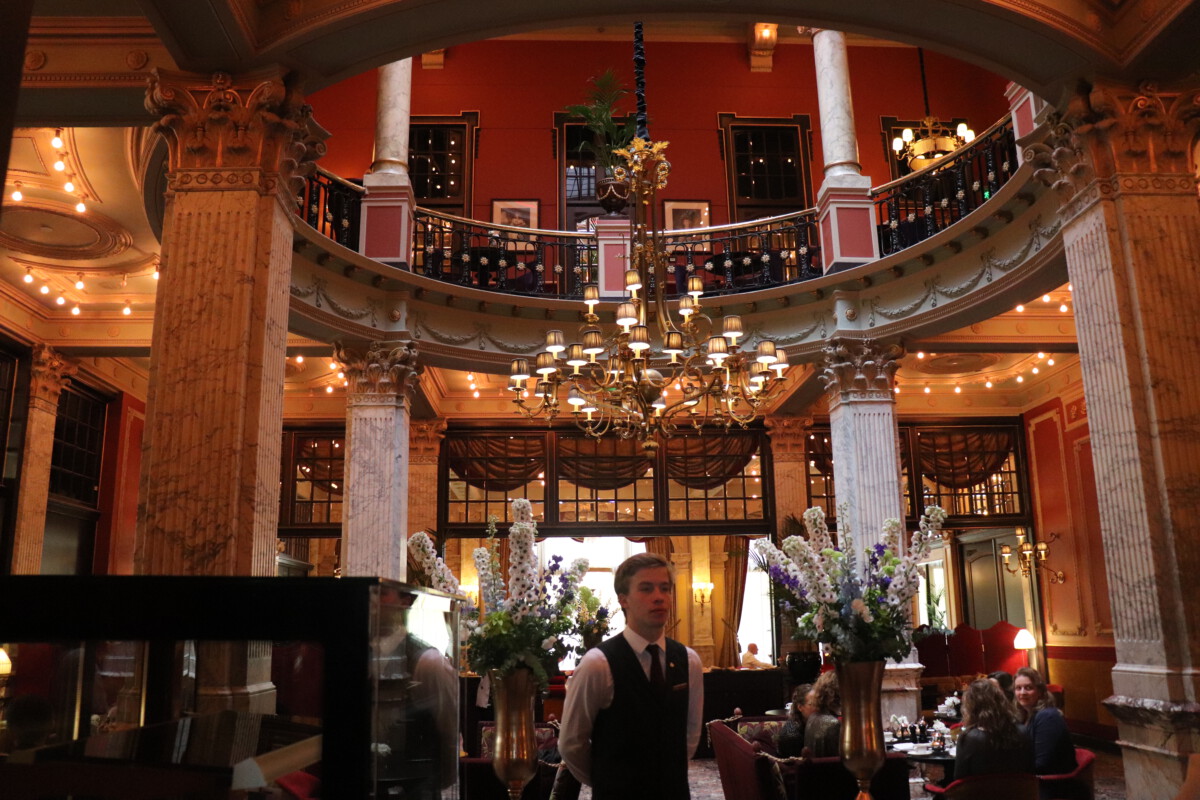
Hotel Des Indes might just be the grandest hotel in the Netherlands, and it’s certainly the most exclusive entry in this article. If you ever want to treat your loved one to something special in The Hague, this is your go-to spot.
You won’t be surprised that this is a hotspot for the diplomatic community and has seen quite its share of heads of state visiting. The service is almost un-Dutch as well, and I mean that in a positive way — very hospitable and polite.
It’s no less impressive from the inside! Image: DutchReview
It’s fancy for sure, but Des Indes also has affordable arrangements for lunch, dinner and high tea. We sat down for a sumptuous lunch.
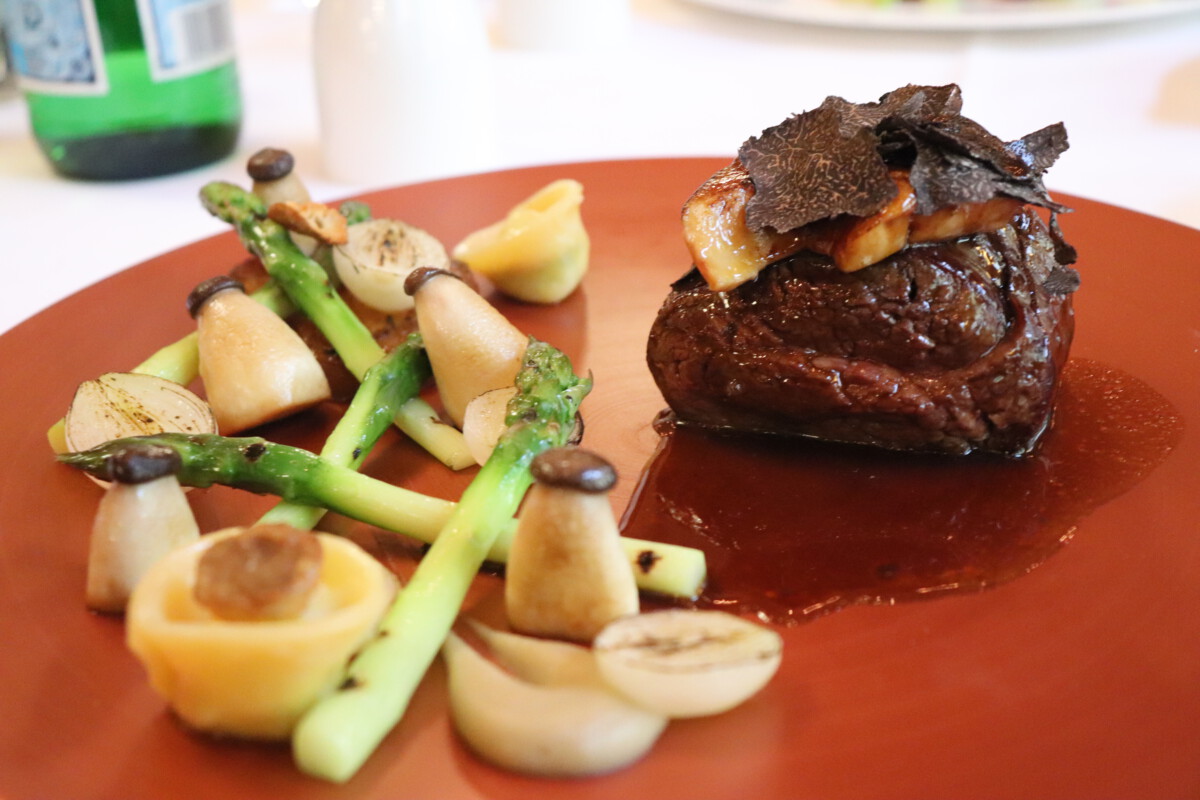
There were gratinated oysters, steak with foie gras and truffle, wine-pairing and delicious sweet treats at the end of it all.
Who else is getting hungry just from looking at these pics? Image: DutchReview
Truly for a special occasion, and especially if you’re living in the Hague, something you should at least do once in life.
Lunch, dinner, cocktails, or loads of art — Gallery 61 in the centre of The Hague has a lot to offer, and there are surprises everywhere.
First of all, they invested a lot in the artwork on their walls — you can easily spend 15 minutes just checking out the art while waiting for your starter to arrive.
You can also get tricked by this magic chair painting:
An optical illusion Escher would be impressed by. Image: DutchReview
The menu also surprises you with all kinds of fancy versions of the street food you know and love. The hot dog is especially worthy of a shout-out, but the burger was also a great way to go. I still have plans to return and try their ‘cheeky pork’ or ‘what the duck’.
It’s any grown-up’s dream to be allowed to eat street food in a fancy restaurant, isn’t it? Image: DutchReview
As you can see, the dishes are original and colourful. The cocktails were all done just like they should be. The music, cutlery, and a boatload of art on the walls all came together in a well-thought-out concept.
7. Haley’s Comet Breakfast Club: for throwback Thursdays
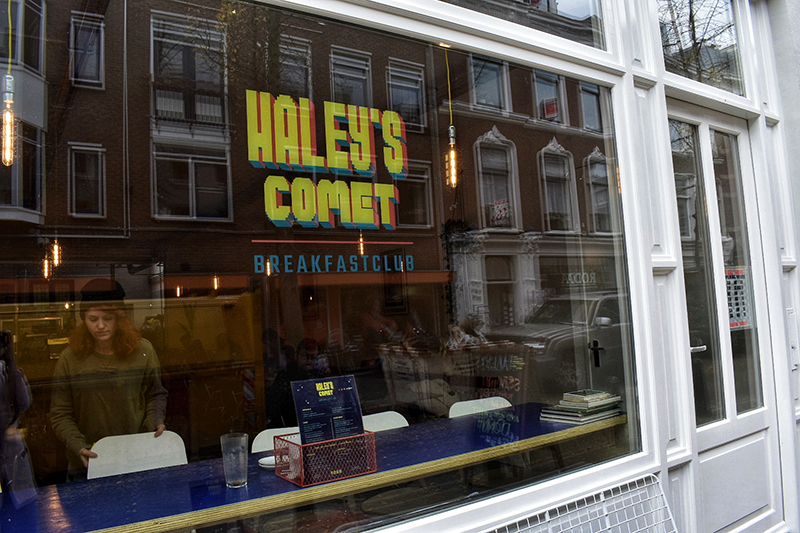
Haley’s Comet Breakfast Club is a lot more than an all-day breakfast place and quite the 80s experience. As soon as you walk in, you can’t help but feel the retro atmosphere and notice all the old-school decor in the room.
Even from the outside, we’re sent right back to the 80s! Image: DutchReview
Aside from having an amazing theme, Haley’s Comet Breakfastclub also has a distinctly homey menu. We tried the lovely soft scramble eggs in a brioche bun and the breakfast muffin (all home-baked!).
We also had a Nesquik hot chocolate (the nostalgia hit us hard) and their special brewed coffee (which they also sell in packs, in case you absolutely fall in love with it).
So simple, yet so perfect. Image: DutchReview
The place also has an open bar and kitchen, so you can see everything happening right in front of you, just like home!
To ensure that people see her breakfast club as a second home, Britt organizes events (like board game nights and pyjama parties) every month.
So, if you’re new to The Hague and in need of a fun community, you can always feel welcome at Haley’s Comet Breakfast Club.
We can hear you asking this question from all the way over there: do cheap Dutch train tickets exist? Well, yes! There are plenty of options, you just need to know where to look.
The NS might have a bad reputation for hiking train prices, but there are surefire ways to find great train ticket deals. And the cherry on top? You’ll often know the price of our journey well in advance.
If you’re keen as a been to start saving some serious cash on your rail journeys, this cheap Dutch train ticket guide will have you snatching up those handy deals right away! 🤑
1. Opt for day tickets (dagkaarten)
Something that I have always done is buy NS day tickets from supermarkets and other high street shops. A few times a year, shops such as Kruidvat, Xenos, Blokker, Hema, and Albert Heijn sell discounted train tickets.
The best thing to do is to check their websites every once in a while, or in the shop window if you happen to be walking past. Found one you like? Hoera, it’s time to buy these tickets in bulk!
However, do remember to read the terms and conditions, as I’ve found that discounted day tickets are often restricted to off-peak hours or on the weekends.
Do you need a bit of extra help sourcing some great deals? This useful website offers an overview of all running discounted train tickets offered by different shops and stores! 🙌
Unfortunately, the information is only offered in Dutch, but if you scroll down you can see the discounted prices per person on the right-hand side.
2. Check out an advantage card (AKA Dal Voordeel)
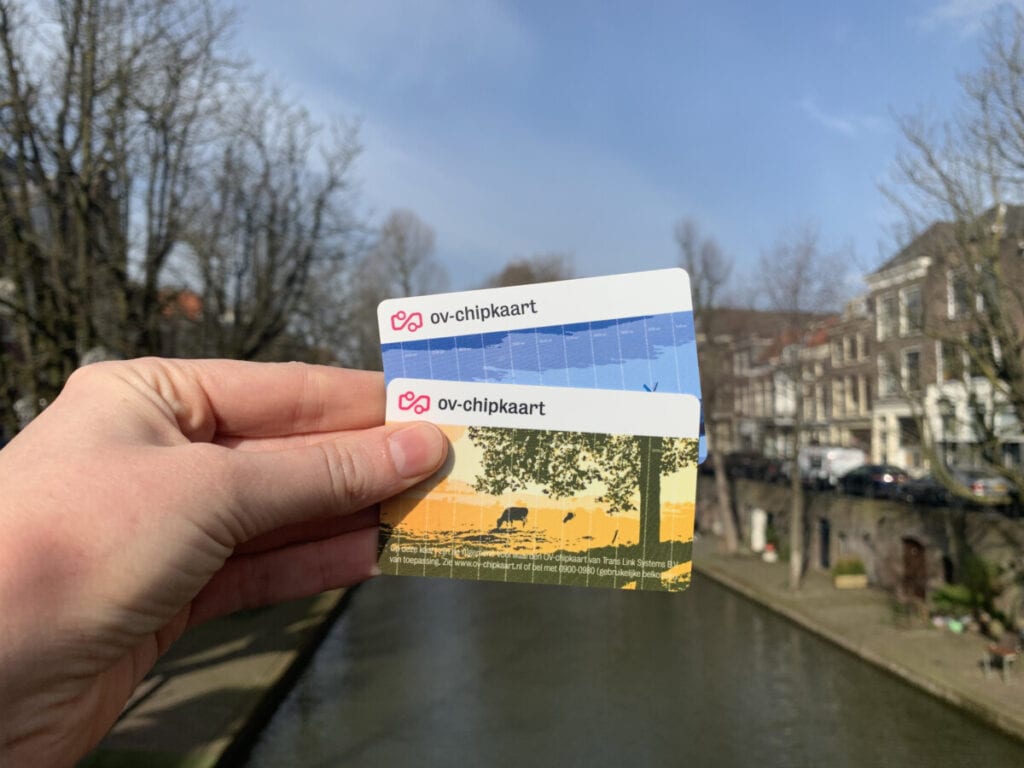
This is available to people who have an OV chipkaart, which you can get online or at any NS info counter for €7.50.
Tip: Owning an OV chipkaart is cheaper if you use public transport regularly in the Netherlands because you don’t need to pay a euro every time for the print-out tickets.
To get this ‘advantage card’ deal, you can pay €67.20 per year or €5.60 per month for a subscription. In return, you get a generous 40% off train prices to any destination in the Netherlands.
Of course, it’s important to read the fine print, as this deal is only valid at off-peak times, so you cannot travel with the discount between 6:30 AM to 9:00 AM, and 4:00 PM to 6:30 PM.
If you want a peak-times discount card (20% off during rush hour), you’ll have to pay a little more per month: €26.70. However, it’s still much cheaper than without a discount!
They come in not one, but two colours! Image: Samantha Dixon/Supplied
Another great thing with the advantage card is that you can take up to three friends with you. You just load the discount onto their OV chipkaarten and they all get the same discount! How kind of you, NS.
3. Grab a group ticket (Groepsticket)
For only €7.15 per person, up to seven passengers travelling together to the same destination off-peak can get a ticket to anywhere in the Netherlands.
Basically, the more people that you gather to travel with you (or the more friends you have! 😉), the cheaper it becomes.
Here’s a breakdown of the prices as an example, so you can easily see how cheap it really is:
Four people = € 9.50 per person
Five people = €8.40 per person
Six people = €7.67 per person
Seven people = €7.15 per person
You can easily order the Groepsticket online, and each person will receive their own personalised ticket. Easy, right?
4. Scour discount websites for cheap Dutch train ticket deals
Another way to get cheap ticket deals is to check the Spoordeelwinkel section of the NS website, which contains new deals every month. These Dutch train ticket deals are linked to specific destinations, such as cities, hotels, or amusement parks.
They also have great tickets for you tourists out there. 🧳
And off we go to bigger and better things. Or, in the case of the Netherlands, smaller and flatter things. Image: Depositphotos.
Occasionally, you can get deals for tourist attractions where you can get transport bundled with a hotel, entry fee, or meal fee paid for in one — so remember to keep checking the site!
5. Buy tickets for your kids, pets — and even your bike
Forget about leaving little Fluffy, your 3 screaming children, or your beloved Dutch bike at home. The NS offers special tickets for all three! 👇
Doggy day ticket
You can buy a day dog ticket for just €3.30 but small dogs and other small animals get to travel for free (wat mooi!). So it’s probably best not to overfeed your pet if you want a free ride. 😂
You can load this onto your OV chipkaart or with a disposable single-use card.
Children’s ticket
If your kids are tagging along with you, the fab news is that they can travel for free — provided they have their own OV chip cards (€7.50).
Oh, and what if their friends are joining in on the fun? Well, the price stays the same: free!
Of course, some requirements do apply, such as the children involved being between the ages of 4 to 11 and accompanied by someone over the age of 12.
If that sounds like something beneficial for you and your nearest and dearest, don’t forget to purchase the Kids Vrij discount! (You “purchase” it for €0.)
Bike ticket
Ja hoor, you can even take your beloved fiets on the train for €7.50 per day.
With the bike train ticket, you don’t have to leave your favourite omafiets behind. Image: Depositphotos.
This ticket is only valid during off-peak hours, but it doesn’t matter how long your journey is, it’s still the same price. That way you will never have to part with your bike ever again.
Just load this onto your OV chipkaart or buy a disposable single-use card.
6. Snap up some international discount cards
So, maybe you want a change of scenery from the Netherlands and are looking to explore something new for the day. The good news is, if you have an OV chipkaart, you can travel to Germany, Belgium, and beyond with a handy discount. 🗺️
With an Interrail ticket, for example, you can get a discount of up to 25% on European rail travel.
If you’re determined to do a round trip of Europe during the summer, opting for a €185 Global Pass will give you access to a whopping 33 European countries for a flexible time period that you can set.
Meanwhile, the €51 One Country Pass will give you unlimited access to the rail network to a European country of your choice. Prima!
7. Browse the NS site
Admittedly, the NS deals aren’t always as good as some of the other deals out there. However, from time to time, the NS does advertise some pretty cool deals on their site.
These are mainly city trip deals to other countries, but who wouldn’t like a little day trip to Brussels or Paris this summer? ⛲️
In addition to this, buying a ticket at least four days before your trip will score you a generous 20% discount for rail journeys between Monday and Thursday — and a 10% discount on weekends. It really does ‘pay’ to be an early bird! 😉
What’s the best deal you’ve got on Dutch transport? Let us know in the comments!
After weeks of rain and storms, a cold winter is finally on its way to the Netherlands! Grab your hats, mittens, and fluffy socks, because this weekend is set to bring temperatures below freezing.
And yes, if you want to, there’s a good chance you’ll be able to go ice skating! ⛸️
As low as -7 degrees Celsius
According to Weeronline, almost the entire Netherlands will freeze up during the night from Saturday to Sunday, with temperatures going as low as -7 degrees Celsius.
From Sunday onwards, we can expect temperatures to also stay around or below 0 degrees Celsius during the day.
“Combined with dry air and little wind, these are ideal conditions for ice formation,” Wouter van Bernebeek from Weerplaza tells the AD. ❄️
The low temperatures are expected to last until at least Wednesday, January 10.
Ice-skating fun!
Due to the low temperatures and high chance of ice formation, we will very likely be able to ice skate on shallow waters in the coming days.
Especially flooded meadows and shallow puddles should be ideal for this. For now, the amount of frost is too small for skating on large bodies of water.
Did you know: It takes at least four whole days of below-freezing temperatures to form ice that’s safe to walk and skate on — and that only applies to ponds or lakes with no currents.
Will you bring out the skates this weekend? Let us know in the comments!
Looking for the perfect spot to spend a long weekend? Everyone can find their favourite things to do in Breda. From nature to beautiful architecture — it’s got it all!
After you fall in love with Breda in the historical city centre, you might want to know what kind of attractions and places are waiting for you there.
Well, lucky you! There are many things to do in Breda for every type of person and mood! Here is a list of our favourite activities for a perfect trip to the city.
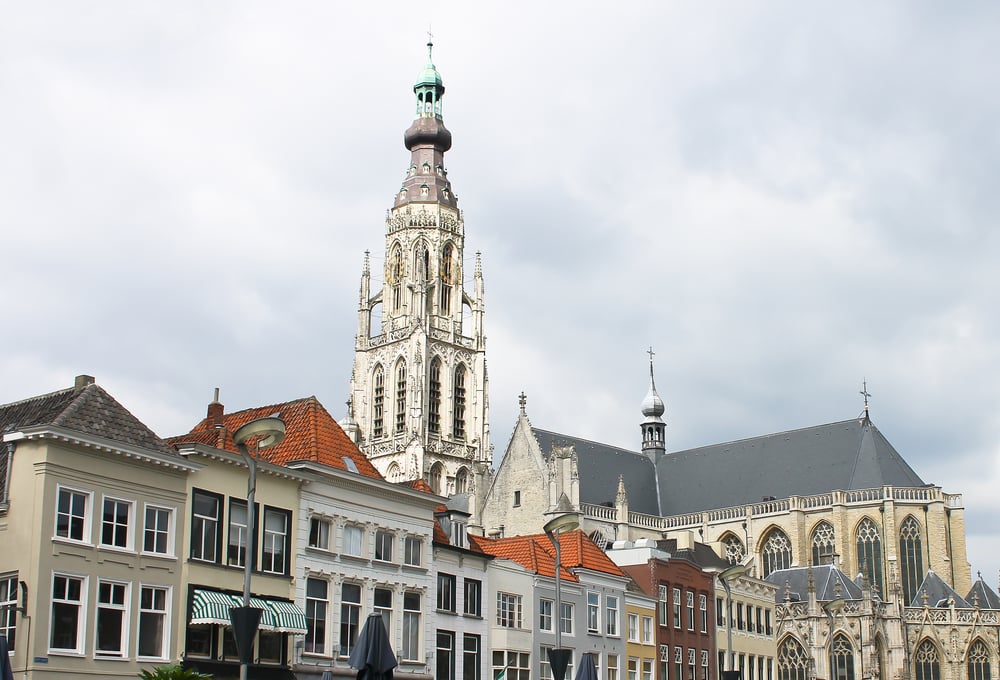
First things first! The Grote Kerk is the perfect spot to fall in love with the city. It’s also quite difficult to miss it since it’s in the middle of town, and oh yes, it’s degrootste!
This long boy is one of the town’s most important monuments, stretching 97 metres into the cloudy sky of the North Brabant region.
The Grote Kerk is in the middle of the city! Image: Depositphotos
Tip! You aren’t the only person starving to have some nature vibes sometimes. If you don’t want to have that festival feeling, we recommend you try going on a weekday for a bit more solidity.
💰 Price: Free! ⏰ Opening hours: 10:00 AM until 5 PM Monday to Saturday, 13:00 AM to 5 PM on Sunday 📍 Location: Kerkplein 2, 4811 XT Breda
🦎 2. Go exotic at Reptile House Earth
If you are looking for a more exotic experience than a Dutch forest, we recommend you visit the Reptile House Earth!
In Breda’s first (mini) zoo, you can step into a rainforest and meet all kinds of scaly friends. This mini zoo is perfect for smaller kids, but also for the older ones if you are easily fascinated by reptiles.
Tip! Reptile House Earth is perfect for little kids to learn about animals.
💰 Price: €12 for 12- 64, €10 for 3 – 11, free under 3 and above 65 ⏰ Opening hours: 10:00 AM until 6:00 PM, Wednesday to Sunday 📍 Location: Aardenhoek 26a, 4817 NE Breda
🏰 3. Take a trip back to the 12th century at Breda Castle
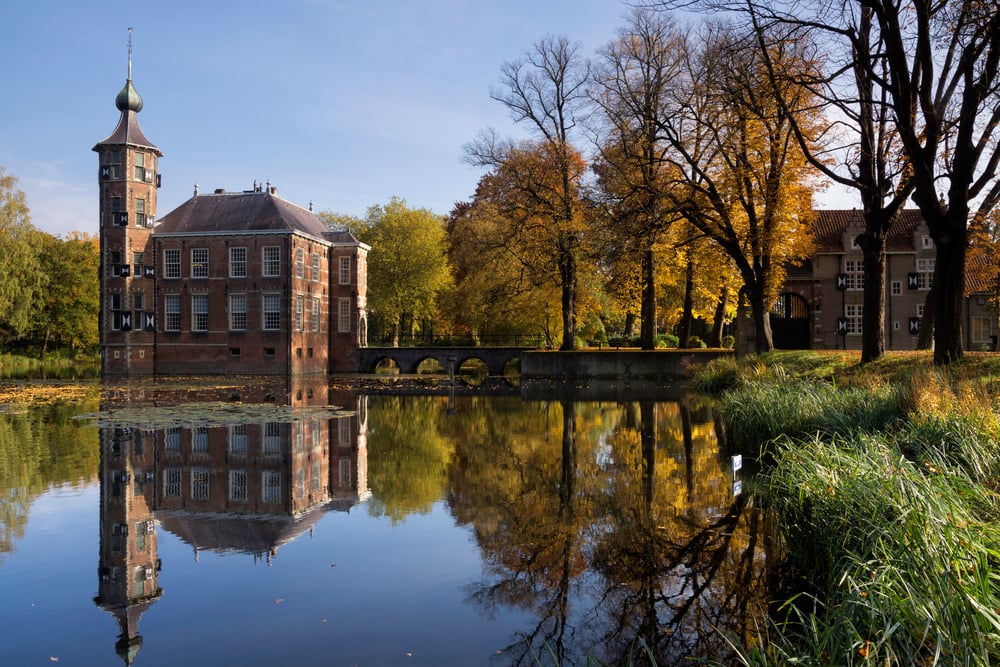
If a castle from the 12th century sounds interesting, we have great news for you! Breda Castle is one of the most important UNESCO sites in the whole of the Netherlands.
Not only can you marvel at its beautiful exterior, but it’s also possible to visit the inside of the castle. There are even guided tours if you want to learn more about the architecture and history of the building.
This beautiful castle in Breda is probably the nicest with the autumn colours. Image: Depositphotos
Tip! If you want to see the castle from the inside, you can join one of the guided tours!
💰 Price: Free to enter (prices depend on the guide) ⏰ Opening hours: Gardens open year-round, castle interior occasionally opens 📍 Location: Kasteelplein 10, 4811 XC Breda
🌳 4. Breath in the city’s lungs at Stadspark Valkenberg
If you’d like to have a walk in the middle of the day, the Stadspark is a great option! The park sits within the city’s lungs (a large green space in the middle of Breda), and it’s ideal for a daytime picnic.
Another pro? You can easily reach it while walking from the main station to the historic city centre.
When the weather is nice, the Stadspark can also be a fabulous spot to munch and lunch. Many of the locals like to visit the park, especially on the weekends — and who can blame them? It’s just so easy to reach.
With this organised beer walk, you can learn about the city and your beer at the same time. Your tour guide will help you to learn all the fun facts about Breda — and perhaps your alcohol tolerance too.
🚲 6. Cycle and learn on Breda’s Highlight Bike Tour
If you are afraid that you won’t be able to remember anything after a drink-filled tour through the city, maybe Breda’s Highlight Bike Tour is more for you.
The city has a very friendly atmosphere, and the best way to explore it is on two wheels!
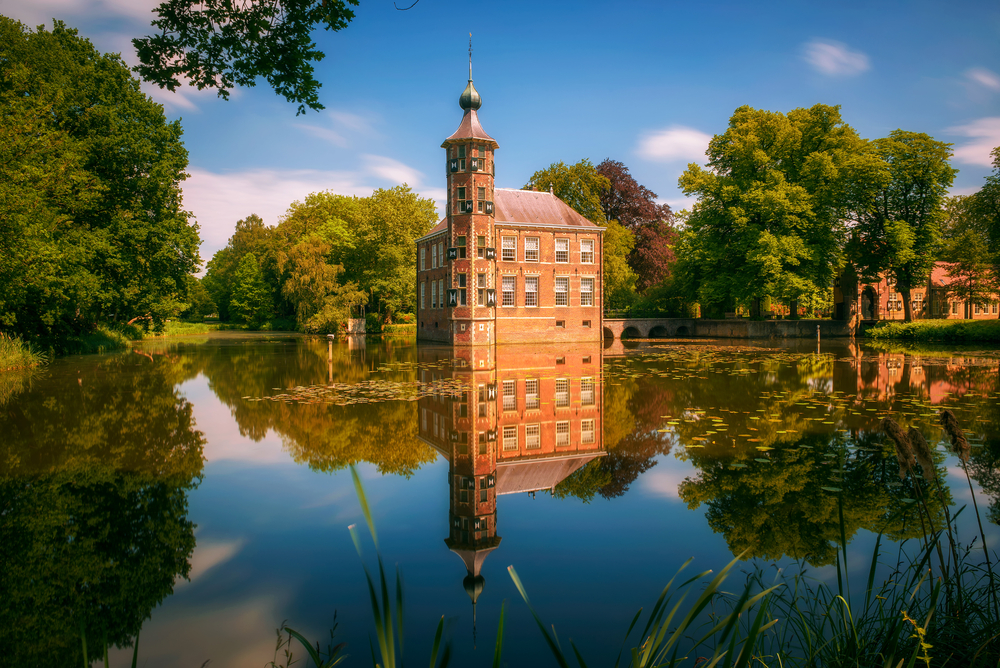
With this organised bike tour, you can discover the sights of Breda, such as the Dome Prison, Castle Bouvigne, and many more, with a local and experienced guide. Also, this is probably the most Dutch thing that you can do if you’re looking for that authentic local experience. 😉
Many of the program ideas included on this list are part of this guided tour!
But you will also have a chance to see the STEK, the Prison Dome, the Moby Dick Blind Walls Gallery, or the Spanjaardsgat.
It won’t be more Dutch than this. Image: Depositphotos
Ginnenkenmarkt is another great spot in the centre of Old Breda to eat, drink, and people-watch. In this always busy market, there are restaurants and bars lining the square near the cathedral.
The best spot to have some fresh lunch! Image: Depositphotos
It can also be an ideal spot to have lunch while having a day in the city centre. There are numerous kiosks where you can try some of the local cheeses.
One of the cutest museums to visit while being in Breda is the Miniaturenmuseum. You can see the most beautiful handmade dollhouses from the Netherlands, and learn all about their history.
Apparently, there are mini Dutchies as well! Image: Depositphotos
On a summer day, it is ideal for a good old heatstroke! Or some summer vibes when the sun is hiding behind the clouds) Belcrum Beach is ideal for a chill day if you want to have a few drinks with your friends or finish that book you started last year.
This artificial beach is also ideal for entertaining kids. Speaking of little balls of chaos, if you prefer to have a more calm day, we recommend you go on weekdays.
If for any reason your deepest desire is to spend a day with a group of goats, then you’re not alone. This extra mini zoo is not only ideal for small children but also for all the goat nerds out there.
This is a dream of kids and goat nerds! Image: Depositphotos
This farm is open for the public to visit, and it can be a great place to pet some echt schattig animals!
After binge-watching the Crown, you might find yourself in the mood for some royal vibes. To quench this thirst, castle Bouvigne is a perfect destination to visit!
While the castle itself is only open to the public for a few days of the year, the garden can be visited all year round on weekdays for free. On the weekend it’s closed.
💰 Price: Free to visit the garden ⏰ Opening hours: 8:00 AM until 5:00 PM, Monday to Friday 📍 Location: Bouvignelaan 5, 4836 AA Breda
⛵️ 12. Become a city expert at Breda’s Museum
If you officially fall in love with the city of Breda, you might want to learn a bit about its history as well!
In Breda’s Museum you can learn about Breda’s part in the 80 years war, but you can also find many fascinating temporary exhibitions.
Tip: Breda hosts a Photo Festival here every year, so if you are interested in photography, make sure that you visit their website before visiting!
💰 Price: €12 for adults, €6 for ages 13 – 17, free for 12 and under ⏰ Opening hours: 11:30 AM until 5:00 PM, Tuesday to Sunday 📍 Location: Parade 12-14, 4811 DZ Breda
With plenty of things to do in Breda, you can easily spend a few days — with full schedules.
Before going, it’s worth doing some research to make sure that you can see everything that you want.
Congrats, you just made the first step! 😊
Do you have a great program idea in Breda? Tell us in the comments!
Trying to decide where to live in the Netherlands or moving from house to house can be a nightmare. In fact, moving anywhere can be stressful. It doesn’t even matter why you’ve come to the Netherlands, whether you’re a student or moving here for work, it can be a struggle.
There are so many different things to consider, such as rental cost, type of property, the property’s location, etc., which can be extra confusing if you’re an international.
Plus, to add to the list, the Netherlands has both social and private housing. But what exactly is the difference, and which is right for me? Here is all you need to know.
Social housing in the Netherlands
What is social housing?
Let’s get back to basics. The Housing Act (1902) recognises that affordable housing in the Netherlands is a shared national responsibility.
It is generally designed for people who have low income, have a disability, are vulnerable in some way or are elderly.
In short: Social housing in the Netherlands is housing where the rent is subsidized to make it more affordable.
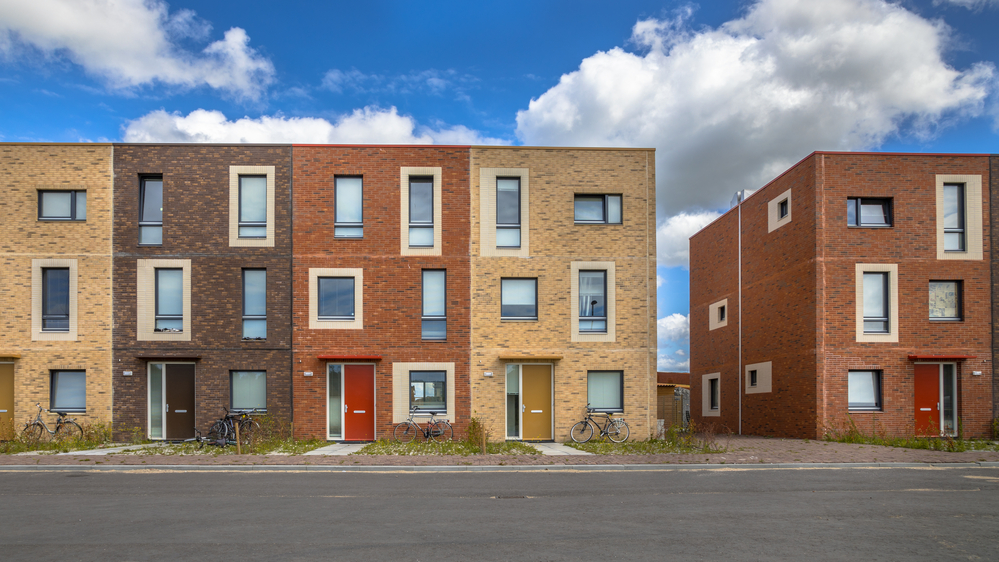
The Hague’s social housing doesn’t look too bad, eh? Image: Depositphotos
What is considered a subsidised home?
In government-subsidised homes, housing associations are required to keep the rent below the limit of €752.33 in 2021 (it was €737.14 in 2020).
If all residents are under 23 years old, rent may not exceed €442.46, unless a child is also living there, in which case the rent can still be €752.33.
A strictly designated 80% of these homes are rented out to people with an income no higher than €39,055. Another 10% of these homes are for people with an income between €39,055 and €43,574.
The additional 10% is available to people with higher incomes. This is the percentage the social housing associations must keep to, although income standards change from year to year.
Applying for social housing in the Netherlands
To apply for social housing, you must first register with your region’s social housing association. Check with your municipality to find your local organisation.
Often, you need a housing permit, which can be requested through your municipality. You may need to provide reasons why you want to live in that specific region (e.g. you work there or have family in the area).
Once you’ve applied, you will be part of a waiting list.
The housing organization that you’ve registered with will have a website you can visit with all of the available properties. You then need to apply for the property you’re interested in.
There are usually many people going for the same property, and as waiting lists are long, many things will be considered.
Of course, one of the requirements is that you do not earn above the yearly income that was mentioned earlier. Your family size will also be taken into account. Also, how long you have been on the waiting list.
As a whole, every aspect is considered, and the right house goes to the right person (for example, if you’re highly vulnerable, you would be considered an urgent case).
There is a points system in the Netherlands for social housing, which determines the value of the property in which you’ll be living. This then determines how much the rent will be.
So, how does it work? Well, points are awarded depending on whether the property is self-contained, its size, and what facilities are included.
The higher the points, the higher the rent. If you feel the number of points is incorrect, you can appeal the decision and have a rent re-assessment.
If the rent is too much and you’re struggling to pay, you can apply for a rent allowance.
What are the responsibilities of housing associations?
Housing associations are responsible for more than just social housing in the Netherlands — they are responsible for the whole neighbourhood.
This means they should clean up any graffiti and help prevent anti-social behaviour.
Housing associations also help with maintaining children’s parks and sports facilities, streets, parking, housing, and everything.
They also have to appoint caretakers for the area. Basically, they’re responsible for making sure that the neighbourhood is kept in top condition.
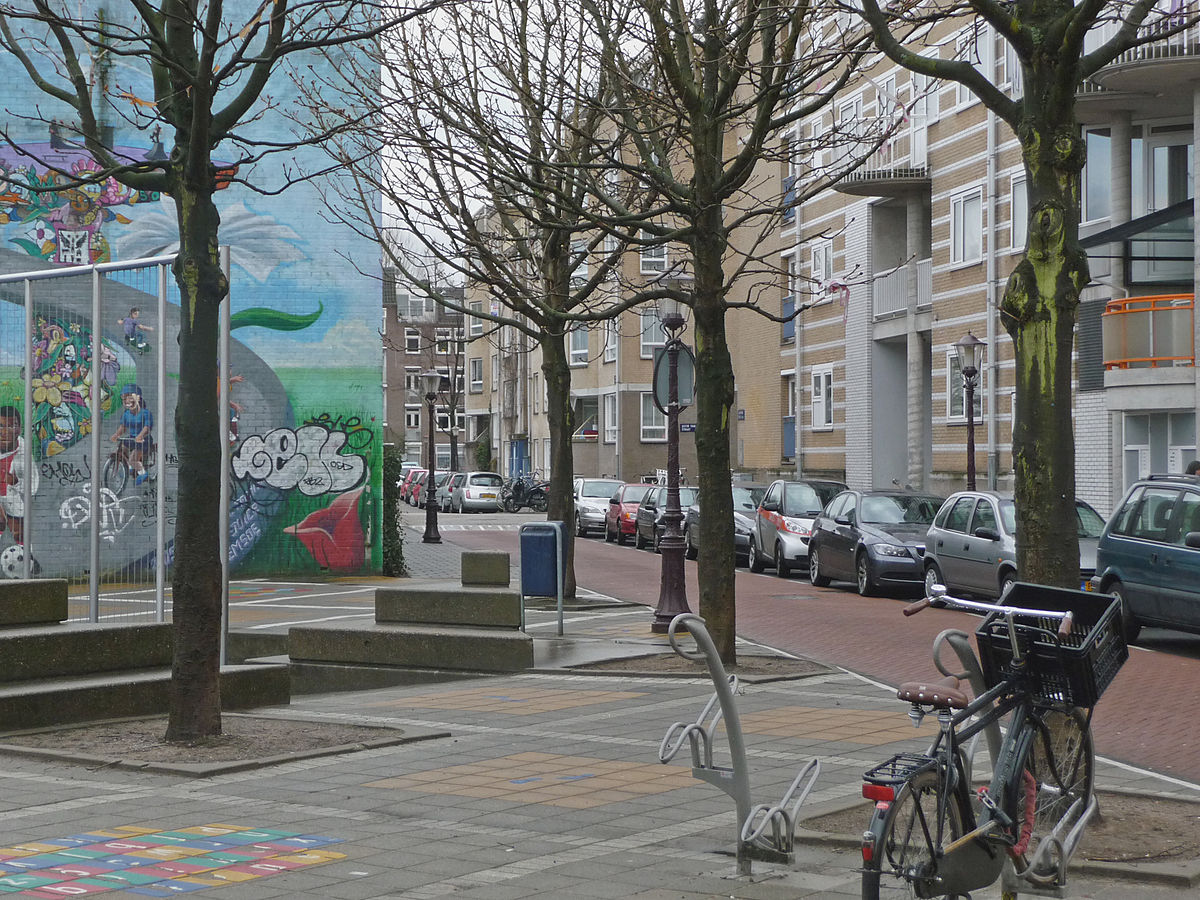
Social Housing in the Netherlands: It’s the association’s responsibility to keep the area nice! Image: FotoDutch/Wikimedia Commons/CC3.0
How do I make a complaint about my housing association?
If you want to complain about your property, you can go to the actual housing association complaints committee to submit your complaint. This should be your first course of action.
If the dispute is not resolved, you can take it to a rent tribunal (huurcommissie), which is an agency that can help solve disputes with housing. It has nothing to do with the court but aims to resolve the dispute. (Normal cost: €450 for a company and only €25 for a regular person).
If the landlord is the issue, complain to the landlord first. Then, if it is not resolved, you can take it to the landlord’s complaints committee.
If it still is not resolved, this dispute can go through a rent tribunal. You do this if your complaint has not been resolved, and they should be able to assist you. Any sort of complaint can be forwarded to them, as long as it has to do with housing.
Private housing in the Netherlands (free-sector)
Private housing in the Netherlands has a lot more flexibility than social housing.
To start, you can find your housing using various online platforms, real estate agencies, newspapers, and social media groups. Popular websites for listings of apartments in the Netherlands include Funda and Pararius.
For a start, contracts are liberalised, which means that there is more flexibility for the landlord and tenant when it comes to the rental price and what it includes.
This means that there is no maximum rent, however, with the steep rise in rental prices, in some places, they have started to cap this. There is also no points system in place.
How do tenancy agreements work in the Netherlands?
Tenancy agreements (rental contracts) in the private sector can be either written in a contract or can even be an oral agreement.
However, an oral agreement is never advised without some sort of evidence (such as a witness), just in case something goes wrong.
Your tenancy agreement in that property can either be for a fixed period or indefinite. So what’s the difference?
A fixed-period contract is the more common of the two contracts. It means that your tenancy agreement has an end date. It’s still essentially an indefinite contract but with a minimum fixed term of six to twelve months.
When the agreement expires, many landlords give the option to move to an indefinite agreement.
With an indefinite agreement, your contract doesn’t have an end date, but you will need to give your landlord an official notice at least one month before moving out.
In the same regard, they will need to give you a 30-day heads-up if they want you to move out.
What can you expect to find in your tenancy agreement?
You should usually find the rental price (sometimes a date that it may increase will be present), your landlord’s personal information, your personal information, the address of the property, any rules for living on the property and both of your signatures.
Remember to read before you sign! Image: Pexels
Any additional charges should also be present on the agreement, such as utility charges (if applicable) and service costs.
Note: Look out for any dodgy charges there, they aren’t just allowed to charge you for anything (for example, key holding charges).
Furniture may or may not be included in the rental cost (if applicable).
What are the responsibilities of the landlord and the tenant?
As with social housing, the overall responsibility of the property falls on the landlord. However, some things also fall on the tenant too, so you need to be aware of this. For example, the landlord has the responsibility to ensure that:
The building is safe to live in;
All major repairs are carried out at their own expense;
All repairs should be done promptly;
They should not be coming to the property without good reason, often or uninvited (unless it’s for major repairs).
The tenant also has responsibilities when living in a privately rented property. The tenant has the responsibility to ensure that:
Minor repairs are dealt with by them;
They pay for these minor repairs (as long as they are not expensive);
They allow the landlord to come into the property while carrying out their repairs/maintenance.
How do I make a complaint about my landlord?
Your first course of action would be to complain to the landlord. If there is no resolution, you can take this up straightaway at a rent tribunal.
Complaints can range anywhere from unfair fees to poor maintenance. Basically, if you have an issue that is not being resolved, they can help you.
Need a more extensive guide to private housing in the Netherlands (and Dutch rental agencies)? Then check out this guide for all of the nitty-gritty that you need to know.
Or, are you looking for cheaper housing that isn’t social housing in the Netherlands? Anti-squatting dwellings may be the answer.
Have we missed anything to do with private or social housing in the Netherlands? Tell us in the comments!
Moved to the Netherlands and need a DigiD? The process of getting a DigiD can be a lengthy and confusing one.
If you need some help navigating the waters of Dutch bureaucracy, we’ve got you covered. Read on to find out how you can set up your own DigiD in the Netherlands — you can thank us later. 😉
What is a DigiD?
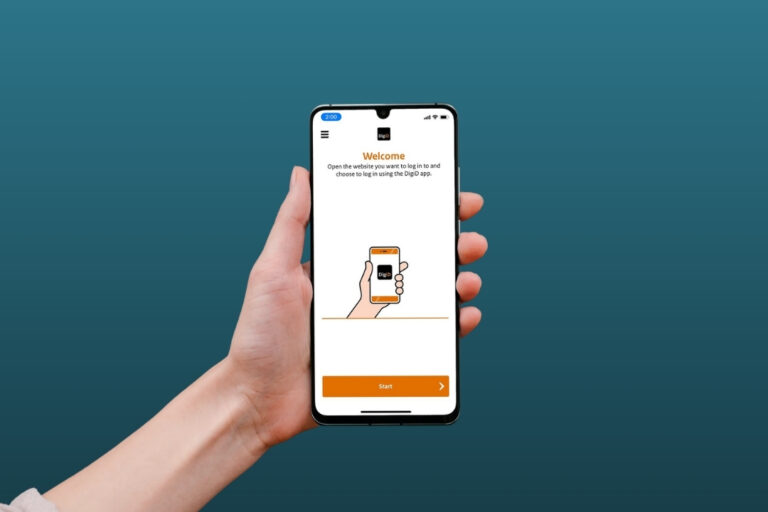
A DigiD (Digital Identification) is an online identification you can use for websites and services of the Dutch government. It’s basically like having your own digital passport. Your DigiD account is linked to your BSN, you may log in with a username and password, the DigiD app or with your ID card.
Do I need a DigiD to live in the Netherlands?
Basically, everything you do in the Netherlands revolves around DigiD, so it’s definitely worth getting one.
Your workplace may ask for it and if you plan on studying in the Netherlands — for example, you want to apply for a master’s — you may need it for things like Studielink. DigiD is also needed if you want to apply for different types of allowances or do your taxes.
However, it’s not like you are going to be kicked out of the country if you don’t have one of these. For example, many international students on Erasmus exchanges are not required to have a DigiD. With that being said, life with a DigiD is certainly simpler.
How do I get a DigiD?
Applying for a DigiD is actually a rather easy process, but receiving one can take a bit of time. To get started, head to the government’s DigiD website. You can switch the website to English and click on “apply” or “activate.”
These steps will take you to the DigiD application form (now available in English), where you have to start by filling in your BSN number (the number you receive upon registering at your local municipality), date of birth, postal code, and house number.
Once you’ve filled in the form, you will have the option to choose different security verification measures.
You can choose to have text message authentication. This is not mandatory, but we recommend it just to save time, as some services do ask for text messages for security reasons, and it makes everything else much easier too.
This part is easy, too — just click “Ja” if you do, or “Nee” if you don’t. Again, click that “next” or, as the Dutchies say, “volgende” button and move on to the next page.
Your DigiD account: username and password
Now it’s time to create your DigiD! On this page, you will have to choose your username and password. Your username should be easy for you to remember (and none of that cringe stuff we used to do with our email names back in the 90s).
Always remember that this is also case-sensitive and you shouldn’t include spaces.
Your password should also be easy for you to remember (yet not so much so that people can guess it). You then need to retype the password.
If you want to be able to recover your password by text message or email, then tick the box underneath called “wachtwoordherstel.” Congratulations, you’ve got a DigiD! (…almost!)
Security validation for the DigiD
You’ll now find that your phone is going off. Unfortunately, it’s not your date texting you back, it’s DigiD. This is the code you should put into the form before continuing to the next page.
You’re also going to have a new email in your inbox, which isn’t from your crush either. It’s DigiD again!
Receiving your DigiD authentication code
Next, you will have to wait to receive a letter to your address stating yet another code for you to put into the system. It should arrive at your address within 5 working days, however, for some people, it could take longer.
Note: Remember that you have 20 days to use this code and activate your account.
I’ve received my code for DigiD by post, now what?
Congrats, you’ve received your letter! Now you’re nearly done. Just head to the DigiD activation page (the same one as last time) and put your activation code into the box provided.
Now you can click “activeren” or “activate” to confirm and voila, you officially have your DigiD!
Tips when you have a DigiD in the Netherlands
Once all the hard work is done and you finally have a DigiD, there are a number of things that you should be aware of.
Ssshh, it’s a secret
First things first, your DigiD is strictly personal — you must not give out your details to anyone. If someone knows your DigiD, you should apply for another one.
It may need updating
If you do not use your DigiD for 3 years, then it will expire, meaning that you will have to apply for another one. Not sure when that will be? This information can all be found in your account!
Install the app!
DigiD has an app that helps to reduce the number of steps needed to authenticate an action. Instead of putting in your password, you can use a simple pin code, or you can scan a QR code on your computer screen.
Setting up the app is an easy process, and you can find all the necessary information on the Dutch government’s website!
Have you applied for a DigiD and do you find it useful? Tell us in the comments!
Maternity leave in the Netherlands is divided up into “pregnancy leave” (zwangerschapsverlof) and “child-birth leave” (bevallingsverlof) to distinguish between the time before and after you bring a new life into this world. 💓
Luckily, in the Netherlands, new moms have quite good conditions for maternity, so let’s take a look, shall we?
The basics of maternal leave in the Netherlands
First things first: If you are employed when you get pregnant, you are automatically entitled to a minimum of 16 weeks of maternity leave. This is true even if you’re self-employed!
You’re pregnant! Time to start thinking about your pregnancy leave. Image: Depositphotos
These 16 weeks are made up of six weeks of “pregnancy-leave,” and 10 weeks of “birth-leave.”
If you’re having twins, triplets, or any amount of multiples, you are entitled to a total of 20 weeks (10 pre-birth, and 10 post-birth).
How to apply for Dutch maternity leave
Taking your maternity leave in the Netherlands can be done at any moment from ten (in case of multiple) to six weeks before your due date.
If you take your so-called zwangerschapsverlof (pregnancy leave) later than six weeks before giving birth, your extra weeks will be added to your bevallingsverlof (childbirth-leave). 🤱
However, in all cases, it is mandatory to take leave by week 36 (four weeks before birth). This gives you at least 12 weeks of maternity leave after the baby is born. In special cases (such as premature birth), the leave starts counting from the moment of birth.
To begin your maternity leave, you need to inform your Dutch employer at least three weeks in advance, meaning at least seven weeks prior to your due date.
It’s important to let your employer know about your maternity leave in due time. Image: Unsplash
Let op! The Dutch Employee Insurance Agency (UWV) can ask for a pregnancy statement up to one year after the end of your maternity leave. So, request a statement from your midwife or GP and keep it for your own administration.
How much can you expect to be paid during your maternity leave in the Netherlands?
Throughout your maternity leave in the Netherlands, you’re entitled to 100% of your earnings, based on your average wage over the past year.
In addition to maternity leave, there is also parental leave (ouderschapsverlof), where both parents are entitled to take a maximum of 26 times their working hours.
This time can be distributed in different ways, and can be taken until the child turns eight.
Thanks to “ouderschapsverloof,” parents get more free time to spend with their child. Image: Depositphotos
So, for example, let’s say you work 40 hours: you are entitled to 26 x 40 = 1040 hours (130 eight-hour days).
You may take this leave all in one go, or, more commonly, take one day a week (the famous mamadag or papadag) for two years and a half or so (counting 52 weeks a year).
Dutch people with both sets of grandparents who are able and willing to help with childcare have a good deal. One day with mom, one day with dad, one day with maternal grandparents, one day with paternal grandparents. 🙌
This means the kid would only need to spend one day at daycare (which is subsidised when both parents work).
For international parents, without help from family, it’s a whole other story — but at least the subsidy for daycare still applies. 🙆♀️
What are your experiences with maternity leave in the Netherlands? Tell us in the comments below!
Student cities in the Netherlands: to an outsider, they can seem practically identical. But, once you get to know them, you realise that they each have their different characteristics.
So, without further ado, here is our ultimate guide to the student cities of the Netherlands.👇
Why should I study in the Netherlands?
The Netherlands may be a small country, but it’s one of the most densely populated in the world. With that comes lots of different people and cities rich in culture and history.
The universities in the Netherlands are pretty top-notch — with most universities in the country ranking in the world’s top 400, with 7 in the top 150!
There are lots of student cities in the Netherlands. And, as the Dutch are among the best English speakers, outside of their native countries, it’s the perfect country for internationals.
Student life in the Netherlands
Most cities in the Netherlands have quite a large student population, and there is always lots to do for them.
Thanks to the large international student community in the Netherlands, it’s easy to find friends from all around the globe! Image: Freepik
What’s more, as the country is so small, you can travel easily from place to place within a few hours (although we have to admit that travelling can be quite expensive 👀).
Also, as they are so pro with speaking English, the Netherlands provides many courses solely in English, and tuition fees are low for EU students (€2000). So, where should I go, we hear you ask?
Where to study in the Netherlands?
Leiden
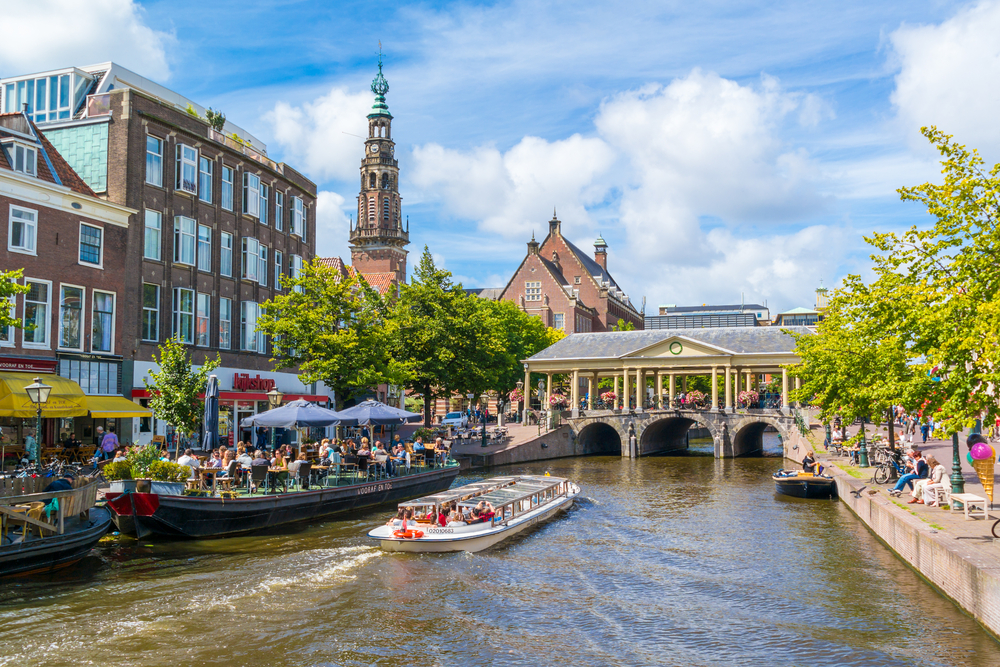
The best way to describe Leiden is your ‘home away from home.’ It’s is a small city, sandwiched between The Hague and Amsterdam (only 15 mins from the Hague and 30 to Amsterdam).
Leiden is known for its picturesque canals, some of which look identical to a view you’ll get in Amsterdam — it’s basically best described as a mix of Amsterdam and Delft.
Leiden is the place to be, especially when you’re on a boat! Image: Depositphotos
We have a massive soft spot for Leiden, as it’s the home of our lovely office. But besides that, it really is so homely and beautiful.
The student community is more tight-knit and makes up for a large part of Leiden, so it’s no wonder that it’s known for its countless student associations.
The city has the oldest university in the whole of the Netherlands (1575! 🤯), and it has taught tons of students over its many running years. Besides its social sciences and law courses, Leiden is also known for its artistic roots, as Leiden is also the birthplace of Rembrandt. 🖼
Groningen
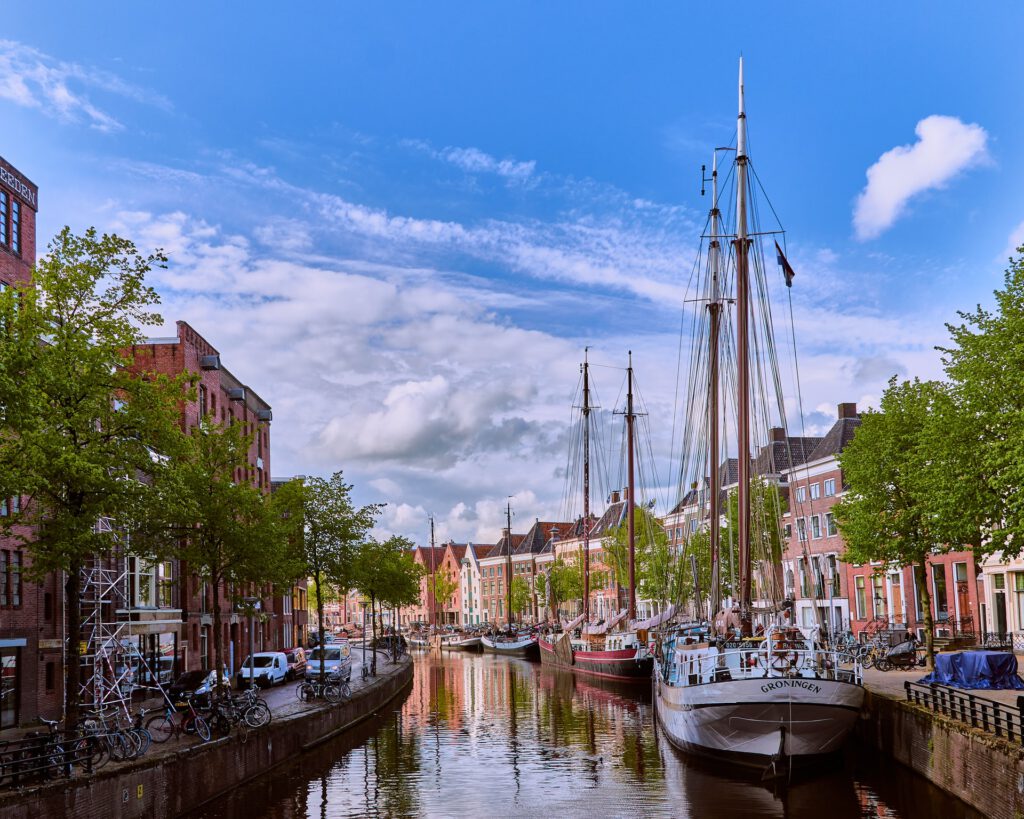
This city in the north of the Netherlands is the largest city in the northern region, and is already bustling with lots of students. Of course, this makes it an incredibly popular place to live in as a student. 👩🎓
It’s equally as appealing to the eye (the city centre was actually voted the best in the country for a few years). The university is a landmark in itself and is the second oldest in the whole country.
Who wouldn’t adore a view like this when commuting to class? Image: Unsplash
The city also has lots to discover and ranks high when it comes to places to study. PLUS, it also has great nightlife if you’re a party animal.
It’s one of the oldest universities in the country (est. 1614) and is known for its female success: having hosted the first female lecturer and first female student — and even the first Dutch astronaut! 💪
Amsterdam
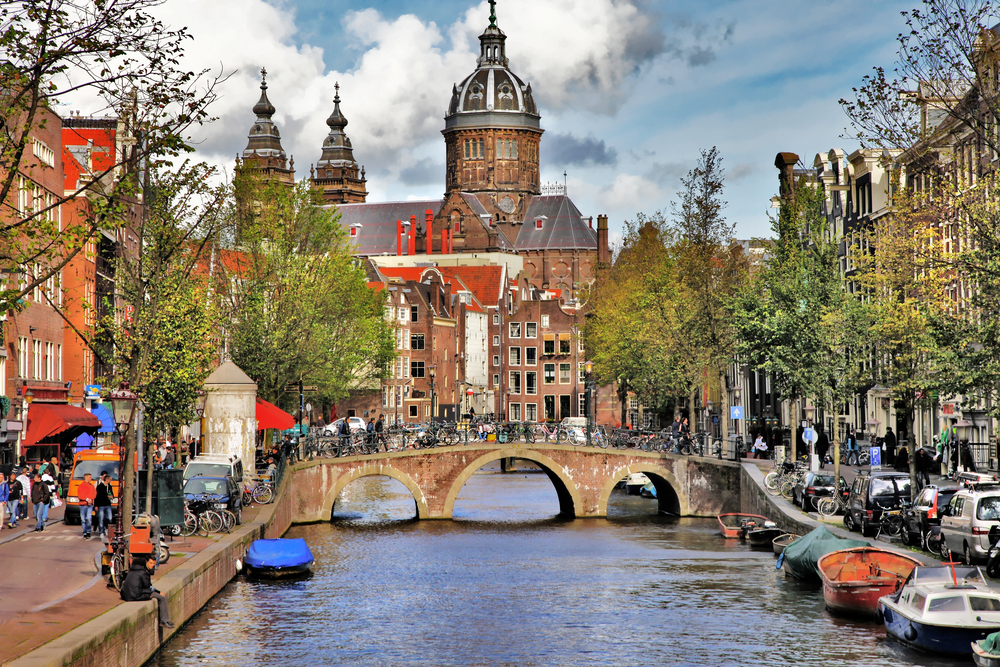
Amsterdam is an obvious choice, being the Dutch capital and all. It is much loved for its museums, canals, picturesque scenery and, of course, there are plenty of things to do.
Amsterdam actually has the 2nd highest-ranked university in the whole of the Netherlands (The University of Amsterdam), and it’s the country’s largest university.
It also ranked in the top 100 in the world for the best student cities. And yes, there are also plenty of courses taught in English (although this has been heavily criticised. 👀)
You can find loads of university buildings scattered around the capital! Image: Depositphotos
If going out is your thing, there is plenty of nightlife in Amsterdam, but entry to a lot of the clubs is pretty pricey (€10 – €15 — ouch for students).
If culture and history are more your thing, then you’re in luck. From the Anne Frank House to the Van Gogh Museum, there’s plenty to learn about here!
Rotterdam
Rotterdam, being the second biggest city in the Netherlands, is also bustling with lots of different people, from lots of different nationalities.
It has a large student community and is known for its large port, which is the biggest in all of Europe.
You won’t find a skyline like this anywhere else in the Netherlands! Image: Freepik
If you appreciate modern architecture and design, then this is the city for you. It has a rich history, one which resulted in mass damage during WWII.
As a result, Rotterdam used the city as a blank canvas to create an up-and-coming city vibe. It is the modern city of the Netherlands, and its architectural design is sublime.
It’s known for its multiculturalism, electronic music scene (the nights out are great) and its university: Erasmus University Rotterdam (72nd in the world— known for its business school).
Eindhoven
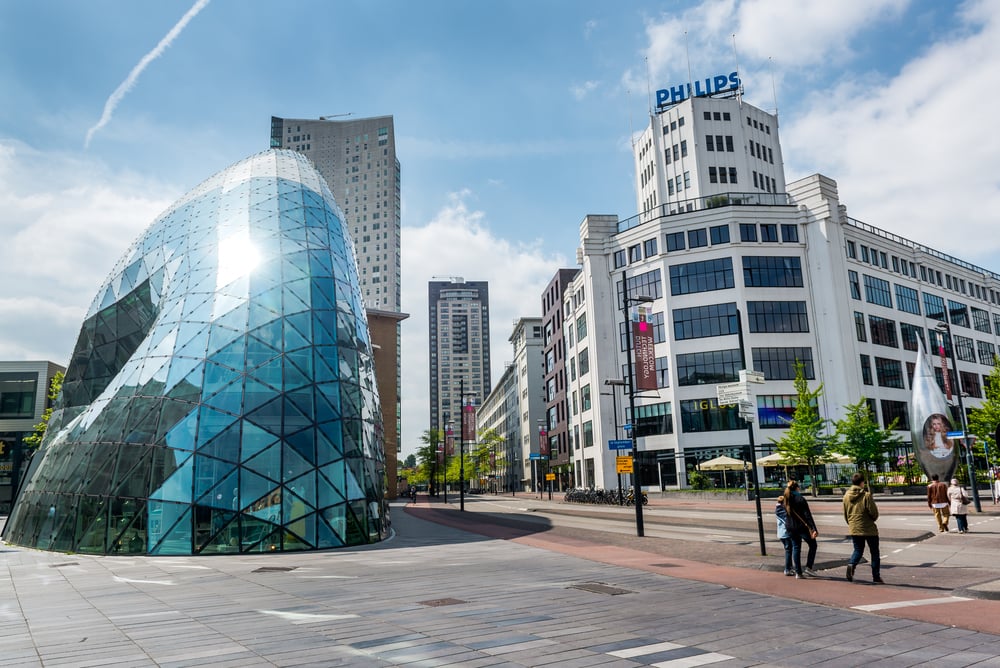
Eindhoven is another city which is really big on innovation, with lots to do. Home to the well-known brand “Philips”, the city is literally “lit up” with innovative spaces and buildings.
Eindhoven is the perfect student city if you’re craving an innovative vibe. Image: Depositphotos
This city is a hub for technology and engineering, which is represented through the Eindhoven University of Technology, which ranks highly among the world’s universities.
Eindhoven itself is also a lovely city, with lots going on. The nightlife isn’t too shabby either, and there are plenty of places to explore.
There is even an international airport there (which usually has cheaper tickets than Schiphol), so it’s easy and cheap to get home if you’re a flyer!
Delft
Delft is a beautiful small city located between the Hague and Rotterdam. Its sports all of the picturesque canals, Dutch houses and cobbled streets that you could ask for.
For this reason, it is seen as a very scaled-down version of Amsterdam — minus the hoards of tourists. The city also has an incredibly rich history and is a true ‘postcard Dutch city.’
Delft looks straight out of a fairytale. 🧚♀️ Image: Unsplash
If mathematics and computer sciences (and anything to do with technology) are your thing, then this is definitely a university to consider.
It is also one of the top universities for architecture. The campus is large, considering how small Delft is, and the university is extremely popular amongst international students.
The Hague AKA Den Haag
The Hague is often described as the ‘should-be’ capital of the Netherlands as it is home to the International Court of Justice, embassies and the government.
The Hague is a large city, close to Rotterdam, Leiden and Amsterdam — so it’s an ideal spot to get around Holland.
Look at that skyline! Image: Kevin Coellner/Supplied. You can check out all of Kevin’s photos of The Hague in our article here!
If you’re after a multicultural city, rich with history and culture, then this may be the city for you.
There are lots to do in the Hague, including (but not limited to), shopping, visiting the Binnenhof (home of the government), the Peace Palace and the Noordeinde Palace (home of the royal family).
Let’s not forget the beach nearby in Scheveningen— because who doesn’t love a good zwemmen day in the sea? 🏊♀️
The most popular institute in the Hague is the The Hague University of Applied Sciences. This is a hoogeschool rather than a university, so it offers hands-on profession-orientated programmes. If science and culture are your thing, then this might just be the place to be.
Besides that, Leiden University also has a campus in The Hague, and offers some of its courses from there.
Tilburg
Tilburg is another city with plenty going on in it. All year round, there are loads of events happening, especially in the summer, when festivals often take place within Tilburg.
Despite Tilburg being known as a less-popular place to live in the Netherlands for expats, it’s rapidly turning into the go-to place and is now especially popular with students.
Tilburg has a large student population, and there is always a lot to do within the university. The nightlife and cultural activities are affordable, and the city’s location puts you in an excellent place to travel (relatively cheaply too).
Utrecht
Utrecht is one of those underrated cities of the Netherlands. It’s another traditional picturesque Dutch city, with more of those canals that we all love. It is also a great place to shop, eat and have a drink on the terraces.
Utrecht has some awesome architecture. Image: Pixabay
It’s also in quite a central location, so it’s literally perfect if you want to go anywhere in the country in a reasonably short time.
Utrecht University is also an excellent research university, with many student societies and activities. It hosts one of the oldest universities in Europe (est. 1636) and is one of the largest universities in the Netherlands — so you can be sure that the student life will be in top form.
The nightlife is said to be good in Utrecht too, so that you can wind down with a drink (or ten 😉) after a hard day of lectures.
Maastricht
Maastricht is a beautiful city that is right in the tail of the far south. Since it borders Germany and Belgium, it’s easy to escape the Netherlands if you’d ever want to.
For this reason, Maastricht is very diverse, and when you visit, you can tell that it’s different to most other traditional Dutch cities.
A view of Maastricht from the river. Image: Unsplash
The region also is hilly, which is weird as hell, knowing that most of the Netherlands is completely flat. But before you panic: it’s still bike-friendly, so don’t worry!
You can be sure that, if you go here, you will be amongst a diverse set of people.
Any other student cities in the Netherlands?
There are plenty of other places to go in the Netherlands for your studies. Here is a list of some of the other cities you can enjoy your studies in. There are just too many to choose from, eh?
Some others include:
Dordrecht — famous Da Vinci College, perfect for design lovers
Arnhem — lots of internationals, perfect for sciences
Wageningen — loads of English-speaking courses, perfect for internationals
And there are many other cities with universities, but the ones listed in the article are definitely the most popular ones.
The only issue now is actually getting a place — it certainly isn’t easy. You’re going to need this article for that. Good luck with your move! 🥳
Do you know any other student cities in the Netherlands? Which is your favourite? Tell us in the comments below!
Almost all students are looking for ways to finance their studies in the Netherlands — and preferably spare a little extra cash for drinks. 🍻
But here’s a tip: if you study in the Netherlands, you might not even realise how much money you could be missing out on.
The Netherlands offers an aid system to help students finance their studies — and it’s not limited to Dutchies.
This is the complete guide to student loans, financing, and scholarships in the Netherlands to get those benefits, stash some cash, and gain some financial knowledge. 💸
Looking for a specific type of student financing? Skip to a section below.👇
Compared to some other countries, the Netherlands can be extremely affordable when studying abroad. But that’s not to say that Dutch university education is cheap.
It’s important to start thinking about your financial situation before you start studying and what steps you need to take to finance your studies in the Netherlands. Image: Depositphotos
How expensive your study will be and how much funding you can get for it is dependent on one major classification: whether you’re an EU/EEA/Swiss student or not.
The difference between EU/EEA and Swiss students and non-EU/EEA students
Now, you might be wondering what on earth EU/EEA means and whether it applies to you.
Tuition fees and student finance in the Netherlands differ if you are from the European Union (EU) or the European Economic Area (EEA) or from a country outside of these areas.
EU, EEA, and Swiss students
You’re an EU/EEA student if you are a national of:
Belgium, Bulgaria, Cyprus, Denmark (excluding the Faroe Isles and Greenland), Germany, Estonia, Finland, France (including French Guiana, Guadeloupe, Martinique, Mayotte, La Reunion and Saint-Martin), Greece, Hungary, Ireland, Italy, Croatia, Latvia, Liechtenstein – (EEA), Lithuania, Luxembourg, Malta, the Netherlands (excluding Aruba, Curaçao, Sint Maarten, Bonaire, Sint Eustatius and Saba), Norway, Austria, Poland, Portugal (including the Azores and Madeira), Romania, Slovenia, Slovakia, Spain (including the Balearic Islands and the Canary Islands), Czech Republic, Iceland, or Sweden.
Switzerland is not an EU/EEA member state, but Swiss nationals have the same rights of residence as EU/EEA citizens.
Non-EU and EEA students
If you do not have a nationality on the above list, you are a non-EU/EEA student.
If you are from the EU/EEA, you can access most Dutch student financing that local students receive.
On the other hand, if you aren’t an EU/EEA national, you won’t qualify for student financing from the Dutch government. You still have a few options to finance your studies, such as getting a part-time job or applying for scholarships.
EU/EEA students: loans, financing, and scholarships
Yep — even if you aren’t a Dutchie, EU/EEA and Swiss students can still apply for student finance if they study in the Netherlands. Here’s how!
Student financing (studiefinanciering) from the Dutch government
Student financing is a form of student aid offered by the Dutch Ministry of Education and Culture (DUO).
DUO handles everything to do with studying in the Netherlands, including enrolling for higher education and registering your diplomas and qualifications. There are some baseline requirements you need to meet to be eligible for student financing:
You are a Dutch national, have the same rights as a Dutch national, or are an EU/EEA/Swiss national,
You are registered for a full-time or dual degree programme in the Netherlands in a research-oriented university (WO) or a higher professional education university (HBO),
Don’t mind us, we’ll just be checking if we fit all the requirements for student financing. 😬 Image: Freepik
There are four main types of Dutch student financing:
a supplementary grant,
regular loans,
tuition fee loans, and
a student travel product.
Keep in mind that not everyone is eligible for all four, as each type has some additional requirements to qualify.
So what are they? Let’s take a look!
Supplementary grants
The supplementary grant is a sort of monthly allowance the Dutch government gives you for your monthly living expenses.
This grant can get you a few hundred euros for your monthly budget, depending on your personal situation.
You’re free to spend it how you like — so whether you want to spend it on groceries, textbooks, or just beers on a night out, it’s up to you!
Having that extra bit of money is always welcome — it definitely makes a difference for your weekly borrels. Image: Depositphotos
The best part is that the supplementary grant is a “gift” from the Dutch government, meaning you don’t have to pay it back if you graduate within 10 years of studying.
However, you only qualify for this supplementary grant if your parents’ total income is less than €50,000 per year.
“What do you mean ‘regular’ loan?”Well, despite the name, a regular loan is similar to a supplementary grant.
You can apply for a loan through DUO and adjust how much money you borrow per month. The money will be given to you every month as a secondary allowance.
The key difference between a regular loan and a supplementary grant is that taking out a regular loan will incur student debt. You then make payments on this debt after your graduate.
Deciding to take out a regular loan is a bigger responsibility. Image: Depositphotos
There are a few requirements you need to meet to qualify for a regular Dutch student loan:
You need to be an EU/EEA or Swiss national
You have lived in the Netherlands for at least five years, or you are working at least 56 hours per month.
It’s important to know that if you want to eventually buy a house, start a business, etc., in the Netherlands, your student debt will be taken into account when your bank calculates your borrowing potential and interest.
Tuition fees loan
Tuition fee loans are for — you guessed it — your Dutch tuition fees (and your tuition fees only!)
Like a regular loan, you also have to pay back your tuition fees loan after graduating.
But luckily, the interest rates for tuition fees loans are low (typically less than 1% per year). Super!
If you’re eligible for student financing, you need to meet a few requirements to qualify for a tuition fees loan:
You are under 30 years old
You come from the EU/EEA or Switzerland
You study full-time or a dual course at a higher professional education university (HBO) or research-oriented education university (WO)
You pay tuition fees in the Netherlands
DUO can give you more information about applying to finance your study in the Netherlands this way.
Student travel product
This type of student financing is for those travel buffs out there! The student travel product means you can use Dutch public transport with a huge discount.
The student travel product tends to be the most common form of student financing non-Dutchies get.
Students can choose between a weekend or a weekday subscription for their student travel product.
If you choose a weekday subscription, you can travel for free on weekdays and 40% off on weekends.
The weekend subscription has it the other way around.
The student travel product lets you travel on any and all forms of public transport for free — just not in first-class cabins. 😅 Image: Depositphotos
If you’re an EU/EEA or Swiss national, you need to meet the following requirements:
You follow a full-time study programme at MBO (vocational education), HBO, or WO level. Even if you are under 18, you will get a student travel product
You must be younger than 30 when the student travel product starts.
You, or your non-Dutch parent or partner from the EU/EEA or Switzerland, have lived in the Netherlands for five consecutive years or longer.
And lastly, if you have a Type I residence permit (you can check this on the back of your ID card), use this handy tool by DUO to see whether you’re eligible for the product.
How to apply for student finance in the Netherlands
So you’re applicable for student financing — hoera! 🎉
Now, how do you actually get student financing for yourself?
To apply for any student finance type, you typically need a valid residence permit and a BSN (citizen service number). Your local municipality will give you a BSN after you register in the Netherlands.
To apply for student finance:
Log on to the DUO website. You’ll need your BSN and DigiD to prove your identity.
Go to “Mijn Producten” (My Products) then “’Studiefinanciering” (Student Finance)
Click on “Studiefinanciering” at the top right of the screen.
Find the “Nu aanvragen” (Request now) section for each type of student financing.
Select the type of student financing you are eligible for and fill in the relevant details DUO asks you for.
Warning! Make sure to sort your student finance in DUO before the first day of the month that your study begins (the government recommends three months before). Otherwise, your payments may be delayed. 😬
Scholarships to study in the Netherlands for EU/EEA students
If you aren’t eligible for student financing or just want an opportunity to get free money while you’re studying in the Netherlands, there are many scholarships available to EU/EEA students. Here are some of the most common ones.
You’ll meet plenty of students in a similar situation on your trips abroad! Image: Depositphotos
Erasmus+
The Erasmus+ Programme is one of the most popular scholarships in the Netherlands (and is not to be confused with the Dutch university, of course!).
It’s intended to help both EU/EEA and non-EU/EEA students find the perfect destination for a study exchange or a traineeship in the EU.
Each university has a different way of providing scholarships to its students who go on a study exchange in Europe, and their requirements vary per university.
It’s best to consult with your study/exchange advisor to see the exact requirements and if you fit into them!
Hundreds of universities across Europe participate in the Erasmus+ programme, which makes studying abroad super accessible. You can be at any level of higher education to apply. It’s an offer you simply can’t refuse. 😍
Erasmus Mundus Programme
This programme is intended for EU master’s students. With an Erasmus Mundus scholarship, you must study in at least two countries as part of the programme for one to two years.
You need to have a bachelor’s degree at a recognised level, and all of your costs (tuition fees, travel costs, study material, and more) are covered!
Loans, financing, and scholarships for non-EU/EEA students
If you are a non-EU/EEA student, there’s bad news: you probably don’t qualify for regular loans, tuition fee loans, or supplementary grants in the Netherlands.
But don’t let that discourage you!
There are other ways to finance your Dutch studies yourself, starting with private loans and scholarships.
Taking out private loans
Because only Dutch, EU/EEA, and Swiss can take out a tuition fees loan, non-EU/EEA students typically have to take out private loans.
If you’re interested in taking out a private loan, you should contact your university’s student advisor to see how this works and whether you’re eligible to take out a private loan from your Dutch bank.
Consult with your bank as soon as possible if you’re thinking about taking out a private loan. Image: Depositphotos
You have to pay back this type of loan with interest after you graduate, but the catch is that it tends to have a higher interest rate (between 8-13%).
This is a much higher interest rate than the regular loan a Dutch, EU/EEA or Swiss national can take out in the Netherlands.
If you don’t want to incur student debt or feel like you have a great CV to show off, applying for a scholarship is another option — and it might be more up your alley.
Scholarships to study in the Netherlands for non-EU/EEA students
As a non-EU/EEA student, you might find yourself feeling a little more pressed for money (international tuition fees are no joke).
If you’re looking for other forms of student financing, the Netherlands has plenty of scholarships you can apply to, but you typically face some tricky competition.
Applying for scholarships can be a complicated business — but there’s a huge payoff once you get everything handed in! Image: Freepik
Here are a few popular scholarships for non-EU/EEA students in the Netherlands.
Erasmus+
We mentioned it before, but this is a really good one! The Erasmus+ Programme is a scholarship for all students to fund their study exchange or traineeships abroad in the EU.
Many higher education institutions in the Netherlands participate in this programme and have different requirements to join. It’s best to ask your study/exchange advisor to determine whether your university takes part and what the requirements are.
You can study in one of a hundred partner universities across Europe for your exchange or traineeship, and the scholarship can cover a lot of your costs — what’s not to love?
MENA Scholarship Programme
This scholarship is intended for young professionals from the Middle East and North Africa to take short courses and training in a specific field of their choice.
The Holland Scholarship
The Holland Scholarship is a one-time grant of €5000 in your first year of university, available to non-EU/EEA nationals.
Many research universities and higher professional education institutions participate in the scholarship, so you might find your university there too!
The Orange Tulip Scholarship
Also known as the OTS, this scholarship is available for non-EU nationals from NESO countries (Netherlands Education Support Offices).
Earning a scholarship is a great relief if you’re a non-EU/EEA student in the Netherlands! Image: Depositphotos
How to find scholarships to study in the Netherlands
The scholarships above are just a handful of many available to EU/EEA and non-EU/EEA students — there are hundreds of scholarships waiting for applications out there!
Your university might also have specific scholarships for their students available, so be sure to check out what your university can offer you as soon as you can. 🏃🏻
You can usually contact your study programme’s student advisors to help you find appropriate scholarships and finance your studies in other ways.
How to apply for scholarships to study in the Netherlands
Each scholarship has its own requirements and methods to apply, but typically you’ll need to:
Find a scholarship online or via your university
Take note of the requirements, your eligibility, and the deadline for the scholarship
Prepare your documents; this usually consists of a valid ID (your passport or Dutch residence permit will do), proof of enrolment at your university, your incredible CV, and a fantastically written motivation letter
Submit your documents before the due date
Wait for the magic to happen! 💰
Student jobs in the Netherlands
If you aren’t entitled to student financing, loans, and scholarships in the Netherlands, there’s another way you can finance your studies: student jobs!
We get it, though; you might be concerned about work-school-life balance.
Handling studies, your social life, a side job, and your sleep can be a real challenge — but it’s not impossible. Image: Depositphotos
A student job is almost always part-time, meaning you can work minimal hours and schedule around your study commitments.
A bonus is that you often don’t need to speak fluent Dutch (or at all).
This will probably come as a relief to internationals, but trying your hand at learning and practising Dutch is something we’d recommend!
Best types of student jobs
There are a few student jobs you can find anywhere, regardless of the city you live in. For example, retail and customer service always need people to work part-time.
Retail stores 👕
Grocery stores 🍍
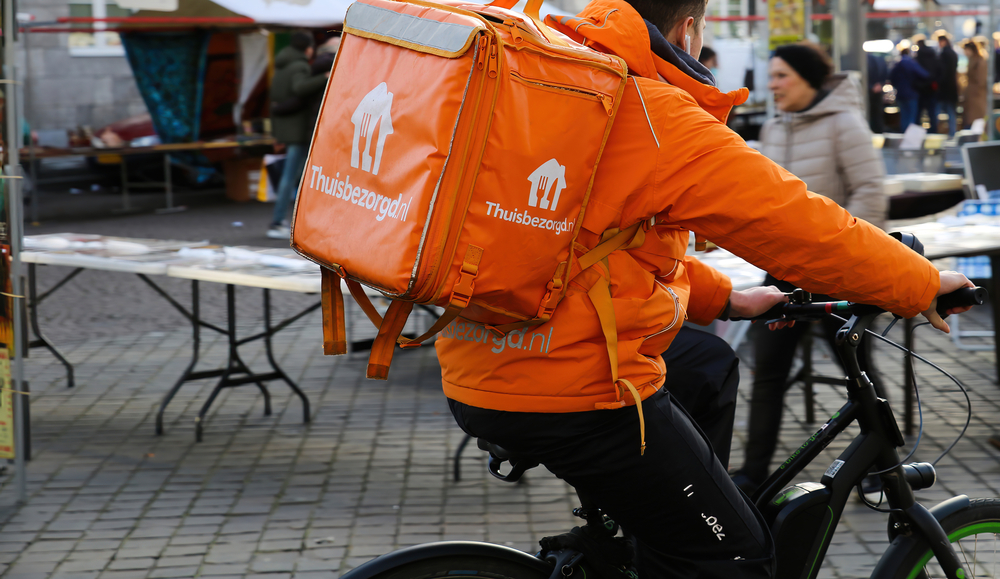
Bike delivery companies (UberEats, Deliveroo, Gorillas, etc.) 🚴♀️
Hotels (as a receptionist or housekeeper) 🏨
Call centres or help desks 📞
Your university 🎓
Restaurants or cafes 🥞
In a country like the Netherlands, it’s no surprise that one of their most common student jobs is delivering food on bicycles! Image: Depositphotos
How to find a student job
Your university is a great place to start looking for a student job to finance your studies. They may have some connections to employment agencies or a student portal to see their vacancies around the city.
You can also google for student jobs in the Netherlands or your city or check websites like Indeed or Glassdoor.
If you are an EU/EEA or Swiss national, you do not need a work permit, and there is no limit to how many hours you can work while you’re studying.
But if you aren’t an EU/EEA or Swiss national, there are a few restrictions. If you live in the Netherlands on a student visa, you need to confirm your working permissions with the immigration office of your university.
Typically, your employer has to provide you with a personal work permit. With this, you can only work for a maximum of 16 hours per week during the year, or full-time during the summer months (June, July, and August).
You and your potential employer can discuss your work permit and contract situation. Image: Freepik
However, if you are studying at a higher education institution in the Netherlands and need or want to complete an internship for your study, you do not need a work permit.
Instead, your host university, internship employer, and you can sign an internship agreement available through the Dutch Ministry of Social Affairs and Employment. If in doubt, it’s best to consult the Dutch government website for information on your specific situation.
Costs of studying in the Netherlands
There are a few key costs to consider when you’re a student in the Netherlands.
Tuition fees
Tuition is one of the major costs of studying at a Dutch university. The cost of yearly tuition fees depends on a few things:
Whether you’re an EU/EEA student or a non-EU/EEA student
Whether you’re applying for a bachelor’s or a master’s degree
If the university is private or public
What kind of higher education you’re doing (research-oriented vs higher professional education)
The type of study programme you are doing
So how much cash will you have to cough up?
On average, a student from an EU/EEA country pays between €2,000 and €4,000 per year.
A non-EU/EEA student pays between €6,000 and €15,000 per year.
TIP: The average higher education programme in the Netherlands tends to be shorter than most. Paired with affordable yearly tuition fees, students often pay less for their degree overall compared to their home countries! 🙌
Living expenses
Other than tuition fees, another big expense in the Netherlands is your housing and utilities.
Before moving to the Netherlands, you should know that it’s notorious for its housing crisis, especially for students. 😵💫
We’re not going to sugarcoat — the house hunting process can be long and stressful, but every student gets through it! Image: Depositphotos
Finding a house in your city at an affordable price can be a real struggle, especially if you’re on a time limit. Your monthly rent will depend on a few factors, including:
Which city and neighbourhood you’re living in
If you want to live alone or with other people
If you live in student housing or private accommodation
Whether the rent price includes utilities (gas, water, and electricity, or GWL in Dutch)
An average student room is between €500 and €800 a month. On the extreme ends, students can rent rooms from as low as €350 to as high as €1500 per room. 😬
Food
As a student, you can get by shopping once or twice a week at most. Depending on which supermarkets or grocers are available, you can get basic groceries for €50 to €60 per week.
Travel
It’s easy to keep your travel costs down in the Netherlands because it’s super bike-friendly. A good bike will set you back around €100 and is the main form of transport for, well, everyone!
Unlike housing, finding a perfectly affordable second-hand bike in the right size is MUCH easier! Image: Depositphotos
For longer distances, Dutch public transport is also exceptionally good and a fraction of the cost compared to Ubers or taxis. Owning a car as a student in the Netherlands is practically unheard of.
School supplies
Most Dutch universities have deals with publishers to print university textbooks at an affordable price.
This means you’ll typically only pay between €20 and €50 per textbook instead of €100+.
Don’t worry— not every university class makes you buy a new textbook, so we guarantee you won’t be looking like this. Image: Freepik
Other costs may include notebooks, writing tools, and licences for certain software (think statistics or Adobe Systems). If your teacher requires these, check in with your university: they can provide them cheaper than on the general market.
How to save money when studying in the Netherlands
Apart from student financing, loans, and scholarships, there are a couple of things you can do to copy Dutch stinginess and save money to pay for your study in the Netherlands.
Buy your textbooks second-hand
Many people sell their textbooks second-hand online on websites like Facebook Marketplace or on Bol.com (the Dutch version of Amazon).
There’s also a good chance your university or study programme association has a website where you can buy second-hand textbooks or new textbooks at student-friendly prices.
Some study programmes organise book trades where students can directly buy books from each other. It’s a great way to meet other students and make connections too. 😉
Rent just a room instead of your own apartment
You’ll be hearing this a lot, but we can’t say it’s wrong — accommodation and housing can be really expensive. When you’re on a house hunt, you’ll find listings for rooms instead of entire apartments more often than not.
Renting a single room in a bigger apartment is a massive money-saver, especially since you can split the utility bill and other housing costs with your housemates. If you meet other students at your university, it’s also a chance to move in with people you know!
Finding a house with other students is a great way to save money, meet people, and experience real university life! Image: Depositphotos
Housing agencies cover listings in plenty of student cities, so it’s only a matter of time and patience (and luck! 🍀) to find accommodation that suits your needs.
Apply for government discounts
There are a couple of government allowances you can apply for when you move to the Netherlands, which will save you a decent amount of cash.
These discounts usually don’t have to be paid back even after you graduate, but you need to check your situation’s exact requirements and qualifications.
Save on your travel costs
You have a few options for saving money and travelling. It’s good to know exactly which kind of ticket you need to travel around (so you don’t accidentally pay too much for what you need).
Being a student in the Netherlands will teach you all the neat tips and tricks to travelling on a budget! Image: Depositphotos
The Dutch train service (NS) offers all kinds of discount subscriptions you can buy to travel at a fraction of the cost.
If you’re feeling extra adventurous and want to explore the Netherlands while studying, the NS has a website for the best and cheapest train trips around the country!
Shop the sales
If you want to learn something about shopping sales, the Dutch are the masters.
Your local supermarket will have weekly discounts for certain products (just grab a membership card), and you can save a lot of money.
TIP: Keep an eye out for 1+1 labels — these labels let you buy one product and get the second one for free! They’re a big deal in the Netherlands, and you can find them everywhere.
If you want to save even more money, shopping at a local market can save you a ton of money on produce — and it’s nice to help local businesses thrive!
Meanwhile, plenty of shops and restaurants in student cities have student discounts available. For example, you can often get a 10% discount on your purchase if you show your student ID at a bookstore or clothing shop.
Take advantage of the few perks you get while you’re a student! Image: Freepik
If in doubt, ask an employee if they give student discounts and keep that ID of yours in hand!
And that’s your complete guide to student financing, loans, and scholarships in the Netherlands.
Hopefully, you’re feeling more knowledgeable about your financial options and how to best fund your studies!
Do you have any tips for how to finance your studies in the Netherlands? Tell us your thoughts in the comments below! 💭
Editor’s Note: This article was originally published in April 2022, and was fully updated in August 2022 for your reading pleasure.
Student finance, loans, and scholarship in the Netherlands: frequently asked questions
How much is student financing in the Netherlands?
EU and EEA students can get student finance for supplementary grants, tuition fee loans, regular loans, and travel discounts. There is a maximum amount you can get for each component of student financing per month.
Students can get up to €419 per month for a supplementary grant. A tuition fee loan can offer up to €184 per month and €513 per month for a regular loan. The amount depends on your personal situation.
Can international students get student loans in the Netherlands?
If you are an EU/EEA or Swiss national, you might be able to take out a loan for your studies. Keep in mind that there are specific requirements for students who want to do this, which also depend on whether you want to take a regular loan or a tuition fee loan.
If you are non-EU/EEA, you aren’t eligible for either of these loans from the Dutch government. Instead, you can contact your university’s student advisor to take out a private loan from your bank in the Netherlands.
Does the Netherlands offer student loans?
The Dutch government offers student loans, but these are usually only available to Dutch, EU/EEA, or Swiss nationals. However, there are some situations where other students might be entitled to take out a student loan.
Is education in the Netherlands free?
Higher education in the Netherlands isn’t free, but it’s considerably affordable compared to some other countries. However, most Dutch primary and secondary schools are free (except for some private schools).
Looking for a new place to stuff your face in throughout 2026? Want somewhere trendy to explore?
The food lovers here at DutchReview roamed the capital to try out some incredible places. Here are some awesome Amsterdam hotspots which will really satisfy that hunger
1. NOMADS
Twice a year, NOMADS “changes” to a different location. Not only does the menu change but so does the interior design of the restaurant. As a Portuguese, seeing photographs of the streets of Alfama and our typical blue tile in a mural in the bathroom was heartwarming.
But tasting the food was the most important. A Portuguese person judging Portuguese food abroad? There is nothing we hate more than people trying to replicate our local food and failing miserably — particularly with the Pastel de Nata.
The interior is sleek and modern — fit for Portuguese food with a twist. Image: DutchReview
NOMADS was a breath of fresh air. Instead of replicating local dishes, the chefs develop the dishes further and give them a special twist. The key elements in each dish made me feel at home, and the added twists made it truly a culinary experience.
We had a four-course meal, accompanied by a bottle of white Serras de Azeitão from Setúbal. For the first course, we had baby octopus salad, bread with sesame butter, asparagus cooked three different ways (wow!), Pasteis de Bacalhau (codfish pastries) and oysters with cucumber gel.
Everything was great, particularly the octopus salad and the Pasteis de Bacalhau. These are staple dishes in Portuguese culture, and I am glad they were not forgotten. The oysters were the best part of this course; they literally tasted like the sea.
We were very well-fed at NOMADS! Image: DutchReview
For the second course, we had some lovely mackerel and a bacalhau à brás that was different from what I had seen. This classic dish is essentially shredded codfish with scrambled eggs.
At NOMADS, the bacalhau à brás is topped with a milk foam infused with codfish.
However, under the foam is a Bacalhau à Brás that tastes exactly like it has been cooked by a Portuguese grandmother.
You would think we would be heading to dessert, but no. They do dinner the Portuguese way — lots of food.
For the third course, we have some Arroz de Marisco (seafood rice), which the waiter kindly pronounced to the best of his abilities, and oxtail.
The arroz de marisco even included clams — another Portuguese staple. The oxtail dish was incredible — the tail cow meat was tender and perfectly cooked. It really paid a tribute to the amazing meat dishes in Portugal.
Authentic Arroz de Marisco a la NOMADS. Image: DutchReview
For dessert, we got a treat from home. The Pastel de Nata that is so hard to replicate was by far the most authentic I have eaten outside of Portugal.
It could not beat the original “Pasteis de Belem” as it follows an ancient recipe from the Jerónimos Monastery. Still, it would surely beat a lot of well-established bakeries in Portugal.
We also had a “rice pudding”, a take on the classic “Arroz Doce”, a dessert my grandma makes all the time. The pudding’s consistency and taste were perfect, which is hard to do with just milk and rice.
It is usually topped with cinnamon, but the chefs at NOMADS innovated again by adding raspberries, blackberries, blueberries, and fruit-infused foam.
The Pastel de Nata was authentic and delicious. Image: DutchReview
It was a great experience. NOMADS made us feel like we were back in our mother’s kitchen in Lisbon. If a Portuguese tells you where to eat good Portuguese food, trust them.
Shortly after a trip to Italy, I was dying for a pizza that had some love in it. Frankly, I was done with the likes of Dominos (that’s definitely not worthy of being ‘Italian’ at all) and wanted something that really got my taste buds going.
Toni Loco is the new kid on the block and offers pizzas of all sizes and toppings. For a perfect snack at lunch, you can buy a single slice, or you can get a super-sized pizza.
Pizza at Toni Loco, a damn fine hotspot if ever we’ve seen one in Amsterdam. Image: DutchReview
This pizzeria restaurant is modern and trendy and gives the atmosphere of Mama’s kitchen. You can watch them make the pizzas by hand. After that, it’s all yours to enjoy!
I opted for a bit of everything as I couldn’t decide. My absolute favourite was the tuna and red onion pizza, mouth-watering (never diss tuna on pizza until you’ve tried it).
Watch the whole Toni Loco process as your dream pizza becomes a reality. Image: DutchReview
We chose a sesame crust, which I’d never tried before (I thought I would hate it). However, it was delicious and left me wondering why no one else does this.
When I asked about it, they said that Dutch people didn’t ever seem to eat the crusts on pizza, so they did this to encourage them to eat the whole pizza. I’ve always loved the crust, but now I love it a little bit more.
Big enough for four. Maybe big enough for two really hungry customers. 😉 Image: DutchReview
What makes this hotspot even better is a wide selection of champagnes to sip alongside your pizza. So if you’re looking for something more classy than vanilla coke (gross), then this is the perfect opportunity to get a glass or two of bubbly in.
The serving plate shows you just how huge their pizzas can get! Image: DutchReview
Verdict: Overall, I loved the food, I loved the champagne, and I loved the hospitality. You can also order and have it delivered to your door (#blessed).
Looking to impress a hot date but don’t want to break a sweat? Well, here’s a cosy little nook that will do all your charm for you. Vanderveen Bar and Restaurant is managed by Fabio, with Luca at the bar, and a dynamite team of five chefs who make their mark in fine dining.
This hotspot will leave you full and happy. The same chefs that do breakfast and lunch have also mastered fine dining in the evening. The staff at Vanderveen are cut from the same very special cloth, and at very reasonable prices.
“I’ll see your cheeseburger and raise you salmon tartar”. Image: DutchReview
This hidden gem can be found in southwest Amsterdam on Beethovenstraat. Upon entering, it’s immediately visible that they’ve got enough space for heaps of people.
The front end has a communal vibe, as if you’ve just come in for a game of chess and a coffee. Out the back is where the wining and dining happens, the real magic.
Their wine menu boasts imports from South Africa, Portugal, Italy, France, and Australia. No shortage of choice at Vanderveen. Image: DutchReview
Knowing that Fabio and his chefs had kept a cheeseburger on the menu, my stomach ordered for me. He smiled and agreed it would fix any hunger I had. For the sake of taste, we agreed the best starter was their refreshing chilled salmon tartar. Grazing the dinner menu, I kept getting distracted by the wine selection.
With wines from Australia, Italy, France, Portugal, and even further imported by their next-door neighbour, it wasn’t long before Luca suggested one. We went with the white wine from Deakin Estate Australia — perfect.
The duck is sublime, let no one tell you different about this hotspot in Amsterdam. Image: DutchReview
The duck took its final form, drizzled in a seductively sweet orange reduction. The cheeseburger? Well, it was delicious, my girlfriend joined me, and she doesn’t like any burger — well, she loved this one.
When it came time to depart, Luca, the bartender, asked if we’d like coffee, agreeing two espressos were the perfect end to a cosy evening at Vanderveen. Talking with Fabio or Luca for a few minutes, it’s plain to see they love good food and good wine.
Olive oil, made and owned by Fabio’s family, is yours to try at Vanderveen Bar and Restaurant. Image: DutchReview
More impressive still is that Fabio’s family has made their own olive oil for generations. It is available to try right now, so if you’re looking to get out of the cold and relax with some good company, Vanderveen on Beethovenstraat is the place.
The music you’ll hear in Vanderveen is reason enough to step in for a hot cup of coffee on a snowy Sunday. They’ve created seamless playlists for morning, noon and night.
If you’ve gone looking for traditional Dutch flavours or an elegant spot in the city centre, De Rode Leeuw is where you will end up. If you love a good bit of steak or you’re a fan of culinary exploration, take a trip to central Amsterdam and let your tastebuds melt.
De Rode Leeuw is spacious and relaxing with that Amsterdam energy just outside. Image: DutchReview
The mix of modern and traditional Dutch cuisine is seamless, a good portion of the menu is reasonably priced, and the atmosphere is electric. The starters were deliciously simple, a poached egg showered in five spices, and served in a glass. From the appetizer, it only gets better.
After two years of renovating, they still provide a lovely dining experience. Image: DutchReview
The former tram depot in Amsterdam known as “Food Hallen” is where you’ll find one of Amsterdam’s most stylish hotspots. The interior of the Kanarie Club’s design is made up of materials and colours inspired by the different activities that took place in the hall, such as woodwork, metalwork, and painting.
Different zones make the hall into a café where you can work, a cosy restaurant and a beautiful cocktail bar. With the film and food halls in the Kanarie Club’s backyard, this old tram depot in Oud-West is rightly one of the most popular work spots in Amsterdam.
With plenty of seating in Food Hallen, you can bring as many friends to Kanarie Club as you like! Image: DutchReview
Drinking with a large group at Kanarie Club
Kanarie Club not only offers a nice spacious bar (including cocktails and bar bites), but it is also centrally located and is ideal for large groups.
The bar bites offer an excellent variety, and there is always something for everyone. There is also the possibility of playing a game of beer pong with colleagues and/or friends. The famous Kanarie Club pool bar serves as a playing field for beer pong.
The fresh bites and good atmosphere is hard to beat. Image: DutchReview
Besides beer pong, there is also enough space to have a drink or celebrate with a nice group of friends. Kanarie Club has introduced the “Bird-Day Box”.
This box contains all the necessities to celebrate a good party with your friends. The box can be reserved for groups of 10 people or more.
What do you get? A cask of beer, two rounds of the famous Dutch bitterballen, balloons and a DJ at the weekend from 9 PM to play your favourite birthday songs for you.
The costs for the Bird-day Box are as follows: 10 people (€130), 20 people (€170) and 30 people (€210), etc.
The dishes are plated up so nicely, you almost don’t want to eat it! Almost. Image: DutchReview
The Kanarie Club isn’t just an ideal work spot for students, freelancers and those looking for a place to enjoy some quiet time or chill with friends and family. The menu is extraordinary, the atmosphere is nice, the staff cheerful, and the setting is as beautiful as one could expect.
Whether you’re there for breakfast, for flexible working, lunch, dinner, or just to drink cocktails: Kanarie Club remains one of Amsterdam’s best hotspots.