What are the best places to get vegan food in The Hague? In honour of vegans everywhere, we’re presenting you with our six favourite vegan cafes and restaurants in the beautiful city of The Hague.
Having lived in The Hague for over three years, I know my way around the vegan scene.
Each of these cafes will please both the consummate vegan and the carnivorous-but-curious: from fresh, exciting salads (they do exist, I promise) to traditional baked goods to mock meats, they’ll have everything your heart desires.
Veggies on Fire is perfect for when you want to celebrate something with a really special meal. It opens in the evenings, so it’s very much a dinner place, and reservations are recommended (though I have managed to eat there without one as well).
The servings are super generous, which is awesome, and contain a real variety of foods. Their desserts are delicious as well.
I also love it because it’s out of the centre of the city, on Beeklaan, but easily accessible by tram (or bike, if you want to work up an appetite beforehand).
If you want fast food, Maoz is the place to be. It’s mostly a falafel shop, selling fries, wraps, bowls and salads.
Located right on Plein, where a lot of people go for a drink in the evening in The Hague, it’s the perfect place to stop off to grab something quick and delicious.
My personal favourite is the falafel pita with mounds of Maoz’s delicious garlic mayo — plus fries. They have some incredible spicy sauces as well, along with pickled chilis for the brave among us.
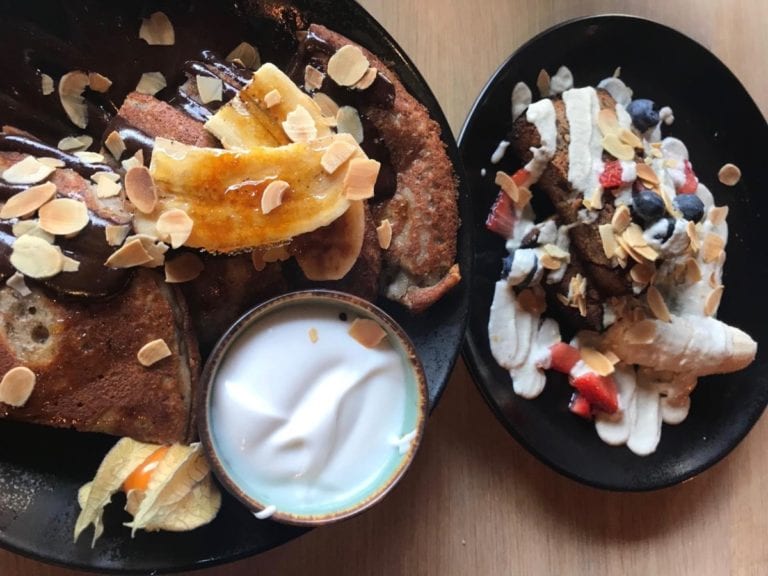
Freshly baked croissants, cinnamon rolls, soda bread (so crunchy! so chewy!) and chocolate cake galore — this is the place to come for a vegan baked treat or, even better, breakfast (and then brunch and then lunch and then afternoon tea).
The decor is also mind-blowingly good — think Scandinavian hipster with salt lamps and a postcard on each table that you can write while you wait for your food.
Please, if you do one thing with your life, it should be to eat here.
Vegan drinks in The Hague? Hell yeah. Image: Freepik
I have such a soft spot for Quench, because it was the first place I found vegan croissants at in The Hague.
Other cafes have them now too (as I’ve mentioned above), but I can still remember the bliss of crunchy, flakey goodness I experienced there.
Quench, as the name suggests, actually specialises in drinks. It’s really like walking into Willy Wonka’s Chocolate Factory, but for vegan beverages (alcoholic or not).
They also do an amazing selection of homemade bagels.
The Conscious Kitchen is an incredible place. Located on Witte de Withstraat in The Hague, it opens every Thursday evening to feed people with food that would have otherwise been thrown away from the Haagse Markt.
Everything is vegan, and you pay what you think the meal is worth — most people pay about eight euros.
The food is collected, prepared and served by volunteers. It’s an amazing way to get to know people in your local community, as well, as many people come alone and are in the mood to chat.
So how can you regain control of that pesky piece of paper?
The good news is that even though managing your Dutch utility bills in recent years has proven to be a different ball game than usual, you can still save on energy costs in the Netherlands.
But let’s first understand why prices have skyrocketed in the first place before we dig into how to bring them down.
This post might have affiliate links that help us write the articles you love, at no extra cost to you. Read our statement.
Energy prices are skyrocketing: why?
The Netherlands, and the rest of Europe, have been in an ever-worsening energy crisis for the past few years.
In 2020, the winter turned out to be colder than usual, and with everyone penned up at home, people turned up the dial on their heaters. This resulted in greater energy demand, causing prices to rise. 📈
In 2021, the price hike continued, worsened by fears of diminishing gas stocks. Initially, the increasing costs were mostly felt by companies, but it didn’t take long before the average Dutchie (half a million of them, to be precise) began having trouble paying their energy bills.
Checking bills is never fun, but it can be made easier. Image: Depositphotos
The increasing motivation for ending the Netherlands’ dependency on Russian gas, coupled with a huge rise in energy bill costs, has made Dutch policymakers think — fast.
Psst! The lovely folks at PartnerPete are experts in hooking internationals up with the best utility providers in the Netherlands. They know a thing or two about saving on energy costs and can help you find the best deals — completely in English.
Dutch energy bills: understand your contract
If there’s one thing you understand when you look at your energy bill, it’s that energy prices are rising, and you see it reflected in the sum total of your utility bills.
We also know that in order to understand that frustratingly expensive slip of paper, you spend an unreasonable amount of time translating, googling, and maybe practising one or two Dutch swear words.
Keeping up with energy prices is one thing, but keeping up with Dutch contract language is a whole other ball game. Nevertheless, it’s important to understand how much you’re paying and for what.
We’ll give you a few minutes to run and check your energy contract. Image: Depositphotos
With continuously climbing energy prices, the most important thing to consider is whether you have a fixed or non-fixed contract.
With a fixed contract, the price you pay for energy is locked in, meaning you aren’t at the mercy of the market. However, if you want to terminate your contract prematurely, you’ll often have to adhere to a 30-day notice period and might have to pay a fee.
However, if you have a non-fixed contract, then the costs billed to you are calculated on the running market price. 🏃 In this scenario, we’d probably try to run ourselves — either from our responsibilities or to a new provider. (Please only attempt the latter, though).
As an international, changing energy providers and switching contracts is not always an easy feat. Luckily, we know someone who can help you navigate the Dutch energy market. ⚡
Meet PartnerPete’s ContractCoach
PartnerPete has developed a special service for internationals in the Netherlands that takes a three-pronged approach to tackle Dutch energy costs. Say hello to your very own ContractCoach! Now, what exactly can they do for you?
Translations
Firstly, the ContractCoach service offers to translate all the important documents you need to stay on top of your utility bills. Not only does PartnerPete help translate Dutch for non-Dutch-speakers, but they also help to make head and tail of the jargon.
Contract follow-ups
In the Netherlands, it is often beneficial to switch providers once a contract expires. This tends to happen once a year. But what also tends to happen is that people forget to follow up after the contract expires, leaving them stuck with their current provider.
A Contract Coach contacts you once a year to discuss all your various utility contracts, ensuring that you’re happy to stay with your current one or helping you make the switch to another.
Contract cancellations
If you do decide to switch to a new supplier, PartnerPete’s ContractCoach will ensure that your old one is terminated correctly. The same goes if you’re moving to a new house in the Netherlands.
Bonus feature: Energy Price Alert
As a new and improved feature, PartnerPete’s ContractCoach service now also includes energy price alerts. 🚨
This is perhaps the easiest way to reduce your energy bill in 2022. Anytime the energy rates drop below the one you have in your current contract, PartnerPete will notify you.
What’s more, your ContractCoach will inform you proactively with a better offer than what you’re currently paying.
You can then decide whether to make the switch or not — a thing you, of course, won’t have to do on your own. 🤝
Cocaine in the Netherlands is available, semi-popular, and relatively affordable.
In fact, the drug and country have a history together that goes way back.
In the Netherlands, there’s often a lot of talk about cocaine — in part due to raging gang wars in the major cities, and also in part due to its growing social acceptability (at least among certain classes).
So, here’s what you need to know.
Disclaimer: DutchReview does not support or condone in any form the use of any illegal drugs, including But hey, if you’re going to do it, you might as well be informed, right?
Cocaine, along with other non-medicinal drugs, is illegal in the Netherlands. This has been the case since 1912 when the Opium Law was passed.
However, because the Dutch government views the idea of a drug-free country as unrealistic, the use of most drugs in the Netherlands is tolerated — which is where the country’s reputation as a drug-tolerant country comes from.
Producing and dealing in cocaine are both punishable by law, although typically you probably won’t be prosecuted for possession of between 0.5 and 1 gram for personal use.
Police do often seize it when they find it on you, though — after all, cocaine is the most commonly-seized drug in the Netherlands.
How do you buy cocaine in the Netherlands?
If you want to score some cocaine in the Netherlands, you’ll need to find a dealer first. Most people find dealers through friends or by asking around at a party.
Buying cocaine in the Netherlands is easy if you know the right people. Image: Depositphotos
It’s best to have an introduction to a dealer through someone who has bought from them before. Street dealers do exist in the Netherlands, so there’s a chance you’ll be offered some cocaine in a dark alleyway — but there’s no guarantee of the quality. You might get crack, talcum powder, or even heroin instead.
TIP: You can have any drugs you purchase in the Netherlands scientifically tested at Jellinek. The service is anonymous and virtually free (It’s €2.50 per drug sample in Amsterdam). Find out more.
Dealers are typically quick and easy. If you messaged a dealer and ordered a pizza at the same time, the cocaine would almost be guaranteed to arrive faster.
Some people purchase their drugs through the Dark Web and have them posted to their mailbox. Pretty silly though, right? You have no idea what you are ordering or if you’ll be caught.
How much does cocaine in the Netherlands cost?
You can expect to pay between €50 and €60 for one gram of cocaine in the Netherlands.
How pure is cocaine in the Netherlands?
A 2018 study found that the average level of cocaine in cocaine powders in the Netherlands was 65.5%. This is considered to be among some of the purest in Europe.
But what substances are commonly used to bulk out the drug? How do you know what you’re actually putting up your nose?
Truth is, unless you get every cocaine batch you order tested, you can’t truly know. There’s no obvious signifier just by looking at it as drug dealers use substances with the same texture and colour.
Sometimes batches of cocaine are mixed with innocent ingredients such as caffeine but most of the time it is dangerous substances like the following:
Substance
What it is normally used for
Strychnine
Rat poison
Sodium carbonate
Laundry detergent
Levamisol
Medication to kill parasitic worms in animals
Magnesium sulfate
Epsom salts
Fentanyl
An opioid used as pain medication
Lidocaine is also common and mimics the numbing of the mouth and gums people associate taking cocaine with. In a study of drugs, lidocaine was discovered in over 66 per cent of the cocaine batches seized for testing.
What an Amsterdam street dealer has to say
Vice spoke to a long-running street dealer who has been selling drugs in Amsterdam in the 1980s. He said “It’s terrible out on the streets now. People are selling all kinds of shit. Like lidocaine, for example. If you put that on your gums, it will numb them a bit, just like with cocaine.”
“People are cutting their stuff more and more. The quality has just gone downhill. And sometimes I sell flour or baking powder.”
Words in Dutch for cocaine
There are a few Dutch slang words for cocaine of course, other words for cocaine in Dutch include: soz/sos, kabouterpost, witte motor, wit brood, Colombiaans marcheerpoeder, neus poederen, nakkie, lijntje, sleuteltje etc.
Other general colloquialisms include coke, coca, snow, blow, charlie sheen, nose whiskey, powder
How does cocaine get to the Netherlands?
Most cocaine sold in the Netherlands today is not produced here, unlike during WWI. Most of it is produced in South America.
So you may be wondering exactly how it gets here. Most of it is produced in Colombia and is then transported to one of the Netherlands’ former colonies in the Caribbean.
From there, it travels by ship to the flat shores of the Netherlands, usually via Rotterdam.
Often smugglers will install a false bottom on a container, under which they will hide their illicit cargo. It’s also been found in the soles of shoes, inside fish, and in fairground rides.
Getting the cocaine from boat to land usually involves either a corrupt official or pure luck (given the amount of cargo coming ashore each day, something will always slip through).
What are the effects of cocaine?
As with anything, it affects people differently. Ever heard the saying “different strokes for different folks”? Well, it’s the same with drugs.
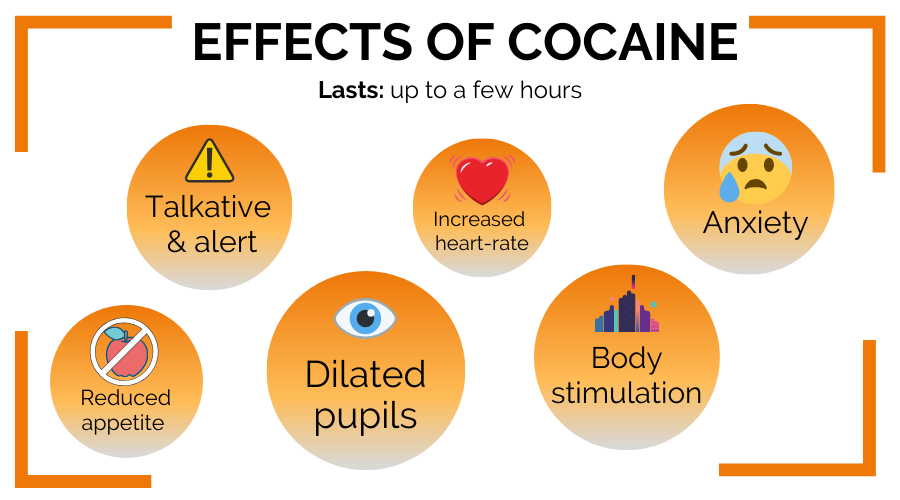
Some people report feeling much more energised and curious on the drug whilst others say it increases their anxiety levels and gives them hot flushes.
Generally speaking, cocaine is a strong stimulant that increases the natural level of dopamine found in our brains. Dopamine is a neurotransmitter that creates feelings of reward, motivation, and pleasure and generally makes us feel good.
A comedown on cocaine
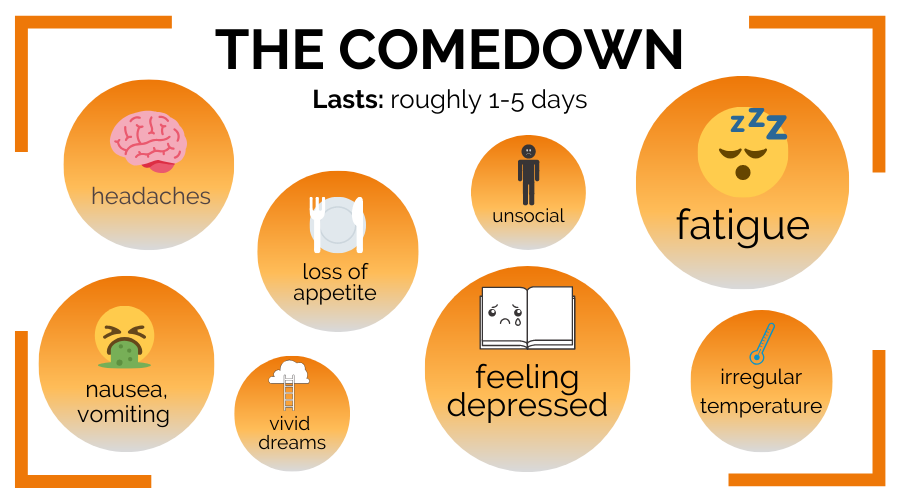
A comedown is a mental and physical crash after taking drugs. If your brain has had an abnormal amount of ‘uppers’, then your body and mind with feel withdrawal when it is no longer high. This can manifest itself in a variety of ways but most commonly:
The comedown can last between a day to a few days depending on what you mixed the drugs with and how late you partied, and so on.
Make sure you drink enough water, try and eat healthy food and get enough rest. If you are still not feeling right after 5 days, go and speak to your doctor.
What is the difference between crack cocaine and cocaine?
Both substances are derived from the coca plant. Cocaine is the powder form of the plant that is typically snorted, rubbed on gums or injected into veins.
Crack on the other hand is smoked. It differentiates chemically because the cocaine powder is mixed with water and baking soda.
This mixture is heated to dissolve the hydrocholoride component and results in a far more concentrated form of cocaine. Instead of a fine powder, tiny rocks are created.
Do’s and don’ts of taking cocaine
We don’t want to glamourise cocaine, but if you make the decision yourself to engage it’s important to be educated on drugs and their use.
Here are a few things that you must take into consideration if you are planning on using cocaine:
Do’s
Dont’s
Do go to the toilet even if you feel you don’t need to go as drugs can interfere with the bladder signals to the brain
Don’t give in to peer pressure – you must feel comfortable taking drugs
Do make sure you are with a friend who trust completely
Don’t buy drugs from street dealers (see point 9)
Do take small doses and work your way up to the high – the effects can take a while to kick in and you don’t want to be caught off-guard by taking too much in one go
Don’t try drugs for the first time in a setting you are not familiar with. If you get anxious or paranoid is it good to be able to venture home
Being educated about drugs is your responsibility. We all must choose wisely, make informed decisions and try to mitigate the risks if we choose to take recreational drugs.
It’s also good to bear in mind that sometimes you’ll get darn right ripped off and dealers will sell you baking soda as “cocaine”.
History of cocaine in the Netherlands
Bizarrely, the Netherlands was once the biggest cocaine manufacturer in the world
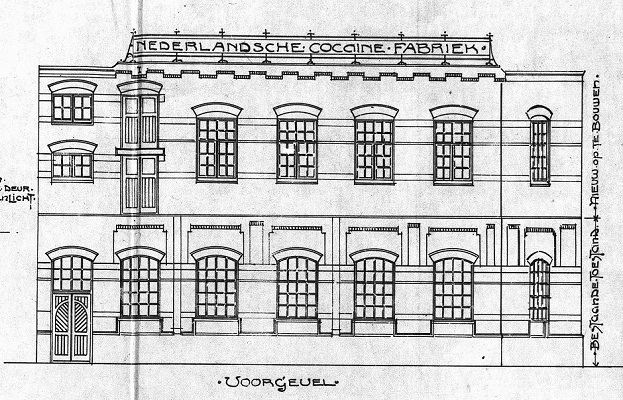
The Dutch cocaine factory supplied soldiers drugs during the war
The Dutch cocaine factory was located in Amsterdam on Weespertrekvaart. Conny Braam wrote a book about the Dutch cocaine factory and spoke to Vice about her findings.
She pointed out how during her research it became apparent that cocaine sales from the Netherlands soared during World War I.
Why? Because cocaine was given to soldiers to increase their productivity in the war zone. It suppressed appetite, reduced fear and heightened alertness which made it very effective for tired and hungry soldiers in battle.
Is that how the Netherlands became such a wealthy economy?
The Dutch sold cocaine to so many people which perhaps held them in good stead to become the most competitive economy in Europe…
“Everybody from the British, the Germans, the French to the Canadians. Neutral Netherlands supplied coke to all of those countries.”
But after the war ended, what happened to the soldiers addicted to cocaine?
In 1919 the Dutch Opium Law came into force making cocaine a controlled substance and exports bans were put in place.
So what happens to the thousands of vulnerable soldiers who are heavily reliant on the drug? A black market emerged (which is still in use today).
History of cocaine: from South America to the most seized drug in the Netherlands
Certain populations of South Americans have been chewing on the leaves of the coca plant for over 4,000 years. This ‘snack’ reduces tiredness and boosted energy levels required for the hard labour in the mountainous terrain.
Spanish invasion
When the Spanish invaded Peru in 1532 they took control of the coca leaves and would regulate their distribution to labourers. They began taxing the leaves and tried to export them to Europe but the leaves did not travel well.
Invention of cocawine
As technology advanced and knowledge of the plant became more refined, cocaine was transported to Europe in a drink called ‘Cocawine’.
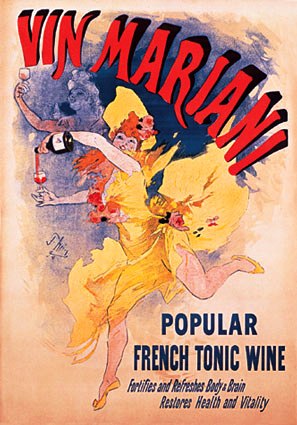
This wine was created by a French chemist named Angelo Mariani who mixed the coca leaves with alcohol to create a potent wine. Advertisements for this wine included “fortifies and refreshes body and brain and restores health and vitality”.
An advertisement for French toxic wine. Image: Jules Chéret/Wikimedia Commons/CC4.0
Coca-Cola
Cocawine is said to be a predecessor of cocaine in coca-cola, invented in 1886. Recognise the “coca” part? Well, now you know where it comes from! — the coca plant of course. About one line of cocaine was added to every bottle of Coca-Cola.
Coca-Cola was originally only distributed in soda fountains, meaning only the elites in society could afford the beverage. In time, Coca-Cola bottles were invented which gave the rest of society access to the soda.
A drink that originally showed status slowly became “corrupted” by the minorities. Grace Elizabeth Hale in The New York Times explains “southern newspapers reported that “negro cocaine fiends” were raping white women, the police powerless to stop them. By 1903, Candler [manager of coca-cola] had bowed to white fears [by] removing the cocaine and adding more sugar and caffeine.”
Widespread use
Writers and artists such as Henrik Ibsen and Robert Louis Stevenson came to love the drug. The Independent found that Sigmund Freud wrote a paper entitled “über cola” and said the drug brought “exhilaration and lasting euphoria, which in no way differs from the normal euphoria of the healthy person”.
It is now one of the most consumed drugs in the world. The European Monitoring Centre for Drugs and Drug Addiction 2019 Netherlands drug report showed that cocaine is the most seized drug in the Netherlands, followed by cannabis and then MDMA.
The human cost of cocaine production
Nearly 75 million euros worth of cocaine is bought in Amsterdam annually and an investigation conducted over six months showed that 30% of people have used the drug.
The production of cocaine is illegal so there is no law which can protect the cocaine producers or drug traffickers.
Many people are coerced into drug trafficking, and cocaine producers in South America make very little money and work in harsh conditions.
The street value of a gram of cocaine ranges between 25 and 50 euros but the South American cocaine labourers receive about 50c for a days work.
You may think narcos are cool because you see them on TV, but did you know that drug cartels make around €24 billion a year on the back of 8 000 dead people? pic.twitter.com/M2EzcVwsAR
We hope you learnt something new about cocaine in the Netherlands. Do you think we missed anything? Or is there something else you would like us to cover? Let us know in the comments below!
As you might know by now, Leiden has a special place in our hearts here at DutchReview. Given it’s where our office is based, it should be of no surprise that we frequently get asked: “where should we go out for dinner in Leiden?”
Well, if you’re wondering the same thing, then lucky you — we like eating, and we like writing about it. So we have come up with the top hotspots for a lekker night out at restaurants in Leiden.
1. Los Cosmos
Missing some southern warmth in the lowlands? With its mouthwatering tapas, delicious cocktails, and a tastefully decorated interior, Los Cosmos will transport you into a warm summer day in Spain.
Ideal for a fancy night out. Image: DutchReview/Supplied
From deep flavoured lamb to delicious gamba’s and fresh asparagus from the grill, there’s something for everyone in your friend group to enjoy! It’s an ideal place for a fancy night out or a quick bocadilla for lunch by the canal.
📍 Location: Aalmarkt 15 🍽 Recommendations: Ceviche de gambas to share, gin basil smash to drink 👍 Socials:Instagram, Facebook
2. Aan de Rijn
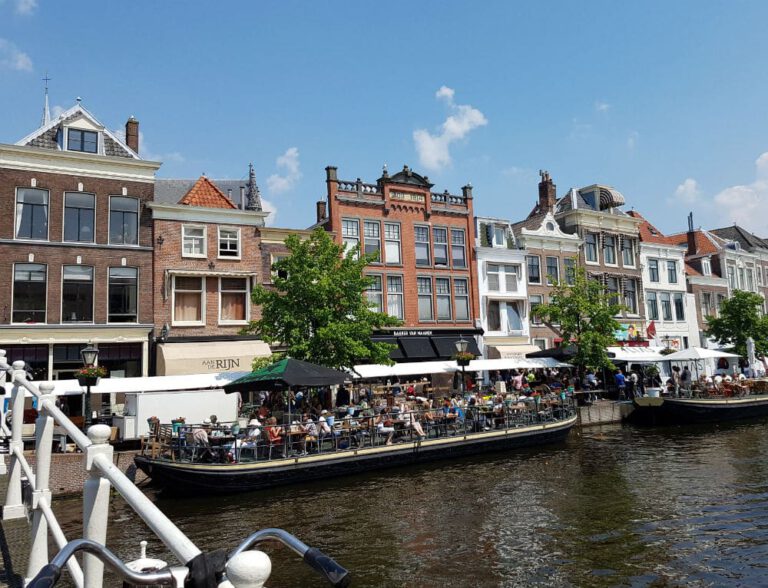
Having a coffee or beer at the beautifully located Aan de Rijn while visiting Leiden’s Saturday street market is one of my favourite things to do. It’s just made for your Instagram.
Perfect for a sunny summer evening. DutchReview/Supplied
So if you’re pining for the classic canal views of Leiden, this is the place to be. The interior is also pretty goddamn gorgeous when the weather in the Netherlands fails us, as usual.
As you can see, the place has got it going on. With some funky tunes and the quality service by Roos, David, and the crew, you’re in for a fun night eating out in Leiden.
It was meant for sharing, but I could’ve eaten it all. Image: DutchReview/Supplied
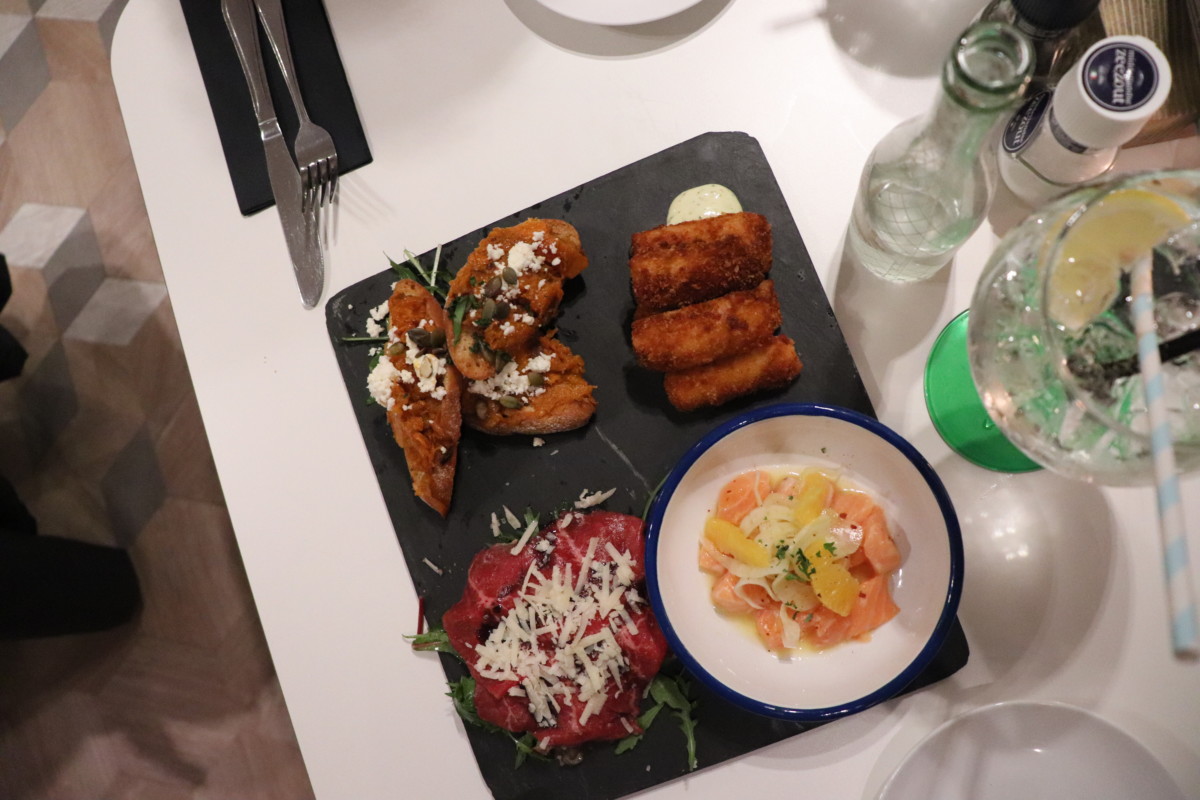
Shared dining is the done thing here. The idea is that you select a couple of small dishes at once, which are beautifully arranged on a wooden board. It’s a solid concept, and you can mix and match whatever you want (honestly, there are no bad choices).
A great terrace, lovely decor, and a shared dining concept is just the start of what Aan de Rijn has to offer — you can’t go wrong with that.
📍 Location: Nieuwe Rijn 37 🍽 Recommendations: Shrimp croquettes, poke bowl, and cheesecake. 👍 Socials: Facebook
3. Bar Lokaal
Not far from Aan de Rijn is another crowd-pleaser in Leiden (not that anything is far away in Leiden, but this one is literally around the corner). Bar Lokaal brings you some deluxe veggie dishes, but no need to worry meat-lovers. They’ve got some top-notch cuts for carnivores as well.
First of all, it’s worth noting that Bar Lokaal is located at one of the most beautiful squares in Leiden — the Hooglandse Kerkplein. After having a few glasses of wine, you can almost taste that romanticized 16th/17th century.
Tip: you have to drink wine there. Not only do they know a lot about wine pairings, but they also serve wines from our favourite wine company, Baltazar.
Like many other spots in the city, Bar Lokaal encourages sharing (which is good because I’m always eyeing up what everyone else has ordered). The portions, and the price tags, are a bit bigger than other shared dining venues, so you should be satisfied if you order between four and six dishes.
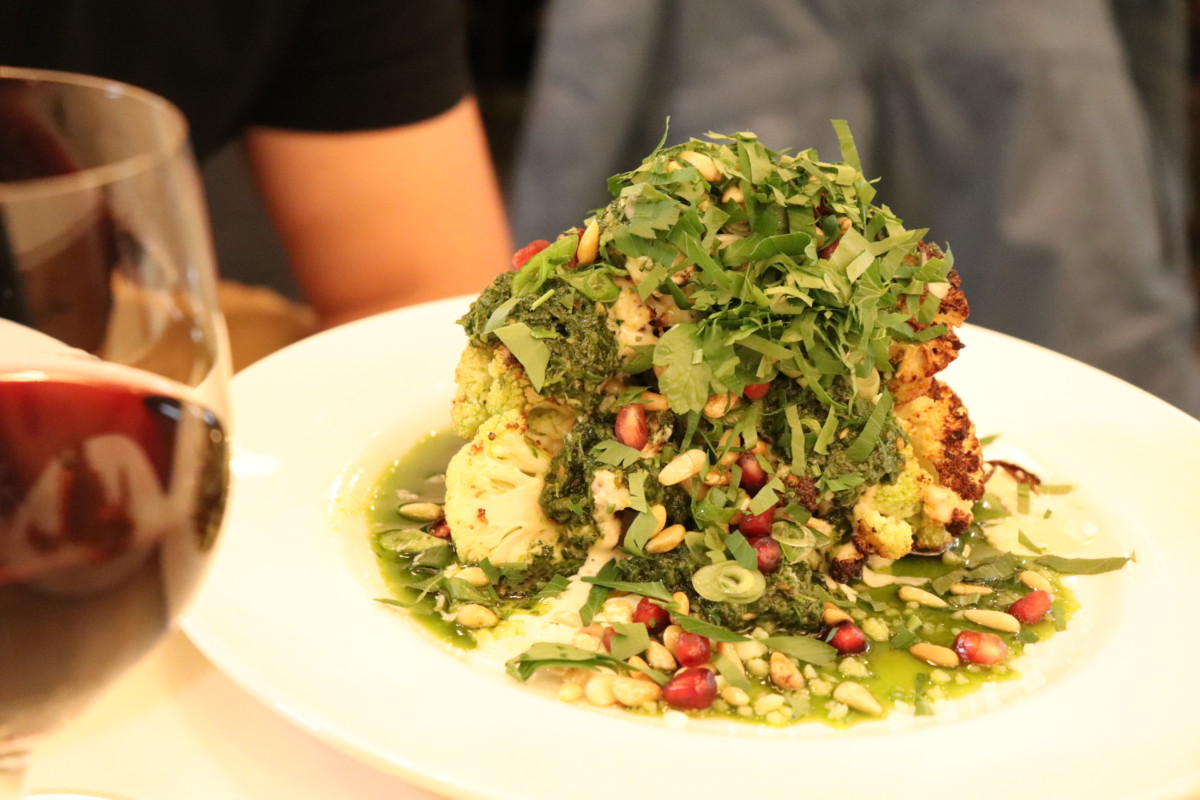
We devoured a lovely smoked rib-eye, but where Bar Lokaal really shines is in when it comes to their vegetarian dishes. Especially their cauliflower dish is making a name for itself. Here’s a picture of it — it tasted just as good as it looks.
That’s a meg plate of food. Image: DutchReview/Supplied
Other tips? Well, make a reservation if you want to bag a spot — it’s packed most of the time, and you can see why. Luckily, they’re open for breakfast and lunch as well if you’re around for a daytime bite.
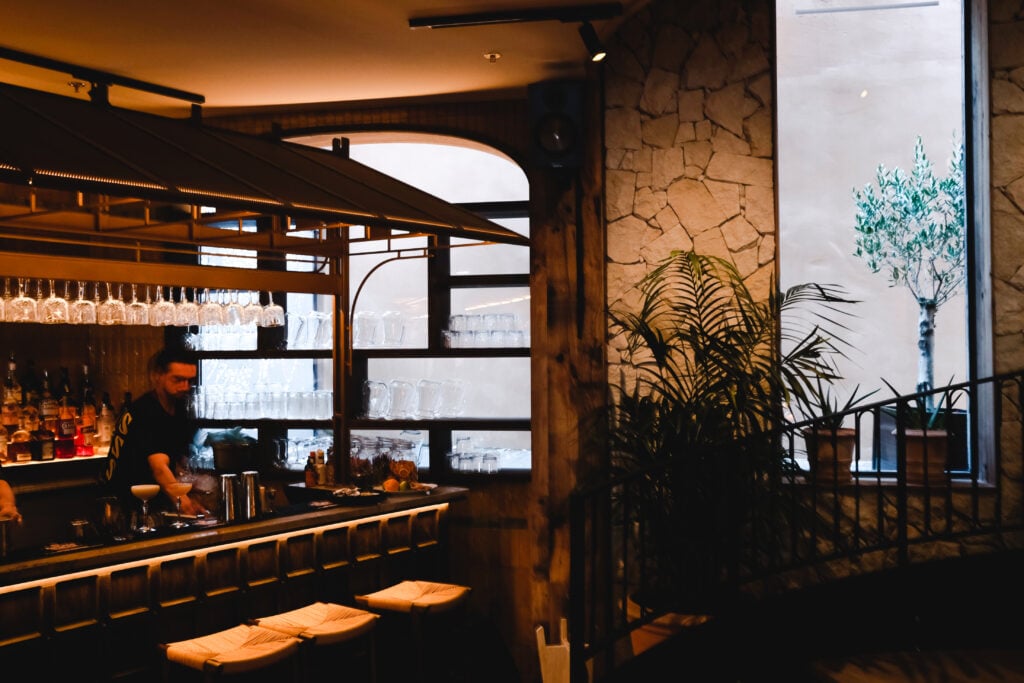
For a tasty meal that will have you lekker waving and a cosy interior, Freddy’s Gastrobar in Leiden is a great place to grab a filling lunch or romantic dinner.
A new restaurant to the landscape of Leiden’s many food hotspots, Freddy’s opened up in 2022. Built into the lowers floors of the Heineken Head Office, this gastro bar is named after the famous Freddy Heineken.
The inside of Freddy’s warm interior. Image: Abuzer Van Leeuwen/Supplied
With multiple food choices on offer, from three-course set meals to delicious desserts and even vegan options for those plant-based folks, this restaurant in Leiden has something for everyone.
Freddy’s is also a mere hundred metres away from Leiden station, so it makes a great final stop on a day out in the small Dutch city. Plus, with some epic borrel deals, it’s also a great spot for post-work drinks — because we all know that Dutch 9-5 is stressful. 😅
And, if you’re a big beer drinker, you’ll be delighted to know that Freddy’s has two tables with their very own beer taps, meaning you can have a night with endless drinks and chatter. 🍺
The different courses at Freddy’s are just lekker! Image: Abuzer Van Leeuwen/Supplied
If you do take a trip to Freddy’s, make sure you do a bit of research about Freddy Heineken, the man who was kidnapped, and make sure you note the painting of the namesake himself on the walls while you enjoy the plush seats and sit at the grand wooden tables.
Fancy a pizza with a view of the prettiest house in Leiden? And all that without breaking the bank? Well then, you’re in luck because there’s a Pizzabakkers in Leiden too!
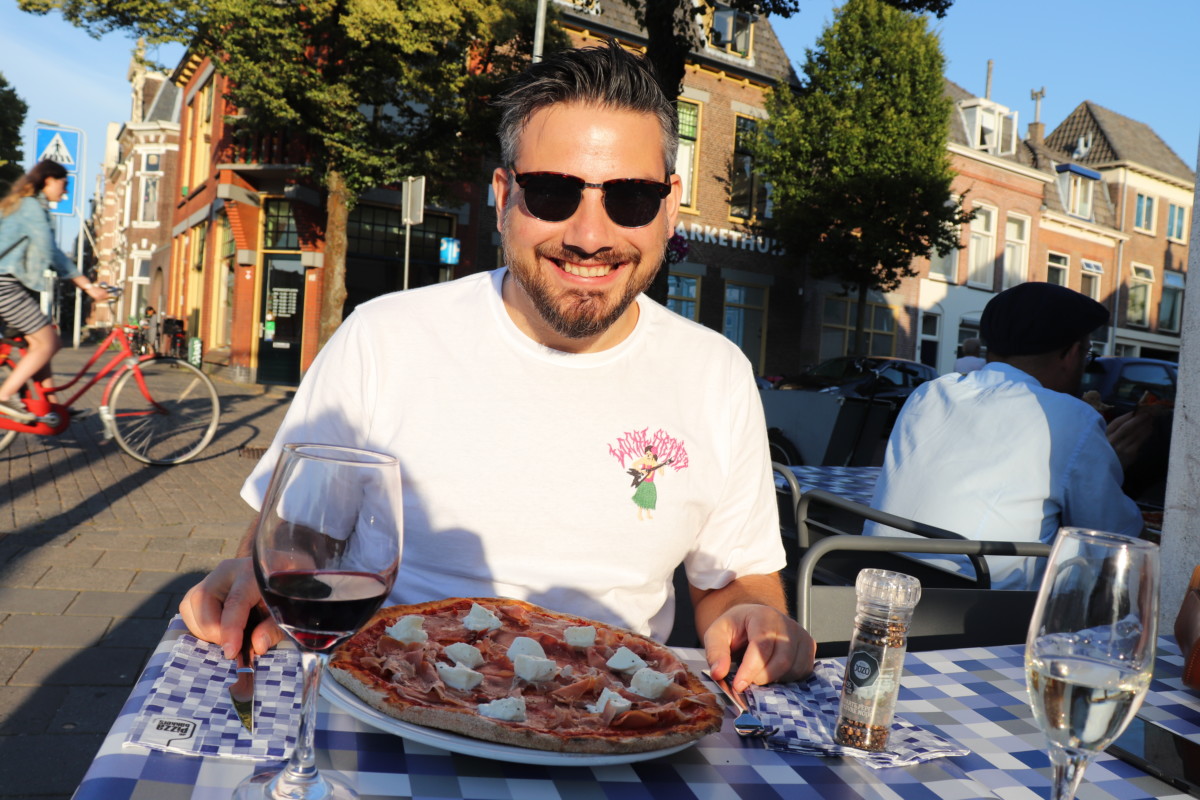
That happy face is reserved for pizza. Image: DutchReview/Supplied
De Pizzabakkers is a small and homley franchise. A few of them are popping up around the Netherlands, all of them run by spirited owners who put in their heart, soul, and salami. Their pizzas are always delicious, thanks to the influx of Italians in the Netherlands. You’ll even find a young Italian lad doing his magic in the kitchen. This authenticity puts it far above other generic franchises.
Since I lived in Italy for a while, I have been absolutely spoiled when it comes to pizza and espresso. So I can happily report that the Pizzabakkers in Leiden also passes my totally unscientific pizza-eating trial.
What else is there to know? Well, prices are reasonable, which is good if you want to swing by for a quick pizza. I had the pizza of the month twice, and both were great pizzas with premium toppings and were enough to satisfy my (large) appetite. Another plus side to the Pizzabakkers in Leiden is that they have a scenic terrace where you enjoy the view of (what is in my opinion) the prettiest house in Leiden.
This one was on my Leiden list for a long time, but it was always packed when I tried to walk in on a Saturday or Sunday. I was relieved when I finally secured a reservation at this deluxe meat-eating establishment on the Breestraat.
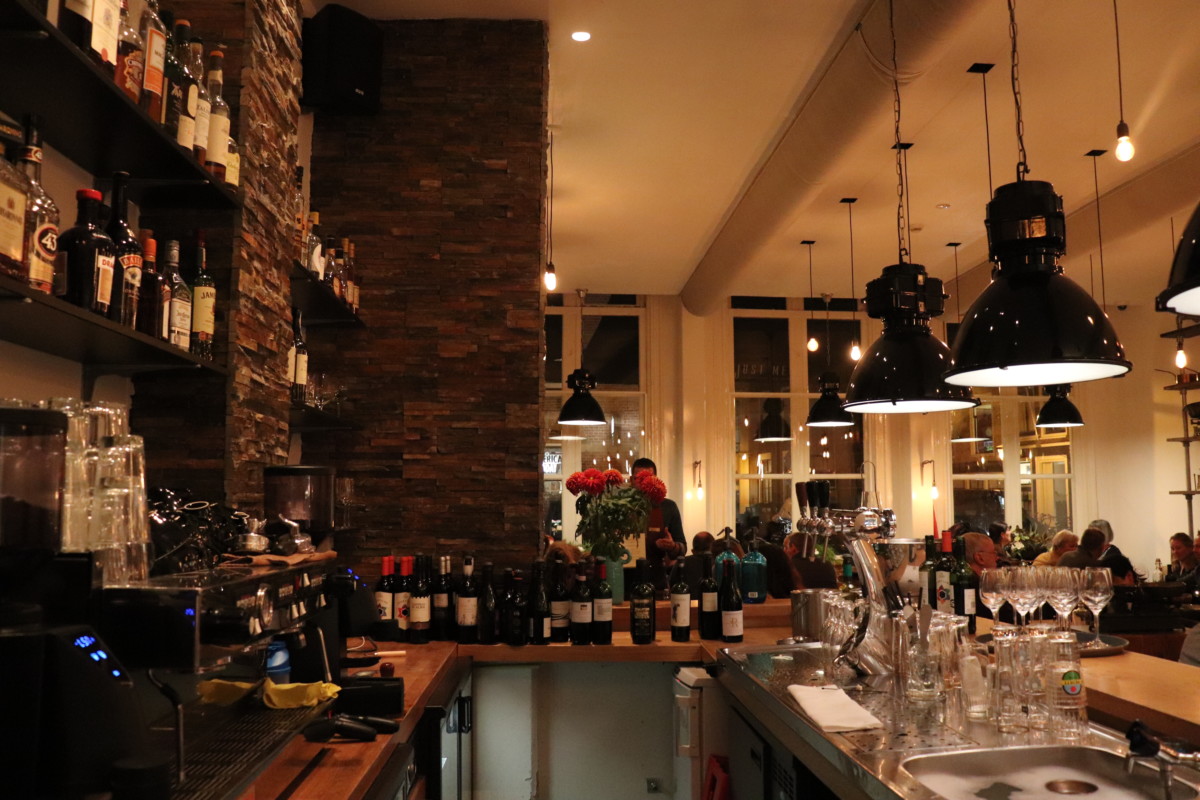
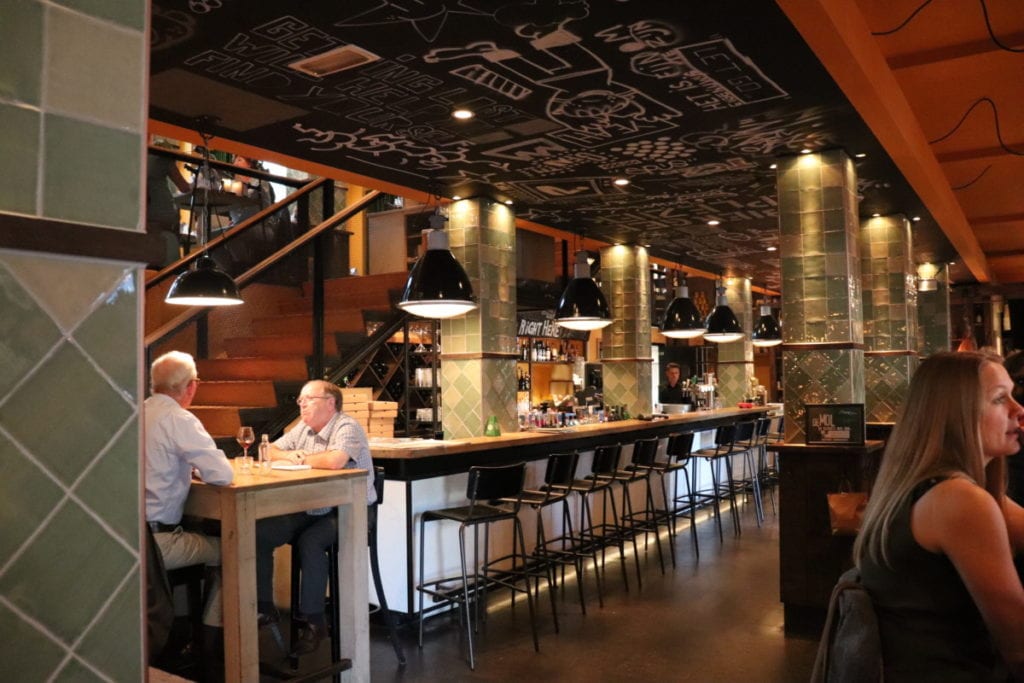
Just Meet is located in an absolutely fabulous building. There are two large dining rooms, both equally atmospheric and divided by a hallway with a large piano in it. It also has one of the best classic staircases you’ll encounter in Leiden.
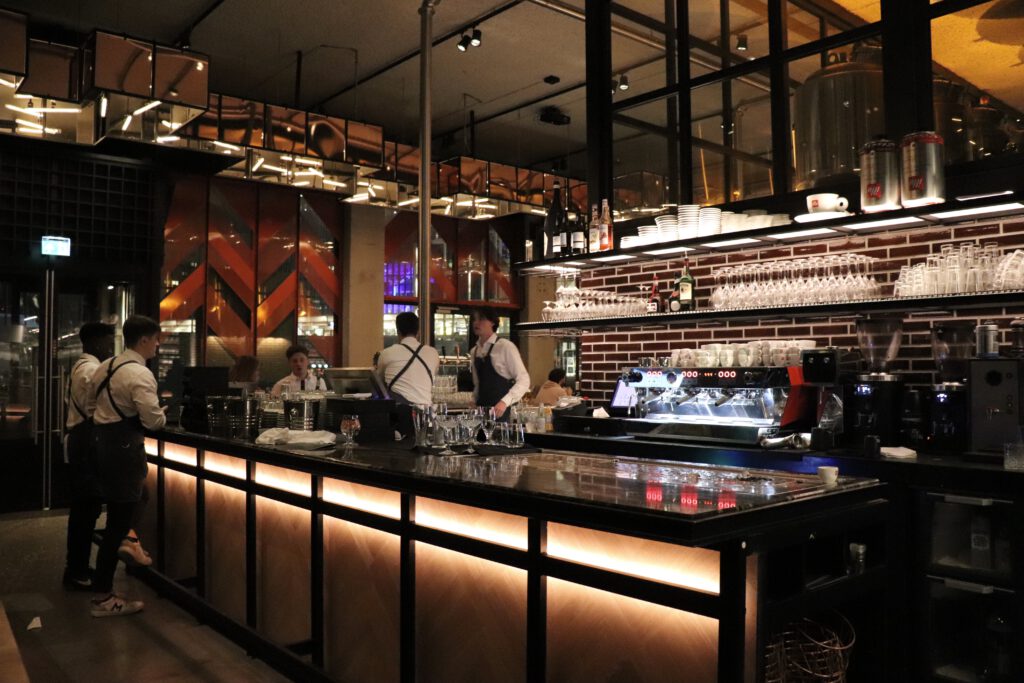
Honestly, I would be happy sitting at the bar. Image: DutchReview/Supplied
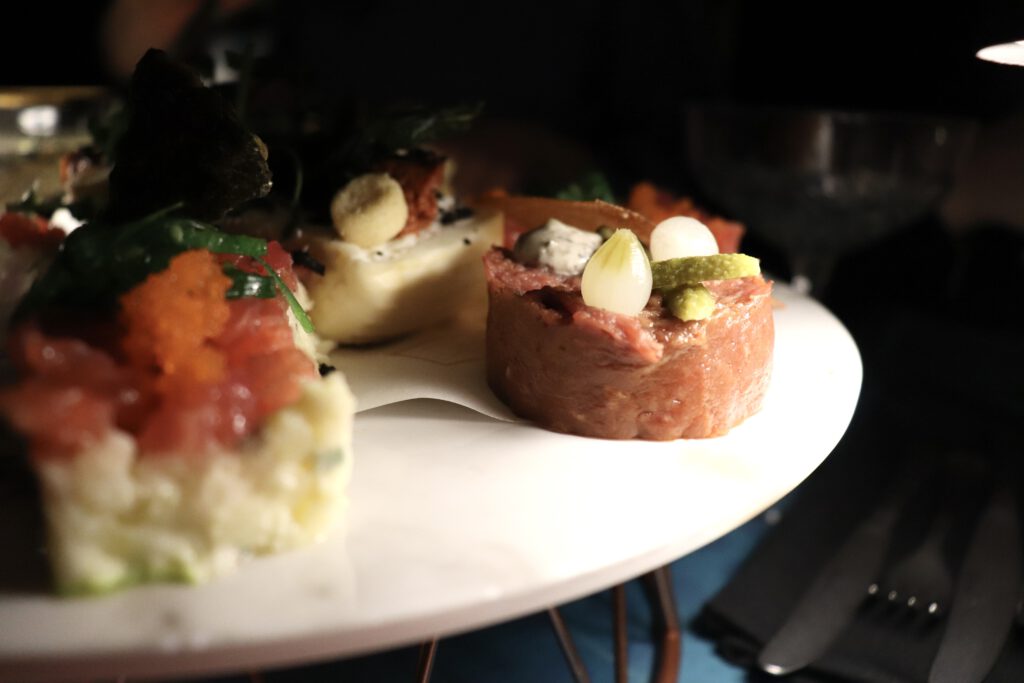
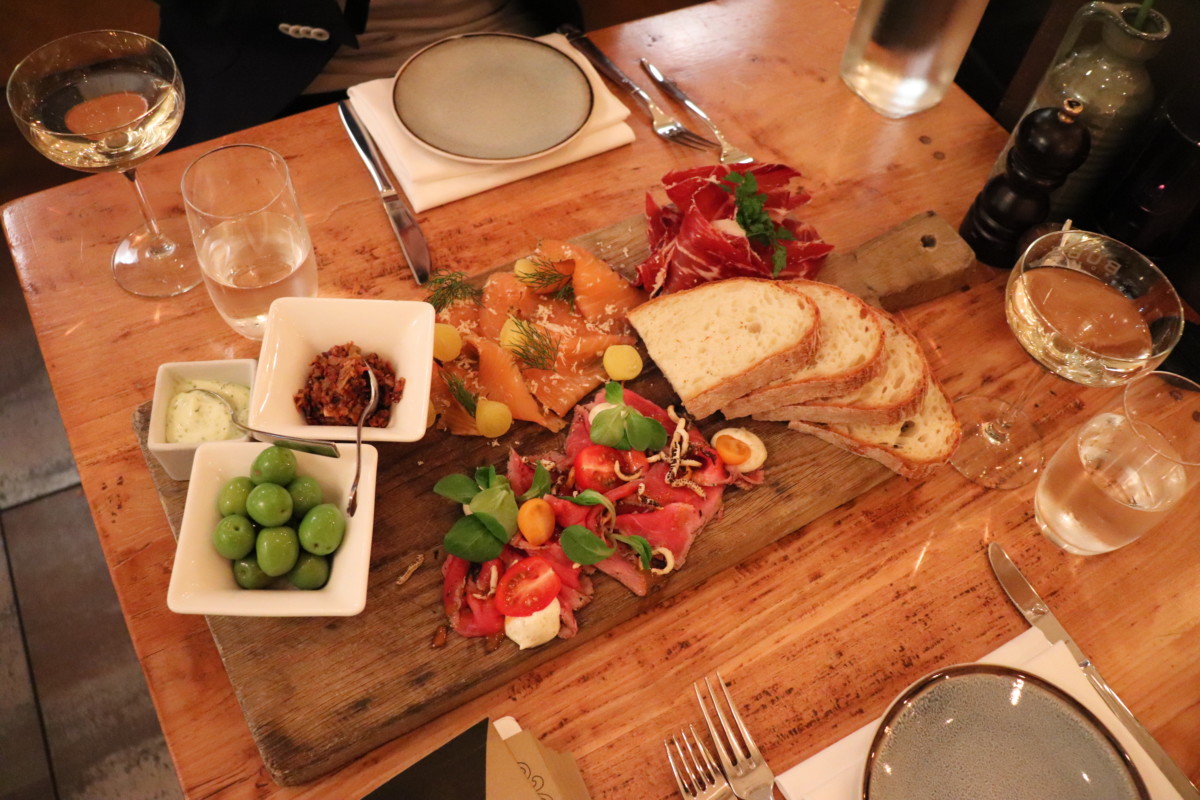
We started this dinner with a serving platter called ‘Plateau Just Meet’, and that was awesome from the get-go. It even featured some vegetables on it:
Would you look at this spread! Image: DutchReview/Supplied
But now, let’s go on a truly carnivorous adventure. See, for real meat lovers, you need to go for one of the sharing steaks. After selecting your meat of choice (ask the waiter for their recommendation), they will collect your meat from the “curing cabinet”.
A fun part of the process is that you get to select your own knife. Each knife comes with its own story (we definitely talked about these knives for 10 minutes — sorry to our lovely waitress for keeping you so long!)
After the foreplay, you can watch the cooks prepping a beautiful plate of meat.
And there it is, one of the best steaks I’ve ever tasted in the Netherlands. My mouth is watering evening now as I’m writing about it.
📍 Location: Breestraat 18 🍽 Recommendations: the cowboy steak for two. 👍 Socials:Instagram, Facebook
7. City Hall
The beautiful interior of the bistro. Image: DutchReview/Supplied
If you’ve ever visited Leiden, you’ll know the City Hall — a beautiful building that marks the city centre. But it offers more than admin queries. Tucked within the historic building is an Italian bistro. This is the perfect place for a treat (as the menu is on the pricey side), but it’s worth splashing out.
📍 Location: Stadhuisplein 3 🍽 Recommendations: Tortellini con pere e pecorino 👍 Socials: Instagram, Facebook
8. Tabú
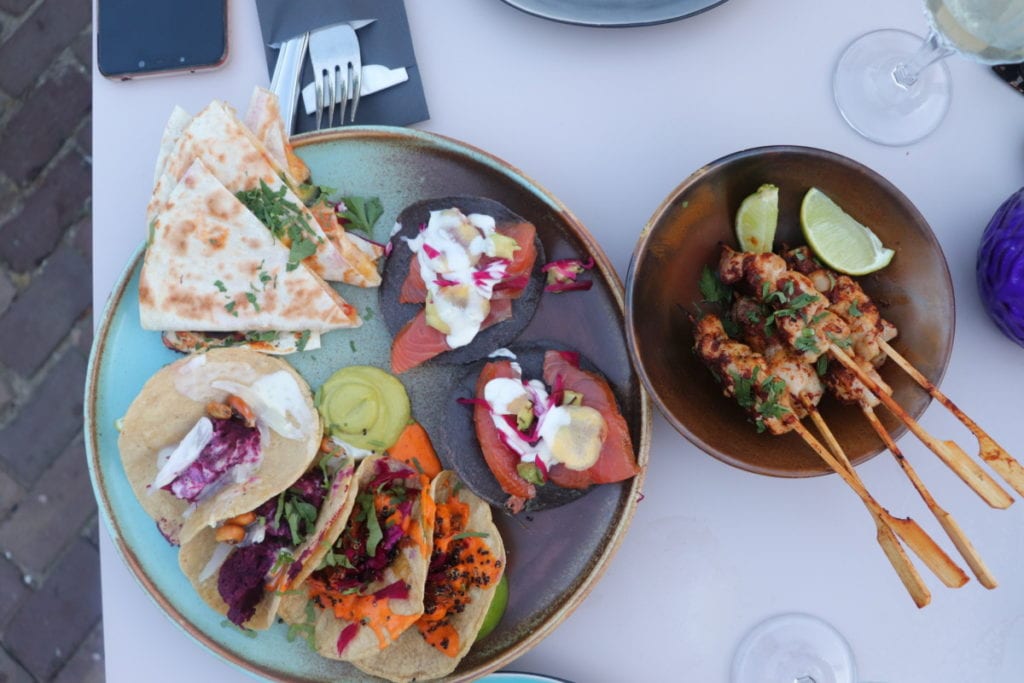
Did you know that Leiden never used to have a Latin, Mexican, or taco restaurant? That’s loco, right. Well, Tabú has solved this issue with its stunning canal views, colourful decor and zesty food.
It has to be mentioned that every Monday and Wednesday from 5 to 7 PM, they host a “cocktail madness” when two of their daily special cocktails go for 12 euros.
An array of zesty starters. Image: DutchReview/Supplied
📍 Location: Rembrandtstraat 27 🍽 Recommendations: Tostada del salmone and the quesedilla 👍 Socials: Instagram, Facebook
9. Lot en de Walvis
It’s a staple of the Leiden food and drinks scene and one of my favourites (whenever the weather permits). One of the best parts of Lot en de Walvis is the great location, with gorgeous views of the marina and an extensive terrace.
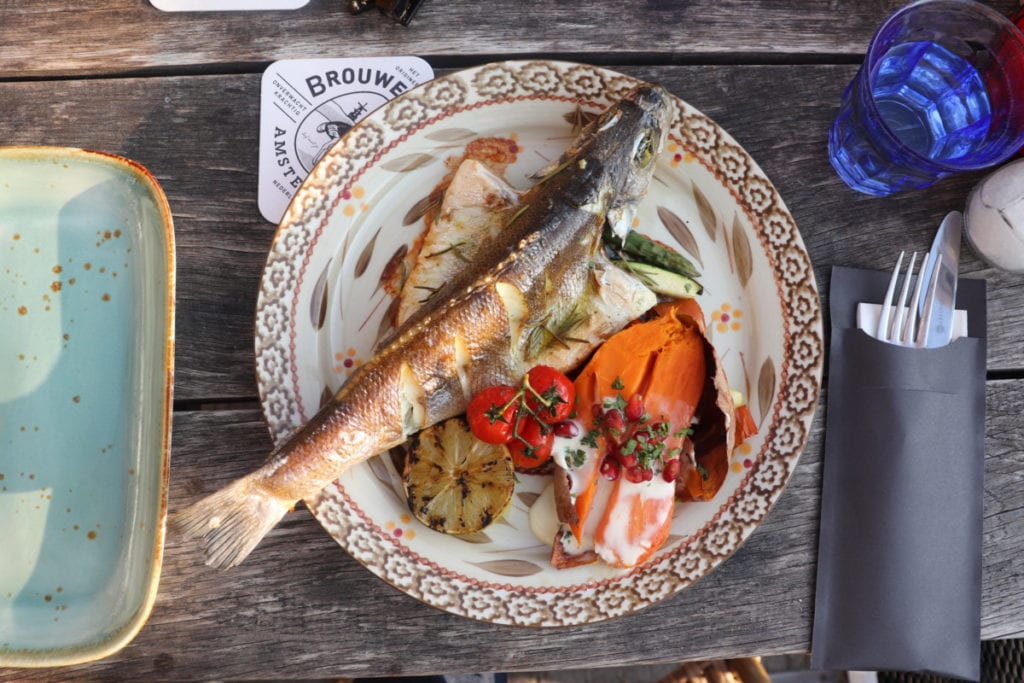
The delectable fish dish! Image: DutchReview/Supplied
📍 Location: Haven 1 2312 MG Leiden 🍽 Recommendations: Pepesan Ikan Nasi Kuning (the fish dish above) 👍 Socials: Instagram, Facebook
Here was our list of top dining spots in Leiden! Have you been to any of these restaurants yet? Or have we missed your favourite off the list? Let us know in the comments below!
Editor’s Note: This article was originally published in July 2019 and was fully updated in December 2022 for your reading pleasure.
A 52-year-old Dutch man died from his injuries after being severely beaten on New Year’s Eve.
It was initially reported that the man died from his injuries after being beaten. However, the NOS now reports that a clear cause of death cannot be given.
The man had reportedly confronted a group of young people after they started throwing fireworks at his dog.
According to Dagblad van het Noord, the man was out walking his dog at 2:30 AM during New Year’s Eve celebrations in Leek (in the province of Groningen) when the assault took place.
After being severely beaten by the youths, the man managed to make it back home, where he died as a result of his injuries.
Nothing confirmed yet
While multiple newspapers are reporting on the incident, the police have yet to confirm the events that took place.
Speaking to the NOS, a police spokeswoman has said that “We are going to hear witnesses again today, the investigation is still in full swing.”
However, an arrest has been made. An 18-year-old who was allegedly involved in the assault was arrested on New Year’s Day.
Dreaming of quitting your job and becoming a freelancer in the Netherlands? It sounds like you may have been bitten by the ZZPer bug and are in love with the idea of being your own boss! 🪄
Even with the stellar Dutch work-life balance, becoming a freelancer and essentially marching to the beat of your own drum can be an enticing option.
So, are you stomping on the pedal to become a fully-fledged ZZPer and start your own fabulous business? You may want to gently nudge the brakes for a minute — at least until you’ve read up on a few things you need to know first. 👇
Ready and rearing to start freelancing? Skip ahead!
This post might have affiliate links that help us write the articles you love, at no extra cost to you. Read our statement.
What’s a ZZPer?
Standing for zelfstandige zonder personneel (independent with no staff), a ZZPer refers to a freelancer in the Netherlands.
The most common business model for freelancers is an eenmanszaak (sole trader/proprietorship), in which you have full legal and professional responsibility for your business.
Going freelance comes with a host of benefits, such as a flexible schedule, full creative control and direction of your business, choosing your own clients, and setting your own rate.
Freelance life isn’t for everyone, and that’s perfectly okay! Image: Freepik
However, things aren’t sunshine and stroopwafels all the time. From wrangling taxes, building your own client base, setting up all the legal requirements… etc., the freelancer lifestyle is not without its challenges.
But if you fancy being your own boss and are willing to navigate a few possible bumps along the road, then the freelancer route just might be the right choice for you!
What do I need to become a freelancer in the Netherlands?
Oké, so you’ve got this exciting new business idea and you’re champing at the bit to make it a reality, but you’re wondering what the next steps are.
We’ve worked our way over that particular hurdle, so here’s something to help: a mini-guide on everything you need to become a freelancer in the Netherlands. 🙌
A KVK number
Legally, you’ll need to register your business with the KvK (Dutch Chamber of Commerce) before you start freelancing.
You can easily make an appointment with a KvKkantoor (office) near you through the official website. Remember to bring your official documents, such as your ID/BSN information with you.
At the end of the process, you’ll be issued with your KVK number. This means that you are registered in the Handelsregister (Dutch Business Register) as a legitimate business in the Netherlands.
In addition to this, you will also be required to choose a unique name for your business, detail its legal structure, and define what activities it will be undertaking.
Not sure if your ideal business name has already been taken? Maak je geen zorgen (don’t worry), because you can search the KvK’s business register.
Let op: Unless you’re an EU, EEA, or Swiss citizen, you’ll also need to be in possession of a valid residence permit.
Your residence permit will provide you with a BSN (Citizen Service Number), which is mandatory in order to register as a freelancer, get insured, and pay your taxes.
A BTW nummer
Also known as a VAT number, your BTW number will be provided to you when you attend your KvK appointment.
Containing part of your BSN (Citizen Service Number), you will need to use your BTW nummer when filing your taxes and when sending invoices.
Insurance
Living in the Netherlands without valid insurance is a bit like driving down the German Autobahn after you’ve been on a six-week bender. You’re probably going to be in a lot of legal trouble (and it might hurt more than just your wallet).
Whether you work from home or a freelancer that’s racked up a wealth of Air Miles, protecting your business and your health should be a top priority. Image: Freepik
In short, you’re legally required to take out Dutch health insurance (zorgvezekering) as a ZZPer. Although international students and expats can receive healthcare in the Netherlands through global or EU health insurance providers, it is mandatory to take out Dutch health insurance instead when legally employed here.
Although Dutch health insurance is mandatory, it’s not the only type of insurance that freelancers are advised to take out.
Freelancers who want to insure their businesses against lawsuits brought about by possible professional errors may also want to take out beroepsaansprakelijksheidsverzekering (professional indemnity insurance). For some lines of work, such as law, accountancy, and architecture, indemnity insurance is legally mandated.
Meanwhile, what if you accidentally drop your customer’s laptop whilst explaining an important report to them? If you’d like to avoid the risk of being liable for the accident, you may want to take out bedrijfsaansprakelijkheidsverzekering (business liability insurance), from a company like Univé.
Tools you’ll need for your business: ZZPer edition
Making the most of your full-time freelance dreams often means treating your one-man (or one-woman) show as a serious business. Although success is never a guarantee, there are definitely tools that can aid the process. 👇
A business bank account
Let’s face it, trying to be über-professional while your ‘freelance’ bank account includes charges for your Netflix and chill binge can get rather… hard.
That’s why investing in a business bank account is a great move. Not only will it create a financial division between work and play, but a business bank account will also give you access to specific features that can help your business flourish and grow.
A business bank account helps you stay on top of things whilst offering you powerful add-ons to boost your freelancing career. Image: Freepik
Whether you’re planning on taking out a loan, setting up an invoicing system, or just need some assistance getting your head around VAT calculations, a company bank account will probably be your wallet’s BFF. In fact, setting up a business account is even recommended by the KVK.
Our top picks for ZZPer-approved business bank accounts include:
Note: You may need some extra documents to open a business bank account. These include proof of identity and an extract from the KVK business register (Handelsregister).
An invoicing program
Oké, it’s time to rip off the plaster: being your own boss means that you NEED to be organised.
Although many freelancers are aware of the importance of keeping many aspects of their business well-organised, the invoicing side can be a tricky beast to master. However, properly filed invoices are both tax obligatory and useful for recording your business’ cash flow.
If you’re new to the ZZPer life or just aren’t comfortable with handling invoices yourself, it stands to reason that you may want a little help.
The easiest and most hassle-free way to get your invoices in order? By using invoicing software!
Hate invoicing? Luckily, there are simple solutions that’ll make this step a walk in the park. Image: Freepik
In fact, some banks (such as bunq) even offer invoicing services straight from the app or offer you the option of connecting to third-party software that’ll make the job easy as pie. 🥧
However, if you’d prefer using dedicated software, our freelancer-approved list of handig (handy) invoicing programs include:
The Dutch tax office collects a 21% BTW tax from freelancers in the Netherlands typically four times per year. In addition to the regular rates for your goods or services, you will need to add this extra tax on every invoice you charge your customers.
Of course, for reasons of transparency, you will need to inform your clients that the cost you’re charging them is including (or excluding!) VAT.
The process of paying taxes (belasting) in the Netherlands as a freelancer can be a bit like walking around Scheveningen beach with a fat stack of patatjes (chips), as greedy seagulls caw overhead. In simple terms, the whole ordeal can be fraught with stress and confusion.
It’s sad, but true: taxes are a necessary evil when living and working in the Netherlands. Image: Freepik
Although enlisting the services of an accountant is always a good idea, freelancers that don’t want to shoulder the additional expense also have apps that can guide them through the process.
One of our personal favourites is Finom, a handy app that helps manage the financial aspect of running your own business, including invoicing, business bank accounts, and offers options for your clients to make payments.
Feeling a little overwhelmed? Maak je geen zorgen (don’t worry), because things aren’t all head-scratchingly confusing when it comes to doing your taxes as a freelancer. 👇
Tax subsidies: freelancers can get them, too
Being self-employed in the Netherlands means that you might be entitled to some tax deductions that’ll help your business thrive.
If you’ve just set up your business, then you’ll likely be eligible for startersaftrek, which is a form of tax relief for new companies.
Not quite new, but making under €20,000 per year? It sounds like the kleineondernemersregeling (small business scheme) might be just right for you. Even better, this scheme means you don’t need to pay VAT!
And calling all ZZPers that cajole their spouses or partners into working for them: you could be entitled to meewerkaftrek (working partner’s abatement), as long as their work is unpaid.
Oh, and if you’re devoted to doing a lot of research and development for your business, the Dutch government really digs that. They’ve even got handy dandy aftrek voor speur- en ontwikkelingswerk (R&D credit) for you, as long as you spend at least 500 hours per year on the task.
Let op: To be eligible for these subsidies, you will need to work at least 1,225 hours per year on your business.
Do I need a contract to work with clients as a freelancer?
According to the Belastingdienst (the Dutch tax authority), it isn’t mandatory for freelancers in the Netherlands to set up a contract with their clients.
However, it may be advisable to create one, so that all parties involved are assured of the obligations and other details that their work relationship involves.
Whether you love marching to the beat of your own drum or could use a bit more supervision, there’s probably a contract that’s perfect for you! Image: Freepik
If you draw up this contract yourself, it entails that you don’t need your client’s supervision or instructions, and can work at your own discretion.
However, the second type of ‘no employer authority’ agreement gives you slightly less freedom as a freelancer. If this contract was drawn up by the Tax and Customs Administration instead, your client may be allowed to provide supervision or define the end goal of your assignment.
No obligation to work personal work
This type of agreement means that you are not mandated to undertake the contracted work yourself and can nominate someone else to do it. In other words, you’re allowed to decide if delegating the work to someone else is a good idea, as well as who’ll be filling your boots.
However, if this agreement was drawn up by the Tax and Customs Administration, then your client can refuse the replacement if they don’t meet the necessary criteria for the job.
No employer authority and no obligation to work in person
This agreement combines several of the specifications of the two previous contracts. Drawing up this contract means that you are allowed to do the job at your own discretion, without supervision from your client.
This agreement deals with the conclusion of assigned work between you and your client.
How to (effectively!) manage your business as a freelancer
If you’re dead set on becoming a freelancer in the Netherlands, there are definitely some helpful things to know!
Learning Dutch is an asset for freelancers in the Netherlands
Think doing your taxes is nerve-wracking? Now picture doing them… IN DUTCH! 😱
Oké, jokes aside, learning Dutch is not a necessary requirement for becoming a ZZPer. However, getting its guttural gs, confusing grammar, and Scheveningen’s spooky syllables under your belt definitely makes navigating freelance life in the Netherlands much easier.
In addition to all of this, learning Dutch opens the door to attending useful networking events in the Netherlands.
Whether you’re paying taxes, reaching out to fellow freelancers, or just networking, Dutch can definitely be an important asset. Image: Freepik
Whether you’re trying to reach out to fellow freelancers or widen your customer base, being able to efficiently communicate in Dutch is a powerful tool in your ZZPer arsenal.
Setting up a Dutch pension plan is a great idea
Of course, being a freelancer also means that you’re solely in charge of your retirement funds.
Whilst many ZZPers may put off setting up a proper pension plan until their businesses are fully established, there’s no better time than the present to work on your financial health.
Not quite sure where to start? It’s perfectly normal to feel a little lost! Thankfully, there are helpful apps that can help you set up and manage your own pension funds.
But wait… am I really a freelancer?
Although this might sound like a purely obvious question, it’s an entirely different story in legal terms. The Belastingdienst (Dutch tax office) has noted that there are three key things that an aspiring freelancer needs to fulfil to legally qualify as a ZZPer.
Do business with people other than friends or family, and compete with other entrepreneurs in a similar industry.
In addition to these criteria, the Belastingdienst may also pay attention to a number of other factors to gauge your ability to take to ZZPer life. You can read all about them here.
Is the freelancer in the Netherlands life right for me?
Of course, just like salted liquorice (or zoute drop), becoming a freelancer in the Netherlands may not be the right choice for everyone.
Freedom is great, but freelancing occasionally has TOO much freedom for some. Image: Freepik
As a ZZPer, you’ll need to have an aptitude for:
Finding (and maintaining!) your own client list
Organising your own schedule and resources
Managing your business’ finances (or employing the services of those that can)
Handling periods without much work
If all of these requirements still have you keen as a bean, then your future ZZP business is likely in very good hands!
Being a freelancer in the Netherlands: FAQs
With a lot of information to sift through on the hows, whats, and whys of freelancing in the Netherlands, we know you’d have some questions. Let’s clarify some of your doubts! 🙌
What is a ZZPer?
Also known as a zelfstandige zonder personnel (independent individual with no staff), ZZPer refers to any freelancer in the Netherlands that is registered to work for themselves.
What do I need to freelance in the Netherlands?
In order to freelance in the Netherlands, internationals will need several things. Mandatory requirements include a valid residence permit, registration with the KvK (Dutch Chamber of Commerce), and Dutch insurance.
Can internationals become freelancers in the Netherlands?
As long as they’re in possession of a valid residence permit, internationals can register as freelancers with the KvK (Dutch Chamber of Commerce).
How can I pay taxes as a freelancer (ZZPer) in the Netherlands?
In order to pay taxes as a freelancer in the Netherlands, you will first need to make an appointment with the KvK to be registered in the Handelsregister (Dutch Business Register).
Then you will be issued a BTW nummer (VAT number), which you need to submit when filing your taxes.
Do freelancers need to pay taxes in the Netherlands?
Yes, as long as freelancers meet set criteria by the Belastingdienst, they are required to pay taxes in the Netherlands.
Are you debating dipping a toe in the ZZP life? Let us know in the comment section below!
So you’re moving to Amsterdam? Excellent choice! It’s a great city that thrives with energy, history, and culture. But where should you live in Amsterdam?
Of course, there’s not just one correct answer to that question. So we’ve done the research to bring you the ultimate guide to Amsterdam neighbourhoods!
Although in many ways Amsterdam is a fast-paced cosmopolitan European capital, when you live here, it can feel like a small town. Snug little neighbourhoods are tucked away all over the city, creating little oases of residential quiet.
City life, bars, restaurants, clubs, museums, and theatres are rarely more than a 30-minute bike ride from anywhere in the city. And no matter where you’re coming from, you’ll love Amsterdam’s international feel with people from all over the world.
Half of the city’s 1.2 million residents are non-Dutch in origin. People of different backgrounds (180 different nationalities at the last count) have been settling in this melting pot since the Golden Age.
The most popular neighbourhoods in Amsterdam
Amsterdam is a big city, and it can be overwhelming to figure out where to live. As internationals ourselves, we’ve broken it down for you into some handy subsections.
The city centre: in the midst of the hustle and bustle
Love Golden Age grandeur and spaces crawling with tourists? Images of Amsterdam often depict the beautiful monumental warehouses and elegant gabled mansions along the Singel, Prinsengracht, Herengracht, and Keizersgracht.
These form the inner canal belt, or grachtengordel, of Amsterdam. The wealthy merchants of the glorious Golden Age spared no cost on building materials and elaborately decorated the facades of their prestigious homes.
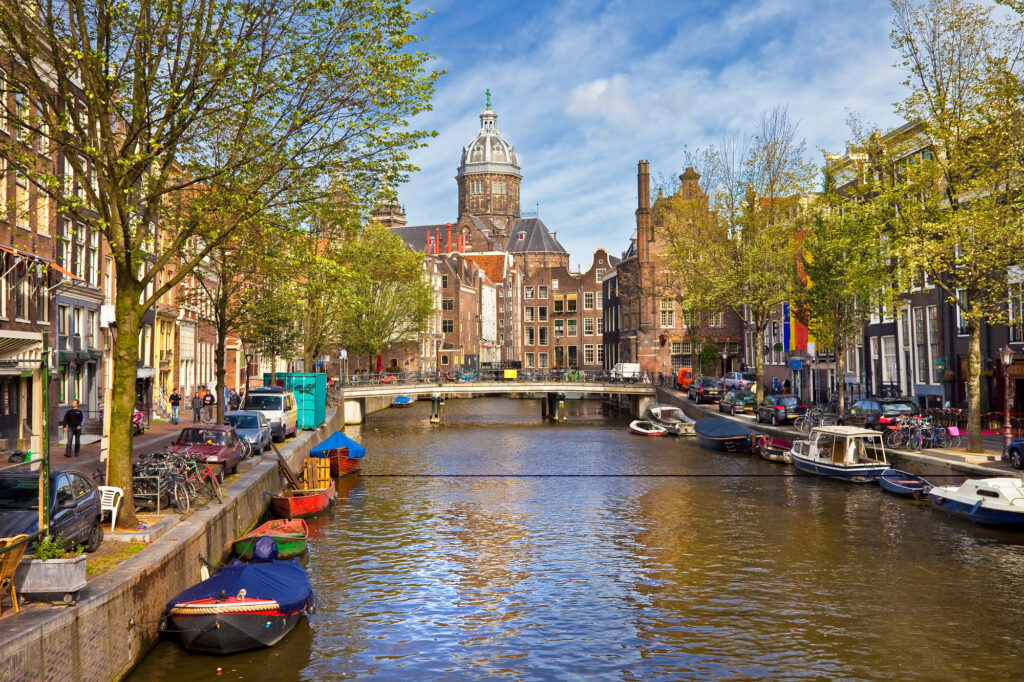
Nowadays, these pontifical houses are often split up and converted into smaller apartments. Expensive as it is, the picturesque inner city — with its typical bridges and pretty houseboats along the tree-lined canals — makes for very pleasant living.
Let yourself fall in love with Amsterdam’s bustling city centre. Image: Depositphotos
But be warned, there is a downside. The streets are often crowded, and in summer, there is a constant stream of tourist boats passing along the canals.
DeJordaan is arguably the most exquisite neighbourhood of Amsterdam. A kaleidoscope of narrow streets, lined with cute and quirky houses, markets, shops, and cafés make this former working-class quarter a favourite hangout for tourists and locals alike.
Although the vibrant, bohemian Jordaan is an absolute must-see for visitors, houses here are cramped and rents high, so this neighbourhood might not be everybody’s cup of tea.
Amsterdam-Zuid: international vibe and nature
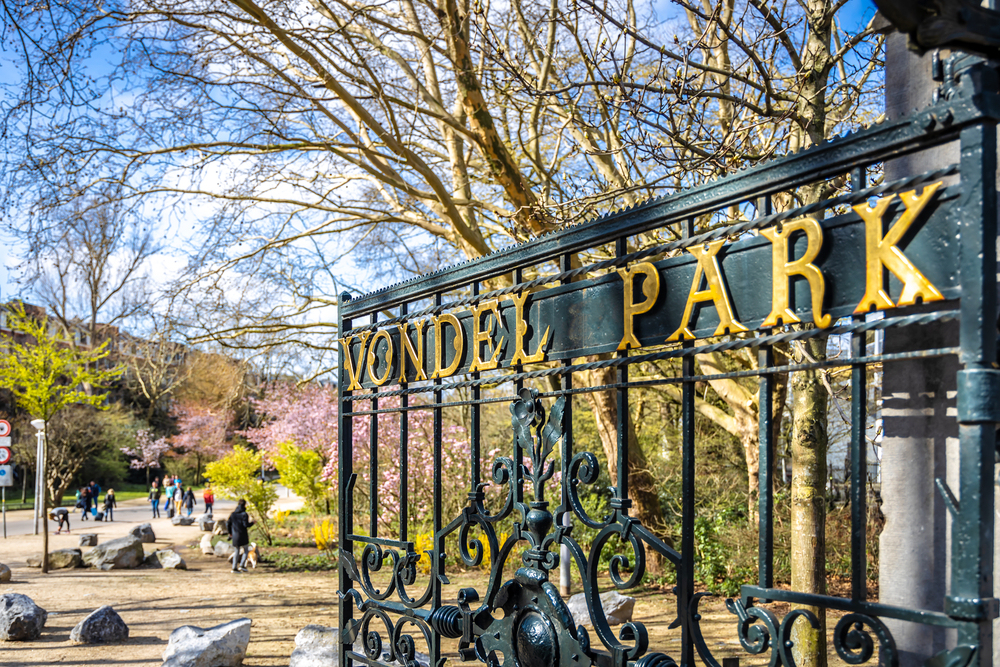
For internationals moving with a young family, the borough Zuid (South) is definitely a good place to start looking when wondering where to live in Amsterdam. It’s not far from the city centre, and it’s bordered by Amsterdam’s largest city park, the Vondelpark.
Zuid has many residential neighbourhoods with privately owned, well-preserved 19th-century houses. Old South includes desirable neighbourhoods in Amsterdam like Duivelseiland and the areas around Museum Square and south of Vondelpark. The apartments are usually spacious and well-built.
The Diamantbuurt, Rivierenbuurt, Stadionbuurt, and Apollobuurt are known as the Nieuw Zuid(New South). The neighbourhoods were built in the 1920s and 30s with sound, comfortably-sized housing, popular among well-off Amsterdammers and internationals.
Vondelpark could be your new backyard! It neatly borders Amsterdam-Zuid. Image: Depositphotos
Less up-market and more colourful, vibrant, and funky is de Pijp, popular among a younger crowd. Although it has greatly benefited from government regeneration in recent years, do watch out for remnants of the ‘revolution’ building period. Cheaper, but often poor quality, badly-insulated, poky apartments.
The Zuidas is also a place you shouldn’t miss. It’s home to many businesses and is a rapidly growing centre of development. It’s exceptionally popular with internationals, as many work in the area. There are also heaps of new apartments in the area, so plenty of options.
Amsterdam-Oost: echoes of the east
Still not sure where to live in Amsterdam? Perhaps in Amsterdam-Oost. Passing down through the contemporary Eastern Docklands, or Oostenlijke Havengebied, you’ll find the older neighbourhoods of Amsterdam: Indische Buurt and Transvaalbuurt.
Amsterdam-Oost is a green and open-plan neighbourhood with good housing, lots of sports fields and city gardening plots. It’s close to the A10 ring road with good connections to the city.
Dating from the 1920s to the 1940s, these areas have been undergoing rapid gentrification since the 90s. Ethnically diverse and bustling with colourful shops and markets, the housing is typically three stories plus an attic (with a shop at street level), which you see in much of Amsterdam.
There’s also the Watergraafsmeer, one of the most low-lying areas of Amsterdam, which was taken back from the sea in the Middle Ages.
Amsterdam-West: up and coming neighbourhoods
Closer to the centre, however, de Baarsjes and Bos en Lommer (or BoLo, as the locals call it) are becoming more popular among students and families and have a large multicultural community. Colourful markets and mosques rub shoulders with trendy cultural establishments and green open spaces.
Westerpark is also a lively, mixed neighbourhood popular with young families and artists. As in BoLo, rents are relatively affordable, and the city centre is only a 10-minute cycle ride away.
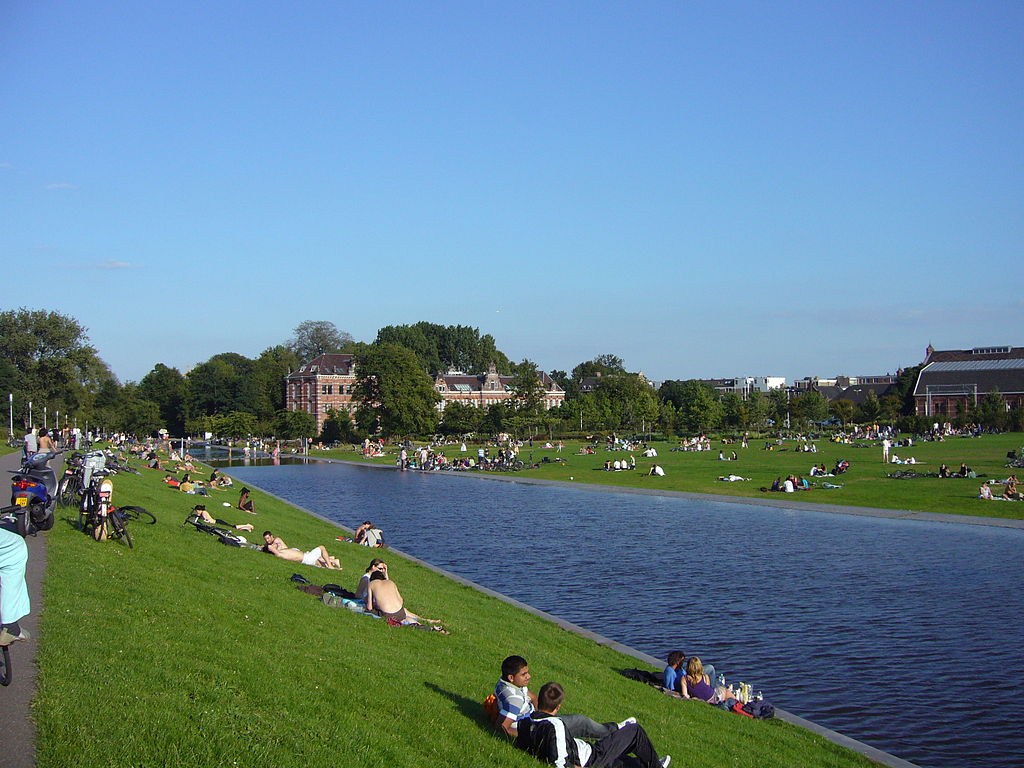
The Westerpark is extremely popular during the summertime. Image: David van der Mark/Wikimedia Commons/CC2.0
Westerpark is also the name of the beautiful city park, which also hosts a TV studio, several music venues, trendy restaurants, a club, and a cinema. These are situated in the monumental industrial buildings preserved from older days when the city’s gas factory was situated here.
On the far side of Westerpark, the pretty Spaarndammerbuurt is becoming hipper by the day, with nice little shops and cafés springing up and affordable apartments in renovated housing blocks.
Though house hunters have long ignored this neighbourhood in Amsterdam, gentrification is turning it into an attractive little neighbourhood to live in, well worth checking out.
Amsterdam-Noord: the coolest neighbourhood in Amsterdam
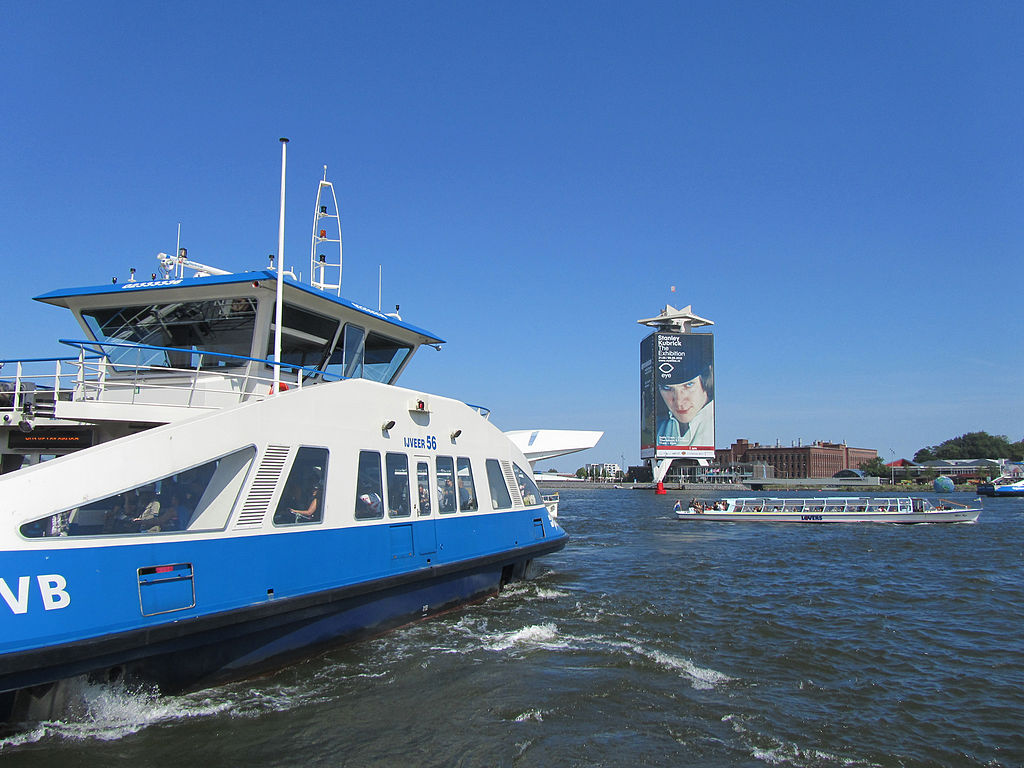
This borough is the latest up-and-coming area of Amsterdam. Noord is basically the entire area north of the IJ River. It’s reachable by metro and ferry (just hop on with your bicycle!) or by bridge or tunnel if you’re driving.
It’s huge and has a little of everything — quaint residential neighbourhoods with family homes with gardens, lots of green parks, and water. The former NDSM-shipyard is now a funky area settled by artists and new media creatives. It hosts festivals and a huge monthly flea market.
Noord used to be relatively cut off from the rest of Amsterdam, but since the area behind the station was redesigned, access to the ferry is much easier.
Where to live in Amsterdam? Perhaps North? Don’t be afraid to head there; you even get a free boat ride out of it. Image: Jvhertum/Wikimedia Commons/CC3.0
The ferry crossing is fast and frequent (every few minutes), and there is also a new metro connection, making Noord’s popularity explode. Modern apartments are springing up everywhere, yet it still doesn’t feel cramped.
It’s right next to the city centre, only a stone’s throw from the countryside and dotted with cute little villages. It’s quiet, yet the scene is hip. So for some, this might be exactly what you’re looking for.
Amsterdam Nieuw-West: vibrant communities and parks galore
To the west of the city centre lies the sprawling borough of Nieuw-West, characterised by the drab urban neighbourhoods of Osdorp, Sloten, and Slotervaart. This place is home to a vibrant community, many up-and-coming hotspots, and stunning parks.
Amsterdam Nieuw-West is a relatively quiet residential area which, since 2001, has been subjected to various urban renewal projects. This means that thousands of new homes were built — and that these neighbourhoods have plenty of space to host you. 😉
Though quiet and laid-back, Nieuw-West has all the amenities you need: from supermarkets to gyms to its very own shopping district. And of course, the bustling city centre is easily reachable by bike or tram.
The local Sloterpark is a huge park at the heart of the district that offers plenty of recreational activities. Petting zoo? Yes, sir! Great running routes? You got it! A lake for swimming? Jazeker!
Amsterdam-Zuidoost: the entertainment paradise
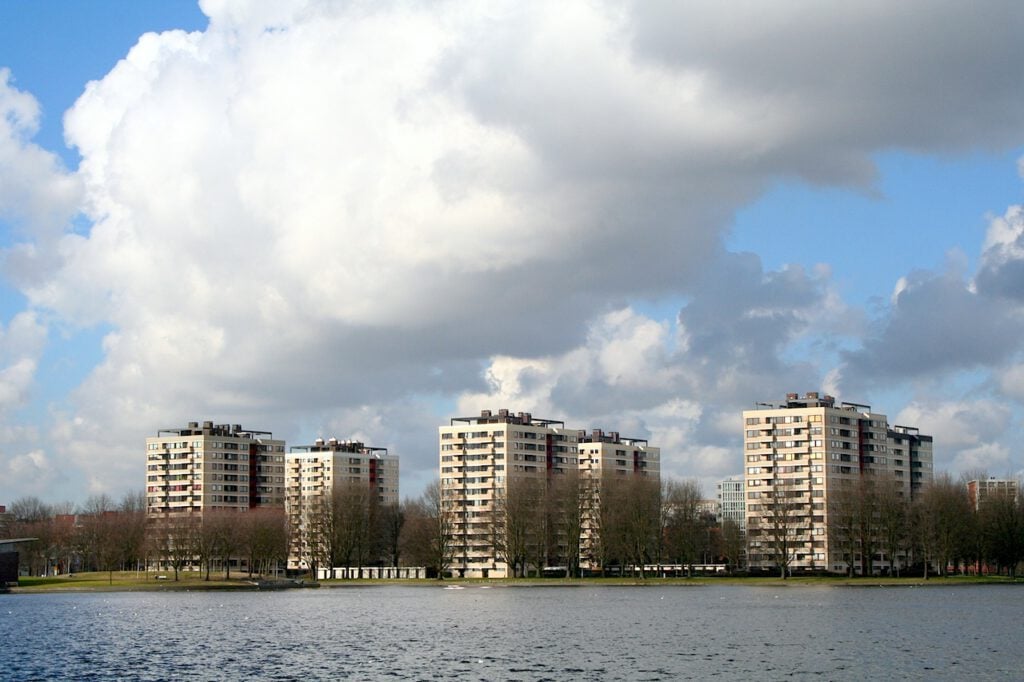
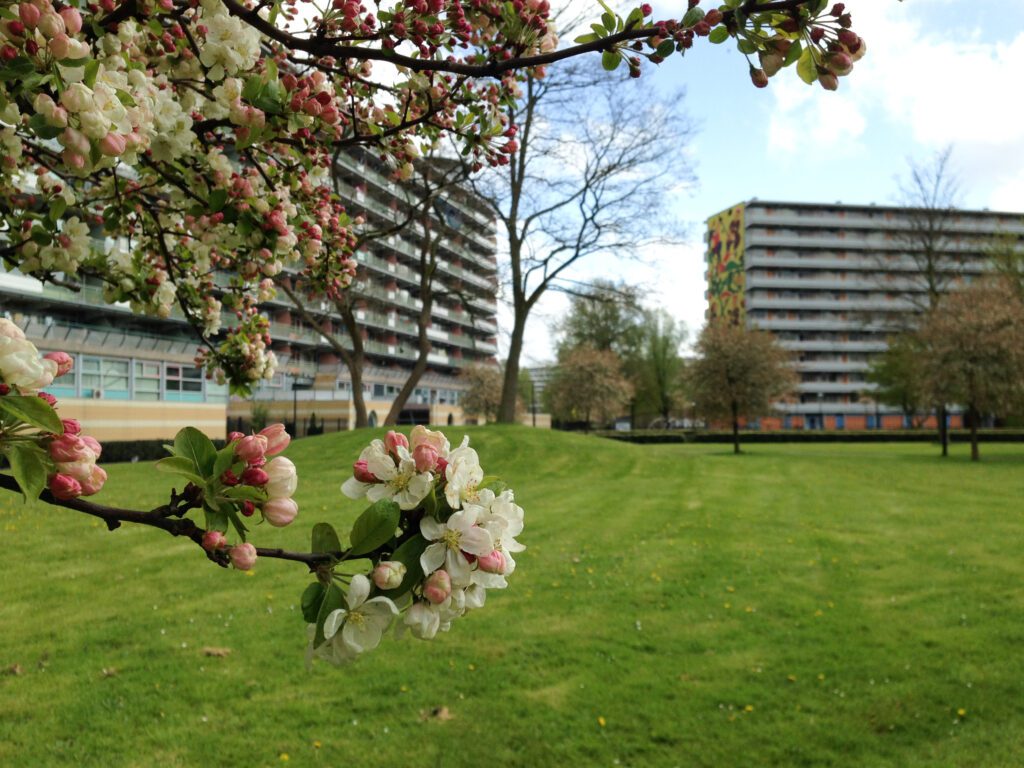
We have Amsterdam Zuid and Amsterdam Oost, but there’s also Amsterdam-Zuidoost! This city district includes the neighbourhoods of Bijlmermeer, Venserpolder, Gaasperdam and Driemond.
There’s a lot of greenery to be found in Zuidoost! Image: Depositphotos
Zuid-Oost lies further away from the city centre, and therefore has cheaper housing! Despite the distance, this place always has a lot going on, and whether or not you live here, you’ll probably make your way down to Zuid-Oost at some point for entertainment purposes.
In fact, Zuid-Oost is often dubbed the entertainment paradise of Amsterdam. Why’s that, you ask? Well, because it’s home to the city’s football stadium, the Johann Cruijff ArenA, and its two biggest concert venues, the AFAS Life Arena and the Ziggo Dome.
The IJ and IJburg: the reclaimed islands
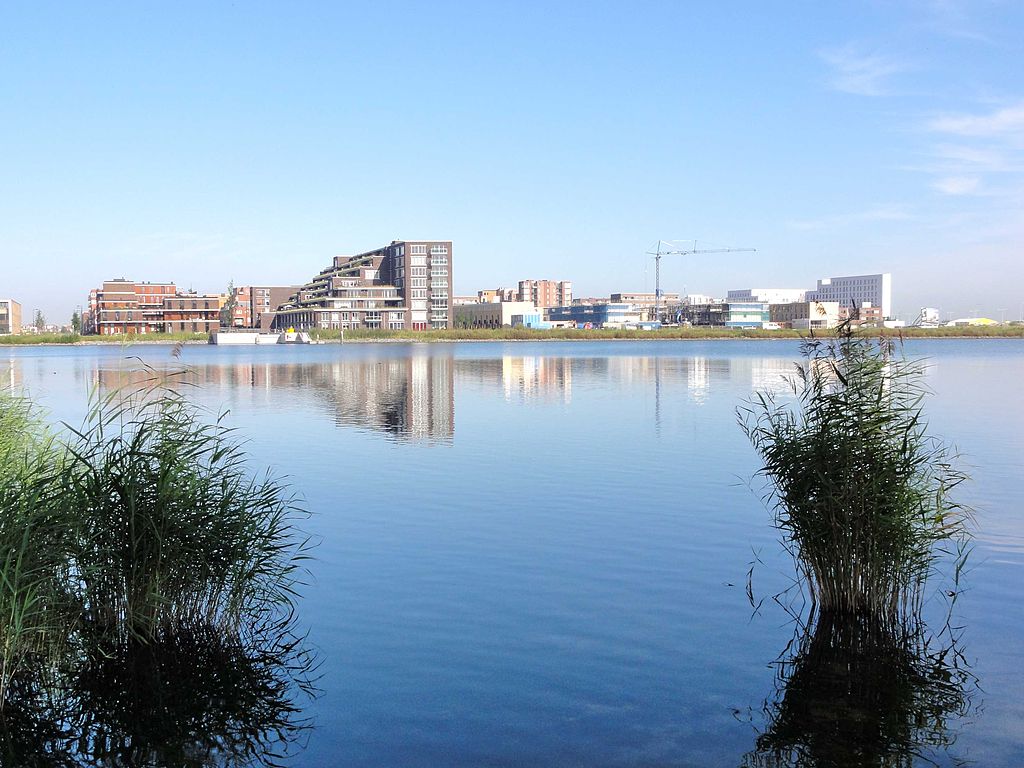
What could be more Dutch than reclaimed land? North-east of the city centre, in the river IJ, lies a string of conjoined man-made islands.
The Java, IJ, and KNSM islands, formerly owned by the Royal Dutch Steamboat Shipping company, were redeveloped into an up-market residential area in the 90s. You’ll find modern apartments with spacious interiors and great views across the river.
Riverside views and new apartments. We’ll take two, please! Image: Gouwenaar/Wikimedia Commons/Public Domain
Further east lay the new artificial islands of IJburg, with large modern homes for those adventurous pioneers who don’t mind the 25-minute tram ride into town (yes, this is considered a long commute in Amsterdam). A big summer attraction here is the artificial city beach of Blijburg, with its groovy Ibiza-like vibes.
Buitenveldert and Amstelveen: Grand architecture
Many of the buildings in Nieuw Zuid are designed in the striking Amsterdamse School style of architecture — decorative dark red brick masonry with beautiful round ‘organic’ forms.
Popular as it is, rents in Nieuw Zuid are generally high, and parking space is scarce. If that feels claustrophobic, it might be worth looking slightly further south, to Buitenveldert and Amstelveen. There, you’ll find lots of open green spaces, wider streets, houses with gardens, and plenty of parking space.
Amstelveen is a quiet and calm suburb. Perfect for family living. Image: Unsplash
Amstelveen is actually a suburb of Amsterdam, but public transport into the city is excellent, and there are lots of restaurants and cafés. It’s also right next to the green lung of the city, the Amsterdam forest.
How about living outside of Amsterdam?
We won’t lie to you: finding a place to live in Amsterdam is hard.
To bypass the housing crisis (as far as that’s possible) and avoid the city’s crowds and tourists, many people opt for an alternative: living outside of Amsterdam in a nearby city or town.
By deciding to live near Amsterdam rather than in it, you can save some serious cash (and nerves 😉), while still profiting from those big-city-perks whenever needed. Thanks to the Netherlands’ great public transport network, you can easily reach the capital within minutes.
We can’t deny it: 2023 was a tough year. But unlike these eight people, at least we didn’t get fired from our jobs for some dang ridiculous reasons.
RTL Nieuws has picked out the strangest reasons Dutch employees were let go in 2023 — and while we feel bad for some of them, it makes for quite an interesting read.
1. A ‘roast’ that went too far
After having worked at the same company for 28 years, one Dutch carpenter thought it would be a good idea to give a speech at a company party.
Sounds normal, except the man didn’t use the speech to express words of gratitude, but instead to poep all over his company’s poor communication and spending habits.
He even took it as far as calling one of the board members as “faithful as a bitch in heat”. 😳
As a thank you for his heartfelt speech, the man was served resignation papers. He maintains that his speech was intended as a playful “roast” — and that he regrets what he said.
2. A cocktail of ashes
In a sad accident, a funeral care worker accidentally mixed the ashes of two cremated bodies. Oeps.
Everybody makes mistakes, right? Yes, and that’s why the woman initially got away with just a reproof. Sounds reasonable.
According to a court hearing, the worker should not have been fired — and although he didn’t get his job back, he was paid €15,000 in severance.
4. Three jobs at once
Ever since the pandemic, we occasionally hear stories of people working two remote jobs at the same time.
This Dutchman took this to the next level by working not two but three full-time jobs for three different housing corporations (talk about time-management skills!).
The eager man, however, was not rewarded for his work appetite, as RTL Nieuws writes.
He was dealt not only three dismissals but also a bill of €90,000 to repay the salaries of two of the three employers.
5. An expensive visit to the Efteling
Kids love Efteling. Adults love Efteling. Everybody loves Efteling.
So naturally, 15 students from an Amsterdam special needs school were delighted when their teacher took them to Efteling.
What they didn’t know was that the teacher was doing this in secret, without the knowledge of the school or the parents.
In reality, the class was meant to visit the Space Expo in Noordwijk. The result? The teacher was let go.
6. Work smarter, not harder
After getting divorced, the employee of a technical wholesaler was caught in a pickle: he needed someone to walk his dog, but he couldn’t leave work to do so.
To help the employee out, his company offered to pay a monthly compensation of €108 to help pay for a dog walker.
The man pocketed the money, called up the ex-wife, and arranged for her to walk the dog on the days he worked. In the meantime, he continued to charge his employer for the compensation.
Once found out, the man was sent home to his pup for good. His appeal was rejected by a court twice.
7. Stealing a bike saddle? Big no-no
Even the smallest offence can have far-reaching consequences in employment law.
This was proven when a municipality official from Zuidplas lost his job after 12 impeccable years of employment.
The small offence in question? He replaced his broken bicycle saddle with a saddle that he found in one of the municipality’s junk rooms.
8. The ‘free’ lunch that cost €10,000
A department leader at Jumbo lost her job after a whopping 42 years of employment. The culprit? A sandwich.
The woman regularly treated herself to a lekker Jumbo sandwich during her shifts — but she never paid for any of them.
After decades of work, Jumbo fired her — and charged her €10,000 in damage payment to cover for not just the estimated costs of the sandwiches she ate, but also for the company detectives who were hired to follow her around and spy on her sandwich-loving-habits.
Have you heard of any other crazy dismissal stories? Share them in the comments!
The hope is that by formally reporting any misbehaviour, the municipality can more easily take action against the landlord in question.
The rental allowance is increasing
Do you receive a rental allowance (huurtoeslag)? Then good news: you’re about to see your monthly payments increase!
In 2024, recipients of the huurtoeslag will receive more than €30 extra per month in huurtoeslag — ka-ching! 💸
You can more easily stay in your deceased parent’s home
If you find yourself without parents in 2024, there’s one bit of comfort we can give you. The Dutch government can’t easily remove you from their rental home — especially if they were renting from a housing association.
In 2024, people who lose their parents may take over their rental home until they are 28 years old. It’s not much, but it’s something.
The bad news for renters in the Netherlands
On that cheery note, let’s move on to the bad news — because it wouldn’t be a new year without some.
Rents in the private sector can increase
And by increase, we mean by a whopping 5.5%. For now, this is only the case until May 1 of this year.
Why is this so wonderfully high? Remember the good ol’ days of major inflation? Well, through the magic of economics, this percentage is linked to that inflation.
What could this mean for you? If you are renting in the private sector and your landlord feels like it (as they often do), they can increase your monthly rent by 5.5%. Happy New Year.
Other people may be prioritised over you
If you’re looking for a rental home in a new municipality, we have some more bad news.
As of January 1, municipalities in the Netherlands may prioritise people who are already living in the municipality when it comes to applying for a property.
This doesn’t mean they will — but they can.
However, there may be some good news for you here, especially if you happen to have a highly sought-after profession (such as a teacher, nurse, or policeman).
Municipalities may now also prioritise people from these professions when they apply for rental properties.
After a rainy Christmas caused flooding across the Netherlands, high tides have stabilised, and there haven’t been any new cases of flooding. But don’t celebrate just yet, as weather forecasts point to rain, rain, rain.
Forget dry January; this year, we’re starting with wet January. Lots of rain and strong winds are on the cards for the first days of 2024, according to Weerplaza.
A stormy start to the year
Tuesday and Wednesday will be especially stormy, with chances of wind gusts of up to 100 kilometres per hour (km/h).
Temperatures are averaging between 10 to 13 degrees Celsius on Tuesday and dropping to between 3 and 6 degrees Celsius on Friday afternoon.
Well-prepared for rain
Luckily, municipalities and safety areas in the Netherlands are well-prepared for the predicted rain, reports the NOS.
The Rijkswaterstaat, the Dutch water management bureau, has set up sandbags in vulnerable areas, and regional authorities say there is no need to deploy the fire brigade to help manage the higher tides.